
牛津译林版高中英语模块7 Unit 1 Living with technology Grammar
方法
讲练结合。小组合作
教学程序设计
教
学
过
程
及
方
法
环节一明标自学
过程设计
二次备课
Show the learning aims
1.students will be able to review the usage of transitive and intransitive verbs;
2.students will be able to read brief explanations of the grammar items and draw conclusions;
Unit 1 Living with technology Grammar教学设计1
年级
组别
高二英语组
审阅
(备课组长)
审阅
(学科校长)
主备人
使用人
授课时间
课题
语法:及物动词和不及物动词m-7 u-1
课型
复习课
课标
要求
本课时从引导学生关注基本规律入手,将及物动词和不及物动词的不同用法和特征进行分类说明。
【注】有时,为了强调直接宾语,可以把直接宾语置于间接宾语之前,但间接宾语前面需要加上介词to或者for。如:
I gave each of the boys an apple. = I gave an apple to each of the boys.
He bought me a book. = He bought a book for me.
教
学
过
程
及
方
法
环节二合作释疑环节三点拨拓展
(备注:合作释疑和点拨拓展可以按照顺序先后进行,也可以根据教学设计交叉进行设计)
过程设计
二次备课
合作释疑:英语中的动词根据其后是否跟宾语,可分为及物动词(transitive verb)和不及物动词(intransitive verb),缩写形式分别为:vt. (及物动词)和vi. (不及物动词)。
They were made to work ten hours a day by the boss.
(2) allow,advise,forbid,permit等动词后可直接跟动名词作宾语;如果这些词后有名词或代词作宾语,其后面要用动词不定式作宾语补足语。即:allow / advise / forbid / permit doing sth.;allow / advise / forbid / permit sb. to do sth.。如:
教
学
目
标
知识与能力
在教学中,指导学生通过阅读课本上精简的说明,自己得出一些结论,有助于提高阅读能力和自学能力
过程与方法
根据句子中动词后有无宾语和有无被动形式来区分动词是及物还是不及物动词。
情感、态度与价值观
培养学生对动词的把握和正确的用语动词
教学
重点
如何掌握一些动词的用法
教学
难点
如何理解并应用一些动词
一、及物动词
及物动词后可直接跟一个宾语、双宾语(即一个间接宾语+一个直接宾语)或复合宾语(即一个宾语+一个补语)。
1.充当宾语的可以是一个名词、代词、动词不定式、动名词或从句。
常接不定式作宾语的动词有:afford,agree,ask,choose,decide,expect,hope,learn,manage,need,offer,promise,plan,pretend,refuse,want,wish等。
【注】(1)在主动语态中,一些动词(如:make,have,let,see,watch,hear,feel等使役动词和感官动词)后接动词不定式作宾语补足语时,动词不定式不带to。但当这些动词(let除外)用于被动语态时,后面的不定式都需加上to。如:
The boss made them work ten hours a day.
【注】一些动词,如:ask,consider,decide,discover,discuss,explain,forget,learn,remember,show,see,tell,think,understand,wonder等常可以接“疑问词(即how,what,where,when,who,whether)+不定式”作宾语。
3.在含有复合宾语的句子中,谓语动词后只跟宾语还不能表达完整的意思,须加一个补充成分来补充说明宾语。能充当宾语补足语的可以是名词、形容词、副词、介词短语、动词不定式或分词。
常跟复合宾语的动词有:admit,ask,allow,cause,call,consider,dislike,expect,encourage,get,have,intend,invite,keep,make,name,need,permit,prevent,see,set,stop,think,tell,want,watch,w,avoid,delay,deny,enjoy,escape,excuse,fancy,finish,imagine,mind,miss,practise,risk,suggest等。
2.在含有双宾语的句子中,谓语动词后必须跟两个宾语才能表达完整的意思,即“一个间接宾语+一个直接宾语”,通常间接宾语在前,直接宾语在后。
3.students will be able to learn how to use them in different situations and by fulfilling some written tasks;
students will be able to know how to accumulate their knowledge of the language every day and try to use what has been learnt as often as possible.
间接宾语前常用to的动词有:bring,describe,explain,give,hand,leave,lend,offer,owe,pass,promise,read,sell,send,show,take,teach,tell,throw等。
间接宾语前常用for的动词有:book,bring,buy,choose,fetch,find,get,make,order,prepare,save等。
牛津译林版高中英语模块7 Unit 1 Living with technology Welcome
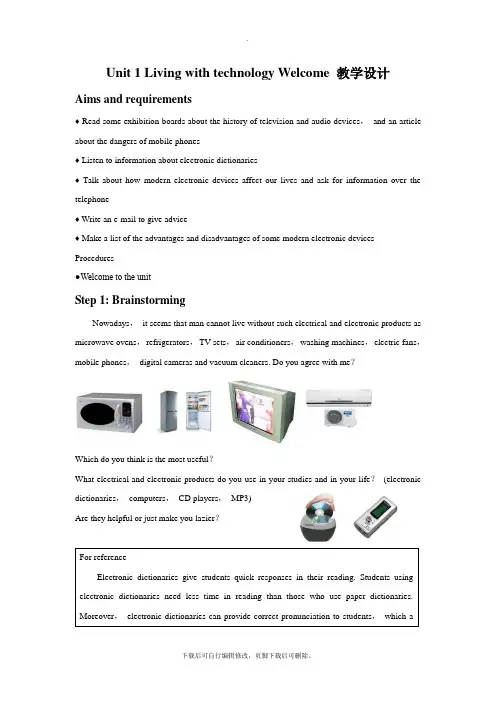
Unit 1 Living with technology Welcome 教学设计Aims and requirements♦ Read some exhibition boards about the history of television and audio devices,and an article about the dangers of mobile phones♦ Listen to information about electronic dictionaries♦Talk about how modern electronic devices affect our lives and ask for information over the telephone♦ Write an e-mail to give advice♦ Make a list of the advantages and disadvantages of some modern electronic devices Procedures●Welcome to the unitStep 1: BrainstormingNowadays,it seems that man cannot live without such electrical and electronic products as microwave ovens,refrigerators,TV sets,air conditioners,washing machines,electric fans,mobile phones,digital cameras and vacuum cleaners. Do you agree with me?Which do you think is the most useful?What electrical and electronic products do you use in your studies and in your life?(electronic dictionaries,computers,CD players,MP3)Are they helpful or just make you lazier?For referenceElectronic dictionaries give students quick responses in their reading. Students using electronic dictionaries need less time in reading than those who use paper dictionaries. Moreover,electronic dictionaries can provide correct pronunciation to students,which aAs we can see,with the rapid development of electronic technology in the last few decades,electrical and electronic products have made ou r lives more convenient. I’d like to give you some examples.Now,let’s have a discussion: What do you think life would be like without these products?Step 2: Sharing information1. Let’s enjoy some wonderful ads about some electrical and electronic produ cts. What conclusion can you draw?Do you think the progress has made our lives more convenient or has made simple things more complicated?2.Group work. Look at the four pictures at page 1. Let’s study them one by one and try to discuss some questions in group of four.Picture 1What kind of TV do you have at home?What differences can you find between the TV in your home and the TV in this picture?(Early TV had antennae on top. The screen was very small and could show only black-and-white pictures. The size of the TV was small compared with modern TV,and usually it looked like a wooden box. Early TV also did not have a remote control. The control panel was on one side of the screen.)What kind of pictures did early TV have?(Early TV had black-and-white pictures that were fuzzy.)What other functions do you need in a modern TV?Picture 2What did people need when they wanted to record music in the past?(Tapes and a tape recorder.)How did people record music in the past?(People put the tapes into the recorder,then played the tape with music at one side and pushed the play and record buttons at the other side to record the music onto the blank tape.)Look at the picture. What devices do people need to record music now?(A computer,an MP3 player and some recording software.)How do People record music using a computer?(People copy the music from a CD to the computer using recording software. The music will then be digitalized in and played by an MP Player. )Picture 3How do you look up a word in a paper dictionary?(The words in a paper dictionary are arranged in alphabetical order from ‘A’ to ‘Z’. We need to look at the first letter of the word and use it to search in the dictionary. If two words start with the same letter,we look at the second letter to decide the alphabetical order. If the first and second letters are the same,we look at the third letter and so on.)How many of you have an electronic dictionary?How do you look up a word in such a dictionary?(We key in the word we want to look up and cli ck the button ‘Enter’. Then the word entry will appear on the screen.)Besides the dictionary,what else can be stored in your electronic dictionary?(There can be a calendar,a list of addresses and phone numbers,memos or a clock. More recent electronic dictionaries have large memory space and some can be used as electronic books with hundreds of books stored inside.)Which do you prefer,an electronic book or a traditional paper book?Why?Picture 4How did people keep in touch in the past?(People sent letters in the past,but letters wereslow,and they took from a few days to several months to arrive. Then people invented the telegraph,but the telegraph could send only short sentences. Later,people could communicate via telephone,but the disadvantage was that not everyone had a telephone. Now,people use e-mails to communicate. E-mails are quick,but people without computers and access to the Internet cannot send e-mails. Today,most people use mobile phones to keep in touch with others. The size of a mobile phone is small so people can carry one in a pocket and receive and make calls wherever they are and whenever it is.)What recent developments have been made to mobile phones?(Now,mobile phones have more and more functions. They can send text messages. They can also be used as a digital camera to take still or even moving pictures. People can send the pictures they take to other mobile phones or e-mail addresses. Mobile phones can be connected to the Internet and people can look at web pages with mobile phones. More technologically advanced mobile phones can receive TV signals so that people can watch live TV programmes on their mobile phones.)It is reported that many high school students bring mobile phones to their schools. Do you think high school students should use mobile phones at school?Why or why not?Please express your ideas freely and make sure that all of you have a chance to speak. Step 3: Discussion:1. How have different electronic devices changed over time?2. How have these inv entions improved people’s lives?Step 4: Homework:1. Collect more information about the development of some electronic and electrical devices.2. Prepare the Reading part.。
牛津译林版高中英语选修七Module 7 Unit 1 Living with technology .docx
高中英语学习材料***鼎尚图文理制作***Module 7 Unit 1 Living with technologyWelcome and ReadingA. 词形变换1. construct__________________ (n.)2. electric _____________________(n.)3. accessible____________________(n.)4. apply ______________________ (n.)5. evolution ___________________ (v.)6. component____________________(v.)7. convenience ____________________(adj.)8. storage _______________________(v.)9.adaptation_____________________(v.)10. wind _________________(pp.)B. 短语翻译:做贡献,有助于______________________ 做出重大突破_____________________二十世纪二十年代晚期______________ .获益于__________________________跟上…________________________上发条__________________________ 便携式袖珍盒带播放器_______________ .播放唱片___________________________ 依赖________________________ 由……组成___________________公众,大众____________________ 由…..决定____________________用作…..的替代物_________________ .原则上____________________ .对…..怀疑的_______________________ .实现首次远距离电视播送:之后不久对电视的发展做出贡献有缺点使用许多由某人首先发现的原理直到…..才花某人多少时间做某事短时期内被用来做某事允许某人做某事现场直播接收节目使电视节目为居住在偏远地区的人们收看看到卫星天线遍布整个乡村及偏远地区一小部分人住在附近的居民C 用所给的短语的正确形式填空contribute to …, benefit from …, keep pace with …,wind up, be absorbed in, rely on, make up1. Your suggestion has greatly ________ the accomplishment of our work.2. As your best friend, you may ________ me to help you.3. Bank loans during the prosperity decade did not ________ the rising level of economic activity.4. Who is likely to ________ the new tax laws?5. Could you ________ the window ________, please?6 The girl sat quietly in the classroom, ________ in her book.7. Women ________ only a small percentage of the prison population.D.单项选择:1. The old clock needs ________ every day, otherwise it will stop workingA. to turn upB. to wind upC. winding upD. wind down2. The situation is hard to ________, because he isn’t a man easy to ________.A. be dealt, communicateB. be dealt with, be communicatedC. deal with, communicate withD. deal , be communicated with3 They ________ invited if there had been room.A. would have been allB. would have all beenC. all would have beenD. would all have been4..My elder brother wants to buy a _____ computer, so that he can carry it around when hetravels.A. removableB. portableC. possibleD. readable5. Who is it up _____ decide what to do next?A. toB. to toC. for toD. to for6. ---How is everything going on with you in Europe?---Quite well. Not so smoothly as I hoped,______.A. thoughB. insteadC.eitherD. too7. ---Why didn’t you tell him about the meeting?---He rushed out of the room_______ I could say a word.A. beforeB. untilC. whenD. after8. Ten ____ the students are absent.A. per cent ofB. percentage ofC. per centD. percentage9. They drove along with all the car windows ____.A. wound upB. winding onC. winded upD. wind up10. It was ______back home after the experiment .A.not until midnight did he go B.until midnight that he didn't goC.not until midnight that he went D.until midnight when he didn't go11.._____ though he was, even he couldn’t get into Harvard.A. A smart studentB. The smart studentC. Smart studentD. Smart students12.Try____ she might, she couldn’t get the door open.A. IfB. whenC. sinceD. as13. The Internet makes more and more violent games _______to children.A. accessibleB. avoidableC. acceptableD. adjustable14.It was_______he came back from Africa that year______ he met the girl he would like to marry.A.when; thenB. not; untilC. not until; that D only; when15 According to a UN report, one third of the world population have no ____to clean drinking water and health care.A. meansB. approachC. channelD. access16. It is more than ten years ___________he worked here.A that B. since C. before D. when17. They delayed ______ the sports meeting.A. to holdB. to haveC. holdingD. taking place18.. The river ______ its way between the two mountains.A. followsB. windsC. flowsD. gets21.Not until recent years ________ a popular means of communication.A.e —mail has become B.e—mail becameC.has e—mail become D.will e—mail become22.Tomorrow I will see myself _________by my family ,_________a delicious dinner.A. accompanying enjoyingB. accompanied enjoiedC.accompanied enjoying C. accompany enjoy23. Patience is ___________it takes to take good care of the naughty boys.A. whatB. whichC. thatD. where24.—The space technology will be ________ great benefit to us in the future.—Yes.Now we are benefiting more and more ________ it.A.of;of B.of;fromC.for;of D.for;fromE、用括号中所给的提示翻译句子。
牛津译林版高中英语模块7 Unit 1 Living with technology Section

(二)根据所给词性和汉语意思写出单词 6. tight adj.亲密的,严密的;紧的,紧身的;严密的 7. merely adv.仅仅,只不过 8. dial vt.& vi.拨( 号码),打 9. rid vt.摆脱;去除;丢弃 10. religious adj.宗教的,宗教信仰的;笃信宗教的,虔诚的 → religionn.宗教信仰
Unit 1 Living with technology Section Ⅴ 课件 1
Unit 1
Section Ⅴ
语言点一
语言点二
语言点三 课
语
时
篇 识理应 识理应 识理应 跟
理 记解用 记解用 记解用 踪
解 掌拓落 掌拓落 掌拓落 检
握展实 握展实 握展实 测
Ⅰ.Read the text and choose the best answers. 1.The Amish do not have personal telephones because
我清楚地告诉他,我拒绝了他的建议。
reject, refuse, decline, deny
强调拒不接受或拒不考虑没有价值或不合标准的意见、
reject 计划、请求等;也可表示拒绝相信,摒弃、厌弃。其后
跟名词或代词作宾语,但不能跟不定式
表示坚决甚至无礼貌地拒绝接受某物或做某事。此外, refuse 作及物动词时,可表示拒绝给予,后可跟不定式作宾语
3.oppose vt.反对,抵抗,阻挠;与……竞争 [教材P14原句] Since the Amish value seeing each other face to face, they oppose having telephones in their houses. 因为阿曼门诺派教徒重视彼此面对面交流,所以他们反对在 住宅里装 。 ①China has opposed the EU plan, saying it goes against international law. 中国反对欧盟这项方案,说它违背了国际法。
牛津译林版必修七 Unit 1 Living with technology
Module 7Unit 1 Living with technology新课标单词review n. 回顾,综述wireless adj. 无线的long-distance adj. 长途的,远距离的broadcast n. 播送,广播broadcasting n. 播送,广播uncertain adj. 不确定的altogether adv. 总共,一共;完全,全部age n. 时代superior adj. 优越的,占优势的consumer n. 消费者signal n. 信号;暗号questionnaire n. 问卷,调查表recording n. 录音,录音制品wind vt. 上发条;缠,绕play vt. 播放record n. 唱片electric adj. 电的patent n. 专利apply vt. & vi. 应用,运用;申请portable adj. 便携的,手提的pocket-sized adj. 口袋大小的,袖珍的demand vt., vi. & n. 需要,需求,要求degree n. 程度;度,度数;学位spring vi. 跳,跳跃;弹起personally adv. 从个人角度,主观地;亲自delight n. 喜悦,快乐,高兴vt. & vi. 〔使〕高兴,〔使〕欣喜variety n. 多样,种种evolution n. 演变,演化,进化birthplace n. 出生地,诞生地assume vt. 假设,设想,以为convenience n. 方便,便利merely adv. 仅仅,只有accompany vt. 陪伴,陪同ownership n. 所有权,物主身份anyhow adv. 无论如何,不管怎样selection n. 可选之物;所选之物;选择,挑选familiar adj. 熟悉的budget n. 预算all-round adj. 功能齐全的;全方位的,全面的weigh vi. 重量为…… vt. 称……的重量,称measure vt. & vi. 测量,度量elegantly adv. 优雅地,高雅地,优美地shape vt. 使成形;塑造,制造suitable adj. 合适的,适合的scan vt. 扫描;细看,审视;浏览elegant adj. 优雅的,高雅的,优美的case n. 套子;盒子,匣子guarantee n. 保证;商品使用保证advancement n. 促进,增进;前进,进步;提高,增加necessarily adv. 必然,必须,必定caution n. 谨慎,小心actual adj. 真实的,实际的expose vt. 使暴露,使显露;使暴光;使处于……作用〔或影响〕之下,使遭受equal adj. 相等的;平等的link n. 联系,关联valid adj. 有根据的,有理的,有效的,令人信服的theory n. 理论,原理,学说;意见,看法,推测,假说profit n. 利润,利益,赢利unwilling adj. 不愿意的,不情愿的thus adv. 因此,因而处adj. 平行的,类似的,相同的acknowledge vt. 承认,认可faith n. 相信,信任;信仰,信念honest adj. 诚实的,真诚的conference n. 会议,研讨会worrying adj. 令人担忧的课文出现短语1. keep in touch with2. shortly after3. contribute to4. consider… to be5. be superior to6. have access to7. come onto the market8. combine…with9. respond to10. add…to11. for the first time (ever)12. spring up13. wind up14. move on to15. It’s up to you to do sth16. up to (three minutes) 17. look into18. head for19. stand for20. in time for21. a variety of22. by means of23. by accident24. by mistake25. up to date26. capable of27. in particular28. above all29. provide sb with sth.30. be based on31. concentrate on32. not necessarily33. be exposed to34. the amount of35. be equal to36. part of37. previous to38. point out39. be unwilling to do sth40. be associated with41. have faith in42. for the time being43. be confident of44. in that case一.单词应用根据单词的首字母或汉语意思填写正确单词,注意形式变化。
牛津译林版高中英语模块7 Unit 1 Living with technology Reading

Unit 1 Living with technology Reading 导学案2 Studying Aims: Mastering the important language points in the textSelf education (自主学习)1.Many different people contributed to the development of TV.翻译:___________________________________________________contribute: _________ (n ) 词组:对…做出奉献____ __________ ____翻译:她对这个公司做出了重要的奉献。
___________________________________________。
She often contributes to the magazine. 此句中contribute的意思为____________It is a reference book intended to _______mainly to the students of Grade 3.A. appealB. attachC. contributeD. refer2. Most early TV broadcasts were made using a system developed by John Logie Baird in the UK. 翻译:___________________________________________________句子的主干是_____________________________________________.此句包含有两个非谓语构造,一是________________,修饰____________;二是______________;修饰_________________.3.but it was not until 1938 that the first colour TV programme was broadcast.翻译:___________________________________________________此句为_________句复原:________________________________________________________.4.Regular colour TV broadcasts were delayed in the UK until 1967.翻译:___________________________________________________delay doing sth _________ without delay ________辨析:delay & put off5.Satellites allow TV to be broadcast live over vast distances,with everyone receiving the same broadcast at the same time.翻译:___________________________________________________allow sb to do sth___________ allow doing sth____________ allowance _________6. satellite dishes can often be seen distributed throughout the countryside.翻译:___________________________________________________句子主干____________________distribute: ___________(n) 把某物分给……:distribute sth _______The firm ______its profits ____its workers.7.most people still benefit from satellite TV,as local TV companies broadcast the signals they get from satellite receivers to the population living nearby.翻译:___________________________________________________句子的主干为____________________________,as引导________此句,其中包含一个定语此句________________________,修饰的先行词为___________.benefit: n/vt benefit from sb/sth _________ benefit by doing……___________for the benefit of ________________ be of benefit to ______________beneficial: adj _________be beneficial to =be of benefit to ________be beneficial to do sth___________Exercises: 完成名师导学P 4 作业。
牛津译林版高中英语模块7 Unit 1 Living with technology Period
(leave 作及物动词) They left last week. 他们是上周离开的。(left 作不及物动词) b)兼作及物动词和不及物动词时,有时意义不尽一样。如: Wash your hands before meals.饭前要洗手。 Does this cloth wash well? 这布经得起洗吗?
3)兼作及物动词和不及物动词 英语里有不少 实义动词可以兼作及物动词和不及物动 词。这样的动词又有两种不同的情况:
a)兼作及物动词和不及物动词时,意义不变。试比较: Shall I begin at once?我可以立刻开场吗?(begin作不及物动词) She began working as a librarian after she left school.她毕业后当图
及物动词不需要介词
• 在英语错误中,"及物动词+介词+宾语"〔transitive verb+preposition+object〕,是常见的一种。所谓及物动词, 就是谓语动词〔predicative verb〕,不必通过介词引荐宾 语。相反的,不及物动词〔intransitive verb〕是不带宾语 的。有许多动词,虽然性质是及物的,但不一定要有宾语, 如以下的①a和②a便是这种情形:
• Everybody listened to the lecture with great interest.每个人都 很有兴趣地听讲课。(to不可省去)(比较:We all heard the lecture.)
• Do they agree to the plan?他们同意这个方案吗?(to不可省去)
牛津译林版高中英语模块7 Unit 1 Living with technology Period
A.in case of B.instead of C.for fear of D.in search of
此题考察介词短语的用法。首先根据句子和镉 语的意思排除选项B、D;再比较:in ease of 意为:假设,如果,万一,强调客观可能;for fear of意为:惟恐,为……起见,强调主观的 担忧。根据句子前后两局部的意思,此题所表 示的应该是主观的担忧。
is ___D____ in quality ______ the one you bought yesterday. A. more superior; to B. superior;than C. more superior;than D. superior; to
3.(2004江苏卷24)He got to the station early,30.可 Nhomakorabea放心使用
caution
31.对熟悉 32.不乐意做… 33.占领市场 34.在随后的几年里 35.家用电器 36.电子产品 37.条形码 38.在某种程度上
31.be familiar with 32.be unwilling to do 33.take over the market 34.in the following years 35.household appliance 36.electronic goods 37.bar codes 38.to some extent
On the whole, women are not equal to men in physical strength.
错题精彩回放: 1.Miss Smith and I keep in touch _B____
译林牛津高二英语模块7 Unit 1 Living with technology 单知识点详解教案
模块7Unit 1 Living with technology重点单词1. circumstance n. 情况,情形,环境;家境,经济状况【常见搭配】【名师点拨】1) circumstance用作“情况,情形,环境;家境,经济状况”解时,常用复数。
2) under/ in no circumstances= in no way= by no means=in no case=on no account= on no consideration=at no time,意为“决不”,当这些词组放于句首时,所在句子谓语部分须用部分倒装。
【即时演练】A: 用常见搭配中的词组填空1. It’s the best result that could be expected ____________________.2. We have been told that ____________________ can we leave school without permission.【答案】1. under the circumstances 2. under no circumstancesB: 单选(徐州市2014届高三考前模拟)—Do you know Mike well? You two seem to have been friends for years.—Not really. But I had met him on several _____ before you saw me talking with him.A. circumstancesB. situationsC. conditionsD. occasions【解析】句意:“你很了解马克吗?你们两个似乎是多年的朋友了。
”“并不是这样。
但是在你看到我与他交谈之前,我已在多个场合见过他。
”occasion“场合”;circumstance“情况,情形”;situation“形势;处境”;conditions“情况,状况;形势”。
牛津译林版高中英语模块7 Unit 1 Living with technology Period
9.value seeing each other face to face
7. 非常便于沟通 The telephone is very convenient for communication.
8. 一个合理的观点,看法 a valid point
9. 无论在什么情况下 no matter what the circumstances
refuse,可以当及物动词,也可以当不及物动词,其后还可跟不 定式。
reject,只能当及物动词,其后不能跟不定式。
1.The soldiers r_e__fu__s_e_d_to obey orders and were put into
prison.
rejected
2. The boy will feel _______ if you refuse to go to his
The disadvantages Supporting Details
Using the mobile
Relationships are
phone for text
nearly always
messages is the worst. quite shallow.
Read the text and answer the questions. 1.Which group of people are talked about?
birthday party.
refused
3. Simon asked the girl to marry him but she ________.
4. oppose v. 反对 be opposed to 反对;对抗 oppose doing sth. 反对做某事 opposed adj. 对立的;相反的 opposite n. 相反的事物 opposition n. 反对;对抗
牛津译林版高中英语模块7 Unit 1 Living with technology Period
• 词根归纳:draw=draw〔拉,拖,绘画 〕
3. principle n.原理,法那么;道德原那么,行为 准那么
• 词汇拆解:prin-=prim=prem=first 第一,cip-=cap-=cep=ceive=take,-le 名词后缀
• 释义理解:法那么或是原理的东西都是第一位的,
13. obvious adj.显然的,显而易 见的
词汇拆解:ob-=near + vi-=voy-=way +ous 释义理解:靠近路→可以被看见→明白的,显然
的 同根词记忆:voyage n.航行;〔尤指〕航海,
航天 (M2,U3) convey con(共同)+vey(way 路):都在一起条路上-同路 →【搬运】 → v. 运载,运送;表达 previous pre-前 + vious via道路,在道路上走在前面的,以前 adj.先 前的,以往的 (M6,U1)
14. translation n.翻译;转化
词汇拆解:trans-=across + late=bring,bear(携带)
释义理解:前缀trans-传转,词根lat拿、送, -e动缀;将一种语言转译成另外一种语言
同根词记忆:relate re-=back + late=bring,bear 表达,〔使〕有关联〔复 原〕
9. foresee vt. 预料,预见,预知
词汇拆解:fore-=before+ see
释义理解:在事物之前就看到了,当然就是预料, 预见了!
同根词记忆:forehead 前额;前部 forefather 祖 先,祖宗 forefinger 食指 foreman 工头,领班 foretell 预言,预测 foreword 前言,引言,序 adj.&adv. 向前的,前面地