
19-20学年新教材高中英语UNIT4HISTORYANDTRADITIONSSectionⅡLis
Section Ⅱ Listening and Speaking & Reading and Thinking—Language PointsⅠ品句填词1.As the old saying goes, “Together, individuals(个人) can make a difference.”2.The United Kingdom(王国) of Great Britain and Northern Ireland is made up of England, Wales, Scotland and Northern Ireland.3.He works as a chief(主要的) editor in China Daily.4.The country needs a defence(防御) capability as insurance against the unexpected.5.My mother works in a nearby(附近的) company and she usually walks home.6.The location(位置) of the Arts Theatre was considered a poor area of town.7.They were unwilling to accept the fact that their son died in the battle(战斗,战役).8.As is known to us, Qingdao is a beautiful port(港口) city with a long history.9.As is known to all, China has made great achievements(成就) during the past decades.10.Tim’s puzzled(困惑的) expression suggested that he didn’t understand what they had said.Ⅱ完成句子/一句多译1.在过去的几年里,中国在环保方面取得了巨大成就。
In the last few years, China has made_great_achievements_in_environmental_protection.2.我们可以更多地了解伟人的生活以及其他国家的历史和文化。
We can know more about the life of great people as_well_as_history_and_cultures_of other countries.3.著名科学家袁隆平于2019年9月29日被授予共和国勋章。
Yuan Longping, known_as_a_famous_scientist,_was awarded National Medals on September 29th, 2019.4.保持环境清洁无污染是使人们生活健康的关键一步。
Keeping_the_environment_clean_and_free_of_pollution is the key step to make life healthy.5.温哥华是加拿大最温暖、最美丽的城市。
它被群山和太平洋环绕。
(1)Vancouver is Canada’s warmest and most beautiful city.It is_surrounded_by_mountains_and_the_Pacific_Ocean.(2)Vancouver is Canada’s warmest and most beautiful city, which_is_surrounded_by_mountains_and_the_Pacific_Ocean.(合并升级为定语从句) Ⅲ课文语法填空Studying British history can help you understand 1.what the United Kingdom, Great Britain, Britain, England mean.In the 16th century, Wales was joined to the Kingdom of England.In the 18th century, Scotland was joined 2.to_create (create) the Kingdom of Great Britain.In the 19th century, the Kingdom of Ireland was added to create the United Kingdom of Great Britain and Ireland.However, the southern part of Ireland broke 3.away_from the UK, which resulted 4.in the full name we have today: the United Kingdom of Great Britain and Northern Ireland.Although the four countries work together in some areas, they still have some 5.differences(different).The United Kingdom has a long and interesting history to explore, 6.which can help you understand much more about the country and 7.its(it) traditions.No matter where you go in the UK, you will 8.be_surrounded(surround) by evidence that four different groups of people who took over at different times throughout history.Studying the history of the country will make your visit much more 9.enjoyable(enjoy).The UK is a fascinating mix of history and modern culture, with both new and old 10.traditions(tradition).Ⅰ单句语法填空1.When he woke up, he found himself surrounded(surround) by some doctors.2.If you continue to do illegal(legal) things, you will end up in prison sooner or later.3.I am quite confused(confuse) by Chinese table manners.I’d appreciate it if you could give me some tips on how to behave properly at a dinner party.4.As well as studying(study) English at school,Alice taught herself Japanese at home.5.She stepped back appearing surprised and put up her hands, as if in defence(defend).6.There is evidence(evident) that Beijing Man used fire to cook food.7.He passed the college entrance examination, which made his parents very proud.8.There is so much more to_learn(learn) about the interesting history and culture of the United Kingdom.9.He was very upset(upset) because his pen pal didn’t reply to his letters in time.10.Have you ever belonged(belong) to a political party?Ⅱ阅读理解AOttawa is the capital of Canada.It is the second largest cityin Ontario and the fourth largest city in the country.The Centre Block is the main building on Parliament Hill(国会山).It is also the location of several ceremonial spaces, suchas the Hall of Honor and the Memorial Chamber.The present CentreBlock is the second iteration of the building, after the first was destroyed by fire in 1916, and it is one of the most recognizable buildings in Canada.Downtown Ottawa is the commercial and economic centre of the city.Most of the buildings are office towers.While most of Ottawa’s high tech industry is based elsewhere, it has a significant presence in the downtown core.The downtown also contains a number of apartments, hotels, and the older single family homes and townhouses along its edges.The National Gallery of Canada is one of Canada’s premier art galleries.The Gallery has a large and varied collection of paintings, drawings, sculpture and photographs.Although its focus is on Canadian art, it also holds works by some noted American and European artists.The Rideau Canal is the oldest continuously operated canal system in North America.At the very beginning, the purpose of the Rideau Canal was military, as it was intended to provide a secure supply and communication route between Montreal and the British naval base in Kingston.It remains in use today primarily for pleasure boating, with most of its original structures undamaged.The locks on the system open for navigation in midMay and close in midOctober.【解题导语】文章描写了加拿大渥太华著名的几处地方,并分别对这几处地方进行了详细的说明。
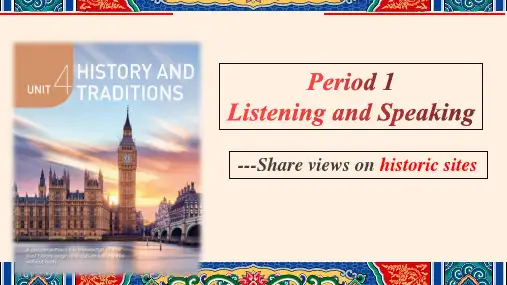
Unit 4 History and Traditions高中英语人教版(2019)必修第二册
Located (locate )to the east of the Temple of Confucius, this was the historical home of the descendants of Confucius where they managed sites and ceremonies in Qufu. Kong Family Mansion Today it is a museum.
other building in the city can be taller than it.
WX::AOWnha,iittd,hyaioot’usmmreesipasnecwat.hnTehreeatxS’sphaarkleietstslpesebiaoritenlwikawesmfhryoicmhoh?mWmethoeawtana–ncSsotirnsactofiodmredn-ecuetp–honCi-noAngvfoudnc.iiufsfaenrdent frSohamkestpheaere,m5._e_a_tw_n_oi_no_fg_t_h_oe_gf_r_eta_ht_ee_st_im_n_i_nd_di_sv_in_id_h_ius_t_aor_ly_w_! oI rredalsly. wSaontmtoeviisdit itohemUKs– I’m
3. He lived _o_ve_r__20_0_0__ye_a_r_s__ago.
Xiao Kong
1. Confucius has _o_v_e_r_3__m_i_ll_io_n__descendants. 2. He was a great _ed_u_c_a_t_o_r and had many ideas about_e_d_u_c_a_ti_o_n____. 3. He was _on_e__o_f _th_e__gr_e_a_t_es_t_m__in_d_s__in history.
2019新人教高中英语必修二Unit4 History and Traditions整单元完整教案

2019新人教高中英语必修二Unit 4 History and Traditions整单元完整教案Unit 4 Listening and Speaking公开课教案Teaching aims:1.Enable students to get familiar with the vocabulary of“Confucius,Temple ofConfucius,Confucius’ descendants,Confucius’ educational thoughts”.2.Guide students to understand some English idioms and their related culturalallusions.3.Help students to talk about Confucius’ ideas on education and introduce thehistory and importance of a historic site.Teaching key and difficult points:1.To help students to get familiar with the vocabulary of“Confucius,Temple ofConfucius,Confucius’ descendants,Confucius’ educational thoughts”.2.To enable students to understand English idioms and the related cultural allusions.3.To lead students to talk about Confucius’ educational thoughts.Teaching procedures:StepⅠLead-inLook at the Opening Page and have a discussion.1.How do you understand the quote“A people without the knowledge of their pasthistory, origin and culture is like a tree without roots”by Marcus Garvey?2.Why is it important to protect historic buildings and cultural traditions? Suggested answers:1.In this quote, Garvey is emphasizing the importance of knowledge about thehistory of your country and people.He uses“people”in the countable form to refer to all the persons who live in a particular place or belong to a particular country,race,or other groups. In Garvey’s case, race is especially important.A tree is a good metaphor for a group of people.For example, we talk about“family trees”,which detail our relatives across time.A tree without roots would easily fall down and die.The roots also feed the tree.The roots of a treecannot usually be seen, but they often spread deep and wide. In this way, a people’s history also has deep roots that spread far and wide.If people do not know about their history, they will not learn from the past and will not be able to develop and progress well into the future.2. It is important to protect historic buildings and cultural traditions because theyare a record of our shared history and tell us a lot about who we are as a country and people.StepⅠListeningActivity 1 Warming upLook at some photos of Qufu.What can you say about these places?Temple of ConfuciusKong FamilyMansion Cemetery of Confucius Suggested answers:Activity 1 1.Temple of Confucius:The most famous and largest temple honoring the greatsage.It is also a UNESCO World Heritage Site.It covers 16,000 square meters and has 460 rooms.The main part consists of nine courtyards with several gates.Dacheng Hall stands at the centre and is the principal place for offering sacrifices to Confucius.2.Kong Family Mansion:Located to the east of the Temple of Confucius,this was thehistorical home of the descendants of Confucius from where they managed sites and ceremonies in Qufu.Today it is a museum.3.Cemetery of Confucius:This is where Confucius and his descendants areburied.There are more than 10,000 of them,buried here over 2,000 years.The cemetery has had many renovations and extensions in its history.Activity 2 PredictionPredict what the listening text is about by looking at Activity 2 on page 38.Suggested answer:The listening text is probably about the introduction of a great educator—Confucius. Activity 3First listeningListen to a conversation between a British tourist and a Chinese student in Qufu,and then write down what they say about Confucius.(红色为学生作答)Name Fact/Opinion about ConfuciusWilliam 1.Confucius is one of his favorite philosophers.2.He was a wise man.3.He lived over 2,500 years ago.Xiao Kong 1.Confucius has over 3 million descendants.2.He was a great educator and had many ideas about education.3.He was one of the greatest minds in history.Activity 4Second listening1.Listen again and decide whether these statements are true(T),false(F),or notmentioned (NM).(1)Confucius said that learning without understanding leads to confusion.()(2)Xiao Kong is doing a research project on Confucius philosophy.()(3)As one of Confucius’ descendants,Xiao Kong’s name is recorded in the familytree.()(4)Dacheng Hall is the tallest building in Qufu.()2.Answer the question:Why do you think William said his hometown was similar toQufu?A.There are famous halls in his hometown.B.There are no tall buildings in his hometown.C.Both places have a famous person who was born there.D.His hometown doesn’t allow other buildings to be more noticeable than thehistoric buildings.Suggested answers:1.(1)F(2)F(3)NM(4)T2.DActivity 5Third listeningWrite down the English idioms that are used in the conversation.Explain their meanings and think about some Chinese equivalents.(红色为学生作答部分)English idiom Meaning Chinese equivalentAchilles’ heel something that is someone’s weakness弱点;要害pull one’s leg to joke with someone戏弄fish out of water someone who feels uncomfortable becausethey are in an unfamiliar place如芒在背StepⅠSpeakingActivity 1Draw a mind map to sort out the information about Confucius in this class and list some examples about his ideas on education.Suggested answer:Activity 2Think about a historic site that you have visited,work in groups and give an introduction to its history and importance.Suggested answer:I visited the Mogao Caves with my family recently.They are famous for their amazingpaintings and statues.They were constructed over many dynasties and are an important record of tradition and belief in China during that time.StepⅣHomework1.Share what you have learned in this class with your friends.2.Find more well-known English idioms and proverbs.Unit 4 Reading and Thinking公开课教案Teaching aims:1.Enable students to master how to read a map and know what the map shows and what the symbols mean.2.Guide students to identify the language features and the structure of the text.3.Help students to understand the significance of learning history for understanding the social and cultural situation of a country.Teaching key points:1.Lead students to apply different approaches of discourse analysis to deepen the understanding of the text and language use.2.Help students to explore and understand the basic information about the history and traditions of the UK.3.Master the structural, stylistic, and linguistic features of the exposition and the text.Teaching difficult points:1.Enable students to identify the language features and the structure of the text.2.Lead students to use critical thinking and talk about opinions and views about the UK.Teaching procedures:StepⅠLead-inAsk students to look at the map on page 40 of the textbook and discuss the following questions in pairs.1.What type of map is it?2.How many parts can you see that make up the UK?Suggested answers:1.It’s an administrative zoning map of the UK.2.There are four different countries that make up the UK.Step Ⅰ PredictionLook at the title and the map and guess what the text is about.(红色部分学生作答)Part Ⅰ Skimming for informationActivity 1Read the text quickly and then write down the main idea of each part.⇓⇓Activity 2Read the text again and then answer the questions.1.What are the four countries of the United Kingdom?Which two were the first to be joined together?2.What are two chief advantages of studying the history of a country?Suggested answers:Activity 1Part 1(Paras.1—2):The origin of the name of the UK.Part 2(Para.3):The similarities and differences of the four countries.Part 3(Paras.4—5):The history,traditions and culture of the United Kingdom.Activity 21.The four countries of the United Kingdom are England,Wales,Scotland and Northern Ireland.England and Wales were the first two to be joined together.2.Two chief advantages of studying the history of a country are to help youunderstand more about the country and its traditions and to make visiting it moreenjoyable.StepⅠ Scanning for details(红色部分学生作答)Activity 1Read the text again and sort out the information according to the timeline.When?What happened?What changed?1st century Romans arrived Towns and roads5th century Anglo-Saxons came Language and the way houses were built8th century Vikings came Vocabulary and the names of locations across the UK11th century Normans conqueredEngland after theBattle of HastingsCastles built,the legal system changed,and new wordsfrom French introduced16th century Wales was joined to the Kingdom of England18th century Scotland was joined toEngland and Wales“The Kingdom of Great Britain” formed19th century Ireland was added“The United Kingdom of Great Britain and Ireland”formed20th century The southern part ofIreland broke awayThe name changed to“the United Kingdom of GreatBritain and Northern Ireland”Activity 2Complete the conversation about the UK using the phrases in their correct forms.Activity 3Draw a mind map to summarize the useful expressions in the conversation and act it out.Suggested answers:StepⅠ Reading for SummaryActivity 1Read the text once again and fill in the blanks.19th century,the Kingdom of Ireland was added to create the United Kingdom of Great Britain and Ireland.Finally,the southern part of Ireland (3)(break) away from the UK,which resulted in the full name we have today.However,most people just use the (4)(shorten) name:the UK.The four countries (5) belong to the United Kingdom work together in some areas.There were four groups of invaders and the last group were the Normans.They had castles (6)(build) all around England and made changes (7)the legal system.Studying the history of the country will make your visit much more(8)(enjoy).The capital city London is (9)ancient port city that hasa history (10)(date) back to Roman times.Suggested answers:(1)what(2)was joined(3)broke(4)shortened(5)that/which(6)built (7)to(8)enjoyable(9)an(10)datingStepⅠ DiscussionDiscuss the following questions in pairs.1.Why is it important to study the history and culture of a country before visiting it?2.What important things should visitors know about before they come to China?Suggested answers:1.Studying a country’s history and culture before visiting it is important because it will help you understand the place better and have a more enjoyable experience.2.Visitors to China should know something about the history of the country and about the cultural traditions of the area being visited,such as the food eaten,or the festivals celebrated there.StepⅠ Homework1.Recite the summary of the passage and share the knowledge with others.2.Do some research on Chinese history,traditions and culture and make a report.Unit4 Discover Useful Structures公开课教案Teaching aims:1.Enable students to identify the past participle and explore the functions of the past participle as the object complement and the attribute.2.Guide students to sum up the usage and the functions of the past participle as the object complement and attribute;3.Help students to use the past participle to express feelings and describe situations.Teaching key and difficult points:1.Lead students to understand the functions of the past participle as the object complement and the attribute in enriching the content of sentences, describing the characteristics of things and supplementing information.2.Enlighten students to use the past participle to express feelings and describe situations.3.How to use the past participle to express feelings and describe situations properly.StepⅠLead-inLook at some pictures and appreciate the past participle by answering the functions of it.1.a broken vase2.an injured player3.a bridge built in 19374.make themselves heardSuggested answers:1.作定语2.作定语3.作定语4.作宾语补足语Step Ⅰ Master the usage of the past participle as the attribute and the object complement.Activity 1 Find and underline the past participles in the sentences below.What function do the past participles have?Answer the questions below.1.Most people just use the shortened name:“the United Kingdom” or “the UK”.2.They use the same flag,known as the Union Jack,as well as share the same currency and military defence.3.They had castles built all around England,and made changes to the legal system.小结:shortened在句1中位置在名词,known as 在句2中位置在名词。
2019_2020学年新教材高中英语Unit4HISTORYANDTRADITIONSSectionⅦReadingforWriting教案新人教版必修第二册
Section ⅦReading for Writing——介绍地点的说明文本单元的读写任务是先读一篇关于爱尔兰的文章后,再写一篇介绍地点的说明文。
Ⅰ.Prewriting(Ⅰ)Learning to write after the modelBEAUTIFUL IRELAND AND ITS TRADITIONS①Ireland’s beautiful countryside has always had a great influence on its people and traditions.②The country has a long history of producing great writers and poets.③Its beautiful countryside excites and inspires all, offering something for each of the senses.④The peaceful landscape of the “Emerald Isle” and its many green counties is a true feast for the eyes, with its rolling green hills dotted with sheep and cattle.⑤And down by the sea, the roar of the ocean waves and cries of the seabirds make up the music of the coast.⑥On a quiet morning in the mountains, feel the sun on your skin, and breathe in the sweet scent of fresh flowers while birds greet the new day with their morning song.⑦With all this beauty, it is not surprising that Ireland has developed strong traditions that include music, dancing, and dining.⑧To have a chance of experiencing this, stop by a village pub and relax with a glass of wine or a local beer.⑨Better yet, enjoy a delicious traditional Irish Beef Stew.⑩If you are lucky, you might be able to enjoy some traditional music and the dancing, too.⑪And if you introduce yourself to a friendly face, you are more than likely to experience local culture and customs firsthand.(Ⅱ)Preparation for writing—words and phrases①have__a__long__history 有着悠久历史②beautiful__countryside 美丽的乡村景色③the__peaceful__landscape 宁静的风景④a__true__feast__for__the__eyes 真正的视觉盛宴⑤the__rolling__green__hills__dotted__with__sheep__and__cattle起伏的绿色山丘上点缀着牛羊⑥a__quiet__morning 一个宁静的早晨⑦a__delicious__traditional__snack 美味的传统美食⑧traditional__music 传统音乐⑨a__friendly__face 友好的面孔Ⅱ.Whilewriting假设你是河源市的李华,你市为吸引国外游客,拟制作英文版河源旅游宣传手册,并公开征稿。
Unit4 History and Traditions教学设计高中英语人教版(2019)必修第二册

【主题大小观念】【语言大小观念】单元教学目标While-reading(57mins)First reading(49mins):·First paragraph(3mins):T will ask students to read the first paragraph and find out how can we solve the puzzle(“What is the relationship between these names?”) in this paragraph.T asks Ss what would the next paragraph talk about and Ss can share their thoughts.·Second paragraph(10mins):T asks Ss to scan paragraph 2 and asks do they notice their are many time tags there.Then T asks Ss paragraph 2 and draw a timeline based on it. After the reading, T will invite Ss share their answers. ·Group work1(6mins)T will ask Ss to form in a group of 4 and have a group work. The 4 should ask the next one a question about the timeline they have made in sequence.Then T will them ask Ss some questions to know whether they’ve known the development of the names. (Exp: What is the relationship between England and Britain; What parts does Great Britain contain...)·Third paragraph(4mins):T will use 56 ethics in China as an example and ask Ss are the 4parts(Scotland, England, North Ireland, Wales) of UK same in any aspects.T then asks Ss to read paragraph 3 and underline the differences and similarities of the 4 parts.·Forth paragraph(8mins):T will say “History can help us know the relationship of those names. And what else can history bring to us? What happened before the time of the united England?” and ask Ss to read paragraph 4. During the reading, Ss should finish the whole timeline on their paper. Then T will explain and check the timeline with Ss.·Group work 2(6mins):T will ask Ss to form in a group of 4 and have a group work. The 4 should ask the next one a question about the information in paragraph 4 in sequence.Then T will them ask Ss some questions to know whether they’ve known the development of the names. ·Pair work(7mins):T will ask Ss to have a pair work with their partner. The A will introduce the history from 1 th century to 11th century to B with the help of the timeline. After that, the B will introduce the history from 16th centuryplaces they think are interesting to the foreign friends mentioned above.。
19-20学年新教材高中英语unit4historyandtraditionssectionⅠlis
UNIT 4 HISTORY AND TRADITIONS
Of the 5.__s_w_e_e_t_____ words you never would say Now, alas, must my fond hopes all vanish For they say you are going away From this valley they say you are going I will miss your bright eyes and sweet smile For they say you are taking the sunshine That has brightened our pathway awhile I will miss your bright eyes and sweet smile
UNIT 4 HISTORY AND TRADITIONS
人们说你就要离开村庄 我将怀念你的明眸和甜蜜微笑 因为你带走所有的阳光 它曾照亮我们的路 来坐在我身旁 如果你爱我 不要离开得这样匆忙 你可要记住这红河谷 还有那真爱你的人
UNIT 4 HISTORY AND TRADITIONS
亲爱的,长久以来,我一直在回想 那些你不曾说出的美好誓言 可是,现在我所有的美好希望都已破灭 你就要离开村庄 人们说,你就要离开村庄 我将怀念你的明眸和甜蜜微笑 因为你带走所有的阳光 它曾照亮我们的路 我将怀念你的明眸和甜蜜微笑
把……和……连接或 联结起来 脱离;背叛;逃脱 属于 同(一样也);和;还 留心;留意 导致 追溯至
重点句型
1.if 条件状语从句的省略形式:So what is the difference between them, __i_f _a_n_y_____ (如果有的话)? 2.as well as 既……又……,连接并列成分:They use the same flag, known as the Union Jack, __a_s_w__el_l_a_s_s_h_a_r_e__th_e__sa_m__e__cu__rr_e_n_c_y__a_n_d _m_i_l_it_a_r_y_d_e_f_e_n_c_e__ (也拥有同样的货币和国防). 3.the way 后省略 that/in which 的定语从句:They introduced the beginnings of the English language, and changed __t_h_e_w__a_y_p_e_o_p_l_e _b_u_i_l_t _h_o_u_s_e_s_____ (人们建造房屋的方式).
2019_2020学年新教材高中英语UNIT4HISTORYANDTRADITIONSSectionⅡListeningandSpeaking (1)
Section ⅡListening and Speaking & Reading and Thinking—Language Pointspuzzle n.谜;智力游戏;疑问vt.迷惑;使困惑(教材P40)Getting to know a little bit about British history will help you solve this puzzle.了解一点英国历史将有助于你解决这个难题。
(1)be in a puzzle 感到困惑be a puzzle to sb.对某人来说是个谜(2)puzzle about/over 苦苦思考(3)puzzled adj.困惑的,迷惑不解的puzzling adj.令人迷惑不解的①What puzzled me was how the accident could have happened.令我感到困惑的这个事故是怎么发生的。
②I’m in a puzzle as to how to get along with him.对如何和他相处使我感到困惑。
[即学即练]——单句语法填空①You must have been troubled by when to say “I love y ou” because it is one of the greatest puzzles(puzzle) in our life.②Their reason for doing it is still a puzzle to me.③These scientists have been puzzling about/over how to solve the environmental problem.④The puzzled look on her face suggested she was puzzling over the puzzling maths problem.(puzzle)join...to...把……和……连接或联结起来(教材P40)In the 16th century, the nearby country of Wales was joined to the Kingdom of England.16世纪,附近的威尔士并入英格兰王国。
Unit 4 History And Traditions高中英语人教版(2019)必修第二册
5 Role Play
B: Welcome to our school! A: Thank you! I’m so happy to be here. Oh, what’s that over there? It looks like a statue of an ancient man. Who is he? …… A: Thank you for your explanations. I am looking forward to studying with you guys under Confucius’ guidance! B: Let me show you our classroom.
3 Listening for the second time
Decide whether these statements are true, false, or not mentioned.
① Confucius said that learning without understanding leads to
一个不了解自己历史、起源、和文化的民族,就如同一颗无根之树。
1 Lead-in
How can we learn more about history and traditions?
1. Read books 2. Watch documentaries 3. Visit websites 4. Read travel journals 5. Visit historical sites 6. Attend cultural festivals
recorded in the family tree.
T F NM
④ Dacheng Hall is the tallest building in Qufu.
2019_2020学年新教材高中英语Unit4Historyandtraditions单元重点知识回顾课件新人教版必修第二册
5.surround vt. 围绕;包围 →surrounding adj. 周围的→surroundings n. 环境;周围的事物
surround ... with ... 以……包围…… be surrounded by/with 被……包围 6.evidence n. 证据;证明 →evident adj. 明显的→evidently adv. 明显地, 显然 There_is_some_evidence_that ... 有证据证明…… It_is_evident_that ... 很明显……
7.fascinating adj. 极有吸引力的;迷人的→fascinate v. 深深吸引;迷住 →fascinated adj. 入迷的;极感兴趣的
8.charge n. 收费;指控;主管 vt. 收费;控告;充电 take charge of 接管/负责…… in charge of 负责/主管 in the charge of 受……的管理 free_of charge 免费 charge sb. (sth.) for sth. 为某物向某人收取(费用) charge sb. with sth. 控告某人(做)某事
4.lega合法的;非法的;违法的 →legally adv. 合法地;法定地
legal action 法律行动 legal advice 法律咨询/建议 legal battle 官司;法律纠纷 legal defence 法律辩护 legal department 法务部 legal documents 法律文件 legal expert 法律专家 legal guardian 法定监护人
10.approach n. 方法;途径;接近 vt. 接近;接洽;着手处理 vi. 靠 近
2019_2020学年新教材高中英语UNIT4HISTORYANDTRADITIONSSectionⅣListeningandTalking
Section Ⅳ Listening and Talking & Reading for WritingⅠ品句填词1.They have announced(宣布,发布) that they will hold their wedding ceremony next week.2.The best approach(方法) to building up your body is to do exercise every day.3.On the way to school,Tom came across one of his classmates, and they greeted(问候) each other by saying “Good morning”.4.After being questioned by the police, she was released without charge(指控).5.The British and the Americans not only speak the same language but (also) share a large number of social customs(风俗).6.With a large family to feed, he has to work in the pub(酒吧) in his spare time.7.It is surrounded by mountains and the Pacific Ocean(海洋).8.They said goodbye to the villagers, with tears rolling(滚动) down their cheeks.9.Bill is a generous(慷慨的) person, who has given millions of dollars to help those people in the disasterhit area.10.A great number of fine poems were written by some famous poets(诗人).Ⅱ选词填空break away from; belong to; as well as; keep your eyes open; in charge; add tomust_keep_your_eyes_open_if United Kingdom enjoyable and worthwhile.2.The doctor in_charge told us that our father was recovering from his illness day by day.3.Only then did I realize that it was foolish of me to break_away_from all of my friends and never contact them.4.It is well known that China is rich in culture as_well_as natural resources.5.Chinese, Maths, English, Physics, Chemistry and Biology all belong_to the College Entrance Examination subjects.6.(2018·全国卷Ⅱ)The short film will surely add_to your further understanding of the development of our school.Ⅲ完成句子1.由于你的慷慨帮助,我相信我会更好地了解你的国家和文化。
2019_2020学年新教材高中英语Unit4HistoryandtraditionsSectionⅢDiscoveringUsefulStructures (1)
Section ⅢDiscovering Useful Structures & Listening andTalking基础知识预习自检Ⅰ.重点词汇1.charge n. 收费;指控;主管vt. 收费;控告;充电2.announce vt. 宣布;通知;声称→announcement n. (一项)公告,布告,通告;(指行动)宣布,宣告3.approach n. 方法;途径;接近vt. 接近;接洽;着手处理vi. 靠近4.sure adj. 确信的;有把握的→ensure vt. 保证;确保;担保5.generous adj. 慷慨的;大方的;丰富的→generously adv. 慷慨地;大方地→generosity n. 慷慨;大方;宽宏大量6.eager adj. 热切的;渴望的→eagerness n. 渴望;殷切;热忱;热情7.shortened_name 简称8.National_Gallery 国家美术馆9.natural_landscape 自然风光10.bread_with_butter_and_honey 黄油蜂蜜面包Ⅱ.教材原句1.Most people just use ________________ (简称): “the United Kingdom” or “the UK”.答案:the shortened name2.Judy and I had our car parked in an underground car park near Trafalgar Square, where we could ______________________ (给我们的车充电).答案:get our car battery charged3.We found ourselves ________________ (非常的惊讶) by the large number of visitors and the amount of noise at the entrance of the National Gallery.答案:very surprised4.It was ________________ (难接近) the painting as there were so many people around.答案:hard to approach5.She had ________________ (摹本) the painting boxed to ensure that it was delivered safely.答案:a copy of6.Loch Ness ________________ (被围绕在) by beautiful natural landscape, whichmade it look amazing.答案:was surrounded7.The family's ancestors once attended to soldiers ________________ (受伤的) in the First World War.答案:who were wounded8.I had expected ________________ (一些不同的事情).答案:something different9.It was like ________________ (走进历史).答案:walking into history10.It wasn't as big as ________________ (我预期的).答案:I had expected重点知识 合作探究①Soon he will take_charge_of the department.他很快会来接管这个部门。