
高二英语必修五unit1知识点
absorb one’s attention 吸引某人的注意力
be absorbed in sth.
专心于某事
be absorbed by/into 被……吞并;为……所吸收
Clever children absorb knowledge easily. He is absorbed in his business.
3、难点
过去分词作定语,表语
一、重要词汇拓展
1.science n.科学 →scientific adj.科学的→ scientist n.科学家 2. announce v.宣布 →announcement n.宣布→ announcer n.广播员,告知者 3. instruct v..指导,命令 →instruction n.指导,指示→ instructive adj.有益的,教育性的 4. enthusiastic adj.热心的,热情的 →enthusiasm n.狂热,热心→ enthusiast n.热心家,狂热者 5. valuable adj.有价值的 →value n. 价值 → value v. 估价, 评价
3. Neither its cause nor its cure was understood. ▲cure vt.&n. 治愈,治疗法;常用于cure sb. of ...结构中。
【易混辨析】
treat和cure
(1) treat强调治疗过程。 treat还可作“对待;看待;款待;请客”讲。 treat sb for sth 医治某人……病 treat...as...把……看作/视为…… treat sb to...请某人……
▲ be exposed to 暴露于……
高手过招
(1)The baby was left ___e_x_p_o_s_e_d_t_o__ the wind and rain.
婴儿被遗弃于风雨之中。
(2)They consider it almost a crime to expose children to violence and sex on TV.
2、重点句型 (1)The second suggested that people absorbed this disease into their bodies with their meals. (2) Only if you put the sun there did the movements of the other planets in the sky make sense.
A.put down B.put off
(2) cure主要指治愈疾病。另外,还可作“矫正;纠正
treat和cure ①—Has the doctor cured the woman of her illness?
—No, he treated her but didn't cure her.
②Being out of work, Lane can no longer treat dinners and movies as she used to.
高手过招
①I can
the house being untidy, but I hate it if it’s not clean.
e up with B.put up with
C.turn to
D.stick to
【答案】B
②The exam results will be
on Friday afternoon.
3. He placed a fixed sun at the centre of the solar system with the planets going round it …..
(with + 宾语+ v. –hn Snow defeats “King Cholera”.
His attitude suggested that he was not interested in it at all.
I suggested that he (should) adapt himself to his new conditions.
▲absorb意为“吸收;吸引;使专心;合并;吞并”,常见结构:
▲defeat意为“击败;打败;使(计划,希望)落空”。
【易混辨析】
defeat, beat与win defeat, beat都表示在战斗或竞赛中“战胜,打败(对手)”,后接竞争对手。如 I can beat/defeat you at swimming. win也表示“战胜,赢得”,但宾语通常是比赛、战争、奖品或表尊重、崇拜之 类意义的词。 如win a race/a battle/a war/a prize/amedal/success/reward
friends to
(2012河北省邯郸市高三模拟)Bob said he was going to himself to a vacation in the mountains because he had been so tired.
A.press
B.add
C.touch D.treat
【答案】D
( every time可作连词使用,引导时间状语从句,“每次,每当”)
2. Only if you put the sun there did the movements of the other planets in the sky make sense.
(Only 引导的状语放在句首,句子需用半倒装.)
6.put forward 提出 用法拓展 put aside / away 放在一边;收拾起来;储存 put down 写下;镇压;放下 put off 推迟;延期 put on 穿上;增加(体重、速度等);上演
put out 扑灭;熄灭 put up 举起;张贴;建造
put up with 忍受;忍耐;容忍
高手过招
完成句子 ① _____ _____ _____ _____ _____ ______, the man walked into a wall. 那个人看报纸太入神撞到了墙上。 ②They were ____ ____ ____ _____ _____ the show on television that they found it hard to pull away. 他们聚精会神地看着电视里的表演,舍不得离开。
4. The second suggested that people absorbed this disease into their bodies with their meals. 第二种看法是人们是在吃饭时把这种病毒引入体内的。 ▲suggest vt. 暗示;表明(陈述语气);建议(suggest doing; suggest that clause)
二、重点短语梳理
1.提出 put forward
2.得出结论 draw a conclusion
3.将......和......链接起来 link...to...
4.除......之外 apart...from...
5.讲得通,有意义 make sense
三、重点句型再现 1. So many thousands of terrified people died every time there was an outbreak.
【练习】根据句子结构,用括号内所提供词的适当形式填空 1) The _________ took a very ________ approach to _________.(science) 2) The ______ make a(n) ________ that all the details should _______ through the broadcast.(announce) 3) It is ______ and easy for the children to read some masterpieces with the _______ at the bottom of each page.(instruct) 4) “You don’t seem very ______ about the idea.” “I don’t mind,” she said, without much ______.(enthusiasm) 5) There is no any criterion to ______ whether it is _______ information. (value)
2. But he became inspired when he thought about helping ordinary people exposed to cholera.但当他一想到要帮助(那些)受到霍乱威胁的普通百 姓,他就感到很振奋。 ▲expose sth / sb / oneself (to...) 显露或暴露某事物/某人/自己(给……)
【答案】①Deeply absorbed in the newspaper ②so deeply absorbed in watching
5. It seemed that the water was to blame.
▲blame v. 责备,谴责;把……归咎于 ① blame sb. for sth./doing sth. 为某事责备某人
Unit 1 Great scientists Language points
第一课时
重点词汇
第二课时
练习巩固
教学目标
1、理解并正确运用本单元的重点词汇和短语 (10) 个: conclude, defeat, attend, expose, blame, handle, link...to..., apart from, strict with, make sense
高二英语必修五unit1笔记整理(完整资料)
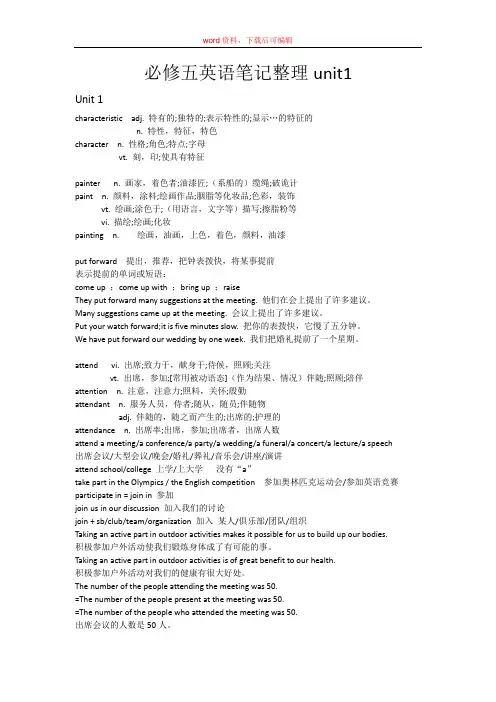
必修五英语笔记整理unit1Unit 1characteristic adj. 特有的;独特的;表示特性的;显示…的特征的n. 特性,特征,特色character n. 性格;角色;特点;字母vt. 刻,印;使具有特征painter n. 画家,着色者;油漆匠;(系船的)缆绳;破诡计paint n. 颜料,涂料;绘画作品;胭脂等化妆品;色彩,装饰vt. 绘画;涂色于;(用语言,文字等)描写;擦脂粉等vi. 描绘;绘画;化妆painting n. 绘画,油画,上色,着色,颜料,油漆put forward 提出,推荐,把钟表拨快,将某事提前表示提前的单词或短语:come up ;come up with ;bring up ;raiseThey put forward many suggestions at the meeting. 他们在会上提出了许多建议。
Many suggestions came up at the meeting. 会议上提出了许多建议。
Put your watch forward;it is five minutes slow. 把你的表拨快,它慢了五分钟。
We have put forward our wedding by one week. 我们把婚礼提前了一个星期。
attend vi. 出席;致力于,献身于;侍候,照顾;关注vt. 出席,参加;[常用被动语态](作为结果、情况)伴随;照顾;陪伴attention n. 注意,注意力;照料,关怀;殷勤attendant n. 服务人员,侍者;随从,随员;伴随物adj. 伴随的,随之而产生的;出席的;护理的attendance n. 出席率;出席,参加;出席者,出席人数attend a meeting/a conference/a party/a wedding/a funeral/a concert/a lecture/a speech 出席会议/大型会议/晚会/婚礼/葬礼/音乐会/讲座/演讲attend school/college 上学/上大学没有“a”take part in the Olympics / the English competition 参加奥林匹克运动会/参加英语竞赛participate in = join in 参加join us in our discussion 加入我们的讨论join + sb/club/team/organization 加入某人/俱乐部/团队/组织Taking an active part in outdoor activities makes it possible for us to build up our bodies. 积极参加户外活动使我们锻炼身体成了有可能的事。
高二英语必修五unit1知识点
高二英语必修五unit1知识点高二英语必修五Unit 1知识点Unit 1 in the textbook for the second year of high school English covers various knowledge points and topics that are important for students to master. In this unit, students will learn about different aspects of human behavior, personal qualities, and social interactions. The following are some key knowledge points that students should focus on:1. Vocabulary and key phrases:- Learn and understand the meanings of new words and phrases introduced in the unit.- Pay attention to collocations and idiomatic expressions related to the unit theme.- Practice using the new vocabulary in context to improve comprehension and fluency.2. Reading comprehension:- Read and understand the main ideas and supporting details in various authentic texts, such as articles, essays, and interviews.- Identify the writer's purpose and tone in different types of texts.- Develop strategies for scanning and skimming to locate specific information quickly.3. Grammar and language use:- Review and apply the appropriate use of tenses, including present simple, present continuous, and past simple.- Practice using reported speech and understand the changes in verb tense and pronoun usage.- Develop skills in using adjectives, adverbs, prepositions, and conjunctions to enhance writing and speaking.4. Writing skills:- Study different types of writing formats, such as narratives, essays, and reports.- Learn how to effectively organize ideas and paragraphs in writing.- Practice using linking words and phrases to create coherence and cohesion in writing.- Work on improving grammar accuracy and vocabulary variety in written assignments.5. Speaking and listening skills:- Participate in class discussions and group activities to practice expressing opinions and ideas.- Develop note-taking skills for listening to lectures, presentations, and conversations.- Focus on listening for specific information, inference, and understanding implied meanings.- Work on pronunciation, intonation, and fluency in spoken English.6. Culture and cross-cultural understanding:- Explore cultural differences and similarities through reading and discussion.- Research and present information about different customs, traditions, and social norms.- Discuss the importance of cultural awareness and empathy in interpersonal communication.It is essential for students to devote sufficient time and effort to understand and internalize the knowledge points covered in Unit 1.Regular practice and revision will help students improve their language skills and achieve success in their English studies.。
新课标高中英语必修5 Unit 1重点知识点

1、defeat vt. 击败;打败;使(计划、希望)落空Our team defeated our opponent by 5:0.He was defeated in his plan.2、attend v. 注意;留意;处理(与to连用)=do with;出席;到场;照看;照料=take care of =look afterattend school/college 上学/上大学attend a lecture/meeting 听讲座/出席会议attend a wedding/ceremony 出席婚礼/参加典礼3、expose vt. 暴露;揭露;使曝光,expose sth./sb./oneself (to ...) 显露或暴露于……be exposed to 暴露于……Don’t expose it to the rain/wind.The soldiers are exposed to the enemy’s fire.Exposed to the sun for a long time, the students felt a little burnt.cure vt.&n. 治愈,治疗;常用于“cure sb. of ...”结构中。
The doctor cured her of a bad cold.It is possible to cure the sickness.4、absorb vt. 吸收;吸引;吸收(液体,气体,光,声等);汲取,理解(知识等);使全神贯注;吸引(注意等),后常接介词in/by;合并(公司等);吞并;常接介词into;承受;经受。
【absorbed adj. 精神集中的absorbing adj. 十分吸引人的be absorbed in 专心于,全神贯注于Cotton gloves absorb sweat.The old man was completely absorbed in the book.Absorbed in the book,he didn’t notice my coming.5、blame vt. 责备;谴责;归咎于n. 责怪;(过失、过错等)责任blame sb. for (doing) sth. 因某事而指责某人blame sth. on sb. 归咎于某人sb. be to blame for(doing) sth. 因(做)某事某人应受到谴责The student blamed the teacher for his failure.The careless driver is to blame for the traffic accident yesterday.Who is to blame for the failure?be to blame 应负责(无被动形式)6、link vt. 连接;联系n. 环;连接;联系;纽带【link ...to/with 将……和……连接/联系起来link up 连接起来The highway links Shanghai to/with Beijing. 重点短语put forward 提出(意见、建议);推荐;提名;将表拨快He put forward a better plan.He puts forward several interesting plans.look into 调查;了解;研究;朝……里面看look into与one’s face/eyes等连用,表示“注视”。
高中英语必修五unit1知识点
高中英语必修五unit1知识点高中英语必修五unit1是英语中比较基础的单元,主要学习的是人类发展史和人类文明的进程。
该单元比较重要,需要同学们认真学习。
本文将对该单元中的一些重要知识点进行详细的讲解。
一、词汇学习1. human being:人类,通常指人类共同的品质和能力。
2. migration:迁徙,指人类或动物集群从一个地方到另一个地方的过程。
3. civilization:文明,指一种生活方式,包括政治、社会、文化、经济等方面的进步。
4. Paleolithic Age:旧石器时代,指人类最早的时期,从大约250万年前到1.8万年前。
5. Neolithic Age:新石器时代,指人类的生产力得到提高,人类社会出现了大规模农业的时期,大约在1.0万年前到5000年前左右。
6. Bronze Age:青铜时代,指人类制造青铜器的时代,大约在公元前3000年到公元前1000年之间。
7. Iron Age:铁器时代,指人类制造铁器的时代,大约在公元前1000年到公元前500年之间。
二、语法学习1. 主谓一致:主语和谓语在数上要保持一致。
例如:The history of human beings is rich and interesting. 人类的历史是丰富而有趣的。
2. 时态的使用:需要根据叙述的时间,选择合适的动词时态。
例如:In the past, human beings lived in caves. 过去,人类住在洞穴里。
Today, human beings live in comfortable houses. 现在,人类住在舒适的房子里。
3. 介词的使用:需要正确使用介词,以表达出完整和准确的意思。
例如:The early humans had to struggle against nature. 早期的人类必须与自然斗争。
4. 特殊句子的使用:需要注意特殊句子的使用,例如:If the human beings had not learned to control fire, their development would have been greatly limited. 如果人类没有学会控制火,他们的发展将受到严重限制。
高中英语必修5unit1知识点讲解
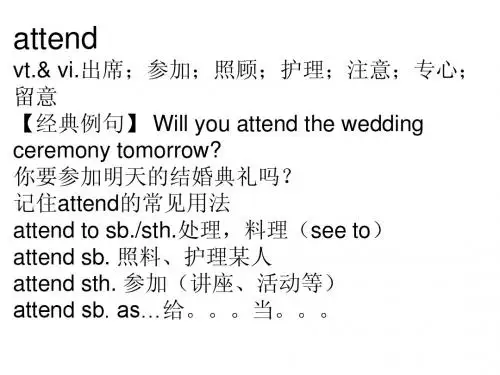
错点二 误接不定式的复合结构作宾语 汉语通常说“建议某人做某事”,但英语习惯 上不能说 suggest sb to do sth,而说suggest sb’s [sb]doing sth. 或后接 that 从句的形式来表达此意 思(注意谓语用 “should+动词原形”这样的虚拟 语气形式)。 他建议我们早点动身。 正:He suggested our (us)leaving earlier. 正:He suggested that we should leave earlier. 误:He suggested us to leave earlier.
When I entered,he was absorbed in reading a novel. We can absorb what we need from foreign languages.
suspect vt. 怀疑;n.嫌疑犯;adj.不可靠的
suspect sb.of ....认为某人有……的嫌疑 suspect sb.to be 怀疑某人是…… ⑴ He is suspected of murder. ⑵ I suspected him to be the spy. ⑶ What made you suspect her of having taken the money?
handle n.& v. 把手,处理;操纵 【经典例句】 Do you know how to handle the computer? 你知道怎样 使用这台电脑吗? 【考点聚焦】 当handle意为“处理”时,相当于deal with.
she had it delivered to her house … 她派人或露出某事物 expose sth./sb./oneself (to sth.)显露或暴露 人/某事物/自己 exposed adj.(指地方)无遮蔽的;不遮挡 风雨的 be exposed to暴露于……
高二英语必修五unit1知识点

▲absorb意为“吸收;吸引;使专心;合并;吞并”,常见结构: absorb one’s attention 吸引某人的注意力 be absorbed in sth. 专心于某事 be absorbed by/into 被……吞并;为……所吸收
Clever children absorb knowledge easily. He is absorbed in his business.
3、难点
过去分词作定语,表语
一、重要词汇拓展
1.science n.科学 →scientific adj.科学的→ scientist n.科学家 2. announce v.宣布 →announcement n.宣布→ announcer n.广播员,告知者 3. instruct v..指导,命令 →instruction n.指导,指示→ instructive adj.有益的,教育性的 4. enthusiastic adj.热心的,热情的 →enthusiasm n.狂热,热心→ enthusiast n.热心家,狂热者 5. valuable adj.有价值的 →value n. 价值 → value v. 估价, 评价
3. He placed a fixed sun at the centre of the solar system with the planets going round it …..
(with + 宾语+ v. –ing构成的复合结构在句中通常作为状语)
1. John Snow defeats “King Cholera”. ▲defeat意为“击败;打败;使(计划,希望)落空”。
【易混辨析】
defeat, beat与win defeat, beat都表示在战斗或竞赛中“战胜,打败(对手)”,后接竞争对手。如 I can beat/defeat you at swimming. win也表示“战胜,赢得”,但宾语通常是比赛、战争、奖品或表尊重、崇拜之 类意义的词。
高二英语必修5unit1知识点
高二英语必修5unit1知识点高二英语必修5 Unit 1 知识点Unit 1: Great Scientists本单元主要介绍了一些伟大的科学家及其重要发现的知识点。
以下是本单元的知识要点:1. 托马斯·爱迪生(Thomas Edison)- 美国发明家和企业家- 创造了电灯、留声机等众多发明- 他的发明对现代科技产生了深远的影响2. 亚历山大·格雷厄姆·贝尔(Alexander Graham Bell)- 苏格兰裔美国科学家、发明家和教育家- 发明了电话,这一发明引领了通信革命3. 汤姆逊(Tomson)- 英国物理学家- 发现了电子,为后来的电子学奠定了基础- 曾获诺贝尔物理学奖4. 约翰·戴尔顿(John Dalton)- 英国化学家和气象学家- 创立了原子理论,为现代化学奠定了基础5. 爱因斯坦(Albert Einstein)- 德裔美籍犹太人,理论物理学家- 发现了相对论和光量子假设- 他的发现对于现代物理学产生了巨大影响,曾获诺贝尔物理学奖6. 牛顿(Isaac Newton)- 英国物理学家、数学家和天文学家- 发现了万有引力定律和三大运动定律- 他的贡献奠定了经典物理学的基础7. 伽利略(Galileo Galilei)- 意大利物理学家、数学家和天文学家- 运用望远镜证明了地球绕太阳转,站在科学与教会之间的冲突中- 他的实验奠定了现代天文学的基础8. 达尔文(Charles Darwin)- 英国博物学家、生物学家- 提出了进化论,对现代生物学产生了深远的影响- 他的著作《物种起源》改变了人们对生命起源和发展的认识9. 奥斯特瓦德(Gregor Mendel)- 捷克奥地利籍的匈牙利籍的神父和生物学家- 发现了遗传规律,创建了现代遗传学- 他的实验为后来的分子生物学和遗传工程奠定了基础10. 居里夫人(Marie Curie)- 波兰物理学家和化学家- 发现了镭元素,为放射性理论及现代核物理学的发展做出了重大贡献- 是第一个获得两次诺贝尔奖的女性科学家总结:本单元我们了解了一些伟大的科学家及其重要发现,这些科学家们的贡献对于人类的科学发展产生了深远的影响,改变了我们对于世界和宇宙的认识。
英语必修五第一单元知识点
英语必修五第一单元知识点一、词汇与短语1. 高级词汇的学习和运用,如:elaborate, perspective, contradict, etc.2. 短语动词的理解和应用,例如:look forward to, break down, etc.3. 常见搭配,如:make a decision, have an impact on, etc.二、语法1. 复杂句子结构,包括宾语从句、定语从句和状语从句。
2. 时态的使用,特别是过去完成时和将来进行时。
3. 语态的变化,包括被动语态的构成和使用场合。
三、阅读理解1. 快速阅读技巧,如扫读和略读。
2. 理解文章主旨和细节信息。
3. 分析作者意图和态度。
四、写作技巧1. 论证文的写作,包括论点的提出、论据的选取和论证的结构。
2. 描述性和叙述性文章的写作。
3. 正式和非正式写作风格的区别和应用。
五、听力理解1. 理解不同口音和语速的英语。
2. 抓住关键信息和细节。
3. 通过上下文线索理解难词和表达。
六、口语表达1. 发音的准确性和流利性。
2. 日常对话和讨论中的话题展开。
3. 公共演讲和表达观点的技巧。
七、文化知识1. 了解英语国家的文化习俗和社会行为规范。
2. 英语文学的基本知识,如著名作家和作品。
3. 当代英语国家的社会问题和发展趋势。
请注意,以上内容是一个示例性的概要,实际的教学内容可能会有所不同。
教师和学生应参考具体的教材和课程大纲来准备和复习。
此外,为了确保文档的可编辑性和可操作性,建议使用Word或其他文字处理软件来创建文档,并保存为兼容的文件格式,以便用户下载和编辑。
高二英语必修5 Unit 1 课文知识点梳理
JOHH SHOW DEFEATS “KING CHOLERA”John Snow was a famous doctor in London - so expert, indeed, that he attend ed Queen Victoria as her personal physician. 【so...that引导结果状从】【when引导时间状从;exposed(done)作后定】This was the deadly disease of its day.Neither its cause nor its cure was understood. 【neither...nor的用法;被动语态】So many thousands of terrified people died every time there was an outbreak. 【every time引导时间状从,中间带有一个there be句型】John Snow wanted to face the challenge and solve this problem.He knew that cholera would never be controlled until its cause was found.【that引导的宾从中套一个until引导的时间状从;情态动词的被动语态】He became interested in two theories that possibly explained how cholera killed people.【be/become interested in...;that引导的定从中套一个how引导的宾从】The first suggested that cholera multiplied in the air.【that引导宾从】A cloud of dangerous gas floated around until it found its victims. 【until引导时间状从】The second suggested that people absorb ed this disease into their bodies with their meals.【that引导宾从】From the stomach the disease quickly attacked the body and soon the affected person died.John Snow suspected that the second theory was correct but he needed evidence.【that引导宾从】So when another outbreak hit London in 1854, he was ready to begin his enquiry.【when引导时间状从】As the disease spread quickly through poor neighbourhoods, he began to gather information.【as引导时间状从】In two particular streets, the cholera outbreak was so severe that more than 500 people died in ten days.【so...that引导结果状从】He was determined to find out why.【被动语态】First he marked on a map the exact places where all the dead people had lived.【where引导定从】This gave him a valuable clue about the cause of the disease.Many of the deaths were near the water pump in Broad Street (especially numbers 16, 37, 38 and 40).He also noticed that some houses (such as 20 and 21 Broad Street and 8 and 9 Cambridge Street) had had no deaths.【that引导宾从;had done过去完成时】He had not foreseen this, so he made further investigations.He discovered that these people worked in the pub at 7 Cambridge Street.【that引导宾从】They had been given free beer and so had not drunk the water from the pump.【过去完成时的被动;so和had间省略主语they】It seemed that the water was to blame.【that引导表从】Next, John Snow looked into the source of the water for these two streets.【that引导宾从;polluted作后定(高考中出现过)】He immediately told the astonished people in Broad Street to remove the handle from the pump so that it could not be used.【so that引导目的状从(是为了);情态动词的被动】Soon afterwards the disease slowed down.He had shown that cholera was spread by germs and not in a cloud of gas.【that引导宾从;被动语态】In another part of London, he found supporting evidence from two other deaths that were linked to the Broad Street outbreak.【that引导定从】A woman, who had moved away from Broad Street, liked the water from the pump so much that she had it delivered to her house every day.【who引导非限制定从;so...that引导结果状从】Both she and her daughter died of cholera after drinking the water.With this extra evidence John Snow was able to announce with certainty that polluted water carried the virus.【that引导宾从(没有直接跟在谓语动词之后)】To prevent this from happening again, John Snow suggested that the source of all the water supplies be examined.【that引导宾从】The water companies were instruct ed not to expose people to polluted water any more.Finally "King Cholera" was defeated.定向练习,举一反三一、单词和短语1.The medicine will cure you ______ your cough.2.The doctor devoted himself to finding the cure ______ the disease.3.Most shin cancers are _______ (cure) if _______ (treat) early.4.Many patients are not getting the medical ________ (treat) they need.5.She likes her job to be ______ challenge.6.The new discovery ________ (challenge) traditional beliefs in 1850.7.Reducing the gap between rich and poor is one of the _________ (challenge) the government faces.8.Try tennis, badminton or boring. In short, try anything _________ (challenge).pletely ________ (absorb) in her new novel, the young writer kept thinking and writing in her study for a dozen hours.10.His ability _______ (absorb) information was astonishing, but his concentration time was short.11.Those small companies have been absorbed ______ the large company.12.When something did interest me, I could become ______ (absorb).13.He left office after _________ (suspect) of theft.*14.They suspected him ______ giving false evidence.15.He is the first _________ (suspect) of giving away government secrets to the enemy.*16.She blamed him ______ the failure of their marriage.17.If you fail the exam, you will only have yourself ________ (blame).18.Which driver was _______ (blame) for the accident?19.They put the blame for the abortion of the project ______ us.20._______ (blame) for the broken vase, the boy hung his head.21.There’s _____ direct link between diet and heart disease.22.The police suspect that the two cases may _______ (link).23.The Channel Tunnel _______ (link) Britain with the European contient.24.They walked with their arms ______ (link).25.Always read the _________ (instruct) on the bottle thoroughly and take the right amount ofmedicine.26.He is the ________ (instruct) who taught me how to shi.st week, we _________ (instruct) by our clients that you owe them 300 dollars.28.He instructs us ______ making self-introduction.29.She arrived at 10 o’clock as _______ (instruct).30.All the evidence suggests that he _______ (steal) the money.31.Earlier reports suggested that a meeting _________ (take) place next Sunday.32.I suggest that you _______ (thought) over your position very carefully.33.I suggest _______ (add) vitamins E and A to your diet.34.He suggested that we _______ (hold) a meeting to discuss this problem.35.He suggested _______ (hold) a meeting to discuss this problem.36.The doctor advised my father _______ (give) up smoking.37.The volunteers contribute most of their own spare time ______ the project.38.The young population of a nation are the people ________ (contribute) most to a country’s economic development.39.Her ________ (contribute) to the reaserch were largely unacknowledged.二、语法专项1.后置定语(1)The adobe dwellings(土坯房) ______ (build) by the Pueblo Indians are admired by even the most modern architects. (2015年全国卷)(2)The airport _______ (complete) last year has helped promote tourism in this area.(3)There are hundreds of vistor _______ (wait) in front of the Art Gallery.COPERNICUS’ REVOLUTIONRRY THEORYNicolaus Copernicus was frightened and his mind was confused.Although he had tried to ignore them, all his mathematical calculations led to the same conclusion that the earth was not the centre of the solar system.【although引导让步状从;that引导同位从】Only if you put the sun there did the movements of the other planets in the sky make sense.【if引导条件状从;only放句首时,句子要用部分倒装(波浪线部分为主句谓语动词,did助动词置于主句主语之前)】【as引导原因状从;would have done虚拟语气】They believed God had made the world and for that reason the earth was special and must be the centre of the solar system.【省略that的宾从;for‘由于...’】The problem arose because astronomers had noticed that some planets in the sky seemed to stop, move backward and then go forward in a loop.【because引导原因状从;that引导宾从】Others appeared brighter at times and less bright at others.This was very strange if the earth was the centre of the solar system and all planets went round it.【if引导条件状从】Copernicus had thought long and hard about these problems and tried to find an answer.He had collected observations of the stars and used all his mathematical knowledge to explain them.But only his new theory could do that.So between 1510 and 1514 he worked on it, gradually improving his theory until he felt it was complete.【until引导时间状从】In 1514 he showed it privately to his friends.The changes he made to the old theory were revolutionary.【省略that/which的定从】He placed a fixed sun at the centre of the solar system with the planets going round it and only the moon still going round the earth.He also suggested that the earth was spinning as it went round the sun and this explained changes in the movement of the planets and in the brightness of the stars.【that引导宾从;as引导时间状从】His friends were enthusiastic and encouraged him to publish his ideas, but Copernicus was cautious.He did not want to be attacked by the Christian Church, so he only published it as he lay dying in 1543.【as引导时间状从】Certainly he was right to be careful. The Christian Church rejected his theory, saying it was against God's idea and people who supported it would be attacked.【who引导定从】Yet Copernicus' theory is now the basis on which all our ideas of the universe are built.【on which 引导定从】His theory replaced the Christian idea of gravity, which said things fell to earth because God created the earth as the centre of the universe.【which引导非限制定从中套一个because引导的原因状从】Copernicus showed this was obviously wrong.Now people can see that there is a direct link between his theory and the work of Isaac Newton, Albert Einstein and Stephen Hawking.【that引导宾从】。
高二英语必修五unit1语法总结
Unit 1 语法重点一、动词不定式不定式可以用来做主语、表语、定语、状语、宾语、独立成分,表示比较具体的意义。
(1)做主语①动词不定式短语To master a foreign language is no easy job.To see this film is to waste time.To solve this problem is out of the question②为平衡整个句子,避免头重脚轻,常用it做形式主语,而将真正主语不定式放后面,用于这种形式是一些特定的结构。
例如:1)谓语部分是系表结构,表语是某些形容词或名词。
例如:It is foolish to do in this way. It sounds reasonable to do it this way.2)某些动词做谓语时。
例如:It took much time to do this. It makes us excited to think about that.(2) 做表语表示打算、计划、命令和要求,用于appear, seem, happen等系动词后面Such questions are to be avoided. What he said proved to be true.He seems to be ill.(3) 做定语做定语时不定式一般紧跟其所修饰名词或代词后面。
例如:He was the first one to come this morning.He didn’t have the chance to go to school in the past.如果不定式是不及物动词时,应注意其相应介词的搭配。
例如:He has nothing to worry about.She is a very nice person to work with.(4) 作状语不定式作状语可以表示目的、原因和结果。