
外研版七年级下册英语Module9重点单词短语、句型、语法汇总
外研版七年级下册英语Module9重点单词短语、句型、语法汇总★重点单词
1.f i n d o u t发现;查明;弄清
2.a t t h e a g e o f在……岁时
3.i n t h e1860s在19世纪60年代
4.a r o u n d t h e w o r l d世界各地
5.W o m e n's D a y妇女节
6.N a t i o n a l D a y国庆节
7.C h i l d r e n's D a y儿童节
★核心句型
1.L o o k a t t h i s!
看看这个。
2.E n j o y t h e b o o k.
享受这本书。
3.S b d i d s t h.
某人做过某事。
4.D i d s b d o s t h?
某人做过某事吗?
5.l e a r n t o d o s t h
学习做某事
6.d e c i d e t o d o s t h
决定做某事
7.b e g i n t o d o s t h
开始做某事
★语法点击
动词的过去式是动词的重要形式,一般用于一般过去时态。
动词的过去式有规则变化和规则变化两种形式。
前一期,我们学习了动词过去式的规则变化,本期我们一起来探寻动词过去式的不规则变化。
过去式的不规则变化一般有以下几种情况:
1.过去式与动词原形相同。
如:l e t-l e t,p u t-p u t,c u t-c u t
2.把动词末尾的字母d改为t。
如:s e n d-s e n t,l e n d-l e n t,s p e n d-s p e n t
3.改变动词中间元音字母:
(1)变i为a或o。
如:s i t-s a t,g i v e-g a v e,b e g i n-b e g a n,s i n g-s a n g,
s w i m-s w a m,w i n-w o n,r i d e-r o d e,d r i v e-d r o v e
(2)变o/a为e。
如:d r a w-d r e w,k n o w-k n e w,g r o w-g r e w,t h r o w-
t h r e w
4.在动词原形后面加t。
如:m e a n-m e a n t,l e a r n-l e a r n t
5.有些含有双写字母的词,把双写改为单写,在词尾加t。
如:k e e p-k e p t,s l e e p-s l e p t,f e e l-f e l t6.动词第一个字母或前两个字母+o u g h t/a u g h t。
如:b u y-b o u g h t,t h i n k-t h o u g h t,t e a c h-t a u g h t,c a t c h-c a u g h t
友情提示:动词过去式的不规则变化还有很多,同学们应该特殊记忆,在平时的学习中注意积累。
★写作一招鲜
S t e p1写作任务
同学们,你们读过《汤姆·索亚历险记》吗?请根据下面的提示,写一篇英文小短文介绍该小说的作者马克·吐温吧!70词左右。
提示:
1.马克吐温于1835年生于美国,是世界上最伟大的作家之一;
2.11岁时,父亲去世。
次年,他只能辍学,到工厂干活。
他先后做过不同的工作,并开始了自己的写作生涯;
3.他交友甚广,非常幽默。
他一生写了大量作品,于1910年4月21日去世。
S t e p2词汇联想
1.工厂f a c t o r y
2.幽默的h u m o r o u s
3.辍学d r o p o u t o f s c h o o l
4.做不同的工作d o d i f f e r e n t j o b s
5.开始写作生涯b e g i n w r i t i n g
S t e p3常用句型
1.S b.b e b o r n ...某人出生……
2. ...i s o n e o f t h e g r e a t e s t w r i t e r s.……是最伟大的作家之一。
S t e p4思路点拨
第一部分先简单介绍一下马克·吐温。
M a r k T w a i n w a s b o r n i n
A m e r i c a i n1835a n d h e w a s o n e o f t h e g r e a t e s t w r i t e r s i n t h e w o r l d.
第二部分再按照时间顺序具体介绍马克·吐温经历的事情。
H e d r o p p e d o u t o f s c h o o l a n d w o r k e d i n a f a c t o r y t h e n e x t y e a r.T h e n h e d i d d i f f e r e n t j o b s a n d b e g a n w r i t i n g.
第三部分最后再对马克·吐温简单总结一下。
H e w r o t e l o t s o f
w o r k s i n h i s l i f e.H e d i e d o n A p r i l21,1910
S t e p5范文展示
M a r k T w a i n
M a r k T w a i n w a s b o r n i n A m e r i c a i n1835a n d h e w a s o n e o f t h e
g r e a t e s t w r i t e r s i n t h e w o r l d.H i s f a t h e r d i e d a t t h e a g e o f11.H e
d r o p p
e d o u t o
f s c h o o l a n d w o r k e d i n a f a c t o r y t h e n e x t y e a r.T h e n h e d i d d i f f e r e n t j o b s a n d b e
g a n w r i t i n g.M a r k T w a i n l i k e d m a k i n g
f r i e n d s w i t h o t h e r s a n d h e w a s v e r y h u m o r o u s.H e w r o t e l o t s o f
w o r k s a l l h i s l i f e.H e d i e d o n A p r i l21,1910.。
外研版丨七年级下册英语Module9~Module11知识点总结
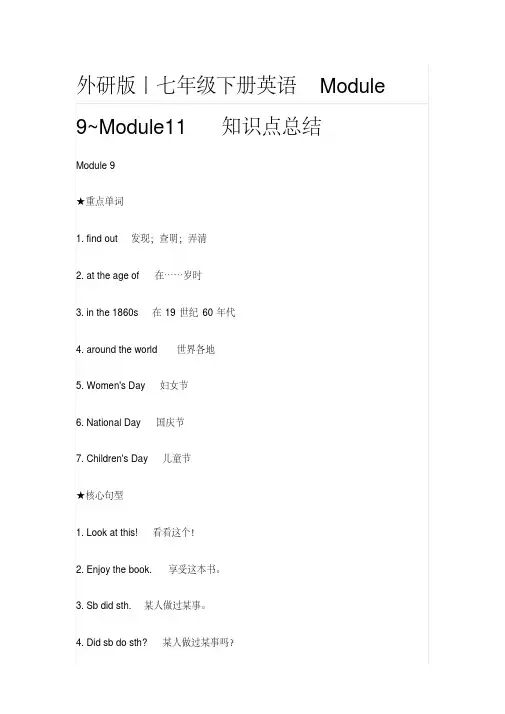
2. 11 岁时,父亲去世。次年,他只开始了自己的写作生涯;
3. 他交友甚广,非常幽默。他一生写了大量作品,于 世。
1910 年 4 月 21 日去
Step 2 词汇联想
1. 工厂 factory
2. 幽默的 humorous
3. 辍学 drop out of school
第二部分 再按照时间顺序具体介绍马克· 吐温经历的事情。He dropped out of school and worked in a factory the next year. Then he did different jobs and began writing.
第三部分 最后再对马克·吐温简单总结一 下。 He wrote lots of works in his life. He died on April 21, 1910
Step 5 范文展示 Mark Twain Mark Twain was born in America in 1835 and he was one of the greatest writers in the world. His father died at the age of 11. He dropped out of school and worked in a factory the next year. Then he did different jobs and began writing. Mark Twain liked making friends with others and he was very humorous. He wrote lots of works all his life. He died on April 21, 1910. Module 10 ★重点单词 1. world-famous 举世闻名的 2. on holiday 度假 3. movie star 电影明星 4. the Pacific Ocean 太平洋 5. by plane 乘飞机 6. at the airport 在机场 7. such as 比如
外研版英语2022-2023学年七年级下册Module9重点知识
38 154 short poems
a few long poems
6、Like many people four hundred years ago, Shakespeare’s parents didn’t learn to read or write.
( B ) It’s important ____ a foreign language.
针对性训练
一、单项选择
( C)1. I’m sure I can _____ the truth one day.
A. look out
B. take out
C. find out
D. go out
( A)2. He went to America _____________ May 26th, 2017.
A. look for
B. find
D. find out
v. 原型 leave v. 原型begin "当…时候" 3、He left school and began work at the age of twelve.
at the age of “在……岁时”, 后面 直接+ 数字
at the age of ... = when sb. was/ were ... year(s) old
他变得很出名。(过去) He became famous. 他成为了一名著名的作家。 He became a famous writer.
4、But he took the name Mark Twain and became very famous in the 1860s.
in the 1860s
外研版七年级英语下册模块9知识点归纳

外研社七年级英语下册模块9 Life History知识点归纳知识点一:模块9的短语1. women’s Day妇女节2.National Day国庆节3.find out 发现,查明,弄清4.at the age of 在……岁时5.Children’s Day儿童节6.New Year’s Day元旦7.Teachers’ Day教师节8.Spring Festival春节9.on the Internet在网络上10.be born出生11.as well也,还12.in the 1860s在19世纪60年代13.around the world世界各地14.get married结婚知识点二:重点词语解释Unit one1.Hey,we can find out about him on the Internet.嘿,我们可以在网上查明有关他的资料。
find out意为“发现;查明;弄清”,后可接名词或从句。
如:Can you find out what time the plane takes of?你知道飞机几点起飞吗?The students found out that their teacher was ill.学生们发现老师病了。
[辨析]find,find out,look forfind,find out和look for都含有“寻找,找到”的意思,但其含义和用法却不同。
(1)find意为“找到,发现”,通常指找到或发现具体的东西,也可指偶然发现某物或某种情况,强调的是找的结果。
如:He didn’t find his bike.他没找到他的自行车。
(2)look for意为“寻找”,是有目的地找,强调“寻找”这一动作。
如:I can’t find my pen. I’m looking for it everywhere.我找不到我的钢笔,我正到处找。
(3)find out意为“找出;发现;查明”,多指通过调查、询问、打听、研究之后“搞清楚、弄明白”,通常含有“经过困难曲折”的含义,指找出较难找到的、无形的、抽象的东西。
外研版七年级下册英语Module9重点单词短语、句型、语法汇总
外研版七年级下册英语Module9重点单词短语、句型、语法汇总★重点单词1.f i n d o u t发现;查明;弄清2.at t h e age of在……岁时3.i n t h e1860s在19世纪60年代4.ar o u n d t h e w o r l d世界各地5.W o m en's D a y妇女节6.N at i o nal D ay国庆节7.C h i l d r en's D a y儿童节★核心句型1.L o ok at t h i s!看看这个。
2.E n j o y t he bo o k.享受这本书。
3.S b d i d st h.某人做过某事。
4.D i d sb do st h?某人做过某事吗?5.l ear n t o d o s t h学习做某事6.d eci de t o d o st h决定做某事7.b egi n t o do st h开始做某事★语法点击动词的过去式是动词的重要形式,一般用于一般过去时态。
动词的过去式有规则变化和规则变化两种形式。
前一期,我们学习了动词过去式的规则变化,本期我们一起来探寻动词过去式的不规则变化。
过去式的不规则变化一般有以下几种情况:1.过去式与动词原形相同。
如:l e t-l et,p ut-p u t,c ut-c u t2.把动词末尾的字母d改为t。
如:sen d-sent,l en d-l en t,spen d-sp en t3.改变动词中间元音字母:(1)变i为a或o。
如:si t-sat,g i v e-g av e,be g i n-b egan,si n g-sa n g, s w i m-sw am,w i n-w on,r i d e-r o d e,d r i v e-d r o v e(2)变o/a为e。
如:d r aw-dr ew,k n o w-k ne w,g r o w-g r ew,t hr o w-t h r ew4.在动词原形后面加t。
外研版七年级下册Module 9重点内容复习总结
外研版七年级下册module 9重点内容总结【语法】不规则动词的一般过去时用法。
不规则动词过去式构成方式独特,因此需要特殊记忆。
如:①We left at nine o’clock in the morning.我们是早上9点钟离开的。
②They swam in the swimming pool and had a good time.他们在游泳池里游泳,玩得很开心。
③He wrote some postcards and sent some emails.他写了一些明信片,还发了一些电子邮件。
以下列举一些常用的不规则动词及其过去式。
be--was\were leave--leftbuy--bought meet--metcome--came read--readdo--did see--sawget--got spend--spentgo--went swim--swamhave--had write--wrotetake--took send--sentbring--brought put--put除了过去式的变化规则不同以外,不规则动词在肯定句、否定句、疑问句等各种句型中的使用与规则动词相同。
下面我们以spend,come,go,take,see,swim为例具体说明:【重点词汇】marry v. 结婚◆ He married in 1582 and had three children.他在1582年结婚并且有三个孩子。
◆ She married John last year. 她去年嫁给约翰了。
◆ She got married to a young man named Frank.她嫁给了一个叫弗兰克的年轻人。
【探究总结】marry的用法(1)用作及物动词构成短语:marry sb. 意为“和某人结婚”marry sb. to. . . 意为“把某人嫁给…”。
(2)用作不及物动词,一般用副词或介词短语来修饰。
初中英语外研版七下Module9笔记讲解,巩固练习以及知识梳理

初中英语外研版七下Module9笔记讲解,巩固练习以及知识梳理外研版七下M9笔记讲解,巩固练习以及知识梳理Unit1笔记整理 By Zora1.辨析:find out,find与 look for①find out发现;查明;弄清,强调过程,多指通过观察、探索、调查等努力发现或弄清一些具体或抽象的东西②find 找到,发现,强调结果,通常指找到或发现具体的东西③look for 寻找,强调寻找的过程We must find out the truth.我们必须查明真相。
She found a good job at last.最后,她找到了一份很好的工作。
I'm looking for my key.我正在找我的钥匙。
2.at the age of 意为“在······岁时”,后接基数词,可位于句首或句末,常用于一般过去时,相当于when 引异的时间状语从句。
The old man died at the age of ninety.这位老人是在90岁时去世的。
【拓展】in+形容词性物主代词+整十的基数词的复数,表示“在某人几十多岁的时候”He lost work in his forties. 他在他四十多岁的时候丢掉了工作。
3.newspaper 可数名词,read newspapers意为“看报纸”。
4.exact adj.准确的,确切的I don't remember the exact words,我不记得确切的话了。
[拓展] exactly 副词,意为“准确地,确切地”5.date n.日期询问日期用 what.-What's the date today? -It's March 15th,6.take the name 意为“取名;起名”。
When did you take the pen name Shan He?你什么时候取了山河这个笔名?7.become 作连系动词,意为“变得”,后接形容词作表语。
外研社七年级英语下册MODULE9重要短语归纳整理
外研社七年级英语下册MODULE9重要短语归纳整理外研社七年级英语下册oDULE9重要短语归纳整理oDULE9onceuponatie从前 2.decidetodosth.决定做某事decidenottodosth.goforaride/al去兜风/散步4.intheforest在森林里picfloers摘花picupsth.捡起/拿起某物picit/theup belost/loseone’say迷路SheisalayslostinBeijing.looaround+sb.看某人的四周looaroundher/e/hi…noticesth.注意到某物hurryto+s.=gotos.inahurry急忙去某地Hehurriedtoschoolithouthavingbreafast.0.nocon/atthedoor敲门1.open开着的adclosed关着的adThedoorisclosed,buttheindoisopen.open打开;经营Heopenedthedoorandit’sopenno.enter+sth进入……Theyentered/entintothebuilding.3.finishsth.Shefinishedthefoodsoon.finishdoingsth.Shehastofinishdoingherhoeorno.Shecountedthreebols.她数了数有三只碗。
countfro1to100rushoutof+s.冲出某地Herushedoutoftheschoolandrodeabietohoe.betired累do/trytodosth.尽力做某事trysth试某物tryit/theondestroyedsth.毁坏了某物18.alintothebedroo走进卧室verysoon不久;很快20.beasleep=besleeping1.inpieces成了碎片22.atfirst起初atthebeginningof23.pointat/to指着……There’sthenaughtygirl.倒装句,原句为:Thenaughtygirlisthere.有一个淘气的女孩。
外研版丨七年级下册英语Module 9~Module11知识点总结
外研版丨七年级下册英语Module 9~Module11知识点总结Module 9★重点单词1. find out 发现;查明;弄清2. at the age of 在……岁时3. in the 1860s 在19世纪60年代4. around the world 世界各地5. Women's Day 妇女节6. National Day 国庆节7. Children's Day 儿童节★核心句型1. Look at this! 看看这个!2. Enjoy the book. 享受这本书。
3. Sb did sth. 某人做过某事。
4. Did sb do sth? 某人做过某事吗?5. learn to do sth 学习做某事6. decide to do sth 决定做某事7. begin to do sth 开始做某事★语法点击动词的过去式是动词的重要形式,一般用于一般过去时态。
动词的过去式有规则变化和规则变化两种形式。
前一期,我们学习了动词过去式的规则变化,本期我们一起来探寻动词过去式的不规则变化。
过去式的不规则变化一般有以下几种情况:1. 过去式与动词原形相同。
如:let -let, put -put, cut -cut2. 把动词末尾的字母d 改为t。
如:send -sent, lend -lent, spend -spent3. 改变动词中间元音字母:(1) 变i 为a 或o。
如:sit -sat, give -gave, begin -began, sing -sang, swim -swam, win -won, ride -rode, drive-drove(2) 变o / a 为e。
如:draw -drew, know -knew, grow -grew, throw -threw4. 在动词原形后面加t。
如:mean -meant, learn -learnt5. 有些含有双写字母的词,把双写改为单写,在词尾加t。
外研版七年级下册Module 9重点内容总结
外研版七年级下册module 9重点内容总结【语法】不规则动词的一般过去时用法。
不规则动词过去式构成方式独特,因此需要特殊记忆。
如:①We left at nine o’clock in the morning.我们是早上9点钟离开的。
②They swam in the swimming pool and had a good time.他们在游泳池里游泳,玩得很开心。
③He wrote some postcards and sent some emails.他写了一些明信片,还发了一些电子邮件。
以下列举一些常用的不规则动词及其过去式。
be--was\were leave--leftbuy--bought meet--metcome--came read--readdo--did see--sawget--got spend--spentgo--went swim--swamhave--had write--wrotetake--took send--sentbring--brought put--put除了过去式的变化规则不同以外,不规则动词在肯定句、否定句、疑问句等各种句型中的使用与规则动词相同。
下面我们以spend,come,go,take,see,swim为例具体说明:肯定否定一般疑问句回答I spent two days here. I didn’t (didn’t)spendtwo days here.Did you spend twodays here?Yes,I did.No,I didn’t.You came here yesterday. You didn’t (didn’t)come here yesterday.Did you come hereyesterday?Yes,you did.No,you didn’t.He\She went to work by bus. He\She didn’t (didn’t)go to work by bus.Did he\she go towork by bus?Yes,he\she did.No,he\shedidn’t.It took two hours to go there. It didn’t (didn’t)taketwo hours to go there.Did it take twohours to go there?Yes,it did.No,it didn’t.We saw the famous film star. We didn’t (didn’t) seethe famous film star.Did we see thefamous film star?Yes,we did .No,we didn’t.They swam in the sea. They didn’t (didn’t)swim in the sea.Did they swim inthe sea?Yes,they did.No,they didn’t.【重点词汇】marry v. 结婚◆ He married in 1582 and had three children. 他在1582年结婚并且有三个孩子。
外研版英语七下第九模块《 Life history》重要知识点总结
Module 9 Life historyUnit 1 He left school and began work at the age of twelve.1.关于month的词汇及其简写:January一月(Jan.); February二月(Feb.); March三月(Mar.);April四月(Apr.); May五月(May); June六月(Jun.);July七月(Jul.); August八月(Aug.); September九月(Sept.);October十月(Oct.)November十一月(Nov.);December十二月(Dec.)2.Tom Sawyer, by the famous American writer, Mark Twain. by, 介词,意为“由……创作;出自”。
3.辨析:find out & find & look for一言辨异:eg.I looked for my umbrella everywhere, but I couldn’t find it. Please help me find out who took it by mistake.我到处寻找我的雨伞,但是没有找到。
请帮我查一下是谁错拿了它。
4.“真实的”real(1)real,形容词,意为“真实的;真正的”。
real name,“真名”。
(2)really,副词,意为“确实;真正地”。
really happy,“确实很高兴”。
一言辨异:Tom really wants to make a real friend.汤姆真的很想结交一个真正的朋友。
5.age表达法at the age of +基数词 = at + 基数词,意为“在……岁时”相当于when sb. was... (years old)。
eg.At the age of 5/At 5,Jack could learn to read and write. =Jack could learn to read and write when he was 5 (years old). Jack 5岁时就学会了读书认字。