
美丽新世界Brave New World
《美麗新世界》作者介紹
•1932年《美麗新世界》出版 •1934年,全家定居在南加州洛杉磯 有一段時間在好萊塢工作 •之後,赫胥黎繼續在好萊塢工作, 寫了很多部小說、短篇故事、 散論與研究、詩、戲劇等等。 •1963年,歿於美國好萊塢。
2018/9/22 4
《美麗新世界》前言
•學生了解低等階級為什麼不能浪費社會 的時間去讀書,而且讀書又有反制約的危 險,那為何要讓德爾塔階級不能接受花朵? •主任解釋:原本讓他們見到玫瑰而驚叫, 是為了高度的經濟政策。他們喜歡花朵, 一有機會就到鄉村,目的是強迫他們消耗 運輸業。可是有一個嚴重的缺點。愛好自 然使工廠不忙碌,但是不去除他們對消耗 運輸業的傾向。
2018/9/22
20
第2章 制約與催眠教育
•第三次問男孩:「哪條河流最長, 湯米?」男孩哭出來,說我不知道。 •這樣的哭叫聲讓早期研究者心灰意 冷。
2018/9/22
21
第2章 制約與催眠教育
•初步階級意識教育:在八十個嬰兒 枕頭下,有一個聲音:「德爾塔兒 童穿卡其。噢,我不要跟德爾塔孩 子玩。愛普西隆更壞。他們笨得連 讀書寫字都不會。還有,他們穿黑 的,最可惡的顏色。我那麼高興我 是貝塔。
•在這本書中有幾個缺點需要提及: 1.野蠻人只獲得在兩種生存狀態之間 做選擇的權利。 2.讓他熟讀莎士比亞,為了戲劇效果 3.野蠻人生命結束於狂烈的自我折磨 與絕望的自殺,符合作者當時對人 生的懷疑態度。
2018/9/22 5
《美麗新世界》前言
•4.討論未來的小說,不論在藝術上 或哲學上是否有完整性,它的預 言必須看起來有可能性。 •5.本書未提到核子分裂,這個時代 原子能是常見的話題。 6.本書主題不是科學進步的本身, 而是科學進步對人的影響。
•第二天早上 •第一次問男孩:「你知道非洲最長 的河流是什麼?」男孩搖頭。「但 你不記得有句話開頭說:尼羅河 是……」男孩立刻說:「尼羅河 ──是──非洲──最長──河 流……」
2018/9/22 19
第2章 制約與催眠教育
•第二次問男孩:「非洲最長的河流 是什麼?」男孩兩眼翻白,他說我 不知道。 •「尼羅河──是──非洲──最長 ──河流……」
2018/9/22 6
第1章
參觀倫敦育種中心
•地點:倫敦中央育種與制約中心, 有34層樓。 •標語:公共、相同、穩定 •事件:育種與制約中心主任帶領學 生參觀該中心、受精室,為 之講解。
2018/9/22 7
第1章 參觀倫敦育種中心
•價值觀:個別的東西是美德與快樂 之源。普遍性的東西只是 知識上必要的罪惡。 •時代:福特紀元六三二年,這年代 沒人會注意相貌、年齡。
2018/9/22 8
第1章 參觀倫敦育種中心
•孵卵器: 卵子和血液同一體溫,精子必 須保持其受精。
2018/9/22
9
第1章 參觀倫敦育種中心
•波康諾夫斯基: 將人分為五階層的處理過程,按希 臘字母順序稱之。 1.阿爾法 2.貝塔 3.伽瑪 4.德爾塔 5.愛普西隆
2018/9/22 13
第1章 參觀倫敦育種中心
•標號系統:T,表示男性,○,表 示女性。?,表示不育女的人(注射 男性賀爾蒙)。 •降低標準:沒有任何方法比缺氧量 更能使胚胎低於標準,階級越低, 含氧越少。首先受影響的是頭腦, 然後是骨骼。
2018/9/22 14
第2章 制約與催眠教育
•地點:育嬰室。新巴夫洛夫制約室 •事件:主任命護士把書本攤開在玫瑰花 束之間,把一個個八個月大的嬰兒放在 地板,任由他們爬向花朵和圖畫書,嬰 兒玩得不亦樂乎時,請護士長按下開關, 產生爆炸聲、警鐘大作,孩子們驚恐、 尖吼。接著又按下電擊,嬰兒身體扭曲 僵直、四肢抽動。
2018/9/22 17
第2章 制約與催眠教育
•主任提到:催眠教育,第一次正式 應用,是在福特紀元二一四年。 •早期催眠教育:一位男孩熟睡著, 有一個音樂盒發出聲音:尼羅河是 非洲最長的河流,地球所有的河流 中,位居第二,以它盆地的幅度來 說,卻是世界第一……
2018/9/22 18
第2章 制約與催眠教育
2018/9/22 10
第1章 參觀倫敦育種中心
•一個卵,一個胚胎,一個成人── 正常。被波康諾夫斯基化的卵,卻 會發芽、繁殖、分裂。從八個到九 十六個芽,每個芽都可已長成一個 完整的胚胎,成為一個體型齊全的 人。所以一個卵,造成九十六個人 ──進步。
2018/9/22 11
第1章 參觀倫敦育種中心
•社會安定的一大功臣:標準的男人 和女人,規格統一的成批產品,一 個小工廠所有的工人都可以由同一 個波康諾夫斯基化的卵所產生的產 品充任。九十六個相同的孿生兒操 縱九十六個機器。
2018/9/22 12
第1章 參觀倫敦育種中心
•最高紀錄:一個卵巢在這個中心可 以生出一萬六千零十二個。共有一 百八十九批相同的孿生兒。 •社會地位註定室:受精卵的試管, 註明遺傳、受精日期以及群體名稱, 身分就固定了,送入此室,建立各 項資料,作統計。
2018/9/22 22
第2章 制約與催眠教育
•睡醒前要反覆播放四、五十次;一 星期三次,連續三十個月。 •而且這個時代,只會喊福特來替代 阿門、主啊。
科技未來研究報告
美麗新世界 Brave New World
研二 指導教授
2018/9/22
謝國基 楊棋明 博士
1
美麗新世界
Brave New World
Aldous Huxley (1894-1963)
2018/9/22
2
《美麗新世界》作者介紹
•Aldous Huxley(1894-1963) •阿道斯•赫胥黎 •他的父親就是英國著名的生物家與 散文家 T•H•赫胥黎 •1915年,牛津大學畢業 •1919年,娶瑪利亞為妻,育有一子
2018/9/22 15
第2章 制約與催眠教育
•「書、噪音、花朵、電擊」已在嬰 兒腦中結合在一起。孩子會帶著心 理學家所謂的對書與花朵『本能的』 厭惡長大。他們終生都可以免於書 本與植物,於是還在哭叫的嬰兒被 推出去,留下吐奶的味道,以及最 受歡迎的沉默。
2018/9/22 16
第2章 制約與催眠教育
BRAVE NEW WORLD 美丽新世界 ppt课件

(野蛮人拘留区).
Occasionally John get into the greatest power area, Central London. John first had the future to look at the night's "Brave New World", where the technology was exciting.
Brief Introduction
•
Protagonist “barbarians” John is a
failure of individual embryos incubated, he
and his mother, Linda, live in New
Mexico which has the “savage reservation”
1,Artificial incubation(人工孵化) ---the birth of mankind depend on the machinery in a neat and clean, no father and mother environment. No one will interfere with your career and marriage, but you have no home and family.
美丽新世界的现实意义
美丽新世界的现实意义《美丽新世界》是英国作家阿道司赫胥黎于1932年创作的一部反乌托邦小说。
小说通过构建一个集合科学技术、娱乐、消费主义和社会控制于一体的未来社会,讽刺了当时社会中的问题和趋势。
小说中虽然描绘了一个荒诞可笑的场景,但其中暗含的现实意义却引人深思。
首先,《美丽新世界》反映了科技对个人自由和人类尊严的侵蚀。
小说虚构的未来世界中,科学技术的进步使人们对生育和繁衍失去了意义,社会中几乎所有的产生和生长都是经过精密计划和控制的,个体的选择权和自由意志被丧失。
同时,人工生殖和胚胎条件的控制剥夺了个体的独立个性和与生俱来的尊严。
在这个世界里,人们被无限放松的乐趣所迷惑,追求舒适和享乐成为了唯一的目标,而人们对于思考、探索和心灵自由的需求则被淹没在消费主义和娱乐的潮流中。
这反映了科技发展的一种悖论:虽然科技为人类带来了很多便利和发展,但在过度依赖科技的同时,人类也面临着自身尊严和自由的丧失。
因此,小说提醒我们在科技的发展中,要保持对人类自由和人格尊严的关注,不能过分依赖科技,而要树立正确的科技伦理观念。
其次,《美丽新世界》揭示了消费主义对人性的扭曲和侵蚀。
小说中的未来社会中,人们被迅猛发展的工业和商品文化所笼罩,人们的生活围绕着消费展开,娱乐、服装、美食等一切都以满足个体欲望和享受为中心。
消费主义成为了社会价值取向的最高准则,而个体的主体性和自主选择被消耗殆尽。
在这个世界中,伦理、道德和精神追求逐渐变得空虚和无意义。
这一现象实际上是对当时社会的一种讽刺,尤其对1920年代花花公子和“追逐快感”的无忧无虑的生活方式提出了质疑。
小说通过对消费主义的讽刺,提醒我们要审视社会文化传统和道德价值观,不要将金钱和享乐作为衡量个体幸福的唯一标准,而是要追求更有意义的心灵富足和精神愉悦。
总之,阿道司赫胥黎的《美丽新世界》虽然是一部反乌托邦小说,描绘了一个荒谬和极端的未来社会,但其中对科技侵蚀、消费主义和人类幸福的思考仍然具有现实意义。
压抑下的启示——赫胥黎《美丽新世界》
压抑下的启示——赫胥黎《美丽新世界》摘要:《美丽新世界》是赫胥黎的代表作,书中描绘了一种“新世界”,这个世界中的人们从出生到死亡都受着控制,让人读后感觉到非常压抑。
《美丽新世界》对高度发达的现代社会进行了批判,让人们对现代人类文化进行深刻反思。
本文通过分析赫胥黎的《美丽新世界》,以期向读者表达出其中的社会意义。
关键词:赫胥黎;《美丽新世界》;启示引言:在人类社会发展历程中,人们一直追求心目中的新世界,无论是中国古代的大同社会,还是西方世界的乌托邦,都体现出人们对美好世界的向往。
在《美丽新世界》这部作品中,作者对人们理想中的“美丽新世界”进行了抨击,让人们从中反思,其对人类社会发展具有重要价值。
一、新世界的“美丽”在美丽新世界中,作者对未来的乌托邦社会进行畅想,并将新世界展现在人们面前。
但这个“新世界”并不是人们心中的理想社会。
新世界的社会中由五个等级的人群组成,其中包括上层社会精英人群,主要进行智力和科技方面工作。
下层则负责体力劳动,各个阶层之间等级森严。
人类来到这个社会之后,会接受社会规范的教育,并将每个人培养成热爱生活、热爱社会的好公民。
另外,在新世界中,传统文化被人们完全忽视,人们大肆享受集体娱乐活动,例如,看电影、参加舞会等,从而获得感官满足。
新世界中,理性完全泯灭,人类不再去思考,不再去追求真理和美。
而是通过集体的性行为麻醉人们感官与意识,从而消灭人类理性,从而保证社会的稳定和谐。
[1]二、反乌托邦的相关内容乌托邦这一词源于希腊语,意思为好地方,普遍是指现实中不存在的理想世界。
传统乌托邦作品中描绘了未来的理想社会,表达出人们美好愿景。
但随着科学技术的发展,乌托邦内涵发生了改变,不再是令人向往的世界,而是令人厌恶的世界,这被称之为反乌托邦,这是乌托邦文学发展的新阶段。
在《美丽新世界》这部作品之中,赫胥黎构建出一个理想社会,名叫世界国,这是世界是我们现代人追求的完美社会。
但在完美世界背后却是虚伪。
The brave new world美丽新世界 ppt
BRAVE NEW WORLD
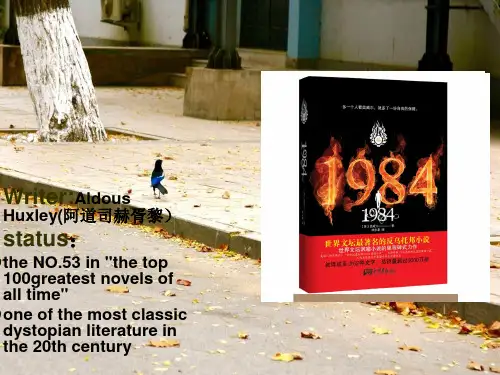
• Aldous Huxley(阿道 司赫胥黎) • time:1894—1963
1:About the writer
• He was a grandson of
the famous biologist Thomas Henry Huxley(1825-1895)
BRAVE NEW WORLD 2:What‘s the Dystopia • A:First,what is the Utopia?
Writer:Aldous status:
Huxley(阿道司赫胥黎)
① the NO.53 in "the top 100greatest novels of all time" ② one of the most classic dystopian literature in the 20th century
• B:cacotopia, kakotopia(坎坷邦)
BRAVE NEW WORLD ---------------------------------
Dystopia
• A dystopia is a community or society that is in some important way undesirable or frightening. It is literally translated as ―notgood place‖( an antonym of utopia. ) • Such societies appear in many artistic works, particularly in stories set in a future. Dystopias are often characterized by dehumanization, totalitarian governments, environmental disaster , or other characteristics associated with a cataclysmic decline in society. Dystopian societies appear in many sub-genres of fiction and are often used to draw attention to real-world issues regarding society, environment, politics, economics, religion, psychology, ethics, science, and or technology, which if unaddressed could potentially lead to such a dystopia-like condition.
《美丽新世界》读后感(通用27篇)

《美丽新世界》读后感(通用27篇)《美丽新世界》读后感篇1如果可以选择,你愿意在温柔乡里耽于安乐,还是于荆棘丛中觅得自由?一直以来,我未曾将这个命题纳入思考——直到我邂逅了阿道司·赫胥黎的《美丽新世界》。
这本书令我惊艳又心折,于掩卷后仍久难平息。
《美丽新世界》得名于莎翁的剧作《暴风雨》中的台词:“人类有多么美!啊!美丽的新世界,有这样的人在里头!”赫胥黎用这高妙的隐喻为整个“新世界”蒙上了一层晦涩的阴影,毕竟这句台词恰恰充满了讽刺意味——说出这句话的米兰达从小与世隔绝,于是才会在初探人世时便被它迷住,对等待着她的种种无常乱象一无所知。
我曾以为“安乐”是幸福的至佳量度,而《美丽新世界》则用堪称绝妙的构想颠覆了我的观念。
赫胥黎笔下的“新世界”如一座虚架在现实世界上空的怪诞浮岛:它物质丰富,科技发达,可身在其中的人却失去个人情感,没有思想自由。
人们沉溺在和乐的“温柔乡”里,既无反省之思,又无抗争之实。
这个世界看似荒谬之极,却恰令人毛骨悚然——反乌托邦大师的离奇幻境下,影射的是刻骨的真实。
再稳定的社会都有涌动的暗流,而连暗流都不存在的社会,只能是混沌的死水,是病态的麻木。
而“美丽”的新世界中,比“死水”更可怕的是被精心设置的“温柔乡”。
“新世界”里,基因设计为每一个人塑造了人生轨道,药物麻醉则令他们不偏不倚地将这冰冷路途走到尽头。
这个世界里,没有爱情与亲情,婚姻成了匪夷所思的笑谈,生育被唾弃为最污秽可耻之事。
人们用合成药物满足各种身心需求,在肤浅庸俗的娱乐活动中令自己获得快感。
因为“愚钝”与“不反抗”是写在人民的基因里,于是每个人都达到了字面意义的“安居乐业”。
阶级矛盾不复存在,人民沉浸在愉快的蒙昧中,勤勤恳恳地侍奉上层,全心全意地化作社会的“齿轮”。
文中的主人公约翰是个“新世界”的闯入者。
作为一个从小意外流落到印第安部落的胎生子,约翰注定是个不为世俗所容的“野蛮人”。
他对新世界感到厌恶与恐慌,曾不顾一切地试图击碎它,却在“文明”的铜墙铁壁前败下阵来。
赫胥黎《美丽新世界》的写作背景是什么介绍

赫胥黎《美丽新世界》的写作背景是什么介绍(最新版)编制人:__________________审核人:__________________审批人:__________________编制单位:__________________编制时间:____年____月____日序言下载提示:该文档是本店铺精心编制而成的,希望大家下载后,能够帮助大家解决实际问题。
文档下载后可定制修改,请根据实际需要进行调整和使用,谢谢!并且,本店铺为大家提供各种类型的经典范文,如诗歌散文、原文赏析、读书笔记、经典名著、古典文学、网络文学、经典语录、童话故事、心得体会、其他范文等等,想了解不同范文格式和写法,敬请关注!Download tips: This document is carefully compiled by this editor.I hope that after you download it, it can help you solve practical problems. The document can be customized and modified after downloading, please adjust and use it according to actual needs, thank you!In addition, this shop provides you with various types of classic sample essays, such as poetry and prose, original text appreciation, reading notes, classic works, classical literature, online literature, classic quotations, fairy tales, experience, other sample essays, etc. if you want to know the difference Please pay attention to the format and writing of the sample essay!赫胥黎《美丽新世界》的写作背景是什么介绍【导语】:美丽新世界是赫胥黎创作的反乌托邦的小说。
被解构的幸福——赫胥黎《美丽新世界》的社会启示
人公 约翰 , 最初来 到 这个世 界 时把它 看作 是 “ 美 丽 新世 界 ” , 对 其 崇 敬 无 比。可 是 , 经 历 并 洞 察 了新
世界 的方 方 面面后 , 约翰 剩下 的感 觉 只有恐 怖 , 甚
至难 以活 下去 , 唯有 一死 了之 。那 么 , 这 个 我们 人
于现 状 , 没 有 任 何 非 分 之 想 。人 们 无 须 担 心 孕 育
会, 到西方世界所憧憬的“ 乌托邦” , 都体现了人们
对 幸福 生活 和理 想世界 的美好 念 想 。 中央 电视 台 曾经推 出了特别 调查 节 目“ 幸 福是 什 么 ” , 来 自不
同行 业 不 同年 龄 的几千 名 被采 访者 面对着 的是 同
福 的 日子 … …这 里 被 当地居 民称 为 “ 文 明社 会 ”, 被 主人公 约翰崇 敬 的称 为“ 美 丽新世 界 ” 。这个 世 界 的社 会箴 言是 “ 共有、 统一、 安定” , 这里 是 人 类
个 问题 : “ 你幸 福吗 ? ” 一时间 , “ 幸福” 这 个 大 家
熟 悉 的词汇 成 为 媒 体 的 热 门词 汇 , 也 引 发 了 中 国 人 对 幸 福 的 深 入 思 考 。 什 么 是 幸 福 ?我 们 幸 福
无 论是 在古 代 、 近代 还 是现 代 , 无论 是在 东方 还是西方 , 人们对幸福 的追求从未停 止过片刻。 幸福 , 是 人们 一 直 迷 恋 的话 题 , 可 以说 , 追求 幸福 让众 生 殊途 同归 。从古 代 中 国所 追 寻的 “ 大 同” 社
鲜 。 因为 发达 的 医疗 技 术 , 人 们 会 保 持 着 健 康 和 青春 的体 魄 , 直 到 六 十 岁 愉 快 地 接 受 安 乐 死 。人 们不 会厌 倦 工作 繁琐 : 因为从 小接 受 的洗 脑教 育 , 人人 都欣 然接 受分 配 给 自己的工作 , 安分守己, 安
读《美丽新世界》——浅谈乌托邦与反乌托邦
读《美丽新世界》——浅谈乌托邦与反乌托邦赫胥黎的《美丽新世界》,作为与乔治·奥威尔的《1984》、扎米亚金的《我们》齐名的“反乌托邦三部曲”之一,享有相当高的世界声誉。
虽然就连高中英语课文中都对其有过介绍,但它却是我在这三部书中最晚读到的一本。
比起《1984》曾在我个人的思想历程里扮演过极其重要的启蒙角色(当然,相信有无数青年都会有类似的感受),《美丽新世界》则让我多看到了另一些可能。
它描述的乌托邦场景,较之另外两本会少一些极权色彩,但却更加具有现实意义,某种程度上说也更加值得警醒。
*三种乌托邦的比较尼尔·波兹曼在其名作《娱乐至死》中,一开始就提到赫胥黎的《美丽新世界》,并认为世界最终没有发展成乔治·奥威尔的预想,却越来越向赫胥黎所描绘的方向发展。
《娱乐至死》的核心观点是“我们终将毁于我们热爱的东西”,这里的矛头明确指向电视、电视节目等娱乐性设施。
波兹曼认为一切公共话语日渐以娱乐的方式出现,政治、新闻、教育等多个方面成为了娱乐的附庸,人们的思考能力受制于此,最终娱乐至死。
《美丽新世界》中描绘的社会与其确有共通之处。
《美丽新世界》(Brave New World)得名于莎士比亚的《暴风雨》,牛津词典的解释是“本欲改善人们的生活,实则带来预料不到的问题”。
这个新世界是一个设定好的机械化的盛世,尊奉汽车大王福特为救世主。
科技与政策管理极度发达。
精子卵子在试管中调制好,胎儿在孵化器中长大。
人类虽被分为五个等级,但却从小就以“睡梦教育”的形式被灌输了幸福的概念,而热爱自己的使命。
他们被设计得厌恶书籍、厌恶艺术、厌恶独处,性滥交、消费主义和享乐主义横行。
即使出现最糟的情况,也还有索麻这一“完美的药物”使人们获得快感。
可以说,“幸福”在这美丽新世界中似乎唾手可得。
诚然,幸福是人类始终追寻的一大终极目标,然而我们看到,这样一种“被幸福”却不等于、甚至往往是有悖于我们真正的幸福概念的,就如同波兹曼描绘的“被娱乐”一样。
《美丽新世界》主要情节
《美丽新世界》主要情节在奥尔德斯·赫胥黎的科幻小说《美丽新世界》中,描述了一个由科技与意识控制统治的未来社会。
故事发生在遥远的2540年,这个世界已经完全由高度工业化的国家统治,人类的生育方式、思维方式以及道德观念等方面都发生了极大的扭曲和变异。
本文将对《美丽新世界》的主要情节进行叙述。
第一章:遥远的未来在《美丽新世界》的开篇,读者被带入到了遥远的未来。
赫胥黎通过描写伦敦中央孵化中心的场景,展示了一个完全工业化、强调等级制度的社会。
在这个世界中,人们通过体外受精和胚胎培育技术来生育后代,所有的人都被分为不同的等级,从Alpha 到Epsilon等不同社会地位的等级。
第二章:稳定剂和麻痹剂在这个近乎完美的社会中,一切都被科技和药物控制。
稳定剂和麻痹剂是人们日常生活中不可或缺的一部分。
稳定剂用于维持人们满足的状态,保持他们的情绪稳定和幸福感。
而麻痹剂则用于消除任何痛苦和矛盾,使人们不再思考和质疑。
第三章:中心人物伯纳德故事的主要角色之一是伯纳德·马克思。
伯纳德是一个身体略小、个性内向的Alpha等级,与其他人不同,伯纳德对这个世界的不公和无趣感到不满。
他偏好孤独,并与集体感和消费主义的社会格格不入。
然而,他又与一位女子莉莉与亲近,并存有复杂的情感。
第四章:莉莉与约翰莉莉也是一个特殊的女性,她在社交方面非常受欢迎,但她与伯纳德的不同之处在于她并没有对这个社会产生怀疑之情。
莉莉带伯纳德参观了一个野蛮人社区,并在那里遇见了一个异类——约翰。
约翰是一个胚胎在野蛮人社区出生的男孩,他在这个社会中长大,对这个全新的世界产生了深深的困惑和憧憬。
第五章:约翰的挣扎随着约翰的成长,他对于这个与伦敦社会完全不同的野蛮人社区展开了深入了解。
他沉浸于诗歌和文学中,迷恋着一个他称为“伊甸园”的理想世界。
然而,当他回到伦敦时,他意识到自己的理想与这个社会格格不入,并因此陷入了沉思和痛苦之中。
第六章:社会崩溃与结局约翰的异端行为引起了伦敦社会的关注和困扰。
BRAVENEWWORLD内容简介(AldousHuxley)
BRAVE NEW WORLD 美丽新世界Aldous HuxleyPlot Overview 情节一览The novel opens in the Central London Hatching and Conditioning Centre, where the Director of the Hatchery and one of his assistants, Henry Foster, are giving a tour to a group of boys. The boys learn about the Bokanovsky and Podsnap Processes that allow the Hatchery to produce thousands of nearly identical human embryos. During the gestation period the embryos travel in bottles along a conveyor belt through a factorylike building, and are conditioned to belong to one of five castes: Alpha, Beta, Gamma, Delta, or Epsilon. The Alpha embryos are destined to become the leaders and thinkers of the World State. Each of the succeeding castes is conditioned to be slightly less physically and intellectually impressive. The Epsilons, stunted and stupefied by oxygen deprivation and chemical treatments, are destined to perform menial labor. Lenina Crowne, an employee at the factory, describes to the boys how she vaccinates embryos destined for tropical climates.The Director then leads the boys to the Nursery, where they observe a group of Delta infants being reprogrammed to dislike books and flowers. The Director explains that this conditioning helps to make Deltas docile and eager consumers. He then tells the b oys about the “hypnopaedic” (sleep-teaching) methods used to teach children the morals of the World State. In a room where older children are napping, a whispering voice is heard repeating a lesson in “Elementary Class Consciousness.”Outside, the Director shows the boys hundreds of naked children engaged in sexual play and games like “Centrifugal Bumble-puppy.” Mustapha Mond, one of the ten World Controllers, introduces himself to the boys and begins to explain the history of the World State, focusing on the State’s successful efforts to remove strong emotions, desires, and human relationships from society. Meanwhile, inside the Hatchery, Lenina chats in the bathroom with Fanny Crowne about her relationship with Henry Foster. Fanny chides Lenina for going out with Henry almost exclusively for four months, and Lenina admits she is attracted to the strange, somewhat funny-looking Bernard Marx. In another part of the Hatchery, Bernard is enraged when he overhears a conversation between Henry and the Assistant Predestinator about “having” Lenina.After work, Lenina tells Bernard that she would be happy to accompany himon the trip to the Savage Reservation in New Mexico to which he had invited her. Bernard, overjoyed but embarrassed, flies a helicopter to meet a friend of his, Helmholtz Watson. He and Helmholtz discuss their dissatisfaction with the World State. Bernard is primarily disgruntled because he is too small and weak for his caste; Helmholtz is unhappy because he is too intelligent for his job writing hypnopaedic phrases. In the next few days, Bernard asks his superior, the Director, for permission to visit the Reservation. The Director launches into a story about a visit to the Reservation he had made with a woman twenty years earlier. During a storm, he tells Bernard, the woman was lost and never recovered. Finally, he gives Bernard the permit, and Bernard and Lenina depart for the Reservation, where they get another permit from the Warden. Before heading into the Reservation, Bernard calls Helmholtz a nd learns that the Director has grown weary of what he sees as Bernard’s difficult and unsocial behavior and is planning to exile Bernard to Iceland when he returns. Bernard is angry and distraught, but decides to head into the Reservation anyway.On the Reservation, Lenina and Bernard are shocked to see its aged and ill residents; no one in the World State has visible signs of aging. They witness a religious ritual in which a young man is whipped, and find it abhorrent. After the ritual they meet John, a fair-skinned young man who is isolated from the rest of the village. John tells Bernard about his childhood as the son of a woman named Linda who was rescued by the villagers some twenty years ago. Bernard realizes that Linda is almost certainly the woman mentioned by the Director. Talking to John, he learns that Linda was ostracized because of her willingness to sleep with all the men in the village, and that as a result John was raised in isolation from the rest of the village. John explains that he learned to read using a book called The Chemical and Bacteriological Conditioning of the Embryo and The Complete Works of Shakespeare, the latter given to Linda by one of her lovers, Popé. John tells Bernard that he is eager to see the “Other Place”—the “brave new world” that his mother has told him so much about. Bernard invites him to return to the World State with him. John agrees but insists that Linda be allowed to come as well.While Lenina, disgusted with the Reservation, takes enough soma to knock her out for eighteen hours, Bernard flies to Santa Fe where he calls Mustapha Mond and receives permission to bring John and Linda back to the World State. Meanwhile, John breaks into the house where Lenina is lying intoxicated and unconscious, and barely suppresses his desire to touch her. Bernard, Lenina, John, and Linda fly to the World State, where the Director is waiting to exile Bernard in front of his Alpha coworkers. But Bernard turns the tables by introducing John and Linda. The shame of being a “father”—the very word makes the onlookers laugh nervously—causes the Director to resign, leaving Bernard free to remain in London.John becomes a hit with London society because of his strange life led on the Reservation. But while touring the factories and schools of the World State, John becomes increasingly disturbed by the society that he sees. His sexual attraction to Lenina remains, but he desires more than simple lust, and he finds himself terribly confused. In the process, he also confuses Lenina, who wonders why John does not wish to have sex with her. As the discoverer and guardian of the “Savage,” Bernard also becomes popular. He quickly takes advantage of his new status, sleeping with many women and hosting dinner parties with important guests, most of whom dislike Bernard but are willing to placate him if it means they get to meet John. One night John refuses to meet the guests, including the Arch-Community Songster, and Bernard’s social standing plummets.After Bernard introduces them, John and Helmholtz quickly take to each other. John reads Helmholtz parts of Romeo and Juliet, but Helmholtz cannot keep himself from laughing at a serious passage about love, marriage, and parents—ideas that are ridiculous, almost scatological in World State culture. Fueled by his strange behavior, Lenina becomes obsessed with John, refusing Henry’s invitation to see a feely. She takes soma and visits John at Bernard’s apartment, where she hopes to seduce him. But John responds to her advances with curses, blows, and lines from Shakespeare. She retreats to the bathroom while he fields a phone call in which he learns that Linda, who has been on permanent soma-holiday since her return, is about to die. At the Hospital for the Dying he watches her die while a group of lower-caste boys receiving their “death conditioning” wonder why she is so unattractive. The boys are simply curious, but John becomes enraged. After Linda dies, John meets a group of Delta clones who are receiving their soma ration. He tries to convince them to revolt, throwing the soma out the window, and a riot results. Bernard and Helmholtz, hearing of the riot, rush to the scene and come to John’s aid. After the riot is calmed by police with soma vapor, John, Helmholtz, and Bernard are arrested and brought to the office of Mustapha Mond.John and Mond debate the value of the World State’s policies, John arguing that they dehumanize the residents of the World State and Mond arguing that stability and happiness are more important than humanity. Mond explains that social stability has required the sacrifice of art, science, and religion. John protests that, without these things, human life is not worth living. Bernard reacts wildly when Mond says that he and Helmholtz will be exiled to distant islands, and he is carried from the room. Helmholtz accepts the exile readily, thinking it will give him a chance to write, and soon follows Bernard out of theroom. John and Mond continue their conversation. They discuss religion and the use of soma to control negative emotions and social harmony.John bids Helmholtz and Bernard good-bye. Refused the option of following them to the islands by Mond, he retreats to a lighthouse in the countryside where he gardens and attempts to purify himself by self-flagellation. Curious World State citizens soon catch him in the act, and reporters descend on the lighthouse to film news reports and a feely. After the feely, hordes of people descend on the lighthouse and demand that John whip himself. Lenina comes and approaches John with her arms open. John reacts by brandishing his whip and screaming “Kill it! Kill it!” The intensity of the scene causes an orgy in which John takes part. The next morning he wakes up and, overcome with anger and sadness at his submission to World State society, hangs himself. Context 背景Aldous Huxley was born in Surrey, England, on July 26, 1894, to an illustrious family deeply rooted in England’s literary and scientific tradition. Huxley’s father, Leonard Huxley, was the son of Thomas Henry Huxley, a well-known biologist who gained t he nickname “Darwin’s bulldog” for championing Charles Darwin’s evolutionary ideas. His mother, Julia Arnold, was related to the important nineteenth-century poet and essayist Matthew Arnold.Raised in this family of scientists, writers, and teachers (his father was a writer and teacher, and his mother a schoolmistress), Huxley received an excellent education, first at home, then at Eton, providing him with access to numerous fields of knowledge. Huxley was an avid student, and during his lifetime he was renowned as a generalist, an intellectual who had mastered the use of the English language but was also informed about cutting-edge developments in science and other fields. Although much of his scientific understanding was superficial—he was easily convinced of findings that remained somewhat on the fringe of mainstream science—his education at the intersection of science and literature allowed him to integrate current scientific findings into his novels and essays in a way that few other writers of his time were able to do. Aside from his education, another major influence on Huxley’s life and writing was an eye disease contracted in his teenage years that left him almost blind. As a teenager Huxley had dreamed about becoming a doctor, but the degeneration of his eyesight prevented him from pursuing his chosen career. It also severely restricted the activities he could pursue. Because of his near blindness, he depended heavily on his first wife, Maria, to take care of him. Blindness and vision are motifs that permeate much of Huxley’s writing.After graduating from Oxford in 1916, Huxley began to make a name for himself writing satirical pieces about the British upper class. Though these writings were skillful and gained Huxley an audience and literary name, they were generally considered to offer little depth beyond their lightweight criticisms of social manners. Huxley continued to write prolifically, working as an essayist and journalist, and publishing four volumes of poetry before beginning to work on novels. Without giving up his other writing, beginning in 1921, Huxley produced a series of novels at an astonishing rate: Crome Yellow was published in 1921, followed by Antic Hay in 1923, Those Barren Leaves in 1925, and Point Counter Point in 1928. During these years, Huxley left his early satires behind and became more interested in writing about subjects with deeper philosophical and ethical significance. Much of his work deals with the conflict between the interests of the individual and society, often focusing on the problem of self-realization within the context of social responsibility. These themes reached their zenith in Huxley’s Brave New World, published in 1932. His most enduring work imagined a fictional future in which free will and individuality have been sacrificed in deference to complete social stability.Brave New World marked a step in a new direction for Huxley, combining his skill for satire with his fascination with science to create a dystopian (anti-utopian) world in which a totalitarian government controlled society by the use of science and technology. Through its exploration of the pitfalls of linking science, technology, and politics, and its argument that such a link will likely reduce human individuality, Brave New World deals with similar themes as George Orwell’s famous novel 1984. Orwell wrote his novel in 1949, after the dangers of totalitarian governments had been played out to tragic effect in World War II, and during the great struggle of the Cold War and the arms race which so powerfully underlined the role of technology in the modern world. Huxley anticipated all of these developments. Hitler came to power in Germany a year after the publication of Brave New World. World War II broke out six years after. The atomic bomb was dropped thirteen years after its publication, initiating the Cold War and what President Eisenhower referred to as a frightening buildup of the “military-industrial complex.” Huxley’s novel seems, in many ways, to prophesize the major themes and struggles that dominated life and debate in the second half of the twentieth century, and continue to dominate it in the twenty-first.After publishing Brave New World, Huxley continued to live in England, making frequent journeys to Italy. In 1937 Huxley moved to California. An ardent pacifist, he had become alarmed at the growing military buildup in Europe, and determined to remove himself from the possibility of war. Already famous as a writer of novels and essays, he tried to make a living as ascreenwriter. He had little success. Huxley never seemed to grasp the requirements of the form, and his erudite literary style did not translate well to the screen.In the late forties, Huxley started to experiment with hallucinogenic drugs such as LSD and mescaline. He also maintained an interest in occult phenomena, such as hypnotism, séances, and other activities occupying the border between science and mysticism. Huxley’s experiments with drugs led him to write several books that had profound influences on the sixties counterculture. The book he wrote about his experiences with mescaline, The Doors of Perception, influenced a young man named Jim Morrison and his friends, and they named the band they formed The Doors. (The phrase, “the doors of perception” comes from a William Blake poem called The Marriage of Heaven and Hell.) In his last major work, Island, published in 1962, Huxley describes a doomed utopia called Pala that serves as a contrast to his earlier vision of dystopia. A central aspect of Pala’s ideal culture is the use of a hallucinogenic drug called “moksha,” which provides an interesting context in which to view soma, the drug in Brave New World that serves as one tool of the totalitarian state. Huxley died on November 22, 1963, in Los Angeles. Utopias and DystopiasBrave New World belongs to the genre of utopian literature. A utopia is an imaginary society organized to create ideal conditions for human beings, eliminating hatred, pain, neglect, and all of the other evils of the world.The word ut opia comes from Sir Thomas More’s novel Utopia (1516), and it is derived from Greek roots that could be translated to mean either “good place” or “no place.” Books that include descriptions of utopian societies were written long before More’s novel, however. Plato’s Republic is a prime example. Sometimes the societies described are meant to represent the perfect society, but sometimes utopias are created to satirize existing societies, or simply to speculate about what life might be like under different conditions. In the 1920s, just before Brave New World was written, a number of bitterly satirical novels were written to describe the horrors of a planned or totalitarian society. The societies they describe are called dystopias, places where things are badly awry. Either term, utopia or dystopia, could correctly be used to describe Brave New World.。