
2017下半年教师资格证考试《英语学科知识与教学能力》(高级中学)真题及答案
2017年下半年中小学教师资格考试英语学科知识与教学能力试题(高级中学)注意事项:1.考试时间120分钟,满分150分。
2.请按规定在答题卡上填涂、作答。
在试卷上作答无效,不予评分。
一、单项选择题(本大题共30小题,每小题2分,共60分)在每小题列出的四个备选项中选择一个最佳答案,请用2B铅笔把答题卡上对应题目的答案字母按要求涂黑。
错选、多选或未选均无分。
1.The sound of“th”in“thin”is ______.A. voiceless, dental, and fricativeB. voiced, dental and fricativeC. voiceless, dental, and affricativeD. voiced, dental, and affricative2. Of all the following pairs of words,______ is a minimal pair.A. boot and boughtB. deep and dogC. either and neitherD. ghost and best3. ______ can fly very high in ______ sky.A. The birds…theB. The birds…/C. Birds…theD. Birds…/4. In my opinion she is kind and polite, so I put her rudeness today down as ______.A. ordinaryB. untimelyC. progressiveD. accidental5. With spring approaching, the pink of the apple-blossom is beginning to ______.A. showB. growC. riseD. ascend6. Mr. Woods, I am here just in case anything out of the ordinary ______.A happensB happenC would happenD. will happen7. I look back on this pleasant holiday in Beijing with ______ pleasure.A. anything butB. all butC. everything butD. nothing but8. Tom, take this baggage and put it ______ you can find enough space.A. whichB. in whichC. whereverD. whereas9. What is the main rhetoric device used in“T he Pentagon was divided on the air strike.”?A. Synecdoche.B. Metonymy.C. Metaphor.D. Oxymoron.10. Which inference in the brackets of the following sentences is a presupposition?A. Ede caught a trout. (Ede caught a fish.)B. Don’t sit on Carol's bed. (Carol has a bed.)C. This blimp is over the house. (The house is under the blimp.)D. Coffee would keep me awake all night. (I don't want coffee.)11. Which of the following instructions is helpful in developing students, ability to make inferences?A. Listen to a story and write a summary.B. Listen to a story and work out the writer's intention.C. Listen to the story of a boy and then draw a picture of him.D. Listen to a story and note down the specific date of an event.12. The most suitable question type to check students comprehension and develop their critical thinking is ______.A. rhetorical questionsB. referential questionsC. close questionsD. display questions13. Diagnostic test is often used for the purpose of ______.A. finding out what students know and don’t knowB. measuring students' general language proficiencyC. knowing whether students have the right language aptitudeD. checking whether students have achieved the teaching objectives14. Which of the following activities is often used to develop students' speaking accuracy?A. Identifying and correcting oral mistakes.B. Acting out the dialogue in the text.C. Having discussions in groups.D. Describing people in pair.15. If a teacher asks students to make their own learning plan, he/she is trying to devel op their ______.A. cognitive strategyB. affective strategyC. communicative strategyD. metacognitive strategy16. When a teacher tells the students that the word“dog” may imply“loyalty”, he/she is teaching the ______ of the word.A. denotative meaningB. collocative meaningC. conceptual meaningD. connotative meaning17. Which of the following is the last step in the process of writing essays?A. Editing the writings.B. Writing topic sentences for paragraphs.C. Gathering information and ideas relevant to the topic.D. Organizing the information and ideas into a logical sequence.18. The main purpose of asking questions about the topic before listening is to ______.A. meet students' expectationB. increase students' confidenceC. activate students' schemataD. provide feedback on tasks19. If a teacher asks students to fill in the blanks in a passage with“that”,“which”or“whom”,he/she is least likely focusing on grammar at ______.A. lexical levelB. syntactic levelC. discourse levelD. morphological level20. If a teacher asks students to talk about their hobbies in groups, he/she is trying to encourage ______.A. peer correctionB. peer feedbackC. peer interactionD. peer assessment请阅读Passage1,完成第21~25小题。
Passage1With her magical first novel, Garcia joins a growing chorus of talented Latino writers whose voices are suddenly reaching a far wider, more diverse audience. Unlike Latin American writers such as Colombia's Gabriel Garcia Marquee of Peru's Mario V argas Llosa -whose translated works became popular here in the1970s-these authors are writing in English and drawing their themes from two cultures.Their stories,from“Dreaming in Cuban”to Julia Alvarez’s“How the Garcia Girls Lost Their Accent”and Victor Villasenor's “Rain of Gold”,offer insight into the mixture of economic opportunity and discrimination that Latinos encounter in the United States.“Garcia Girls”for example, is the story of four sisters weathering their transition from wealthy. Dominicans to ragtag immigrants, “We didn't feel we had the beat the United States had to offer,”one of the girls says, “We had only second-hand stuff, rental houses in one redneck Catholic neighborhood after another, clothes at Round Robin, a black and white TV afflicted with wavy lines. ”Alvarez,a Middlebury College professor who emigrated from Santo Domingo when she was10,says being an immigrant has given her a special vantage point: “We travel on that border between two worlds and we can see both points of view.”With few exceptions, such as Chicago writer Rudolfo Anaya, many Hispanic-Americans have been writing in virtual obscurity for years, nurtured only by small presses like Houston's Arte Publico or the Bilingual Press in Tempe,Ariz. Only with the recent success of Sandra Cisneros's“Woman Hollering Creek”and Oscar Hijuelos's prize-winning novel, “The Mambo Kings Play Songs of Love, ”have mainstream publishers begun opening door to other Latinos. Julie Grau, Cisneros's editor at Turtle Bay, says, Editors may now be looking more carefully at a book that before they would have deemed too exotic for the general readership.”But if Villasenor's experience is any indication, some editors are still wary.In1989, Putnam gave Villasenor a $75,000advance for the hardcover rights to“Rain of Gold,”the compelling saga of his family's migration from Mexico to California. But the editors, says Villasenor, wanted major changes: “They were going to destroy the book. it's nonfiction;they wanted to publish it as a novel. And they wanted to change the title to ‘Rio Grande,’which sounded like some old John Wayne movie. ”After a year of strained relations, he mortgaged his house, borrowed his mother's life savings and boughtback the rights to the book that had taken10years to write.In frustration, Villasenor turned to Arte Publico. In the eight months since its release, “Rain of Gold”has done extremely well, considering its limited distribution; 20.000 copies have been sold. “If we were a mainstream publisher,this book would have been on The New York Times best-seller list for weeks,”says Arte Pulico's Nicolas Kanelos. The author may still have a shot: he has sold the paperback rights to Dell. And he was just named a keynote speaker(with Molly Ivins and Norman Schwarzkopf) for the American Booksellers Association convention in May. Long before they gained this sort of attention, however, Villasenor, Cisneros and other Latino writers were quiet building devoted followings. Crossing the country, they read in local bookstores, libraries and schools. Their stories, they found, appeal not only to Latinos-who identify with them, but to a surprising number of Anglos, who find in them a refreshingly different perspective on American life. Still, there are unusual pressures on these writers. Cisneros vividly recalls the angst she went through in writing the final short stories for“Woman Hollering”:“I was traumatized that it was going to be one of the first Chicano books‘out there.’ I felt I had this responsibility to my community to represent us in all our diversity. ”21. Which of the following is true of Garcia as a Latino writer according to the passage?A. She offered insight into the confrontations between two cultures.B. She emigrated from Santo Domingo when she was10years old.C. She became popular for her translated works in America in the1970s.D. She described her transition from wealthy Dominicans to ragtag immigrants.22. What advantage do the new generation Latino writers have over Latin American writers according to the passage?A. The former are able to write in two different languages.B. The former can translate their works into different languages.C. The former are able to express ideas from a bi-cultural perspective.D. The former can travel freely across the border between two countries.23. Which of the following is true of the Latino writers according to Paragraph2?A. Their works are full of obscurities.B. None of their works won an overnight success.C. Most of them remained unknown to the public for years.D. They have great difficulty getting their work published.24. What can be drawn from Villasenor's experience?A. Some editors of mainstream publishers are critical.B. Many Latino writers were mostly favored by small presses.C. “Rain of Gold ”was going to be one of the first Chicano books.D. “R ain of Gold”was intended to be published as a novel by the author.25. What did the new generation Latino writers do to get their works known to the public?A. They avoided writing those too exotic for readers.B. They revised their works as required by press.C. They translated their works into English.D. They read their books in public places.请阅读Passage2,完成第26~30小题。
2017年下半年中小学教师资格考试英语学科知识与教学能力试题及答案解析(初级中学)
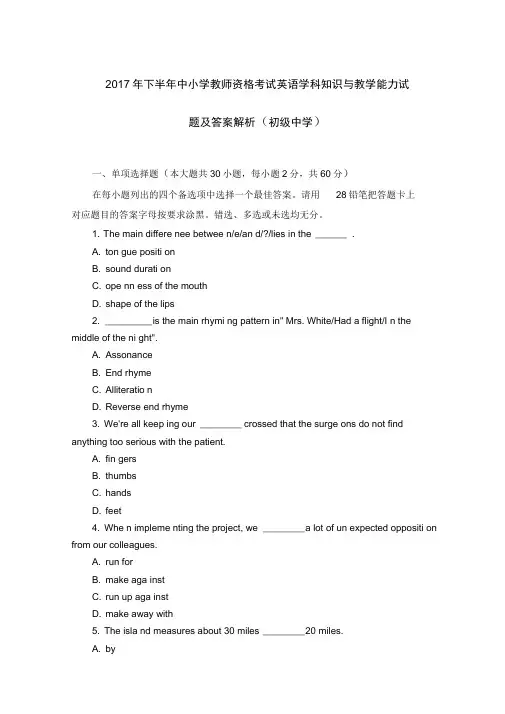
2017年下半年中小学教师资格考试英语学科知识与教学能力试题及答案解析(初级中学)一、单项选择题(本大题共30小题,每小题2分,共60分)在每小题列出的四个备选项中选择一个最佳答案。
请用28铅笔把答题卡上对应题目的答案字母按要求涂黑。
错选、多选或未选均无分。
1. The main differe nee betwee n/e/an d/?/lies in the ______ .A. ton gue positi onB. sound durati onC. ope nn ess of the mouthD. shape of the lips2. _________ i s the main rhymi ng pattern in" Mrs. White/Had a flight/I n the middle of the ni ght".A. AssonanceB. End rhymeC. Alliteratio nD. Reverse end rhyme3. We're all keep ing our ________ crossed that the surge ons do not find anything too serious with the patient.A. fin gersB. thumbsC. handsD. feet4. Whe n impleme nting the project, we ________ a lot of un expected oppositi on from our colleagues.A. run forB. make aga instC. run up aga instD. make away with5. The isla nd measures about 30 miles ________ 20 miles.A. byB. withC. toD. upon6. --Will John come to the party?--No, he won't come and _________ .A. Antony n either won' tB. won' t Antony n eitherC. either will An to nyD. n either will Antony7. Garbo plays the role of the queen, _______ in the love she has found withAn to nio.A. rejoicedB. rejoici ngC. being rejoicedD. to rejoice8. ________ m i nisters decide to in stigate an inquiry, we welcome it.A. Should ... wouldB. Suppose ... couldC. If... wouldD. Would ... will9. What is miss ing at the discourse level betwee n the two sen ten ces "Carol loves tomatoes. She was born in Africa."?A. Refere nee.B. Cohesi on.C. Cohere nee.D. Substituti on.10. The synonyms "charge" and "accuse" mai nly differ in _______ .A. emotio nB. dialectC. formalityD. collocati on11. Which of the following instructions is helpful in developing students' ability to make inferen ces?A. Liste n to a story and write a summary.B. Liste n to a story and work out the writer' s in ten tio n.C. Liste n to the story of a boy and the n draw a picture of him.D. Liste n to a story and note dow n the specific date of an eve nt.12. The most suitable questi on type to check stude nts' comprehe nsion and develop their critical thi nking is ________ .A. rhetorical questio nsB. refere ntial questio nsC. close questi onsD. display questio ns13. Diag no stic test is ofte n used for the purpose ofA. finding out what stude nts know and don' t knowB. measuri ng stude nts' gen eral la nguage proficie ncyC. knowing whether stude nts have the right Ian guage aptitudeD. check ing whether stude nts have achieved the teach ing objectives14. Which of the following activities is often used to develop students' speaking accuracy?A. Ide ntify ing and correct ing oral mistakes.B. Act ing out the dialogue in the text.C. Having discussi ons in groups.D. Describ ing people in pair.15. If a teacher asks students to make their own leanning plan, he/she is trying to develop their ________ .A. cog nitive strategyB. affective strategyC. com muni cative strategyD. metacog nitive strategy16. When a teacher tells students that the word "dog" may imply "loyalty", he/she is teach ing the ________ o f the word.A. deno tative meaningB. cono cative meaningC. con ceptual meaningD. conno tative meaning17. Which of the following is the last step in the process of writing essays?A. Edit ing the writ in gs.B. Writ ing topic senten ces for paragraphs.C. Gatheri ng in formatio n and ideas releva nt to the topic.D. Orga nizing the in formati on and ideas into a logical seque nee.18. The main purpose of ask ing questi ons about the topic before liste ning is toA. meet stude nts' expectati onB. i ncrease stude nts' con fide neeC. activate stude nts' schemataD. provide feedback on tasks19. Ifa teacher asks stude nts to fill in the bla nks in a passage with "that", "which" or "whom",he/she is least likely focus ing on grammar at _______ .A. lexical levelB. syn tactic levelC. discourse levelD. morphological level20. If a teacher asks stude nts to talk about their hobbies in groups, he/she is trying to encourage _______ .A. peer correct ionB. peer feedbackC. peer in teract ionD. peer assessme nt请阅读Passage,完成第21-25小题。
2017下半年教师资格证高中英语面试真题
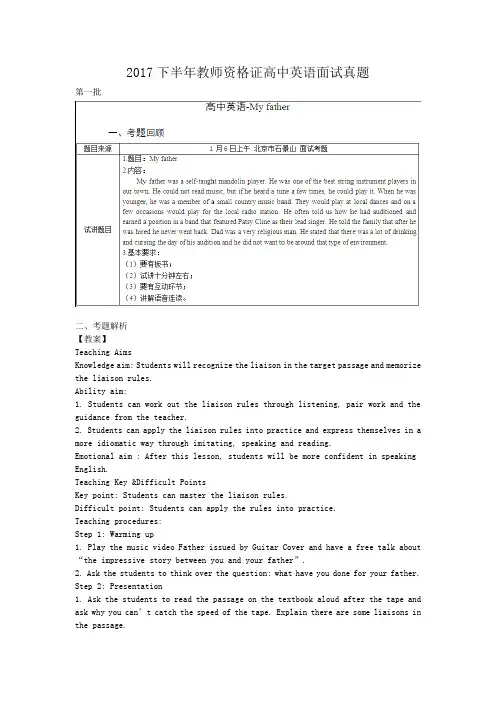
2017下半年教师资格证高中英语面试真题第一批二、考题解析【教案】Teaching AimsKnowledge aim: Students will recognize the liaison in the target passage and memorize the liaison rules.Ability aim:1. Students can work out the liaison rules through listening, pair work and the guidance from the teacher.2. Students can apply the liaison rules into practice and express themselves in a more idiomatic way through imitating, speaking and reading.Emotional aim : After this lesson, students will be more confident in speaking English.Teaching Key &Difficult PointsKey point: Students can master the liaison rules.Difficult point: Students can apply the rules into practice.Teaching procedures:Step 1: Warming up1. Play the music video Father issued by Guitar Cover and have a free talk about “the impressive story between you and your father”.2. Ask the students to think over the question: what have you done for your father. Step 2: Presentation1. Ask the students to read the passage on the textbook aloud after the tape and ask why you can’t catch the speed of the tape. Explain there are some liaisons in the passage.2. Ask students to circle all of the liaison in the target material through listening to the tape.3. Ask students to work in pairs to find out the rules of liaison by classifying whether a word is ended with a consonant and the following word is initiated witha vowel.4. Lead the students to read the liaison after the teacher and tell students liaison happens when a word is ended with a consonant and the following word is initiated with a vowel.Step 3: PracticeAsk the whole class to read after the tape several times and try to imitate, then some students will be invited to have a competition to read the passage to the class, and others justify who reads faster.Step 4: Production1.Present them another piece of passage and ask them to work in pairs to underline the liaison inside and try to read it fluently. Afterwards, the standard edition will be presented.2.Funny dubbing: a part of the movie Despicable Me is presented for students to imitate, practice and compete for the best voice actor.Step 5: Summary & Homework1. Ask students to summarize and memorize the liaison rules.2. After class, choose their favorite part from their favorite movie and do the voice acting job.IV Blackboard design二、考题解析【教案】Teaching aims:Knowledge aim: students will know more about British coffee culture.Ability aim: students can catch some detailed information about the passage. Emotional aim: students will appreciate different culture.Key and difficult point:Students will get the general idea of this passage.Students can express their ideas about the topic.Teaching procedure:Step 1: Warming-upGreet the students.Have a free talk with them and ask them if they drink coffee.Step 2: Pre-readingPlay them a short video to introduce British tea culture, and fill them in with the information that Britain has a long history for tea culture to give them some background information for the passage understanding.Step 3: While-reading1st reading: give them 2 minutes to read the passage quickly to get the general idea of this passage and invite some students to share their answers.2nd reading: leave the question to them--what is the stereotype and truth about British people? And give them 5 minutes to read the passage carefully to find the answers. After 5 minutes, invite some students to share their ideas. And then divide them into groups of 4 to find the evidence from the text to support their ideas. Step4: Post-readingActivity 1: invite two students to retell the passage according the clues on the blackboard.Activity 2: divide them into groups of 3 to talk about China food culture.Step5: Summary and homeworkInvite a student to make a summary then leave them the homework-search online for the development of coffee culture in China.Blackboard design:二、考题解析【教案】Teaching aims:Knowledge aim: students will recognize the structure and grammar meaning of appositive clauses.Ability aim: students will be able to apply appositive clauses in their daily use. Emotional aim: students will cultivate the awareness of protecting the environment. Key and difficult point:Students will master the structure and grammar meaning of the appositive clause. Students can tell the difference between appositive clauses and attributive clauses. Teaching procedure:Step 1: Warming-upGreet the students.Have a short review about attributive clause from last class. Then ask students to compare the two sentences below and lead to the new lesson for the appositive clause. The news that my father told me yesterday made me cry.The news that my father won the game made me cry yesterday.Step 2: PresentationAsk students to read the above material first, then invite them to share their understanding about the two “that”clauses. Then try to find the structure with them together: the two that clauses(appositive clauses) here explain the noun “doubt” and show the meaning of it. Another example of this is that “The news that my father won the game made me cry yesterday.”Here, “that my father won the game” is actually the content of the news. The function of it is not to modify the noun but to show the content of it which is different from the attributive clause. Step 3: Practice1.Find the attributive clause in the material and rewrite it to an appositive clause: “ it is human activity that has caused this global warming ”---”it is human activity that we drive too many cars that has caused this global warming”2.List some sentences on the screen and ask students to tell which are attributive clauses and which are appositive clauses.Step4: ProductionDivide them in groups of 4 to have a discussion about what can we do to help the global warming and give them 5 minutes to discuss. Show them an example as:I hold the idea that promoting the public transportation system will encourage more people travel less by private cars.The news that the government is putting money on clean energy is also helpful. Step5: Summary and homeworkInvite a student to make a summary then leave them the homework-search online for 5 common nouns which often appear in the appositive clause.Blackboard design:二、考题解析【教案】Teaching aims:Knowledge aim: students will master the structure and grammar meaning of passive voice.Ability aim: students will be able to speak or write in passive voice. Emotional aim: students will understand the importance of teamwork..Key and difficult point:Students will master the structure and grammar meaning of passive voice. Students can apply the grammar in their daily speaking.Teaching procedure:Step 1: Warming-upGreet the students.Show them a sentence: Cambridge University Press published this book. And have a short review about the active voice.The active voice is the typical word order. We put the subject (the topic or the theme) first. The subject is the ‘doer’ or agent of the verb. And tell them that we can also rewrite this sentence into “This book was published by Cambridge University Press.” and lead to the new lesson.Step 2: Presentation1. Take the above sentence as an example, and analyze it with the students together:In the passive, the person or thing that the action was done to becomes the topic or theme. We can leave out the ‘doer’ or agent, or we can place the ‘doer’ in a prepositional phrase (by + ‘doer’).2. Show the sentence “It is reported that many a house is being built at present in the disaster area.” and ask them to talk about the two passive forms. And complete the table with them together.Step 3: PracticeThen show the sentence “It is reported that many a house is being built at present in the disaster area.” and ask them to add up the doers in this sentence.Step4: ProductionAsk them to work with their desk mates and to describe their daily activities with each other. And passive voices need to be applied. And after 5 minutes, invite some pairs to share their answers.Step5: Summary and homeworkInvite a student to make a summary then leave them the homework-come out or more examples of passive voice in different tenses.Blackboard design:第二批二、考题解析【教案】Teaching aims:Knowledge aim: By the end of the class, students will know some key words about environment protection, such as suffer form, reusable shopping bags, do harm to and so on. .Ability aim: Students’ writing ability of expressing their opinions can be improved by the end of the class.Emotional aim: Students will foster the awareness of .protecting environment. Key and difficult point:Students will improve their writing ability.Leading students to think about things beyond their real life.Teaching procedure:Step 1: Warming-upGreet the students.Watch a short video about pollution and share their opinions about this issue. Step 2: Pre-writing1.Tell students we would write an article and the topic is environment protection.2.Show students a passage and try to find out the bad effects of cigarette and plastic pollution.3.Run a brainstorming activity and have a discussion: ask students the question as follows:What should we do to prevent the environment protection?They can change their ideas with their partners. After the discussion, I would picksome students to report their topics at the front.Step 3: While-readingGive students some guides, such as: pay attention to the spelling, punctuation, sentence structure and tenses.10 minutes would be given to them to complete their articles individually.Step4: Post-writingPeer editing: Ask students to check and edit their partners’ article and give them some suggestions.Share and evaluation: Invite some students to share their articles at the front and I would give them some comments.Step5: Summary and homeworkInvite a student to make a summary then leave them the homework to make a poster to publicize our ideas.Blackboard design:第三批二、考题解析【教案】Teaching AimsKnowledge aim:1. Students can do the right email format.2. Students will know more about the history, customs of Mid-Autumn Festival. Ability aims:1. Students will be able to write emails to give information.2. Students will be able to introduce our traditional festival----Mid-Autumn Festival .Emotional aims:Students will feel proud of our traditional culture, and be willing to bring it to the world.Teaching Key &Difficult PointsTeaching Key Point:They can write an email with right format.Teaching Difficult Point:Students can introduce Mid-Autumn Festival with enough information to make it clear to people from foreign cultures .Teaching Methods:Task-based Teaching ApproachTeaching AidsPPT, picturesTeaching proceduresStep 1 Warming-up (3 minutes)Show them some pictures about Mid-Autumn Festival which are about different activities. And then ask them to have a discussion about these pictures and they can write down the key words, sentences and so on. After the discussion, invite some students to describe these pictures.For example, they may describe the first picture as “ They are having a big family reunion.”And the second picture, they might describe as “China started to celebrate the festival since Tang dynasty.” Give some necessary guidance and corrections. Step 2 Pre-writing (8 minutes)1. Set up a situation for the students: Your name is Liha. Your open-pal, Max, is coming from Australia with his parents. And he is writing to ask information about Mid-Autumn Festival.2. Show them the email from Max.Ask them to read the email first and figure out what kind of information does Max want. Later invite some students to share the answers. For example, they will find out that Max wants to know the history and traditions about Mid-Autumn Festival.3. After they figure out what they should write to Max, I will lead their attention to the format of Max’s email and remind them to pay attention to the salutation and the comma after it, as well as the greetings and so on.And I will invite some students to to clear out what we have got about email writing, and some other students to add up. For example, they will know after the salutation, we should put a punctuation-comma instead of colon, and instead of put “Looking forward to seeing you soon.” in the greetings part, we can also use “Best wishes/regards. Your sincerely/truly. ” and so on.4.After we finish the format, we will go to the main body part. And I divide them into groups of 4 to have a discussion about the information that they want to convey in the email. And then they will have 5 minutes to redo the information that they have chosen. During this section, they need to figure out:First, the writing order about the email. For example, they need to decide if they want to begin with the history then traditions or otherwise.Second, how to polish the expressions, like “It has long history and it is traditional” from the pre-writing part. For example, they can reorganize the sentences as Mid-Autumn Festival is a traditional Chinese festival with long history, etc.Step 3 While-writing (5 minutes)First, ask them to write a main body of the email.While writing, I will ask them to pay more attention to the spelling, grammar, and the logic of sentences.Next, ask them to put the main part into an email format.Step 4 Post-writing (3 minutes)After they finished the writing, I will ask them to modify their drafts by themselves, and then exchange their draft to do the pair editing.Then I will ask some students to read their emails to us, and let them give some suggestions together.Step 5 Summary and homework (1 minute)Summary: Summarize their key points about the email format together; then summarize the main activities happening in Mid-Autumn Festival.Homework: write another to Max to tell him something about the Spring Festival. Blackboard design。
2017下半年教师资格考试初中英语真题及答案
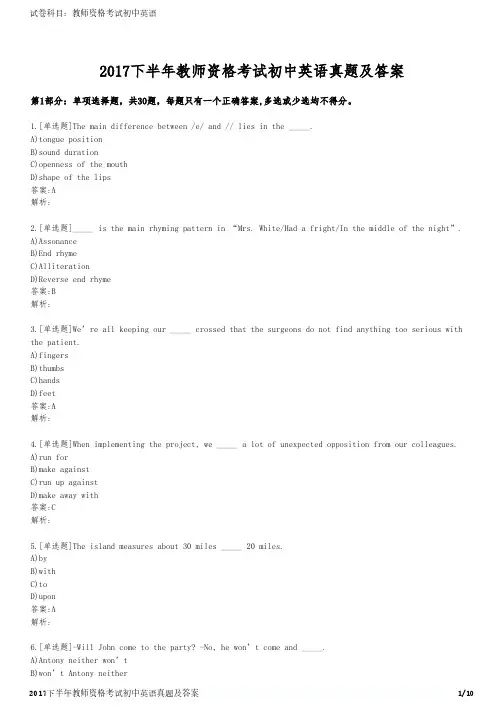
2017下半年教师资格考试初中英语真题及答案第1部分:单项选择题,共30题,每题只有一个正确答案,多选或少选均不得分。
1.[单选题]The main difference between /e/ and // lies in the _____.A)tongue positionB)sound durationC)openness of the mouthD)shape of the lips答案:A解析:2.[单选题]_____ is the main rhyming pattern in “Mrs. White/Had a fright/In the middle of the night”.A)AssonanceB)End rhymeC)AlliterationD)Reverse end rhyme答案:B解析:3.[单选题]We’re all keeping our _____ crossed that the surgeons do not find anything too serious with the patient.A)fingersB)thumbsC)handsD)feet答案:A解析:4.[单选题]When implementing the project, we _____ a lot of unexpected opposition from our colleagues.A)run forB)make againstC)run up againstD)make away with答案:C解析:5.[单选题]The island measures about 30 miles _____ 20 miles.A)byB)withC)toD)upon答案:A解析:6.[单选题]-Will John come to the party? -No, he won’t come and _____.A)Antony neither won’tB)won’t Antony neitherC)either will AntonyD)neither will Antony答案:D解析:7.[单选题]Garbo plays the role of the queen, _____ in the love she has found with Antonio.A)rejoicedB)rejoicingC)being rejoicedD)to rejoice答案:B解析:8.[单选题]_____ ministers decide to instigate an inquiry, we _____ welcome it.A)Should ... wouldB)Suppose ... couldC)If ... wouldD)Would ... will答案:A解析:9.[单选题]What is missing at the discourse level between the two sentences “Carol loves tomatoes. She was born in Africa.”?A)Reference.B)Cohesion.C)Coherence.D)Substitution.答案:C解析:10.[单选题]The synonyms “charge” and “accuse” mainly differ in _____.A)emotionB)dialectC)formalityD)collocation答案:D解析:11.[单选题]Which of the following instructions is helpful in developing students’ ability to make inferences?A)Listen to a story and write a summary.B)Listen to a story and work out the writer’s intention.C)Listen to the story of a boy and then draw a picture of him.D)Listen to a story and note down the specific date of an event.答案:B解析:12.[单选题]The most suitable question type to check students’ comprehension and develop their critical thinking is _____.A)rhetorical questionsB)referential questionsC)close questionsD)display questions答案:B解析:13.[单选题]Diagnostic test is often used for the purpose of _____.A)finding out what students know and don’t knowB)measuring students’ general language proficiencyC)knowing whether students have the right language aptitudeD)checking whether students have achieved the teaching objectives答案:A解析:14.[单选题]Which of the following activities is often used to develop students’ speaking accuracy?A)Identifying and correcting oral mistakes.B)Acting out the dialogue in the text.C)Having discussions in groups.D)Describing people in pair.答案:A解析:15.[单选题]If a teacher asks students to make their own learning plan, he/she is trying to develop their _____.A)cognitive strategyB)affective strategyC)communicative strategyD)metacognitive strategy答案:D解析:16.[单选题]When a teacher tells students that the word “dog” may imply “loyalty”, he/she is teaching the _____ of the word.A)denotative meaningB)collocative meaningC)conceptual meaningD)connotative meaning答案:D解析:17.[单选题]Which of the following is the last step in the process of writing essays?A)Editing the writings.B)Writing topic sentences for paragraphs.C)Gathering information and ideas relevant to the topic.D)Organizing the information and ideas into a logical sequence.答案:A解析:18.[单选题]The main purpose of asking questions about the topic before listening is to _____.A)meet students’ expectationB)increase students’ confidenceC)activate students’ schemataD)provide feedback on tasks答案:C解析:19.[单选题]If a teacher asks students to fill in the blanks in a passage with “that”, “which” or “whom”, he/she is least likely focusing on grammar at _____.A)lexical levelB)syntactic levelC)discourse levelD)morphological level答案:D解析:20.[单选题]If a teacher asks students to talk about their hobbies in groups, he/she is trying to encourage _____.A)peer correctionB)peer feedbackC)peer interactionD)peer assessment答案:C解析:21.[单选题]请阅读Passage 1,完成第21~25小题。
2017下半年教师资格证考试《英语学科知识与教学能力》(高级中学)真题及答案

2017 下半年教师资格证考试《英语学科知识与教学能力》(高级中学)本卷共分为 2 大题 33 小题,作答时间为 120 分钟,总分150 分,90 分及格。
一、单项选择题(本大题共 30 小题,每小题 2 分,共 60 分) 在每小题列出的四个备选项中选择一个最佳答案。
请用 2B 铅笔把答题卡上对应题目的答案字母按要求涂黑。
错选、多选或未选均无分。
1. The sound of "th" in "thin" is .A.voiceless, dental, and fricativeB.voiced, dental, and fricativeC.voiceless, dental, and affricativeD.voiced, dental, and affricative【答案】A【解析】考查辅音的发音。
本题属于语音知识,也属于语言学中语音学的知识。
th 字母组合在单词 thin 中发/θ /音,发此音时,声带是不振动的,即不带声的(voiceless);另外,发/θ /音时舌头要顶住牙齿,所以叫齿音(dental);按照发音方式,它是空气通过与牙齿摩擦发出的声音,属于摩擦音(fricative)。
故选 A。
2. Of all the following pairs of words, is a minimal pair.A.b oot and boughtB.d eep and dogC.e ither and neitherD.g host and best【答案】A【解析】考查音系学中的最小对立体。
最小对立体(minimalpair)指除了出现在同一位置上的一个音之外其余都相同的两个语音组合。
在音位分析中,只涉及一个音素差别的对立体叫做最小对立体。
如 pen[pen]和ben[ben]。
几个选项中只有 A 项中两个单词的元音发音不同.前后两个音都是爆破音/b/和/t /。
2017年下教资《高中英语》解析

2017年下半年教师资格证考试《高中英语》真题解析1.答案:A本题主要考察语音知识中的辅音发音。
voiceless(不带声的):发音时声带不振动的;voice (带声的):发音时声带振动;dental(齿音):发音时舌头要顶住牙齿;fricative(摩擦音):空气通过与牙齿摩擦发出的声音;affricative(塞擦音的):通过阻碍空气在声腔流动来发音。
A项:不带声的齿音摩擦音,符合题意,正确。
B项:不带声的齿音塞擦音,不符合题意,错误。
C项:带声的齿音摩擦音,不符合题意,错误。
D项:带声的齿音塞擦音,不符合题意,错误。
题干意为“在单词“thin”中,“th”的发音属于_____”,故A选项符合题意,B、C、D均不符合。
故正确答案为A。
2.答案:A本题主要考查语音中的最小对立体。
最小对立体(the minimal pair):指除了出现在同一位置上的一个音之外,其余都相同的两个语音组合。
A项:boot和bought中元音发音不同,前后两个音都是爆破音/b/和/t/,属于最小对立体,符合题意,正确。
B项:deep和dog不属于最小对立体,不符合题意,错误。
C项:either和neither不属于最小对立体,不符合题意,错误。
D项:ghost和best不属于最小对立体,不符合题意,错误。
题干意为“以下几组单词中,哪组单词是最小对立体?”故A选项符合题意,B、C、D均不符合。
故正确答案为A。
3.答案:C本题主要考查语法知识中的冠词使用。
“不定冠词+单数名词”或单个复数名词可以表示一类事物,这里的birds表示鸟类,是泛指所有的鸟,不需要加定冠词;“sky”是独一无二的事物,前面需要定冠词“the”的修饰。
题干意为“鸟儿可以在天空中飞翔”,C选项符合题意,A、B、D均不符合。
故正确答案为C答案:4.答案:D本题主要考查形容词和副词词义辨析。
A项:ordinary 意为“普通的、平常的、一般的”,不符合题意,错误。
教师资格考试试卷高中英语真题及解析
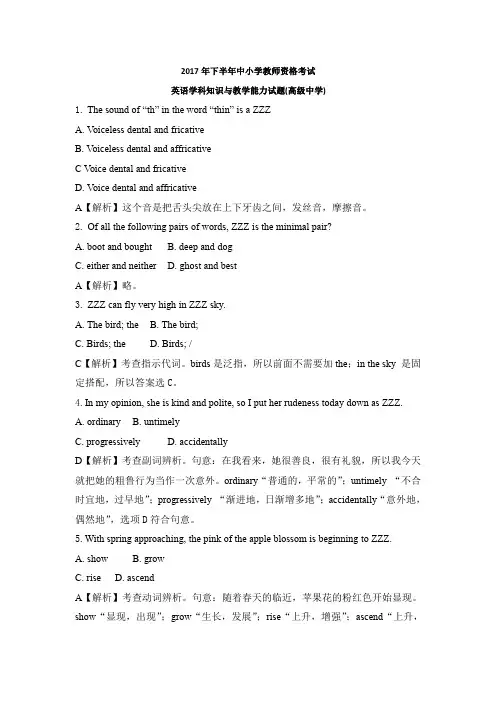
2017年下半年中小学教师资格考试英语学科知识与教学能力试题(高级中学)1.The sound of“th”in the word“thin”is a ZZZA.Voiceless dental and fricativeB.V oiceless dental and affricativeC V oice dental and fricativeD.Voice dental and affricativeA【解析】这个音是把舌头尖放在上下牙齿之间,发丝音,摩擦音。
2.Of all the following pairs of words,ZZZ is the minimal pair?A.boot and boughtB.deep and dogC.either and neitherD.ghost and bestA【解析】略。
3.ZZZ can fly very high in ZZZ sky.A.The bird;theB.The bird;C.Birds;theD.Birds;/C【解析】考查指示代词。
birds是泛指,所以前面不需要加the;in the sky是固定搭配,所以答案选C。
4.In my opinion,she is kind and polite,so I put her rudeness today down as ZZZ.A.ordinaryB.untimelyC.progressivelyD.accidentallyD【解析】考查副词辨析。
句意:在我看来,她很善良,很有礼貌,所以我今天就把她的粗鲁行为当作一次意外。
ordinary“普通的,平常的”;untimely“不合时宜地,过早地”;progressively“渐进地,日渐增多地”;accidentally“意外地,偶然地”,选项D符合句意。
5.With spring approaching,the pink of the apple blossom is beginning to ZZZ.A.showB.growC.riseD.ascendA【解析】考查动词辨析。
2017下半年全国教师资格笔试高分攻略(高中英语科目)含试题及答案解析
2017下半年全国教师资格笔试高分攻略《英语学科知识与教学能力(高级中学)》第一部分考情分析一、历年考题分析(一)题型题量全国教师资格笔试《英语学科知识与教学能力》(高级中学)考试包含模块:语言知识与能力、语言教学知识与能力、教学设计、教学实施与评价。
其题型题量具体分布如下:通过对历年考题以及考试大纲的分析,我们得出这样的数据:《英语学科知识与教学能力》(高级中学)笔试中主观题所占的分值比重较大,约为60%,客观题部分比重较小,约为40%;另外,学科知识所占比重约为27%,而教学能力比重约为73%,远远超越学科知识比重。
(二)考点分布二、命题规律总结全国教师资格笔试《英语学科知识与教学能力》(高级中学)笔试试卷结构基本上由单项选择题、简答题、教学情境分析题和教学设计题构成。
单项选择题:前10道题主要是由词法、句法、语言学和情景交际知识构成,其中对词法的考查较多,语言学考点较灵活,前两年的命题热点是语音学和音系学,近年来开始加强对语义学和语用学的考查;接下来的10道题基本上是对教学理论知识的考查,考情比较稳定,涉及的知识点较全面,旨在要求考生掌握英语教学所必需的理论知识和基本技能,树立正确的教育观念;后10道题是阅读理解题目,基本上是两篇,每篇设题5道,阅读题材以人文科技类为主,也会涉及与教育教学相关的材料,大多数文章都选自外文网站,考生备考过程中可加强阅读。
简答题:考查点比较明确,需要考生根据对理论知识的掌握和理解进行作答,主要答题思路:①读题找关键词。
②熟悉教学理论体系,了解出题人心理,紧靠理论框架,不跑题不偏题。
③理清思路,不长篇大论重复答题。
教学情境分析题:考查对于教学法、教学设计、教学实施的综合理解和灵活运用。
教学设计题:考查学生根据教学材料进行教学设计的能力,考查形式比较统一,要求全英文作答。
这就要求考生既要掌握相关的英语教学理论知识,又要了解教学的各个环节,力求设计内容清晰、准确,促进教学目的的实现。
教师资格证考试《英语学科知识与教学能力》(高级中学)考试自测卷二
教师资格证考试《英语学科知识与教学能力》(高级中学)考试自测卷二1. 【单项选择题】_______as he is, he has turned_______professional writer.A. Teenager; /B. A teenager; aC. Teenager; aD. A teenager; /正确答案:(江南博哥)C参考解析:本题考查倒装结构和冠词用法。
句意为“尽管还是个少年,(但是)他已经成了一名职业作家”。
as引导的让步状语从句使用倒装结构,如果是名词作表语置于句首,名词前不加冠词。
turn表示“成为”时,其后的名词前一般不加冠词,但若该名词有形容词修饰时,则需要加冠词。
故本题选C。
2. 【单项选择题】No one knows exactly_______this ancient bridge was built. Some say it was built during the Tang dynasty, but others disagree.A. howB. whyC. whenD. whether正确答案:C参考解析:本题考查宾语从句。
句意为“没有人知道这座古桥是什么时候建成的。
有人说它建于唐朝,但是有些人不认同”。
宾语从句引导词在从句中作时间状语。
故本题选C。
3. 【单项选择题】The syntactic component provides the_______for a sentence.A. lexiconB. structureC. meaningD. sound正确答案:B参考解析:本题考查句法学知识。
句法成分使句子具备了结构。
4. 【单项选择题】The older worker and the young each_______their own tools.A. haveB. hasC. are havingD. is having正确答案:A参考解析:复数形式的主语与each连用,each位于复数形式的主语之后作同位语,该主语不受each的影响,谓语动词仍用复数形式。
2017下半年教师资格考试《高中英语学科》真题及答案
2017下半年教师资格考试《高中英语学科》真题及答案【- 教师资格考试试题及答案】2017年教师资格考试结束啦,在这里提前预祝考生们都能取得好成绩!小编为您提供《2017下半年教师资格考试《高中英语学科》真题及答案》,希望对您有所帮助!2017下半年教师资格考试《高中英语学科》真题及答案一、单项选择题1、…… sound of th in thin (2分)参考答案:A. voiceless, dental, and fricative2、……Of all the foll owing pairs of words (2分)参考答案:A. boot and bought3、……can fly very high in (2分)参考答案:C. Birds...the4、……In my opinion she is kind and polite,so I (2分)参考答案:D. accidental5、……With spring approaching,the pink of the (2分)参考答案:A. show6、……I am here ju st in case anything out (2分)参考答案:B.happen7、……I look back on this pleasant holiday in Beijing (2分)参考答案:D. nothing but8、……Tom,take this baggage and put it (2分)参考答案:C.wherever9、……What is the main rhetoric devise used in (2分)参考答案:B.Metonymy10、…… inference in the brackets of the following sentences is (2分)参考答案:B.Don’t sit on Carol’s bed. (Carol has s bed.)11、……instructions is helpful in developing students' ability (2分)参考答案:B. listen to a story and work out the writer’s intention.12、……The most suitable question type to cheek students' comprehension (2分) 参考答案:B. referential questions13、……Diagnostic test is often used for (2分)参考答案:A. Finding out what students know and don’t know14、……activities is often used to develop students's speaking (2分)参考答案:A. identifying and correcting oral mistakes15、……If a teacher asks studentes to make their own learining plan (2分)参考答案:A. cognitive strategy16、……When a teacher tells the students that the word dog (2分)参考答案:D. connotative meaning17、……the last step in the process of writing essays (2分)参考答案:A. Editing the writing18、……The main purpose of asking questions about the topic before (2分)参考答案:C. activate students’schemata19、……to fill in the blanks in a passage with that,which (2分)参考答案:B. syntactic level20、……to talk about their hobbies in groups, (2分)参考答案:C. peer interaction21、……is true of Garcia as a Latino writer according to passage (2分)参考答案:21. A.She offered insight into the confrontation between two cultures. 22、……advantage do the new generation Latino writers (2分)参考答案:22. C.The former are able to express ideas from a bi-cultural perspective.23、……is true of the Latino writers according to Paragraph2 (2分)参考答案:23. A.Their works are full of obscurities.24、……be drawn from Villasenor's experience (2分)参考答案:24. A.Some editors of mainstream publishers are critical. 25、……new generation Latino writers do to get (2分)参考答案:25. A.They avoided writing those exotic for readers.26、……is clo set in meaning to the underlined phrase (2分)参考答案:D. Causing disagreement.27、……why does the author cite the findings of previous (2分)参考答案:D. To provide empirical data to confirm a prior belief.28、……can be inferred form the passage (2分)参考答案:C.Westerners focus on individualism while East Asians on collectivism.29、……a significant breakthrough achieved by cultural (2分)参考答案:B. It correlates cultural differences with different brain activities. 30、……may best describe the author's attitude toward s universal (2分)参考答案:B. Positive.。
2017下半年教师资格考试《高中英语》真题(原卷)
预览—收藏-关注考点课堂素材精粹第十版依据考试大纲总结命题规律辅导备考策略历年考题详析梳理考试要点总结核心知识筛选最新考点拓展解题思路精编典型习题积累备考经验全真模拟测试预测考试趋势注:下载前请仔细阅读资料,以实际预览内容为准让学习为我们创造终生价值2017下半年教师资格证考试《英语学科知识与教学能力》(高级中学)一、单项选择题(本大题共30小题,每小题2分,共60分) 在每小题列出的四个备选项中选择一个最佳答案。
请用2B铅笔把答题卡上对应题目的答案字母按要求涂黑。
错选、多选或未选均无分。
1The sound of "th" in "thin" is__________.A、voiceless, dental, and fricativeB、voiced, dental, and fricativeC、voiceless, dental, and affricativeD、voiced, dental, and affricative2Of all the following pairs of words, __________ is a minimal pair.A、boot and boughtB、deep and dogC、either and neitherD、ghost and best3__________ can fly very high in __________ sky.A、The birds ... theB、The birds ... /C、Birds ... theD、Birds ... /4In my opinion she is kind and polite, so I put her rudeness today down as __________.A、ordinaryB、untimelyC、progressiveD、accidental5With spring approaching, the pink of the apple-blossom is beginning to __________.A、showB、growC、riseD、ascend6Mr. Woods, I am here just in case anything out of the ordinary __________.A、happensB、happenC、would happenD、will happen7I look back on this pleasant holiday in Beijing with __________ pleasure.A、anything butB、all butC、everything butD、nothing but8Tom, take this baggage and put it __________ you can find enough space.A、whichB、in whichC、whereverD、whereas9What is the main rhetoric device used in "The Pentagon was divided on the air strike. "?A、Synecdoche.B、Metonymy.C、Metaphor.D、Oxymoron.10Which inference in the brackets of the following sentences is a presupposition?A、Ede caught a trout. (Ede caught a fish.)B、Don' t sit on Carol' s bed. (Carol has a bed.)C、This blimp is over the house. (The house is under the blimp.)D、Coffee would keep me awake all night. (I don' t want coffee.)11Which of the following instructions is helpful in developing students´ ability to make inferences?A、Listen to a story and write a summary.B、Listen to a story and work out the writer' s intention.C、Listen to the story of a boy and then draw a picture of him.D、Listen to a story and note down the specific date of an event.12The most suitable question type to check students´ comprehension and develop their critical thinking is __________.A、rhetorical questionsB、referential questionsC、close questionsD、display questions13Diagnostic test is often used for the purpose of__________.A、finding out what students know and don' t knowB、measuring students' general language proficiencyC、knowing whether students have the right language aptitudeD、checking whether students have achieved the teaching objectives14Which of the following activities is often used to develop students´ speaking accuracy?A、Identifying and correcting oral mistakes.B、Acting out the dialogue in the text.C、Having discussions in groups.D、Describing people in pair.15If a teacher asks students to make their own learning plan, he/she is trying to develop their__________.A、cognitive strategyB、affective strategyC、communicative strategyD、metacognitive strategy16When a teacher tells the students that the word "dog" may imply "loyalty", he/she is teaching the __________of the word.A、denotative meaningB、collocative meaningC、conceptual meaningD、connotative meaning17Which of the following is the last step in the process of writing essays?A、Editing the writings.B、Writing topic sentences for paragraphs.C、Gathering information and ideas relevant to the topic.D、Organizing the information and ideas into a logical sequence.18The main purpose of asking questions about the topic before listening is to __________.A、meet students' expectationB、increase students' confidenceC、activate students' schemataD、provide feedback on tasks19If a teacher asks students to fill in the blanks in a passage with "that", "which" or "whom", he/she is least likely focusing on grammar at __________.A、lexical levelB、syntactic levelC、discourse levelD、morphological level20If a teacher asks students to talk about their hobbies in groups, he/she is trying to encourage __________.A、peer correctionB、peer feedbackC、peer interactionD、peer assessment21请阅读Passage 1,完成第{TSE}小题。