
外研版2018 年初二英语八年级上册全册教案
Module 1 How to learn EnglishUnit 1 Let’s try to speak English as much as possible.一、学习目标:A.单词和短语:pair, correct, spelling, word, practice, match, meaning, complete, sentence, dictionary, grammar, letter, look up, mistake, make a mistake, understand-understood, advice, should, possible, write down, notebook, forget-forgot, pronounce, aloud, radio, pronunciation, key, main, excellent, agree, agree with sb., vocabulary, ask for, improve, basic, time, advise, shy, conversation, quickly, natural, suggest, placeB.交际用语:1. Ready?2. That’s a good idea.3. What else?4. Thanks a lot!5. Excellent!6. We should always speak English in class.7. Let’s try to speak English as much as possible.8. Why not write down the mistakes in our notebooks?9. It’s a good idea to s pell and pronounce new words aloud.10. How about listening to the radio?11. It’s better not to translate.12. It’s a good idea to check new words every day.二. 教学目标1. Function: Giving suggestions (English study)2. Structure: Giving advice: 1) We/You sh ould…2) Let’s try to…3) Why not…?4) It’s a good idea to…5) How about…?6) Why don’t we/you…?7) It’s better not to…3. Skills: 1) Listening and understanding familiar topics (English study).2) Talking about problems in English study and giving advice, conductingconversations in several turns.3) Reading and finding specific information about English study.4) Drafting a letter asking for advice about English study, revising through pairdiscussion..4. Around the world: English online5. Task: Writing your English study plan.三、重点及难点:Giving advice: 1) We/You should…2) Let’s try to…3) Why not…? 4) It’s a good idea to…5) How about…? 6) Why don’t we/you…? 7) It’s better not to…四、教学设计:Unit 1 Let’s try to speak English as much as possible.ⅠTeaching modelListening and speakingⅡTeaching methodPWP approachⅢTeaching aims1. To understand conversations involving advice on learning English.2. To get information about how to learn English from the conversation.3. To understand the way of giving advice.4. To practise giving advice on English learning.ⅣTeaching Objectives1. Key vocabulary: pair, correct, spelling, word, practice, match, meaning, complete, sentence,dictionary, grammar, letter, look up, mistake, make a mistake,understand-understood, advice, should, possible, write down, notebook,forget-forgot, pronounce, aloud, radio, key, main, excellent, agree, agree withsb., vocabulary2. Key structures: 1) We/You should…2) Let’s try to…3) Why not…? 4) It’s a good idea to…5)How about…? 6) Why don’t we/you…? 7) It’s better not to…ⅤTeaching aidsTape recorder, OHP , videoⅥTeaching StepsStep 1 Warming up1. Show some pictures of school things. Say how to learn English well.2. Read the words after the teacher.3. Introduce the new words.4. Learn the new words.Step 2 Read and check.1. Read the instructions in Activity 1and check(√) the ones you understand.1) Work in pairs. Ask and answer the questions.2) Correct the spelling.3) Listen and check the words you hear.4) Practise saying the words.5) Match the words with the meaning.6) Complete the sentences with the words in the box.3. Ask the students to check their answer with a partner.4. Call back the answer from the whole class and check the answer.Step 3 Listen and repeat.1. Ask the students to read the word and expressions in Activity2.dictionary grammar letter look up make a mistake meaning understand 2. Read through the questions.1) Which word did Daming not understand?2) What mistake did Lingling make?3) How does Daming usually check the spelling of a word?4) Why is it difficult for Daming to check the spelling of cinema?3. Play the recording and ask the students to listen to the recording carefully.4. Listen and answer the questions. Use the words and expressions from the box.5. Play the recording again, then they can check their answer with a partner.6. Call back the answer from the whole class and check the answer.Step 4 Listen and read.1. Show some pictures, and ask the students to talk about them.2. Ask the students to read the conversation silently.3. Play the recording and ask the students to listen and read the conversation.4. Read the conversation.5. Act it out.6. Learn “Everyday English”Ready?That’s a good idea.What else?Thanks a lot!Excellent!7. Tell the students how to learn English well.1) We should always speak English in class.2) Let’s try to speak English as much as possible.3) Why not write down the mistakes in our notebooks?4) Don’t forget to write down the correct answers next to the mistakes.5) It’s a good idea to spell and pronounce new words aloud every day.6) How about listening to the radio?7) How about reading English stories?8) W hy don’t we try to find some English pen friends?Step 5 Writing.1. Read the conversation again.2. Ask the students to write notes about learning English.Listening : listen to the radioSpeaking : ___________________________________________________ Reading : ____________________________________________________ Writing: ____________________________________________________ Learning new words: ___________________________________________3. Ask the students to check with a partner.4. Check the answers:Keys:Listening : listen to the radioSpeaking : speak English as much as possibleReading : read an English storiesWriting: write to pen friends, write down our mistakes in our notebooks, write down the correct answers next to the mistakesLearning new words: spell and pronounce new words aloud every dayStep 6 Underline the correct words and expressions.1. Ask the students to read through the passage in Activity 4.Here’s my (1) advice / notebook about learning English. Speak English (2) always / as much as possible in class, and listen to English (3) in the newspaper / on the radio. I (4) agree / forget it’s a good idea to look up new worlds in the ( 5) notebook / dictionary. You can find the (6) correct / excellent pronunciation and learn the meaning2. Underline the correct words and expressions.3. Check with a partner.4. Call back the answers from the whole class.Keys: 1. advice 2. as much as possible 3. on the radio 4. agree 5. dictionary 6. correct 5. Read the passage together.Step 7 Listen and repeat.1. Play the recording once without stopping.2. Play the recording again and ask the whole class to repeat.1) We should always speak English in class.2) Let’s try to speak English as much as possible.3) Why not write down the mistakes in our notebooks?4) It’s a good idea to spell and pronounce new words aloud.5) How about listening to the radio?3. Ask the students to listen and mark the intonation.4. Now listen again and repeat.Step 8 Work in pairs.1. Talk about problems and give advice.Problems AdviceI can’t… How / What about …?I don’t know… Why not / don’t you …?2. Read through the example with the class.—I can’t speak English well. What should I do?—Why don’t you try to talk to our classmates in English?3. Work in pairs.Step 9 Important and difficult points1 Why not write down our mistakes in our notebooks?何不在笔记本上把我们的错误记下来?Why not …? 用来表示提出某种建议,而不是询问为什么不做某事的原因,例如:Why not take a walk in the park ?何不在公园里散散步?我们还可以用下面的表达方式来提建议:Why don’t we drive t o the country?我们何不开车去乡下?What / How about going to Europe for a holiday?去欧洲度假怎么样?Write down 或者put down 表示“记下,写下”。
外研版初中英语八年级上册全册教学设计教案
外研版初中英语八年级上册全册教学设计教案外研版初中英语八上全册教案及导学案初二英语(上)Module 1 Unit 1 教学设计教材分析:Unit 1通过听、读、说训练,初步学习给别人提建议的方法。
其中活动1要求将所给表示学习活动的词汇分类;活动2要求根据录音判断对话主题;活动3—5听读包含建议的对话并完成填表、答问等任务。
活动6学习英语中的连读法;活动7根据提示口头练习给别人提建议的方法。
教学目标:To get to know the key vocabulary.To understand the dialogue 3.To be able to talk about the problems in learning English.教学重点:Key points: translate, correct, grammar, pronunciation, spelling, try to do,Why don‘t you…? How about…?教学方法Listening and speaking.教具准备Tape recorder教学流程Grade8 Module1 Unit2达标题:一.Complete the sentences with the next words.Check correct improve match number1.______your English by listening to the radio.2.______the pictures in the order you hear them.3.______the mistakes in these sentences.4._______the pictures with the paragraphs.5._______ your spelling and punctuation.二.完成单词1.You should practice more to i ___________ your English.2.Can you c_________ to 100 in English.3.Don‘t f_________ to turn off the English when you leave the room .4.I can‘t r__________ all the new words .5.Can you t__________ this word .I don‘t understand it.6.R__________ the correct answer.Unit 3 Language in use 教学设计贾建芝教学目标T o encourage students to write an English study plan for themselves this year.To say what they‘re good at, what they aren‘t good at and what they should do.教学重点Focus: Why don‘t we …?How about…?You should do ….It is + adj. + to do ….设计思路Present a practical task for the students to learn language in use.Teaching stepsWarming-up教师活动 1.Ask the Ss to retell the text in Unit 2. Choose one question to retell2.Ask the Ss ― How to learn English?‖ and let them to discussin groups and presenttheir answers.(也可以My ways to learn English为题演讲)学生活动 1.Try to retell the text.2.Discuss in groups and show the answers in front of the class.(2 minutes to prepare ,then give a speech.)In-put教师活动Read and learn the useful sentences in Language in use.You should …Why don‘t you….?It‘s + adj. + to do sth.学生活动Read loudly and try to understand the meaning of every sentence ,then use them to make some sentences.Practice 1.Listening practice.Play the tape and finish off part 1 and 2.2.Show six pictures. Ask them to talk about them and say if Jack is a goodstudent.(work in pairs.)3.Ask the Ss to give advice to Jack.4.Ask them to work in pairs and read the problem and give advice.(work in groups,each student answer two problems.)5.Ask them to finish part 6-9Practice1. -What are you doing ? -I _____________( play ) football.2. Today is my sister's birthday. She is __________ (cut) her birthday ake now.3. Li Ming _______( have ) five lessons every day.4. He ___________( visit ) his grandfather in Nanning thisweekend.5. Leny comes from India. He is ___________(India).6. I will take some _________(photo) in Lingshui Lake.7. On Sunday morning I will help my mother ___________(make) the lunch.8. Jenny will practise ___________(play) the piano this afternoon.9. Would you like __________ (have) a cup of tea?10. I hop you'll enjoy ____________(go) to your grandparents' farm.Out-putAsk students to present their thinking and their English study plan and finish off part 10-12.Make an English study plan for themselves for this year, then read it in front of the class. Summary The difficulties of this unit.Homework 1.Write the new words ten times.2.Write an English study plan.教学反思It‘s hard to improve the students‘ writing skill. Some students need help.达标题一、单项选择:( ) 1.-Where are you from?-I am from______.A. ChineseB. AmericanC. JapaneseD. America( ) 2.-What's your favourite_____?-It's Maths.A. teacherB. subjectC. foodD.drink( ) 3. I have English, Maths, Chinese and Physics _____ Monday orning.A. onB. inC. atD. to( ) 4.-Can I ask you _____ questions____ a survey ?-Sure.A.any, forB.some, forC.a, toD.an, of( ) 5. He is good at _______ football .A.playB.plaiingC.playingD.plays( ) 6. I like Physics,____Maths is my favourite !A.andB.soC.orD.but( ) 7. Will you do ________ for National Day holidays.A. something specialB. special somethingC. anything specialD. special anything( ) 8. He is looking forward to _______ the famous singer.A. seeB. seesC. seeingD. saw( ) 9.Don't forget _______the flowers when I leave.A.to waterB.waterC.wateringD.waters( ) 10.It will _____ me half an hour to go to school on foot.A.spendB.payC.costD.take( ) 11.I hope you 'll enjoy____here with us.A.liveB.livesC.livingD.to live( ) 12.-_____T om come to your party this evening ?-I am not sure.A.WasB.AreC.IsD.Will( ) 13.Li Ming often helps me ____ my homework on the weekends.A.withB.onC.inD.about( ) 14.-What will you do in Hong Kong ?-I am not sure. _____ I'll see some famous sights.A.MayB.May beC.MightD.Maybe( ) 15. My brother is too _________ to go to school.A. smallB. youngC. bigD. old二、词形变换,用括号中单词的正确形式填空(20分)1. -What are you doing ? -I _____________( play ) football.2. Today is my sister's birthday. She is __________ (cut) her birthday ake now.3. Li Ming _______( have ) five lessons every day.4. He ___________( visit ) his grandfather in Nanning this weekend.5. Leny comes from India. He is ___________(India).6. I will take some _________(photo) in Lingshui Lake.7. On Sunday morning I will help my mother ___________(make) the lunch.8. Jenny will practise ___________(play) the piano this afternoon.9. Would you like __________ (have) a cup of tea?10. I hop you'll enjoy ____________(go) to your grandparents' farm.Module 2 ExperiencesUnit 1 Have you ever entered a competition?贾建芝题材内容:本模块的语法为现在完成时,内容主要涉及经历。
外研版八年级英语上册全册教学设计 初二第一学期全套教案
Module 1 How to learn EnglishUnit 1 Let’s try to speak English as much as possible.一、学习目标:A.单词和短语:pair, correct, spelling, word, practice, match, meaning, complete, sentence, dictionary, grammar, letter, look up, mistake, make a mistake, understand-understood, advice, should, possible, write down, notebook, forget-forgot, pronounce, aloud, radio, pronunciation, key, main, excellent, agree, agree with sb., vocabulary, ask for, improve, basic, time, advise, shy, conversation, quickly, natural, suggest, placeB.交际用语:1. Ready?2. That’s a good idea.3. What else?4. Thanks a lot!5. Excellent!6. We should always speak English in class.7. Let’s try to speak English as much as possible.8. Why not write down the mistakes in our notebooks?9. It’s a good id ea to spell and pronounce new words aloud.10. How about listening to the radio?11. It’s better not to translate.12. It’s a good idea to check new words every day.二. 教学目标1. Function: Giving suggestions (English study)2. Structure: Giving advice: 1) We/You sh ould…2) Let’s try to…3) Why not…?4) It’s a good idea to…5) How about…?6) Why don’t we/you…?7) It’s better not to…3. Skills: 1) Listening and understanding familiar topics (English study).2) Talking about problems in English study and giving advice, conductingconversations in several turns.3) Reading and finding specific information about English study.4) Drafting a letter asking for advice about English study, revising throughpair discussion..4. Around the world: English online5. Task: Writing your English study plan.三、重点及难点:Giving advice: 1) We/You should…2) Let’s try to…3) Why not…? 4) It’s a good idea to…5) How about…? 6) Why don’t we/you…? 7) It’s better not to…四、教学设计:Unit 1 Let’s try to speak English as much as possible.ⅠTeaching modelListening and speakingⅡTeaching methodPWP approachⅢTeaching aims1. To understand conversations involving advice on learning English.2. To get information about how to learn English from the conversation.3. To understand the way of giving advice.4. To practise giving advice on English learning.ⅣTeaching Objectives1. Key vocabulary: pair, correct, spelling, word, practice, match, meaning, complete,sentence, dictionary, grammar, letter, look up, mistake, make amistake, understand-understood, advice, should, possible, writedown, notebook, forget-forgot, pronounce, aloud, radio, key, main,excellent, agree, agree with sb., vocabulary2. Key structures: 1) We/You should…2) Let’s try to…3) Why not…? 4) It’s a good idea to…5) How about…? 6) Why don’t we/you…? 7) It’s better not to…ⅤTeaching aidsTape recorder, OHP , videoⅥTeaching StepsStep 1 Warming up1. Show some pictures of school things. Say how to learn English well.2. Read the words after the teacher.3. Introduce the new words.4. Learn the new words.Step 2 Read and check.1. Read the instructions in Activity 1and check(√) the ones you understand.1) Work in pairs. Ask and answer the questions.2) Correct the spelling.3) Listen and check the words you hear.4) Practise saying the words.5) Match the words with the meaning.6) Complete the sentences with the words in the box.3. Ask the students to check their answer with a partner.4. Call back the answer from the whole class and check the answer.Step 3 Listen and repeat.1. Ask the students to read the word and expressions in Activity2.dictionary grammar letter look up make a mistake meaning understand 2. Read through the questions.1) Which word did Daming not understand?2) What mistake did Lingling make?3) How does Daming usually check the spelling of a word?4) Why is it difficult for Daming to check the spelling of cinema?3. Play the recording and ask the students to listen to the recording carefully.4. Listen and answer the questions. Use the words and expressions from the box.5. Play the recording again, then they can check their answer with a partner.6. Call back the answer from the whole class and check the answer.Step 4 Listen and read.1. Show some pictures, and ask the students to talk about them.2. Ask the students to read the conversation silently.3. Play the recording and ask the students to listen and read the conversation.4. Read the conversation.5. Act it out.6. Learn “Everyday English”Ready?That’s a good idea.What else?Thanks a lot!Excellent!7. Tell the students how to learn English well.1) We should always speak English in class.2) Let’s try to speak English as much as possible.3) Why not write down the mistakes in our notebooks?4) Don’t forget to write down the correct answers next to the mistakes.5) It’s a good idea to spell and pronounce new words aloud every day.6) How about listening to the radio?7) How about reading English stories?8) W hy don’t we try to find some English pen friends?Step 5 Writing.1. Read the conversation again.2. Ask the students to write notes about learning English.Listening : listen to the radioSpeaking : ___________________________________________________ Reading : ____________________________________________________ Writing: ____________________________________________________Learning new words: ___________________________________________3. Ask the students to check with a partner.4. Check the answers:Keys:Listening : listen to the radioSpeaking : speak English as much as possibleReading : read an English storiesWriting: write to pen friends, write down our mistakes in our notebooks, write down the correct answers next to the mistakesLearning new words: spell and pronounce new words aloud every dayStep 6 Underline the correct words and expressions.1. Ask the students to read through the passage in Activity 4.Here’s my (1) advice / notebook about learning English. Speak English (2) always / as much as possible in class, and listen to English (3) in the newspaper / on the radio. I (4) agree / forget it’s a good idea to look up n ew worlds in the ( 5) notebook / dictionary. You can find the (6) correct / excellent pronunciation and learn the meaning2. Underline the correct words and expressions.3. Check with a partner.4. Call back the answers from the whole class.Keys: 1. advice 2. as much as possible 3. on the radio 4. agree 5. dictionary 6. correct 5. Read the passage together.Step 7 Listen and repeat.1. Play the recording once without stopping.2. Play the recording again and ask the whole class to repeat.1) We should always speak English in class.2) Let’s try to speak English as much as possible.3) Why not write down the mistakes in our notebooks?4) It’s a good idea to spell and pronounce new words aloud.5) How about listening to the radio?3. Ask the students to listen and mark the intonation.4. Now listen again and repeat.Step 8 Work in pairs.1. Talk about problems and give advice.Problems AdviceI can’t… How / What about …?I don’t know… Why not / don’t you …?2. Read through the example with the class.—I can’t speak English well. What should I d o?—Why don’t you try to talk to our classmates in English?3. Work in pairs.Step 9 Important and difficult points1 Why not write down our mistakes in our notebooks?何不在笔记本上把我们的错误记下来?Why not …? 用来表示提出某种建议,而不是询问为什么不做某事的原因,例如:Why not take a walk in the park ?何不在公园里散散步?我们还可以用下面的表达方式来提建议:Why don’t we drive to the country?我们何不开车去乡下?What / How about going to Europe for a holiday?去欧洲度假怎么样?Write down 或者put down 表示“记下,写下”。
外研版英语八年级上册教案 全册教案
1. Think about. 2. Read the instructions. (activity 1). 3. Check the ones you understand.
说明或设计 意图 让学生熟悉生词和短语。
练习做了大量的铺垫。从而 解决了阅读中的疑难。让学 生轻松地进入课堂。告诉学 生 How do people usually learn English?同时把 Advice 引入课堂,让学生通过练习, 学习并总结提建议的句型。
1. Read the words and phrases. 2. Listen and answer the questions. (Part 2). 1. Make sentences to practice the sentence structure. And then discuss what the sentence structure is like.要学生找出 Part3 中 提出建议的句型。 2. Listen to Part 3 and complete Part 4 then practice reading the dialogue in groups. Then several should be asked to read in public. At last ask some groups to act out part3. 1. Read the dialogue together with the tape recorder. Then read the sentences of Part 5, with the tape recorder. 2. Read the sentences to let the partner check if the sentences are pronounced in a correct way. Talk about problems in learning English and give advice. Students read, write and remember.
外语教学与研究出版社初中英语八年级上册全册教学设计教案
外语教学与研究出版社初中英语八年级上册全册教学设计教案教学设计目标- 帮助学生掌握八年级上册英语的基本语法知识和词汇量- 提升学生听、说、读、写的能力- 培养学生的英语交流和表达能力- 激发学生对英语研究的兴趣和自主研究的能力教学内容安排第一单元:Meeting New Friends- 语言知识:- 重点词汇:greeting, introduce, name, age, hobby, country, etc. - 语法重点:be动词的使用和一般现在时的基本句型- 听力:听取对话并选择正确的答案- 口语:运用所学词汇和句型进行自我介绍和询问他人信息- 阅读:阅读短文并回答相关问题- 写作:写一篇关于自我介绍的短文第二单元:School Life- 语言知识:- 重点词汇:classroom, teacher, subject, homework, test, etc. - 语法重点:there be句型和物主代词的使用- 听力:听取学校活动并选择正确的回答- 口语:描述学校的不同场所和活动- 阅读:阅读有关学校生活的短文并回答相关问题- 写作:写一篇关于学校活动的日记第三单元:Hobbies and Interests- 语言知识:- 重点词汇:hobby, interest, music, sport, game, etc.- 语法重点:动词的ing形式和频度副词的使用- 听力:听取关于不同爱好和兴趣的对话并回答相关问题- 口语:谈论自己和他人的爱好和兴趣- 阅读:阅读有关兴趣爱好的文章并回答相关问题- 写作:写一篇关于自己的兴趣爱好的短文第四单元:Family and Relationships- 语言知识:- 重点词汇:family, father, mother, brother, sister, friend, etc.- 语法重点:所有格的使用和形容词的比较级- 听力:听取有关家庭和关系的对话并回答相关问题- 口语:描述自己的家人和朋友,并表达关系- 阅读:阅读有关家庭和友谊的短文并回答相关问题- 写作:写一篇关于自己家庭和朋友的介绍教学方法- 多媒体教学:利用图片、音频和视频等多媒体资源,激发学生的研究兴趣- 互动式教学:通过小组讨论、合作活动和角色扮演等形式,提升学生的参与度和表达能力- 循序渐进教学:根据学生的实际水平和能力,逐步引导学生研究新的语法知识和词汇量- 多样化评估:通过口语演示、书面作业和小测验等方式,全面评估学生的研究成果教学资源- 《外语教学与研究出版社初中英语八年级上册全册教材》- 多媒体设备和教学软件- 翻译工具和在线词典- 练册和作业本以上是本教学设计教案的内容安排和方法介绍。
2018学年外研版八年级英语上Module

Module 12HelpUnit 1What should we do before help arrives?【教课目的】Knowledge objective1.To understand the conversation in relation to accidents.2.To get specific information from the listening material.3.To talk about and understand the imperative sentences.Ability objectiveEnable students to listen to and talk about things that could/can/must happen. Moral objectiveGet the students to know about how to deal with the accidents.【教课要点】New words and expressionsLearn the usage of imperative sentences.【教课难点】Grasp the phrases and important sentences.【教课方法】PWP method, task-based method and interactive approach【教课手段】A tape recorder, multimedia and some pictures【教课过程】Teaching Procedures:Step 1Lead-inSs look at the pictures and fill in what we can do when we see someone in danger.Step 2Consolidate new wordsLook and say. The teacher shows the pictures of new words and let the students to say the new words as quickly as possible.Step 3Talk in pairsLet Ss look at the pictures and talk about the pictures by using the words and expressions in the box to help you.Step 4ListeningListen and check what the pictures are about.Step 5TalkingLook at the picture and talk about it in groups.Step 6ListeningListen to the dialogue and answer the questions.1.Where is the boy lying?2.Do they lift him up?Step 7Read the dialogue and answer the questions1.Could he have trouble hearing or speaking?2.Is it good idea to shout for help or call 120?3.How does Betty cover the boy?Step 8Read these first aid suggestions and decide if they are good ideas or bad ideasRead the passage carefully and tell if they are good or bad ideas anddraw answers from the Ss.Step 9Complete the passage with the words in the boxRead the passage to get the main idea and then choose the right words, at last use the correct form of the words to fill in the blanks.Step 10Everyday EnglishWhat do we do to ...?How do we do that?How can we do that?Step 11Language pointsLet Ss master the main points of the passage.Step 12Listening1.Listen and underline the words the speaker stresses.2.Now listen again and repeat.Step 13ReadingRead the conversation in Activity 5 aloud in pairs.Step 14GrammarThe use of the imperative sentence.Step 15Summary要点短语、句型。
外研版初中英语八年级上Module 1-Module 12全册全套精品教案设计附教学资源
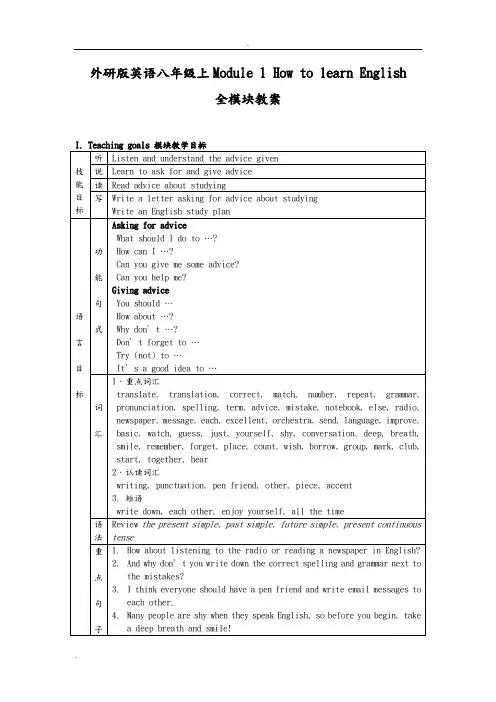
外研版英语八年级上Module 1 How to learn English全模块教案II. Teaching material analyzing 教材分析本模块以“How to learn English”为话题,以学习征求建议、提出建议的方法为主线,介绍了单词分类记忆、根据上下文判断词义;听力细节辨认、反向推理;略读等学习方法。
通过模块学习,学生除了能掌握上述英语学习方法之外,还可以根据同学的建议制定更适合自己的学习计划;同时,模块也复习了一般现在时、现在进行时、一般过去时、一般将来时的用法。
Unit 1 通过听、读、说训练,初步学习给别人提建议的方法。
其中活动1要求将所给表示学习活动的词汇分类;活动2要求根据录音判断对话主题;活动3—5听读包含建议的对话并完成填表、答问等任务。
活动6学习英语中的连读法;活动7根据提示口头练习给别人提建议的方法。
Unit 2 通过读、写训练,学会向别人征求建议或给别人提出建议。
其中活动1要求学生列举自己在语言学习活动中遇到的实际困难。
活动2—4要求学生阅读一语言学习网站“问答专栏”中内容后完成补全句子、回答问题等练习。
活动5—6要求学生根据自己的学习实际,完成一封求助信并征求同学的建议。
Unit 3 对“提供学习建议”的功能项目进行综合训练,并在此基础上完成制定学习计划的任务。
其中活动1、2 要求听取Charlie和Mary的对话,选出所听到的表示建议的句式并完成问答练习。
活动3—5 要求根据所供图片,描述、评论Jack的学习、生活情况,并根据提示问题提出建议。
活动6要求阅读 Helen的问题并用所供表达完成Simon的回信。
活动7—9是词汇的拓展训练:其中7要求根据图片写出单词;8用所供词汇组成短语;9用所供词汇完成句子。
Around the world给学生介绍了通过多种渠道学习英语的方法。
Module task要求学生反思自己的英语学习,通过图标明晰信息,并根据图标信息制定学习计划;然后小组交流,提出修改建议。
【2018年秋季课程外研版初二英语】八年级上册Module 3 Sports_教案
2018年秋季课程外研版初二英语八年级上册Module 3 Sports一、课程介绍知识点1. 重点词汇用法:beat \ miss \ keep的用法2. 重点词组用法:plenty of / cheer...on / warm up 的用法3. 重点语法: 形容词比较级副词比较级教学重点1. 各重点词汇及短语用法2. 形容词比较级和副词比较级的用法教学难点形容词副词原级的用法及其比较级区别二、要点回顾Ⅰ.词汇短语1.n.小山,小丘2.n.人口3.adj. 宽阔的4.vt. 变成5.n.岛屿6.adj. 矮的7.n. 地区8.n. 山岳9.adj. 南方的10.n..雨伞11.pretty good12.home town13.be famous for【答案】1.hill 2.population 3.wide 4.get 5.island 6.short7.area 8.mountain 9.south 10. umbrella11.相当好12. 家乡13.因...而闻名Ⅱ.活用句型翻译下列句子1.深圳有多少人口?_________________________________________________.2.我的家长尤其以其大学而著名。
_________________________________________________.3.剑桥是英格兰东部的一个美丽的城市。
___________________________________________________.【答案】1.What’s the population of Shenzhen?2.My home town is especially famous for its university.3.Cambridge is a beautiful city in the east of England.4.二、知识精要1)词汇2)词组3)语法【语法点一】That’s because......的用法That’s because + 原因,“那就是因为......”That’s why + 结果,“那就是(为什么)......的原因”【语法点二】否定词与比较级连用的用法Nothing is more enjoyable than...... “没有什么比......更......的了”【语法点三】形容词副词比较级用法1. 可以单独使用。
外研版英语八年级上册全册教案
Module 1 How to learn EnglishUnit 1 Let’s try to speak English as much as possible.主备人:李桂青审核人:张硕课时:2一、教学目标1. Function: Giving suggestions (English study)2. Structure: Giving advice: 1) We/You should… 2) Let’s try to…3) Why not…? 4) It’s a good idea to…5) How about…? 6) Why don’t we/you…?7) It’s better not to…3. Skills: 1) Listening and understanding familiar topics (English study).2) Talking about problems in English study and giving advice, conductingconversations in several turns.3) Reading and finding specific information about English study.4) Drafting a letter asking for advice about English study, revising through pair discussion..4. Around the world: English online5. Task: Writing your English study plan.二、重点及难点:Giving advice: 1) We/You should…2) Let’s try to…3) Why not…? 4) It’s a good idea to…5) How about…? 6) Why don’t we/you…? 7) It’s better not to…三、教学设计:Unit 1 Let’s try to speak English as much as possible.ⅠTeaching modelListening and speakingⅡTeaching methodPWP approachⅢTeaching aims1. To understand conversations involving advice on learning English.2. To get information about how to learn English from the conversation.3. To understand the way of giving advice.4. To practise giving advice on English learning.Ⅳ Teaching StepsStep 1 Warming up1.Elicit the topic: How to learn English well?2. Learn the new words and expressions.Step 2 Listening and vocabulary1. Read the instructions in Activity 1and check(√) the ones you understand.1) Work in pairs. Ask and answer the questions.2) Correct the spelling.3) Listen and check the words you hear.4) Practise saying the words.5) Match the words with the meaning.6) Complete the sentences with the words in the box.Ask the students to compare their answer with a partner.2. Listening1) Ask the students to read the word and expressions in Activity 2.dictionary grammar letter look up make a mistake meaning understand2) Read through the questions.1) Which word did Daming not understand?2) What mistake did Lingling make?3) How does Daming usually check the spelling of a word?4) Why is it difficult for Daming to check the spelling of cinema?3) Play the recording and ask the students to listen to the recording carefully.4) Listen again and answer the questions. Use the words and expressions from thebox.5) Play the recording again, then they can check their answer with a partner.6) Call back the answer from the whole class and check the answer.Step 3 Listen and read.1. Show some pictures, and ask the students to talk about good ways to learn English.2. Ask the students to read the conversation silently.3. Play the recording and ask the students to listen and read the conversation.4. Work on Activity 3 on page 3.5. Learn “Everyday English”Step 4 Language points1. Practise saying the words.practise用作动词,意为“练习”,后面可跟名词、代词或动词-ing形式作宾语。
【2018年秋季课程外研版初二英语】八年级上册Module 7 A famous story_教案
2018年秋季课程外研版初二英语八年级上册Module 7 A famous story一、课程介绍知识点1. 重点词汇用法:fall / follow / hole / rabbit / ssh / ground / twice / suddenly / pink / pocket / field / deep / while / land / dry的用法2. 重点词组用法:tea party / once or twice / think about的用法3. 重点语法:过去进行时教学重点1. 各重点词汇及短语用法2. 过去进行时的结构、基本用法教学难点过去进行时与一般过去时的区别二、要点回顾Ⅰ.词汇短语1.n. 蛇2.n. 颈;脖子3.a dj. 薄的;细长的4.n. 危险;危害5.a dj. 关心的;感兴趣的6.v. 允许;准许7.v. 保护;保卫8.adj. 野生的n. 野生环境9.v.(逐渐)变得;生长10.adj.足够的;充分的11.n.和平;太平12.n. 布告;告示13.v. 筹集(钱款);抚养;养育14.n. 研究;探讨15.n.婴儿;婴孩16.n. 形势;情况17.n. 科学家18.v. 生育;繁殖19.n. 西南adj. 西南的;朝西南的20.n. 政府21.v.设置;设定22.n. 大自然;自然界23.v. 研制;制定24.v. 喂养;饲养25.n. 象征;标志26.in danger27.at last28.think of29.take away30.in peace31.look after32.in order to33.set up34.nature park35.be interested in...36.many kinds of37.find out【答案】1. snake 2. neck 3. thin 4. danger 5. interested 6. allow7. protect 8. wild 9. grow 10. enough11.peace12.notice 13. raise 14. research 15. baby 16. situation 17. scientist 18. produce 19. southwest 20. government 21. set22. nature 23. develop 24. feed 25. symbol 26. 处于危险中27. 终于;最后28. 想到;想出29. 夺去;拿走30. 和平地;平静地31. 照顾;照管32. 为了33. 开办;设立;创办;建立34. 自然公园35. 对......感兴趣36. 许多种37. 找出;发现;查明Ⅱ.活用句型翻译下列句子1.但我对卧龙熊猫保护区更感兴趣,因为那儿允许人们接近它们。
外研版英语(新标准)八年级上册教案(全册)(完美版)
外研版英语(新标准)八年级上册教案Module 1 How to learn EnglishUnit 1 Let’s try to speak English as much as possible.一、学习目标:A.单词和短语:pair, correct, spelling, word, practice, match, meaning, complete, sentence, dictionary, grammar, letter, look up, mistake, make a mistake,understand-understood, advice, should, possible, write down, notebook, forget-forgot, pronounce, aloud, radio, pronunciation, key, main, excellent, agree, agree with sb., vocabulary, ask for, improve, basic, time, advise, shy, conversation, quickly, natural, suggest, placeB.交际用语:1. Ready?2. That’s a good idea.3. What else?4. Thanks a lot!5. Excellent!6. We should always speak English in class.7. Let’s try to speak English as much as possible.8. Why not write down the mistakes in our notebooks?pell and pronounce new words aloud.9. It’s a good idea to s10. How about listening to the radio?11. It’s better not to translate.12. It’s a good idea to check new words every day.二. 教学目标1. Function: Giving suggestions (English study)2. Structure: Giving advice: 1) We/You sh ould…2) Let’s try to…3) Why not…?4) It’s a good idea to…5) How about…?6) Why don’t we/you…?7) It’s better not to…3. Skills: 1) Listening and understanding familiar topics (English study).2) Talking about problems in English study and giving advice,conductingconversations in several turns.3) Reading and finding specific information about English study.4) Drafting a letter asking for advice about English study, revisingthrough pair discussion..4. Around the world: English online5. Task: Writing your English study plan.三、重点及难点:Giving advice: 1) We/You should…2) Let’s try to…3) Why not…? 4) Itgood idea to…5) How about…? 6) Why don’t we/you…? 7) It’s better no 四、教学设计:Unit 1 Let’s try to speak English as much as possible.ⅠTeaching modelListening and speakingⅡTeaching methodPWP approachⅢTeaching aims1. To understand conversations involving advice on learning English.2. To get information about how to learn English from the conversation.3. To understand the way of giving advice.4. To practise giving advice on English learning.ⅣTeaching Objectives1. Key vocabulary: pair, correct, spelling, word, practice, match, meaning,complete, sentence, dictionary, grammar, letter, look up,mistake, make a mistake, understand-understood, advice,should, possible, write down, notebook, forget-forgot,pronounce, aloud, radio, key, main, excellent, agree, agreewith sb., vocabulary2. Key structures: 1) We/You should…2) Let’s try to…3) Why not…? 4 good idea to…5) How about…? 6) Why don’t we/you…? 7) It’s better no ⅤTeaching aidsTape recorder, OHP , videoⅥTeaching StepsStep 1 Warming up1. Show some pictures of school things. Say how to learn English well.2. Read the words after the teacher.3. Introduce the new words.4. Learn the new words.Step 2 Read and check.1. Read the instructions in Activity 1and check(√) the ones you understand.1) Work in pairs. Ask and answer the questions.2) Correct the spelling.3) Listen and check the words you hear.4) Practise saying the words.5) Match the words with the meaning.6) Complete the sentences with the words in the box.3. Ask the students to check their answer with a partner.4. Call back the answer from the whole class and check the answer.Step 3 Listen and repeat.1. Ask the students to read the word and expressions in Activity2. dictionary grammar letter look up make a mistake meaning understand2. Read through the questions.1) Which word did Daming not understand?2) What mistake did Lingling make?3) How does Daming usually check the spelling of a word?4) Why is it difficult for Daming to check the spelling of cinema?3. Play the recording and ask the students to listen to the recording carefully.4. Listen and answer the questions. Use the words and expressions from the box.5. Play the recording again, then they can check their answer with a partner.6. Call back the answer from the whole class and check the answer.Step 4 Listen and read.1. Show some pictures, and ask the students to talk about them.2. Ask the students to read the conversation silently.3. Play the recording and ask the students to listen and read the conversation.4. Read the conversation.5. Act it out.6. Learn “Everyday English”Ready?That’s a good idea.What else?Thanks a lot!Excellent!7. Tell the students how to learn English well.1) We should always speak English in class.2) Let’stry to speak English as much as possible.3) Why not write down the mistakes in our notebooks?4) Don’t forget to write down the correct answers next to the mistakes.spell and pronounce new words aloud every day.5) It’s a good idea to6) How about listening to the radio?7) How about reading English stories?we try to find some English pen friends?8) Why don’tStep 5 Writing.1. Read the conversation again.2. Ask the students to write notes about learning English.Listening : listen to the radioSpeaking : ___________________________________________________ Reading : ____________________________________________________ Writing: ____________________________________________________ Learning new words: ___________________________________________3. Ask the students to check with a partner.4. Check the answers:Keys:Listening : listen to the radioSpeaking : speak English as much as possibleReading : read an English storiesWriting: write to pen friends, write down our mistakes in our notebooks, writedown the correct answers next to the mistakesLearning new words: spell and pronounce new words aloud every dayStep 6 Underline the correct words and expressions.1. Ask the students to read through the passage in Activity 4.Here’s my (1) advice / notebook about learning English. Speak English (2) always / as much as possible in class, and listen to English (3) in the newspaperew worlds in the/ on the radio. I (4) agree / forget it’s a good idea to look up n ( 5) notebook / dictionary. You can find the (6) correct / excellent pronunciation and learn the meaning2. Underline the correct words and expressions.3. Check with a partner.4. Call back the answers from the whole class.Keys: 1. advice 2. as much as possible 3. on the radio 4. agree 5. dictionary 6. correct 5. Read the passage together.Step 7 Listen and repeat.1. Play the recording once without stopping.2. Play the recording again and ask the whole class to repeat.1) We should always speak English in class.2) Let’s try to speak English as much as possible.3) Why not write down the mistakes in our notebooks?4) It’s a good idea to spell and pronounce new words aloud.5) How about listening to the radio?3. Ask the students to listen and mark the intonation.4. Now listen again and repeat.Step 8 Work in pairs.1. Talk about problems and give advice.Problems AdviceI can’t… How / What about …?I don’t know… Why not / don’t you …?2. Read through the example with the class.—I can’t speak English well. What should I do??—Why don’t you try to talk to our classmates in English3. Work in pairs.Step 9 Important and difficult points1 Why not write down our mistakes in our notebooks?何不在笔记本上把我们的错误记下来?Why not …? 用来表示提出某种建议,而不是询问为什么不做某事的原因,例如:Why not take a walk in the park ?何不在公园里散散步?我们还可以用下面的表达方式来提建议:Why don’t we drive to the country?我们何不开车去乡下?What / How about going to Europe for a holiday?去欧洲度假怎么样?Write down 或者put down 表示“记下,写下”。