
翻译讲义
翻译专题讲解一、大学英语四级考试翻译题型概述:全国大学英语四级考试的最后一个题型是翻译,要求考生在5分钟内处理5个句子,占总成绩5%的比例。
这道题不是整句的中译英翻译,而是在英文句子中挖掉一部分,给出中文,要求考生将中文译成英文,使句子完整。
句子的长度一般在15个词左右,要求翻译的内容大约有3-8个单词。
如:It has been decided that the meeting___________(延期到下星期六).四级考试翻译(汉译英)试题难度相对较低,属于考生应该争取拿分的基础题。
命题没有在词汇方面设置很高的难度,对考生而言,选择正确的词汇和句型才是更大的挑战。
换言之,翻译试题更多考察的是考生对基本语法和基础词汇的掌握能力。
二、重点:虚拟语气、从句(定语从句、主语从句、状语从句)、比较级、分词、常用词组表达。
第一课时:(四级翻译)1虚拟语气:用来表示非真实的假设,或者用来表示命令、建议或说话人的主观愿望。
考生应能够根据所给的信息判断出需要使用虚拟语气的情况。
虚拟语气的表现形式多种多样,一般来说,四级考试常考的虚拟语气形式有如下四种。
1.11) The victim (本来会有机会活下来) if he had been taken to hospital in time.would have had a chance to survive2) If she had returned an hour earlier, Mary (就不会被大雨淋了)wouldn’t have been caught by the rain.1.2特殊动词在表示建议、要求、命令等的动词suggest、advise、propose、demand、require、insist、request、command、order等后的宾语从句中,谓语动词用should + 动词原形或是动词原形表示虚拟。
真题讲解:1)The professor required that (我们交研究报告) by Wednesday.We should hand in the research report.1.3 as if/as though, even if/even though在as if/as though、even if/even though等引导的表语从句或状语从句中表虚拟。
如果从句表示的动作发生在过去,用过去完成时表虚拟;指现在状况,则用一般过去时表虚拟;指将来状况则用过去将来时表虚拟。
真题讲解:1)Even if_________(他在这), she could not solve the problem.she were here1.4 由连接词in case, lest , for fear that引起的状语从句中,谓语动词要用虚拟形式,即should(might, would)+动词原形真题讲解:1)She put a blanket over the baby for fear that_______(他着凉).he should catch cold知识点测评1:翻译---虚拟语气1.The special committee recommended that _________________________________ (这项工程不应动工) until all the preparations have been made.答案:the project not be started考点:虚拟语气,动词recommend后的宾语从句中使用should 加动词原形的虚拟式,should 可以省略.2.The audience must have missed their musical performance or they________________________________________(给予高度评价).答案:would have spoken highly of it考点:1)虚拟语气,表示和过去事实相反时,主句用would havedone 结构;2)短语“给予…高度评价”,可译为speak highly of….3.He works very hard___________________________________.(好像永远不打算睡觉似的) 答案:as if he never intended to sleep.考点:本题考查的是as if的用法,as if 后面可以是真实情况,也可以是虚拟情况,如果是虚拟情况,对现在的虚拟要用一般过去时,对过去的虚拟,要用过去完成时。
4.I was really anxious about you. You______(你本不应该一句话不说就离开家)答案:shouldn't have left home without a word.考点:考查的是情态动词的虚拟,对过去情况的虚拟用过去完成时。
5. If we had caught the 10 o'clock train,we (午饭时间到那里).would have got there by lunch考点:同上2 定语从句:定语从句通常修饰名词或代词,对其进行限制、描述和说明。
受定语从句修饰的词语叫先行词,引导定语从句的词语叫关系词。
关系词按其性质又分关系代词和关系副词。
关系代词主要有that, who, whose, which等,它们在定语从句可用作主语、宾语或定语;关系副词主要有when, where 和why,它们在定语从句中均用作状语。
关系词不仅引导定语从句,同时还在定语从句充当一定的句子成分。
that 与which的用法区别:两者都可指物,有时可互换。
其区别主要在于:(1) 引导非限制性定语从句时,通常只用which:He drove too fast, which was dangerous. 他开车很快,这是很危险的。
(2) 直接放在介词后作宾语时,通常只用which:The tool with which he is working is called a hammer. 他干活用的那个工具叫做锤子。
(3) 当先行词是none, all, everything, anything等不定代词或受其修饰时,通常用that:All [Everything] that can be done must be done. 凡能做的事都必须做。
(4) 当先行词受the very, the only, the same 等修饰时,通常用that:This is the only example that I know. 我知道的例子只有这一个。
(5) 当先行词有形容词最高级或序数词等修饰时,通常用that:This is the best dictionary that I’ve ever used. 这是我用过的最好的词典。
(6) 当先行词是一个既指人又指物的并列词组时,通常用that:They talked about the persons and things that most impressed them. 他们谈论了使他们印象最深的人和事。
真题讲解:1) The prevention and treatment of AIDS is (我们可以合作的领域)The field in which we can cooperate2. Medical researches are painfully aware that there are many problems_________ (他们至今还没有答案) (08.12)to which they still have no answers知识点测评2:翻译---定语从句1. What he objects to is the bureaucracy, ____.(这种情况正在不断滋长)答案:which is on the increase.考点:本题考查非限制性定于从句which 指代前句话的用法,考生不易想到。
2. We felt very disappointed after the show,______.(因为很多应该参加演出的名演员没有来)答案:as many famous stars who should have appeared did not come.考点:用关系代词who引导定语从句;在英语中表示过去应该做而实际上没有做的事,要用“should + have +过去分词”的句式。
3 主语从句:作句子主语的从句叫主语从句。
主语从句通常由从属连词that,whether,if 和连接代词what,who,which,whatever,whoever以及连接副词how,when,where,why 等词引导。
that在句中无词义,只起连接作用;连接代词和连接副词在句中既保留自己的疑问含义、又起连接作用,在从句中充当从句的成分。
例如:What he wants to tell us is not clear. 他要跟我们说什么,还不清楚。
Who will win the match is still unknown. 谁能赢得这场比赛还不得而知。
It is known to us how he became a writer.我们都知道他是如何成为一名作家的。
Where the English evening will be held has not been announced. 英语晚会将在哪里举行,还没有宣布。
真题讲解:1)(很多人所没有意识到的)is that Simon is a lover of sports, and football in particular.What people don’t realize2)(大多数父母所关心的)is providing the best education possibility for their children.What most parents are concerned about4 状语从句1.1 地点状语从句(adverbial clause of place) where, wherevere.g. You should have put the book where you found it. 你本来应该把书放回原来的地方.e.g. We will go wherever the motherland needs us most.我们要到祖国最需要的地方去1.2 原因状语从句,(adverbial clause of cause) because ,as, since常用的引导连词有because,as和since,三者的区别是:在回答问题的时候,使用because;对于显而易见的原因,常用as或since;as和since的从句常放在主句之前,而because的从句常放在主句之后。
翻译讲义 大学笔译

笔译(一)第一讲翻译概论Some suggestions1. Students are expected to keep on improving language competence both in their English and Chinese so that they can be fit for the work of translation;2. Students are expected to cultivate a sense of bi-culture involved in translation and observe similarities and difference between two languages in lexicology, syntax, discourse.3. Students are expected to read and study translation works by well-known translators, and to have a lot of exposure to both SL (源语) and TL(目的语).4. Students are expected to do ample translation practice to improve translation ability and try to apply translation theory to practice.5. Students are expected to read extensively after class to get ample knowledge in different fields. General knowledge is of vital importance.6. Discuss with your classmates and teachers.7. Summarize and make a frequent reflection.8. Be patient and careful.The Story of Babel 巴别塔的故事那时,诺亚的后代都使用同一种语言。
翻译讲义

英汉翻译技巧:减词(Omission)E-C.1. A soldier must obey orders.军人必须服从命令。
(省冠词)(王令坤<英汉翻译技巧>上海交大出版社)2. When the pressure gets low, the boiling point becomes low.气压低,沸点就低。
(省动词)(许建平<英汉互译实践与技巧>清华大学出版社) 3. It was an early September day, cool and bright and just right for running, and I was in the first few miles of a 10.5-mile race over a course through steep exhausting hills.那是九月初的一天,秋高气爽,阳光明媚,正是赛跑的好时光。
我正参加一场10.5英里的比赛,刚跑了几英里。
比赛路线要穿越一些陡峭、使人精疲力竭的山坡。
(省连词)(王令坤<英汉翻译技巧>上海交大出版社)4. It is conflict and not unquestioning agreement that keeps freedom alive.使自由保持活力的是冲突而不是绝对的一致。
(省强调句中的it)(王令坤<英汉翻译技巧>上海交大出版社)5. One must make painstaking efforts before one could succeed in mastering a foreign language.要掌握一门外语,非下苦功夫不可。
(省代词)(靳梅琳<英汉翻译概要>南开大学出版社)6. Never trouble yourself with trouble till trouble troubles you.不要自寻麻烦。
(省名词)(许建平<英汉互译实践与技巧>清华大学出版社) 7. Where there is a will, there is a way.有志者事竟成。
文学翻译讲义

Style1. Definition of styleStyle: the way language is used by a given person, for a given purpose, in a given context. In a broad sense, style is the “specific or characteristic manner of expression, execution, construction, or design in any art, period, work, employment, etc. When applied to literature, style suggests the result of a successful blending of form with content. Here form refers to the language a writer uses, and content the theme or ideology of the writer or his/her work.Three grades/domains of style in translation concerning language:1)levels of speech: such as formal or informal, familiar or polite, spoken or written(语体)2)literary forms: such as poetry, drama and novel(文体)3)manner of expression, characteristic of a particular writer, or the way in which languageis used in a particular school or period(风格)Style in the last sense can be viewed as literary style., which is the essential characteristics of every piece of writing, the outcome of the writer‟s personality and his/her emotions at the moment.2. Stylistic Markers2.1 Formal markers1) Phonological markers2) Register markersRegister refers to the scope to which a word is applicable, such as spoken language and written language, dialect and standard speech, male speech and female speech, etc.Another way of classification is to classify register into five categories: (a) the frozen, (b) the formal, (c) the consultative, (d) the casual, (e) the intimate.3) Lexical markersLexical markers indicate the author‟s inclination to the choice of words, e.g. the personal preference of plain and simple words, particular adjectives, adverbs, etc..4) Syntactic markersSentences can be examined in terms of their length (short, economical / long, involved), form (simple / compound / complex), construction (loose / periodic / balanced). In a broad sense, any employment of a particular sentence structure which forms a linguistic feature(e.g. coordination, subordination, parallelism, antithesis对偶, omission, etc.) can beregarded as a syntactic marker.5) Textual markersTextual markers refer to the striking features revealed in the organization of a piece of writing, in which the writer‟s style is mainly revealed. They are revealed in the following aspects: (1) omission of some parts to cause staccato断音in context; (2) recurrence or alternation of long or short sentences; (3) flashback or cutback in temporal sequence in narration; (4) overuse of direct speech or indirect speech; (5) explicitness or implicitness.6) Markers of figures of speech(修辞格)e.g. Charles Dickens: irony and exaggeration2.2 Non-Formal Markers1) Ways of expressionEvery writer has his / her own way of expressing and processing what he / she writes about, even if they are of the same literary school.e.g. symbolic undertones象征性潜隐叙事法“Near the curb of the crowded sidewalk, pigeons were tossing around a bread crust that someone had dropped or thrown them. They couldn’t cope with it or let it be. These creatures filled me with both compassion for them and rage against their Creator. Where did they spend the nights in this severe weather? They must be cold and hungry. They might die this very night.”It seems that the writer is describing the phenomena in pigeons‟ world, but in fact he refers to the reality of human society. The symbolic meanings exist between and behind the lines, leaving much room for readers‟ exploration.2) Subject mattere.g. Hemingway‟s subject matter is always about death, violence, danger and the like. His preoccupation with individual courage, will and power is unique and characteristic of Hemingway style.3) Ideological Contents3. The difficulty in reproducing the original styleStyle is usually part of the original literary works‟ textual meaning; therefore harm will be done, to a great extent, to the textual meaning of the original, if the translator fails to pay enough attention to the style of the SLT in translation.Owing to the different natures of language, however, which may differ in word formation, syntactic structure, figure of speech, etc., there do exist some linguistic difficulties in stylistic transference. Those who believe style cannot be reproduced insist that style belongs to the category of linguistic form, not content. Form cannot be independent of the concrete mode of expression in the literary text, which has to be changed in the translating process, thus the style is changed accordingly. For example:1)此木为柴山山出,因火成烟夕夕多。
英语翻译讲义

第八节正反译法一英语为肯定式,汉语译作否定式1. The first bombs missed the target.2. Predictably, it was Mike who released the secret to Mary.3. The explanation is pretty thin.4. It was beyon d his ability to undertake this task.5. Time is what we want most, but what, alas, many use worst.6. The general would rather fight to death before he surrendered.7. Both sides thought that the peace proposal was one they could accept with dignity.8. Don’t lose time in cleaning this machine.9. I dropped medicine and took up physics.10. He failed to set a good example for his kids.二英语为否定式,汉语译作肯定式1. He manifested a strong dislike for his father’s business.2. He was an indecisive sort of person.3. The examination left no doubt that the patient had died of cancer.4. Don’t lose the opportunities to practice English.5. Some people can eat what they like and get no fatter.6. The washroom is at the next corner,you can't miss it.三同一词语,既可译作肯定式,又可译作否定式1. The machine is far from being complicated.2. She is anything but a bright student.3. The square is no distance at all.翻译实践:1. She was at a loss to know what to do.2. His refusal was not final.3. I hate to say good-bye.4. My father will kill me when he finds out the truth.5. Many students went to class before they had prepared their lesson.6. In Greek myth, Helen’s beauty is beyond compare.7. The newspaper accounts are far from being true.8. He is the last man I want to see.9. I’ll do anything but that.10. Your temper is more than I can bear.11. “How are you?” “I couldn’t feel better.”12. There is no rule but has exceptions.13. You can’t be too careful.14. She is not a little interested in American Literature.15. He never met her afterwards without asking her the same question.16. She’s not stupi d, merely ignorant.17. Don’t lose time in catching up with us.18. Though they’ve held several meetings, the problem is still unsolved.第九节被动语态的译法一、翻译成汉语的主动句(一)原句中的主语在译文中仍做主语1. Nuclear power’s danger to health, safety and even life itself can b e summed up into one word : radiation..2. On their domestic stations events in the Middle East were dismissed briefly.3. Since this club was set up one month ago, more than 300 people have joined in it.(二)原文中的主语在译文中作宾语1. He said he was assured by the State Department that the U.S. is willing to normalize relationswith his country.2. The house has been sold out.3. It would be astonishing if that loss were not keenly felt.(三)翻译成带表语的主动句1 The decision to attack was not taken lightly.2 All scientific and technological achievements are founded on rational thinking, without which there would have been no science.(四)译为汉语的无主句1. The unpleasant noise must be immediately put an end to.2. Due care must be taken to ensure that the pulse signal itself shall show no irregularities and no interruptions.(五) 有些含有形式主语的英语句子,在英译汉时常改为主动句,可在汉译中加上主语“有人”、“人们”、“我们”、“大家”等,有的也可以不加。
翻译讲义
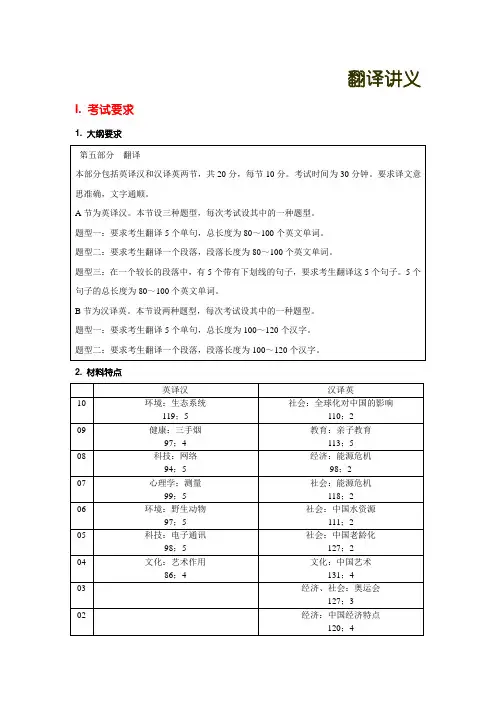
翻译讲义I. 考试要求1. 大纲要求2. 材料特点II. 英译汉1. 步骤:1) 找断点:介词、连词、标点符号五大逻辑关系:转折:conj. [Although though while even if, even though S V,] S V…. Prep. In spite of…. Despite…. Instead of….Adv. however, nevertheless, but因果:原因状语conj because since as in that now thatI was late [because there was a traffic jam]Prep because of…. Own to…. Due to….结果。
so that so + adj. / adv. that…..The traffic was so heavy [that I was late]目的so that in order thatSo as to do…. In order to do…条件if provided that S V…. supposing that…Given that …..unless = if notprep. Givenbut for but that 要不是并列和递进And A B and C adj. adj. and adj.V1 V2 and V3S V, SV and S V….总分:such n. as A B and Cn. such as A B and Ce.g.: such energy as sun, wind and tide.First second从句的连词定语从句That which whose who whom asWhere when why名词从句What how;how many how muchif whether…. 是否2) 找主谓S VTips: 1 be am is are was were2. 情态V + do….3. have has had + done4. do does did….3) 逻辑关系4) 组织语言e.g. 1. I || let bird <out of his cage>, you || see, this morning, and he ||’s disappeared.我让鸟出来他的笼子,你知道,今天早上,并且他不见了是这样的,我今天早上把小鸟放出笼子,他不见了Let sth./sb. <Adj./do/prep…>___________________e.g. 2. Although the object (of the annual performance review) || is to improve performance, it often || has the opposite result.尽管目标年度行为表现评估年度绩效评估为了提高行为表现,它经常有相反的结果尽管年度绩效评估的目标是为了改善工作表现,但是它经常适得其反___________________e.g. 3. It || is a very common belief that the problems (of the population explosion) || are caused mainly by poor people (living in poor countries) (who || do not know enough to limit their reproduction).It || is a very common belief that S V…人们|| 【普遍】认为People commonly believe that…Tips: n n 表功能MBA master of business administrationAdj. n.Doing + n.A swimming boy 现在分词表状态A swimming pool 动名词表功能n. (doing….) (who…..) 定语的翻译拆译法Do you know the lady (who lives in the next door)?住在隔壁的女士你认识那位女士吗,她就住在隔壁人们|| 【普遍】认为人口爆炸的问题主要是由生活在贫困国家的贫困人口造成的,他们对限制生育了解不足。
翻译讲义(19)
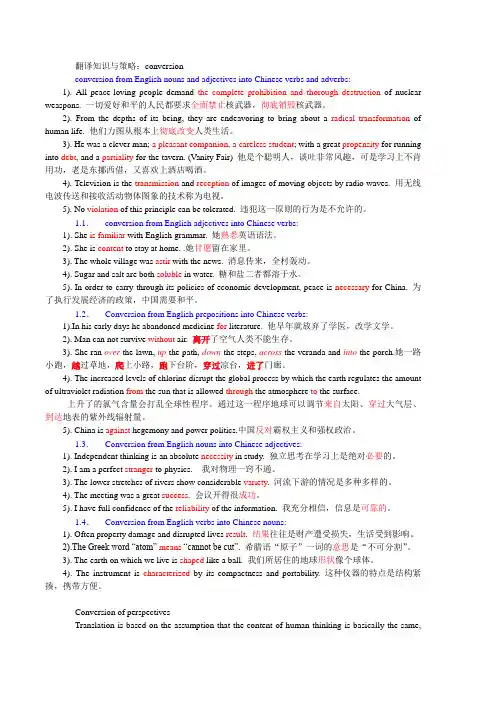
翻译知识与策略:conversionconversion from English nouns and adjectives into Chinese verbs and adverbs:1). All peace-loving people demand the complete prohibition and thorough destruction of nuclear weaspons. 一切爱好和平的人民都要求全面禁止核武器,彻底销毁核武器。
2). From the depths of its being, they are endeavoring to bring about a radical transformation of human life. 他们力图从根本上彻底改变人类生活。
3). He was a clever man; a pleasant companion, a careless student; with a great propensity for running into debt, and a partiality for the tavern. (V anity Fair) 他是个聪明人,谈吐非常风趣,可是学习上不肯用功,老是东挪西借,又喜欢上酒店喝酒。
4). Television is the transmission and reception of images of moving objects by radio waves. 用无线电波传送和接收活动物体图象的技术称为电视。
5). No violation of this principle can be tolerated. 违犯这一原则的行为是不允许的。
1.1.conversion from English adjectives into Chinese verbs:1). She is familiar with English grammar. 她熟悉英语语法。
翻译讲义(18)
作业讲评In the future days, which we seek to make secure, we look forward to a world founded upon four essential human freedoms.The first is freedom of speech and expression--everywhere in the world.The second is freedom of every person to worship God in his own way everywhere in the world.The third is freedom from want, which, translated into world terms, means economic understandings which will secure to every nation a healthy peacetime life for its inhabitants--everywhere in the world.The fourth is freedom from fear, which, translated into world terms, means a world-wide reduction of armaments to such a point and in such a thorough fashion that no nation will be in a position to commit an act of physical aggression against any neighbor -- anywhere in the world.参考译文(1):我们期待,在我们尽力确保安定的未来日子里,能够建立一个基于人类不可缺少的四大自由之上的世界。
四级翻译讲义
大学英语四级翻译讲义英语翻译三步曲第一:找主干第二:定时态第三:加修饰第一、找主干什么是句子的主干?――主要成份第二、定时态如何确定时态?找信号词A一般现在时信号词:现在、是、总是、给谓语构成:be动词(am/is are)动词原形(do/does)B 一般过去时信号词:过去某个具体时间点(从前、早在、在2011年,朝代)相传,据说谓语构成:be(was,were)或者didC.现在完成时信号词:(副词)到目前为止,已经,自从,在近……以来,早就(助词)了,过,结构:have/ has + done (动词的过去分词)表示完成时的时间状语标志D.一般将来时信号词:将来、会、可以…谓语构成:will (be going to)+doE 现在进行时信号词:正在、此时此刻、(助词)正……着谓语构成:be(am/is are)+doingF.情态动词结构:should/may/can/could/must等+do信号词:将,可能,也许时间状语一位帝王于五千年前发现了茶。
(1312四)An emperor found the tea five thousand years ago.在明清期间,茶馆遍布全国。
(1312四)During the Ming and Qing Dynasties, the tea houses were widespread all over the country.几个世纪以来,西湖一直以其秀美风景而闻名于世。
For centuries, the West Lake has been well-known for its beautiful scenery.地点状语“中国结”(Chinese Knot)在中文里意味着爱情,婚姻和团聚。
(1312四)Chinese Knot means love, marriage and reunion in Chinese.好的厨师总是努力在谷物、肉类和蔬菜之间取得平衡. (1312四)Good cooks always try to seek balance among grains, meat and vegetables.方式状语中国应进一步发展核能. (1406四)China should further develop the nuclear energy.食物对健康至关重要.(1312四)Food is crucially important to health.阅读对于中小学生尤为重要.(1406四)Reading is crucially important to primary and middle school students.目的状语为了,针对,以用to do 形式为驱厄运、迎好运,家家户户都会进行大扫除(样题)。
《英汉互译》教案与讲义
《英汉互译》教案与讲义一、教学目标1. 让学生掌握英汉互译的基本原则和技巧。
2. 提高学生对英汉两种语言的对比分析能力。
3. 培养学生的跨文化交际意识,增强英汉互译的实际应用能力。
二、教学内容1. 英汉互译的基本原则1.1 忠实于原文1.2 保持原文的风格和语气1.3 符合目标语言的表达习惯2. 英汉互译的技巧2.1 词汇翻译2.2 语法翻译2.3 结构翻译2.4 文化背景翻译3. 英汉两种语言的对比分析3.1 词汇差异3.2 语法差异3.3 表达习惯差异三、教学过程1. 导入:通过一个简单的英汉互译实例,引发学生对英汉互译的兴趣。
2. 讲解:讲解英汉互译的基本原则和技巧,并通过实例进行分析。
3. 对比分析:分析英汉两种语言的差异,并讲解如何在翻译过程中进行调整。
4. 练习:布置适量的英汉互译练习题,让学生进行实践操作。
四、教学方法1. 讲授法:讲解英汉互译的基本原则、技巧和语言差异。
2. 案例分析法:通过实例分析,让学生理解和掌握英汉互译的方法。
3. 练习法:让学生通过实际操作,提高英汉互译的能力。
五、教学评价1. 课堂参与度:观察学生在课堂上的积极参与情况和提问回答。
2. 练习完成情况:检查学生完成的英汉互译练习质量和数量。
3. 课后反馈:收集学生的课后反馈,了解他们对英汉互译的认识和困惑。
六、教学资源1. 教材:《英汉互译教程》2. 辅助材料:英汉互译案例集、多媒体课件3. 网络资源:相关英汉互译的在线资料和论坛七、教学环境1. 教室:宽敞、安静,有利于学生集中注意力2. 设备:投影仪、计算机、音响等教学设备八、教学进度安排1. 第一课时:介绍英汉互译的基本原则和技巧2. 第二课时:分析英汉两种语言的差异3. 第三课时:讲解英汉互译的实践操作4. 第四课时:布置练习题,进行课堂练习九、课后作业1. 复习本节课的内容,整理笔记2. 完成布置的英汉互译练习题3. 收集英汉互译相关的资料,进行自主学习十、教学反思2. 对学生的反馈进行整理,针对存在的问题进行调整教学策略3. 不断更新教学资源,提高自身教学水平,以更好地为学生服务重点和难点解析一、教学目标难点解析:跨文化交际意识的培养和实际应用能力的提升。
英汉翻译讲义-第五章PPT课件
03
翻译技巧
选词技巧
确定词义
在翻译过程中,需要确定每个 英文单词的准确含义,特别是
那些具有多重含义的单词。
选择合适的词汇
根据上下文和语境选择最合适 的词汇进行翻译,确保译文准 确传达原文的意思。
注意词义的褒贬色彩
在翻译时需要注意英文单词的 褒贬色彩,确保译文的情感色 彩与原文一致。
考虑文化因素
在选词时需要考虑文化因素, 选择符合目标语言文化的词汇 ,避免产生文化冲突或误解。
翻译的过程
理解阶段
在翻译过程中,首先需要对原文 进行深入理解,包括语义、语境、
文化背景等方面的理解。
表达阶段
在理解原文的基础上,译者需要运 用目标语言的表达方式将原文的意 义、情感和风格传达出来。
校对阶段
完成初步翻译后,译者需要进行校 对工作,检查译文中的错别字、语 法错误、表达不流畅等问题,并进 行修正。
英汉翻译讲义-第五章
目 录
• 第五章导言 • 翻译理论 • 翻译技巧 • 实践与案例分析 • 总结与思考
01
第五章导言
章节概述
01
介绍英汉翻译的基本原 则和技巧,包括直译、 意译、音译等。
02
探讨英汉两种语言在词 汇、语法、句法等方面 的差异。
03
分析英汉翻译中的常见 问题,如词义选择、句 子结构调整等。
下章预告
• 第六章:翻译中的修辞手法与风格处理
感谢您的观看
THANKS
根据不同的分类标准,翻译可以分为 多种类型,如文学翻译、科技翻译、 商务翻译等。
翻译的标准
01
02
03
忠实于原文
译文应忠实于原文,准确 传达原文的意义、情感和 风格,不得随意改动或曲 解。