
牛津译林版英语八上练习:Unit5词组句子练习(答案)
一、翻译下列词组
1.居住在野外
2有空
3.同情他们
4实际上
5.看起来像一只白色的老鼠
6.在四个月时候
7.开始学英语
8.第一次
9.学会说话
10.面对严重问题
11.生孩子
12.主要以一种特殊的竹子为生
13.越来越美丽
14.结果因此
15.处于危险中
16.重大约8千克
17.害怕他们
18.学会照顾自己
19.特别的东西
20.在老师的帮助下
21.单独居住
22.捕捉老虎得到他们的皮毛
23.对人类危险
24.团队合作
25.以捕杀为乐
26.保护野生动物
27.需要我们的保护
28.幸福感
28.接受我们的邀请
29.在白天
30.在世界上
31. 关于熊猫的报告
32.动物世界的国王
33.在开始的时候
34.越来越重要
35.立刻采取措施
36.制定法律保护熊猫
37.生病
38.半年以后
39.计算出简单的数学题
40.擅长爬山和游泳
1.你更喜欢哪一张动物,大熊猫还是小松鼠?
2.许多野生动物处于危险之中,它们随时都可能成为桌上的菜肴。
3.事实上我们应该同情那些贫困的农民。
4.我最喜欢狮子,因为它们强壮而且跑得快。
5.一开始我们都很害怕那些动物。
6.我们应该立刻采取措施保护野生动物。
7.我父亲经常鼓励我学好英语。
8.如果明天天气好,他将去动物园。
9.他第一次去了广州。
10.对我们来说,保持教室干净是必要的。
11孩子们没有玩得地方。
12.因为早上赶得太早,下午的时候那个男孩觉得有点累。
13.我们的家乡变得越来越美了。
14.那匹马闭着眼睛站着,它可能在睡觉。
15.有时它们忘记了哪儿可以找到食物。
16.在嘴和耳朵的帮助下,蝙蝠能够按正确的方向飞行。
17.我认为大家应该采取措施来保护野生动物。
18.他们经常以团队形式工作。
19.蜜蜂总是记得他们走过的同样的路。
20.海豚足够聪明能算出简单的数学题目。
一、翻译下列词组
1.居住在野外live in the wild
2有空be free/ have time
3.同情他们have pity on them
4实际上in fact
5.看起来像一只白色的老鼠look like a white mouse
6.在四个月时候at four months old
7.开始学英语begin to learn English
8.第一次for the first time
9.学会说话learn to speak
10.面对严重问题face serious problems
11.生孩子have babies
12.主要以一种特殊的竹子为生live mainly on a special kind of bamboo
13.越来越美丽more and more beautiful
14.结果因此as a result
15.处于危险中be in danger
16.重大约8千克weigh about 8 kilograms
17.害怕他们be afraid of them
18. 学会照顾自己learn to look after oneself
19.特别的东西something special
20.在老师的帮助下with the help of the teacher
21.单独居住live alone
22.捕捉老虎得到他们的皮毛catch tigers for their fur
23.对人类危险be dangerous to humans
24.团队合作work as a team
25.以捕杀为乐kill for fun
26.保护野生动物protect wild animals
27.需要我们的保护need our protection
28.幸福感the feeling of happiness
28.接受我们的邀请accept our invitation
29.在白天in the daytime
30.在世界上in the world
31. 关于熊猫的报告 a report on pandas
32.动物世界的国王the kings of the animal world
33.在开始的时候in the beginning
34.越来越重要more and more important
35.立刻采取措施take action right away
36.制定法律保护熊猫make laws to protect pandas
37.生病get sick
38.半年以后half a year later
39.计算出简单的数学题work out an easy maths problem
40.擅长爬山和游泳be good at climbing and swimming
1.你更喜欢哪一张动物,大熊猫还是小松鼠?
Which animal do you like better, a giant panda or a small squirrel?
2.许多野生动物处于危险之中,它们随时都可能成为桌上的菜肴。
Many wild animals are in danger. They may become dishes on the table any time.
3.事实上我们应该同情那些贫困的农民。
In fact we should have pity on those poor farmers.
4.我最喜欢狮子,因为它们强壮而且跑得快。
I like lions best because they are strong and they can run very fast.
5.一开始我们都很害怕那些动物。
We were very afraid of those animals at the beginning.
6.我们应该立刻采取措施保护野生动物。
We should take action to protect wild animals right away.
7.我父亲经常鼓励我学好英语。
My father often encourages me to learn English well.
8.如果明天天气好,他将去动物园。
He will go to the zoo if it is fine tomorrow.
9.他第一次去了广州。
He went to Guangzhou for the first time.
10.对我们来说,保持教室干净是必要的。
It’s necessary for us to keep the classroom clean.
11孩子们没有玩得地方。
The children have nowhere to play.
12.因为早上赶得太早,下午的时候那个男孩觉得有点累。
The boy felt a little tired in the afternoon because of getting up too early in the morning.
13.我们的家乡变得越来越美了。
Our hometown is getting more and more beautiful.
14.那匹马闭着眼睛站着,它可能在睡觉。
The horse is standing with its eyes closed .It may be sleeping.
15.有时它们忘记了哪儿可以找到食物。
Sometimes they forget where to find the food.
16.在嘴和耳朵的帮助下,蝙蝠能够按正确的方向飞行。
With the help of their mouths and ears bats can fly the right way.
17.我认为大家应该采取措施来保护野生动物。
I think everybody should act to protect wild animals.
18.他们经常以团队形式工作。
They often work as a team.
19.蜜蜂总是记得他们走过的同样的路。
Bees always remember the same way as they went.
20.海豚足够聪明能算出简单的数学题目。
Dolphins are clever enough to work out easy maths problems.。
Unit5课课练词组句型默写版 牛津译林版八年级英语上册
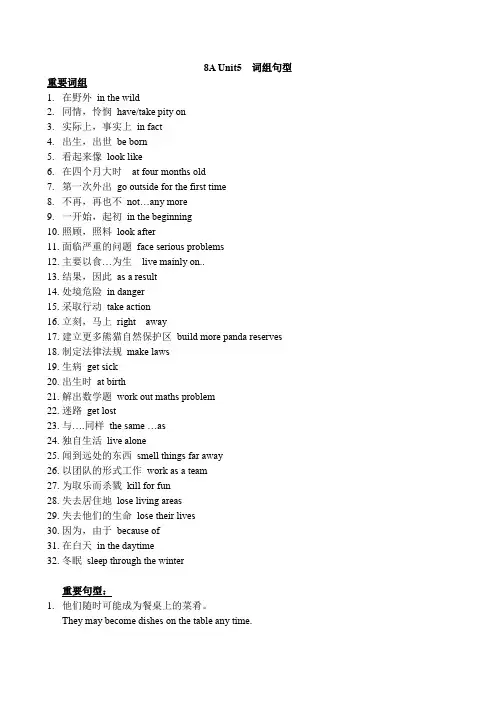
8A Unit5 词组句型重要词组1.在野外in the wild2.同情,怜悯have/take pity on3.实际上,事实上in fact4.出生,出世be born5.看起来像look like6.在四个月大时at four months old7.第一次外出go outside for the first time8.不再,再也不not…any more9.一开始,起初in the beginning10.照顾,照料look after11.面临严重的问题face serious problems12.主要以食…为生live mainly on..13.结果,因此as a result14.处境危险in danger15.采取行动take action16.立刻,马上right away17.建立更多熊猫自然保护区build more panda reserves18.制定法律法规make laws19.生病get sick20.出生时at birth21.解出数学题work out maths problem22.迷路get lost23.与….同样the same …as24.独自生活live alone25.闻到远处的东西smell things far away26.以团队的形式工作work as a team27.为取乐而杀戮kill for fun28.失去居住地lose living areas29.失去他们的生命lose their lives30.因为,由于because of31.在白天in the daytime32.冬眠sleep through the winter重要句型:1.他们随时可能成为餐桌上的菜肴。
They may become dishes on the table any time.2.—那么请您不要吃它们,好吗?—不可能。
So could you please not eat them?No way.3.你最喜欢什么野生动物?What wild animals do you like best?4.八个月后她就不再是个小宝宝了,并且体重超过35千克。
译林版八年级上册英语Unit 5 单元练习(包含答案)
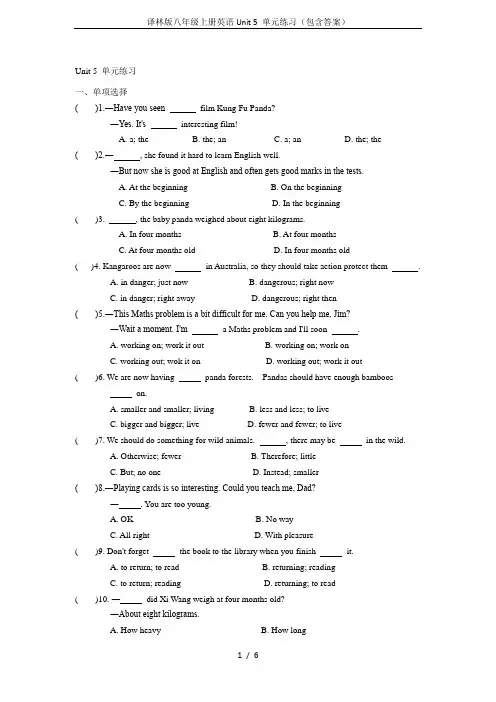
Unit 5 单元练习一、单项选择( )1.―Have you seen film Kung Fu Panda?―Yes. It's interesting film!A. a; theB. the; anC. a; anD. the; the( )2.―, she found it hard to learn English well.―But now she is good at English and often gets good marks in the tests.A. At the beginningB. On the beginningC. By the beginningD. In the beginning( )3. , the baby panda weighed about eight kilograms.A. In four monthsB. At four monthsC. At four months oldD. In four months old( )4. Kangaroos are now in Australia, so they should take action protect them .A. in danger; just nowB. dangerous; right nowC. in danger; right awayD. dangerous; right then( )5.―This Maths problem is a bit difficult for me. Can you help me, Jim?―Wait a moment. I'm a Maths problem and I'll soon .A. working on; work it outB. working on; work onC. working out; wok it onD. working out; work it out( )6. We are now having panda forests. Pandas should have enough bambooson.A. smaller and smaller; livingB. less and less; to liveC. bigger and bigger; liveD. fewer and fewer; to live( )7. We should do something for wild animals. , there may be in the wild.A. Otherwise; fewerB. Therefore; littleC. But; no oneD. Instead; smaller( )8.―Playing cards is so interesting. Could you teach me, Dad?―. You are too young.A. OKB. No wayC. All rightD. With pleasure( )9. Don't forget the book to the library when you finish it.A. to return; to readB. returning; readingC. to return; readingD. returning; to read( )10. ―did Xi Wang weigh at four months old?―About eight kilograms.A. How heavyB. How longC. How muchD. How many( )11. Do you write a report wild animals danger for the newspaper?A. about; onB. in; withC. to; fromD. on; in( )12. He spent a lot of time on English. , he got the most points in the English test.A. In factB. OtherwiseC. As a resultD. However( )13. We should have on the homeless people and try our best to help them.A. shameB. pityC. reportD. danger( )14. ―Is David coming by train?―He sho uld, but he not. He likes driving his car.A. canB. needC. mayD. must( )15.―Excuse me, but do we have any sandwiches, Mum?―. You'd better get some by yourself.A. NothingB. NoC. NoneD. Not anything二、完形填空One day, I heard an American boy say to a Chinese girl student, "You speak very good English." But the girl answered, "No, no. My English is very poor. " The foreigner was quite 1at the answer. Thinking he had not made himself understood or the girl had not 2 him clearly, he said, "Yes, indeed, you speak very well. " 3 the girl still kept saying, "No." In the end, the American boy could not understand and didn't know what to say.What's wrong with the girl's answer? She didn't 4 a compliment(恭维) in the same way as the American people do. She should answer, "Thank you" instead of "No". She 5 understood what the American boy had said, but she thought she should be modest. In the west, people will feel proud and 6 when they are praise. So if someone says the 7 you have cooked are very delicious, you should say, "Thank you".In our country we think being modest is a virtue(美德)and being proud is a bad thing, but in my opinion, being confident does not 8 being proud, so sometimes you should be confident instead of being modest.9 you are modest and say, "No. I'm afraid I can't do it well.”While working in a western country, the others may think that you really cannot do it. If you often say "No", you will certainly be looked down upon by 10 . When asking for a job, if one says something like "Yes. I can certainly do it" instead of "Let me have a try", he or she will expect to get it. So in the west, you should be brave to show your self-confidence.( )1. A excited B. surprised C. relaxed D. frightened ( )2. A. heard B. watched C. listened to D. looked at ( )3. A. Though B. Although C. Or D. But( )4. A. receive B. accept C. refuse D. disagree( )5. A. hardly B. really C. rarely D. badly( )6. A. dutiful(尽职的) B. modest C. shameful D. confident(自信的) ( )7. A. dishes B. cups C. glasses D. bowls( )8. A. think B. say C. mean D. ask( )9. A. Unless B. Until C. If D. Whether( )10. A. another B. the other C. others D. the others三、阅读理解AA tree frog is a frog that spends most of its life in trees. It likes living in very tall trees or other high-growing plants. These frogs do not often descend to the ground, except to mate and spawn(产卵)-some build nests (巢)on leaves and during their adult lives, do not leave the trees at all.Tree frogs are usually small, as their weight has to be carried by the twigs(小枝、嫩枝)of their homes. They are not easy to find. The back colour of tree frogs is usually bright green, but many tree frogs can change their colours; when resting on barks(树皮)they are usually bright brownish(褐色的)gray. On green leaves, they stay green. On green branches(树枝),they turn brown. Some of them can change from green to gold or blue.Tree frogs have legs and wide feet. They have sticky(粘性的)pads(掌肉)on the end of their toes. These sticky toe pads kip than from falling from the trees.Tree frogs can be alt different colours. Their eyes are different colours too. Some have green eyes, some gray. Some frogs' eyes are gold, and some are bright red.The sounds they make in spring and summer are different too. One frog makes a sound like dog barking. Another frog makes a loud noise like a snore(鼾声).There is even a frog that whistles(口哨)!Isn't it interesting?( )1. From the passage, we can learn that tree frogs build their nests .A. on short treesB. on tall treesC. on large treesD. on small trees( )2. The underlined word "descend" here means .A. run away fromB. come downC. live inD. make holes( )3. Tree frogs are difficult to find because they .A. can stand on their toesB. can make dog barking soundsC. can change coloursD. have sticky pads( )4. The sticky pads can .A. change tree frogs' FloursB. stop tree frogs from falling from the treesC. help tree frogs jump fasterD. change tree frogs' sounds( )5. According to the passage, the tree frog .A. is usefulB. can be different coloursC. is usually strongD. spends all its life in treesBIf you have no special plans for your holidays, why not spend your time helping others?Don't listen to people who say the young people today often think only of themselves. It's not true at all. More and more people in the USA volunteer to spend their school holidays working for others. And they don't do it for money. Here are some of their stories.Alice Hamilton, 17I'm going to help the Forest Centre build new hiking paths in the mountains. It's going to be terrific-I'll spend the whole summer living in the tent and breathing(呼吸)the clean mountain air. I'm going to sleep under the stars. It'll be a nice sport, and I'll be able to do something good at the same time.Jason Moore, 18This summer, I'm going to volunteer with Special House Program. They build good, low-cost houses and sell them to families that are not very rich. They'll teach me what to do, so I'll help people and also have a chance to learn how to build houses.Trish Anderson, 16I'm going to teach kids who have trouble reading. I'll work for a program called Reading For Life. Every day, I'm going to help kids choose and read books that they like. I want to be a teacher and I love children and reading, so this is going to be a great experience(经历)for me. ( )1. Young people in the USA volunteer to spend helping others.A. school holidaysB. weekdaysC. every morningD. every afternoon( )2. What does Alice volunteer to do in summer?A. To breathe the clean mountain air.B. To spend the whole summer living in the tent.C. To sleep under the stars.D. To help build new hiking paths in the mountain.( )3. From the passage, we know that special House Program helps .A. children in poor familiesB. workers who build housesC. poor families that can't afford housesD. build hiking paths( )4. wants to be a teacher.A. Alice HamiltonB. Trish AndersonC. Jason MooreD. none of them( )5. Which is the most possible title for this passage?A. Reading for lifeB. A Special House ProgramC. The Forest CentreD. Young American V olunteers四、词汇运用A.根据句意及所给汉语注释或首字母提示,写出单词的正确形式。
【最新】牛津译林版八年级英语上册Unit5 词汇练习
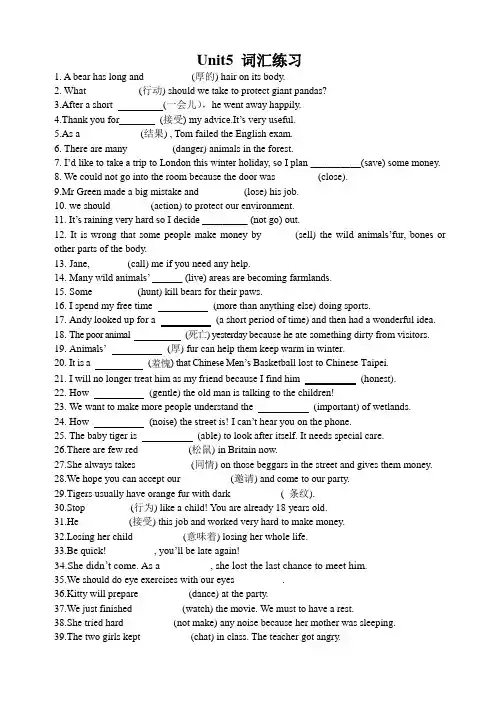
Unit5 词汇练习1. A bear has long and _________(厚的) hair on its body.2. What __________(行动) should we take to protect giant pandas?3.After a short (一会儿),he went away happily.4.Thank you for (接受) my advice.It’s very useful.5.As a ___________ (结果) , Tom failed the English exam.6. There are many ________ (danger) animals in the forest.7. I’d like to take a trip to London this winter holiday, so I plan __________(save) some money.8. We could not go into the room because the door was ________(close).9.Mr Green made a big mistake and ________ (lose) his job.10. we should _______ (action) to protect our environment.11. It’s raining very hard so I decide _________ (not go) out.12. It is wrong that some people make money by ______(sell) the wil d animals’fur, bones or other parts of the body.13. Jane, _______(call) me if you need any help.14. Many wild animals’ ______ (live) areas are becoming farmlands.15. Some ________ (hunt) kill bears for their paws.16. I spend my free time (more than anything else) doing sports.17. Andy looked up for a (a short period of time) and then had a wonderful idea.18. The poor animal (死亡) yesterday because he ate something dirty from visitors.19. Animals’ (厚) fur can help them keep warm in winter.20. It is a (羞愧) that Chinese Men’s Basketball lost to Chinese Taipei.21. I will no longer treat him as my friend because I find him (honest).22. How (gentle) the old man is talking to the children!23. We want to make more people understand the (important) of wetlands.24. How (noise) the street is! I can’t hear you on the phone.25. The baby tiger is (able) to look after itself. It needs special care.26.There are few red _________ (松鼠) in Britain now.27.She always takes __________ (同情) on those beggars in the street and gives them money.28.We hope you can accept our _________ (邀请) and come to our party.29.Tigers usually have orange fur with dark _________ ( 条纹).30.Stop ________ (行为) like a child! You are already 18 years old.31.He _________ (接受) this job and worked very hard to make money.32.Losing her child _________ (意味着) losing her whole life.33.Be quick! _________, you’ll be late again!34.She didn’t come. As a _________, she lost the last chance to meet him.35.We should do eye exercises with our eyes _________.36.Kitty will prepare _________ (dance) at the party.37.We just finished _________ (watch) the movie. We must to have a rest.38.She tried hard _________ (not make) any noise because her mother was sleeping.39.The two girls kept _________ (chat) in class. The teacher got angry.40.__________ (make) laws for the wild animals is very important.41.Do you remember _________ (post) the letter for me?42.Would you like _________ (join) the school trip to Wuxi?43.At the ________ (begin) of next month, we’ll go on a school trip.——Where __________ (be) you born? ——I _________ (be) born in Suzhou.44. Doing eye exercises is good for _________(保护) our eyes.45. We hope you can accept our ______________(邀请).46. We hope you can _____________(提供)us with some information about shopping online.47. Kanas Lake is a beautiful place. A large number of ____________(旅游者) come here to enjoy themselves every year.48. Thanks to Lily’s _________(极好的) advice! I fee better now.49. Don’t worry. There is enough ________(空间) for you to park a car.50. We hope the local _______________(政府) will take action to call on people to plant trees.51. Jack is so smart that he can answer these questions ____________(容易地)。
英语八年级上译林牛津版unit5 练习(含答案)

英语八年级上译林牛津版Unit5巩固检测(含答案)Unit 5 Comic and welcome to the unitI. 从方框中选择合适的选项完成句子。
1. Her __________ made me feel sad deeply.2. Many people __________ during famines(饥荒) those years.3. It doesn’t look like a __________ fox.II. 根据汉语意思写单词完成句子。
1. These animals like living in the __________(自然环境).2. Everyone longs for living a __________(自由的) life.3. It is always polite to let elder people at the table taste every__________(一道菜) first.III. 单项选择。
( )1. Why not __________ with the most interesting one?A. staringB. to startC. startD. to starting( )2. The villagers had pity _____ the hungry travelers and gave them some hot food.A. inB. onC. forD. to( )3. —Could you leave the cake for Amy?— __________. It’s only for me.A. No way.B. So what?C. What for?D. You too.( )4. —Your pencil case looks really beautiful.—Thanks. But __________, Gina’s looks better than mine.A. of courseB. not at allC. I’m afraid notD. in fact Unit 5 Reading AI. 根据句意及首字母提示完成单词。
牛津译林版八年级上册 知识点+同步练习(带答案)

8.(not go) near the tigers!They may hurt you.o15daoM To
9.Would you please(protect) our forests by doing little things?
He doesn't know what to do next.他不知道下一步做什么。
1 .-Do you have any places for the coming vacation? Sure.We decideFrance in July.
A.visit B.visiting C.visited D.to visit
10.At the(begin) of the concert,Tan Dun played a piece of music with water.
三、单项选择。
( ) 1.一Daniel,do you know that bees never get lost?
一Yes.Bees always rememberthe same way as they went.
4.This book is much(厚) than that one.I'll take that one.
5.The(失去) of living areas makes tigers have nowhere to live.
6.People sometimes(猎杀) tigers for their fur.
No,you mustn't.不,你不可以。
1.一Will Anna go to the movies with us tonight?-Shego,but I'm not sure.
译林牛津版英语八年级上册 Unit 5 考点讲义+练习(有答案)
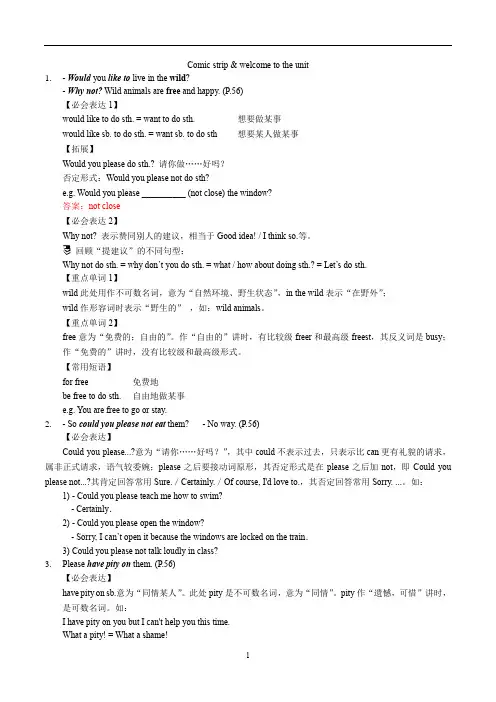
Comic strip & welcome to the unit1.- Would you like to live in the wild?- Why not? Wild animals are free and happy. (P.56)【必会表达1】would like to do sth. = want to do sth. 想要做某事would like sb. to do sth. = want sb. to do sth想要某人做某事【拓展】Would you please do sth.? 请你做……好吗?否定形式:Would you please not do sth?e.g. Would you please __________ (not close) the window?答案:not close【必会表达2】Why not? 表示赞同别人的建议,相当于Good idea! / I think so.等。
回顾“提建议”的不同句型:Why not do sth. = why don’t you do sth. = what / how about doing sth.? = Let’s do sth.【重点单词1】wild此处用作不可数名词,意为“自然环境、野生状态”,in the wild表示“在野外”;wild作形容词时表示“野生的”,如:wild animals。
【重点单词2】free意为“免费的;自由的”。
作“自由的”讲时,有比较级freer和最高级freest,其反义词是busy;作“免费的”讲时,没有比较级和最高级形式。
【常用短语】for free免费地be free to do sth.自由地做某事e.g. You are free to go or stay.2.- So could you please not eat them? - No way. (P.56)【必会表达】Could you please...?意为“请你……好吗?”,其中could不表示过去,只表示比can更有礼貌的请求,属非正式请求,语气较委婉;please之后要接动词原形,其否定形式是在please之后加not,即Could you please not...?其肯定回答常用Sure./Certainly./Of course, I'd love to.,其否定回答常用Sorry. ...。
牛津译林版英语八上练习:Unit5
Unit 5 Wild animals第1课时Welcome to the unit一、根据提示,写出单词。
1. Would you like to live in the ______________(野外)?2.Will you be ____________(有空) tomorrow?3. The ___________(道菜) on the table taste delicious!4. Look at these____________(斑马), how lovely they are!5. He didn’t pass the driving test, what a ____________(遗憾)!6. His grandfather _____________(死) two years ago.7.How many __________(海豚) are there in the water?8.My sister likes __________ _______(大熊猫) best.9.One of the_______________(松鼠) is very clever, it is eating some nuts.10.Many animals are in ____________(危险).二、完成下列词组和句子。
1. 事实上_____________________2. 没门_____________________3. 你想住在野外吗?______________________________________________________?4. 为什么不呢?野外动物很自由很快乐。
_________________? __________________________________________________.5. 我不这么认为。
______________________________________________________.6. 野生动物随时会成为桌上的菜。
牛津译林版八年级上学期Unit5-6考点词汇精选精练(有答案)
一、根据句意及首字母提示完成单词(共l0小题,每小题l分,计l0分)1. _________(令人悲伤的是),I los t my mobi l e phone las t Sunday.2. Our Engl i sh t eacher to ld us tha t a good ________(开始)i s ha l f done.3. Chinese __________(政府)and peop le a r e t ry ing to he lp t he b i rds in Zha long.4. He can see the words on the b l ackboard (清晰地) wi th h i s new g lasses.5. The __________(自然的)wor ld i s fu l l o f amaz ing th ings.6. Can you ___________(描述)the works o f a r t fo r me?7. The ___________ (主席) o f our soc ie ty i s r ead i ng my app l ica t ion le t t e r.8.Would you help me wi th the ___________(报告)?9.We wi l l he lp people unders tand the i___________of the wet lands.10. Please have p ___________on wild animals and don’t eat them.二、用所给单词的适当形式填空(共10小题,每小题l分,共l0分)1. A lo t o f _______(tour)come t o v i s i t Nan j ing i n sum mer every year.2.Jack wants to be a speaker because he i s in te rest ed in ________(g ive)t a lks.3. Now there a re f ewer and fewer _________(wol f)in the wor ld t han before.4. Father is sleeping. You’d better walk ____________ (quiet).5.I may no t pass the exam ___________(wi th) your he lp.6.Think carefully while reading. Then we’ll have a ________(discuss) about the topic.7. Many people dec ided ___________(do)something fo r those poor ch i ld ren.8. Farmers o f ten a sk the boys ___________(not wa lk)on the c r op land.9.We of ten see her ___________(read) Eng l i sh under the b ig t r e e.10. S tuden ts go t o the rese rve every year (watch)the b i rds.三、词汇(每题1分,计10分)1.The Chinese g ___________shou ld t ake ac t ion to p ro tec t the wild an imals.2.Gian t pandas l ive _________(主要的) on a s pec ia l k ind of bam boo.3.I’m g lad that the t r a in a r r ived a t _________[ɪɡ'zækt l i] 8 o’c l ock.4.I t i s sa id that Mr. Smi th faces _________(严重的)prob lems r ecen t ly.5. A grea t number o f t__________ come to v i s i t Xi j in Fer ry every year.6.He spends as much t ime as poss ib le___________(prac t ice) Engl i sh every day.7.Somet imes i t i s _________(na tu re)to ask people wha t peop le wil l be wi thou t Steve Jobs.8.As we a l l know,swal lows f ly t o ___________ (nor th)count r ie s in sum mer.9.We shou ld s top them f rom___________(hunt)an imals in the rese rve.10.There ___________(be)l e s s space fo r wi ld l i f e in the wor ld.四、词汇运用(共15小题;每小题1分,满分15分)(A)根据句意和汉语注释,写出单词的正确形式。
牛津译林版英语八年级Unit5阅读理解单元练习(含答案)
八年级Unit5阅读理解单元练习一、完形填空Ashley was outspoken, fashionable, and the “Queen Bee” in my school.I looked up to her and admired her. I listened to the music she listened to, wore theclothes she wore. I even took art class though I had really wanted to take theatre. I finallyfitted in her group.One day, I skipped (溜走) out of my last class a few minutes early to 1 seatsfor our group at the dining hall. Focusing on my homework, I didn't notice they had sat down behind me. Before I could say a word, I realized what they were talking about.I listened silently. “She's such a loser,” one girl said.Another girl added, “Ashley, she 2 follows you, trying to copy you.”“I wish she would leave us alone. We were in the same summer school and now she thinks we’re best friends.” The once familiar voice sounded so 3 and strange.I felt really mortified (尴尬的). My hands were shaking. I couldn't help crying sadly. I felt heart-broken for the very first time. How did this happen? I 4 we were friends.I ran home. My mother just held me while I cried for hours. The advice she gave was so 5 , and I had heard it a million times. “Just be yourself and people will like you for 6 you are.” This time it became so meaningful. Then and there I 7 to find myself back. That was exactly what I did.Over the next month, I went through a lot of 8 . I bought new clothes that I wanted to wear. I no longer went to art class with them, and took theatre. I began making new friends. I developed my own 9 and never again followed the crowd.I had an amazing school year. When I look back, I think it was the year when I discovered the person I was going to be. Despite (尽管) the pain I felt that day, it was a 10 they had given me.1. A. get B. buy C. cover D. move2. A. hardly B. always C. never D. sometimes3. A. serious B. special C weak D. cold4. A. found B. dreamed C. realized D. thought5. A. funny B. simple C. useful D. different6. A. where B. what C. how D. who7. A. failed B. forgot C. decided D. continued8. A. pains B. doubts C. changes D. troubles9. A skills B. habits C. projects D. opinions10. A. gift B. chance C. promise D. surprise二、阅读理解It was Day 1 of our vacation on Cortes, a beautiful quiet island. “iPhone, iPhone, iPhone,” my son kept moaning (呻吟). In front of him was a big window facing the blue ocean. And a cool gentle wind was coming in from the door. Clearly, he saw and felt none of it.Back at home, I’d soon give up and hand the phone over to him after five minutes of listening to this kind of moaning.But not here, before we left, I had told my 10-year-old son the rule—no e-mails, no Facebook, no video games, and no iPhone. We came here to get away from them all. Here we were on our first day and already, he couldn’t stand it.▲I walked down the grass road to the beach and looked out to the sea. My 6-year-old daughter and my husband were drawing on pieces of wood. They were doing just fine.On Day 2, we spent the whole morning digging for shells(贝壳). This time, my son joined us. He collected shellfish and other sea treasures. When we got back to our little wood house, I gave my son a book, and put him on the lovely garden chair. It was almost dinner when he looked up.。
牛津英语译林版八年级上册 8上 单元评价 Unit 5 (含答案)
牛津英语译林版八年级上册8上单元评价Unit 5 (含答案)一、听力 (共20小题;每小题1分, 满分20分)第一部分听对话回答问题, 录音读两遍。
1. How did Mike go to the zoo yesterday?2. When will Cindy help to raise money?3. What did Alice learn about?4. What is Jenny’s fath er?5. What will the speakers do on Sunday afternoon?A. Climb the mountains.B. Play tennis.C. Watch the dolphin show.6. What wild animal does Lucy like best?A. Bears.B. Squirrels.C. Tigers.7. What is Bob doing?A. Eating some seafood.B. Doing his homework.C. Looking for the post office.8. What did the boy feed?A. Pigs.B. Chickens.C. Ducks.9. What do most bats eat?A. Insects.B. Fruit.C. Fish.10. What does the girl think of squirrels?A. They are lovely.B. They are clever.C. They are quiet.第二部分听对话和短文回答问题, 录音读两遍。
听一段对话, 回答第11-12小题。
11. What is Bob doing on the computer?A. Playing games.B. Reading news.C. Writing an email.12. What did the two men kill?A. A bear.B. A tiger.C. A lion听第一篇短文, 回答第13-15小题。