
人教版高一英语必修三 unit1 grammar 情态动词课件
人教版高一英语必修三 unit1 grammar 情态动词练习题
情态动词练习题
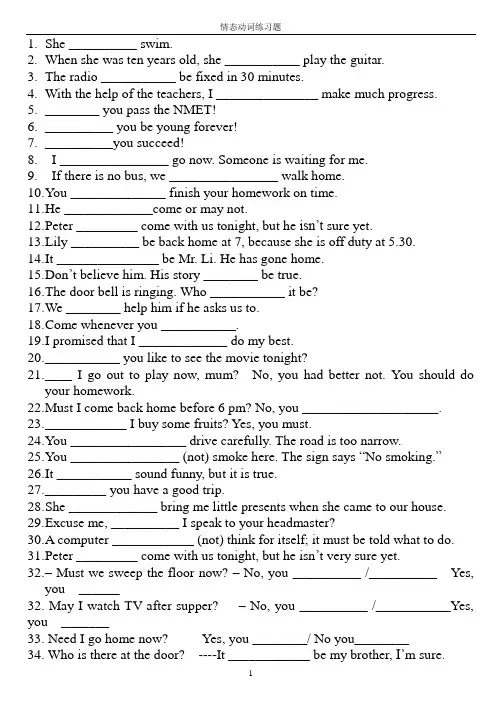
1 1. She __________ swim.
2. When she was ten years old, she ___________ play the guitar.
3. The radio ___________ be fixed in 30 minutes.
4. With the help of the teachers, I _______________ make much progress.
5. ________ you pass the NMET!
6. __________ you be young forever!
7. __________you succeed!
8. I ________________ go now. Someone is waiting for me.
9. If there is no bus, we ________________ walk home.
10. You ______________ finish your homework on time.
11. He _____________come or may not.
12. Peter _________ come with us tonight, but he isn’t sure yet.
13. Lily __________ be back home at 7, because she is off duty at 5.30.
14. It _______________ be Mr. Li. He has gone home.
15. Don’t believe him. His story ________ be true.
16. The door bell is ringing. Who ___________ it be?
高中英语Unit13Lessons3-4Grammar-表示推测的情态动词讲练北师版必修5
表示推测的情态动词
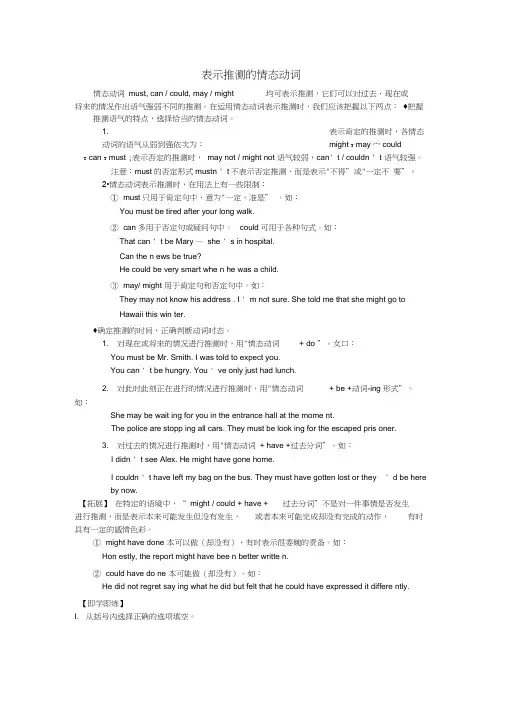
情态动词 must, can / could, may / might 均可表示推测,它们可以对过去、现在或
将来的情况作出语气强弱不同的推测。在运用情态动词表示推测时,我们应该把握以下两点: ♦把握推测语气的特点,选择恰当的情态动词。
1. 表示肯定的推测时,各情态动词的语气从弱到强依次为: might T may宀could
T can T must ;表示否定的推测时, may not / might not 语气较弱,can' t / couldn ' t 语气较强。
注意:must的否定形式mustn ' t不表示否定推测,而是表示"不得”或"一定不 要”。
2•情态动词表示推测时,在用法上有一些限制:
① must只用于肯定句中,意为"一定,准是” 。如:
You must be tired after your long walk.
② can多用于否定句或疑问句中。 could可用于各种句式。如:
That can ' t be Mary — she ' s in hospital.
Can the n ews be true?
He could be very smart whe n he was a child.
③ may/ might 用于肯定句和否定句中。如:
They may not know his address . I ' m not sure. She told me that she might go to
Hawaii this win ter.
♦确定推测的时间,正确判断动词时态。
1. 对现在或将来的情况进行推测时,用"情态动词 + do ”。女口:
You must be Mr. Smith. I was told to expect you.
You can ' t be hungry. You ' ve only just had lunch.
最新2019-2020学年人教版英语必修三Unit2_Grammar课时作业有答案-(高一)
..
.. 《Unit 2 Healthy eating Grammar & Writing》
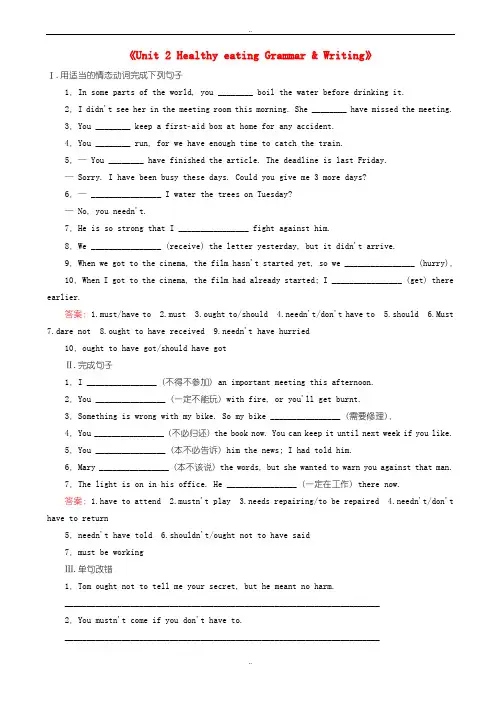
Ⅰ.用适当的情态动词完成下列句子
1.In some parts of the world, you ________ boil the water before drinking it.
2.I didn't see her in the meeting room this morning. She ________ have missed the meeting.
3.You ________ keep a firstaid box at home for any accident.
4.You ________ run, for we have enough time to catch the train.
5.— You ________ have finished the article. The deadline is last Friday.
— Sorry. I have been busy these days. Could you give me 3 more days?
6.— ________________ I water the trees on Tuesday?
— No, you needn't.
7.He is so strong that I ________________ fight against him.
8.We ________________ (receive) the letter yesterday, but it didn't arrive.
9.When we got to the cinema, the film hasn't started yet, so we ________________ (hurry).
10.When I got to the cinema, the film had already started; I ________________ (get) there
20172018学年高中英语专题Unit1Art3Grammar&Writing试题(含解析)新人教版选修6

百度文库 - 让每个人平等地提升自我
1 Unit 1 Art
1.3 Grammar & Writing
Grammar: 虚拟语气(Ⅰ)(Subjunctive Mood (Ⅰ))
一、语气的分类
语气是动词的一种形式,表示说话人对某一行为或事情的看法或态度。英语中的语气分为陈述语气、祈使语气和虚拟语气三类。
1.陈述语气
表示动作或状态是现实的、确定的或符合事实的,用于陈述句、疑问句和某些感叹句。
☛There are two sides to every question.每个问题都有两面性。
2.祈使语气
表示说话人对对方的请求或命令。
☛Please lend me your dictionary.请把你的字典借给我用一下。
3.虚拟语气
用来表示所说的不是事实,或者是不可能发生的情况,而是一种假设、愿望或建议等。虚拟语气通过谓语动词的特殊形式来表示。
☛If I were a bird,I could fly in the air.
如果我是一只小鸟,我就能在空中飞行。
二、 虚拟语气在条件句中的应用
包含条件从句的句子称为条件句。条件句分为两类:一类是真实条件句,一类是虚拟条件句。
如果假设的情况很可能发生,就用真实条件句。
☛If he has time, he wil come. 如果他有时间,他会来的。
☛He won’t succeed unless we plan well. 他不会成功的,除非我们计划好。
如果假设的情况发生的可能性不大,则用虚拟条件句。虚拟条件句分为三种,见下表:
假设情况 条件从句的谓语形式 主句的谓语形式
与现在事实相反 过去式(be的过去式常用were) would/should/might/could + 动词原形
与将来事实相反 (1) 过去式
(2)should + 动词原形 would/should/might/could + 动词原形 百度文库 - 让每个人平等地提升自我
高中英语Unit3SportsandfitnessSectionⅢGrammar——附加疑问句教案(含解析)新人教版必修1
- 1 - Section Ⅲ Grammar——附加疑问句
语 境 自 主 领 悟
先观察原句 后自主感悟
1.Wonderful gym,isn't it?
2.This isn't your first time here,is it?
3.You come here often,don't you?
4.But it won't make me too tired,will it?
e along and join us,will
you? 附加疑问句,又称反意疑问句,主要用于口语,其作用是说话人向对方验证自己的陈述或者判断,也可以用祈使句表示请求或者建议,在句子结构上前半部分为陈述句,后半部分是前面部分的简短问句,如果前半部分为肯定句,后半句的简短问句则为否定式;如果前半部分为否定句,后面简短问句则为肯定式。另外如果前半部分句子的主语是名词,在反意疑问句中要改为代词。
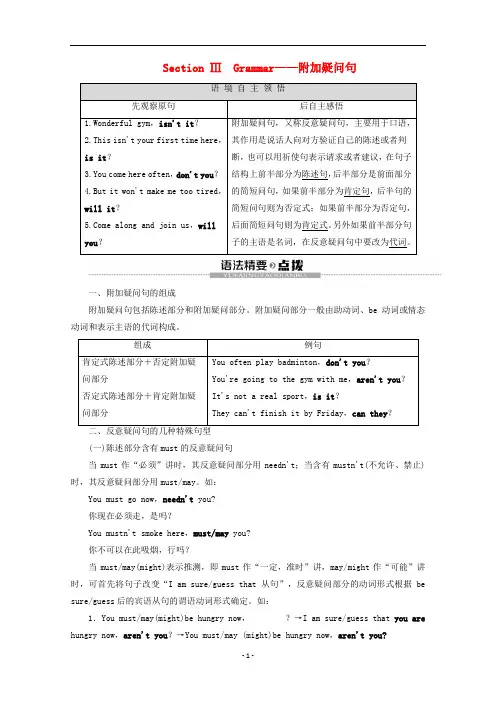
一、附加疑问句的组成
附加疑问句包括陈述部分和附加疑问部分。附加疑问部分一般由助动词、be动词或情态动词和表示主语的代词构成。
组成 例句
肯定式陈述部分+否定附加疑问部分
否定式陈述部分+肯定附加疑问部分 You often play badminton,don't you?
You're going to the gym with me,aren't you?
It's not a real sport,is it?
They can't finish it by Friday,can they?
二、反意疑问句的几种特殊句型
(一)陈述部分含有must的反意疑问句
当must作“必须”讲时,其反意疑问部分用needn't;当含有mustn't(不允许、禁止)时,其反意疑问部分用must/may。如:
You must go now,needn't you?
你现在必须走,是吗?
You mustn't smoke here,must/may you?
人教新课标高中英语必修三Unit 1 Festivals around the world全章教案
人教新课标高中英语必修三Unit 1 Festivals around the world全章教案
I.教学内容分析
本单元的中心话题是“节日”,主要讲述了不同地区不同种类的节日。
Warming Up部分设计了小组活动,通过图表填写让学生区分中国的传统节日与别国节日的异同,目的在于激活学生已有的节日背景知识,引出主题,为以后几堂课学习热身。
Pre-reading 通过几个问题,调动学生已有的知识和经验,激发学生想了解更多节日的好奇心,让他们主动参与到主题教学活动中,为下面学习阅读文章作铺垫。
Reading 部分先简要介绍了一下早期各种节日的起源以及存在的原因,然后又分别介绍了几种世界各地的节日,依次的顺序是亡灵节、纪念名人的节日、丰收节、春天的节日等。
Comprehending 由四个部分组成。第一、三、四部分通过表格形式,第二部分通过让学生回答问题的方式,鼓励学生积极思考,加深对课文的理解。
Learning about Language 部分主要突出了本单元的语法项目——情态动词的用法。这些情态动词主要有:can,could,may,might,will,would,shall,should,must,can’t 等的用法。
Using Language 部分中包括了听、说、读、写几个部分的内容。学生可通过对Trinidad
Carnival、情人节等一些节日的学习,分析问题,锻炼自己的思维能力。阅读后的习题及讨论不仅帮助学生理解文章的主旨大意,更重要的是让学生寻找解决问题的方法。
Learning Tip 部分主要建议学生搜集各种资料,查询与世界各地节日有关的信息,了解各种节日的来源与内涵。
II.教学重点和难点
1. 教学重点 (1) 本单元的生词和短语;
(2) 掌握一些情态动词的基本用法;
(3) 了解有关节日和民俗,掌握有关词汇,如custom,religious等 。
2019-2020学年人教版英语必修三Unit2_Grammar课时作业有答案-(高一)(已纠错)
/
/ 《Unit 2 Healthy eating Grammar & Writing》
Ⅰ.用适当的情态动词完成下列句子
1.In some parts of the world, you ________ boil the water before drinking it.
2.I didn't see her in the meeting room this morning. She ________ have missed the meeting.
3.You ________ keep a firstaid box at home for any accident.
4.You ________ run, for we have enough time to catch the train.
5.— You ________ have finished the article. The deadline is last Friday.
— Sorry. I have been busy these days. Could you give me 3 more days?
6.— ________________ I water the trees on Tuesday?
— No, you needn't.
7.He is so strong that I ________________ fight against him.
8.We ________________ (receive) the letter yesterday, but it didn't arrive.
9.When we got to the cinema, the film hasn't started yet, so we ________________ (hurry).
10.When I got to the cinema, the film had already started; I ________________ (get) there
人教版高一英语必修三unit1 grammar 情态动词练习题
最新试卷
情态动词专项练习题
1. --- Where is Mary?
--- She ____ in the library.She told me she wanted to borrow some books from the library.
A. should be B. must be C. can be D. must have been
2. His room is dark. He must ____ to bed. A. go B. be going C. have gone D. have been gone
3. “Will your father stay home tonight?” “I’m not sure, He ____to work.”
A. must go B. can go C. may be gone D. may be going
4. “Where is Tom?” “He isn’t here I think he ____ have gone home.”
A. may B. must C. might D. A or B or C
5. “I think Helen is at home.”
“ No, she ____ be at home, for she phoned me from the airport just five minutes
ago.”
A. mustn’t B. needn’t C. can’t D. daren’t
6. He’s late. What ____ have happened to him? A. can B. may C. should D, must
英语人教版必修3学案:Unit 1 Section Ⅲ Grammar—情态动词(Ⅰ)
高中英语必修课程
1 Section_ⅢGrammar—
情态动词(Ⅰ)
语法图解
探究发现
①Festivals can also be held to honour famous people.
②Some festivals are held to honour the dead or to satisfy the ancestors, who might return
either to help or to do harm.
③Most ancient festival would celebrate the end of cold weather, planting in spring and
harvest in autumn.
④For the Japanese festival Obon, people should go to clean graves and light incense in
memory of their ancestors.
[我的发现]
以上四个句子都使用了情态动词。其中,第①句中的can表示许可,意为“可以”;第②句中的might表示推测,意为“可能会”;第③句中的would表示过去习惯性动作,意为“过去常会”;第④句中的should表示劝告或建议,意为“应该”。
一、基本特征
1.情态动词有一定的词义,不能单独作谓语,需和实义动词或系动词一起作谓语。
She can speak English though she is six.
尽管她才6岁,但她会说英语。
2.情态动词一般无人称和数的变化,个别情态动词有现在时和过去时两种时态变化。
They must be in the classroom.
他们一定在教室里。 高中英语必修课程
2 3.构成否定句时,not放在其后面。
The young man can't carry the big stone.