
人教版高一英语必修三 unit1 grammar --情态动词
高中英语(人教版)必修3同步讲练:Unit 3 Grammar
1 GRAMMAR
宾语从句和表语从句
【语境展示一】 观察下面句子,并试着归纳宾语从句的用法要点。
1. We never doubt (that) he is honest.
2. Lisa told me (that) she was ill and that she couldn’t go to school the next day.
3. Do you know whether / if any decision has been arrived at?
4. It depends on whether the letter arrives in time.
5. I still don’t know whether or not he’s planning to come.
6. I wondered who phoned this morning.
7. I believe what he told me.
8. The teacher didn’t say whose performance was better.
9. They’re all so pretty. I don’t know which one I should buy.
10. Nobody can tell when she will arrive.
11. None of us knows where these new parts can be bought.
12. Do you know why the door is locked?
13. I wondered how he could make such rapid progress in his French studies.
【自我归纳一】
在复合句中,担任宾语的从句叫宾语从句 (句1—句11)。引导宾语从句的词有:连词that, whether, if(句1—句5);连接代词who, what, whose, which(句6—句9);连接副词when, where, why, how(句10—句13)等。
高中英语必修三 Unit2 Grammar 情态动词

高中英语必修三 Unit2 Grammar 情态动词(二)练习
Review
1. ---Could I borrow your dictionary? ---Yes, of course you____.
A. might B. will C. can D. should
2. — The room is so dirty. _____ we clean it? — Of course.
A. Will B. Shall C. Would D. Must
3. Peter ___come with us tonight, but he isn't very sure yet.
A. must B. may C. can D. will
4. ---Shall I tell John about it? ---No, you ___. I've told him already.
A. needn't B. wouldn't C. mustn't D. shouldn't
5. ---Don't forget to come to my birthday party tomorrow. ---______.
A. I don't B. I won't C. I can't D. I haven't
Exercise
1. I lived with my sister this summer and didn’t have to pay rent. So I _____ save most of my salary.
A. was able to B. would C. could D. should
人教版必修三Unit 1语法专题练习 情态动词
Ⅰ.用适当的情态动词填空
1.When you cross the street, you must be careful with the passing cars.
2.It can’t be his mother, for she has been ill at home for a long time.
3.We enjoy good weather in January, but sometimes it can be terribly cold.
4.I may come to the party with you, but I am not sure.
5.When he was young, he would climb the small hill every morning.
6.—May I take this seat?
—Yes, you may/can.
7.Tom comes from Australia, so he can speak English very well.
8.If you can pass the driving test, you shall get a new car.
Ⅱ.单项填空
1.—I heard they went skating in the mountains last winter.
—It ________ be true because there was little snow there.
A.may not B.won’t
C.couldn’t D.mustn’t
解析:选C。句意:“我听说他们去年冬天去山区滑雪了。”“那不可能是真的,因为那里几乎没有雪。”couldn’t“不可能”,表示有把握的否定推测。may not“可能不”,与语境不符;won’t“不会”;mustn’t“禁止”。
2.— I haven’t got the reference book yet, but I’ll have a test on the subject next
人教版必修3高中英语 必修3 Unit 2 Grammar
Book 3 Unit 2 Healthy eating
Period 4 Grammar (The Modal verbsⅡ)
Learning aim:
To review the Modal verbs in Unit1 and be able to use “will\would\shall\should\ought
to\need”
课前预习案Previewing Case
Task 1
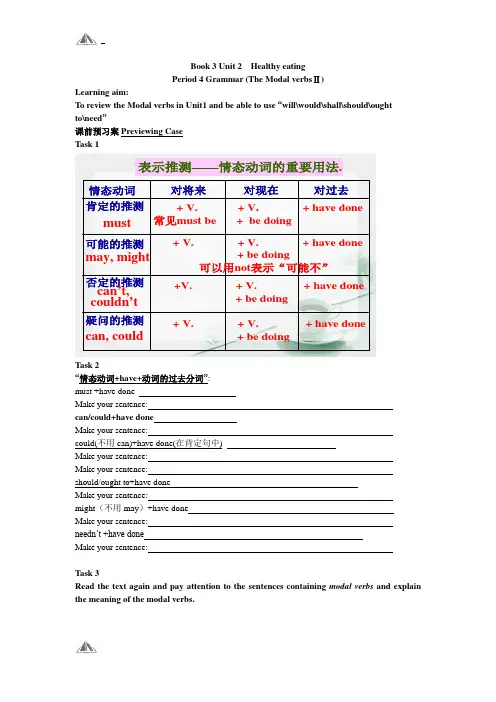
表示推测——情态动词的重要用法.肯定的推测可能的推测否定的推测疑问的推测must对将来对现在对过去情态动词may, mightcan’t, couldn’tcan, could+ V.+ V. + have done常见must be + be doing+ V. + V. + have done+ be doing可以用not表示“可能不”+V. + V. + have done+ be doing+ V. + V. + have done+ be doing
Task 2
“情态动词+have+动词的过去分词”:
must +have done
Make your sentence:
can/could+have done
Make your sentence:
could(不用can)+have done(在肯定句中)
高一英语人教版必修三Unit5 Grammar 教案

Grammar
Knowledge &ability goals:
Get students to know more about noun clauses.
Enable students to use noun clauses as the appositive correctly and properly according to the
context.
Process&methods:
Practice,explanation,summary
Emotional aims:
1.Get students to become interested in grammar learning.
2.Develop students’ sense of group cooperation.
Key & difficult points:
Get students to understand and use noun clauses as the appositive.
Enable students to learn how to use noun clauses as the appositive correctly.
Step1 Revision
T. What kind of noun clauses are they?
1. What it was to become was a mystery.(主语从句)
2. I don’t know who will help Henry to win the bet.(宾语从句)
3. His trouble is that he doesn’t know anybody in London. (表语从句)
4. The fact that ships can go there surprises many people. (同位语从句)
高一英语必修二unit3 grammar

1 Unit 3 Computers
Period 4: Grammar
Learning aims(学习目标): 掌握现在完成时的被动语态。
Important points:如何准确熟练的运用被动语态。
Learning guide(学习指导): 激情诵读→观察→总结归纳
【课前】【预习热身 激情投入】
展示单元一:回归文本
1.Over time I have been changed quite a lot.
2.… I have been used in offices and homes since the 1970s.
3.Over time my memory has developed so much that, like an elephant, I never
forget anything I have been told!
4.Since the 1970s many new applications have been found for me.
5.The windows haven’t been cleaned for weeks .
6.--Have his books been sold out?
----Yes, so you cann’t buy one now.
How many experiments have been done by the students this month.
归纳:现在完成时态的被动语态结构(肯定式):
否定式:
一般疑问句的形式:
特殊疑问句的形式:
展示单元二: 语法知识贮备
高中英语 4.3 Grammar练习 新人教版必修1
1 Grammar
一、从括号内选择正确的关系词完成句子
1.The soldier leg was broken in the battle was taken to
hospital.(that/whose)
答案:whose
2.The season follows spring is summer.(that/who)
答案:that
3.The student the teacher praised at the class meeting is our
monitor.(which/不填)
答案:不填
4.This is the museum we visited last year.(which/whom)
答案:which
5.Will you please show me the dictionary you bought last
week?(which/whose)
答案:which
6.We found an old temple was not far away from the town.(不填/that)
答案:that
7.The teacher with you talked yesterday is our English
teacher.(who/whom)
答案:whom
8.They were talking about the interesting stories and persons they
remembered.(whom/that)
答案:that 2 9.The house
roof is red is my uncle’s house.(which/whose)
答案:whose
10.This is the second book
人教新课标高中英语必修三Unit 1 Festivals around the world全章教案
人教新课标高中英语必修三Unit 1 Festivals around the world全章教案
I.教学内容分析
本单元的中心话题是“节日”,主要讲述了不同地区不同种类的节日。
Warming Up部分设计了小组活动,通过图表填写让学生区分中国的传统节日与别国节日的异同,目的在于激活学生已有的节日背景知识,引出主题,为以后几堂课学习热身。
Pre-reading 通过几个问题,调动学生已有的知识和经验,激发学生想了解更多节日的好奇心,让他们主动参与到主题教学活动中,为下面学习阅读文章作铺垫。
Reading 部分先简要介绍了一下早期各种节日的起源以及存在的原因,然后又分别介绍了几种世界各地的节日,依次的顺序是亡灵节、纪念名人的节日、丰收节、春天的节日等。
Comprehending 由四个部分组成。第一、三、四部分通过表格形式,第二部分通过让学生回答问题的方式,鼓励学生积极思考,加深对课文的理解。
Learning about Language 部分主要突出了本单元的语法项目——情态动词的用法。这些情态动词主要有:can,could,may,might,will,would,shall,should,must,can’t 等的用法。
Using Language 部分中包括了听、说、读、写几个部分的内容。学生可通过对Trinidad
Carnival、情人节等一些节日的学习,分析问题,锻炼自己的思维能力。阅读后的习题及讨论不仅帮助学生理解文章的主旨大意,更重要的是让学生寻找解决问题的方法。
Learning Tip 部分主要建议学生搜集各种资料,查询与世界各地节日有关的信息,了解各种节日的来源与内涵。
II.教学重点和难点
1. 教学重点 (1) 本单元的生词和短语;
(2) 掌握一些情态动词的基本用法;
(3) 了解有关节日和民俗,掌握有关词汇,如custom,religious等 。
高中英语(人教版 必修3)Unit 3 Section_Ⅳ Grammar_-_Writing
- 1 - Section_ⅣGrammar_&_Writing
在复合句中起名词作用的句子叫名词性从句(Noun Clauses)。名词性从句的功能相当于名词词组,它在复合句中能担当主语、宾语、表语、同位语,因此根据它在句中不同的语法功能,名词性从句又可分为主语从句、宾语从句、表语从句和同位语从句。
一、宾语从句
在句子中作动词或介词宾语的从句叫宾语从句。
1.由连接词that引导的宾语从句
(1)连接词that引导宾语从句时,在句中不充当任何句子成分,在口语或非正式的文体中常被省去。
She has told me (that) she will go to Hong Kong tomorrow.
她已经告诉我明天她要去香港。
[点津] 引导词that不能省略的情况:
①当主句的谓语动词与宾语从句之间有插入语时,引导词that不能省略;
②当一个动词带有两个或两个以上宾语从句时,此时第一个that可以省略,第二个或第二个以后的that不可以省略。
I believe (that) you have done your best and that things will improve.
我相信你已经尽力了,一切都会好起来的。
[考题印证]1
(北京高考改编)Experts believe that people can waste less food by shopping only when it is
necessary.
(2)动词+it+形容词或惯用搭配+that从句
We think it important that every citizen should have good manners.
我们认为每个市民有礼貌是很重要的。(其中it为形式宾语,而真正的宾语就是that引导的从句)
I made it clear that I was determined to carry out the plan.(that不能省略)
高中英语必修三教师用书:Unit 1 Section ⅢGrammar—情态动词(Ⅰ) 含答案
人教版高中英语必修3
- 1 -
Section Ⅲ Grammar——情态动词(Ⅰ)
[语 境 自 主 领 悟]
先观察原句 后自主感悟
①Most ancient festivals would celebrate the
end of cold weather, planting in spring and
harvest in autumn.
②Some festivals are held to honour the dead or to
satisfy the ancestors,who might return either to
help or to do harm.
③For the Japanese festival Obon,people
should go to clean graves and light incense in
memory of their ancestors.
④Festivals can also be held to honour famous people. 以上四个句子都使用了情态动词。
其中,句①中的would表示过去习惯性动作,意为“过去常会”;句②中的might表示推测,意为“可能会”;句③中的should表示劝告或建议,意为“应该”;句④中的can表示许可,意为“可以”。
[语 法 精 要 点 拨]
一、基本特征
1.情态动词有一定的词义,不能单独作谓语,需和实义动词或系动词一起作谓语。
The idea that computers can recognize human voices surprises many people.
电脑能识别人的声音,这种想法使很多人感到吃惊。
They must be in the classroom.
他们一定在教室里。
2.情态动词一般无人称和数的变化,个别情态动词有现在时和过去时两种时态变化。