
牛津译林版英语九年级上册U6 Welcome to the unit 教案
《英语》(九年级上册)
Unit 6 TV programmes
Comic strip and Welcome to the unit
I. Teaching aims and learning objectives
By the end of the lesson, students should be able to:
1.learn different types of TV programmes;
2.learn to talk about their favourite TV programmes.
II. Teaching contents
1. New words and phrases: done, chat show, game show, real-life, dialogue, comedy, documentary,
drama series
2. New structures: Aren’t you getting bored with staying at home all day?
If you’re as busy as I am, you won’t get bored.
A dog’s work is never done!
There’s not much dialogue in it.
III. Focus of the lesson and predicted area of difficulty
1. Different types of TV programmes.
2. How to talk about their favourite TV programmes.
IV. Teaching procedures
A Comic strip
Step 1 Lead-in
1. Do you like watching TV in your spare time? I like watching Korean drama series because they are interesting. How about Eddie?
【设计意图:通过free talk迅速进入本课话题】
Step 2 Presentation
1. Listen to the tape and answer some questions.
What TV programme does Eddie watch?
What else does he do every day?
2. Let’s watch the cartoon and complete the story.
Hobo asks Eddie whether he is getting bored with staying at home all day. Eddie thinks if Hobo is as busy as he is, he won’t get bored. Eddie is busy every day. He watches sports on TV, has lunch and then needs a little sleep. A dog’s work is never done! However, Hobo doesn’t think so. In his opinion, Eddie has nothing to do.
【设计意图:听录音,了解对话大意;看动画片,通过填空的方式巩固学生对于动画的理解】Step 3 Practice
1. Read the dialogue after the tape.
2. Now you are Eddie and Hobo. It’s time for you to have a talk. Work with your partner and act out the dialogue.
【设计意图:熟读课文后,采用给动画配音的方式,进一步巩固学生对于对话的掌握】
B Welcome to the unit
Step 1 Lead-in
Eddie often watches sports on TV. What other TV programmes can we watch on TV?
【设计意图:通过free talk,自然过渡到welcome to the unit部分】
Step 2 Presentation
1. Show six short clips of different TV programmes and learn more about them.
2. Help Sandy match the scenes with the types of TV programmes and read them together.
【设计意图:通过小短片帮助学生更直观地理解各种电视节目,并通过简单的英文解释加深他们的理解】
Step 3 Presentation
1.Sandy and her friends are talking about their favourite TV programmes. Work in groups, read
the dialogue in roles and complete the table.
【设计意图:分角色朗读调动学生参与课堂活动的积极性,填表的形式有助于学生整理对话中所获得的信息,增强条理性,词汇的拓展更为下一个活动做好铺垫】
Step 4 Practice
1. What type of TV programmes do you like? Discuss this question with your group members and then make a dialogue.
S1: What type of TV programmes do you like?
S2: I like … because …
【设计意图:通过对话表演,让学生灵活掌握并运用对话句型】
Step 5 Revision
1.Words review
2.Finish the exercises.
【设计意图:通过单词复习和练习,进一步巩固本课所学要点】
V. Homework。
牛津译林版九年级英语上册Unit 6 Comic strip 示范课教案
活动层次
学习理解之感知与注意、获取与梳理
效果评价
通过观察学生的作答情况,掌握学生对不同类型的电视节目的表达方式的掌握情况。
环节设计意图:通过看图说话及匹配活动引导学生学习描述不同类型电视节目的正确表达,加深学生对目标语言的理解,同时为后面的听力活动做铺垫。
活动层次
迁移创新之想象与创造
效果评价
通过观察学生的交流情况,了解学生在实际生活中运用目标语言的能力。
环节设计意图:培养学生将所学知识运用到实际生活中的能力。
作业与拓展
1.Ask your family members about their favourite TV programmes and take notes.
环节三:听录音获取信息,搭建谈论电视节目的语言框架(10mins)
通过听录音和读对话以及对话练习的活动,获取信息,并搭建语言输出框架。
教学活动
4. Students listen to the conversation andanswer the questions.
5. Students listen and fill in the form.
4.学会分享自己的课余生活。
四、教学重难点
【重点】
1.激活已知的与电视节目相关的表达。
2.梳理电视节目的类型。
【难点】
能够描述自己喜欢的电视节目,并阐述理由。
五、教学活动设计
环节一:话题导入,激活已知(3 mins)
设置三个问题,引导学生进行讨论,激活学生已有的关于电视节目的知识。
新牛津译林版九年级英语上册教案Unit6第一课时
Unit 6TV programmes第一课时Comic strip & Welcome to the unit◇目标导航◇◇教学过程◇一、方法指导预习新单词,并与同桌相互检查预习效果。
然后预习Page 78~79中的对话,将不懂的地方标记出来。
二、预习检测Ⅰ.汉译英1.感到厌烦get bored2.和……一样忙as busy as3.赢得一个大奖win a big prize4.参加take part in5.系列剧drama series6.访谈节目chat show7.竞赛节目game show Ⅱ.根据句意及汉语提示完成单词1.His favourite TV programmes are cartoon(s)(卡通).2.There’s going to be a big concert(音乐会) next week.3.The documentary(纪录片) about Chinese food is very popular these days.4.There will be a chat(谈话) show on CCTV 4 tonight.5.The drama series is adapted from a real-life(真实生活的) event.Step1情景导入Teacher:Do you like watching TV?How often do you watch TV?What type of TV programmes do you like?Step2完成教材Comic strip的任务1.让学生听录音,熟悉漫画内容。
2.引导学生观察Page 78中的四幅漫画,回答下列问题。
(1)Is Eddie getting bored with staying at home all day?No,he isn’t.(2)Does Hobo think Eddie is so busy?No,he doesn’t.3.组织学生两人一组,练习对话。
新牛津译林版英语九年级上册第六单元教案
9A Unit6TV programmes
第1课时
课题
Comic strip and Welcome to the unit
课型
New
教学目标
1.知识目标:了解与电视节目相关的词汇;了解电视节目的分类。
2.技能目标:学会用英语谈论喜欢或者不喜欢的电视节目类型并说出理由。
3.情感目标:学会怎样从压力中释放出来。
1).Who play the roles in a drama?
2).Where is CCTV News made in?
3).How can we see the programmes?
4).How are the programmes sent?
5).What do you need when you want to change the channel?
...
SomeLanguage points
总课题
9A Unit6TV programmes
第2课时
课题
Reading I
课型
New
教学目标
1.知识目标:进一步认识和掌握与电视节目相关的词汇、词组。
2. 能力目标:
1)学会不同电视节目的特征及描述用语。
2)将学生自己的偏好和时间安排与电视节目匹配起来。
Do you get bored with staying at home all day?
If you get bored, what will you do?
Will you watch TV? Will you keep yourself busy all day?
2、听第78页comic strips回答问题:
牛津译林版九年级英语上册《nit 6 TV programmes Welcome to the unit》优质课教案_1
二次备课
3 :While – task 2 Task 1 Choose the correct words to fill in the blanks – Part A Task 2 Complete the dialogue using the words in Part A – Part B. Task 3 Talking about favourite TV programme using the following sentence patterns: I like…
I prefer… I love… My favourite one is…
Step Seven: Post-task 2 Language points: game show, chat show/talk show, drama series, learn from, take part in, on these shows, in front of/in the front of Homework 1. Recite the important sentences. 2. Preview Reading.
总课题
Unit 6 TV programmes
课题
Comic strip & Welcome to the unit
总课时
6
课型
第 1 课时 新授
教学目标 教学重难点
课前预习
1 To understand vocabulary relating to TV programmes. 2 To think about TV preferences and rate different types of TV programmes.
1.Words: far, broadcast, studio, distance, cartoon, MTV busy, have nothing to do, send out, on radio/TV, 2. Phrases: far too perform in films, control a machine from a distance, a TV station 3. Sentence patterns: -- I’m far too busy to go shopping. -- From 9 to 12, I have to watch T V. Then I’ll have lunch and a little sleep between 2 and 7. After that, it’s dinner time. --A dog’s work is never done!
牛津译林版九年级英语上册《nit 6 TV programmes Welcome to the unit》优质课教案_0
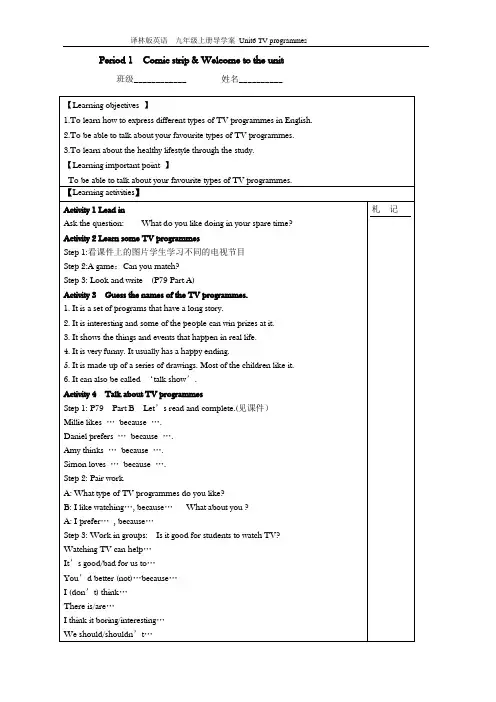
班级____________姓名__________
【Learningobjectives】
1.To learn how to express different types of TV programmes in English.
I (don’t) think…
There is/are…
I think it boring/interesting…
We should/shouldn’t…
Activity 5
Step 1: Listen to the tape and answer the following questions
2. It is interesting and some of the people can win prizes at it.
3. It shows the things and events that happen in real life.
4. It is very funny. It usually has a happy ending.
Step 2:A game:Can you match?
Step 3:Look and write (P79 Part A)
Activity 3Guess the names of the TV programmes.
1. It is a set of programs that have a long story.
Step 4: Discussand solve the language points
【Learning outcome】
牛津译林版九年级上册Unit 6《TV programmes》(Comic strip and Welcome to the unit)教案

Unit6 TV programmesComic strip and Welcome to the unitTeaching goals:1.知识与技能:了解与电视节目相关的词汇;了解电视节目的分类。
2.过程与方法: 学会用英语谈论喜欢或者不喜欢的电视节目类型并说出理由3.情感、态度与价值观: 学会怎样从压力中释放出来Important and difficult poi nts:1.知识目标:了解与电视节目相关的词汇;了解电视节目的分类。
2.技能目标:学会用英语谈论喜欢或者不喜欢的电视节目类型并说出理由。
3.学会用英语谈论喜欢或者不喜欢的电视节目类型并说出理由。
Teaching procedures:Welcome to the unit学习A部分。
1、讨论: What types of TV programmes do you know?2、根据课文第79页内容,回答问题。
1). Who play the roles in a drama?2). Where is CCTV News made in?3). How can we see the programmes?4). How are the programmes sent?5). What do you need when you want to change the channel?3、独立完成课本第79页A部分的练习,全班核对答案。
Say: Let’s look at these pictures. Each picture represents a scene of a TV programme. Sandy is trying to match the scenes with the correct types of TV programmes. Can you help h er?学习B部分。
1、Listen and answer:Say: Sandy and her friends are talking about their favourite TV programmes. Let’s listen to their conversation and find out who likes game show.1) What type of TV programmes do es Millie like?2) Why does Millie like watching documentaries?3) What does Amy thi nk of chat shows?4) Who loves cartoons?2、将学生分成五人小组分角色朗读对话,组内就每个学生各自喜欢的电视节目进行询问和讨论,鼓励学生运用以下句型。
牛津译林版英语九上U6L1Welcometotheunit教案
英语(九年级上册)Unit 6 TV programmesComic strip& Welcome to the unitI. Teaching aims and learning objectivesBy the end of the lesson, students should be able to:1. learn different types of TV programmes;2. learn to talk about their favourite TV programmes.II. Teaching contents1. New words and phrases: done, chat show, game show, real-life, dialogue, comedy, documentary,drama series2. New structures: Aren’t you getting bored with staying at home all day?If you’re as busy as I am, you won’t get bored.A dog’s work is never done!There’s not much dialogue in it.III. Focus of the lesson and predicted area of difficulty1. Different types of TV programmes;2. How to talk about their favourite TV programmes.IV. Teaching proceduresComic stripStep 1 Lead-in1. Do you like watching TV in your spare time? I like watching Korean drama series because they are interesting. How about Eddie?【设计意图:通过Free talk迅速进入本课话题】Step 2 Presentation1. Listen to the tape and answer some questions.What TV programme does Eddie watch?What else does he do every day?2. Let’s watch the cartoon and complete the story.Hobo asks Eddie whether he is getting bored with staying at home all day. Eddie thinks if Hobo is as busy as he is, he won’t get bored. Eddie is busy every day. He watches sports on TV, has lunch and then needs a little sleep. A dog’s work is never done! However, Hobo doesn’t think so. In his opinion, Eddie has nothing to do.【设计意图:听录音,了解对话大意;看动画片,通过填空的方式加深学生对于动画的理解。
2019年译林牛津版初中英语九年级上册Unit 6 TV programmes Welcome to Unit优质课教案
What does Eddie do every day?
2.Read after the tape and pay attention the pronunciation and intonation .
Andy: What ___ do you like?
Tom: I prefer sports programmes on CCTV-5. I like watching basketball games. What about you, Andy?
Andy: I like watching ____ because I can learn a lot about nature, history and _____ from them.
难点:Learn to s ay your favorite type of TV programmes.
教学过程
Learning aims:
1. Master the different types of TV programmes.
2. Learn to say your favorite type of TV programmes.
StepI.Free Talk
Do you like watching TV?
Step II Presentation
1.Show students different pictures of TV programm es and let them guess what types they belong to.
牛津译林版九年级英语上册《nit 6 TV programmes Welcome to the unit》优质课教案_5
Write the correct name under each pictures
Practice the dialogue
Listen to
conversation and answer
the questions
Read the new words.
Step 2 Free talk
1. Do you like watching TV?
2. How often do you watch TV?
3. What type of TV programmes do you like?
Present some pictures and teach the new words.
(3) What kind of things does Eddie do every day?
Keys: 1.No, he isn’t.
2.No. Because he thinks Eddie has nothing to do.
3.He has meals, sleeps and watches TV every day.
Ask the students to talk about the question:
1. Do you know whether dogs like watching TV?
2. What type of TV programmes does Eddie like watching? Can you guess?
Teaching methods:Listening、reading、acting& Discussing