
牛津英语8B Unit1 Welcome优秀版
Comic strip & Welcome to the unit
in the past (过去)…
at present (现在)…
Our living areas have changed a lot. What about Hobo and Eddie?
English? A:I have learnt it for eight years.
2. I've just eaten it. 我刚才把它吃了。 just adv. 意为“刚才”常与完成时连用。 他们刚刚到达。
They have just arrived. 注意:just now 意为“刚才”,相当于“a moment ago”通常与一般过去时连用。 我刚才去了图书馆。
His parents used to live in the countryside. Tom 过去常常早起,不是吗?
Tom used to get up early, didn't he? be used to doing sth.习惯于做某事 我父亲习惯晚饭后读报。
My father is used to reading newspapers after
Language points
1.Have you seen my food?
解析:此句时态是现在完成时疑问形式。现 在完成时由“主语+have/has +动词过去分词形 式”构成。它的要义在于表达过去已经发生的 事情对现在造成的某种影响,或者,强调过 去发生的事情一直持续到现在的状态。
它的否定形式为:haven’t /hasn’t +动词过去 分词
Daniel
transport
coach
It is a comfortable bus for carrying people over a long way.
plane
It is the fastest way of traveling to a place far away, but it will cost you a lot of money.
bus
It travels along a fixed route and has many stops to let people get on and off.
taxi
It is a car with a driver, and you have to pay the driver to take you somewhere.
它的疑问形式:把have或者 has 提到相应主 语的前面。
For example: A: Have you studied English for ten years? B: Yes, I have. And you? A: No, I haven’t. B: Then how many years have you learnt
5.present n. 现在,目前 at present n.礼物
Tanslation 1.我刚刚完成我的作业。 I have just finished my homework.
2.过去这里有一所老房子。 There was an old house in the past.
3.现在我们不再需要什么了。 We don't need anything at present.
Some key points(要点):
1. Eddie, have you seen my food?
Eddie, 你看见我的食物了吗?(你知道我的食物在哪儿 吗?)
base formsimple past past participle
原形
过去式
过去分词
see
saw
seen
have/has + 过去分词
eat
ate
eaten
现在完成时: have eaten
3. You’ve changed, Eddie. (You’ve=You have)
你(已经)变了。
base formsimple past past participle
原形
过去式
过去分词
change changed
changed
现在完成时: have changed
base form present perfect tense
原形
现在完成时
see
have/has seen
eat change
have/has eaten have/has changed
use
have/has used
Have a try! (想一想,试一试)
1. Eddie, have you seen my food?
[此结构为“现在完成时(present perfect tense)”,表 示过去的动作一直延续到现在,或与现在有一定联系]
2. I’ve just eaten it.(I’ve = I have)
我刚刚把它吃了。
base formsimple past past participle
原形
过去式
Байду номын сангаас
过去分词
2. I’ve just eaten it.(I’ve = I have)
3. You’ve changed, Eddie. (You’ve=You have)
base formsimple past past participle
原形
过去式
过去分词
use
used
used
我已经使用这支钢笔长达两年了。
2. Is Hobo happy? No, he isn’t.
3. What does Hobo think of Eddie?
He thinks Eddie has changed.
4. What does Eddie think of Hobo? He thinks Hobo was kind before.
Work in pairs and take turns to talk about it. Use the conversation below as a model.
A:How did you go to school when you were a student, Mum/ Dad/grandma... ... B:I used to go to school ... ... A: Why didn't you... ...? B: ... ... A: ... ...
underground
Thousands of people go to work on it every day. It is fast and it is under the ground.
train
It runs above the ground on tracks over a long way.
Read and answer:
1. What is Hobo looking for? He is looking for his food.
2. Where is Hobo’s food? Eddie ate it.
Read and answer:
1. Why did Eddie eat Hobo’s food? Because he was very hungry.
I have used this pen for two years.
Fill in the blanks:
Hobo’s food _w_a_s_ in the _b_o_w__l an hour ago. But it isn’t there now. Why? Eddie has just e_a_t_e_nit because he was h_u_n__g_ry_. Eddie thinks Hobo has c_h_a_n__g_ed_ and he is not _k_i_n_d_ now.
I went to the library just now.
3.You used to share food with me! 你过去常与我分享食物! used to do sth. 意为“过去经常做某事,以前常常 做某事”,表示过去的习惯。本身已是过去时态, 没有人称和数的变化,暗含现在已不再如此。 他的父母过去住在乡下。
Have a try! (想一想,试一试)
base formsimple past past participle
原形
过去式
过去分词
see
saw
seen
eat change
ate changed
eaten changed
use
used
used
现在完成时: have/has used
Have a try! (想一想,试一试)
dinner.
share v. 共用;分享 分享某物
share sth 和某人分享某物
share sth with sb
4.past n. 意为“过去”。 她正在回忆她的过去。
She is thinking of her past. past adj.意为“过去的” in the past 过去 in the past few years 在过去的几年中
他们一个15岁,一个16岁,花开的季节。初学立体几何,大熊用小纸壳手工助洁心理解立体与平面的迥异,地理考试这对同桌囊括了班里两个第一,大熊94分,第一名,洁心47分, 倒数第一。大熊不知怎么就让无论如何都搞不懂季风洋流方向的洁心尤如神助,醍醐灌顶。洁心盼着上作文课,老师会朗读几篇上榜佳作,每每读到洁心的作文,大熊会看洁心一眼, 好像在说我知道这一篇是你写的,洁心也会漫不经心瞥一眼,故作平淡地回复嗯,是我。不知从何时起,他们走进彼此的心。大学毕业的第二年,他们结了婚,第三年,有了一个可爱 的孩子。洁心的日常开始以大熊小熊为中心,辞去优渥工作,成为家庭主妇,曾经的诗情画意干练要强变成琐碎的柴米油盐酱醋茶,窈窕淑女变成自带三层救生圈的黄脸婆,大熊成为 业内认可的职业经理人,小熊也取得全国乃至世界各大数学竞赛计算机竞赛的各色奖牌。被大熊小熊的光环映着,洁心日复一日忙忙活活庸庸碌碌地快乐着。人和人之间的比较,是丢 失快乐最简单的方式。昔日的同学大多事业有成,成为各自领域的精英,而洁心日渐落伍,好像被抛弃在另一个时代。比较也是客观认识自己最直接的方式。失落带来思考,洁心终于 意识到这十几二十年的岁月她把自己搞丢了。洁心想重回轨道却无力又无助,知识陈旧,书生意气,与社会严重脱节,抱怨,她偏执地认为大熊消耗了她的青春改写了她的命运,而人 到中年的大熊再不会像过去只要听到洁心呼唤,马上放下全世界飞奔而来,事业有成的他也不再对洁心的发号施令全盘言听计从,洁心觉得自己失去了整个世界。洁心没有意识到很多 时候大熊只是在迁就她,不和她计较,也没有意识到一个企业高管若凡事对一个家庭主妇唯命是从究竟是好事还是坏事,她越来越暴躁,越来越容易愤怒,家庭气氛像一只随时会被引 爆的火药桶,说不定什么琐事就会成为导火索。大熊忙碌粗心,洁心心灰意冷,俩人之间有了罅隙,有了不满,洁心不止一次发怒时大喊分手。洁心最脆弱的时候,大熊没有及时给予 支持和关注,洁心撕心裂肺的难过,大熊忙于工作,浑然不觉,洁心认为大熊不再爱自己,痴心错付,悔不当初,对自己的婚姻感到绝望,她给自己7天的时间思考,要不要走出这曾 欣欣然冲进来的围城。一位生性爱冒险的作家本杰明,无法走出半年前的丧妻之痛,带着一个青春期一个幼儿期的两个孩子,生活一团糟。本杰明放弃了专栏写作,拒绝开始新感情, 欲带着儿女换一个崭新环境开始新生活,于是他买了新房子,未曾想这房子却是一个经济窘迫、难以维系正常运转的动物园……本杰明走投无路之时,发现妻子给留下的“冒险基金”, 妻子自知无法常相陪伴,竭尽所能给丈夫最后的成全,这份爱让人唏嘘汗颜。本杰明给一双儿女讲述他和妻子初次见面,一见钟情,自惭形秽,踌躇不前时,自己骨子里天生的冒险精 神推着自己抓住了这份非你莫属的爱情。看着本杰明和一双儿女对着阴阳相隔的妻子、妈妈,互诉衷肠,洁心百感交集,泣不成声,她想世人听过见过无数美丽的爱情故事,但都是别 人的,现实的生活总会有种种难言的苦楚不如意,“万物皆有裂痕,那是光照进来的地方。”接受人和事的缺憾不完美,才是真实的生活。发起冷战的第三天,洁心不再继续臆想徒生 闷气,她决定给彼此一个机会,和大熊进行了一次推心置腹长谈,长谈的结果是洁心庆幸失而复得的婚姻和爱情,大熊说洁心没失去过,自己一直都在,从未离开,只是不该忽视了洁 心的内心需求。洁心开始找回自己的人生旅程,列清单,定目标,开始学习、锻炼、尝试,由内而外改变自己,每晚洁心大熊两人瑜伽对望,相伴练习腹肌撕裂。假期里,大熊更多地 陪伴洁心,两人相濡以沫走遍千山万水,洁心开始一展所长,用文字记录下他们的所见所闻,所感所悟。人到中年,两人相互珍惜,共同成长,生命和爱情焕发出绚丽光彩,照亮了彼 此的人生,很多小伙伴说因为他们,自己又开始相信并渴望爱情了。一日,,麦克是校园篮球明星,他本可以因篮球特长被全额奖学金保送进大学,但因女友怀孕他放弃了关键的冠军 赛而向女友求婚。20年后,麦克穷困潦倒,事业家庭均失意,戏剧性地他重返了17岁,仍是青春闪耀,17岁的他遇到现实中的一对儿女,中年的妻子,一切重来,当他又站在可以延 续辉煌改变人生命运的关键时刻,他意识到妻子和一双儿女才是他人生最宝贵的财富,依旧做出了和20年前相同的选择。当麦克和妻子紧紧相拥时,麦克又恢复了中年的模样,妻子说,
Unit+1+Friends+Welcome+课件-2024-2025学年牛津译林版英语八年级上册

C.to drink somethinlors can change our moods (情绪)and make us A
happy or sad.(吉林)
A.feel
B.to feel
C.felt
D.feeling
9.—Bill,can I get you anything to drink?
二、单项选择 6.Mary isn't in the classroom.Do you know. A ?
A.where she is B.where is she
D 7.I'm thirsty.Please bring me
C.who is she
A.something to eat
B.to eat something
polite /pə'lait/adj.礼貌的 tidy /'taidi/adj.爱整洁的,整洁的 make /meik/linking v.成为;适合
trust /trʌst/vt.信任
跟读单词
1.Do you have a good friend? 2.Why do you choose(选择)him /her as your good friend?
care tell sb.sth.
Thankyou!
It is too hot in the room.What about opening the
window?
12.你难过时你的朋友关心你吗?
Does your friend care
about you when
you are sad ?
本节课主要学习了以下知识点,请同学们及时 巩固练习:
新版译林牛津英语8B单词表
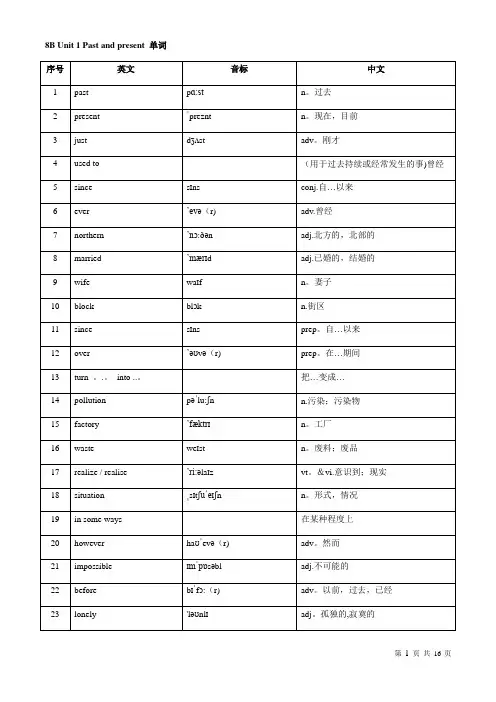
45
transport
'trænspɔ:t
*n。交通车辆,运输工具
46
narrow
'nærəʊ
*adj。狭窄的
8B Unit2Travelling单词
序号
英文
音标
中文
1
travelling / traveling
ˈtrævəlɪŋ
n。旅行
2
miss
mɪs
vt。想念,思念
3
fantastic
adj.世界著名的,举世闻名的
15
trade
treɪd
n。贸易
16
southern
’sʌðən
adj。南方的,南部的
17
international
ˌɪntə’næʃnəl
adj。国际的
18
huge
hju:dʒ
adj。巨大的
19
island
'aɪlənd
n.岛屿
20
several
ˈsevrəl
det.几个,数个
10
against
əˈgenst
prep。紧靠,碰,撞
11
be tired out
筋疲力尽
12
tie
taɪ
vt.捆,绑
13
over
’əʊvə(r)
prep.从一边到另一边
14
stomach
’stʌmək
n.腹部;胃
15
until
ənˈtɪl
conj.直到……为止
16
finger
’fɪŋɡə(r)
n.手指
牛津译林版英语八年级上册Unit1 Comic strip and welcome to the u
Lead-in
Presentation
Practice
Are Eddie and Hobo good friends?
Lead-in
Presentation
Practice
Watch a cartoon and answer the questions.
Lead-in
Questions
Presentation
Lead-in Presentation Consolidation Extension
Summary
a puppet called Pinocchio
If he tells a lie, his nose will grow longer. He should learn to be honest.
Lead-in Presentation Consolidation Extension
Summary
Who would you like to make friends with? Why?
Comic strip
Lead-in Presentation
Practice
Lead-in
Presentation
Practice
Lead-in
Presentation
Practice
Free talk
1. Who is your good friend? Could you tell us something about him/her? 2. Why do you choose him/her as your good friend?
译林版八上
Unit 1 Friends
Comic strip and welcome to the unit
牛津译林英语8B Unit1--Unit8单词短语知识点(默写版)
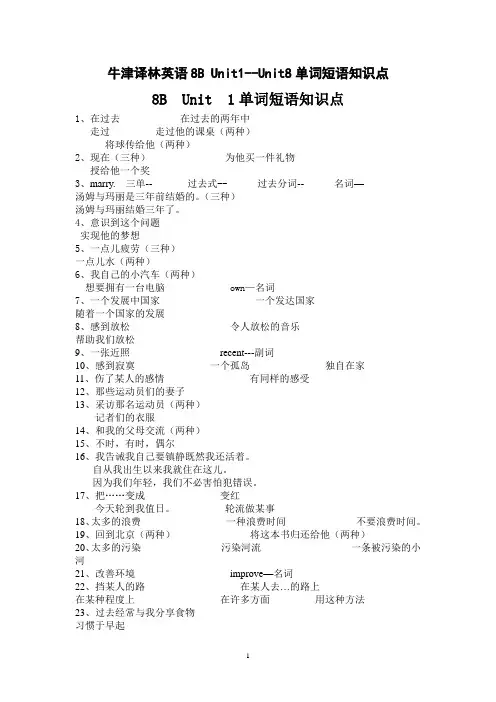
牛津译林英语8B Unit1--Unit8单词短语知识点8B Unit 1单词短语知识点1、在过去在过去的两年中走过走过他的课桌(两种)将球传给他(两种)2、现在(三种)为他买一件礼物授给他一个奖3、marry. 三单-- 过去式-- 过去分词-- 名词—汤姆与玛丽是三年前结婚的。
(三种)汤姆与玛丽结婚三年了。
4、意识到这个问题实现他的梦想5、一点儿疲劳(三种)一点儿水(两种)6、我自己的小汽车(两种)想要拥有一台电脑 own—名词7、一个发展中国家一个发达国家随着一个国家的发展8、感到放松令人放松的音乐帮助我们放松9、一张近照recent---副词10、感到寂寞一个孤岛独自在家11、伤了某人的感情有同样的感受12、那些运动员们的妻子13、采访那名运动员(两种)记者们的衣服14、和我的父母交流(两种)15、不时,有时,偶尔16、我告诫我自己要镇静既然我还活着。
自从我出生以来我就住在这儿。
因为我们年轻,我们不必害怕犯错误。
17、把……变成变红今天轮到我值日。
轮流做某事18、太多的浪费一种浪费时间不要浪费时间。
19、回到北京(两种)将这本书归还给他(两种)20、太多的污染污染河流一条被污染的小河21、改善环境improve—名词22、挡某人的路在某人去…的路上在某种程度上在许多方面用这种方法23、过去经常与我分享食物习惯于早起习惯于艰苦的工作被用来寄信24、我常常骑一辆红色的自行车上学。
(两种)步行去某地(两种)25、太多的人太多的食物电视看得太多实在太快26、在镇北边(两种)27、这些年期间在过去的世纪期间从椅子上跳过去河上有一座桥。
全世界二十多名学生28、我的老朋友中的大多数人他们中的许多人29、打牌下象棋30、对阳光镇知之甚少31、在路的两边32、我已经完成了我的家庭作业。
我还没有完我的家庭作业。
你完成了你的家庭作业了吗?33、丽丽曾经看过这部电影吗?以前我从来没有去过北京。
34、刚才我看电视的。
牛津译林版英语8B八年级下册_Unit1_表格式教案

课题8B Unit1 past and present welcome to the unit 授课时间主备人总共课时 6 第几课时第一课时备课时间授课班级授课教师学情分析This unit is very easy , it is connected with the students’ life.教学目标 1.To introduce the concept of situations that started in the past and is continuing in the past.2.To introduce the grammatical concept of the present perfect tense.重点难点 1.To introduce the concept of situations that started in the past and is continuing in the past.2.To introduce the grammatical concept of the present perfect tense.授课内容和过程StepⅠRevision二次备课1. Dictate new words from own to check.Step ⅡPresentationA. Translate some sentences.1. He has been back for two hours.2. Jimmy has kept the book since last week.3. They have been married since 10 years ago.4. K ate has been a member of the club for 2 years.5. We have never been to Japan.Step ⅢWarm-up activitiesListen to a short dialogue and think about the questions.1. Where was Hobo’s food an hour ago?2. What did Eddie do?3. How has Eddie changed?4. How has Hobo changed?B. Listen to the dialogue again and try to repeat the tape.Step ⅣProduction1 .Read the dialogue together and understand the meaning of thedialogue.2.Change some sentencepatterns according to the dialogue.E. g: ---Have you done your homework?Yes, I have. / No,I haven’ t.Step ⅤPresentationTransport at different timesWrite the correct names under the pictures.B. Back to the past , complete the timetable.Step ⅥPracticeMake sentences according to the timetable.People began to use buses in 1935.Buses have been in use since1935.Step ⅦProductionDiscussionTry to make the sentences as long as possible. ( Group discussion)Step ⅧAssignment1. Recite Comic strip.2.Make sentences with “have/has been in use”.3. Preview Reading.作业布置 1. Review the contents of this lesson.板书设计教学反思课题8B Unit1 past and present Reading 1授课时间主备人总共课时 6 第几课时第二课时备课时间授课班级授课教师学情分析这一课时非常贴近学生的生活,很容易引起学生共鸣。
牛津译林版8A Unit1 welcome (共18张PPT)

Other qualities:
5. Lily always greets her teachers when she meets them. We think she is a_p_o_l_it_e__student in our class.
6 .Jim often makes the classroom
Do you believe what he/she says?
Y/N
= Is your friend honest (诚实)?
Congratulations, if your answers are all ‘Yes’.
Qualities of a good friend
(be) helpful (be) honest keep secrets make sb. happy share one’s joy
best friend to be good-looking? B: No. I think that to be helpful and polite is very
important. A: I agree.
We also have a good friend, Eddie. He is funny and can always make us happy. Who is Eddie’s good friend? Why do you think so? Let’s have a look.
Please help Daniel match the qualities with the questions in ‘Teenagers’ magazine’ on Page 7.
What makes your friend so special?
八年级英语下册: 8B Unit 1复习1(无答案) 牛津版
8B Unit 1复习一词组1.turn the place into a park把那个地方变成公园2.dump something into a river 向河里倾倒3.from time to time 有时4.in the past在过去5.on one’s own 独自6. take action to reduce the pollution采取措施减少污染7 used to do sth. 过去常常做某事 8.cause problems引起问题9.feel a bit lonely 感到有点孤独 10.over the years在过去的几年里11.be in use 在使用中 12.be in service在服务中13.get married结婚 14.the changes to Moonlight Town 月光镇的变化15.by the way 顺便说一下 16.railway station 火车站17.primary school 小学 18.water pollution 水污染19.have an interview with sb.采访某人 20 in some ways在一些方面21.hear from sb=get/receive/have a letter from 22 start with..以…开始二.句型1. I moved here with my family when I was two years old and have lived here since then.2.We lived together till 1965,when I got married.3.Now the government has turned the place into a park.4.The pollution was terrible then because the factory used to dump its wasteinto the water.ter the government realized it was a serious problem and took action to reducethe pollution.6.It is nice to have open space and pretty gardens.7.Eddie has lived with Millie since he was born.8.Have you seen any exhibitions recently?9.The town has changed a lot over the years.Great changes have taken place in the town over the years.There have been great changes in the town during the years.10.They have moved to other areas in Beijing, and I feel a bit lonely from timeto time.11.I must say that it is the best place that I have ever seen.12.Daniel lent me a book about Starlight Town in the past and the present13.The changes to the town have brought many advantages, but they have also causedmany problems for people.14.I am happy that she has time to relax more.三语法The present perfect tense现在完成时1谓语构成:have/has+动词的过去分词2.用法及常用的时间状语①已经完成的用法,时间状语主要表示谓语动作的完成情况:just, alerdy, yet, recently, so far…The train to Guang Zhou has just arrived in LYG②持续的用法,常带的时间状语有:for+时间段,since+时间点,in the past few years,over the years.Lianyungang has changed a lot over the two years.③经历的用法,常带的时间状语有:never ever before once twiceHave you ever visited the great wall?3. 现在完成时持续用法中,谓语动词必须是持续动词,如果是短暂性动词必须转换成持续性动词或短语,常见的转换有:① leave--be away from ②die/pass away--be dead ③borrow--keep④ join--be in/be a member of ⑤finish/end--be over ⑥begin/start--be on⑦arrive--be here ⑧move to--live in ⑨open--be open ⑩close--be closed⑾get married--be married ⑿begin to work--work ⒀get to know--know会议已经结束3个小时了。
牛津译林版八年级英语下册8B U1 随堂练习和巩固练习(附答案)
8B U1 随堂练习Welcome to the unit随堂练习1. _______2. _______3. _______4. _______5._______ B.单项选择。
( )1. -_______ is my bike? It was under the tree five minutes ago.A. HowB. WhatC. WhereD. How long( )2. - Why don't you want to see the dolphin show?- Because I_______ it before.A. seeB. sawC. will seeD. have seen( )3. - Have you just_______ an apple? - Yes, I have.A. eatB. eatsC. ateD. eaten( )4. I_______ eat snacks before.A. am used toB. used toC. use toD. using to( )5. I was tired_______ I walked a long way.A. so .B. becauseC. butD. howeverC.汉译英。
1.你看到我的英语书了吗?_______ you _______my English book?2.我迟到是因为我起床太迟了。
I was late_______ I________ ______too late.3.我常和他合打一把伞。
I often _______one_______ _______him.4.你能告诉我北京在过去一百年中的变化吗?Can you tell me the_______ in Beijing_______ _______ _______ _______ years? 5.在英语课上我过去常说汉语,但现在我习惯于说英语了。
江苏译林版本牛津初中英语8B说课文稿全册.docx
Good morning, everyone. I?m____ .. I?m from English 8B Unit 1 Comic strips& welcome to the Part One Analysis of the TeachingMaterial (一) Status and Function. Middle School. Now I?ll say junior Oxfordunit. I?ll prepare to say the lesson from four parts.This is the first lesson of the unit. Such a topic is related to daily life, so it is helpful toraise learning interests of students and it will be also helpful to improve their society sense.It can help students to attain “four skills ”nrinegq,usepset aokf ilnisgt,ereading and writing. Therefore thislesson is in the important position of the teaching material.(二) Teaching aims and Demands1. Knowledge objectsTo learn the vocabulary about the traffic at different times in Beijing.2. Ability objects(1)To introduce the grammatical concept of the present perfect tense .(2)To act out the comic strips .3. moral objectsTo get the Ss to love their present life.(三) Teaching key and Difficult point1. Key pointsTo master the words about the traffic at different times in Beijing.2.Difficult points:To learn the use of the present perfect tense .Part Two The Teaching Methodsmunicative teaching method2.Audio-visual teaching method3.Task-based ” teaching method1.Teach the Ss how to be successful language learners.2.Let the Ss pass Obse-rIvmai tiaotnion- Practice to study language.Part Three Studying Ways3.Teach the Ss how to master dialogues and how to communicate with others.Part Four Teaching Procedures I?ll finish the lesson in four steps.Step1.Lead-inHave a free talk between T and Ss about some changes to our life.Step2.Presentation1. Look at the pictures in partA on page7,let Ss talk about the different forms of transport in Beijing.Then show them on PPT.2. Ask Ss to fill in the blanks,and practice reading them again and again.3.Show 4 pictures on page6 to the Ss then play the tape. Ss listen carefully and repeat.4. Act out the dialogue in front of the class.Step3.Ptactice 1.Retell the dialogue,and act out the dialogue with the partner.2. Do exercises on PPT then check the answers.Step4.Homework 1.Recite the new words and useful phrases.2. Finish off the exercises in workbook.That?s all, thank you.Good morning, everyone. Now I?ll say junior Oxford English 8B Unit 1Reading part A Timeshave changed. I?ll prepare to say the lesson from four parts.Part One Analysis of the Teaching Material( 一)Status and FunctionThis is the second lesson of the unit. The lesson aims to introduce the changes in Mr Chen ?s hometown. Such a topic is related to daily life, so it is helpful to raise learning interests of students andit will be also helpful to improve their society sense.It can help students to attain “ four skills request of listening, speaking, reading and writing. Therefore this lesson is in the importantposition of the teaching material.(二)Teaching aims and Demands1.Knowledge objects(1). To learn the new words and expressions.(2)To learn and get a better understanding of the passage.2.Ability objects(1). To develop the students?reading skills.(2)To be able to search some information about Sunshine Town.3. moral objects(1). To get the Ss to love their present life.(2).To arouse the Ss? interests in English.(3) .To build up the S s? confidence.(三) Teaching key and Difficult point1. Key points (1). To master the new words and expressions.(2).To grasp the useful expressions.2.Difficult points:(1). To understand the specific information and think about related points.(2).To retell the main idea of the text.Part Two The Teaching Methods1. Communicative teaching method2. Audio-visual teaching method3. Task- based” teaching methodPart Three Studying Ways1. Teach the Ss how to be successful language learners.2. Let the Ss pass“ Observation-Imitation-Practice” to study language.3.Teach the Ss how to master the conversation and how to communicate with others.Part Four Teaching ProceduresI?ll finish the lesson in four steps.Step1.Lead-in Have a free talk between T and Ss about some changes to our life.T:What changes have taken place in our life?Do you want to know the changes to the Sunshine Town? Work in pairs, say sth about it.Step2.Presentation1.Ask Ss to skim the text quickly on their own and answer some questions.2.Check the answers. And play the tape for the Ss to listen and repeat. Then get Ss to do true orfalse questions.Step3.Ptactice 1.Ask Ss to read the conversation in pairs and do the exercises on PPT.2. Explain some important language points.3.Ask some able Ss to retell the passage. Step4.Homework1.Read and recite the text.2.Remember all the new words and useful language points.Good morning, everyone. Now I?ll say junior Oxford English 8B Unit 1Vocabulary.I?ll prepare to say the lesson from four parts.Part One Analysis of the Teaching Material( 一 ) Status and Function(Teaching contents)This is the fourth lesson of the unit. The lesson aims to introduce about opposites.It?s very easy, but It?s important to master the knowledge. From this, Ss can also extend their vocabulary.Therefore this lesson is in the important position of the teaching material.( 二 ) Teaching aims and Demands1.Knowledge objects(1)To learn the new words.(2) To learn the opposites.2.Ability objectsTo use appropriate adjectives in context to express positive and negative meanings.3.moral objectsTo get the Ss to love their present life.( 三 ) Teaching key and Difficult point1.Key pointsTo understand the word-formation..2.Difficult points:To know and grasp the negative prefix..Part Two The Teaching Methodsmunicative teaching method2.Audio-visual teaching method1.Teach the Ss how to be successful language learners.2.Let the Ss passto study language. Obse-rIvmai t iaotnion- Practice”3. Task-based” teaching method Part Three Studying Ways3.Teach the Ss how to master the suffixes and how to correct the mistakes.Part Four Teaching Procedures I?ll finish the lesson in four steps.Step1.Lead-inShow some pictures or draw some pictures on the Bb.Get Ss to say the opposites. e.g. big-small tall-short happy-unhappyStep2.Presentation1.Show some sentences with pictures or flash on PPT. Underline some adjectives and get Ss to find out the opposites.2.Explain the opposites. Someare regular, others are irregular. im-, dis-,il-,ir to form negatives.3. Read and remember the opposites.Step3. Practice(1) Show some exercises on PPT, let Ss finish them.(2) Finish off the exercises on page12,then check the answers.Step4. HomeworkTry to remember all the adjectives and their opposites with right prefixes. Good morning, everyone. Now I?ll say junior Oxford Engl ish 8B Unit 1 say the lesson from four parts.Part One Analysis of the Teaching Material( 一 )Status and Function(Teaching contents)Weadd some prefixes like in-,un-, GrammarA&B. I?ll prepare toThis is the fifth lesson of the unit. We have learnt about the present perfect tense in unit1.This period continues to talk about the use of the present perfect tense and the time expressions with the present perfect tense. It?s very important and difficult. From this, Ss can also extend their knowledge. Therefore this lesson is in the important position of the teaching material.( 二 )Teaching aims and Demands1. Knowledge objects(1)To learn the use of the present perfect tense .(2) To learn the spelling of the past participles of some verbs.2. Ability objects(1)To understand the differences between the present perfect tense and the simple past tense.(2) To understand adverbs of time and use them with the present perfect tense.3. moral objects To get the Ss to love their present life.( 三 ) Teaching key and Difficult point1.To use the present perfect tense to talk about events that started in the past and are connected to the present..2.To understand adverbs of time and use them with the present perfect tense correctly.municative teaching method 。
牛津英语8BUnit1Welcome公开课PPT课件
1913
1935
1958 1971
2002
1900 1910 1920 1930 1940 1950 1960 1970 1980 1990 2000
light rail double-decker
underground coach,plane
bus
taxi train
Listen to the dialogue between Eddie and Hobo and answer the following questions:
❖ It is a comfortable bus for carrying people over a long way. ( coach )
❖ It is a bus with two floors. ( double-decker )
❖ It is the fastest way of travelling to a place far away, but it will cost you a lot of money. ( plane )
Unit 1 Period 1 Welcome to the unit
Transport in the future
ke bicycle
boat
coach coaches
bus buses
train
underground
light rail n. 轻轨
taxi
double-decker n. 双层巴士
1. Where was Hobo’s food an hour ago? It was in the bowl.
2. Why did Eddie eat food? Because he was very hungry.