
2014年新目标人教版八年级英语下册Unit1+What’s+the+matter_+复习课课件
请根据提示做题。 hurts (受伤) 1、My brother‟s leg _______. hurt 2、Kevin‟s ears ________. (受伤) hurt my arms. (受伤) 3、I_____ sore (受伤) 4、The boy‟s finger is ______. 5、Lily‟s shoulder _______. (受伤) hurt 6、I have a earache.(就划线部分提问) What‟s the matter with you? ________________________________ What‟s the wrong with you? ———————————————— 7、My teeth are sore.(写出这个句子的同义句) I have a toothache. ________________________________ My teeth hurt . ————————————————
should should属情态动词, 后接动词原形, 没有人称 和数的变化。用于提出建议劝告别人。 should的否定形式为 should not, 通常缩写为 shouldn‟t。 1. — Tom, I have a toothache. 汤姆, 我牙痛。 — You should see a dentist. 你应当去看牙医。
2. — I‟m not feeling well these days. I have bad cough. 这些天我身体不适, 老是咳嗽。 — You shouldn‟t smoke so much, I think. 我认为你不该抽这么多烟。 3. — Should I put some medicine on it? — Yes, you should. / No, you shouldn‟t. 4. — What should she do? — She should take her temperature.
④That is an eraser. 那是一块橡皮擦。
五、不可数名词作主语时为第三人称单数。 如: ①The milk is in the glass.
牛奶在玻璃杯里。
②The bread is very small. 那面包很小。 六、当数字或字母作主语时,看作第三人称 单数。 如: ①“6” is a lucky number. “6”是个吉利 数字。 ②“I” is a letter. “I”是个字母。
1. 作“有”讲。 如: I have a bag. 我有一个包。 He has a red cup. 他有一个红杯子。 2. 作“吃、喝”讲。如: have breakfast (吃早饭) have tea (喝茶) have a biscuit (吃块饼干) have a drink (喝点水)
第三人称单数知识扩充: 一、人称代词he, she, it是第三人称单数。 如: He likes watching TV. 他喜欢看电视。 It looks like a cat. 它看起来像只猫。 二、单个人名、地名或称呼作主语;是第三人称单数。 如: ①Han Mei looks like her mother. 韩梅看起来像她的母亲。 ②Beijing is in China. 北京在中国。 ③Uncle Wang often makes cakes. 王叔叔经常做蛋糕 。 三、单数可数名词或“this / that / the+单数可数名词”作 主语时,是第三人称单数。如: ①A horse is a useful animal. 马是有用的动物。 ②This book is yours. 这本书 是你的。 ③That car is red. 那辆小汽车是红色的。 ④ The cat is Lucy„s. 这只猫是露茜的。
复数 ourselves yourselves
1. 可用作宾语,指的是宾语和主语表示 同一个或同一些的人或事物。
如:Maria bought herself a scarf. 玛丽亚给自己买了一条围巾。 We must look after ourselves very well. 我们必须好好照顾自己。
Does he have a toothache? Yes, he does. He should see a dentist and get an X-ray. What should she do? She should take her temperature.
Should I put some medicine on it? Yes, you should. No, you shouldn‟t.
himself 和ourselves称为_____ 反身代词。
反身代词又称为自身代词,表示 动作行为反射到行为执行者本身。它 还可以在句中起到强调的作用,用以 加强语气。
英语中共有八个反身代词,在使用时应注 意和它式如下表所示:
第一人称 单数 myself 第二人称 yourself 第三人称 himself herself itself themselves
1. — She has a stomachache. — She __________ shouldn‟t eat so much next time. 2. — Should she see a dentist and get an Xray? should / No, she _________. shouldn‟t — Yes, she _______.
1. 观察下列句子。
1) He found himself in a very dangerous situation. 2) He was climbing by himself. 3) He bandaged himself so that he would not lose too much blood. 4) … we find ourselves “between a rock and a hard place”…
2. 可用作表语,指的是表语和主语表示同一 个或同一些人或事物。 如:She isn‟t quite herself today. 她今天身体不太舒服。
3. 可用作主语或宾语的同位语,常用来加强 语气。
如:She herself will fly to London tomorrow. 明天她自己将要坐飞机去伦敦。 I met the writer himself last week. 我上周见到了那位作家本人。
名词后缀-ache表示部位疼痛
tooth+ ache = toothache (牙痛) head+ache = headache (头痛) back+ache=backache(背痛) stomach +ache = stomachache(胃痛) Ear + ache=earache (耳朵痛) Heart + ache=heartache(心脏病)
如:我自己能完成作业。 (误) Myself can finish my homework. (正) I myself can finish my homework. / I can finish my homework myself.
2. 反身代词表示“某人自己”,不能表示“ 某人的东西”,因为它没有所有格的形式 。表达“某人自己的(东西)”时,须要 用one‟s own. 如:我用我自己的蜡笔画画。 (误) I‟m drawing with myself crayons. (正) I‟m drawing with my own crayons.
4. 用在某些固定短语当中。
照顾自己 look after oneself / take care of oneself 自学 teach oneself sth./ learn sth. by oneself 玩得高兴,过得愉快 enjoy oneself 请自用……(随便吃/喝些……) help oneself to sth.
3. 作“患病”讲。
have a cold, have a fever 4. 固定短语 have a try, have a look, have a party
1. 她有许多好朋友。 has lots of good friends. She ____ 2. 当我们感冒时,应该多喝水。 When we _____ have bad colds, we should drink more water. 3. 他早餐常吃鸡蛋。 He ____ has eggs for breakfast. 4. 他昨天去参加聚会了。 had a party yesterday. He ___________
ache 这个单词本身就是一个单独 的单词,表示“疼痛”的意思,与tooth、 head等单词合在一起组成一个新的单词, 这就叫做复合名词,发音为/eg/。
除此之外,我们以前还学过许多这样的单 词,如:bedroom ,snowman, watermelon, eggplant, newspaper等等都是复合名词。
What‟s the matter? I have a stomachache. You shouldn‟t eat so much next time. What‟s the matter with Ben? He hurt himself. He has a sore back. He should lie down and rest. Do you have a fever? Yes, I do. / No, I don‟t. / I don‟t know.
摔伤自己 hurt oneself 自言自语 say to oneself 沉浸于,陶醉于……之中 lose oneself in 把某人单独留下 leave sb. by oneself 给自己买…...东西 buy oneself sth. 介绍……自己 introduce oneself
新版2014新目标英语八年级下册Unit1What's the matter教案(完整)
Unit 1 What’s the matter?The First Period (Section A 1a-2d)Teaching Aims1. Knowledge Objects(1) Function:①Learn to describe and talk about the health problems and accidents.②Learn to give others some right advice according to their problems.(2)Key Vocabulary: matter, sore, throat, stomachache, foot, neck, stomach, fever, lie, rest, cough, toothache, headache, have a sore back, have a stomachache, have a cold, lie down, see a dentist, get an X-ray, take on e’s temperature, have a fever, have a headache, take breaks, in the same way, go to a doctor (3)Target Language:①What’s the matter? I have a stomachache./ I have a sore back. / I have a cold.②She has a very sore throat.③My head feels very hot.④What should I do?⑤I think you should lie down and rst.(4)Structure:①have a+ the names of the illnes s②should+verb2. Ability ObjectsEnable students to talk about health problems and give advice with the language points.3. Moral Objects(1)Improve the cooperative spirit through pair work and role playing.(2)Students care more about themselves and their family members’ health.Teaching Key Points1. Learn and master the parts of the body, the names of the illness and the expressions of giving advice.2. Learn to talk about health problems by using “What’s the matter? I have a…” and give advice by using “should”.Teaching Difficult Points1. Learn to talk about health problems by using “What’s the matter? I have a…”.2. Learn to give appropriate advice to the certain health problems.Teaching MethodsTask-based language teaching method, the cooperative learning method, and multimedia-assisted teaching and learning method.Teaching AidsThe picture about illness; PPT.Teaching ProceduresStep 1 Warming-up (about 2 minutes)Sing the English song If you’re happy.Step 2 Presentation (about 6 minutes)T: This is really a beautiful song. What can you do if you are happy?Ss: Clap our hands and stamp our feet.T: Yes. Hands and feet are parts of our body; do you know other parts of our body in English?Ss: Eye, head…T: You’re great. Today, let’s learn the names of thee body parts.The teacher touches the parts of the body one by one and says them. While teaching each one, let students touch or show it.Present a picture of Pan Changjiang on the screen. Let students say each part of the body.Work on Section A 1a.Play the game: Touch the parts of your body. Let the whole class touch the parts of their body when teacher say: Touch your…Ask eight students to come to the front and do as the teacher tells them: Touch your…If one does wrong, let him or her go back, the last one who’s in the front is the winner.Step 3 Presentation and Practice (about 8 minutes)The teacher mimes having a stomachache with an action of touching his stomach, and asks, “What’s the matter?”(Write it on the blackboard), then says, “I’m not feeling well, I have a stomachache.”(Students repeat with teacher.)Then show some pictures on the screen and ask students to practice.Have students look at the picture and ask: What can we say to him?Ss: What’s the matter?T: Yes. And what should the boy say?Ss: I have a stomachache.Let students repeat with other pictures about other illness.Ask some students to use gestures to show the illness, and have others to guess.Make a model dialogue. (S1 does an action to express an illness.)T: What’s the matter?Ss: He/ She has a headache.Let students practice other illness.A: What’s the matter?B: He/ She has a headache/ toothache/ a sore back/ a sore throat/ a cold and a cough.Show other pictures, and ask students to talk about health problems of the persons in the pictures inpairs.Step 4 Listen and Say (about 8 minutes)Work on Section A 1b, listen and number the names [1-5].Have students look at the picture and read 1c, and tell students that the girl talked too much yesterday and she has a very sore throat now. Then ask them look at the picture, practice saying other problems. For example: The boy eats too much ice cream and has a stomachache.Have students work in pairs according to 1c and ask some pairs to act out their conversations.Step 5 Presentation (about 5 minutes)Teacher pretends to cough and asks:T: What’s the matter with me?Ss: Do you have a cough/ a sore throat?T: Yes, I have a sore throat. Can you give me some advice? What should I do?Ss: You should drink hot tea with honey/ shouldn’t talk too much/ go to a doctor…(Students can give different advice as they like)Show different pictures to students, have them practice in pairs.S1: What’s the matter with him/ her?S2: Yes, he/ she has a/ an toothache/ fever/ headache…(Teach the new words)What should he/ she do? S2: He/ She should go to see a dentist/ lie down and rest/ drink a lot of water./ see a doctor… He/ She shouldn’t drink cold water/ play basketball…Work in groups, and have students role-play between a doctor and a patient. Ask them to talk about the health problems and give advice in groups.Step 6 Practice (about 7 minutes)Do 2a. Have students listen and number the picture [1-5]in the order they hear. Then check the answer. Play the tape again for the students and let them do 2b by themselves.Have students listen again and match the problems with the advice. Then play it again and check the answers.Do 2c. Pair work. Let students read the conversations in 2c first. Then work in pairs, make a new conversation according to 2a and 2b. For example:A: What’s the matter?B: My back feels terrible.A: Maybe you have headache. You should see a doctor and get an X-ray.B: That’s a good idea.Show more pictures and let students make more conversations.Step 7 Expansion and Extension (about 5 minutes)Role-play the conversation.First, have students to role-play the conversation in 2d in groups and choose the best.In groups, students discuss the language points and solve the problems. The teacher walks around and gives them some help if they need.Work in groups. Have students do a survey in groups about their health problems, then discuss in groups and give some right advice and make a new conversation.Ask each group to report their conversations.Step 8 Summary (about 3 minutes)Ask students to sum up the parts of a body and the names of illness.Help students to sum up how to give advice by using “should” and “shouldn’t”, then ask them to give the right advice about different problems.Step 9 Homework (about 1 minute)Give advice to the following problems as much as possible: sore throat, toothache, headache, cold. Then choose one to make a dialogue with your partner.Search on the internet about more advice of different health problems and accidents.Blackboard DesignUnit 1 What’s the matter?The First Period (Section A 1a-2d)What’s the matter? I have a stomachache/ sore throat/ a cold.She/ He has a very sore throat.My head feels very hot.What should I/he/she do? You should/ shouldn’t…第一课时作业设计一、根据句意、汉语意思和首字母提示完成句子。
2014年春八年级英语下册 Unit 1 Whats the matter全单元精美课件 (新版)人教新目标版
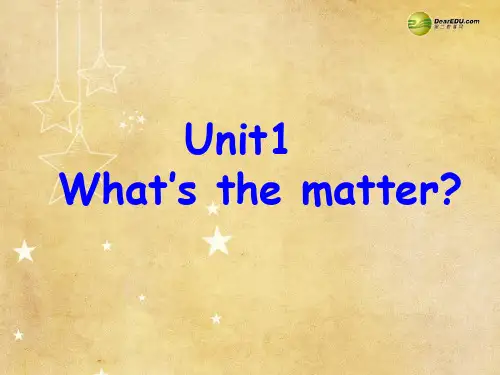
What’s the matter with him? He has/has got a sore back/backache.
他背痛。
What’s the matter with him ?
He has a sore throat.
他喉咙痛。
What’s the matter with her ? She has/has got a (high) fever.
hot tea with honey 加蜂蜜的茶
1.用,使用工具或手段 He is writing with a pen. 他用钢笔写字。 2.和,表陪伴
Will you go home with me? 你和我一起回家吗?
3.随着,与......什么同时
The shadow moves with the sun.影子随着太阳而动。
常用sore 修饰的词: throat leg foot
eye
常加后缀-ache构成的词: head tooth stomach ear
两者都可用的词:back
Look and match
1. have a cold 2. have a fever 3. have a headache 4. have a stomachache 5. have a toothache 6. have a sore throat 7. have a sore back a. 喉咙痛 b. 背痛 c. 牙痛 d. 头痛 e. 胃痛
leg foot
healthy
neck
shoulde r
arm
back
I have a sore back. What’s the matter?
2014年春新目标八年级下英语Unit1_What's_the_matter_SectionB
失去手臂之后, 他写了一本名为《生死两难》的书。
一个固定习语,表示在艰难或危险的处境下“从
两难中进行选择”, 意为“ 左右为难;进退两难”
E.g.: Who will you save when your mother and your wife fall into the water? For many people, it’s between a rock and a hard place. 当你放入母亲和妻子同时落水,你会救谁? 对很多人说这是一个两难的问题。
2b. Read the passage and underline the words you don’t know. Then look up the words in a dictionary and write down their meanings.
Finding the Order of Events Writers describe events in a certain order. Finding the order of the events will help you understand what you are reading.
Unit 1
What’s the matter ?
2a. Accidents or problems can sometimes happen when we do sports. Write the letter of each sport next to each accident or problem that can happen.
He/She shouldn't
3b Write a conversation between the nurse and the student using the notes in 3a. Use the questions and phrases below to help you. What's the matter?/What happened?/Are you OK? No, I don't feel well/ I feel ... /I have a ... / Should I …? You should ... /You shouldn't... fell down/got hit by ... /cut my self/hurt my ... Nurse:____________________________ Student: __________________________
2014年人教版新八年级英语下《Unit1_What's_the_matter_》Section_B&self_check课件

I have a cold. What should I do?
You should
• • • • • • •
stay in bed . have a good rest. lie down and rest. wear warm clothes. drink lots of water. drink hot tea. take some medicine.
.
What’s the matter?what should they do?
1a When these accidents happen, what should you do? Put the actions in order. 1 Go to the hospital. __ __ 2 Get an X-ray. __ 3 Rest for a few days. __ 3 Put a bandage on it. __ 1 Run it under water. __ 2 Put some medicine on it. __ 2 Clean your face. 1 Put your head back. __ 3 Put on a clean T-shirt. __
Unit 1 What’s the matter?
1. Write different health problems next to the body parts. Then write more health problems you know of.
Have a headache Head:________ have a sore back Back:________ Have a sore throat Throat:_______ Have a toothache Tooth:_______ Have a stomachache Stomach:_____ Have a cold Have a fever Other problems:_____ Have a heart problems
2014新版新目标英语八年级下unit_1_What's_the_matter_Section_A课件
课堂小测验:
1. 你怎么了? with you? What’s the matter _____ ________ 2. 我喉咙痛。 had _____ a sore throat yesterday . I _____ 3. 你应该喝些加了蜂蜜的热茶。 with honey. You should _____ drink some hot tea ____ 4. 你应该测量体温。 take _______ You should ______ temperature. your 5. Tom 现在感冒了。 has a cold _______. now Tom _____
Listen to Para. 1 and fill in the blanks. At 9:00 a.m. yesterday _______, bus No. 26 was going along Zhonghua Road driver saw an old when the _______ lying on the side of the man ______ next to him road. A woman ________ shouting was __________ for help.
3a. Read the passage. Do you think it comes from a newspaper or a book? How do you know? Bus Driver and Passengers Save an Old Man
八年级英语下册 Unit 1 What’s the matter短语、句子练习(新版)人教新目标版

第一单元短语、句子What’ s the matter?怎么啦?出什么事情了?What’ s the matter with you?= What’s the trouble/problem with you?= What’ s wrong with you?= What happened (to you)?=Is there anything wrong (with you )?Section 短语1.患(重)感冒2.发烧/咳嗽3.头痛/胃痛/牙痛/背痛4.背痛/喉咙痛5.患心脏病6.躺下休息7.喝点蜂蜜热茶8.看牙医9.拍X光片10.量体温11.吃药12.在伤口上敷药13.割/切/擦伤自己14.做某事伤了自己15.远离电脑16.看医生17.期待某人做某事18.等下一班车19.照看好某人20.偶然;意外地21.看见某人在做某事22.大声呼救23.认真思考;权衡利弊24.下车/上车25.让某人感到惊奇的是26.同意做某事同意某人的观点27.多亏;因为;由于28.及时29.陷入麻烦30.考虑自己31.救命32.摔倒;跌倒句子1、你怎么了?2、她该怎么办呢?她应该喝些蜂蜜热茶。
3、我应该量一下体温吗?4、你晚上不应该出去。
5、我想我以同样的姿势一动不动地坐得太久了。
6、回家路上,我看见一条狗正躺在地上。
7、多亏了王老师,我取得了好成绩。
Section B短语33.用绷带包扎伤口34.在水下冲洗伤口35.按压住鼻子的两边36.放弃做37.用……来做……被用于做某事习惯于(做)某事38.让自己活得自在39.休息几天40.在烈日下41.感觉病了/感到不舒服42.划伤了膝盖43.流鼻血44.伤了背45.碰了头46.晒伤47.呼吸有问题48.被球打/碰了49.爬山(活动)50.去爬山51.对……有兴趣52.冒险53.失去生命54.因为55.亲自;独自56.(主语为物)耗尽;用光(主语为人)耗尽;用光57.准备做某事58.切掉他一半右臂59.失血太多60.左右为难;进退两难61.在困难的情况下62.摆脱;脱离63.学好英语的重要性64.做出好决定65.掌控一生66.坚持爬山67.活着还是死亡68.发生事故69.放弃做句子1、他在学习英语方面有困难。
【VIP专享】2014新目标人教版八年级英语下册Unit 1 Whats the matter?全单元教案(共计26页)
Unit 1 What’s the matter?教学目标:1语言目标:描述健康问题的词汇,及如何根据别人的健康问题提建议。
2 技能目标:能听懂谈论健康问题的对话材料;能根据别人的健康问题提建议;能写出重点单词和重点句型,并能描述怎样对待健康问题。
3 情感目标:通过开展扮演病人等活动,培养学生关心他人身体健康的品质。
通过本课的阅读,培养学生处理紧急事件的基本能力,树立紧急事件时互相帮助的精神。
教学重点:短语: have a stomachache, have a cold, lie down, take one’s temperature, go to a doctor, get off, to one’s surprise, agree to do sth., get into trouble,fall down, be used to, run out (of), cut off , get out of, be in control of ,keep on (doing sth.), give up句子:1 What’s the matter? I have a stomachache. You shouldn’t eat so much next time.2 What’s the matter with Ben?He hurt himself. He has a sore back.He should lie down and rest.3 Do you have a fever? Yes, I do. No, I don’t. I don’t know.4 Does he have a toothache? Yes, he does.He should see a dentist and get an X-ray.5 What should she do? She should take her temperature.6 Should I put some medicine on it? Yes, you should No, you shouldn’t.教学难点:掌握情态动词should \shouldn’t. 的用法学习have的用法课时划分:Section A1 1a – 2dSection A2 3a-3cSection A3 Grammar Focus-4cSection B1 1a-2eSection B2 3a-Self checkSection A 1 (1a – 2d)Step 1 Warming up and new words1.Look at a picture and learn the parts of the body.2.New words and phrases.Step 2 Presentation1a Look at the picture. Write the correct letter [a-m] for each part of the body.___arm ___ back ___ ear ___ eye ___ foot ___hand ___ head ___ leg ___ mouth___ neck ___nose ___ stomach ___ toothStep 3 Listening1b Listen and look at the picture. Then number the names 1-5Listen to the conversations again and fill in the blanks.Conversation 1Nurse: What’s the matter, Sarah?Girl: I ___________.Conversation 2Nurse: What’s the matter, David?Boy: I _________________.Conversation 3Nurse: What’s the matter, Ben?Boy: I _________________.Conversation 4Nurse: What’s the matter, Nancy?Girl: I _________________.Conversation 5Betty: What’s the matter, Judy?Ann: She __________________.Step 4 Speaking1c Look at the pictures. What are the students’ problems? Make conversations.ExamplesA: What’s the matter with Judy?B: She talked too much yesterday and didn’t drink enough water.She has a very sore throat now.A: What’s the matter with Sarah?B: She didn’t take care of herself on the weekend. She was playing withher friends at the park yesterday. Then it got windy, but she didn’t puton her jacket. Now she has a cold.Step 5 Guessing gamesGuess what has happened to the students by using the important sentences.Step 6 Listening2a Listen and number the pictures [1-5] in the order you hear them.2b Listen again. Match the problems with the advice.Step 7 Speaking2c Make conversations using the information in 2a and 2bA: What’s the matter?B: My head feels very hot.A: Maybe you have a fever.B: What should I do?A: You should take your temperature.Step 8 Role–playImagine you are the school doctor. A few students have health problems.Role-play a conversation between the doctor and the students.2d Role –play the conversationStep 9 Language points and summary1. What’s the matter?这是人们特别是医生和护士询问病人病情时最常用的问句, 意思是“怎么了?”其后通常与介词with连用。
人教新目标八年级英语下册Unit 1 What’s the matterPart A教案1
Unit 1 part A 教案3【教学目标】Ability objectiveTo summarize and consolidate the grammar and usage【教学重点】summarize and consolidate the grammar and usage【教学难点】掌握情态动词should \shouldn’t. 的用法学习have的用法【教学方法】PWP method, task-based method and interactive approach【教学手段】A tape recorder, multimedia and some pictures【教学过程】Teaching Procedures:Step 1 Revision (Guessing game)Look at the pictures, guess what has happened and revise the important points the students have learned.Step 2 Grammar focusWhat’s the matter? I have a stomachache. You shouldn’t eat so much nexttime.What’s the matter with Ben?He hurt himself. He has a soreHe should lie down and rest.back.Do you have a fever? Yes, I do. / No, I don’t. / I don’t know.Does he have a toothache? Yes, he does. He should see a dentist and getan X-ray.What should she do? She should take her temperature.Yes, you should. / No, you shouldn’t.Should I put some medicine onit?观察与思考读以下四个句子,总结出have的用法。
2014人教新目标英语八下 unit 1《What’s the matter》period 1 section a (1a-1c)教案
Unit 1 What’s the matter?Period 1 Section A (1a-1c)Teaching Aims and Demands:1、Knowledge Object:(1) Ss can use the following words:head , ear, eye, mouth, nose, throat , neck, back, hand, arm, leg, tooth-teeth, foot-feet , matter, have a cold, stomachache, , backache, headache, toothache (2) Ss can use the following sentence patterns:What’s the matter?I have a stomache./I have a sore back./I have a cold.He/She has a sore throat.2、Ability Object:Enable students to talk about health problems using target language.3、Emotion Object:Let Ss know keeping healthy is important.Teaching Key Points:Learn how to talk about health, use have /has to talk about health problems Teaching Difficult Points:Learn the English names of different parts of human body and talk about various health problems.Teaching Methods:1. Listening and speaking practice.2 .Autonomous and cooperative approach.Teaching Aids:CAI, A tape recorder.Teaching Procedure:Step 1 Warming-upSing an English song: If you’re happy and you know it, clap your hands.Step 2 Word study1. T: Are you happy? S: Yes, we are. T: When we’re happy, we can clap our hands and stamp our feet. Hands and feet are parts of our body, do you know other parts of our body in English?2. Teach the parts of the body one by one by touching it. While teaching one, let them touch or show it.3. Present a picture of a baby and Yao Ming. let the Ss say the parts of the body.4. Work on Section A 1a5. Play a game: Touch the parts of your bodyLet th e whole class touch the parts of their body when the teacher says: Touch your…2) Ask eight Ss to come to the front and do as the teacher tells them: Touch your…if one does wrong, let him or her go back, the last one who in the front is the winner. Step 3 Presentation and Practice1. T: Are you happy? Ss: Yes, we are.T: When there’s something wrong with your body, are you still happy?Ss: No.T: Look at the picture, is he happy?Ss: No, he isn’t.T: Why?(Help the Ss to answer: He has a stomachache.)2. Present other pictures, talk about health problems of the persons in the pictures. What’s the matter? He/She has a headache/ toothache /a sore back/ a sore throat/a cold and a cough.3. Let the Ss practice in pairs4. T: Suppose there is something wrong with your body, please use gestures to show it .You may say: I have a headache. I have a sore throat.Make a model dialogue with two Ss.T: What’s the matter?S: I have a headache.T: Oh, that’s too bad. I’m sorry to hear that.Let the Ss practice in pairs.5. Show the following on the screen. Let students get familiar with the names of some illnesses.Part of human body Illnessstomach stomachachetooth toothachehead headacheback a sore backthroat a sore throatcold, fever ...Ask two students to read the sample conversation in activity 1c. Then let them work in pairs and make more similar conversations.Then help students understand: When the subject is “he/she/it”, we use “has” instead of “have” to talk about health.Let students play a game to practice it. Tell the student in the first line, “I have a headache”,then he/she repeats it to the second student, “He/she has a headache” and so on.Step 4 listen and sayWork on Section A 1b, listen and number the names 1-5.Talk about the health problems of the persons in the picture. Eg: Nancy has a toothache, Sarah has a cold,…Step 5 ChantHead, head, I have a headache. I have a headache,Stomach, stomach, I have a stomachache. I have a stomachache,Ear, ear, I have an earache. I have an earache,Tooth, tooth, I have a toothache. I have a toothache.Back, back, I have a sore back. I have a sore back,Throat, throat, I have a sore throat. I have a sore throat.Oh, dear! Do more exercise, please and keep healthy!Homework:1. Listen to the tape of 1b and repeat.2. Copy the new words in Period1.3. Finish the exercises in this period.Blackboard Design:Unit 1 What’s the matter?Period 1 Section A (1a-1c)A: What’s the matter with Judy?B:She talked too much yesterday and didn’t drink enough water. She has a very sore throat now.Period 2 Section A (2a-2d)Teaching Aims and Demands:1、Knowledge Object:(1). Review the names of each part of the body and the names of the illness.(2) Continue to learn the names of the illness: toothache, fever and headache.(3). Words and expressions:lie down, rest , cough, X-ray, toothache, take one’s temperature, headache, havea fever, take breaks, hurt.2、Ability Object:Enable students to talk more about health.Learn to give others some advice according to their matters.3、Emotion Object:Learn to live in a healthy way.Learn to take care of others and themselves.Teaching Key Points:1. How to teach the Ss to learn the names of the illness: toothache, fever and headache.2. How to give others some advice according to their matters.Teaching Difficult Points:How to give advice using should.Teaching Methods:1. Listening and speaking practice.2. Role-playing.Teaching Aids:CAI, A tape recorder.Teaching Procedure:Step 1 Warming-upEnjoy and sing an English song: Head and shoulders knees and toesHead and shoulder knees and toesKnees and toes, knees and toes,Head and shoulder knees and toesEyes, ears, mouth, nose(Repeat 4 times)Step2. Greeting and revision1. Greet the whole class as usual.T: What’s the date today?/ What day is it today?/ How’s the weather?/ How was your weekend?/What do you usually do on weekends?/ Do you like exercising?/ How often do you exercise?/ That’s great! To do exercise can keep us healthy, but if we don’t pay attention to our health, there will be something wrong with our body. Now , look at these people.2. RevisionT: (Show pictures) How is he/she? ( He / She is not fine.)What’s the matter?He /She has a cold (flu) / stomachache/ sore back/ cough.Step3. PresentationGuessing gameT shows some part of the pictures to the Ss and let them guess .T: What’s the matter with him/her?S: Does he/she have a …?T: Yes, he/she has a sore throat (Teach the new word) Can you give him/ her some advice? What should he /she do? (Teach the new word)S: He /She should drink hot tea with honey/ shouldn’t speak more/ go to see a doctor…(Ss can give different advice as they like)T: What’s the matter with him/her?S: Does he/she have a …?T: Yes, he / she has a / an toothache /fever / headache / earache…(Teach the new words) What should he /she do?S: He /She should go to see a dentist / shouldn’t eat ice cream/shouldn’t drink cold water /lie down and rest / shouldn’t play basketball/ should drink a lot of water./should see a doctor…Step4. PracticeDo 2a. Listen and number the pictures 1-5 in the order you hear them.Play the tape for the Ss and let them do it by themselves. Then check the answer. Do 2b. Listen again . Match the problems with the advice.Play the tape for the Ss. For the first time, let them do it by themselves. Then play it again and check the answer.Then the teacher summarize the advice using the structure with the students: When you have a_________ , you should __________.Do 2c. Pairwork.. Role play the conversations in 2b. Let the Ss read the conversations in 2c first. Then work in pairs, make a new conversation according to 2b.A: What’s the matter?B: I have a …A: Maybe you should …B: That’s a good idea.Show more pictures and let the Ss make more conversations.Problems Should Shouldn’t!B: That ’s a good idea.Step5. Role-play the conversation1. Read the conversation silently and understand the meaning.2. Read it again and answer the questions:(1) What ’s the matter with Lisa?(2) Did she have a fever?(3) What did she do the night before?(4) What does she need to do?(5)What should she do now?(6) What should she do if things don ’t get better?3. Role-play the conversation in two halves of the class.4. Explanation about the useful expressions in 2d:Are you OK?What should I do?It doesn ’t sound like …That ’s probably why.Can ’t move my neckAll weekendTake breaks away from the computerSit in the same way for too long without moving5. Practice the conversation in pairs, one acts Mandy, the other acts Lisa. A few minutes later, invite two or three pairs to act out the conversations.Step6. TaskReport:To keep healthy, we should … we shouldn ’t …Step6 Homework1. Copy the new words.2. Write the report in the exercise books.3. Search on the Internet about more advice of keeping healthy.Blackboard Design:Unit 1 What’s the matter?Period2 Section A (2a-2d)1 Words :have a fever/cough/headache/toothachelie down and rest ,see a dentist and get an X-raytake one’s temperature , take breaks,hurt2.Sentences:A: What’s the matter?B: I have a …A: Maybe you should …but you shouldn’t…B: That’s a good idea.Period 3 Section A (3a-3c)Teaching Aims and Demands:1、Knowledge Object:(1) Words and expressions:passenger, off , get off , to one’s surprise, onto, trouble ,hit ,right away, get into ,bus No.26, see sb. doing sth. , shout for help, thanks to,(2)Reading2、Ability Object:Train and develop the students’ reading ability.3、Emotion Object:To be a helpful person because helping others is helping yourself.Teaching Key Points:(1) Words and expressions:passenger, off , get off , to one’s surprise, onto, trouble ,hit ,right away, get into ,bus No.26, see sb. doing sth. , shout for help, thanks to,(2)ReadingTeaching Difficult Points:Train and develop the students’ reading ability.Teaching Methods:1. Talking method.2. Discussion method.Teaching Aids:CAI, A tape recorder.Teaching Procedure:Step1. Warming upChant: I have a headacheHead, head, I have a headache.I have a headache,And my eyes hurt!Stomach, stomach, I have a stomachache.I have a stomachache,And I have the flu!Ear, ear, I have an earache.I have an earache,And I have a fever!Tooth, tooth, I have a toothache.I have a toothache,And a sore throat!Back, back, I have a backache.I have a backache,And my knee hurts!I have a headache, I have an earache,A toothache, a backache,And a sore throat.My eyes hurt, my knee hurts, I have a stomach ache.I have a fever,And I have the flu!Oh, dear. Next, please!Step2. Greeting and revisionGreet the whole class as usual.RevisionT: Oh! They all have matters. What about you ? What’s the matter with you ?S1: I have a …T: Maybe you should …but you shouldn’t…S1: That’s a good idea. (Turn to S2) What’s the matter with you?S2: I have a/an…S1: Maybe you should /shouldn’t…S2: That’s a good idea. ( Turn to S3) …Step3. Presentation1. Show the picture of accident in 3a and the title of the passage.Have a discussionabout it.T: Look! The man is lying by the road.What happened to him ?What was the woman next to him doing?Did the man die? Who do you think is going to save the man?2.Teach the new words .passenger, off , get off , to one’s surprise, onto, trouble ,hit ,right away, getintoStep4. Reading1. Do 3a. Fast-reading.Do you think it comes from a newspaper or a book? How do you know?2. Careful-reading.Read the passage carefully and fill in the time line.Something happened Bus driver’s reaction Passengers’reaction ResultDiscuss the answers in pairs.3. 3b. Check the things that happened in the story.Then check the answers together.4. 3c.Have the students discuss the questions with the partners. Give Ss some minutes to prepare and then ask some students to say out their opinions.nguage pointsHave the students summarize the expressions:Expressions about bus:Bus No.26, bus driver, the passengers on the bus, stop the bus without thinking twice, get off/ on the bus, help to move the man onto the busExpressions about first aid:See a man on the side of the road, have a heart problem, go to the hospital, take the man to the hospital, save the man in time, only think about saving a life.3.Other expressions:to one’s surprise, in time, agree to do sth. expect to do sth. ,get into troubleStep6 HomeworkMemorize the words and expressions.Finish off the exercises in the workbook.Blackboard Design:Unit 1 What’s the matter?Period 3 Section A (3a-3c)Expressions about bus:Bus No.26, bus driver, the passengers on the bus, stop the bus without thinking twice, get off/ on the bus, help to move the man onto the busExpressions about first aid:See a man on the side of the road, have a heart problem, go to the hospital, take the man to the hospital, save the man in time, only think about saving a life.3.Other expressions:to one’s surprise, in time, agree to do sth. expect to do sth. ,get into troublePeriod 4 Section A (Grammar Focus-4c)Teaching Aims and Demands:1、Knowledge Object:Summarize the grammar and practice them.2、Ability Object:Enable the students to do things using the target language and the grammar.3、Emotion Object:Learn to look after yourself and others.Teaching Key Points:The grammar.Teaching Difficult Points:Use the grammar to do things.Teaching Methods:1. Practising method.2 .Activities.Teaching Aids:CAI, A tape recorder.Teaching Procedure:Step1. RevisionCheck the homework. Have the students write the word and expressions in 3a.Step2. Grammar focusHave the students read the sentences in Grammar Focus. And then sum up the grammar: have a(an) +疾病名词,表患病,如,have a cold /fever/ cough/toothache /headache/ stomachache/ backache/, 某些搭配中还会用catch, 如, catch a cold.be/feel +形容词,表不适,be/feel sick/bad/terrible,/tiredget hurt 表受伤hurt /cut/ break +具体部位,表伤害,如:hurt my leg, cut her finger, break his arm, hurt myself, cut himself, cut one’s knee, hurt one’s backtake /get 表示诊治:take one’s temperature, take some medicine, get an X-ray,用see或者go to …表达就医:See a doctor, see the dentist , go to the doctor, go to the hospital.用情态动词should表达建议He should lie down and rest.She should take her temperature.Should I put some medicine on it ? Yes, you should./ No, you shouldn’t.You shouldn’t eat so much next time.Step3. Practice1.4a.Fill in the blanks and practice the conversations.2.4b.Let the students do it individually, the teacher goes around the room finding out the common errors that students have. Write them on the blackboard and have students correct them. Then work in pairs.Step4. Miming4c. Work in pairs . One student mimes a problem. The other students in the group guess the problem and give advice.A sample conversation:A: What’s the matter ? Did you hurt yourself playing soccer?B: No, I didn’t.C: Did you fall down?B: Yes, I did.D: You should go home and get some rest.The teacher moves around the classroom checking the progress and praising the group that does well. Then have one or two groups act out in the front of the class. Step 5.HomeworkT: Suppose you have a cold, write about what you sho uld and shouldn’t do. You can make use of the expressions and structures learnt.You can begin with “When you have a cold ...”.A sample article:Do you have a cold?Sometimes people have a cold. When you have a cold, you shouldn’t do too much work. You should go to bed early and have a good rest. You should also drink a lot of water. You shouldn’t drink smoke.Blackboard Design:Unit 1 What’s the matter?Period 4 Section A (Grammar Focus-4c)1.have a(an) +疾病名词,表患病,如,2.be/feel +形容词,表不适,3.hurt /cut/ break +具体部位,表伤害,如:4.take /get 表示诊治:5.用see或者go to …表达就医:6.用情态动词should表达建议Period 5 Section B (1a-1d)Teaching Aims and Demands:1、Knowledge Object:(1) Words and expressions:Feel sick, cut one’s knee, have a nosebleed, fall down, cut oneself , have problems breathing, get hit by a ball, hurt one’s back or arm, get sunburned(2)Listening.2、Ability Object:Train and develop the students’ listening and speaking ability.3、Emotion Object:When accidents happen, know how to deal with them calmly.Teaching Key Points:(1) Words and expressions:Feel sick, cut one’s knee, have a nosebleed, fall down, cut oneself , have problems breathing, get hit by a ball, hurt one’s back or arm, get sunburned(2)Listening.Teaching Difficult Points:Train and develop the students’ listening ability.Teaching Methods:1. Listening method.2 .Pairwork.Teaching Aids:CAI, A tape recorder.Teaching Procedure:Step1. Warming upTaskT: You know, there are lots of problems in our life. If you are a doctor, please tell us how to solve the problem. I will divide you into 9 groups. Please work in groups. And then choose one of you to report your ideas.The following are the problems:I have a toothache.I am hungry. I have a sore throat.I am stressed out. I have a sore back.I am tired. I can’t sleep.I have a cold. I have a headache.Report:If you have a headache, you should go to bed early.You should see the doctor. You should eat some medicine.You shouldn’t wash your face with cold wa ter.You shouldn’t sleep late.You shouldn’t swim.…..T encourages the students to give advice as much as possible.Step2. PresentationShow some pictures on the screen, discuss the accidents with the students, teaching the new words: cut oneself, cut one’s hand / finger, fall down ,cut one’s knee, have a nosebleed, have problems breathing, get hit by a ball, get hit on the head,hurt one’s back or arm, get sunburned and so on.Let students do 1a individually. Then check the answers by asking a students to say out the answers.Have students describe the actions what you should do when the accidents happen in order, using first, next, then and so on.Step3.Listening1.1b. Listen to the school nurse. Check the problems you hear. Play the recording twice, then check the answers.2.1c.Play the recording again, ask Ss to write letter of each treatment next to the problems you checked in the chart above.Check the answers together by talking.T: When someone felt sick, the nurse… You tell me the whole sentence ,please. Ss: The nurse took his temperature and told him to rest.…Step4.Practice1d. Role-play a conversation between the nurse and the teacher. Use the information in 1b and 1c. First let students read the listening text, and try to work in pairs according to it. Then invite some pairs to act out their conversations in front. Step5.ExercisesShow some exercises on the screen and Ss do them carefully. Then check the answers.Step 6.HomeworkRemember the expressions learnt in the period.Write a passage about what you should do and shouldn’t do if accidents happen according to the contents in the period.Blackboard Design:Unit 1 What’s the matter?Period 5 Section B (1a-1d)cut oneself, cut one’s hand / finger, fall down ,cut one’s knee,have a nosebleed, have problems breathing, get hit by a ball,get hit on the head, hurt one’s back or arm, get sunburnedPeriod 6 Section B (2a-2e)Teaching Aims and Demands:1、Knowledge Object:(1) Words and expressions:ourselves, climber, be used to, risk, take risks, accidents, situation , kilo, rock, run out of , knife , cut off, blood , mean , get out of ,importance, decision, control, be in control of, spirit, death, give up, nurse(2)Reading.2、Ability Object:(1) Train and develop the students’ reading ability.(2) Learn the reading strategies: Finding the order of events.3、Emotion Object:Never give up whenever you meet difficulties and problems in study and life. Learn the spirit of Aron.Teaching Key Points:(1) Words and expressions:ourselves, climber, be used to, risk, take risks, accidents, situation , kilo, rock, run out of , knife , cut off, blood , mean , get out of ,importance, decision, control, be in control of, spirit, death, give up, nurse(2)Reading.Teaching Difficult Points:Train and develop the students’ reading ability.Teaching Methods:1. Scene teaching method.2. Reading method.Teaching Aids:CAI, A tape recorder.Teaching Procedure:Step1. RevisionShow some pictures on the screen and revision the accidents or problems that can happen when we do sports.Step2. Lead-in and PresentationPlay the video of the movie 127 Hours. Ss watch it and feel the difficult situation.Present the new words and expressions by showing the pictures on the screen: take ricks, caught under a 360-kilo rock, fell on somebody, find yourself in a very dangerous situation, get out of a difficult situation , bandage yourself, lose too much blood, lose half of his right arm, kept on climbing mountains.3. Ask Ss to read aloud the expressions in 2a and the new expressions.Step3. Reading1.2b. Read the passage and underline the words you don’t know. Then look up the words in a dictionary and write down their meanings.( decision, control, spirit, death , mean , importance, be used to , free , run out of ,keep on)2.2c. Read the passage and circle TRUE, FALSE or DON’T KNOW.(1)Aron almost lost his life three times because of climbing accidents.(2)Aron had a serious accident in April 2003.(3)Aron ran out of his water after three days.(4)Aron wrote his book before his serious accident.(5)Aron still goes mountain climbing.First let students read aloud the sentences in 2c and understand the meanings. If they have problems, give some explanation. Next, students do it individually. Then students check the answers each other. Finally, the teacher checks the answers.3.2d. Read the passage again and answer the questions.(1)Where did the accident happen on April, 2003?(2)Why couldn’t Aron move(3)How did Aron free himself?(4)What did Aron do after the accident?(5)What does “ between a rock and a hard place” mean?After students finish them ,invite students to say out their answers.4.2e. Put the sentences in the correct order. Then use them to tell Aron’s story to your partner. Try to add other details from reading.______ On April 26, 2003, he had a serious mountain climbing accident.______ Aron loves mountain climbing and doesn’t mind taking risks.______ Aron did not give up after the accident and keeps on climbing mountains today. ______ He wrote a book about his experience.______ Aron lost half his right arm from the 2003 accident.Step4. Summary about the reading strategiesFinding the Order of Events.(Writers describe events in a certain order. Finding the order of events will help you understand what you are reading.)找出本文描述事件发生先后顺序的句子或短语。
人教新目标八年级英语下册教案Unit1Whatsthemat教案
Unit1 What’s the matter?复习课教学设计一、设计背景初中英语升学考试所涉及的知识面广,因而复习时需要扎扎实实打好基础,对课本的复习可以说是以“地毯式”搜捕的方式进行的。
教师要在有限的时间内完成如此大容量的复习任务,就必须要想方设法提高复习效率,让学生的复习取得事半功倍的效果。
我在复习中采用“知识递进式”复习法,用话题带动词句的使用,注重知识的综合运用。
二、设计理念本课是以“problems and advice”为话题的复习课,课堂上把主动权交给学生,以听说训练为主线,通过看、听、说、写等一系列教学活动,让学生运用所学知识来完成单词拼写、即时翻译短语、小组合作翻译句子,定时背诵语篇。
使学生获得最基本的英语听、说、读、写能力,并在教学中充分激发学生强烈的学习愿望。
在注重学生知识能力发展的同时,注重提高学生的人格修养,学会关心别人,帮助别人,达到培养学生互助的德育教育的目的。
三、教学目标设计用具体、明确、可操作的行为语言,描述本课的知识、技能、能力、方法、情感、态度、价值观等方面的教学目标。
Objectives: By the end of the session, most students will be better able to acquire the required information. This will be achieved by:1.Knowledge Objectives:1)Be able to master the pronunciation, meaning and spelling of the names of diseases: fever, sore throat, sore back; stomachache, headache, toothache, cold, cough;2) Be able to learn the expressions of giving advice: lie down and rest, drink hot tea with honey, see a dentist, take this medicine;3) Be able to talk about health problems by using “What’s the matter? I have a …” and give advice by using “You should…You shouldn’t…”2. Ability Objectives:1) Be able to talk about one’s health problems and give advice fluently;2) Be able to role play doctor and patient;3. Moral Objectives:1) Improve the cooperative spirit through pair work and role playing2) Care more about yourself and your family members’ health.四、教学重点难点设计由于本节课的话题是谈论健康,根据教学大纲的要求,学生需掌握有关疾病的单词,并能针对疾病提出合理的建议。