
2019年人教版七年级下册英语各单元知识点总结归纳
1 | 2013春季 初一年级 | 期末短语复习 人教版七年级下册英语各单元知识点大归纳
Unit 1 Can you play the guitar?
◆短语归纳
1. play chess 下国际象棋 2. play the guitar 弹吉他 3. speak English 说英语
4. English club 英语俱乐部 5. talk to 跟…说 6. play the violin 拉小提琴
7. play the piano 弹钢琴 8. play the drums 敲鼓 9. make friends 结交朋友
10. do kung fu 练 (中国) 功夫 11. tell stories 讲故事 12. play games 做游戏
13. on the weekend/on weekends 在周末
◆用法集萃
◆典句必背
1. Can you draw? Yes, I can. / No, I can’t.
2. What club do you want to join? I want to join the chess club.
3. You can join the English club.
4. Sounds good./That sounds good.
5. I can speak English and I can also play soccer.
6. Please call Mrs. Miller at 555-3721.
◆语法
一、情态动词can的用法:
情态动词无人称和数目的变化,后面必须接动词原形,情态动词和动词原形一起构成谓语。常用的情态动词有:can, may, must, need。 1. play +棋类/球类 下……棋,打……球
2. play the +西洋乐器 弹/拉……乐器
3. be good at doing sth.= do well in doing sth. 擅长做某事
4. be good with sb. 和某人相处地好
5. need sb. to do sth. 需要某人做某事
6. can + 动词原形 能/会做某事
7. a little + 不可数名词 一点儿……
8. join the …club 加入…俱乐部
9. like to do sth. =love to do sth. 喜欢/喜爱做某事 like ding sth.喜欢做某事
1. show sth to sb = show sb sth “把某物给某人看”
2 | 2013春季 初一年级 | 期末短语复习 “能、会”是情态动词,没有人称和数的变化,不能单独做谓语,只能和实义动词原形或be动词原形一起构成谓语,常见用法如下:
(1).表示某种能力。
(2).表示请求或许可。
二、动词play的用法: play games with sb 与某人做游戏
(1).play+西方乐器名词,乐器名词前要加the,“play + the+ 乐器”“弹奏某种乐器”。
play the guitar弹吉他 play the piano 弹钢琴 play the drums 敲鼓
play the violin 拉小提琴 play the trumpet吹喇叭
(2).play加球、棋牌时,球棋牌前不加the,“play +球类名词”表示“踢、打某种球”。
play ping-pong打乒乓球 play football/soccer踢足球
play basketball打篮球 play baseball 打棒球 play volleyball打排球
play chess 下国际象棋 play cards 打牌
(3). play with+玩具/其他名词 He can play with a ball.
三、be good
(1).be good at (doing) sth 擅长… 精通…
(2).be good with sb/sth 善于应付/相处…的,对…有办法
(3).be good for sb/sth 对…有益处
◆句型
1. Can you play the guitar?
① play sb.sth.”=“play sth.for sb.”表示“为某人播放……”
3 | 2013春季 初一年级 | 期末短语复习 例如: Play me a song=Play a song for me.请为我放一首歌听听吧。
② “play sth.on+乐器”表示“用乐器演奏…”,
例如: The girl often play the English song on the piano.这个小女孩经常用钢琴演奏英文歌曲。
③ play chess“下国际象棋”,例如: Can you play chess?你会下棋吗?
【误区警示】 “下棋”用play chess,棋类之前不加冠词。
2.I want to join the art club.我想加入艺术俱乐部。
【用法透析】
1) 句中join为动词,表示“加入,成为……的一员,连接,结合”等之意。
例如: She wants to join the English club.她想加入英语俱乐部。
Come and join us.来加入我们吧。
Join the two maps togethes.把这两个地图连起来。
2) 句中art为“艺术,美术”,
如: an art teacher美术老师,an art lesson一堂美术课,an artist一位艺术家
3.Can you speak English? 你会讲英语吗?
【易混辨析】speak/say/tell/talk
speak意为“说话”,指说话的能力和方式,一般作不及物动词,意为“演讲”,作及物动词时,其后跟某种语言。
例如: Who wants to speak at the meeting? 谁想在会议上发言?
Do you speak Chinese? 你会说汉语吗?
talk意为“谈话,交谈”,指相互间的谈话,一般作不及物动词时,要谈到某人某事时,后面接介词about或of。
4 | 2013春季 初一年级 | 期末短语复习 例如: Don’t talk in class!不要在课堂说话。
Let’s talk to Mr Green.咱们跟格林先生谈谈吧。
say意为“说出,说过”,强调说话的内容。
例如: Can you say it in English? 你能用英语说话吗?
They say China is great.他们说中国是伟大的。
tell意为“告诉”、“讲述”,to:
Can you tell me about it?你能告诉我有关此事吗?
4.Tom can play the quitar but he can’t play it very well.汤姆会弹吉它,但是他弹得不是很好。
【用法透析】
1)这是一个由转折连词but连接并列句,前面的简单句是情态动词can的肯定句形式,后面的简单句是情态动词can的否定式。
2)句中veny well意为“很好”,是副词短词,常用来修饰句中的动词,放于句尾。如: She speaks English very well.她英语说得很好。
5.Are you good with children?你和孩子们相处得好吗? 【用法透析】(1)be good with表示“与……相处得好”,
例如: My father is good with my mother.我爸爸和我妈妈相处得好吗?
(2)be good with的同义表达方式为:get on well with,
例如: How do you get on well with your friend? 你和你朋友相处得怎么样?
【发散思维】be good at something表示“擅长做某事”,介词at后面可以直接接名词,如果接动词的话,要用动名词形式。
5 | 2013春季 初一年级 | 期末短语复习 She is good at singing. 她擅长唱歌。 He is good at English. 他擅长英语。
6.Can you help kids with swimming? 你能帮助小孩游泳吗?
【用法透析】“help sb.with sth.”表示“帮助某人做某事”,句中的with表示“就某一方面而言”。
例如: Do you often help him with his English? 你经常帮助他学习英语吗?
注意:因为with是一个介词,所以其后可跟名词,代词或动名词。
又如: Can you help me with singing? 你会帮助我唱歌吗?
He can help me with the box. 他能帮我提那个箱子。
【用法透析】help sb.with sth.的同义句为help sb.to do sth.
【发散思维】help作动词,意为“帮助”, help sb.(to) do sth. 这一结构中不定式do sth.前可带不定式符号to,也可不带。
例如: Could you help me(to) open the window? 你能帮我打开这扇窗户吗? He helps me(to) go over my lessons. 他帮我复习功课。
7.Are you a musician?
【用法透析】这是个选择疑问句,问话人提出两种或两种以上的情况,让对方选择其中一种回答。并列的两部分用or连接,or的意思是“或者……”“还是……”等。若有并列的三部分或更多,用or连接最后两个并列成分,前面的并列成分用逗号隔开。回答不用“Yes”或“No”,而是从选择中选出一个正确的来回答。朗读时一般or前部分用升调,or后面部分用降调。
其结构是:“一般疑问句 + or + 供选择部分?”
例如: —Is she at home or at school? 她是在家里还是在学校里?
—She is at school. 她在学校里。
—Are you Chinese or Japanese? 你是中国人还是日本人?
2019-2020年人教版英语七年级下册Unit6 I’m watching TV 知识点与练习(
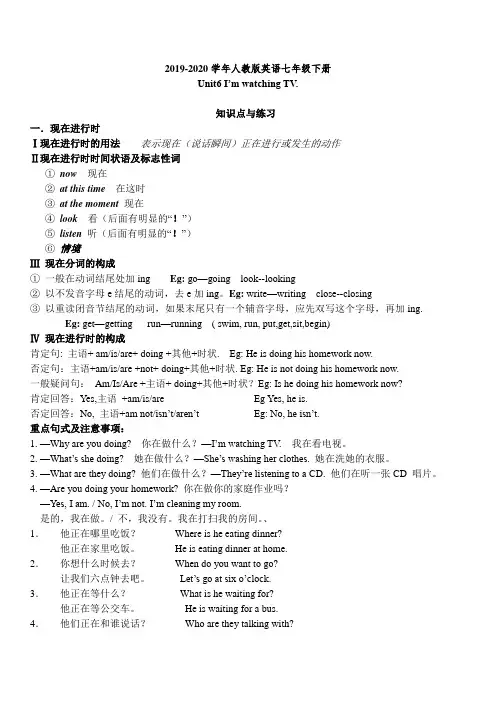
2019-2020学年人教版英语七年级下册
Unit6 I’m watching TV.
知识点与练习一.现在进行时
Ⅰ现在进行时的用法 表示现在(说话瞬间)正在进行或发生的动作
Ⅱ现在进行时时间状语及标志性词
① now 现在
② at this time 在这时
③ at the moment 现在
④ look 看(后面有明显的“!”)
⑤ listen 听(后面有明显的“!”)
⑥ 情境
Ⅲ 现在分词的构成
① 一般在动词结尾处加ing Eg: go—going look--looking
② 以不发音字母e结尾的动词,去e加ing。Eg: write—writing close--closing
③ 以重读闭音节结尾的动词,如果末尾只有一个辅音字母,应先双写这个字母,再加ing.
Eg: get—getting run—running ( swim, run, put,get,sit,begin)
Ⅳ 现在进行时的构成
肯定句: 主语+ am/is/are+ doing +其他+时状. Eg: He is doing his homework now.
否定句:主语+am/is/are +not+ doing+其他+时状. Eg: He is not doing his homework now.
一般疑问句: Am/Is/Are +主语+ doing+其他+时状?Eg: Is he doing his homework now?
肯定回答:Yes,主语 +am/is/are Eg Yes, he is.
否定回答:No, 主语+am not/isn’t/aren’t Eg: No, he isn’t.
重点句式及注意事项:
1. —Why are you doing? 你在做什么?—I’m watching TV. 我在看电视。
2019-2020年人教版英语七年级下册Unit 1 Can you play the guitar
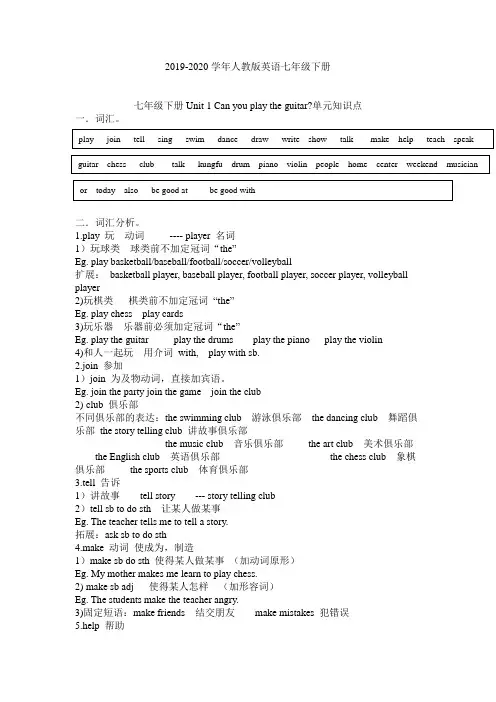
2019-2020学年人教版英语七年级下册
七年级下册Unit 1 Can you play the guitar?单元知识点
一.词汇。
二.词汇分析。
1.play 玩 动词 ---- player 名词
1)玩球类 球类前不加定冠词“the”
Eg. play basketball/baseball/football/soccer/volleyball
扩展: basketball player, baseball player, football player, soccer player, volleyball
player
2)玩棋类 棋类前不加定冠词 “the”
Eg. play chess play cards
3)玩乐器 乐器前必须加定冠词“the”
Eg. play the guitar play the drums play the piano play the violin
4)和人一起玩 用介词 with, play with sb.
2.join 参加
1)join 为及物动词,直接加宾语。
Eg. join the party join the game join the club
2) club 俱乐部
不同俱乐部的表达:the swimming club 游泳俱乐部 the dancing club 舞蹈俱乐部 the story telling club 讲故事俱乐部
the music club 音乐俱乐部 the art club 美术俱乐部
the English club 英语俱乐部 the chess club 象棋俱乐部 the sports club 体育俱乐部
3.tell 告诉
2019-2020年人教版英语七年级下册Unit 5重难点知识讲练(无答案)
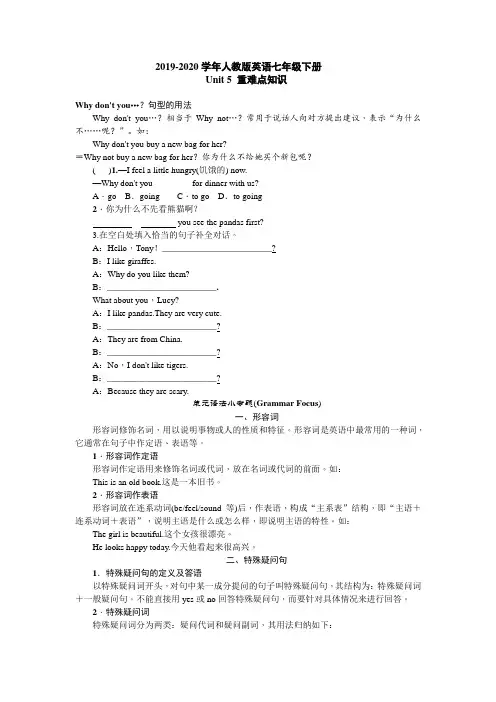
2019-2020学年人教版英语七年级下册
Unit 5 重难点知识
Why don't you…?句型的用法
Why don't you…?相当于Why not…?常用于说话人向对方提出建议,表示“为什么不……呢?”。如:
Why don't you buy a new bag for her?
=Why not buy a new bag for her?你为什么不给她买个新包呢?
( )1.—I feel a little hungry(饥饿的) now.
—Why don't you ________ for dinner with us?
A.go B.going C.to go D.to going
2.你为什么不先看熊猫啊?
________ ________ you see the pandas first?
3.在空白处填入恰当的句子补全对话。
A:Hello,Tony!_________________________?
B:I like giraffes.
A:Why do you like them?
B:_________________________.
What about you,Lucy?
A:I like pandas.They are very cute.
B:_________________________?
A:They are from China.
B:_________________________?
A:No,I don't like tigers.
B:_________________________?
A:Because they are scary.
单元语法小专题(Grammar Focus)
一、形容词
形容词修饰名词,用以说明事物或人的性质和特征。形容词是英语中最常用的一种词,它通常在句子中作定语、表语等。
1.形容词作定语
2019年新版人教版初中英语七年级英语初一下册英语单词汇表
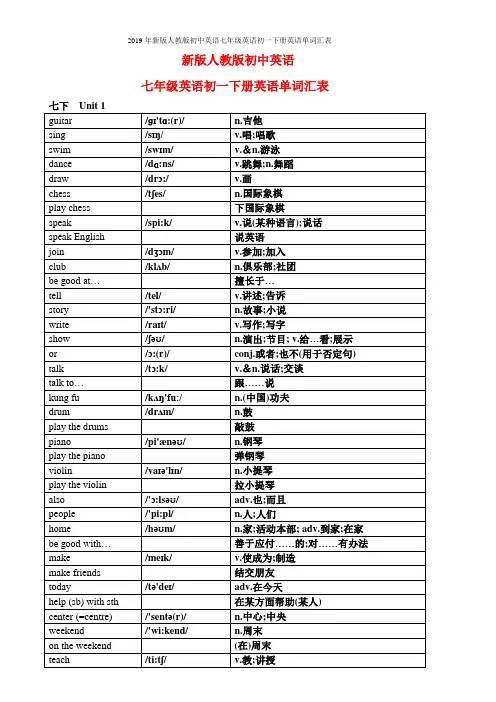
2019年新版人教版初中英语七年级英语初一下册英语单词汇表
新版人教版初中英语
七年级英语初一下册英语单词汇表
七下 Unit 1
guitar /ɡɪ'tɑ:(r)/ n.吉他
sing /sɪŋ/ v.唱;唱歌
swim /swɪm/ v.&n.游泳
dance /dɑ:ns/ v.跳舞;n.舞蹈
draw /drɔ:/ v.画
chess /tʃes/ n.国际象棋
play chess 下国际象棋
speak /spi:k/ v.说(某种语言);说话
speak English 说英语
join /dʒɔɪn/ v.参加;加入
club /klʌb/ n.俱乐部;社团
be good at… 擅长于…
tell /tel/ v.讲述;告诉
story /'stɔ:ri/ n.故事;小说
write /raɪt/ v.写作;写字
show /ʃəʊ/ n.演出;节目; v.给…看;展示
or /ɔ:(r)/ conj.或者;也不(用于否定句)
talk /tɔ:k/ v.&n.说话;交谈
talk to… 跟……说
kung fu /kʌŋ'fu:/ n.(中国)功夫
drum /drʌm/ n.鼓
play the drums 敲鼓
piano /pi'ænəʊ/ n.钢琴
play the piano 弹钢琴
violin /vaɪə'lɪn/ n.小提琴
play the violin 拉小提琴
also /'ɔ:lsəʊ/ adv.也;而且
people /'pi:pl/ n.人;人们
home /həʊm/ n.家;活动本部; adv.到家;在家
be good with… 善于应付……的;对……有办法
make /meɪk/ v.使成为;制造
make friends 结交朋友
today /tə'deɪ/ adv.在今天
help (sb) with sth 在某方面帮助(某人)
2019-2020年人教版英语七年级下册Unit-2 What time do you g to
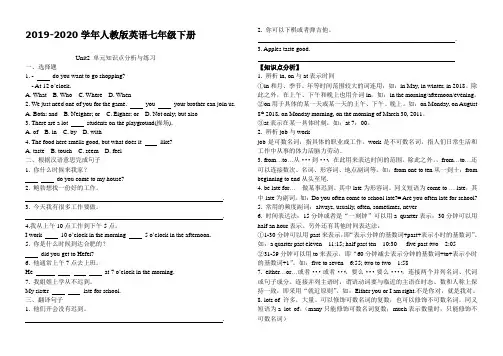
2019-2020学年人教版英语七年级下册
Unit2 单元知识点分析与练习
一、选择题
1. - do you want to go shopping?
- At 12 o’clock.
A. What B. Who C. Where D. When
2. We just need one of you for the game. you your brother can join us.
A. Both; and B. Neigher; or C. Eigher; or D. Not only; but also
3. There are a lot students on the playground(操场).
A. of B. in C. by D. with
4. The food here smells good, but what does it like?
A. taste B. touch C. seem D. feel
二、根据汉语意思完成句子
1. 你什么时候来我家?
do you come to my house?
2. 鲍勃想找一份好的工作。
.
3. 今天我有很多工作要做。
.
4.我从上午10点工作到下午5点。
I work 10 o’clock in the morning 5 o’clock in the afternoon.
5. 你是什么时候到达合肥的?
did you get to Hefei?
人教版英语七年级下册 Unit 8 Is there a post office near here 重点知识精炼总结

1 2019-2020学年人教版英语七年级下册
Unit 8 Is there a post office near here?
重点知识精炼讲解
一、短语归纳
1.post office 邮局
2.police station 警察局
3.pay phone 付费电话
4.near here =around here =in the neighborhood在附近
in the neighborhood of在...附近
5.across from 在···对面
6.in front of 在……前面 (物体外部) in the front of 在……前面 (物体内部)
7.next to=close to 在···附近
8.behind 在···后面
9.between…and… 在···两者之间
10.excuse me. 打扰了
11. far from 离……远
12.far from here 离这远
13.go along/down沿着……走 ◆ go straight 径直往前走
14.turn right/left:向右/左转
15.on one’s right/left 在某人的右边/左边
16.on the right / left 在右边 / 左边
17. turn right=turn to the right 向右转
18.at the first crossing/turning 在第一个十字路口/转弯处
◆19. at the beginning of ...在...的开始
20.clothes store: 服装店
21.in my neighborhood 在我的街区
22.spend time 花时间
23.live near a supermarket 住在超市附近
2019-2020年人教版英语七年级下册Unit 3 How do you get to schoo
2019-2020学年人教版英语七年级下册
单元知识点
Unit3 How do you get to school?
Section A 基础部分
Part1词汇:
●get to, how far. bicycle, subway, car, train. early
● bus stop, train station, bus station, subway station
●minute, kilometer, mile, transportation , calendar
句型:
● How do you get to school? I take the bus.
● How long does it take? It takes 20 minutes.
● How far is it? It’s 10 miles.
Part2.巩固练习
1..搭乘(某种交通工具) v
2..地铁。地下火车n
3.走。步行。散步v.
4..(用以促使注意,表示惊异或询问)嘿。喂int
5..火车n
6.四十num.
7.五十num.
8..六十num
9..七十num
10.八十num.
11.九十num.
12..一百num
13..分钟n
14.花费(时间) v.
15.经、由(表示交通、传递等的方式)prep
16.乘坐公共汽车
17.远的。遥远的adj.
18. 多远
19.公里。千Mn. 20. &n.淋浴v.
21.快的。迅速的adj.
22..自行车。两轮脚踏车n
23..车站n
24..早的。提早的adj
25..英里n
26..车站n
27.运送。运输
28..北部的。北方的
29.北美洲
30.地区。区域n.
31.事物。事情n.
32.另外的。其他的adj.
33..依赖。依靠v
34. 视……而定。决定于
【教育资料】人教版 英语 七年级下册 Units 11-12语法归纳学习专用
教育资源
教育资源 人教版 英语 七年级下册 Units 11-12语法归纳
一、学习目标
1. 一般过去时的用法
2. 一般过去时的句式
3. 一般过去时的标志词
4. 一般过去时中动词过去式的构成
二、重点、难点
一般过去时的句式
【语法学习】
1. 一般过去时的用法
(1)一般过去时表示过去某个时间发生的动作或存在的状态。
(2)一般过去时也表示过去经常或反复发生的动作。
【例句】
He was not at home yesterday. 昨天他没在家。
I often practiced the guitar last year. 去年我经常练习吉他。
【考题链接】
1. —What did you do yesterday evening?
—I _____ my homework.
A. do B. did C. does D. am doing
答案:B
思路分析:根据问句句意“昨天晚上你做了什么?”可知答语的动作发生在过去,即:昨天晚上,故应用一般过去时态。浏览各选项可知B项表示过去时态,是do的过去式。
2. The boy often_______ for his tests last year.
A. study B. studied C. studies D. studyed
答案:B
思路分析:句中虽然有often,但不能用一般现在时,因为句末有表示过去的时间状语last year;本句表示过去经常性、习惯性的动作;study的过去式为studied,故选B项。句意为“去年这男孩经常为测试而学习”。 教育资源
教育资源 2. 一般过去时的句式
一般过去时有两种谓语动词,一种是系动词be,另一种是实义动词。
(1)主语+was/ were +其他。
(2)主语+实义动词的过去式+其他。
2019-2020年人教版英语七年级下册Unit-12-What did you do last w
学生姓名 性别 年级 七年级 科目 英语
上课时间 日期: 辅导
教师 学期课时 学生
所在
学校
时间:星期 本次授课 第 次
教学目标 七年级下第十二单元
教学重难点
课前准备 Ⅰ、课前师生交流:有( ) 无( )
Ⅱ、上次练习完成情况:良( ) 好( ) 般( ) 有待完善( )
课堂讲解 Ⅲ、本次课知识点归纳与讲解:
Unit 12 What did you do last weekend?
一般过去时(past tenses):定义:表示过去某时间的动作或状态。
结构:“主语+动词的过去式”
1.规则动词的过去式:
1)一般情况在动词原形后加-ed
2)以不发音e结尾的加-d
3)以辅音加y结尾的,去y变i加-ed
4)以重读闭音节结尾,末尾只有一个辅音字母,先双写该辅音字母,再加-ed
watch---watched practice---practiced study---studied stop---stopped
课堂练习 Ⅳ、同步巩固:
2.不规则动词的过去式:
am,is-was are-were have,has-had do-did write-wrote go-went
1) want - wanted 2)live--lived 3) study – studied
• clean – cleaned dance – danced play – played
turn ______ taste _______ stay _______
happen ______ waste _______ cry ________
• wish _________ agree _______ marry _______
2019人教版新教材英语各单元知识内容框架概览 全7册
readingspeakingreading for writingpronunciationfirst impressions开学初印象making introductions andgreetings自我介绍和欢迎同学student profiles学生信息表vowel letters元音字母发音listeningstructurewritingproject & video timeregistering 学籍注册learning stylesbasic sentence structure基本句型a student profile填学生信息×readingspeakingreading for writingpronunciationThe Freshman Challenge高中新生活的挑战Skim 略读Talking about futureactivities谈论未来活动A Letter of Advice一封建议信the face-down generationvowel+consonantcombinations字母组合发音listeningstructurewritingproject & video timeSchool clubs 学校兴趣小组youth campsPredict content 听前预测noun phrases adjective phrases andadverb phrases名词短语、形容词短语和 副词短语A Letter of Advice一封建议信*set up a student club*learning acrossgenerationsreadingspeakingreading for writingpronunciationTravel Peru 游览秘鲁Recognise text type 辨识文体Making reservations行程预订(交通住宿等)A Travel Plan to Xi'an游览西安的计划be a good touristconsonants and consonantcombinationslisteningstructurewritingproject & video timeGetting ready to travel 游前准备booking air ticketsFocus on key words 注意关键词the present continuous tenseexpressing future plans现在进行时表将来A travel plan写一份出游计划*design a travel brochure*machu picchureadingspeakingreading for writingpronunciationLiving Legends 活着的传奇Make predictions 读前预测Agreeing and disagreeing赞同和反对Going Positive 保持积极心态cool cold sportsintonationlisteningstructurewritingproject & video timeInviting a friend to a sportsevent邀请朋友参加体育活动sportsmanshipListen for main ideas 听懂要点tag questions反义疑问句a page in a wellness book健康生活记录册*make a survey on sports interestsand needs*the karsts of china:a verticaljourneyreadingspeakingreading for writingpronunciationThe Night the Earth Didn'tSleep那一夜,山河无眠Use context to understand newwordsGiving instructions解释,说明Tsunami Hit Asia Over 6500Dead海啸袭击亚洲,逾6500人死亡the story of an eyewitnessvoiceless and voicedconsonants & -ed endingslisteningstructurewritingproject & video timeNews about natural disasters自然灾害的新闻报道preparing for a disasterListen for details 听辨故事细节restrictive relativeclauses限制性定语从句 (引导词为疑问代词)A summary of a news report给新闻报道写文章摘要*give a presentation on naturaldisasters*tsunami:killer wavereadingspeakingreading for writingpronunciationThe Chinese Writing SystemConnecting the Past and thePresent 汉字书写系统古今发展Scan 略读Asking for clarification要求解释或澄清Learning English 英语学习polyglots:what are they andwho can be oneaccents of english:Americanenglish and british englishlisteningstructurewritingproject & video timeLanguages Around the World世界各国的语言different kinds of englishReference 查阅参考资料restrictive relativeclauses限制性定语从句 (引导词为疑问副词)A blog about English study英语学习日志*create your own wordbank*chinese characterswelcome unit