
牛津译林版八年级下册Unit 3《Online tours》(Integrated skills)课件
Peter is writing about the
online tour. Listen to their
second conversation again and
help him complete his article.
Today Daniel and I took an online tour on the website “Around the World in Eight Hours”. Sydney is on the (1)_________ south-east coast of largest city in Australia. It is the (2)_______ Australia.
Peter took some notes of Sydney. Listen to Daniel and Peter’s second conversation. Write a T if a sentence is true or an F if it is false.
F T
F
T F F
1. Sydney is on the north-east coast of Australia. 2. Sydney is the largest city in Australia. 3. Sydney is near a lake. 4. The Sydney Opera House looks like a ship with many sails. 5. It takes about 30 minutes to climb the Harbour Bridge. 6. In April, it is spring in Australia.
an online tour of Sydney,
Australia. Listen to their conversation and his notes.
How to use the website
The website takes you to different places around the world. To learn about a city, just find it in the menu at the top of the page and click on it. (1)________ If you click on the “(2)_________” Camera icon, you will see some (3)_________ pictures of the city first. Further down at the bottom of the page, you can also find (4)_______ other information about the city.
4. 你有没有曾经梦想过不用护照 环游世界?
Have you ever dreamt of travelling around the world without a passport?
5. 你真幸运!我还从未去过香港。
Lucky you! I have never been to Hong Kong.
Translation
1. 几天前我在街上遇见了一位老朋友。
I met an old friend in the street the other day.
2. 我已经很久没有看电影了。
I haven’t seen a movie for a long time.
3. 我希望有一天能去欧洲游览。
I hope I can visit Europe some day.
1. To listen and get useful information from the tape recording. 2. To grasp some listening skills. 3. To talk to your partners about the problems you may have. 4. To know some basic information of Sydney.
On the website, we saw lots of pictures of Sydney. Sydney is near the sea (3)_______. There are many beautiful (4)_______ beaches there. We also saw a wonderful building called the Sydney Opera House It is a (5)__________________. (6)_________ theatre and looks like a (7)______ ship with many sails.
Near the Sydney Opera House is the famous (8)_______________. Harbour Bridge People can climb it. It takes about (9)___________. three hours It is really cool! Australian seasons are the opposite of ours. For example, in April, it is (10)_________ autumn in Australia!
• Do you like travelling? • Where would you like to visit if possible? • How can we go travelling if we don’t have enough money?
Daniel and Peter are planning
Unit3Onlinetours知识讲义牛津译林版八年级英语下册

牛津版译林英语8B知识点总结Unit3 Online tours【Wele to the unit】1. I agree.【知识点一】:agree v.同意①同意某人的意见agree with + 人②就某事达成一致意见agree on + 事情③同意做某事agree to do sth.④同意… agree + 宾语从句(1) 反义词disagree(2) 名词agreement2. send and receive emails【知识点一】:send v. 发送;寄出(sent/sent)寄给某人某物send sb sth = send sth to sb【知识点二】:receive v.收到,接到从某人哪里收到某物receive sth. from sb.区分:receive 客观收到accept主观接受Eg. The man received a letter just now.My aunt gave me a book and I accepted it happily.(1) I __________ a new bike on my birthday, but I didn't ___________ it.A. received; receiveB. accepted; receiveC. received; acceptD. accepted; accept(2) I haven't __________ my penfriend's letter for two weeks.Maybe he is too busy recently.A. acceptedB. receivedC. writtenD. collected(3) Nowadays _____________(接收) emails is faster and _____________(简单) than before.3. —What do you usually use your puter for?—I usually use it to search for information.【知识点一】: use sth. to do sth. 使用某物做某事= use sth. for doing sth.【知识点二】: search /sɜːtʃ/(1)v. 搜寻,搜索①search sp. 搜寻某地搜寻房间search the room②search sp. for... 在某地搜寻某物Eg. They are searching the forest for the missing boy.③search sb. for sth. 搜查;搜身Eg. The police searched the thief for the lost money.④search for sth. / sb. 寻找某物/ 某人=look / hunt / seek for(2) n.搜寻,搜索in search of... 为了寻找...Eg. She went into the kitchen in search of something to drink.(1) — Why did Mike _____ the room?— I’m not sure. Maybe he wanted to ____ his watchA. search; findB. search for; findC. search; lookD. search for; look for(2) It took the parents the whole day ___________ the town ___________ the lost baby.A. searching; forB. to look; forC. to search; forD. finding; out(3) — Would you please show me your new puter?— Sorry, my brother __________ (search) for something on it.【知识点三】: information /ˌɪnfəˈmeɪʃn/ un. 信息①一条信息a piece of information②信息时代information age(1) v. inform 通知①inform sb. of sth. 通知某人某事Eg. The boss informed us of his arrival.4. —How often do you use your puter for this? —Almost every day.【知识点一】:how often(1) how often 表多久一次,问频率Eg. How often does your brother exercise? Twice a week.(2) how long 表示多长时间,对一段时间进行提问Eg. How long did you stay there? A bout three weeks.(3) how soon 表示多久,对将来的时间进行提问Eg. How soon will he be back?In a week.(1)_____________ do you write to your pen friend?Twice a month.A. How oftenB. How soonC. How longD. How many times(2)___________ do you water the plants? Twice a day.A. How longB. How soonC. How oftenD. How much【知识点二】:almost adv. 几乎,差不多辨析almost 和nearly(1) almost:在程度上比nearly更强可与any、nobody、never、nothing、none等否定词连用(2) nearly:常用在具体数字前面不可与any、nobody、never、nothing、none等否定词连用可与not构成短语not nearly—远远不如:Nearly everyone knows him.=Almost everyone knows him.【Reading】1 I’m your tour guide.【知识点一】:guide /ɡaɪd/(1) cn. 导游,向导①一位导游a tour guide②导盲犬guide dog(2) n. 指南,手册a Guide to Family Health(3) v. 领路;指引带领某人到/穿过guide sb. to/ throughEg. She guided us through the busy streets to the park.2. Have you noticed the “Tour” icon at the top of the page? Just click on it, and you can visit Asia, Africa, Europe, America and more in only eight hours!【知识点一】:notice(1) v. 注意;注意到①注意到某人/某事notice sb/sth②注意到某人做某事notice sb do (强调动作发生的全过程或经常发生)notice sb doing sth. (强调动作正在发生)③notice + 从句(2) un. 注意注意到… take notice ofEg. Don't take any notice of what you read in the papers.(3) cn. 通知,布告,公告牌Eg. There is a notice on the office door saying “No Smoking”.(1) Have you noticed a tall boy __________ a basketball ____________ into the building?A. has; runB. have; runningC. with; runD. with; running(2) When I passed the river, I saw some children ________________ (play) on the sand.【知识点二】:at the top of 在……顶端反义短语:at the bottom of 在……底部Eg. There stands a tall tree at the top of the mountain.【知识点三】:click vi. 点击单击某物click on sth.double left click on左键双击left click on左键单击3. Wall Street, the worldfamous trade center, is here at the southern end of Manhattan Island. There are many big panies and international banks here.【知识点一】:worldfamous /wɜ:ld ˈfeɪməs/(adj.) 世界著名的,举世闻名的①因为...而举世闻名be worldfamous for...This player was worldfamous for scoring the first goal of the 2010 World Cup.这位球员因打进了2010世界杯第一个球而举世成名。
牛津译林版八年级下册Unit 3《Online tours》说课稿4

牛津译林版八年级下册Unit 3《Online tours》说课稿4一. 教材分析《Online tours》是牛津译林版八年级下册Unit 3的一篇课文,主要介绍了网络旅游的发展以及其给人们带来的便利。
通过阅读这篇课文,学生可以了解网络旅游的相关知识,提高自己的英语阅读能力,同时也能够培养自己的信息素养和跨文化交际能力。
二. 学情分析学生在学习这篇课文之前,已经掌握了基本的英语语法和词汇知识,具备一定的阅读理解能力。
但是,由于网络旅游是一个比较新的概念,学生可能对其不太了解,因此在教学过程中需要教师对其进行解释和引导。
三. 说教学目标1.知识目标:学生能够掌握课文中的关键词汇和句型,理解网络旅游的概念和特点。
2.能力目标:学生能够通过阅读课文,提高自己的阅读理解能力和跨文化交际能力。
3.情感目标:学生能够认识到网络旅游的便利性,同时也能够意识到其可能带来的负面影响,培养自己的信息素养。
四. 说教学重难点1.重点:课文的理解和词汇的掌握。
2.难点:对网络旅游的理解和评价,以及与之相关的文化背景知识。
五. 说教学方法与手段1.教学方法:采用任务型教学法,让学生在完成任务的过程中,提高自己的阅读理解和跨文化交际能力。
2.教学手段:利用多媒体教学,播放相关的网络旅游视频,让学生更直观地了解网络旅游。
六. 说教学过程1.导入:利用网络旅游的图片或视频,引导学生进入话题,激发学生的学习兴趣。
2.阅读理解:学生阅读课文,回答相关问题,教师进行讲解和解答。
3.词汇学习:教师引导学生学习课文中的关键词汇和句型,进行口语练习。
4.讨论:学生分组讨论网络旅游的优缺点,分享自己的看法和经验。
5.总结:教师对课堂内容进行总结,强调网络旅游的正确使用和评价。
七. 说板书设计板书设计主要包括课文标题、关键词汇、句型和课堂讨论的要点。
通过板书的展示,学生可以更加清晰地理解和记忆课堂内容。
八. 说教学评价教学评价主要通过学生的课堂表现、作业完成情况和考试成绩来进行。
牛津译林版英语八下(三)8 Unit 3 Online tours
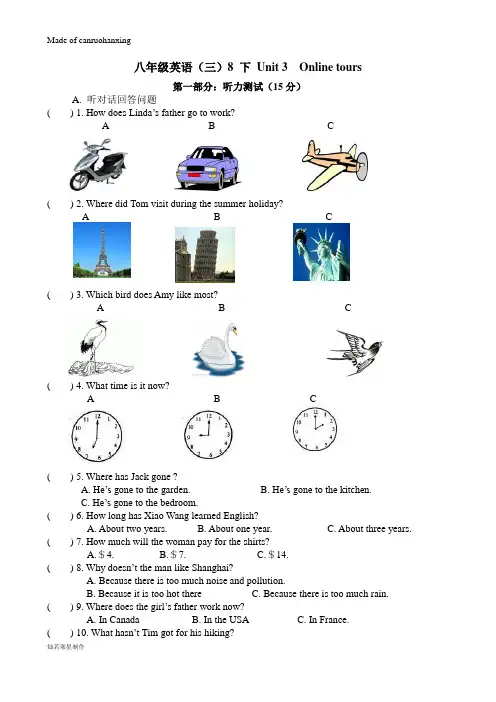
八年级英语(三)8 下Unit 3 Online tours第一部分:听力测试(15分)A. 听对话回答问题( ) 1. How does Linda’s father go to work?A B C( ) 2. Where did Tom visit during the summer holiday?A B C( ) 3. Which bird does Amy like most?A B C( ) 4. What time is it now?A B C( ) 5. Where has Jack gone ?A. He’s gone to the garden.B. He’s gone to the kitchen.C. He’s gone to the bedroom.( ) 6. How long has Xiao Wang learned English?A. About two years.B. About one year.C. About three years. ( ) 7. How much will the woman pay for the shirts?A.$4.B.$7.C.$14.( ) 8. Why doesn’t the man like Shanghai?A. Because there is too much noise and pollution.B. Because it is too hot thereC. Because there is too much rain. ( ) 9. Where does the girl’s father work now?A. In CanadaB. In the USAC. In France.( ) 10. What hasn’t Tim got for his hiking?A. FoodB. A mapC. A mobile phoneB. 听一篇短文,回答第11~15小题。
牛津译林版英语八下《Unit 3 Online Travel》(Integrated skills)

Now answer the following questions.
1. What does Sandy want to start? He want to start the online tour
of Australia,
2. Does Millie know how to start it? Yes, she does.
The package includes a(4)_____ book and
(5)______________. five CD-ROMs
It is very good for(6)________ tourists and(7) ________. students I’m sure we can learn a lot from it. We can learn about (8) _________________, using the telephone asking and (9) _________ answering questions. We can also learn to talk about the(10) _______ weather and
牛津版初中英语Байду номын сангаас年级下
Unit 3 Online traveling
Integrated skills
Competition You will see some hints. Try to guess which part of the computer it is. Let's begin!!!
Homework
1. Copy the new words. 2. Practice the conversation between Sandy and Millie. 3. Finish off the exercises on the Workbook.
牛津译林版八年级下册Unit3《Onlinetours》说课稿3

牛津译林版八年级下册Unit 3《Online tours》说课稿3一. 教材分析《Online tours》是牛津译林版八年级下册Unit 3的一篇课文,主要介绍了一种新兴的旅游方式——在线旅游。
通过网络摄像头,游客可以在家中欣赏到世界各地的美景。
本文旨在让学生了解在线旅游的发展和优势,以及如何利用网络资源进行旅游规划。
二. 学情分析八年级的学生已经具备了一定的网络素养和信息技术能力,对网络旅游有一定的了解。
但他们在实际应用中,可能会遇到词汇、语法和阅读理解等方面的困难。
因此,在教学过程中,需要关注学生的个体差异,引导他们主动参与课堂活动,提高他们的英语素养。
三. 说教学目标1.知识目标:让学生掌握课文中的关键词汇和语法结构,了解在线旅游的发展和优势。
2.能力目标:培养学生通过网络资源进行信息搜索和交流的能力,提高他们的阅读理解和写作能力。
3.情感目标:激发学生对旅游的兴趣,培养他们积极上网查阅资料的良好习惯。
四. 说教学重难点1.重点:课文的理解和词汇、语法的学习。
2.难点:如何利用网络资源进行旅游规划,提高实际应用能力。
五. 说教学方法与手段1.任务型教学法:通过设定具体任务,让学生在实践中学习英语,提高他们的实际应用能力。
2.情境教学法:创设真实的旅游情境,让学生在情境中学习英语,提高他们的口语表达能力。
3.信息技术辅助教学:利用网络资源,为学生提供丰富的学习材料,提高他们的自主学习能力。
六. 说教学过程1.导入:以一段关于在线旅游的视频导入,激发学生的兴趣。
2.阅读理解:学生自主阅读课文,回答相关问题,检测他们对课文内容的理解。
3.词汇学习:教师讲解课文中的关键词汇和语法结构,学生进行笔记。
4.实践环节:学生分组讨论,结合课文内容,设计一份在线旅游计划。
5.展示环节:各组学生展示他们的在线旅游计划,其他学生进行评价。
6.总结:教师对课堂内容进行总结,强调在线旅游的优势和注意事项。
七. 说板书设计板书设计主要包括课文标题、关键词汇、语法结构和课堂活动流程。
Unit3OnlinetoursIntegratedskills课件牛津译林版八年级英语下册(1)
city.
Nothing great was ever achieved without enthusiasm
Nothing great was ever achieved without enthusiasm
探究一
Nothing great was ever achieved without enthusiasm
Millie : That’s easy. If you click on the “Camera” icon, you can see many pictures of the city.
Loss of blasting (失去爆破) want to
Sandy : Great! These pictures are so clear.
牛津译林版八年级英语下 册
Unit3 Online tours Integrated skills
Take an online tour
Use a website to travel around the world
back
Daniel and Peter are planning an online tour of Sydney,Australia.
Millie: Of course not. Just click on the “Tour” icon and it’ll start.
Linking (连读) click on
Sandy : Oh, good! It’s starting. I want to look at some pictures first.
Nothing great was ever achieved without enthusiasm
最新牛津译林版八年级英语下册 Unit 3 Online tours精品课件
最新初中英语精品课件设计
• (2). Say how to remember the words what your partner can’t remember.(2′ (3).Work in groups.(4' One speaks English, the others speak Chinese. Have a match. Who remembers the most?
pronunciation and intonation (5').
最新初中英语精品课件设计
• 2. Learn to read them from each other.(5 • Have a match. Who reads best?
• Let me check. Let’s solve the problems.(3′
Practice a dictation. • Have a match. Who can remember the most words? • 2.Correct your mistakes.
最新初中英语精品课件设计
remote control→ re mote con trol international→ in ter na tio nal several→ se ve ral Europe→ eu rope European→ eu ro pean
Guide Two
e different ways to remember them quickly.(5' 2.Check with your deskmate.(3′
牛津译林版八年级下册Unit 3《Online tours》说课稿9
牛津译林版八年级下册Unit 3《Online tours》说课稿9一. 教材分析《Online tours》是牛津译林版八年级下册Unit 3的一篇课文,主要介绍了一种新兴的旅游方式——在线旅游。
通过阅读课文,学生可以了解到在线旅游的特点、优势以及如何进行在线旅游。
本课的主题与学生的日常生活紧密相连,能够激发学生的学习兴趣。
二. 学情分析八年级的学生已经具备了一定的英语基础,对于日常生活中的事物和现象有一定的认知。
然而,他们在阅读长篇文章时可能会遇到困难,特别是对于一些专业术语和较长句子。
因此,在教学过程中,教师需要关注学生的个体差异,尽可能地调动学生的积极性,帮助他们克服学习困难。
三. 说教学目标1.知识目标:让学生掌握在线旅游的相关词汇和表达方式,如“virtualtour”、“interactive”等。
2.能力目标:培养学生具备快速获取信息、处理信息的能力,提高学生的阅读理解能力。
3.情感目标:引导学生正确看待新兴事物,培养学生的创新意识。
四. 说教学重难点1.重点:在线旅游的相关词汇和表达方式。
2.难点:理解课文中的长句子和复杂结构,以及如何运用所学知识进行实际应用。
五. 说教学方法与手段1.交际式教学法:通过小组讨论、角色扮演等形式,让学生在实际语境中运用所学知识。
2.任务型教学法:引导学生完成课后的实践任务,提高学生的实际操作能力。
3.多媒体教学手段:利用多媒体课件和网络资源,为学生提供丰富的学习资源,增强课堂教学的趣味性。
六. 说教学过程1.导入:以一个关于在线旅游的短动画引入课题,激发学生的兴趣。
2.阅读理解:让学生阅读课文,回答相关问题,提高学生的阅读理解能力。
3.词汇学习:引导学生学习课文中的新词汇,并通过实例进行讲解。
4.课堂讨论:分组让学生讨论在线旅游的优缺点,培养学生的批判性思维。
5.实践任务:让学生设计一个在线旅游方案,并进行展示,提高学生的实际操作能力。
6.总结:对本课内容进行总结,强调在线旅游的特点和优势。
牛津译林版八年级下册Unit 3《Online tours》教学设计8
牛津译林版八年级下册Unit 3《Online tours》教学设计8一. 教材分析《Online tours》是牛津译林版八年级下册Unit 3的一篇课文,主要介绍了一种新兴的学习方式——网上旅游。
通过阅读课文,学生可以了解网上旅游的优势以及如何在网上选择旅游目的地。
本课主要围绕“网上旅游”这一主题,通过引入真实、生动的例子,让学生更好地理解网上旅游的优点和乐趣。
二. 学情分析八年级的学生已经具备了一定的英语基础,对于日常生活中的一些现象和事物有了一定的认识。
然而,对于网上旅游这一新兴领域,他们可能还比较陌生。
因此,在教学过程中,教师需要引导学生了解网上旅游的基本概念,并通过实例让学生体验网上旅游的乐趣。
三. 教学目标1.知识目标:–学生能够掌握与网上旅游相关的词汇和表达方式。
–学生能够理解课文中关于网上旅游的描述和例子。
2.能力目标:–学生能够用英语简单介绍网上旅游的优势和如何进行网上旅游。
–学生能够在小组合作中运用所学知识,进行网上旅游的讨论和分享。
3.情感目标:–学生能够培养对网上旅游的兴趣,激发他们学习英语的积极性。
四. 教学重难点•学生能够掌握与网上旅游相关的词汇和表达方式。
•学生能够理解课文中关于网上旅游的描述和例子。
•学生能够用英语进行网上旅游的介绍和讨论。
五. 教学方法1.任务型教学法:通过设定具体的任务,让学生在完成任务的过程中运用所学知识,提高学生的实际应用能力。
2.合作学习:通过小组合作,让学生共同探讨和分享网上旅游的经验和心得,提高学生的团队合作能力。
3.情境教学法:创设真实的网上旅游情境,让学生在情境中感受和体验网上旅游的乐趣,提高学生的学习兴趣。
六. 教学准备1.教师准备:–熟悉教材内容,了解学生的学习情况。
–准备相关的教学资源和素材。
2.学生准备:–预习课文,了解网上旅游的基本概念。
–准备相关的学习资料和工具。
七. 教学过程1.导入(5分钟)–教师通过提问方式引导学生思考:你们有没有参加过网上旅游?网上旅游和实地旅游有什么不同?–学生分享自己的网上旅游经验,教师总结并引入本课的主题。
牛津译林版英语八下Unit3《Onlinetours》(Grammar)说课稿
牛津译林版英语八下Unit 3《Online tours》(Grammar)说课稿一. 教材分析《Online tours》是牛津译林版英语八年级下册Unit 3的一篇课文,主要介绍了网上旅游的现象以及其优缺点。
通过本文的学习,学生可以了解网上旅游的相关知识,提高自己的英语阅读能力,并学会如何运用目标语言描述事物。
二. 学情分析考虑到学生已经有一定的英语基础,对网上旅游这一主题也有一定的了解,因此,在教学过程中,我将注重提高学生的阅读理解能力,引导他们运用目标语言进行表达,并培养他们的合作意识和创新精神。
三. 说教学目标1.知识目标:学生能理解课文主要内容,掌握相关词汇和短语,并能运用目标语言进行简单的描述。
2.能力目标:学生能提高自己的阅读理解能力,学会从文章中获取有用信息。
3.情感目标:学生能认识到网上旅游的优缺点,培养正确的旅游观念。
四. 说教学重难点1.重点:学生能理解并运用目标语言描述网上旅游的现象。
2.难点:学生能从文章中获取有用信息,并运用批判性思维分析网上旅游的优缺点。
五. 说教学方法与手段1.任务型教学法:通过小组讨论、角色扮演等活动,激发学生的学习兴趣,提高他们的参与度。
2.情境教学法:创设真实的旅游情境,让学生在实践中学会运用目标语言。
3.多媒体教学法:利用网络资源,展示相关旅游视频和图片,丰富教学内容,提高学生的学习兴趣。
六. 说教学过程1.Pre-reading:引导学生关注网上旅游的话题,激发他们的学习兴趣。
2.While-reading:学生速读课文,回答相关问题,确保对课文内容的理解。
然后,学生细读课文,分析文章结构,了解网上旅游的优缺点。
3.Post-reading:学生进行小组讨论,分享自己的网上旅游经历,并运用目标语言进行描述。
最后,学生进行角色扮演,模拟网上旅游的咨询过程。
七. 说板书设计板书设计主要包括课文标题、主要词汇、短语和网上旅游的优缺点。
通过板书,学生可以一目了然地了解课文主题和关键信息。