
仁爱版英语七年级上册Unit 5 Topic 2 Section A
He is playing cards. (play cards 玩牌,打牌)
What is she doing?
She is talking on the phone.
1b. Listen to 1a and circle the correct answers.
1. Michael and Jane are talking _________________ (on the telephone, in the classroom). 2. Jane is _______________ (doing her homework, watching TV). 3. What is Michael doing? He is ______________ (playing cards, making cards).
3a. Listen and match. Pay attention to the structure of the Present Continuous.
Maria
Kangkang
Wang Li and Li Mei
Wang Wei and are dancing Lin Tao
in the gym. are doing some cleaning on the playground. is reading in the lab. is running in the library
Grammar
动词 v.-ing的构成形式
wash catch make ride sit get washing catching making riding sitting getting
一般在动词原形末尾加-ing 以不发音的e结尾的动词,先 去掉e,再加-ing 以重读闭音节结尾的动词,如 果末尾只有一个辅音字母,应 先双写这个字母,再加-ing
skating
skiing dancing
What are they doing?
They are cleaning the classroom.
What sheis Look, is what doing? he doing?
He is She is running. dancing.
地点介词in/on 在…
4a. Listen and read the sounds and words aloud.
4a. Listen and read the sounds and words aloud.
4b. Read aloud and compare the sounds of the colored letters.
2. Look at the picture and match the places with the correct words or phrases.
(6)A. library
(3)B. playground (7)C. lab (8)D. computer room (9)E. dining hall (1)F. teachers’ office (4)G. gym (2)H. classroom building I. swimming pool (5)
on the playground in the library
in the gym
in the garden
in the kitchen
in the bedroom
in the lab(laboratory)
in the park
in the swimming pool
in the computer room
3b. Work in pairs. Make up conversations with the information in 3a.
• • • • • • • Example: A: ..., where is Maria? B: She is ... A: What is she doing now? B: She is ... A: Is Kangkang reading in the library, too? B: No, he isn't. He is ...
Jane: Michael: See you.
Would you like to play basketball? Good idea! See you soon.
Pair Work
1c. Work in pairs and practice 1a. Then make up a new conversation with the following structures. A: What are you doing?
sea head need neck even ever weak dead again early paper person worker work winter word bag page league large grow age guest orange
1. The names of school facilities. 2. Present continuous tense. e.g. What are you/they doing? I’m/They're reading. Are you/they watching TV now? Yes, I am/they are. / No, I’m not/they aren't. What is he/she doing? He/She is making cards. Is he/she running now? Yes, he/she is. / No, he/she isn't.
in the dining room
in teachers’ office
What are they doing?
They are doing some cleaning.
What are they doing?
They are making cards. (make cards 做卡片)
What is he doing?
1. Review the names of school facilities.
2. Make sentences with the structure of
1a. Listen, look and say.
Michael: Hello, Jane! This is Michael. What are you doing now? Jane: Guess! Michael: Are you doing your homework? Jane: No, I’m not. Michael: Are you watching TV? Jane: Yes, I am. What about you? Michael: I’m making cards, but it’s boring.
We learn: 1. some words: boring, soon, classroom, playground, lab, computer, hall, gym… 2. some phrases: do some cleaning, dining hall, swimming pool, computer room. 3. some sentences: What are you/is he/is she doing? I’m/He/She is reading. We can: 1. talk about the name of school facilities. e.g. There is a big library in our school. 2. use the Present Continuous to talk about actions. e.g. She is watching TV now.
B: I’m doing … A: What is he/she doing? B: He/she is doing … A: Is she/he doing …? B: Yes, she/he is. / No, she/he isn’t. A: Are you/they doing …? B: Yes, … / No, …
Work in pairs
A: What are you doing?
B: I am skating. A:What are they doing? B:They are running. A:What is she/he doing?
swimming
running
cycling
rowing
B:She/He is swimming.
用现在进行时完成下列句子: 1. What ______ doing are you ________(do)? am singing (sing) an English song. 2. I____________ drinking 3. What _____she ____________(drink)? is is driving (drive) a car. 4. He___________ Are you _______(fly) flying 5. _____ a kite? Yes, _______. I am Is she ________ 6. ____ sitting (sit) in the boat? 7. ______you ________ Are asking (ask) questions? are playing (play) games now. 8. We___________
be (am/is/are) + doing +其他。 肯定句式: 主+ ___________________ 否定句式: 主+am/is/are+ ___ not +doing+其他。
Unit2Topic2SectionA+课件+2023-2024学年仁爱版英语七年级上册
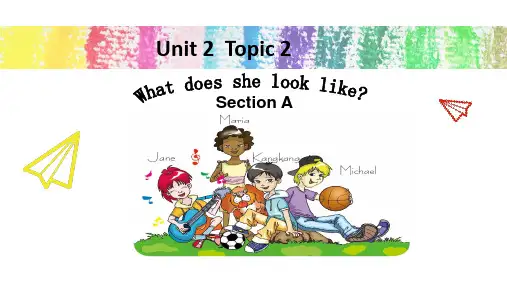
请把照片涂成绿色。
1b. Listen and complete the table. (录音P35-1a)
Name
Country Hair (color) Eyes (color)
2018 Yukio
Michael
Japan America
black blond
Kangkang China
black
同义句转换:
1.I have long hair.= My hair is long. 2.Her legs are long.= She has long legs. 3.She has a small nose.= Her nose is small. 4.His feet are big.= He has big feet.
3. 是的,你说的对
Yes, you're right.
4.他是中国人,他有一个大鼻子。
He's Chinese and he has a big nose.
5. 他有一头长发吗?是的,有。/不,没有
Does he have long hair? Yes, he does. No, he doesn't
描述外貌特征: 主语 + have +颜色+五官
Eg. They have brown hair and blue eyes. 他们都有棕色的头发,蓝色的眼睛。
3.We don't look the same, but we're good friends.
but 和and 区别: but“但是”, 表示转折关系
( )5. The girl ____ black is my sister.
仁爱版七年级英语上册Unit2topic2SectionA教案
Topic 2 What color is it?Section AThe main activities are 1a and 2a. 本课重点活动是1a和2a。
Ⅰ. Teaching aims and demands 教学目标1.(1) Learn some new words about the colors:black, blue, pink, red, purple, brown, white, gray, green, yellow(2) Learn some other new words:both, color, here2. Learn some useful sentences:(1)You look the same.(2)That’s right.(3)We are good friends.(4)It’s here.3. (1)Continue to talk about people’s appearances:①We both have black hair and black eyes.②I have blond hair and blue eyes.③We don’t have the same looks.(2)Identify colors:①—What color is it?—It is pink.②—What’s red and yellow?—It’s orange.Ⅱ. Teaching aids 教具实物/教学挂图/录音机/小黑板/调色盘/白纸/彩笔Ⅲ. Five-finger Teaching Plan 五指教学方案Step 1 Review 第一步复习(时间:10分钟)师生对话,复习并导入新课。
由具体实物引出生词,学习用英语描述人物特征。
培养学生的观察能力。
1. (One by one练习,对Does she/he have …?句型进行复习。
仁爱版七年级英语下册教学设计:Unit5Topic2SectionA
-设想实施:根据学生的英语水平和学习风格,提供不同难度的学习材料和任务。给予学生个性化指导,确保每个学生都能在原有基础上得到提升。
4.结合课堂评价,及时给予学生反馈,鼓励学生自我反思和自我提升。
-设想实施:建立多元化的评价体系,包括自我评价、同伴评价和教师评价。通过评价,帮助学生认识自己的优点和不足,激发内在的学习动力。
三、教学重难点和教学设想
(一)教学重难点
1.词汇和短语的理解与运用:本章节涉及的核心词汇和短语是学生进行有效交流的基础,如何让学生熟练掌握并运用这些词汇进行观点表达是教学的重点和难点。
-教学设想:通过词汇卡片、头脑风暴、词汇游戏等多种形式,让学生在趣味性活动中记忆词汇,并通过真实的语境练习,加深对词汇意义的理解和运用。
2.时态的正确使用:一般现在时和现在进行时在本章节中的运用,对于学生来说是语法学习的难点。
-教学设想:设计图表、时间线等视觉辅助工具,帮助学生直观理解时态的概念和使用场景。通过情景对话和写作练习,让学生在实际操作中掌握时态的正确运用。
3.听力策略的培养:学生需要学会在对话中捕捉关键信息,理解他人的观点和态度。
四、教学内容与过程
(一)导入新课
在导入环节,教师将通过以下方式激发学生的学习兴趣和探究欲望:
1.利用图片展示不同场景下人们争论、讨论的画面,引导学生关注并思考:Why do people argue? How do they express their opinions?
2.引入一段关于“成功与努力”的短视频,让学生初步感知本节课的核心话题,激发他们对成功与努力的探讨欲望。
3.培养学生学会关心他人,尊重他人,理解和接纳不同的观点和意见。
新版仁爱版七年级上册英语课文翻译
Unit 1 Making New Friends交新朋友No, I ’m not. I’m Jane.不,Topic 1 Welcome to China!欢迎来到我不是。
我是 Jane。
中国!Oh, nice to meet you, Jane.哦。
Section A很高兴见到你, Jane。
1a Nice to meet you, too.我也很Good morning! I ’m Kangkang. 早上好,高兴见到你。
我是康康! 3.Good morning !早上好!Hi, Maria!你好,Welcome to China!欢迎来到Maria !中国!Hi, Kangkang.你好,康Thank you.谢谢!康!2a Welcome to China!欢迎来到Hello !你好!中国!Hello !你好!Thanks.谢谢 !I ’m Kangkang. Are you Michael ?Section B我是康康。
你是Good morning,Mr. Brown!Nice to see Michael 吗?you.Yes, I am.是的,我早上好,布朗先生!很高兴见到你。
是。
Good morning,Maria! Nice to see you, 2.too.Hello !Are you Maria ?你好!你早上好, Maria !我也很高兴见到你。
是 Maria 吗 ?Mom, this is my teacher, Mr. Brown.Mr. Brown, this is my mom.1a妈妈,这是我的老师,布朗先生。
布朗Hello, I ’m Li Ming.What’s your先生,这是我的妈妈。
name?How do you do?你好!你好,我是李明。
你叫什么名字?How do you do?你好!My name’s Jane.Topic 2 Where are you from?你来我的名字是 Jane。
仁爱版英语七年级下册Unit5topic2sectionA说课稿
仁爱版英语七年级下册Unit5 topic 2 section A 说课稿一. 教材分析仁爱版英语七年级下册Unit5 topic 2 section A主要讲述了在业余时间人们喜欢做什么,以及怎样做。
通过本节课的学习,学生能够掌握一般现在时的表达方式,并且能够运用所学知识进行简单的交流。
教材内容贴近学生的生活,激发学生学习兴趣,提高学生的语言运用能力。
二. 学情分析面对七年级的学生,他们在经过一段时间的英语学习后,已经具备了一定的英语基础。
但是,仍然有一部分学生在语言表达方面存在一定的困难。
因此,在教学过程中,需要关注学生的个体差异,因材施教,充分调动学生的积极性,让他们在轻松愉快的氛围中学习英语。
三. 说教学目标1.知识目标:学生能够掌握一般现在时的表达方式,理解课文内容,掌握关键词和短语。
2.能力目标:学生能够运用所学知识进行简单的交流,提高口语表达能力。
3.情感目标:培养学生热爱生活,积极向上的生活态度,增进同学之间的友谊。
四. 说教学重难点1.教学重点:一般现在时的表达方式,课文内容的掌握。
2.教学难点:一般现在时的运用,单词和短语的理解。
五. 说教学方法与手段1.采用任务型教学法,让学生在完成任务的过程中,自然的运用所学知识,提高语言运用能力。
2.运用多媒体教学手段,如图片,视频等,激发学生的学习兴趣,帮助学生更好的理解课文内容。
3.采用分组合作学习的方式,培养学生的团队协作能力,提高学生的口语表达能力。
六. 说教学过程1.导入:通过展示图片,引导学生谈论图片中的人们在做什么,引入本节课的主题。
2.呈现:展示课文图片,让学生根据图片预测课文内容,然后播放课文录音,让学生跟读。
3.讲解:讲解一般现在时的表达方式,以及课文中的关键词和短语。
4.练习:通过小组活动,让学生运用一般现在时进行交流,巩固所学知识。
5.输出:让学生结合自己的生活,用英语谈论自己在业余时间喜欢做什么,提高学生的语言运用能力。
仁爱版英语七年级下册 第五单元 知识点汇总
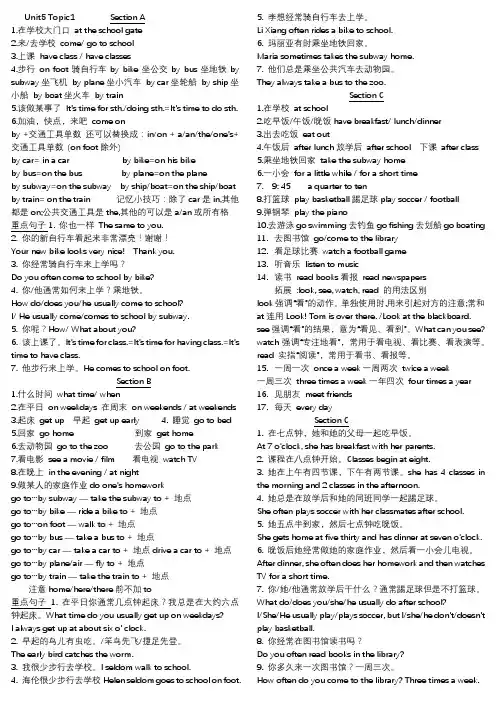
Unit5 Topic1Section A1.在学校大门口at the school gate2.来/去学校come/ go to school3.上课have class / have classes4.步行on foot骑自行车by bike坐公交by bus坐地铁by subway坐飞机by plane坐小汽车by car坐轮船by ship坐小船by boat坐火车by train5.该做某事了It’s time for sth./doing sth.=It’s time to do sth.6.加油,快点,来吧come onby +交通工具单数还可以替换成:in/on + a/an/the/one’s+交通工具单数(on foot除外)by car= in a car by bike=on his bikeby bus=on the bus by plane=on the planeby subway=on the subway by ship/boat=on the ship/boat by train= on the train 记忆小技巧:除了car是in,其他都是on;公共交通工具是the,其他的可以是a/an或所有格重点句子1. 你也一样The same to you.2. 你的新自行车看起来非常漂亮!谢谢!Your new bike looks very nice! Thank you.3. 你经常骑自行车来上学吗?Do you often come to school by bike?4. 你/他通常如何来上学?乘地铁。
How do/does you/he usually come to school?I/ He usually come/comes to school by subway.5. 你呢?How/ What about you?6. 该上课了。
It’s time for class.=It’s time for having class.=It’s time to have class.7. 他步行来上学。
Unit5课时2SectionA(2a-2e)分层作业新人教版七年级英语上册
Unit5Fun Clubs第二课时分层作业夯基达标一、单词拼写1.My grandpa enjoys watching(新闻)on TV every night.2.Beethoven is a(有音乐天赋的)pianist.He is well-known all over the world.3.In China many children begin to learn to play musical(乐器)when they are young.4.Jim can't remember(准确地)his mother's birthday.5.Tom can(打鼓).6.To improve your reading(能力),you should read more English articles.7.We can p(用颜料画)the picture together.8.Would you like to j(加入)our music club?.9.I have the same(感受)as all my friends.10.If you like singing,you can join the Singing(俱乐部).二、单项选择11.一What can you do,Liz?A.I like sportsB.I am in the art clubC.I can do Chinese kungfuD.I want to join the dance club12.—club are you in?一I'm in the story telling club because I like to tell stories.A.HowB.WhatC.WhenD.Where13.下面句子中哪处发音可以失去爆破?Sharing a problem with others is li ke cutting it in half.A.Shari ngB.wi thC.l ikeD.it14.I don't like cooking,so I join the Food and Drink Club.A.canB.mayC.mustD.can't15.They are very happy to the Music Club.A.join inB.joinC.go in forD.take part in16.根据辅音分类规则,下列选项中不同于其他三个的是oA./t//d/B./f7/v/C./s//z/D./w//u/17.一Do you want to join the music club?—Sorry,I can't play the piano_______the violin.A.butB.andC.soD.or18.下列单词中划线部分发音不同的单词是A.calmB.careC.costD.cent19.Becky often plays________violin fbr an hour every day.A.aB.anC.theD./20.下列哪一组音素全都是清辅音?A./k//s//3/B./s//|7/9/C./t//g//tf7三、补全对话根据对话内容,从方框中选择合适的选项补全对话。
仁爱版七年级英语下册Unit5Topic2SectionA说课稿
2.提问:通过提问,如“你们参加过哪些节日庆祝活动?”或“你们记得上次假期去了哪里吗?”来吸引学生的注意力,并引导他们思考过去的活动。
3.简单游戏:设计一个快速反应游戏,如“快速说出你昨天做了什么”,让学生在轻松愉快的氛围中进入学习状态。
我将通过以下方式应对这些问题:
1.对于不规则动词,我会提供更多的练习和记忆策略,如编写不规则动词的口诀或歌曲。
2.我会设计更多的互动活动,让学生在模拟的语境中练习使用过去式。
课后,我将通过学生的作业、课堂表现和学生的反馈来评估教学效果。具体的反思和改进措施包括:
1.分析学生的作业,了解他们掌握知识的程度,针对普遍存在的问题进行集中讲解。
3.收集并记录一些不规则动词的过去式,下节课分享给全班同学。
作业的目的是巩固学生对一般过去时的理解,提高他们的写作能力和词汇量,同时培养他们的自主学习能力。
五、板书设计与教学反思
(一)板书设计
我的板书设计注重布局合理、内容精炼、风格清晰。板书布局分为三个部分:
1.主题区域:在板书顶部写上本节课的主题“Unit5 Topic2 SectionA”,以及副标题“谈论过去的活动”。
3.在实际交际中,难以准确运用过去式描述过去发生的事件。
4.部分学生可能因为语言环境的限制,缺乏足够的听说练习,影响语言运用能力。
(三)学习动机
为了激发学生的学习兴趣和动机,我将采取以下策略或活动:
1.利用多媒体资源,如视频、图片等,展示不同国家的节日庆祝活动,激发学生的好奇心和兴趣。
2.设计互动性强的课堂活动,如角色扮演、小组讨论等,让学生在真实的语境中使用目标语言。
仁爱版英语七年级上册--Unit2-Topic-2-Section-A--教学设计与反思
仁爱版英语七年级上册 2 2 A 教学设计与反思陈素芳一、教材分析:这一话题进一步谈论人的相貌特征,从谈论头发、眼睛的色彩,到服装的色彩进而谈到各种色彩。
而本主要让学生了解并掌握12种不同的颜色,会用…? / …? 这一句型和同伴进行交谈,能谈论头发、眼睛的色彩。
二、教学目标:语言知识目标:1.(1) :, , , , , , , , .(2) :, , , .2. (1) ’s :①.②I .③, .(2) :①—? —.②—? —.③—? —.语言技能目标:能听懂并识别各种不同的颜色,并能用英语描述各种颜色。
情感态度目标:通过学习不同的色彩,培养学生热爱生活、热爱美的情感,并培养他们的观察能力和概括能力。
学习策略目标:本主要谈论色彩,在教学时联系学生的实际,利用他们身边的实物等进行描述。
从而让学生形成把学习和生活实际联系起来的学习习惯,培养任务型学习方法与技巧。
三、教学重、难点:1a 3四、教学方法:任务型教学法、自主探究法、小组讨论法。
体现“导学——自悟”新课程教学模式的套路和特色。
五、课时安排:1课时六、教具准备:录音机、课件、实物、图片七、教学过程:第一步:营造课堂氛围,激发学生学习兴趣。
1. : , .2. .第二步:复习(幻灯片3、4)1. .(单词竞赛)2. ( 练习,对…?句型进行复习) :T: ?S1: , . ?S2: , ’t. a ? .3. (1)(拿出彩笔,通过师生互动来学习新句型。
)T: . , I . .(呈现出一支白色的笔)T: ? (学生第一次不懂,马上用汉语解释,学生此时也会用汉语回答:白色。
然后我再用英语重复。
)T: . ’s . (再次对同样的笔重复提问。
)T: ? : ’s .(然后呈现不同颜色的彩笔。
)T: . ? : 红色。
T: . ’s . ? : ’s .(板书新句型和新单词。
领读,并让学生熟读。
)?’s / / / / / / / / / .(2) (句型与单词读完后,把全班分成男女两大组,根据我所指的图片进行问答。
仁爱版七年级上册Uni-Toic-SectionA课件
— What do you do? — I’m a student/nurse …
—What does he/she do? — He/She is a driver/teacher … — What do they do? — They are office workers...
1. What do you do? I am a student. 2. What do your parents do?
Look at the photos and complete the sentences
My father works on a farm. He is a__fa_r_m__e_r .
He drives a Taxi. He is_a_d_r_iv_e_r_.
She acts in the film(电影). She is_a_n_a_c_t_o_r_.
此课件下载可自行编辑修改,供参考! 感谢您的支持,我们努力做得更好!
They are office workers. 3. What does he/she do?
He/She is a (an) driver/teacher/actor.
1. I am a teacher. (对画线部分提问)
W___h_a_t_ do you __d_o___?
2. His sister is a nurse. (对画线部分提问)
Unit3 Topic2
Be What You Wanna Be
Doctor, actor, lawyer or a singer 医生,演员,律师或歌 唱家
Why not president, be a dreamer 为什么不是总统?做一 个有梦想的人