
外研社高中英语必修四module2课件
3. Good manners are the mark of a civilized
person.
标志
4. It is dange做ro标us记to swim beyond this mark.
5. He marked the floor with chalk. 标记
6. Mark the place on the map.
5.Distance _s_u_r_g_e_r_y_ (外科手术) will become common.
6.I’ll d__e_fi_n_it_e_ly__ (肯定) study _m_e_d_i_c_in__e (医学) after I finish school.
7.Doctor is a very useful and interesting c_a_r_e_e_r_ (事业).
2.Earth’s _n_a_tu_r_a_l_ _re_s_o_u__rc_e_s_ (自然资源) will run out some day.
3.Smoking will be possible only _o_u_t_d_o_o_r_s (在户外).
4.All forms of _r_e_c_re_a_t_io__n_ (娱乐活动) will be free.
8.We will _re_c_y_c_l_e_ (回收) a lot of _m__a_t_e_ri_a_ls___ (材料).
9.What do you think about the future of _u_rb_a_n__ (都市) life.
10.The captain c_o_m_m__a_n_d_e_d_ him to stay where he was.
9.A long distance bus is called a _c_o_a_c_h_. 10.He was so angry that he could not
say a si_n_g_le___ word.
1.Simply raise your hand, and a taxi appears _in__n_o__ti_m_e__. (立刻)
bus/train/air/cab fare
I need some money for my bus fair.
6.be limited to 局限于,受……限制
Seating is limited to 500. 限定500个座位。
limit n./vt. 限制, 限定(多与to连用)
There is a limit to the amount of money I can afford. 我所能支付的钱是有限的。
Families are limited to four free tickets
each.
每户限发四张免费票。
7. have a view of 能看见, 能观赏到
In Yunnan Province, we had a good view of the stone forest.
在云南省,我们很好地观赏了石林
3.New York is a city worth visiting.
后置定语
13. explore v. 探索,勘探, 探险,研究
1.China plans to explore the Mars in 10
years.
探索
2.The children have gone exploring in
10. one-way 单向的,单程的 single two-way 双向的,双程的 return
11. mark n.标志,标记,分数 v.标志,做标记
分数
1. He got a mark of 95 instead of 100. 2. He got 90 marks f分or数Chinese.
away. 13._N_o_t_a_l_l_(不是所有的) predictions
come true.
14.E_v_e_n_tu_a_l_l_y_(最后), I’d like to
become a surgeon.
15.I’m too busy enjoying my life now to w__o_r_r_y_a_b_o_u_t__(担心) the future.
2. in no time=very soon 立即,马上
Wait a moment. I’ll be back in no time.
3. check v. 检测/核对 (正误、真假以
及状况好坏) n. 支票
check that/whether/how/who …
①I will check your homework. ②Go and check that I’ve locked
注意:指某人“坐下”时,sit用主动形式, seat 用被动形式。
9. under construction 正在修建,在建设中
The new railway is still under construction.
under control 在控制中 under discussion 在讨论中 under repair 在维修中 under attack 遭受攻击
16.This kind of computer is o_n__t_h_e_ w__a_y_o_u_t_(即将淘汰).
17.The movement has been _in__p_r_o_g_r_es_s_ (在进行中)for many years.
1.Yesterday he took a _c_a_b_ (出租车)to work. But on the way, the driver had an accident.
the woods.
探险
3.China is one of the earliest countries
to explore the Antarctic regions.
勘探
explorer n.探险者
1.Even making _p_r_e_d_ic_t_io__n_s_ (预测) is a _r_i_s_k_y_ (冒险的) business.
标出
12. worth 值…
1.The bicycle is worth£500.
be worth +钱数 值……
be worth a lot
值许多钱
2.This book is worth reading. be worth doing 某事值得做
be worthy of being done be worthy to be done 注意:worth多作表语和后置定语
9. All forms of recreation will be provided f_r_e_e_o_f_c_h_a_r_g_e_ (免费) by the
city.
10._S_e_n_io_r__c_it_iz_e_n_s_(老年人) and people w__it_h_d__is_a_b_i_li_ti_e_s (有残疾的) should be respected.
1. He will present at the meeting f_o_r_s_u_r_e (肯定地).
2. I_n__t_h_e_f_u_tu__re__(在未来), care for the
environment will become very
important.
3. The earth’s natural resources will _r_u_n_o_u_t_/_b_e__u_s_ed__u_p_ (用光) one day.
2.You’ll _h_a_v_e_a__g_o_o_d__v_ie_w__o_f__ (很好的 观赏到) the rapidly changing city.
3.They run _re_g_u_l_a_r_s_e_r_v_ic_e_s_ (有规律的 服务) and follow the same routes as large _p_u_b_l_ic__b_u_s_e_s_. (公交车)
2.In every city of China, there are bicycle _la_n_e_s__(车道) for bicycle riders.
3. T_ro_l_le_y_b_u__s_e_s use electricity as power. 4.You break the law if you drive without
firing nets instead of guns. 7. Catalogues will have voice commands
to _p_la_c_e_o_r_d_e_r_s_(订货). 8. Everyone will be given a number at
birth that will never change _n_o_m__a_t_te_r__w_h_e_r_e_/w__h_e_r_ev_e_r__th_e_y__li_v_e_ (无论他们住在哪里).
the door. ③Let me check whether the potatoes
are cooked.
4. public transport n. 公共交通;公交车辆 in public 公开地
the public 大众 (+谓语用复数)
a public telephone 公用电话 5. fare cn. (坐车,飞机等花费的)费用
11.It will be possible to change the color of cars _a_t _th__e_f_li_c_k_o_f_ (轻轻一按) a
合集下载
外研 高中英语必修4Module 2writing 教学ppt课件(15张)
solutions to traffic problems on May Day.
2. Which problems are mentioned? Lack of parking lots and traffic jams.
3. Which traffic problem is more serious in our city?
rules Road condition: • roadworks of the government • limited parking areas • the narrow roads Others: • Accidents and bad weathers
Brainstorming
Discuss the solutions to traffic jam in groups. New & creative ideas are quite welcome!
To cope with holiday traffic, the government should develop smart transportation and use advanced technologies including artificial intelligence and big data to improve travel condition.
Moreover, “green travel ", that is, maximum use of public transport, should also be encouraged.
1. What does this passage mainly talk about? It talks about some traffic problems and
2. Which problems are mentioned? Lack of parking lots and traffic jams.
3. Which traffic problem is more serious in our city?
rules Road condition: • roadworks of the government • limited parking areas • the narrow roads Others: • Accidents and bad weathers
Brainstorming
Discuss the solutions to traffic jam in groups. New & creative ideas are quite welcome!
To cope with holiday traffic, the government should develop smart transportation and use advanced technologies including artificial intelligence and big data to improve travel condition.
Moreover, “green travel ", that is, maximum use of public transport, should also be encouraged.
1. What does this passage mainly talk about? It talks about some traffic problems and
外研版必修4 Module2课件
即景活用
⑤Our new house is very________for me as I can get to the office in five minutes.In fact,this is the reason why I decided to buy it a year ago.
【温馨提示】 (1)可以说allow/permit sb.to do sth.不能说allow/permit to do sth.。
(2)permit“许可证”,指一种文本形式,是可数名词;permission“允许”,
表示同意,是不可数名词。 即景活用
①—Would you mind my________here?
重点单词 1.permit n.通行证,许可证,执照;v.许可,允许,准许 She has managed to obtain a temporary residence permit.
她设法取得了暂住证。[剑桥高阶]
I’m afraid I cannot permit you to do such foolish things. 恐怕我不会允许你做这样的傻事。
—Sorry,but________is not permitted here. A.to smoke;to smoke B.smoking;to smoke
C.smoking;smoking
D.to smoke;smoking
解析:permit后要用动名词,permit doing变为被动语态,用动词的-ing 形式作主语。所以选C项。
【知识整合】 (1)convenience n.方便,便利 at one’s convenience在某人方便时 conveniently adv.方便地 (2)It is/was convenient for sb.to do sth.对某人来说做……方便 sth.be convenient to/for sb.对某人来说……是方便的 sth.be convenient to/for sth.对某事物来说……是近而方便 【特别点击】 convenient作表语时,不可用人作主语,而要用事物或形式主语作主 语。“当你方便的时候”应译成“When it is convenient to you.”而 不能译成“When you are convenient”。
英语高中外研版必修四Module_2《Traffic_jam》课件

9. a place to sit seat 10. another word for taxi cab 11. a document which gives you the right
to do something permit 12. a document which shows you have
uses regularly route 5. the busiest time of day rush hour 6. the price of a ticket fare 7. a ticket for a one-way journey single 8. the place you want to go to destination
paid for something receipt
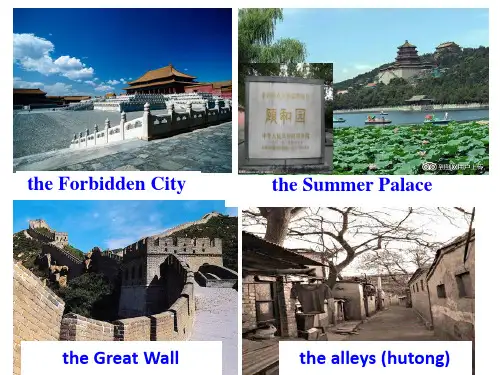
the Forbidden City 紫禁城
Bird Nest
Water Cube
Beihai Park
Getting Around in Beijing
Fast reading
1. Read the passage and find what means of transport are mentioned in it.
coach
It’s a bus used for long distances.
a large boat for carrying people and goods on the sea
plane
helicopter a type of aircraft
electric motorbike
pedicab
Who might care about the transportation information ?
外研社高中英语必修四module2课件
III. Fill in the blanks
Taxis are on the streets 24 hours a day. Simply raise your and a taxi appears in no time. You should check hand, 1.______ a the cab has 2._____business permit, and make sure you ask for a receipt. provides (provide) a cheap way Public transport 3._______ to get 4.__________(get) around in Beijing. It is a good idea to avoid 5.________(avoid) public transport during the rush hour. Tourists shouldn’t miss the 103 bus 6.________ which/that offers one routes (route). of the most impressive 7.________ There are four underground lines in Beijing, and several construction lines are under 8.___________(construct) .Trains are fast convenient and 9.___________(convenience), but rush hours can be using terrible. Tricycles are worth 10._______(use) if you want to explore the narrow alleys of old Beijing.
外研版 高中英语必修4Module2reading (共38张PPT)

Pedicabs
advantages 24 hours on the street / easy to get cheap
always get a seat fast & convenient
disadvantages
expensive
crowded only in some areas terrible in rush hours
➢ They’re often very crowded.
➢ The 103 bus.
➢ 12 people.
➢ It’s fast and convenient.
➢ It closes at 11:00 pm.
➢ The narrow alleys of old Beijing.
cab destination fare get around passenger permit(n.) receipt return(n.) route rush hour seat single(n.)
___p_e_r_m__i_t
Careful Reading
Read the passage carefully and fill in the blank.
Means of transport in Beijing
Taxis Buses & trolleybuses Minibuses
Underground
truck
a simple vehicle for carrying goods
underground / subway/train
This is a suburban railway. It is usually under the city.
advantages 24 hours on the street / easy to get cheap
always get a seat fast & convenient
disadvantages
expensive
crowded only in some areas terrible in rush hours
➢ They’re often very crowded.
➢ The 103 bus.
➢ 12 people.
➢ It’s fast and convenient.
➢ It closes at 11:00 pm.
➢ The narrow alleys of old Beijing.
cab destination fare get around passenger permit(n.) receipt return(n.) route rush hour seat single(n.)
___p_e_r_m__i_t
Careful Reading
Read the passage carefully and fill in the blank.
Means of transport in Beijing
Taxis Buses & trolleybuses Minibuses
Underground
truck
a simple vehicle for carrying goods
underground / subway/train
This is a suburban railway. It is usually under the city.
外研 高中英语必修4Module2Reading(共21张PPT)优秀课件

1.Write down the conversation on a piece of paper and hand it in tomorrow.
2.Preview the Grammar-Imperatives(祈使句)
单句语法填空
1.Give blood if you can, _a_n_d_many lives will be saved.
However, 10._m__a_k__e__ sure you know the price
before you take them.
Speaking:
假设你是北京的高中生韩梅,你的笔友 Tom现在来到了北京旅游, 请你设计一个简短 的对话.
1.向他介绍一下北京 不同的交通方式
2.推荐一个最值得去的景点并采用适宜的交 通方式
This is the first time… May I ask you some questions about … H: Of course. Go ahead. T: Could you tell me ……. H: …….. … H:… T: Thank you!
conclusion and homework
3.尽可能多运用本课词汇和句型(可以适当增 添细节)
参考词汇: worth, idea
Make a conversation (speaking &writing)
Han Mei: Hello, Tom. Welcome to Beijing. TOM : Hi, Han Mei. I am happy to see you .
Which sentence in the text can be replaced by the following one?
2.Preview the Grammar-Imperatives(祈使句)
单句语法填空
1.Give blood if you can, _a_n_d_many lives will be saved.
However, 10._m__a_k__e__ sure you know the price
before you take them.
Speaking:
假设你是北京的高中生韩梅,你的笔友 Tom现在来到了北京旅游, 请你设计一个简短 的对话.
1.向他介绍一下北京 不同的交通方式
2.推荐一个最值得去的景点并采用适宜的交 通方式
This is the first time… May I ask you some questions about … H: Of course. Go ahead. T: Could you tell me ……. H: …….. … H:… T: Thank you!
conclusion and homework
3.尽可能多运用本课词汇和句型(可以适当增 添细节)
参考词汇: worth, idea
Make a conversation (speaking &writing)
Han Mei: Hello, Tom. Welcome to Beijing. TOM : Hi, Han Mei. I am happy to see you .
Which sentence in the text can be replaced by the following one?
外研 高中英语必修4Module2Imperatives(共26张PPT)
A. not waste B. no wasting C. not to waste D. no
waste
4. —____ higher, and you will see the house.
—OK.
A. If you stand
B. To stand
C. When you stand D. Stand
8. —Call me when you get home. —OK, ____. A. I must B. I can C. I will
D. him D. No D. I won’t D. I may
Guessing Game Turn left!
Guessing Game
Turn right!
imperatives in our daily life.
只有创造,才是真正的享受,只有拼搏,才是充实的生活。 失败的定义:什么都要做,什么都在做,却从未做完过,也未做好过。 天空的高度是鸟儿飞出来的,水无论有多深是鱼儿游出来的。 我们的人生必须励志,不励志就仿佛没有灵魂。 觉得自己做得到和做不到,只在一念之间。 每个人的一生都有许多梦想,但如果其中一个不断搅扰着你,剩下的就仅仅是行动了。 任何人都可以变得狠毒,只要你尝试过嫉妒。 平时没有跑过千米,比赛时就难以进行一百米的冲刺。 奋斗的双脚在踏碎自己的温床时,却开拓了一条创造之路。 命是弱者的借口,运是强者的谦辞,辉煌肯定有,就看怎么走。 君子赠人以言,庶人赠人以财。——荀况 成功就是把复杂的问题简单化,然后狠狠去做。 好好扮演自己的角色,做自己该做的事。 并非神仙才能烧陶器,有志的人总可以学得精手艺。
1. Jim, _____ me a hand.
A. gives B. is giving C. will give D. give
外研版 高中英语必修4Module2Reading (共15张PPT)
match them with the pictures. There are
two extra pictures. Picture 1
Conversation 1
Picture 2
Conversation 2
Picture 3
Conversation 3
Picture 4
Conversation 4
பைடு நூலகம்
5 Look like a local 6 Transport sense
7 Be polite
8 Travel light
Read the passage and match the headings with the paragraphs.
A—8 B—4 C—6 D—2 E—7 F—1 G—3 H—5
Answer the questions. Why should you… 1 only take a few clothes and not
many books? 2 keep your passport in a travel belt? 3 tie your suitcase to your arm? 4 ask to see the taxi driver’s permit?
Role – play
Try to act out the dialogue in pairs.
5 wear dark clothes? 6 avoid showing your feelings? 7 cross the street with other people? 8 always carry a spare bag? 9 avoid wearing expensive clothes?
英语必修IV外研版Module2课件(35张)
公交车和电车
公共交通为人们旅游北京提供了低价 位的出行方式。北京大约有两万多辆 公交车和电车,但是,它们有时会很 拥挤。最明智的做法是避免在高峰期 (上午6:30—8:00,下午5:00—6:30) 乘坐公交车和电车。这些车车票价格 便宜,一元起价。空调车则要贵一些。
4. public transport n. 公共交通;公交车辆 in public 公开地 the public 大众 (+谓语用复数) a public telephone 公用电话 5. fare cn. (坐车,飞机等花费的)费用
7. have a view of 能看见(的)
1.In Yunnan Province, we had a lovely view of the stone forest.
2.As we drove out along the road, we had a fine view of the country.
2.I will call the company to check whether the beds can be delivered today.
permit vt. 许可,允许。
常用于“permit sth. / doing sth. 以及permit sb. / sth.
to
do sth.”结构;
bus/train/air/cab fair I need some money for my bus fair.
公交线1到100路都是仅限于市中心的, 车号更高一些的线路,可以通达郊区。 对于游人来说,最不该错过的是103路 电车,它途经紫禁城和北海白塔,沿 途风景令人印象深刻。如果你乘坐双 层公共汽车,请务必坐在上层,这样 你会一览这个飞速发展城市的亮丽风 景。
外研 高中英语必修4Module2Imperatives (共27张PPT)
• Be型
Be careful. Be quiet.
Note
• What’s the difference between let’s and let us?
• Let us have a try, will you?
• Let's go there together, shall we?
Don’t break the rules of the road
Function
Request/command
• Please open the door. • Please switch off the lights. • Pass the book, please!
Invitation
• Please come to my wedding. • Go to the movies with us tonight. • Please join us for the party tonight!
Lay down arms! Raise your hands and turn around!
Practice1 Translation
Traffic rules
1. Don't run the red light. 不要闯红灯。
2. Please fasten your safety belt. 请系好安全带。
Warning/prohibition
An instruction
• First, boil some water. • Then, put coffee into a cup. • Next, pour the hot water into the cup. • After that, add a little milk. • Finally, stir the coffee.
Be careful. Be quiet.
Note
• What’s the difference between let’s and let us?
• Let us have a try, will you?
• Let's go there together, shall we?
Don’t break the rules of the road
Function
Request/command
• Please open the door. • Please switch off the lights. • Pass the book, please!
Invitation
• Please come to my wedding. • Go to the movies with us tonight. • Please join us for the party tonight!
Lay down arms! Raise your hands and turn around!
Practice1 Translation
Traffic rules
1. Don't run the red light. 不要闯红灯。
2. Please fasten your safety belt. 请系好安全带。
Warning/prohibition
An instruction
• First, boil some water. • Then, put coffee into a cup. • Next, pour the hot water into the cup. • After that, add a little milk. • Finally, stir the coffee.