
牛津沪教版英语六年级上Unit 5 Open Day 复习
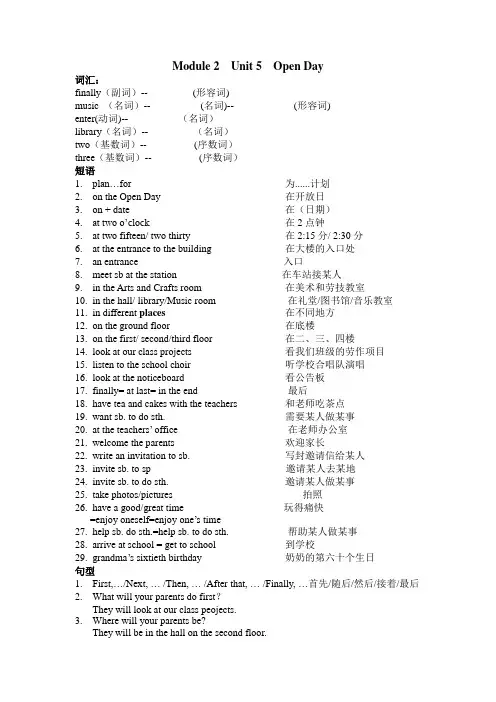
六年级上Unit 5 Open Day Part 1 单词梳理(1) programme n. 活动安排Program n. 程序,计划,大纲(2) entrance n. 入口exit n.. 出口拓展:enter v. 进入,开始Eg. This is the entrance of the house.(3) choir n. 合唱队(4) noticeboard n. 布告栏拓展:notice v. 注视(5) parent n. 父母(6) arrive adv. 到达拓展:arrive at / arrive in / reach / get to 到达arrive at后接小地方arrive in 后接大地方Eg:I arrive at school at 7:15.(7) classroom n. 教室(8) next adv. 紧接着短语:next to 紧挨着(9) project n. 习作项目(10) craft n. 工艺(11) club n.. 俱乐部(12) finally adv. 最后近义词:at lastin the endEg: Finally, he went to the Newyork.(13) ground n.. 地,地面拓展:underground 地下playground 操场在操场:on / in the playground(14) invitation n.. 请柬invite v. 邀请(15) yesterday n. . 昨天Part 2 短语梳理1.an Open Day 一个开放日2.Open day programme 开放日活动安排3.an entrance 一个入口处4.listen to a choir 听一个合唱队(唱歌)5.a notice board 一块布告栏6.my parents 我的父母亲7.meet sb. at the entrance 在入口处迎接某人8.arrive in + 大地方到达一个大地方9.arrive at + 小地方到达一个小地方10.visit the classroom 参观教室11.First, … /Next, … /Then, …/ After that, …/ Finally, …首先,紧接着,然后,在那以后,最后12.look at our class projects 看一看我们的班级习作项目13.in the Arts and Crafts room 在美术劳技室14.in the hall 在大厅里15.our English Club 我们的英语俱乐部16.have tea and cakes 喝茶吃蛋糕17.in the Music room 在音乐室18.welcome the parents on the Open Day 在开放日欢迎父母19.in different places 在不同的地方20.on the ground floor 在第一层(英式表达法)21.write an invitation 写一封邀请函22.take some photos 拍一些照片23.have a great/good time 过得愉快Part 3 知识点小结知识点1.1arrive at / arrive in / reach / get to 到达arrive at后接小地方arrive in 后接大地方He will arrive in Shanghai at two o‟clock.reach是个及物动词,后面直接接地点名词I reach school at 7:15.I get to school at 7:15.2.will / be going to都是用来表将来的,他们后面应该接动词的原形。
will是个情态动词,没有人称的变化.He will arrive in Shanghai at two o‟clock.I will meet them at the entrance.Your parents will arrive at two o‟clock.但是be going to有人称的变化.He is going to go fishing tomorrow. I am going to go fishing tomorrow. They are going to go fishing tomorrow.3.look at 看;see 看见;listen to 听;hear 听见4.at the entrance 在入口处enter 进入(动词)in the hall/in the Music room /in classroom6A/in the Arts and Crafts room5.具体的某一天介词只能用onOn Sunday, On Sunday morning,On the Open Day6.在具体的某一楼层只能用介词on,并且第几层还要用序数词On the ground floor, on the first floor, on the fifteenth floor7. want sb. to do sth. = would like to do sth.想要做某事I want you to read English everyday.我想要你们每天都读英语。
8.i n the same place / in different places9. First,…/Next,…/Then…/After that,…/Finally,… Finally=at last =in the end10. take photos拍照11. invite 邀请(动词)invitation邀请(名词)Invite sb to sp邀请某人去某地She invites me to her birthday party.她邀请我去她的生日晚会。
12. on the tenth of September / on September tenth 9月10日13. two fifteen= a quarter past two 2:15Three ten = ten past three3:10 One thirty = half past one1:30 two forty = twenty to three 2:4014. have a great / good time 玩得开心,过的愉快15.Parent = father or mother parents = father and mothePart 4 基础练习一单项选择1. Jack is a fisherman. He always _________ fish in the sea.A. catchB. catchesC. catchingD. catchs2. Which block do you ____________?A. liveB. live atC. live onD. live in3. The policemen _________ make Shanghai a safer place.A. helpsB. helpC. helpingD. is helping4. My father is thin, but my mother is _________ our family.A. thinB. thinerC. the thinnestD. thinner5. __________ does Jane usually have lunch?A. WhoB. WhatC. WhenD. Which6. There is __________ food on the table.A. muchB. manyC. a fewD. a lot7. John always plays football with his friends __________.A. at the weekendsB. at weekendsC. at weekendD. on the weekend8. I don’t like crisps _________ sweets.A. andB. alsoC. orD. too9. What’s on the shelf? __________ some bread.A. They areB. There areC. It’sD. There is10. I’m going to write a list __________ food _________ tomorrow.A. of…ofB. of…forC. for…ofD. for…of11. Tom likes ________ football, he also _________ coins.A. playing, plays withB. play, playC. playing, playD. play, playing with12. We must keep our school __________ and _________.A. clean, beautifulB. cleanly, beautifullyC. clean, beautyD. cleanly, beauty二用所给单词的适当形式填空1. Let’s meet at the ________ (enter) of th e cinema.2. You must finish English exercise ________ (one).3. __________(final),they put out the fire.4. The students’_________(parent) are coming on Open Day.5. Kitty and her classmates took some ______( photo) on the Great Wall.6. Did she write any ___________ (invite) last week?7. Keep _______ (quietly) ! My little sister is sleeping.三句型转换1. There are some new cards on the desk, (改为一般疑问句)________there________new cards on the desk?2. They go to see a film every Saturday afternoon, (改为一般疑问句)________they________to see a film every Saturday afternoon?3. He is cleaning the windows. (就划线部分提问)________is he________?4. Tom likes pop songs very much. (就划线部分提问)___________ Tom like pop songs?5. The lady in blue is a foreigner. (就划线部分提问)________ _ is a foreigner?6. have, and, tea, in, four, at, the Music room, twenty-five, will, cakes, they.,_____________________________________________________________Part 5 综合练习ReadingA. True or false.Mrs. Brown’s mother was ill in bed tow days ago. So she had to go and look after her. Before she left, she said to her husband, “I must tell you where everything is, or you don’t know what to do, but my train is leaving in half an hour’s time and I must go now.”“Don’t worry,” Mr. Brown said, “I can look after myself.” In fact, he could not do anything without his wife. But when his wife came back the next day, she did not have to wash any plates because he had his metals in restaurants.1. Mr. Brown’s mother was ill in bed two days ago.2. Mrs. Brown went to look after her sick mother.3. Before she left, Mrs. Brown did not tell her husband where everything was.4. Mr. Brown had his meals in restaurants.5. Mrs. Brown didn’t have to wash any plates because there were no plates to wash.B.A boy who was cleaning shoes in the street said to a young man passing by, “Let me clean your shoes. ” The young man said, “No, thank you.” ”You may pay me only a pound, sir.” Said the boy. But the young man refused again. Then the boy told him that he would clean his shoes for nothing. The young man agreed to this, and soon one of his shoes was shining brightly. The man put the other shoe on the boy, but the boy refused to clean it unless he was paid two pounds for his work. The young man refused to p ay anything and went away. But the dirty one looked so bad that he couldn’t walk away. He had to turn back and gave the boy two pounds. In a very short time his shoes shone brightly.1. The boy was a shoes __________.A. cleanerB. makerC. repairerD. seller2. At first the young man refused to clean his shoes, because __________.A. he couldn’t payB. he had not enough moneyC. he didn’t think it necessaryD. he ha d just cleaned his shoes3. Then the young man agreed to clean his shoes, because the boy asked for __________..A. two poundsB. one poundC. nothingD. few money4. The boy refused to clean the second shoe, because __________A. it was very dirtyB. the young man paid only one poundC. it was difficult to cleanD. he asked to be paid two pounds5. The boy said he would clean the young man’s shoes for nothing just in o rder to __________.A. show his kindnessB. help the young manC. get more money from himD. let everyone see/C. Mrs. Black was a poor old woman and she lived in a small village. Her husband died ten years ago. But she had a 24-year-old daughter. Her name was Alice. She worked in New York and lived there. It was far away from her mother’s village, and she was not happy about this. One day Alice said to her mother, “I’ve found a good job in Boston, and I ca n make a lot of money there, so I will go to work in Boston next week. But don’t worry, Mum, I’ll send you some money every week.”A month later, Mrs. Black was very angry. She decided to go to see her daughter in Boston on a train. When she saw her daught er, she said, “Alice, why do you never call me?”Alice laughed, “But mother, ”she said, “Alice, why do you never call me?”“No,” she answered, “I haven’t, but you have got one.”1. Where did Mrs. Black live?__________________________________2. Did Mrs. Black live with her daughter?__________________________________3. Why did Alice go to work in Boston?__________________________________4. A month later, how did Mrs. Black go to see her daughter in Boston?__________________________________5. Had Alice telephoned her mother? Why?__________________________________D. Read the passage and fill in the blanks with proper words.We are often warned by our teachers never to w______1____ time, because time lost will never r_______2___. I think it quite true. What is time l______3____? Nobody know, and we cannot see it or touch it and no amount of money can buy it. Time is abstract, so we have to imagine about it. Time p_______4___ very quickly. Some students say that they don’t have enough time to p_______5___ all their lessons. It is b_____6_____ they don’t know how to make use of their time.1 _______________2 _______________ 3_______________ 4_______________5_______________ 6_______________。
新牛津上海版一起六年级上册unit 5《open day》优秀教案(重点资料).doc
Unit 5 Open DayTasks in this unitTalking about future events; planning events; sequencing activities; writing invitations; reading captions; writing a description of events.Period OneLanguage focus:Using the simple future tense to talk about future eventse.g., Your parents will arrive at two o’clock.Using adverbs of timee.g., What will they do first?Language skills:ListeningRecognize the difference in the use of intonation in questions, statements (including approval) and commands, and respond appropriatelySpeakingUse appropriate intonation and stress to convey intended meanings and feelingsReadingRead written language in meaningful chunksWritingDevelop written texts by expressing own ideasMaterials:1.Student’s Book 6A page 322.Workbook 6A pages 28 and 293.Cassette 6A4.Cassette playerPre-task preparationAsk the students: What do we do on Open Day? What do parents do? Write a list on the board as the students mention activities. Play the cassette for Look and learn. The students repeat. While-task procedure1.Give the students time to read Look and read silently.2.Play the cassette. The students follow in their books.3.In groups of six, students practise the dialogue. Selectgroups to read the dialogue.4.In pairs, students complete the programme with the correcttime.5.Ask questions about the programme: e.g., What time will theparents arrive? What will they do first/next/then/after that/ finally? When?6.Select other groups to read the dialogue.7.Ask further questions: e.g., Where will they meet theirparents? What will they look at in the classroom and Arts and Crafts room> What will they do in the hall? What will they look at in the library? What will they have in the Music room? 8.Consolidation:Workbook 6a page 28-29Period TwoLanguage focus:Using the simple future tense to talk about future eventse.g., I’ll be in classroom 6ALanguage skills:ListeningListen for specific informationSpeakingMaintain an interaction by agreeingReadingRead written language in meaningful chunksMaterials:1.Student’s Book 6A page 332.Workbook 6A pages 313.Cassette 6A4.Cassette playerPre-task preparationReview: ground/ first/second/third/ floor. Ask: Where is the library/hall/ Arts and Crafts room? To elicit: e.g., It’s on the first floor.While-task procedure1. Give the students time to look at the floor plan of the school. Ask individual students to read the names of the rooms. Ask: Where is the Arts and Crafts room? To elicit: It’s on the third floor.2. Play the cassette for Look and Listen. The students listen. Ask: Where will kitty be? To elicit: She’ll be in the Arts and Crafts room.3. Select students to be Kitty, Peter, Alice and Jill. Ask: Where will you be, Kitty? To elicit: I’ll be on the third floor.4. In pairs, students practise Ask and answer.5. Workbook 6A page 31a. Give the students time to look at the pictures.b. Play the cassette. The students listen and match.ConsolidationWorkbook 6A page 32Period ThreeLanguage focus:Using the simple future tense to talk about future eventse.g., What will our parents do first?Using formulaic expressions to begin and end a lettere.g., Dear…; YoursLanguage skills:ListeningIdentify details that support a main ideaSpeakingMaintain an interaction by replyingReadingRecognize format and language features when reading non-narrative textsWritingDevelop written texts by using appropriate format, conventions and language featuresMaterials:1.Student’s Book 6A page 342.Workbook 6A pages 32, 343.Cassette 6A4.Cassette playerPre-task preparationTalk about invitations. Ask: When do you send invitations? To elicit: e.g., for a birthday party. Try to get the students to mention other occasions.While-task procedure1. Read the outline of the dialogue in Plan and speak.Ask the students to suggest a list of five activities. Write them on the board.2. In pairs, students decide on the activities and complete theprogramme. They then practice the dialogue.3. Ask individual students about their programme using the questions in Plan and speak. q5 The students complete Read an write. Ask one or two students to read their completed reports.4.Give students time to read Read, think and write. In groups, students discuss how to complete the invitation. Ask a representative from each group to rea their invitation.5.The students write the invitation to their parents. Askindividual students to read their invitations.ConsolidationWorkbook 6A pages 32, 34Period FourLanguage focus:Using the simple past tense to talk about past activitiese.g., The parents arrived at Rose Garden School at two o’clock.Language skills:ListeningListen for specific informationSpeakingMaintain an interaction by replyingReadingIdentify details that support a main ideaWritingDevelop written texts by presenting main and supporting ideas Materials:1.Student’s Book 6A page 352.Cassette 6A3.Cassette playerPre-task preparationIntroduce the past forms of the verbs on this page. Write the verbs on the board; arrive- arrived; visit- visited; look-looked; listen- listened; have- had.Ask: What time did you arrive at school? To elicit: e.g., I arrived at school at eight o’clock. Continue with: When did you visit your grandparents? When did you look at the noticeboard? What time did you have your breakfast?While-task procedure1 Give the students time to look at the pictures in Read and Match.2 Play the cassette. The students listen. Play the cassette again. The students repeat.3. In pairs, students match the pictures and sentences. Ask individual students to read a sentence in the correct order.ConsolidationCopy the new wordsRecite the passage.。
2019-2020学年度牛津上海版小学英语六年级上册unit 5 Open Day复习特训六十四
2019-2020学年度牛津上海版小学英语六年级上册unit 5 Open Day复习特训六十四第1题【单选题】They will begin the flower show ________.A、at fourB、just nowC、justD、already【答案】:【解析】:第2题【单选题】It"s 7:40 now. The film ________ an hour ago.A、startingB、startedC、startD、starts【答案】:【解析】:第3题【单选题】I"m ten. Kitty is eight. Kitty is ________ than me.A、youngerB、biggestC、youngD、How【答案】:【解析】:第4题【单选题】I ________ some people talking in the next room.A、1istenB、hearC、listen toD、hearing【答案】:【解析】:第5题【阅读理解】判断下面的句子是否与短文的意思相同。
The sun, the moon and the stars are all in the sky. We see the sun in the day. We see the moon and the stars at night. The sun is a ball. It is bigger than the moon. The sun has a family. It is the biggest in the family. The moon is a ball, too. It is much smaller than the sun. It is smaller than the stars. The light on the moon comes from the sun. The stars look smaller than the sun and the moon. But most of the stars are bigger than the sun. They are very far away from us, so they look small. All day the stars are in the sky. But the light from the sun is too bright. We cannot see the stars in the day.We can see the moon and the stars in the day.A、正确B、错误The moon is smaller than the sun.A、正确B、错误The light on the moon comes from the stars.A、正确B、错误The stars are very far away from the people.A、正确B、错误Most of the stars are smaller than the sun.A、正确B、错误【答案】:【解析】:第6题【句型转换】Mike lives far away from school. (改为一般疑问句)______ Mike ______ far away from school?【答案】:【解析】:第7题【选词填空(词汇运用)】Would you like ______ (meeting/to meet) my sister tomorrow? 【答案】:【解析】:第8题【选词填空(词汇运用)】Alice always ______ (go/goes) to school with her classmate, Kitty. 【答案】:【解析】:第9题【语法填空】When will they arrive ______ Shanghai Station? (填介词)【答案】:【解析】:第10题【语法填空】I"ll meet the new comer ______ the entrance. (填介词)【答案】:【解析】:第11题【语法填空】When does your mother come home ______ work? (填介词) 【答案】:【解析】:第12题【语法填空】There is an ______ (invite) on the shelf. Please get it for me. 【答案】:【解析】:第13题【语法填空】—Who are you waiting ______?—Mr Black. I have something important to tell him. 【答案】:【解析】:第14题【语法填空】______ that, he will go back to school. (填介词) 【答案】:【解析】:第15题【语法填空】How many ______ (visit) are from Tokyo?【答案】:【解析】:。
牛津上海六年级上册Unit5 Open Day课后练习(有答案)
I. Choose the best answer (选择)1— __________________ does Jane go to school?— By bicycle.A. WhatB. WhenC. WhichD. How2Last Sunday, one of my relatives from America ____________________ my family.A. meetB. meetsC. metD. meeting3Please ___________________ to the library with your teacher.A. goB. goesC. wentD. going 4The train will leave at 8.00 a.m. _________________ tomorrow morning.A. /B. onC. atD. in5Next, they'll___________________ their class project.A. meetB. visitC. listen toD. look at6It's 7.30 now. The film __________________ an hour ago.A. startingB. startC. startedD. starts7I___________________ c arefully but can't __________________ anything.A. listened ... heardB. listened ... hearC. listened to ... heardD. heard ... listened8We can get ___________________ by watching TV every day.A. informationsB. informationC. an informationD. a information9Do you want to make any changes_____________________ your programme?A. forB. onC. atD. to10 What time will Professor Wang_____________________ ?A. arriveB. arrivedC. arrivesD. arrivingplete the sentences with the given words in their proper forms(适当形式填空)1Let's meet at the_________________ (enter) of the cinema.2You must finish English exercise_______________ (one).3 _______________ (final) , they put out the fire.4The students'________________ (parent) are coming on Open Day.5Kitty and her classmates took some_________________ (photo) on Open Day.Ⅲ. Choose the proper word or expression from the bracket to complete the sentence. (选择恰当的单词或词组填入空格,完成句子)1All the students are _______________ (listening to, hearing) the lecture in the hall.2Ben is writing some_________________ (invitation, invitations) to his friends.3We must wash our hands__________________ (before, after) each meal.4 _________________ (Last, Finally), Peter won the Olympic Maths Contest.5Would you like to_________________ (see, look at) a flower show with me?Ⅳ. Choose the words or expressions and complete the passage.A.True or False(判断下列句子是否符合短文意思,符合用“T”表示,不符合用“F”表示)Mary was the only little girl in her street, but when she was eight years old, another girl came to live in the house next door to hers. The new girl was eight years old, too, and her name was Joan. Joan had two brothers. She didn't go to the same school as Mary, but they soon began to play together after school.One day Joan came home to have her milk and cakes, and then went to Mary's house. She said to her friend, "Hi, Mary, will you come to my home to play? I've got a nice new game. "Mary answered, "I'm sorry, Joan, but my mother won't let me play with you today, because your brother George has a bad cold, and she doesn't want me to get it. ""Oh, that's all right, Mary. "Joan answered quickly. "George isn't really my brother. He's my step-brother(非同一父母所生之兄弟). "( ) 1. When Mary was eight years old, one little girl came to live on her street.( ) 2. Joan was eight years old.( ) 3. Mary and Joan were neighbours.( ) 4. Mary and Joan studied in the same school.() 5. Mary and Joan played together after school.( ) 6. From the story we can see Mary's mother loved her daughter very much.( ) 7. George was Joan's brother.B.Choose the best answer(根据短文内容,选择最恰当的答案)Joe had a holiday, so he decided to go to the seashore for a few days. He got on a train one morning, and an hour later he was in a small town. He got off the train and left the station. A few minutes later, he saw a small hotel and went in. He asked the owner how much it would cost for one night there."Fifteen dollars," the owner answered. "That's more than I can really afford (支付)," Joe said sadly. "All right," the owner answered. "If you make your bed yourself, you can have the room for ten dollars. " Joe was very happy because he always made his own bed at home. "Okay," he said, "I'll do that. "The owner went into a room at the back, opened a closet, took some things out and came back to Joe. "Here you are," he said, and gave him a hammer(铁锤) and some nails(钉子).( ) 1. It took Joe____________ to get to the seashore.A. an hourB. a few daysC. a few minutesD. ten minutes( ) 2. Joe decided to go to seashore for ___________ .A. one dayB. a few daysC. a monthD. a longtime()3. The usual price of a room in the small hotel was_____________ for one night.A. less than fifteen dollarsB. one thousand centsC. fifteen yuanD. fifteen dollars()4. Joe was willing to pay ___________ f or his room.A. ten dollarsB. fifteen dollarsC. fifteen yuanD. one thousand cents( ) 6. The owner wants Joe to________________ .A. clean his quilt in the morningB. build a bed for himselfC. buy a bedD. borrow a bed for himself( ) 7. John always made his own bed _____________ .A. at homeB. in hotelsC. at workD. onholidays( ) 8. Joe went to the seashore ______________ .A. on businessB. to visit his friendC. to visit hotelD. to spend his holidayC. Read the passage and choose the correct words (阅读短文,选择恰当的单词)Some people work on Sunday but a few don’t. Many people get up late, but ____1____ don’t. Nearly everyone reads the Sunday paper.Often the paper is outside the door before the family ____2____ up. The Sunday paper is usually very ____3_____. Many men like to read the world news and sports. Most men don’t read the _____4____ pages, but the mother of the family usually _____5_____. These pages have news _____6___ parties, food, health and clothes.Most Sunday papers have pictures. Children like to read them. Old people can find the old things. There is ____7____ for everyone in the Sunday paper.( ) 1. A. other B. others C. another D. the others( ) 2. A. is getting B. will get C. get D. got( ) 3. A. many B. thick C. more D. much( ) 4. A. women’s B. woman’s C. a woman D. womens’( ) 5. A. does B. did C. do D. reads( ) 6. A. about B. at C. on D. in( ) 7. A. nothing B. everything C. something D. anythingD.Read the passage and fill in the blanks with proper words.(在短文的空格内填入适当的单词,使其内容通顺,每空填一词,首字母已给出)We usually use two kinds of money. One kind is money made of paper and the other kind is money made of metal. But in the past people used many things i_______ of money. Some countries used salt, tea or stones (石头). Other countries even used some animals. Today people in some p________ in the world still do not use paper money all the time.On the island of Yap, people use the h__________ money in the world — Yap stones. These are round, white stones w_______ a hole in the middle. The Yap stones do not come from this island. The Yap men have to go to the islands over 600 kilometres away to get t_________.Rich people do not carry Yap stones. Servants (仆人) follow the rich. Each servant carries astone on a long s_______ over his shoulder (肩|). Today people on the island of Yap use paper money for everyday shopping. But for other things they still p_________ Yap stones to paper money.E. Read the passage and answer the questions. (根据短文内容回答问题)Can dolphins talk? Maybe they can't talk with words, but they talk with sounds. Dolphins travel in a group. We call a group of fish a "school". They don't study but they travel together. Dolphins are mammals, not fish, but they swim together in a school.Dolphins talk to other dolphins in the school. They give information. They tell when they are happy or sad or afraid. They say welcome when a dolphin comes back to the school. They talk when they play.They make a few sounds above water. They make many more sounds under water. People can't hear these sounds because they are very high.Scientists make tapes of the sounds and study them. Sometimes people catch a dolphin for a large aquarium(水族馆). People watch the dolphins in a show. Dolphins don't like to be away from their school. In the aquarium they are sad and lonely. There are many stories about dolphins.They can help people. Sometimes they save somebody's life. Dolphin meat is good but people don't like to kill them. They say that dolphins bring good luck. Many people believe this.1.What is a school of dolpins?2.When do dolphins talk to others?3.When do they say “ Welcome” ?4.Do they make more sounds above or under water?5.Can people hear dolphin sounds? Why ?6.How does a dolphin feel in a aquarium?I. Choose the best answer (选择)1-5 DCAAD 6-10 CBBDAplete the sentences with the given words in their proper forms(适当形式填空)1. entrance 2. first 3. Finally 4. parents 5. photosⅢ. Choose the proper word or expression from the bracket to complete the sentence.(适当形式填空)1.listening to2. invitations3. before4. Finally_5. seeⅣ. Choose the words or expressions and complete the passage.A 1. T 2. T 3. T 4. F 5. T 6. T 7. TB 1. A 2. B 3. D 4. A 5. B 6. A 7. DC BCBAADDD 1. .instead 2. places 3. heaviest 4. with 5. them 6. stick 7. preferE 1. A group of dolphins.2. When they are happy or sad or afraid.3. When a dolphin comes back to the school.4. Under water.5. No. Because the sounds are very. Very high.6. Sad and lonely.。
初中英语 牛津上海六年级上册Unit5 Open Day重要知识点及语法点
U5 Open Day重点词汇1. entrance n. 入口______________________ 在入口处【联想】___________ v. 进入enter some place=go/walk/come into some place进入某地He enters the room quietly.= He walks into the room quietly.他安静地进入了房间。
2. n. 信息板You can find a lot of information___________________________. 你能在信息板上找到很多信息。
3. plan1)v. 计划★_________________________ 计划做某事We plan to have a meeting next week。
我们计划下周开个会。
★plan sth. 计划某事They are planning a meeting. 他们正在计划一次会议。
2)n. 计划__________________________________ ? 你们有假期计划了吗?4. arrive in, arrive at, get to和reach四者都可以表示“到达”;arrive in后接“较大的地方”,arrive at后接“较小的地方”,get to 和reach后直接加宾语。
I will arrive in Shanghai tomorrow evening.=I will get to Shanghai tomorrow evening.=I will reach Shanghai tomorrow evening.我将在明天晚上到达上海。
5. look at和see的区别look at意为“看”,强调看的动作;see意为“看见”,强调看到的内容。
Look at the picture, what can you see?看这张图片,你能看到什么?6. listen to和hear的区别listen to意为“听”,强调听的动作;hear意为“听到”,强调听到的内容。
Unit+5+Open+day+单元复习课件-英语六年级上册(牛津上海试用本)

重要短语剖析
Open Day 开放日 arrive at 到达 at the entrance 在入口处 arts and crafts 手工艺 English Club 英语俱乐部 Music room 音乐室
重要句型分析
★1.Open Day意为“开放日”,指某地接待公众参观之日,平时该处不对 外开放, 例如:Today is the Open Day at the village school. 今天是乡村学校的开放 日。 [友情提示] Open Day开放日 这是指学校向家长开放的日子,届时家长可以进校听课 、参观学校并与老师、校长交流。有点类似于“家长接待日”。 ★2…are planning…意为“正在计划”,是一句现在进行时,表示说话的 时候正在进行的动作或状态, 例如:The telephone is ringing. Would you answer it, please?
Unit 5 Open day
上海版牛津六年级上册(试用本)
目录
CONTENTS
01. 单词解析 02. 重要短语剖析 03. 重要句型分析 04. 考点通过
单词解析
1. programme n. (1)活动安排; (2)(广播或电视)节目 v. (1)计划安排某事物 (2)使……按预定的步骤进行(尤指 自动地或不假思索地)
单词解析
11. craft n. (1)工艺;手艺 (2)船舶(复数仍为 craft)(3)骗术; 狡诈 craftsman n. 匠人;能工巧匠
For example
例如: 1.. Mary teaches arts and crafts in local school. 玛丽在当地的学校教工艺美术。 2. Hundreds of small craft accompany the liner into harbour. 数百只小艇随同这艘班轮驶入港湾。 3.He's a crafty old fox. 他是一只狡猾的老狐狸。
牛津上海版英语六上 Unit 5 Open Day 知识梳理(无答案)
Module 2 Unit 5 Open Day词汇:finally(副词)-- ________ (形容词)music (名词)--__________(名词)--____________(形容词)enter(动词)--__________(名词)library(名词)--_________(名词)two(基数词)--_________ (序数词)three(基数词)--_________ (序数词)短语1.plan…for为......计划2.on the Open Day 在开放日3.on + date 在(日期)4.at two o’clock在2点钟5.at two fifteen/ two thirty 在2:15分/ 2:30分6.at the entrance to the building 在大楼的入口处7.an entrance 入口8.meet sb at the station 在车站接某人9.in the Arts and Crafts room 在美术和劳技教室10.in the hall/ library/Music room 在礼堂/图书馆/音乐教室11.in different places在不同地方12.on the ground floor 在底楼13.on the first/ second/third floor 在二、三、四楼14.look at our class projects 看我们班级的劳作项目15.listen to the school choir 听学校合唱队演唱16.look at the noticeboard 看公告板17.finally= at last= in the end 最后18.have tea and cakes with the teachers 和老师吃茶点19.want sb. to do sth. 需要某人做某事20.at the teachers’ office 在老师办公室21.welcome the parents 欢迎家长22.write an invitation to sb. 写封邀请信给某人23.invite sb. to sp 邀请某人去某地24.invite sb. to do sth. 邀请某人做某事25.take photos/pictures 拍照26.have a good/great time 玩得痛快=enjoy oneself=enjoy one’s time27.help sb. do sth.=help sb. to do sth. 帮助某人做某事28.arrive at school = get to school 到学校29.grandma’s sixtieth birthday 奶奶的第六十个生日句型1.First,…/Next, … /Then, … /After that, … /Finally, …首先/随后/然后/接着/最后2.What will your parents do first?They will look at our class peojects.3.Where will your parents be?They will be in the hall on the second floor.4. What time will they do this?They will do this at a quarter past three/ three fifteen.原形将来式过去式arrive will arrive arrivedvisit will visit visiteddo will do didlook at will look at looked at listen to will listen to listened to have will have had填空1. My brother ________ (go) to Shanghai next week.2. Mary __________ (see) her grandfather tomorrow.3. David __________ (fly) kites in the park this weekend.4. I_________ (make) a plan for English study in three days.5. Who _________ (be) going to learn a new song next Tuesday?6. _______ (be) you going to Beijing tomorrow?7. There _________ (be) a football match tomorrow.8. Where _______ you _______ (leave) for tomorrow?9. _______ Tom _______ (have) a P.E. lesson next Monday?10. What _______ they _______ (watch) in the gym tomorrow?11.What _____ they _______( do ) tomorrow ?12.The boy _______( not have ) an English lesson tomorrow .13.________ you _______( learn ) Chinese next week ?14.I ________ ( arrive ) there tomorrow .15.Mike _________ ( not watch ) a movie tomorrow.。
牛津沪教版六年级上6A-Unit 5知识点梳理 + 拓展阅读
Unit 5 Open Day知识点梳理I. Useful words and expressions1. Miss Guo and her students are planning the programme for their Open Day.for 介词,为了。
Open Day 开放日2. I will meet them at the entrance.meet sb. 接某人。
at the entrance/ exit 在入口/ 出口处。
3. Miss Guo wants some students to welcome the parents on the Open Day.want sb. to do sth. 想要某人做某事。
on the Open Day 在开放日。
具体日期前介词用on。
4. Help Kitty write an invitation to her parents.an invitation to sb. 给某人的一张请帖。
5. Kitty and her classmates took some photos for the English Club on the Open Day. take some photos for … 为……拍一些照片。
注意photo的复数直接加s。
6. The parents arrived at Rose Garden School at two o’clock.arrive at 表示到达学校、医院等小地方。
arrive in 表示到达国家、城市等大地方。
II. Word studyenter v. 进入→entrance n. 入口处final adj. 最后的→finally adv. 最后invite v. 邀请→invitation n. 请帖one 基数词→first 序数词two 基数词→second 序数词three 基数词→third 序数词III. Language explanation1. First, …/Next, …/then …/After that, …/Finally, …首先,……接着,……然后,……在那之后,……最后,……2. Your parents will arrive at two o’clock.“will + 动词原形构成的一般将来时,用于描述将来某一时刻的动作或状态,相当于Unit3 中出现的be going to do sth.。
初中英语 牛津上海六年级上册Unit5 Open Day重要知识点及语法点
U5 Open Day重点词汇1. entrance n. 入口______________________ 在入口处【联想】___________ v. 进入enter some place=go/walk/come into some place进入某地He enters the room quietly.= He walks into the room quietly.他安静地进入了房间。
2. n. 信息板You can find a lot of information___________________________. 你能在信息板上找到很多信息。
3. plan1)v. 计划★_________________________ 计划做某事We plan to have a meeting next week。
我们计划下周开个会。
★plan sth. 计划某事They are planning a meeting. 他们正在计划一次会议。
2)n. 计划__________________________________ ? 你们有假期计划了吗?4. arrive in, arrive at, get to和reach四者都可以表示“到达”;arrive in后接“较大的地方”,arrive at后接“较小的地方”,get to 和reach后直接加宾语。
I will arrive in Shanghai tomorrow evening.=I will get to Shanghai tomorrow evening.=I will reach Shanghai tomorrow evening.我将在明天晚上到达上海。
5. look at和see的区别look at意为“看”,强调看的动作;see意为“看见”,强调看到的内容。
Look at the picture, what can you see?看这张图片,你能看到什么?6. listen to和hear的区别listen to意为“听”,强调听的动作;hear意为“听到”,强调听到的内容。
初中英语牛津上海六年级上册Unit5OpenDay重要知识点及语法点
初中英语牛津上海六年级上册Unit5OpenDay重要知识点及语法点Unit 5: Open Day 重要知识点及语法点本单元主要介绍了学校开放日(Open Day)的相关内容,让学生了解如何描述一个学校开放日并学习相关的重要知识点与语法点。
以下是本单元的重要知识点及语法点概述。
1. 重要知识点:1.1. 单词与短语:- Open Day: 开放日- visit: 参观- classroom: 教室- library: 图书馆- playground: 操场- science lab: 科学实验室- computer room: 电脑室- art room: 美术室- music room: 音乐室- sports field: 运动场- bookshop: 书店- concert hall: 音乐厅- busy: 忙碌的- exciting: 刺激的- fun: 有趣的- interesting: 有趣的- friendly: 友好的- show: 展示- performance: 表演1.2. 问句与回答:- What's your school like? 你们学校怎样?- It's big and modern. 它很大也很现代化。
- Where's the library? 图书馆在哪里?- It's on the second floor. 在二楼。
- Can I visit the art room? 我可以参观美术室吗?- Yes, you can. 是的,可以。
2. 语法点:2.1. There is / There are 句型:- There is + 单数名词:表示某处有某物。
例如:There is a library in our school. 我们学校有一间图书馆。
- There are + 复数名词:表示某处有多个物品。
例如:There are classrooms and a playground in our school. 我们学校有教室和一个操场。
Unit5Openday-2023-2024学六年级英语上册英语单元速记巧练(牛津上海版)(原卷版)
Unit5 Open day考点1、1. programme n. (1)活动安排(2)(广播或电视)节目v. (1)计划安排某事物排开放日的活动。
(2)使……按预定的步骤进行(尤指自动地或不假思索地)【例题】1.What’s the programme for tomorrow?明天安排了什么活动?2.They're putting on a programme about winemaking.他们正在推出一个介绍酿酒方法的节目。
3.They are programming a music festival.他们正在为音乐会演编排节目。
4.The video is programmed to switch itself on at ten o'clock.这台录傢机已调好在十点钟常见短语programme music 标题音乐programme note 简介;剧情考点2. entrance n. (1)入口处(2)进来,进入(3)进入的权力,批准进入v. 使某人狂喜,着迷,通常用于被动语态【例题】1.Where is the entrance to the cave?这个洞穴的入口在哪里?2.They were refused entrance to the club. 他们被拒绝进入俱乐部。
3.They were pletely entranced by the music. 他们完全陶醉在音乐中。
【练一练】1 Let's meet at the _____________ (enter) of the cinema.考点3.choir n. 合唱队,唱诗班【例句】1.She sings in the school choir. 她在学校合唱队唱歌。
2.The performance of the choir is perfect. 合唱队的表演十分精彩。
【拓展】choirboy 唱诗班的男童歌手choir master 唱诗班指挥choir school 唱诗班考点4.parent n 父亲或母亲【例句】May I introduce you to my parents?我把你介绍给我的父母可以吗?【拓展】A person of unknown parentage 家世不明的人Parent pany 总公司【练一练】The students' _____________ (parent) are ing on Open Day.考点5.arrive v. 到达,抵达【例句】1.Good weather has arrived at last. 好天气终于来到了。