
小学英语牛津译林苏教版六年级上册(新版)Unit4 Now and then Cartooon time
The player in the red sweater was the winner. 你能说出更多含有 的单词吗?
er
Miss Fox gets angry.Why?
Miss Fox gets angry.Why?
1.It is a Chinese lesson. It is an English lesson. 2. Today is Wednesday .
3. Bobby listened carefully in class. Bobby didn’t listen carefully in class. 4. Miss Fox was very angry. 造句 5. Sam made a sentence with ‘egg’.
Sam didn’t make a sentence with ‘egg’.
Sam made a sentence with ‘cake’.
What do you think of Sam and Bobby?
What do you think of Sam and Bobby?
1、It’s an English lesson.Bobby is looking out of the window.
The Four Great Inventions of ancient China.
Compass Gun power Paper making Printing
What other inventions do you know? 你还知道其他那些发明呢?
弗莱明 Fleming
电话 telephone
My mother is a teacher. She works hard every day. My cousin is a worker. Now he’s on holiday.
er /ə/
sister summer mother teacher winter
仔细读这些单词,你发现它们共同的读音了吗?
They are talking about a book called Great inventions(发明).
It tells us the great inventions in the world.
aeroplane
train
Who invented the aeroplane and the train?
Unit4 Then and now
About me
Age
Appearance
Thirty years ago , I was /liked/ couldn’t--Now I am /like/can----
Ability
Hobbies
About you
Age
Appearance
Ten years ago , I was/liked/couldn’t---
aeroplane
train
世界上第一列,美国的威尔伯· 莱特和奥维尔· 莱特兄弟俩 设计制造的“飞行者”号飞机在卡罗来纳州的基蒂霍克 试飞成功,这是世界上公认的第一架飞上天空的可操纵
世界上第一列商用火车的发明者是英国的斯帝 芬森: 斯蒂芬森,英国工程师,铁路机车的发明家。
4、Miss Fox waits for the answer.
Miss Fox, the egg was in the cake.
If you were Miss Fox, what would you say? …
Read in roles and try to act.
What are Bobby and Sam talking about?
1. Read the dialogue with expression and try to recite it. (有感情地朗读卡通对话,并试着背它。) 2 Surf the Internet and find out some stories about inventions.
Try to remember
father singer
brother together writer winter player sweater
letter winner
My father and my brother often play together.
The writer wrote a letter to the singer last winter.
Ability
Hobbies
Now I am /like/ could----
This is an English lesson.
My mother is a teacher. She works hard every day. My cousin is a worker. Now he’s on holiday.
青霉素 penicillin
爱迪生 Edison 电灯 electric light
瓦特 Watt 蒸汽机steam engine
Great inventions have changed our lives.
Listen carefully in class, we will know a lot and be a useful person! 课堂上认真听讲,我们将知道很多知识, 将成为一个有用的人!
Bobby, please listen to me. Yes, Miss Fox.
2、The lesson goes on ,but Bobby is still looking out of the window.
Bobby, what day is today? It’s Wednesday ,Miss Fox. OK. Can you spell it, Bobby? W-e-d-n-e-s-d-a-y.
3、Now Bobby and Sam are talking . Miss Fox gets angry.
Sam, make a sentence with “egg”. I ate a cake yesterday. Where’s the egg? Oh, the egg, the egg...
牛津译林版六年级上册英语 Unit4 Then and now知识点
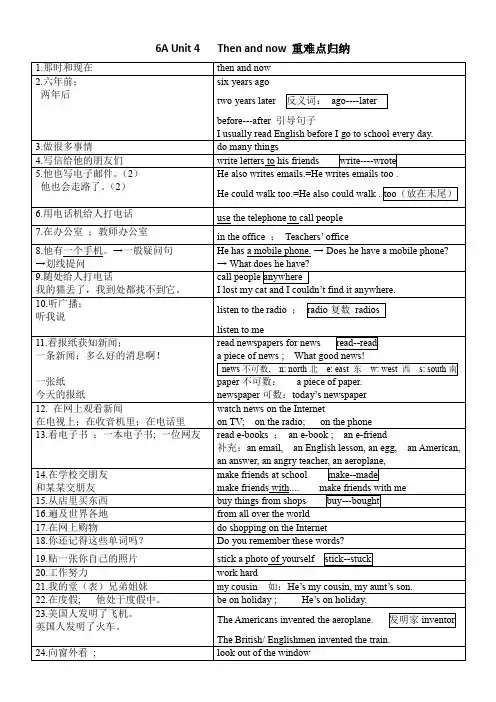
28.变得生气;变得激动
get angry; get excited get +adj 变得如何
29.用鸡蛋造句
make a sentence with “egg” with 介词,用
ቤተ መጻሕፍቲ ባይዱ
我能用眼睛看。 鸟能用翅膀飞。 30.我昨天吃了个蛋糕 31.等待答案 等待某人(做某事) 让我们等我们的老师 (动词:问---答);(问题---回答);服务员 32.一岁 ; 三岁 一个八岁的男孩
listen to the radio ; radio 复数 radios
listen to me read newspapers for news read--read a piece of news ; What good news!
译林英语六年级上册第四单元Unit4 Then and Now (Story time)
?
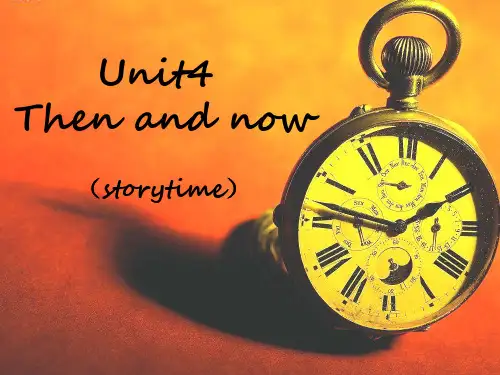
What could Mike do?
Mike
?
s
d
can
w ?
r
Mike could read and draw, but he could not write.
Mike
The change of ability 能力的变化
Six years ago Mike could read and draw, but he could not write. Now he can do many things.
Internet too.
What are the changes in the text ? Tick them out.
1
2
the way to go travelling(出行)
the way to contact(联系) people
the way to make friends the way to do shopping the way to have a rest the way to get news People are changing.
They were eggs two days ago.
They are cute chicks.
Байду номын сангаас and
A
B
判断照片中的物品属于“过去”还 是“现在”,属于“过去”就大声 说“then”,属于“现在”就大声 说“now”。 Then Now
a mobile phone
It’s a book without paper. It has a screen(屏幕). You can carry it with you. What’s this?
牛津译林版-英语-六年级上册-Unit 4 Then and now.教案

预习作业
1.听U4 Story time录音,试读课文。
2.圈出动词过去式,并尝试写出动词原形。
学程预设
导航策略
调整与反思
Step1.Learning aims(1分钟)
Step2.Pre-reading(6分钟)
1.Free talk
2.a. What day is it today?
1.learn‘mobile phone和telephone, radio和TV ,newspaper和e-book’。
2.新旧照片对比,操练一般现在时和一般过去时。
3. learn can和could
4操练could
T: Ten years ago,I could cook.
Ss: Yes! Yes! Yes!
6.通过对比Mike一家人过去与现在的学习、工作和生活等方面,让学生感受科技对生活和工作的影响。
教学重难
点
教学
重点
1.能正确理解故事内容,有感情地朗读故事。
2.四会掌握词句。
教学
难点
1.一般过去时与一般现在时的比较和运用。
2.mobile phone的读音及动词过去式.
教学资源
1.学生已有的学习经验:
Unit 4 Then and now.教案
第几课时
1
教学
目标
1.能正确理解故事内容,有感情地朗读故事。
2.能听懂、会读、会说词汇:then and now, use, telephone, mobile phone, anywhere, radio, make friends, all over the world, do shopping。
明确作业要求。
牛津译林英语六年级上 册Unit4 Then and now单元知识点归纳
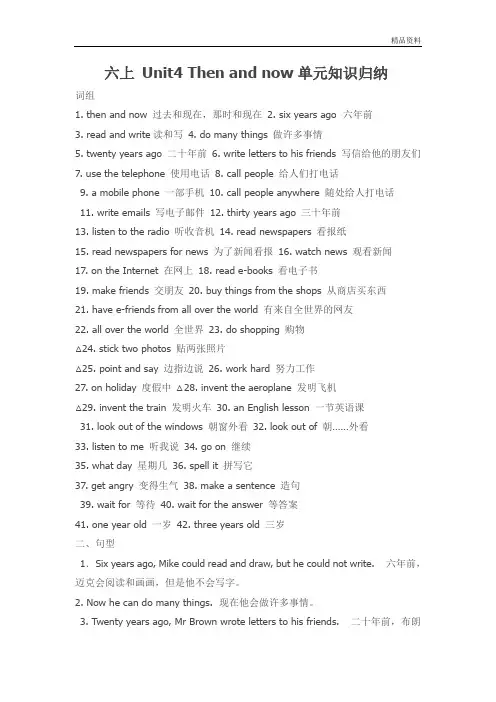
六上Unit4 Then and now单元知识归纳词组1. then and now 过去和现在,那时和现在2. six years ago 六年前3. read and write读和写4. do many things 做许多事情5. twenty years ago 二十年前6. write letters to his friends 写信给他的朋友们7. use the telephone 使用电话8. call people 给人们打电话9. a mobile phone 一部手机10. call people anywhere 随处给人打电话11. write emails 写电子邮件12. thirty years ago 三十年前13. listen to the radio 听收音机14. read newspapers 看报纸15. read newspapers for news 为了新闻看报16. watch news 观看新闻17. on the Internet 在网上18. read e-books 看电子书19. make friends 交朋友20. buy things from the shops 从商店买东西21. have e-friends from all over the world 有来自全世界的网友22. all over the world 全世界23. do shopping 购物△24. stick two photos 贴两张照片△25. point and say 边指边说26. work hard 努力工作27. on holiday 度假中△28. invent the aeroplane 发明飞机△29. invent the train 发明火车30. an English lesson 一节英语课31. look out of the windows 朝窗外看32. look out of 朝……外看33. listen to me 听我说34. go on 继续35. what day 星期几36. spell it 拼写它37. get angry 变得生气38. make a sentence 造句39. wait for 等待40. wait for the answer 等答案41. one year old 一岁42. three years old 三岁二、句型1.Six years ago, Mike could read and draw, but he could not write. 六年前,迈克会阅读和画画,但是他不会写字。
苏教版译林小学英语六上6Aunit4 now and then课件.
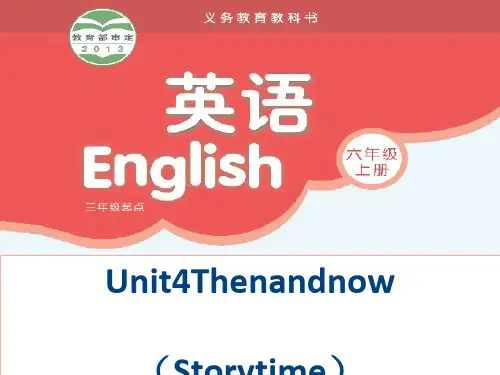
TwAen. tSyhyeeharassaeg-of,rMienrsdBsrforwonmmdaifdfeerferinent dcsoautnstcrhieosol. She boinugthhtetwhiongrlsdf.rom shops. Now she has e-friends
froBm. Salhl eovhearsthee-fwrioernld.sSihneCdhoiensas.hopping on the
the way to get news
新闻
Ten years ago, I could get news from newspapers or the radio.
can-could
anrneawewsdpspaipaoperesr
Now, I can get news from e-books.
2021/5/27
2021/5/27
18
Listen and repeat
3. Thirty years ago, Mike’s grandpa listened to the radio and read newspapers for news. Now he can read and watch news on the Internet. He reads e-books too.
2021/5/27
4
changes of people
Tips: 同桌两人一组,用以下句型讨论自己身上的变化.
…之前
… ago,
I could…, but I could not…
Now I can do many things. I can…, but I can’t….
2021/5/27
苏教译林版英语六年级上册unit 4《then and now》ppt课件(1)
方式
ቤተ መጻሕፍቲ ባይዱ
the way to contact(联系) people
√
the way to make friends
√
the way to do shopping
√
the way to have a rest
the way to get news
√
英语大师 【全免费】
Read and choose
英语大师 【全免费】
随处,到处
英语大师 【全免费】
观看
watch TV
英语大师 【全免费】
全世界
网友
英语大师 【全免费】
Unit4 Then and now
Six years ago, Mike c四ou人ld 一rea组d a,nd任d选raw一, b种ut方he式co,ul看d not write. Now he can do m看an哪y 一thin组gs读. 得最好。
新版译林版小学英语6下 Unit4
Then and now
英语大师 【全免费】
英语大师 【全免费】
英语大师 【全免费】
英语大师 【全免费】
英语大师 【全免费】
The world is changing.
Internet too.
英语大师 【全免费】
Try to say
英语大师 【全免费】
Six years ago
英语大师 【全免费】
Twenty years ago
英语大师 【全免费】
Thirty years ago
the way to make friends
the way to do shopping
the way to have a rest
Unit4 Then and Now(Story time)(教学设计)-2022-2023学年英语
Unit4 Then and Now(Story time)(教学设计)一、教材分析《牛津小学英语》六年级上册 Unit4 Then and Now 是一节通过对话式的故事情境来学习英语知识点的课程,本单元主要讲述了两个时代的生活差距,为学生直观展示英语知识在实际生活中的应用,课程包括以下内容:•对比过去和现在生活的差异•学习使用“used to”描述过去的生活和事件•学习使用“now”描述现在的生活和事件•学习使用“going to”描述将来的计划二、教学目标本节课主要以听、说、读、写四方面的能力提升为教学目标,要求学生能够:•能听懂并模仿英语口语表达;•能够流利、准确地口头表达差异、使用“used to”、描述现在的生活和事件等;•能够理解并正确使用“going to”描述将来的计划;•能够自行撰写使用“used to”和“now”描述过去和现在的生活差异,并向同学展示自己的作品。
三、教学内容和步骤Step 1 Warm-up运用比较典型的生活场景让孩子们自行开口口头表达,利用已经掌握的日常生活词汇将学生引入到本节课的主题,激发他们的学习兴趣。
Step 2 Presentation通过对比过去和现在的生活差异,让孩子们理解英语中过去和现在时态的使用,体验不同时代的生活,在讲述中融入常用单词和词组,引导孩子们学习和掌握语言表达的技巧。
Step 3 Practice为巩固孩子们的理解和应用,分组为3-4人,让小组内自行编写有关过去和现在的生活的小故事。
时间约10分钟,以每组为单位进行依次展示,并给与几点评价,以促进孩子们的学习、互相学习、分享和交流的能力。
Step 4 Production通过自行展示他们自己的写作,对孩子们进行激励,鼓励他们自行思考生活、发现生活、分享生活,立足于英语学习和生活实践,增加他们的学术、观察和表达能力。
Step 5 Wrap up总结课堂内容,让孩子们重温本节课所学内容,并形成深刻理解,培养他们的记忆力和自信心,并为下堂课做好铺垫。
译林英语6上Unit4Then-and-now(storytime)教学设计.doc
译林英语六年级上册Unit4 Then and now (storytime)教学设计一.教学内容:译林英语六年级上册6A Unit4 Storytime二.教学目标:1知识目标:1)能听懂、会读、会说词汇: then and now, use, telephone, mobile phone, anywhere, radio, make friends, all over the world, do shopping。
2)能听懂、会读、会说、会写词汇:ago, office, newspaper, news, watch, e-book, with, yesterday。
3)能听懂、会读、会说、会写句型:ago, he/she Now he/she。
4)能正确理解故事内容,有感情地朗读故事。
2能力目标:学生通过观察、对比等方式总结归纳一般过去时和一般现在时两种时态的用法,并尝试在正确的语境中使用。
3情感目标:1)通过对比 Mike 一家人过去与现在的学习、工作和生活等方面,让学生感受科技对生活和工作的影响。
2)通过过去和现在的对比,感受个人的成长和社会的进步以及自己成长过程中的得与失。
三.教学重点:1能正确理解故事内容,有感情地朗读故事。
2掌握四会词句。
四.教学难点:1一般过去时与一般现在时的比较和运用。
2mobile phone 的读音及动词过去式 .五.教学准备和策略:1学生已有的学习经验:本单元是在前三个单元的基础上,对一般过去时做进一步理解和运用。
而一般现在时的句型学生已在五年级上学期学过。
2学生可能遇到的问题:两种时态有所混淆。
3教学策略:A.通过观看光盘,创设情境,组织游戏等活动帮助学生建构知识B.让学生在主动探究、合作学习的过程中,内化知识,提升能力。
C.启发学生通过观察、对比等方式,总结归纳两种时态的用法,并尝试在正确的语境中使用。
4.教学准备: PPT、旧照片若干(家、学校、城市)预习作业: 1 听 U4 Story time 录音,试读课文。
小学英语译林牛津版六年级上册《then and now》教案
小学英语译林牛津版六年级上册《Then and now》教案
《Then and now》教案
课题Unit4 Then and now课型新授课时备课时间授课时间
教学目标1. 能够理解并掌握动词过去式的不规则变化及读音。
2. 学生能运用句型…….years ago, I was/ I could (not)/ didn’t……..。
重点难点1. 能正确掌握动词过去式的不规则变化及读音。
2. 能用一般现在时和一般过去时的语句来描述自己。
教具准备单词卡片,PPT
教学过程二次备课
Step 1. Preparation
1. Free talk
T: What did you do yesteday /last weekend?
S:…
T:What do you often do at weekends?
S:…
2. Act and say
T: What did I do just now ?
S: You listened to music just now.
Step 2. Presentation & Practice
1. Think and say
T: Think about the changes of Mike’s family and finish the
table.
2. Read and learn
T: Look at the pictures and learn the words.
3. Try to use
《Then and now》教案
《Then and now》教案。
2023六年级英语上册Unit4Thenandnow第4课时教案牛津译林版
简短介绍过去时和现在时的基本概念和重要性,为接下来的学习打下基础。
2.过去时和现在时讲解(10分钟)
目标:让学生了解过去时和现在时的基本概念、组成部分和用法。
过程:
讲解过去时和现在时的定义,包括其主要组成元素或结构。
详细介绍过去时和现在时的组成部分或功能,使用图表或示意图帮助学生理解。
课堂小结,当堂检测
1.课堂小结
(1)教师简要回顾本节课的主要内容,包括过去时和现在时的基本概念、组成部分、用法和对话分析等。
(2)强调过去时和现在时在现实生活或学习中的价值和作用,鼓励学生进一步探索和应用过去时和现在时。
(3)提醒学生注意过去时和现在时的区别和用法,避免在使用时混淆。
2.当堂检测
(1)填空题:设计一些填空题,让学生运用过去时和现在时描述事物的变化,如:“When I was young, I _____ (used to) play football every weekend. Now, I _____ (often) play basketball with my friends.”
对于本节课的内容,学生可能对过去的学校生活有一定的了解,但对于不同年代的生活差异可能缺乏深入的认识。因此,在教学过程中,教师需要通过图片和对话等直观的方式,帮助学生建立起对过去和现在的对比认知,引导他们观察和思考不同年代的生活变化。
针对学生的学情分析,教师应根据学生的实际情况进行针对性的教学设计。首先,教师可以通过引入有趣的图片和对话,激发学生的学习兴趣,吸引他们的注意力。其次,教师可以通过分层次的教学活动,满足不同学生的学习需求,使他们在课堂上能够积极参与并展示自己的能力。同时,教师应注重纠正学生的发音和语法错误,提高他们的语言表达能力。此外,教师还可以通过设计有趣的实践活动,培养学生的思维能力和批判性思维能力。最后,教师需要关注学生的学习习惯,提醒他们保持良好的学习态度和行为习惯,以提高学习效果和成绩。