
牛津译林版英语九上第三单元测试卷
南京市南化二中2014-2015学年九年级上英语第三单元测试卷姓名班级一、单项填空( )1. .––––Can I come this evening or tomorrow morning?––––_______ is OK. I’m free today and tomorrow.A. EitherB. NeitherC. BothD. None( )2. There are so many kinds of sweaters in the shop . I can’t decide _________ .A. to buy whatB. to buy whichC. what to buyD. which to buy( )3. .Our teacher did what she could _______ us with English.A. helpB. helpedC. helpingD. to help( )4. My brother would rather __________ at home .A. stayingB. stayC. to stayD. like staying( )5. ––––I’m sorry to trouble you. ––––_______.A. It’ a good ideaB. It’s very kind of youC. Thank youD. It’s OK( )6._____ of the twins has been there before.A. BothB. NeitherC. AllD. None( )7.Not only Tom but also I ______from the city of Paris.A. amB. isC. areD. was( )8.Our maths teacher is very ______,so we are all afraid of him.A. strictB. kindC. generousD. patient( )9.—______great progress he has made during the last few months!—Yes. That’s all because of his hard work.A. WhatB. HowC. What aD. How a( )10.—When shall we have a picnic, Tuesday or Wednesday?—_____is OK.I am free this week.A. NeitherB. EitherC. BothD. All( )11.Teachers asked us______ questions in English ,not in Chinese.A. answerB. to answerC. answeringD. answered ( )12.He felt lonely then, because he had no communication_________ his teachers and classmates.A. with B .to C. on D. of( )13. Some students in our class have problems _______ English.A. to learnB. in learnC. in learningD. learn( )14.Don’t laug h the people are in trouble.A. at; whoB. at; whichC. to; whoD. to; which ( )15.He gave us on how to learn English.A. some advicesB. many advicesC. some adviceD. an advice ( )16. — How much should I pay for the food, Sir?— It costs ______. The food is free on our ship. ______ needs to pay for it.A. nothing; NobodyB. none; AnybodyC. none; No oneD. nothing; Everybody( )17. — What do you think of the film?— Wonderful. ______ the children ______ their mother likes to see it.A. Both; andB. Either; orC. Not only; but alsoD. Neither; nor( )18. —Mike hardly puts up his hand in class, ________ he?— ________, he is one of the most active students in our class.A. does; NoB. doesn’t; YesC. does; YesD. doesn’t; No( )19. — Excuse me, could you tell me ?— Certainly. In half an hour.A. when the high speed train would arriveB. when the high speed train will arriveC. when would the high speed train arriveD. when will the high speed train arrive ( )20.Wars are disasters. A large number of people will lose their homes if a war .A. is broken outB. breaks outC. breaks upD. is broken up二、完形填空About a year ago, a couple with 3 children moved into the apartment next door to me. I never heard any noise from the children, but the parents were always 1 them, in a frightening way. We met often in the hallway when we were coming or going. I always spoke, but the only2 I ever got was a hello from the 4-year-old girl.I usually go out for breakfast and one day when I returned ,they were just coming from their apartment and the little girl was holding the door open for others. I stayed in the car doing unnecessary things as I wasn’t in a 3 . The parents were telling her to get into the car immediately. I looked up and saw the little girl was still holding the door open, waiting for 4 .As a disabled man, I can’t hurry at 5 , but I hurried as much as I could and thanked her. She was smiling like a lovely angel. I was so 6 by her small act of kindness. That afternoon I was shopping and I saw a white bear. I thought of the 7 and said to myself. “I believe she would like that” so I bought it.The next day there was a knock on the door and it was the little girl and her parents. She was so 8 of her bear and thanked me as if I had never been thanked before. The mother and father 9 thanked me.Now when we meet in the hall we all speak, and in a friendly manner I might add. As time passes, I do n’t hear that shouting as often. 10 , hardly at all.Last night we had about four inches of 11 . I looked out at my car and wondered 12 I was going to keep my doctor’s appointment(约会).When I opened the outside door, there was my car with all the snow cleaned. I can’t express how I felt at that moment. The man next door was the only person I knew in the whole building, 13 when I saw him the next day, I asked him if he was the good man that cleaned my snow. He said 14 . He wanted to but his wife said she wanted to do it.Isn’t it amazing that a 4-year-old girl can change so many things for the better? My guardian angel(守护天使) says that good things usually come from 15 .( )1. A. worrying about B. shouting at C. playing with D. laughing at( )2. A. present B. sound C. act D. answer( )3. A. hurry B. mess C. mood D. surprise( )4. A. me B. others C. her parents D. her( )5. A. everything B. anything C. something D. nothing( )6. A. worried B. surprised C. moved D. enjoyed( )7. A. apartment B. door C. parents D. girl( )8. A. proud B. afraid C. short D. full( )9. A. all B. every C. either D. both( )10. A. In all B. After all C. In fact D. For example( )11. A. rain B. clouds C. snow D. earth( )12. A. why B. that C. where D. how( )13. A. but B. so C. or D. yet( )14. A. Of course B. No C. Thanks D. Yes( )15. A. little children B. nice presents C. small acts D. good neighbors三、阅读理解AOn February 9th, 2013, Sarah Darling was walking along the street when she met a homeless man named Billy Ray Harris. She reached into her change purse, emptied out all the coins she had and gave them to the homeless man. Neither of them realized that this small generous act would change their lives.Sarah didn’t realize that she had given Billy not only all her change but also her diamond ring that she had put in her change purse earlier until the following morning. She and her husband, Bill Krejci, rushed to see if they could find Billy. The homeless man was not only in the same place, he also immediately returned the ring. The grateful couple paid him back for his honesty by emptying out their pockets of all the money they had.Bill Krejci, a web designer, felt that he needed to do something more for this amazingly honest man. So on February 18th, he set up a special page to raise money for him. In just four days, Billy received over $85,000 and there seems to be no end yet.That is not enough. Billy is living with a person who is generous instead of living in the streets. And that’s not all—Thanks to the news report, he got together again with his older brother, Edwin Harris who he had been unable to find for 27 years.All the good luck is just because Billy did the right thing—returning something that did not belong to him.1.When did Sarah realize that she had also given Billy her diamond ring?A. On February 9th, 2013B. On February 10th, 2013C. On February 18th, 2013D. On February 22nd 20132. Which of the following is NOT mentioned in the passage?A. Billy is living with a generous person.B. Billy has found his brother.C. Billy bought a diamond ring.D. Billy appeared in the news report3. The unde rlined word “That” in Paragraph 4 refers to(指代) “________”.A. returning the ringB. setting up a pageC. living in the streetsD. receiving money4.What’s the best title of the passage ?A. Generous Woman Changed Her Own LifeB. Kind Man Set Up Special PageC. Homeless Man Returned Diamond RingD. Many People Donated Much MoneyBWhat problems do the teenagers probably have? Here is a survey showing their main problems.Problems Causes AdviceFeeling stressed Too much homework. Don’t haveenough time for their hobbies.Make a plan for study andhobbies. Find time to relax aspossible as you can.Getting short-sighted Too much homework. Bad reading andwriting habits. Do homework or reading in a correct way.Fights Don’t know how to get on well withclassmates. Make more friends and understand each other. Share your problems with them.Feeling tired of study Computer games’ bad influence.Don’t be crazy about computergames. Play them just for ashort time when you are tired.Getting fat Having more pocket money to buysnacks. Dislike doing exercise. Use your pocket money to do something meaningful. Spend some time doing exercise every day.5. How many main problems are there in the survey?A. Four.B. Five.C. Six.D. Seven.6. What problems are caused by too much homework?A. Feeling stressed and fight.B. Feeling tired of study and getting fat.C. Feeling stressed and getting short-sighted.D. Getting short-sighted and feeling tired of study.7. If Simon is feeling stressed, he should______.A. do much more homeworkB. make a plan to spend time on study and hobbiesC. donate his pocket money to Project HopeD. buy some snacks8. Peter is tired of study, maybe because he ______.A. has no close friendsB. has no pocket moneyC. plays too many computer gamesD. gets fatter and fatterCDreams are expressions of thoughts, feelings and events that pass through our mind while we are sleeping. Everybody dreams. But only some people remember their dreams. Our dreams often include all the senses ---- smells, sounds, sights, tastes and things we touch. Sometimes we dream the same dream over and over again.Early in the twentieth century, two famous scientists developed their personal ideas about dreams. Austrian psychiatrist (奥地利心理学家) Sigmund Freud wrote a book called “The Interpretation (诠释) of Dreams” in 1900. Freud believed people often dream about things theywant but can’t have. Swiss (瑞士) psychiatrist Carl Jung worked closely with Freud for several years, but he believed dreams could help people grow and understand themselves. He believed dreams provide solutions to problems we face when we are awake. Today we know more about the science of dreaming because researchers can take pictures of people’s brains while they are sleeping.Other researchers are studying how dreaming helps our bodies work with problems and very sad emotions (感情). Robert Stickgold is a professor of psychiatry (心理学教授) at Harvard University in Massachusetts. Doctor Stickgold says that when we dream, the brain is trying to make sense of the world. He does not agree with Sigmund Freud that dreaming is the way we express our hidden feelings and desires (愿望).Scientists believe it is important to keep researching dreams. Doctor Stickgold says it has been more than one hundred years since Sigmund Freud wrote his important book about dreaming. Yet there is still no agreement on exactly how the brain works when we are dreaming or why we dream.( ) 9. From the passage we know ________.A. dreams are remembered by everyoneB. dreams express all that we think in our mindC. dreams include all the senses and things we touchD. how the brain works while dreaming and why we dream( ) 10. The underlined word “solutions” probably means ________ in Chinese.A. 分析的过程B. 解决的方法C. 面临的形势D. 坚持的立场( ) 11. In the passage , all the psychiatrists ________.A. believe dreams can help people understand all the problems that they faceB. believe when we dream, the brain is trying to make sense of the worldC. study dreams and dreaming and have their own ideasD. have the same idea that people often dream about things they want( ) 12. Which would be the best title for the passage?A. The Fact of DreamsB. The Ways of DreamsC. The Solutions to DreamsD. The Mystery of Dreams and Dreaming四.词汇I.根据句意及首字母或汉语提示完成单词1.Don’t(打扰)your father. He is thinking about something about his company.2.I am pleased that he gladly a our invitation.3.As students, we should have the c to go into the teacher’s office to ask questions.4.The place has lots of amazing things. It’s_______(值得)a visit.5.The tourists had no______(选择)but to wait for the next train.Ⅱ.用所给单词的适当形式填空6.You must tell the (true).Don’t tell a lie any more.7.Your (spell) must be paid more attention to.7.The film provided us with a______(value)record of the earthquake.9. It is a _______(please)for me to stay with you.10. Would you like to give me some _______(suggest) on how to keep fit?五. 根据汉语意思完成下列句子1. I always ______ ______ ______ ________ (把我的建议给他们) and tell them how to do it.2.太多的考试使得他整天忙于功课。
牛津译林版九年级上册英语第三单元测试 含解析
Unit 3 Teenage problemsName__________一、选择填空:( )1.Taking more exercise and eating less food_____ good for your health.A. isB. areC. wasD. were( )2. ______ your parents strict_____ you and_____ your study?A. Is, with, inB. Are, in, withC. Is, in, withD. Are, with, in( )3. Don’t forget_____ your girlfriend here next time.A. to bringB. bringingC. to takeD. taking( )4. Would you please_____ in the library?A. not to talk l oudlyB. don’t talk loudlyC. not talk loudlyD. not talking loudly ( )5. The boy is very lazy. Before the exams he would rather watch TV than____for his tests.A. reviseB. to reviseC. revisingD. to revising( )6. We don’t think it’s good to stay_____ late to play computer games.A. onB. outC. fromD. out of( )7. It’s so_____ in the classroom that he can’t focus on his homework.A. noiseB. noisyC. noisierD. noisily( )8. Would you like some coffee?Yes, and please get me some milk, too. I prefer coffee_____ milk.A. withB. ofC. toD. than( )9. You shouldn’t_____ too much. It’s bad for your health to_______.A. worry, worriedB. worried, worryC. worry, worry aboutD. worry, be worried ( )10. Would you mind lending me your bike?_________.A. Certainly not, here you areB. Yes, OKC. Yes, My bike is brokenD. Yes, here you are.( )11. Why don’t you like the talk? It’s_____ one that I have ever listened to.A. the most interestingB. the least interestingC. more interestingD. such an interesting( )12. What are you going to do this afternoon? I’m not sure. I ___go shopping with my mother.A. mayB. canC. mustD. need( )13. I haven’t heard from him_____ last year.A. byB. sinceC. /D. in( )14. If you are feeling stressed, you should_____.A. shout at your friendsB. share your problems with friendsC. quarrel with your friendsD. blame your parents( )15. Students should pay no attention to people who_____ them.A. laughs atB. laugh atC. laugh overD. laughs over( )16. Thanks for listening to my problem and_____. ________.A. give me your adviceB. giving me your adviceC. give me your adviceD. giving me your advices( )17. I’m sorry I’m late again because I _____ catch the early bus.A. won’tB. didn’tC. don’tD. haven’t( )18. He feels very lonely because he has_____ close friends.A. A. fewB. a fewC. littleD. a little( )19. Can I get you a cup of tea? _________.A. With pleasureB. It’s nice of youC. Thank you for the teaD. You can, please ( )20. Do you think that Mr Smith is a _______ person?A. happilyB. quicklyC. slowlyD. friendly( )21.The meeting will be held in half an hour, but they haven’t got everything ready____.A. everB. alreadyC. yetD. still( )22. He doesn’t know_____ to hand in the homework. I think he may do it tomorrow.A. whereB. whatC. whichD. when( )23. He has got something to_____ at the meetingA. tellB. talkC. speakD. say( )24. I like the pictures which_____ on show.A. isB. beingC. wasD. are( )25. Let’s go to play football,_____?A. shall weB. shall youC. will weD. will you二、词形变换:1. If you work hard, you’ll_________________(success) in the exams.2. Thank you very much for giving us some______________(value) advice.3. On of my_____________(hobby) is to collect stamps.4. You must give up_____________(play) computer games, or you’ll fail in the exam.5. He often________________(quarrel) with his wife about housework.6.When you have problems, you’d better write a letter to your best friend abouthow________________(deal) with these problems.7. I read about one of his___________(article) on___________(teen) problems in the newspaper.8. From his words, we draw the ____________(conclude) that he was lying to us.9. It’s ______________(polite) to laugh at the disabled persons.10. Why not ____________(send) an e-mail to her instead of ___________(reply) to her letter?11. We think it _________(necessary) to give students tests every day. If so, the students will bevery tired.12. He’s business-like. He’s good at _______________( plan) things ahead.13. Our English teacher uses different____________(act) to keep us __________(interest) in class.14.I really d on’t know which __________(do) first. I feel __________(stress) from time to time.15.I hope I can have my parents’________________(support).16.Are you crazy about ______________( play) football?17.Keeping your ____________(worry) to yourself can make them worse.18. She’s making a few birthday _______________(wish) , but we don’t know what she’s wishing for.19. ______________(hand) in your homework on time, or your teacher will be angry with you.20. It’s my_______________(please) to give you some usef ul ________________(suggest).21. Don’t make any _____________(noise) any more. It’s much too ______________(noise) here.22.______________(much) you eat, the ____________(health) you’ll be, because ___________(eat) too much will make you ___________(health).23. It’s not _______(wise) to spend hours_____(play) football after school or ______(stay) out late.24.She is not very ________________(sport), she can’t run fast and hates swimming.25.The problem of stress gets _________________(bad) when people do n’t share their problems.三、完形填空:It was very cold that day. It was __1__ heavily and the ground was covered with __2__ snow. The shepherd thought it was dangerous to __3__ the hill and it was difficult for the sheep to find some __4__ there. So he decided to stay in the __5__ room. He put some hay(干草) in a pen(围栏) __6__ the sheep could eat it when they were __7__. The dog, who felt cold outside, lay on the __8__ hay and soon went to sleep.At noon the sheep wanted to eat the hay. They were __9__ afraid of the dog and __10__ could get close to it. At last the __11__ sheep came to the hay. Before he started to eat, the dog heard it and opened his eyes. He barked(吠) loudly to __12__ him. The sheep ran away __13__. Looking at the unnatural(不近人情的) dog, the sheep began to talk __14__.“What a selfish(自私的) dog!” said one of the sheep. “He cannot eat the hay, and yet refuses to __15__ those who can to eat!”( )1. A. raining B. snowing C. blowing D. shining( )2. A. thick B. thin C. beautiful D. big( )3. A. play on B. live on C. climb up D. go to( )4. A. cake B. grass C. fruit D. vegetables( )5. A. cold B. cool C. hot D. warm( )6. A. in order to B. so as to C. so that D. in order( )7. A. hungry B. sick C. full D. free( )8. A. hard B. soft C. thin D. wet( )9. A. both B. either C. all D. neither( )10. A. none B. neither C. any D. some( )11. A. smallest B. youngest C. weakest D. strongest( )12. A. meet B. greet C. warn D. receive( )13. A. easily B. happily C. sadly D. quickly( )14. A. angrily B. happily C. quietly D. politely( )15. A. let B. ask C. forget D. allow四、阅读理解:Sigmund Freud was a world-famous doctor of Vienna(维也纳). He was also a man full of humour(幽默). Once, at his 70th birthday party, a friend asked Freud if he could put his work into several words. “Well,” said Freud, “we take the sick out of their tr ouble and return them to the common suffering.”As a devoted(忠实的)son, Freud often visited his old mother. His mother usually spent her summers in a small mountain town in Austria(奥地利). The King Josef usually spent hissummers there, too. One day in the summer, a band(乐队)was playing a lively tune(曲子)when Freud’s mother was sitting at the window and watching the people singing and dancing on Main Street. The old woman had a poor memory. She heard the band playing, but forgot it was the King’s birthday. Freud was visiting his mother on her 95th birthday. He told his mother, “Mama, the band is playing for your birthday.” She believed him and had a wonderful day.( )1、Freud was a famous of .A.doctor, Austria B.general, ViennaC.King, Austria D.doctor, Australia( )2、From what Freud said at his 70th birthday party, we can see that he was .A.a brave man B.a sick manC.a devoted man D.a man full of humour( )3、One day Freud came to the small mountain town for .A.his 70th birthday B.the King Josef’s birthdayC.his mother’s birthday D.for his holiday( )4、Which of the four sentences is wrong?A.Freud’s mother and the King Josef usually spent their summers in the same place.B.Freud’ mother’s birthday and the King’s birthday were on the same day.C.Freud’s mother was so old that her memory was very bad.D.She knew that the band was playing for the King.( )5、Freud’s mother felt very happy on her 95th birthday because . .A.the King Josef himself came to celebrate(庆贺)her birthdayB.the people of the town came out to celebrate her birthdayC.she believed that the band was playing for her birthdayD.she heard the band playing a lively tune so wonderfullyUnit 3一、选择填空: BDACA, BBADA, BABBB, BBABD, CDDDA二、词形变换:1. succeed2. valuable3. hobbies4. playing5. quarrels6. to deal7. articles, teenagers’/ teenage8. conclusion9. impolite10. send, replying 11. unnecessary 12. planning 13. activities, interested14. to do, stressed 15. support 16. playing 17. worries 18. wishes19. Hand 20. pleasure, suggestions 21. noise, noisy22. The more, more unhealthy, eating, unhealthy 23. wise, playing, stay24. sporty 25. worse三、完形填空:名师点评本篇是一个寓言故事,说的是一只牧羊犬,因为天冷,就睡在牧羊人给羊吃的干草上。
牛津英语译林版 单元测试 (Unit 3,九年级上册)
(Unit 3, 九年级上册)听力部分(共20分)一、听力(共20小题, 每小题1分, 计20分)第一部分听对话回答问题。
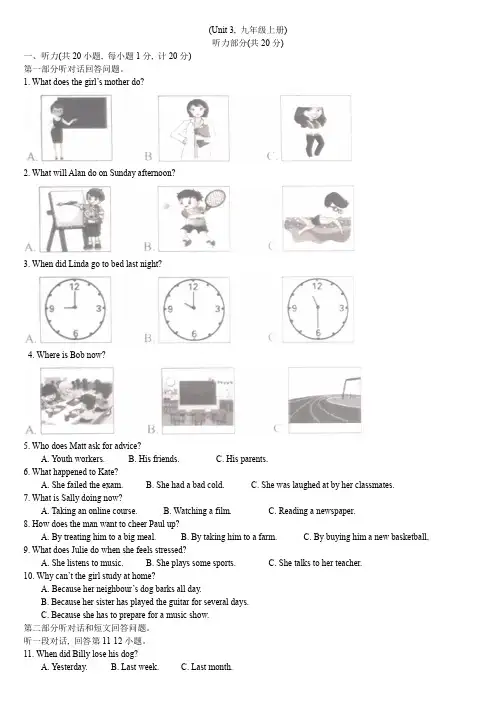
1. What does the girl’s mother do?2. What will Alan do on Sunday afternoon?3. When did Linda go to bed last night?4. Where is Bob now?5. Who does Matt ask for advice?A. Youth workers.B. His friends.C. His parents.6. What happened to Kate?A. She failed the exam.B. She had a bad cold.C. She was laughed at by her classmates.7. What is Sally doing now?A. Taking an online course.B. Watching a film.C. Reading a newspaper.8. How does the man want to cheer Paul up?A. By treating him to a big meal.B. By taking him to a farm.C. By buying him a new basketball,9. What does Julie do when she feels stressed?A. She listens to music.B. She plays some sports.C. She talks to her teacher.10. Why can’t the girl study at home?A. Because her neighbour’s dog barks all day.B. Because her sister has played the guitar for several days.C. Because she has to prepare for a music show.第二部分听对话和短文回答问题。
牛津译林九年级上册英语Unit 3 Teenage problems 单元测试卷(含答案)
Unit 3 Teenage problems 单元测试卷一、单项填空( )1. For a long time they walked without saying _____word. John was the first to break _____silence.A. a; theB. the; aC. a; /D. the; / ( )2. —Is there anyone in the room upstairs? —1 don’t think so. Look, the lights are _____.A. onB. offC. openD. closed ( )3. —How often do you drink milk? —_____ ever.A. HardB. NearlyC. AlmostD. Hardly ( )4. I hear that they will hold a charity show, but I don’t know when _______.A. to hold itB. will they hold itC. they will hold itD. are they going to hold it ( )5. —Look! It _____a cat. —_____ you are right.A. may be;May beB. maybe;MaybeC. may be;MaybeD. maybe;May be( )6. —Could you tell me how many times ______ to Beijing? —Only once.A. have you goneB. have you beenC. you have goneD. you have been( )7. Whose CD player is this? It looks nice. How much is it ?A. worthB. payC. spendD. cost ( )8. We all think _______ really kind ______Lucy to give her seat to the youngA. that; forB. it; ofC. it; forD. that; of ( )9. Sometimes we stay out_____ late and sleep_______.A. too much;too littleB. much too;too manyC. much too;too littleD. too much;too much ( )10. —The film was wonderful. Thank you for inviting me.—_____. Fm glad you enjoyed it.A. All rightB. Don’t mention itC. You’re rightD. Thank you all the same ( )11. I can’t decide _____first. Can you give me some a dvice.A. to go over which l essonB. which lesson to go overC. which lesson I should go over itD. go over which lesson ( )12. I wonder if you have any trouble friends withA. in making;the othersB. make;the otherC. to make;othersD. making;others( )13. These photos will show you _____our school _____like.A. what;looksB. what does;lookC. how;looksD. how does; look( )14. He made it ____ for people ____the computers by inventing new software(发明新软件).A. easily; to useB. easier; usingC. easier; to useD. easy; use ( )15. —1 doubt if he _______ in the discussion tonight.—I believe if he _______his homework, he will join us.A. will join;will finishB. will join;finishesC. joins; finishesD. joins; will finish( )16. What way can you think of ______ with these broken computers?A. to dealB. dealingC. dealsD. deal( )17. People in Suzhou are proud of _____ they have achieved in the past thirty years.A. howB. whichC. whatD. when( )18. I never doubt _______ this park is worth _____.A. whether;visitingB. that;a visitC. that; to visitD. whether;to visit( )19. —Gould you tell me _____?—Certainly. Go straight ahead and you’ll see it’s just opposite the road.A. how can I get to the nearest bus stationB. where the nearest flower shop wasC. how I could get to the nearest bookshopD. which, is the way to the nearest Bank of China( )20. —It might be cool to see a film this afternoon —Yes, _____?A. why notB. so whatC. what forD. how二、完形填空I had always cared about sick children and tried to help them. But when my little grandson received third, degree burns, I learned first-hand how ___1___ a loving adult feels when his or her child is suffering (受罪) and he or she can’t take the pain away. This experience ___2___ me to feel sorry for parents with sick children.One mom told me that she ___3___ like running into the street and screaming, “My child is sick, Would somebody pl ease help us?” It breaks my ___4___ that these, parents are so anxiously (忧虑地)searching for someone to care and help them ___5___ the hard times of watching their helpless child suffer. So I decided to do something to help them.Two years ago, I almost lost my eyesight. Luckily,I regained (後复)some eyesight,but I was no longer able to work. ___6___ I had a lot of time. At first, I thought, that my life was ___7___because I couldn’t do any of the things I used to do. I believed that my life had no purpose and I was no ___8___ to anybody any more. I began to be interested in surfing theInternet for information. One day I received several emails asking for help for sick children. I decided to post their stories and pictures on a webpage. What began as a ___9___ has grown into a fulltime job I enjoy doing every day. Since my website was built, I’ve received tens of emails from worried parents asking me to put their children stories online. And over 325 volunteers have ___10___ me in sending children “happy mail” without being paid.( )1. A. bored B. puzzled C. helpless D. hopeful ( )2. A. made B. advised C. guided D. led( )3. A. seemed B. felt C. looked D. sounded ( )4. A. heart B. head C. legs D. face( )5 A over B. with C. across D. through ( )6. A. If B. Though C. So D. Since ( )7. A. boring B. meaningful C. interesting D. meaningless ( )8. A. point B. sense C. good D. hope( )9. A. picture B. wish C. hobby D. website ( )10. A. paid B. joined C. invited D. advised三、阅读理解AYou may have heard of the famous saying, “East or west, home is the best.” What does the word “home” mean to you? How do you say the word in French? In Chinese ? In your language? Although(尽管)people usually know what the word means,it sometimes has no exact translation. It’s not surprising, because the idea of home is different from country to country, and from person to person. A home is more than a roof(屋顶)and four walls. It’s cooking, eating, talking, playing and sleeping that go on inside. And at home you usually feel safe and relaxed. Homes look different in different countries. They also have different things inside. For example, in cold northern Europe, there’s a fire in the living room or kitchen and all the ch airs face it. In the south,where the sun shines a lot and it’s more important to keep the heat out, there are small windows and cool stone floors. We asked some people about their homes. How often do people move house in your country? “In my country many people don’t stay in one place for a very long lime. They often move every ten years or so.”—Chery, Boston, USA.What are features of homes in your country?“In Britain,even in town,there’s always a garden. We have separate(各自的)bedrooms and living rooms. But we don’t often have balconies. The weather isn’t warm enough!一Pat. Exeter, England.( )1. The word “home” sometimes has no exact translation because ______.A. people can’t find this word in the dictionaryB. no one knows what it isC. it has different meanings in different countriesD. people can’t understand each other very well( )2. According to the passage, at home? you can do everything except______.A. making friendsB. cooking and eatingC. playing and talkingD. sleeping and relaxing( )3. Why is it important to keep the heat out of the houses in southern Europe?A. Because they want to breathe(呼吸) fresh air outside.B. Because there’s a fire in the living room.C. Because they wear heavy clothes all day long.D. Because the sun there shines a lot.( )4. From the second paragraph? what kind of homes people have depends on ______.A. whether they are rich or notB. the climate (气候) they haveC. Row old they areD. whether they live in the city or the countryside ( )5. Which one of the sentences below is TRUE?A. People in Britain seldom have balconies because it s so hot outside.B. Some Americans move house several times during their lifetime.C. Homes look the same in different countries.D. Houses in northern Europe have big windows and cool stone floors.BHow quickly can you count from one to ten? Do you use ten different words to do it? Can you do it in English, or do you have to use your first languages? Do you count on your fingers? Many people think that numbers and math are the same all over the world. But scientists have discovered that it is not true.People in different parts of the world use different ways to count on their fingers. In the United States, people think begin counting with their first fingers, which they extend or stick out. They then extend the rest of their fingers and finally the thumb(拇指)to count to five. Then they repeat this with the other hand to get to ten. In China, people count by using different finger positions. In this way, a Chinese person can easily count to ten on only one hand.Besides ways of finger counting, scientists have found that cultures and languages are also different when it comes to numbers. Some languages have only a few words for numbers, and others have no words for numbers. A group of scientists studied aboriginal(土著的)people in Australia. These people don’t have hand movements to stand for numbers. They don’t even have word for numbers. However, they are still able to understand different ideas about numbers.In a similar study, researchers from the Massachusetts Institute of Technology discovered that people of the Piraha tribe(部落)in northwestern Brazil don’t have words for numbers such as“one” or “three.”. They are not able to say “five trees” or “ten trees” but can say “some trees,” “more trees,” or “many trees.” Professor Edward Gibson said that most people believe that everyone knows how to count, “but here is a group that does not count. They could learn, but is’t not useful in their culture, so they’ve never picked it up.”Although all humans are able to understand quantities(数量), not all languages have numbers and not all people use counting. Number words in a certain language are a result of people needing numbers in their daily lives. Now we know that people have different ideas about numbers and math, too.( )6. The writer begins with the four questions in order to______.A. make a surveyB. interest readersC. tell a storyD. solve math problems ( )7. What do we learn from the difference in finger counting between the U.S. and China?A. People from China count much faster than people from the U.S.B. People from China need two hands to count from one to ten.C. People of different cultures may use different ways of finger countingD. People of different cultures use the same way of finger counting.( )8. Which of following is true about aboriginal Australians?A. They have only a few words for numbersB. They have hand movements to stand for numbersC. They can only count to five on their fingersD. They can understand different ideas about numbers( )9. The study of the Piraha tribe shows that____ .A. people all over the world know how to countB. People of the tribe have words for numberC. Some groups of people are not smart enough to countD. Counting is not useful in the culture of the tribe( )10. What is the main idea of the passage?A. people from different cultures have different ideas about numbers and mathB. Chinese people can count more easily on their fingers than AmericansC. In some abo riginal culture, people don’t even know how to countD. Some languages don’t have number words because people don’t need numbers.四、单词拼写1. ______(化学) is one of my favourite subjects in school.2.Jack finds it hard to spell some English words_______ (正确地).3.The teacher asks us not to keep our_______ (令人担忧的事)to ourselves.4.We have already got more than 100 _______答复)to our advertisement.5.He read the letter _______ (大声地)as Grandpa’s hearing was not so good.6.More than half of the students say that _______ (学业)takes them the most time.7.We formed a close _______ (友谊)when we were in middle school.8.—Can you tell me how to_______ this maths problem?一Think it over again. I think you can do it yourself.9.—Since you have missed the film, what are you going to do next?—I think we have no _____but to go back home.10.—I really don’t know what to do now. I think I need_______ from others.—Go for Feynman. He always gives good ones.五、句子翻译1.父母们应该在日常生活中严格要求孩子。
新牛津译林版九年级上册第三单元测试含答案
9A unit3单元测试一.单项选择20分1._________your Englishi teacher______you? Yes, but he still encourages us to try our best.A.Does, strict with B.Does, strict in C.Is, strict with D. Is , strict in2.He lices_________in a small house,but he doesn’t feel__________.A.lonely.aloneB.alone,lonelyC.lonely.lonelyD.alone.alone3.Would you like to attend the show?___________But I’m busy revising for my test.A.Don’t mention it .B.I’d loce to .C.That’s all right.D.My pleasure4.How long does ti take to get to the airport?Forty minutes.But it’sfoggy today..I’m not sure__________the highway will close soon..Let’s set off earlier.A.whetherB.whenC.howD.why5.How often do you drink milk?-__________ever.A.HardB.NearlyC.AlmostD.Hardly6.You shoudn’t_________too much,It’s bad for your health to_________.A.worry,worriedB.worried,worryC.worry,worry aboutD.worry,be worried7.They tried several time to __________the problem,and in the end they succeeded.A.give upB.work outC.look throughD.stay up8.Students should pay no attention to people who ________them.ughs atugh atugh overughs over9.My teacher gace me ________and I made great progress in my study.A.a good adviceB.some good advicesC.some good suggestionD.a good suggestion10.Could you pleade tell me__________?They are over there..A.where are the restroomsB.where were the restroomsC.where the restrooms areD.where the restrooms were二、完形填空(15分)One day, a boy found the cocoon of a butterfly and brought it home. A few days later, the boy saw a small ___11___in the cocoon. He sat and watched for several hours as a butterfly struggled to make ___12___body through that little hole. Suddenly it stopped.So the boy ___13___to help the butterfly, thinking the butterfly might be ___14___. He took a pair of scissors and cut the hole ___15___. The butterfly came out of the cocoon, but it ___16___a little different. It had a weak body and small, thin ___17___. The butterfly didn’t start to fly. In fact, the butterfly spent the rest of its life crawling around with a weak body and thin wings. It was never able to fly.The boy acted with___18___but he didn’t understand why it could be like this.When a butterfly crawl out of the cocoon, it must struggle. The hard work of ___19___out of the cocoon makes the fluid from the butterfly’s body into its wings. It helps the butterfly be ___20___to fly. If the butterfly never has to squeeze itself out of the cocoon, its wings will never get the fluid and it can never fly.___21___struggles are what we need in our lives. If we lived our lives without any problems, we would never learn or grow. We would not be ___22___ we could have been and we would never fly.In our lives, pain and suffering is the key to all windows, and sometimes even ___23___ growth, without it, there’s no way of life. We can’t avoid ___24___ or problems. So, next time you are ___25___ a problem or difficulty, remember the butterfly. Struggle a little–then fly!( )11.A. hole B. worm C. tail D. snake( )12.A. it B. it’s C. itself D. its( )13.A. decided B. asked C. showed D. ordered( )14.A. afraid B. interested C. surprised D. grateful( )15.A. slimmer B. bigger C. shorter D. smaller( )16.A. touched B. sounded C. looked D. smelt( )17.A. wings B. feet C. eyes D. head( )18.A. success B. excitement C. kindness D. humour( )19.A. get B. getting C. to get D. got( )20.A. ready B. quiet C. glad D. used( )21.A. Somewhere B. Something C. Some time D. Sometimes( )22.A. as helpful as B. as weak as C. as strong as D. as creative as( )23.A. repeats B. recommends C. requires D. represents( )24.A. happiness B. difficulties C. pleasure D. hope( )25.A. served with B. growing into C. bringing in D. faced with三.阅读理解20分AAccording to scientists’ research, the month in which babies are born could affect them in some ways.Babies born in spring get sick easily. Children born under Aquarius (Jan. 21st—Feb. 19th) may be less clever than those born in other seasons. They may also have shorter lives than those born in autumn. Scientists believe many of the differences can be explained by the mother’s exposure to sunlight in pregnancy (怀孕). Sunlight helps lead to the production of vitamin D in the body. The lack (缺乏) of vitamin D in the first months of life may have a bad effect on health.Vitamin D is called the “sunshine vitamin”. It has a good effect on health. A study showed that people born from April to June had slightly shorter lives than those born in October, November or December. Similar studies in the US showed that people born in autumn lived about 160 days longer than those born in spring.Professor Russell Foster said the conclusions were surprising and interesting. He added, “These are small effects but they are very, very clear. I am not giving voice to star signs and they are just for fun. But it is true that we are affected by our season of birth.”( )26. A child’s sea son of birth can affect all the following things EXCEPT according to the first two paragraphs.A. his healthB. his heightC. his length of lifeD. his quality of being clever( )27. What does the underlined word “exposure” me an in Chinese?A. 偏爱B. 抗拒C. 过敏D. 暴露( )28. What can we know about vitamin D according to the passage?A. It comes from sunlight.B. It helps people live longer.C. Sunlight prevents its production.D. It does h arm to people’s health.( )29. Which of the following is TRUE according to the passage?A. Women should get enough sunlight in pregnancy.B. Children born under Aquarius are cleverer than those born in autumn.C. People born in May will live longer than those born in October.D. Professor Russell Foster is interested in star signs and believes in them.( )30. What does the passage mainly tell us?A. People can know the length of life by star sign.B. Women should choose to give birth to children in spring.C. A child’s season of birth has an effect on him or her.D. Vitamin D is very important to people’s health.BThe size and shape of your ears show your character more than any other part of the face. Other parts of the face change shapes as we get older,but ears do not change their shapes. They only change in size.Reading people’s character from their ears is a very old science. In the past people thought that a person’s ears with colour was dangerous. They also thought that the shape of the ears showed if a person was musical or not. Today,too,many people believe that the size and shape of the ears help you know if a person is musical.Ears are all different,and each different thing has a meaning. Next time you look at a person,see if his or her ears are large,medium-size,or small. Look at the lobes .Do they stick to the face? Ears that are always red mean that a person may get angry easily. Ears that are always cold and nearly white colour mean that a person has a nervous character.( )31. When a baby is born, .A.his / her ears are red B.his / her ears will not change all the life C.his / her ears will not change in shape D.he / she will get large ears( )32. Reading people’s character from their ears is.A.only for music B.an old ideaC.very new D.a good way to talk with others( )33. When one’s ears are red,it means .A.he is a kind man B.he is very happyC.he may get angry easily D.he drinks too much( )34 If you look at someone’s ears,the right way is . A.to look at his face,ears and nose B.to look at the size,colour,and shape C.to look at his mouth,eyes and nose D.to look at the hair,eyes and colour ( ) 35. Which may be the best title of the article?A.Looking at a person in the right way.B.Ears and colours.C.The change of ears.D.Ears and characters四.根据汉语意思完成句子10分36.I send him an e-mail every week,but he never ________(回复)to me.37.It’s quite important that you can________(获得)a balance between study and hobbiesl..38.Tom is always singing in the classroom and that really drives me _________(生气)39.To keep fit, you’d better try more_________(锻炼)every day..40.You have to be 18 years old before you are ____(允许)to drive a car.五.用所给的适当形式填空1041.Who can spell the word_________(correct)?42.If she doesn’t take a pill, she will be_________(wake) all night.43.Why does he feel so sleepy now?__Because he _________(stay )up late ot see a film last night.44.Her parents are satisfied with her,, for Lucy ________(make) much progress since last term.45.I hope you can listen to their________(value) suggestions.五.作文。
牛津译林版九年级上英语第三单元测试(附答案)

九年级上英语第三单元测试Array一、单项选择(每小题1分,共10分)( )1. –Have you decided _______ to do next? --- Not yet.A. whatB. howC. whereD. when( )2. ---Can you work out the physics problem?--- Sorry, I can _______ understand its meaning.A. almostB. quiteC. nearlyD. hardly( )3. Students can’t be made _______ all day.A. studyB. to studyC. of studyD. studied( )4. We must _______ ourselves _______ our work.A. strict in, withB. be strict in, withC. be strict with, inD. strict with, in( )5. She is often seen _______ under the big tree .A. danceB. dancingC. to danceD. to dancing( )6. –Are there any eggs in the fridge? ---_______ . Let’s go an buy some.A. NothingB. NoneC. NOD. Not( )7. The most important is we need to learn how to _______ his problem.A. deal withB. doC. tellD. know( )8. _______ advice it sounds!A. How usefulB. What usefulC. What a usefulD. How usefully( )9. I feel very worried when I can’t think of anyone _________.A. to talkB. talk toC. to talk toD. to talk to about( )10. His father could hardly walk any more, _______?A. Does heB. Doesn’t heC. could heD. couldn’t he二、完形填空(每小题1分,共10分)His stories have no magic tricks or heroes, but still touch teenage readers.Benjamin, a young Beijing cartoonist, is famous ___11___ his comic books “Remember” and“One day”. His colourful stories of young people working hard for dreams and love have___12___support from lots of fans.Benjamin has been drawing ___13___ for 10 years. He tried many jobs before that, ___14___ what he enjoys mos is the freedom of drawing. “Drawing cartoons is ___15___ writing diaries,” he said. “ I mix the special people and things that I meet into the drawings”For Benjamin, a good story is more important than a picture. Benjamin says drawing ___16___ be Painful(痛苦的). He sometimes even thinks he can’t go on. Once he ___17___ a month on one picture! “Sometimes you are stuck(卡住)at one point. Look at the from a different angle(角度),like from the back of the paper. Then you’ll know how to ___18___.”“ __19___ my parents don’t let me draw or read cartoons?” Benjamin has the___20___: “Be a good kid and work hard. Then steal (偷)time for the hobby.”11. A.as B.for C.with D.in12. A.won B.given C.beat D.taken13. A.photos B.articles C.cartoons D.stories14. A.so B.while C.or D.but15. A.different from B.similar to C.better than D.easier than16. A.should B.must C.can D.shall17. A.cost B.spent C.talk D.play with18. A.continue B.stop C.finish D.start19. A.No wonder B.What else C.What if D.No matter20. A.question B.answer C.mind D.road三、阅读理解。
牛津译林版九年级英语上册Unit-3-单元测试

Unit 3 Teenage problems 测试卷一、听力(共15小题,每小题1分,共15分)听对话,回答以下各小题。
1.Which is NOT the girl’s problem?A.She has too much homework.B.She can’t get enough sleep.C.She has no close friends.2.Who disturbs(打扰) her when she’s studying?A.Her sister. B.Her parents. C.Her deskmate.听对话,回答各小题。
3.What will Billy use to make a model airplane?A.Glass. B.Paper. C.Wood.4.What is Lucy’s paper about?A.The planet. B.The city. C.The invention. 5.What does Lucy also need to do to collect information?A.Read books. B.Visit websites. C.Do interviews.听对话,回答各小题。
6.Who is the woman?A.Isabelle’s friend.B.Isabelle’s mother.C.Isabelle’s teacher. 7.What’s wrong with Isabelle?A.She gives up her study.B.She doesn’t like her job.C.She spends too much on work.8.What are Isabelle’s grades?A.One C and three Ds. B.One D and three Cs. C.One A and three Bs. 9.What is Carrie’s advice?A.Shouldn’t work on weekends.B.Shouldn’t work from Monday to Sunda y.C.Shouldn’t work during the week.10.How does Isabelle deal with the woman’s advice?A.She follows it.B.She is strongly against it.C.She doesn’t pay attention to it.听独白,回答小题。
牛津译林版英语九年级上册第三单元测试卷(含答案)
牛津译林版英语九年级上册第三单元测试卷(含答案)考生作答时要沉着冷静,规范书写,确保字迹清楚、卷面整洁。
按照要求在指定位置正确填写信息、在与题号相对应的答题区域内答题,考试结束信号发出后,立即停笔并停止答题。
I.根据句意及首字母或汉语提示完成单词(每小题1分,满分5分)1. Don't (打扰) your father. He is thinking about something about his company.2. I am pleased that he gladly a our invitation.3. As students, we should have the c to go into the teacher's office to ask questions.4. The place has lots of amazing things. It's (值得) a visit.5. The tourists had no (选择) but to wait for the next train.II.用所给单词的适当形式填空(每小题1分,满分5分)6. You must tell the (true). Don't tell a lie any more.7. Your (spell) must be paid more attention to.7. The film provided us with a (value) record of the earthquake.9. It is a (please) for me to stay with you.10. Would you like to give me some (suggest) on how to keep fit?III.句型转换(每小题1分,满分5分)11. It takes me much time to do my homework.(改为同义句)I much time my homework.12. Both he and his deskmate have passed the exam.(改为否定句)he his deskmate has passed the exam.13. They don't know when they should start.(改为同义句)They don't know .14. This is a very interesting book.(改为感叹句)interestin g book it is!15. It's her dream to be a nurse.(改为同义句)is a nurse.IV.根据汉语意思完成句子(每小题1分,满分10分)16.你的建议对我们很有价值。
牛津译林版九年级英语上册 Unit 3单元测试 (含答案)
九上 Unit 3班级学号姓名得分一、单项选择。
(共20小题;每小题1分,共20分)( ) 1. The teenagers usually have many problems at school, and they don’t ________ them, so we should given them some help.A. what should they do withB. how should they do withC. what to deal withD. how to deal with( ) 2. Having _______ homework makes me feel stressed. I’m often ______ tired during the daytime.A. too much; much tooB. too many; too muchC. much too; too manyD. many too; much too( ) 3. —Jim, what do you think of the development in your hometown. What’s up?—I don’t know the _______ of this problem, _______.A. reason; tooB. cause; eitherC. reason; as wellD. cause; either( ) 4. In the new round of teaching and learning reform (改革), our teachers are all strict ___ us ___ lessons.A. with; withB. in; withC. with; inD. at; in( ) 5. —Why did Miss Yang look so worried when we saw her?—Because she wondered __________.A. where did the other students goB. when would the policeman comeC. what her students have done during the tripD. if her students had survived the earthquake( ) 6. —Can you explain __________________, especially my writing?—Of course. It’s my pleasure.A. How can I make progress in my EnglishB. How I can improve my EnglishC. What could I do with my English learningD. What I could do to improve my English( ) 7. —What’s wrong with your lessons these days?—I have tried my best, but I don’t understand ______ I still get so low marks.A. thatB. whetherC. whyD. how( ) 8. —David, have you written to Sigmund Friend to ask for help?—Yes, but I’m sorry I haven’t got any ________ my problems.A. replies toB. answers to D. replies D. answers( )9. ________ you've made! But you should work still harder," the teacher said to the boy.A. What a big mistakeB. How big mistakesC. What great progressD. How great progress( ) 10. His cousin hardly has vegetables these days, __________?A. has heB. have theyC. doesn’t sheD. does he( ) 11. I always advise my father __________ smoke. I think it is _______.A. not; a good ideaB. not to; a piece of good adviceC. not; a good adviceD. not to; a good piece of advice( ) 12. —Have you ever noticed your son _______ much harder before?—Yes. He seldom goes out at weekends.A. to workB. workedC. workD. works( ) 13. —I fell stress from time to time. Could you give some advice?—__________ sharing your worries with your parents? They will certainly help you.A. How aboutB. Why don’t youC. Why notD. Would you like( ) 14.We wish you ______ in the future. We never doubt ______you will have a bright future.A. success, thatB. succeed, whetherC. successful, ifD. successfully, that( ) 15. Mrs Brown never feels ________ although she lives _________ in a remote village.A. alone; lonelyB. lonely; lonelyC. alone; aloneD. lonely; alone ( ) 16. If you want to be thinn er and healthier, you shouldn’t eat ______food or take______ exercise.A. more, fewerB. more, lessC. fewer, moreD. less, more( ) 17.Simon is very crazy _____ football and he often _____to watch football matches on TV.A. of, stay upB. about, stays upC. about, give upD. of, gives out( ) 18.This story book belongs to ___________, it is well worth ____________.A. me, readingB. mine, to readC. me, reading itD. mine, reading( ) 19. We had no choice but ____________ such a snowy day.A. walk onB. walk inC. to walk onD. to walk in ( ) 20. ---Thank you for offering me some advice. ---_______________.A. Don’t mention itB. You are r ightC. Thank you all the sameD. It doesn’t matter二、完形填空。
译林牛津英语九年级上册 Unit 3 单元测试题附答案
Unit 3 Teenage problemsⅠ. 单项选择(每小题1分,共15 分)从各题后所给的A、B、C、D四个选项中选出最佳答案。
( )1. —I have written to them twice to tell them the problem, but there is no ______ at all.—Maybe they didn’t get your letters.A. newsB. callC. informationD. reply( )2. Could you speak louder, please? I can ______ hear what you are saying from here.A. hardlyB. nearlyC. almostD. easily( )3. The Internet is so closely connected with our daily life. Can you ______ a life without it?A. understandB. imagineC. wonderD. influence( )4. The neighbour’s children are always making much noise outside on Sundays. It’s nearly______ me mad.A. keepingB. turningC. causingD. driving( )5. —What do you think of the programme Running Man?—I think it is very fun, and it is worth ______.A. watchB. watchesC. watchingD. to watch( )6. Simon’s head teacher was ______ him because he was late again.A. surprised atB. mad atC. excited aboutD. friendly to( )7. —I hear that you have ______ work to do today.—Yeah. I’m ______ busy today.A. too much; much tooB. much too; too muchC. too much; too muchD. much too; much too( )8. In order to improve my English, I bought lots of English test papers ______ my brother’s advice.A. instead ofB. as forC. according toD. thanks to( )9. —I don’t know ______ I can pass the exam.—Of course you can. You work hard all the time.A. whetherB. howC. whyD. which( )10. If you don’t know how to ______ the problem, please ask your teacher for help.A. deal withB. do withC. catch up withD. get on with( )11. —Why do you look so sleepy in class, John?—Sorry, sir. I ______ to watch a live football match last night.A. kept upB. made upC. stayed upD. put up( )12. The mid-term exam is coming, so the students are all busy ______ the lessons.A. going downB. going onC. going overD. going through( )13. —Bob, it’s getting cold outside. ______ take a jacket?—You are right, Mum.A. Would you like toB. Why notC. Why do youD. Why didn’t you( )14. —Simon, I wonder ______ last week.—Last Saturday.A. when the foreign visitors arrivedB. when did the foreign visitors arriveC. when the foreign visitors will arriveD. when will the foreign visitors arrive( )15. —Thank you for sharing your stationery with me.—______ That’s what friends are for.A. Don’t mention it.B. Good idea.C. I agree.D. Not really.Ⅱ. 完形填空(每小题1分,共10 分)根据材料内容,从各题后所给的A、B、C、D四个选项中选出最佳答案。
牛津译林版英语九上unit3单元测试卷
九年级英语Unit 3单元测试卷第Ⅰ卷(选择题共80分)一、听力部分(本题共20小题;每小题1分,满分20分)I.听对话回答问题( ) 1. What does the woman do after school?A B C( ) 2. What does the man like best?A B C( ) 3. What are they doing?A B C( ) 4. What is the girl doing now?A B C( ) 5. What are they talking about?A. Having a birthday party.B. Buying a birthday present.C. Learning French. ( ) 6. When can the girl go out with her friends?A. On Saturday afternoon.B. On Sunday afternoon.C. On Thursday afternoon. ( ) 7. When does the meeting begin?A. At 7:45.B. At 8:00.C. At 8:15.( ) 8. What did Jack's father use to do?A. A history teacher.B. An English teacher.C. A Chinese teacher. ( ) 9. What does the woman mean?A. Never watch TV.B. Watch TV after the homework has been done.C. Do anything when the homework hasn't been finished.( ) 10. Which pet will cause less trouble?A. Dog.B. Cat.C. Goldfish.II. 听对话和短文回答问题听一段对话,回答第11-12小题。