
仁爱版英语九年级上册Unit 2 Topic 2 重难点知识归纳总结
仁爱版英语九年级上册
Unit 2 Saving the Earth
Topic 2 All these problems are very serious.
【重点单词】
1.sand /sænd/ n. 沙
2.sandstorm /ˈsændstɔːm / n. 沙暴
3.desert /'dezət/ n.沙漠 /dɪ'zɜːt/ v. 舍弃,遗弃
4.human /ˈhjuːmən/ n. 人
5.although /ɔːlˈðəʊ/ conj. 虽然,尽管,即使
6.reduce /rɪˈdjuːs/ v. 减少;减轻
pletely /kəmˈpliːtli/ adv. 彻底地;完整地
er /ˈjuːzə(r)/ n. 使用者,用户
9.none /nʌn/ pron. 没有一个;毫无
10.rubbish /ˈrʌbɪʃ/ n. 垃圾;废弃物
11.spit /spɪt/ v. 吐,唾
12.wild /waɪld/ adj. 野的,野生的
13.nobody /ˈnəʊbədi/ pron. 没有人 n. 小人物,无足轻重的人
14.untidy /ʌnˈtaɪdi/ adj. 不整洁的,凌乱的
15.worst /wə:st/ adj. 最差的,最糟的
16.rude /ruːd/ adj. 无理的,粗鲁的
17.behavior /bɪˈheɪvjə/ n. 行为,举止 18.situation /ˌsɪtʃuˈeɪʃn/ n. 状况;形势;局面
19.punish /ˈpʌnɪʃ/ v. 处罚,惩罚
20.perhaps /pəˈhæps/ adv. 可能,大概
21.everybody /ˈevribɒdi / pron. 人人,每个人
22.nowhere /ˈnəʊweə(r)/ adv. 无处;哪里都不
23.oxygen /ˈɒksɪdʒən/ n. 氧气
24.hole /həʊl/ n. 洞,坑
25.ozone layer /ˈəʊzəʊn ˈleɪə(r)/ 臭氧层
26.radiation /ˌreɪdiˈeɪʃn / n. 放射,放射物
27.directly /dəˈrektli/ adv. 直接地
28.carbon dioxide /ˈkɑːbən daɪˈɒksaɪd/ 二氧化碳
29.form /fɔːm/ v. (使)出现;(使)形成 n. 种类;形式
30.blanket /ˈblæŋkɪt/ n. 毛毯,毯子
31.escape /ɪˈskeɪp/ v. 渗出;逃跑;逃脱
32.rise /raɪz/ v. 上升;起床;升起
33.shortage /ˈʃɔːtɪdʒ/ n. 不足;缺少;短缺
34.avoid /əˈvɔɪd/ v. 防止,避免
35.resource /rɪˈsɔːs/ n. 资源;财力
36.discover /dɪˈskʌvə(r)/ v. 发现,找到
37.reuse /ˌriːˈjuːs/ v. 再次使用;重复使用
38.thirsty /ˈθɜːsti/ adj. 缺水的;(口)渴的
39.nearly /ˈnɪəli/ adv. 几乎,将近 w /lɔː/ n. 法律,法令;定律
【重点短语】
1.as a result 结果
2.change into 转换成,变成
3.stop...from 阻止……做
4.blow...away 把……吹走
5.wash...away 把……冲走
e into being 形成
7.do something useful 做一些有用的事情
8.here and there 在各处;到处
9.care for 关心,照顾
10.cut down 砍倒
11.the greenhouse effect 温室效应
12.take away 拿走
13.refer to 涉及;指的是
14.make some progress 取得一些进步
15.be covered with 被……覆盖
16.day by day 一天天;逐日
【重点句型】
1.As a result, a lot of rich land has changed into desert.
结果,许多肥沃的土地变成了沙漠。
2.They can also stop the water from washing the earth away. 它们还可以阻止水冲走土壤。
3.Cutting down trees is harmful to human beings, animals and plants.
砍伐树木对人类、动植物都有害。
4.But the government is doing something useful to protect the environment.
但是政府正在做一些有益的事情来保护环境。
5.None of us likes pollution.
我们都不喜欢污染。
6.We shouldn’t leave rubbish here and there.
我们不应该到处乱扔垃圾。
7.When it rains or when the wind blows, the earth is taken away.
下雨或刮风的时候,土就被冲走了。
8.All these problems are very serious, so we must do something now.
所有这些问题都很严重,所以我们现在必须做点什么。
(完整版)仁爱英语九年级上册知识点归纳
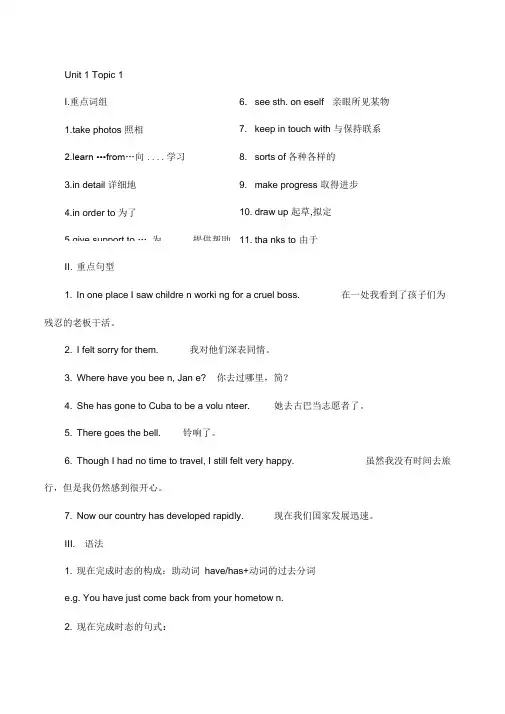
Unit 1 Topic 1
6. see sth. on eself 亲眼所见某物
7. keep in touch with 与 保持联系
8. sorts of 各种各样的
9. make progress 取得进步
10. draw up 起草,拟定
11. tha nks to 由于
II. 重点句型
1. In one place I saw childre n worki ng for a cruel boss. 在一处我看到了孩子们为
残忍的老板干活。
2. I felt sorry for them. 我对他们深表同情。
3. Where have you bee n, Jan e? 你去过哪里,简?
4. She has gone to Cuba to be a volu nteer. 她去古巴当志愿者了。
5. There goes the bell. 铃响了。
6. Though I had no time to travel, I still felt very happy. 虽然我没有时间去旅
行,但是我仍然感到很开心。
7. Now our country has developed rapidly. 现在我们国家发展迅速。
III. 语法
1. 现在完成时态的构成:助动词 have/has+动词的过去分词
e.g. You have just come back from your hometow n.
2. 现在完成时态的句式: I.重点词组
1.take photos 照相
2.learn •••from…向 .... 学习
3.in detail 详细地
4.in order to 为了
5.give support to … 为 ...... 提供帮助 e.g. (1) I have been to Mount Huang with my parents. (2) I haven ' t seen him for a long time.
最新推荐 仁爱版九年级英语上册unit1-2重要知识和语法归纳
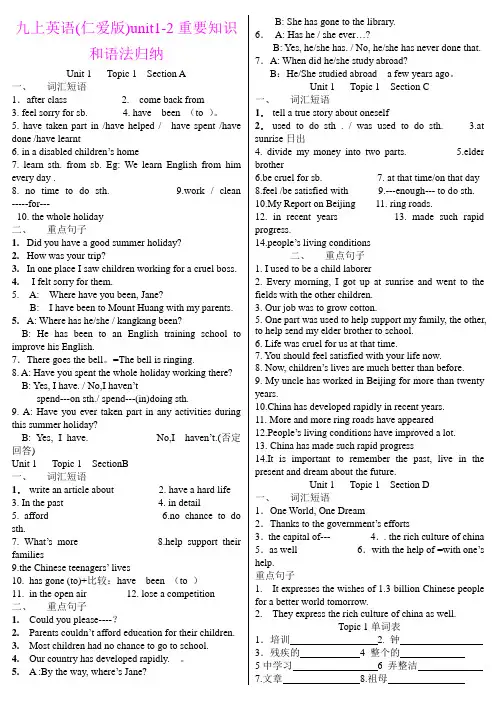
九上英语(仁爱版)unit1-2重要知识和语法归纳
Unit 1 Topic 1 Section A
一、 词汇短语
1.after class 2. come back from
3. feel sorry for sb. 4. have been (to )。
5. have taken part in /have helped / have spent /have
done /have learnt
6. in a disabled children’s home
7. learn sth. from sb. Eg: We learn English from him
every day .
8. no time to do sth. 9.work / clean
-----for---
10. the whole holiday
二、 重点句子
1. Did you have a good summer holiday?
2. How was your trip?
3. In one place I saw children working for a cruel boss.
4. I felt sorry for them.
5. A: Where have you been, Jane?
B: I have been to Mount Huang with my parents.
5. A: Where has he/she / kangkang been?
B: He has been to an English training school to
improve his English.
7.There goes the bell。=The bell is ringing.
8. A: Have you spent the whole holiday working there?
仁爱版九年级英语上册Unit 2 Topic 3知识点总结

1 Unit 2 Saving the Earth 知识点总结
Topic 3 What can we at home to protect the environment?
序 短语/句型 翻译 例句/用法
1 protect the environment 保护环境 动词性短语
2 environmental protection 环境的保护 名词性短语
3 ask sb about sth=ask sb sth 询问某人(关于)某事 ask sb for sth:问某人要某物
4 work for… 为…而效力/工作 work for an orgnization:为一个组织效力
5 main job 主要工作
6 spread the message 传播消息
7 reduce the waste 减少废物 reduce the waste we produce:减少我们所产生的废物。
we produce:是从句部分,做主句“waste”的定语,所以是“定语从句”,省略了连接词“that”。
8 both sides of paper 纸的两面 both:两者都,后跟名词复数
9 plastic bags 塑料袋
10 save money 省钱;存钱
11 encourage sb to do sth 鼓励某人做某事 We encourage students to collect waste paper and soft drink
cans. 我们鼓励学生们收集废纸和饮料罐。
12 sort sth 给某物分类 sort:【动】分类;【名】种类=kind
13 It’s a pleasure. 我的荣幸。 常用来回答“Thank you”的句子。
14 fail sth/fail in doing sth 做某事失败了
15 nod the head 点头
16 shake the head 摇头
最新仁爱九年级英语上册Unit 2 Topic 3 知识点归纳与练习
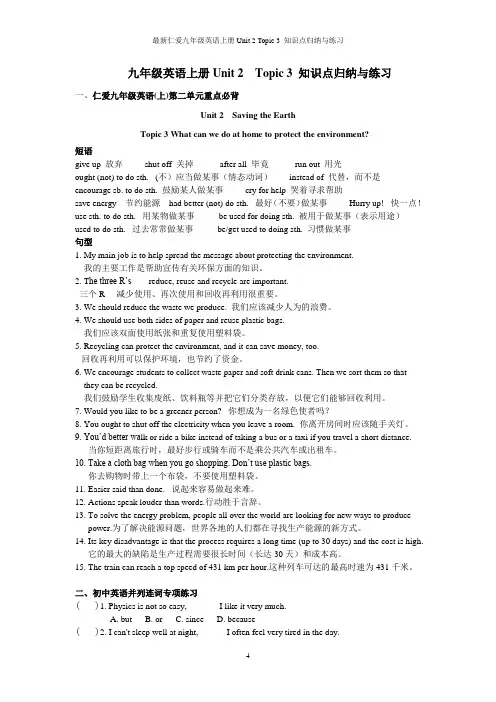
最新仁爱九年级英语上册Unit 2 Topic 3 知识点归纳与练习
4 九年级英语上册Unit 2 Topic 3 知识点归纳与练习
一、仁爱九年级英语(上)第二单元重点必背
Unit 2 Saving the Earth
Topic 3 What can we do at home to protect the environment?
短语
give up 放弃 shut off 关掉 after all 毕竟 run out 用光
ought (not) to do sth. (不)应当做某事(情态动词) instead of 代替,而不是
encourage sb. to do sth. 鼓励某人做某事 cry for help 哭着寻求帮助
save energy 节约能源 had better (not) do sth. 最好(不要)做某事 Hurry up! 快一点!
use sth. to do sth. 用某物做某事 be used for doing sth. 被用于做某事(表示用途)
used to do sth. 过去常常做某事 be/get used to doing sth. 习惯做某事
句型
1. My main job is to help spread the message about protecting the environment.
我的主要工作是帮助宣传有关环保方面的知识。
2. The three R’s------reduce, reuse and recycle are important.
三个R----减少使用、再次使用和回收再利用很重要。
3. We should reduce the waste we produce. 我们应该减少人为的浪费。
仁爱版英语九年级上册 Unit2 Topic2 SectionD 教学设计
整理文本
. Unit2 Topic2 SectionD 教学设计
Ⅰ. Material analysis
本课是第二单元第二话题的第四课时,是本话题的复习课,主活动是1a和Project。通过Grammar和Functions让学生归纳总结本话题的语法知识——不定代词和不定副词的用法,以及一些重要的表达。通过1a部分,培养学生寻找段落之间的逻辑关系,再利用逻辑关系完成排序任务。1b引导学生在阅读过程中注意“wh-questions”,提高阅读效率。2是通过小组讨论的方式,探究保护水资源和和节约用水的方法,为3的写作任务作铺垫。3是教会学生如何写倡议书,培养学生在写作中排篇布局,即先构建写作框架,再加上合理的观点。Project是通过让学生换位思考,充当不同的自然资源,描述各自的功能,现状和期望,来唤起大众保护环境的意识。本课所设置的“写倡议书”和“制作海报”都在培养学生“用英语做事情”的能力。
Ⅱ. Teaching aims
1.Knowledge aims:
掌握本课的重点词汇和短语,复习不定代词,不定副词和重点表达法。
了解淡水资源短缺的现状。
2.Skill aims:
培养学生通过wh-questions(如:what,why等),理解短文的意思。
能够读懂有关自然资源的文章。
能够利用已有框架,加上自己的观点,提高写作技能。
3.Emotional aims: (optional)
关注自然资源的现状,倡导学生保护环境,节约用水。 整理文本
. 4.Culture awareness:(optional)
通过对水资源现状的了解,认识到自然资源对人类的重要性,加入到保护环境、珍惜资源的队伍中。
Ⅲ. The key points and difficult points
1. Key points:
Words and phrases: avoid, discover, thirsty, nearly, law, shortage, resource, reuse,
仁爱版九年级英语上册Unit 2 Saving the Earth Topic 2 All thes

1 / 18 Unit 2 Saving the Earth 教案
Topic 2 All these problems are very serious
Section C
Ⅰ. Material analysis
本课是第二单元第二话题的第三课时,主活动是1a和3。通过阅读1a,进一步学习各种污染对地球造成的危害和造成这些污染的原因,培养学生通过图片预测文章大意的能力,其中出现了很多关于环境的专业术语,需要学生了解。1b是训练学生运用不同的阅读策略完成不同的任务,如:通过观察1a中的图片匹配相应的标题,再阅读文章,给每段话选择标题;另外,继续训练学生通过语境,找出单词指代的内容;最后在理解课文的前提下,归纳文章的大意。1c培养学生通过精读文章,学会用简单的词句做笔记,再通过1c表格中的内容简要复述文章大意。2是培养学生的资源策略。要求学生合理地运用网络资源查找与环境危害相关的信息,然后进行小组讨论,并要求学生做好笔记,为任务3做准备。3要求学生运用这些信息,在1c和2的基础之上进行写作练习,教师应强调衔接词在作文中的重要性。由于课堂上不方便完成2,因此,可将2和3安排为课后作业。通过读写的结合训练,引导学生关注全球环境的现状,意识到环境保护的重要性,树立正确的环保观念。
Ⅱ.Teaching aims
1.Knowledge aims:
2 / 18 掌握本课的重点词汇和短语,初步感知定语从句。
进一步学习各种污染对地球造成的危害和造成这些污染的原因。
2.Skill aims:
能读懂有关环境问题的文章。
能根据不同的阅读目的,运用简单的阅读策略获取信息。
能正确运用网络资源获取需要的信息。
能用英语书面的形式表达环境问题的成因及危害。
3.Emotional aims: (optional)
仁爱英语九年级上册语法精讲
仁爱英语九年级上册语法精讲
Unit 1-topic1
现在完成时(ǀ)
1.现在完成时的构成:助动词have/has+过去分词。它的肯定式、否定式、疑问式和答语的结构如下表(以work为例):
肯
定
式 I (You)have worked.
He (She/It) has worked.
We (You/They) have worked.
否
定
式 I (You) have not/haven’t worked.
He (She/It) has not/hasn’t worked.
We (You/They) have not/haven’t worked.
疑
问
式 Have I (you) worked?
Has he (she/it) worked?
Have we (you/they) worked?
简
单
回
答 Yes, you (I) have. / No, you (I) have not/haven’t.
Yes, he (she/it) has. / No, he (she/it) has not/hasn’t.
Yes, you (we/they) have. / No, you
(we/they)
have not/haven’t.
2. have (has) been to与have (has) gone to
have (has) been to +某地,说明到过某地,说话时已回来。
have (has) gone to +某地,说明去某地了,说话时还没回来。
e.g. He has been to Beijing three times. 他去过北京三次。
He hasgone to Wuhan. 他到武汉去了。
Unit 1-topic2 现在完成时(Ⅱ)
1.现在完成时的用法:表示过去某一时间发生的动作或存在的状态,对现在仍有影响。
仁爱版九年级上册unit 1 topic 2 课文重点
仁爱版九年级 Unit 1 topic2
Topic2 A部分
课文要点如下:ever,never,already,yet 用法
1、ever曾经 :用在疑问句和否定句中Have you ever been to Jilin University? 曾经去过吉林大学 吗?2、never:从不No,I have never been to Jilin University. 从没去过吉林大学3、already 已经: 用在肯定句But I have already been to Tsinghua University. 去过清华大学4、yet 已经,还,然而:用在疑问句和否定句中I haven't been to Peking University yet.还没去过北京大学I have never been to Peking University.从没去过1、popular流行的 ---unpopular---popularity流行度be popular with 受某些人的欢迎2、populate聚居---population---人口3、(1)购物中心-----shopping center(2)百货商场-----department store
(3)中心公园-----central park
(4)center中心-----central 中心的
(5)世纪公园-----Century Park
(6)天安门广场----Tian'anmen Square
(7)时代广场-----Times Square
(8)莫斯科红场------Red Square
第 1 页4、我以前从未去过那儿,但我再也不想去那儿了
I have never been there before,but I don't want to go there any more.
not...any more 不再...
not ..any longer 时间上不再继续 例:He couldn't wait any longer.
Unit2+Topic2单词、词组默写清单+仁爱版九年级英语上册
Unit2-Topic2单词、词组默写清单
英译汉
Unit2-Topic2 sand
Unit2-Topic2 sandstorm
Unit2-Topic2 change into
Unit2-Topic2 desert
Unit2-Topic2 human being
Unit2-Topic2 although
Unit2-Topic2 reduce
Unit2-Topic2 completely
Unit2-Topic2 user
Unit2-Topic2 none
Unit2-Topic2 rubbish
Unit2-Topic2 here and there
Unit2-Topic2 spit
Unit2-Topic2 wild
Unit2-Topic2 nobody
Unit2-Topic2 untidy
Unit2-Topic2 worst
Unit2-Topic2 rude
Unit2-Topic2 behavior
Unit2-Topic2 situation
Unit2-Topic2 punish
Unit2-Topic2 perhaps
Unit2-Topic2 everybody
Unit2-Topic2 nowhere
Unit2-Topic2 take away
Unit2-Topic2 oxygen Unit2-Topic2 hole
Unit2-Topic2 ozone layer
Unit2-Topic2 radiation
Unit2-Topic2 directly
Unit2-Topic2 carbon dioxide
Unit2-Topic2 form
Unit2-Topic2 blanket
Unit2-Topic2 escape
Unit2-Topic2 rise
Unit2-Topic2 the greenhouse effect
九上英语(仁爱版)unit1-2重要知识和语法归纳
亿库教育网
亿库教育网 Unit 1 Topic 1 Section A
一、 词汇短语
1. after class 2. come back from
3. feel sorry for sb. 4. have been (to )。
5. have taken part in /have helped / have spent /have done
/have learnt
6. in a disabled children’s home
7. learn sth. from sb. Eg: We learn English from him every day .
8. no time to do sth. 9.work / clean -----for---
10. the whole holiday
二、 重点句子
1. Did you have a good summer holiday?
2. How was your trip?
3. In one place I saw children working for a cruel boss.
4. I felt sorry for them.
5. A: Where have you been, Jane?
B: I have been to Mount Huang with my parents.
5. A: Where has he/she / kangkang been?
B: He has been to an English training school to improve his
English.
7.There goes the bell。=The bell is ringing.
8. A: Have you spent the whole holiday working there?