
高中英语选修6:Unit+2+Poems+reading+教案+
Unit 2 Poems
Reading
Teaching goals
a. Enable Ss to talk about different types of poems: nursery rhymes; list poems; cinquain, haiku; Tang poems
b. Enable Ss to talk about different purposes of writing poems.
c. Understand the main theme of each poem.
d. Enable Ss to distinguish different types of poems. Teaching important points
1.Talk about five main types of poems.
2.Understand the main purpose of writing the poems. Teaching difficult points
How to write a list poem.
Teaching methods
1.Skimming and scanning.
2.Asking-and –answering activity
3.Discussion
4.writing
Teaching aids
Multimedia
Teaching procedures
Step 1. Greetings
Step 2. Lead-in
Do you like listening songs? I am sure that you like listening songs
very much and you like many popular singers. For example, Zhou Jielun, Wang Fei and so on. So at first, I will share a song with you. Show the song “little star” and ask the students to follow if they can sing.
Brainstorming: can you predict some characteristics from the colorful words. (star, are; high, sky; gone, on; light, night.)
Tell the students that this is a song and a poem as well. So the colorful words show the rhyme of a poem.
Step 3.Warming up
Let the Ss enjoy the English form of some pieces of famous Chinese poems and try to translate them into Chinese. Try to experience the difference between the English forms and the Chinese ones.
Step 4.Reading
1.fast reading
Analyze the structure of the passage and divide the passage into two parts, one part is the poems, another part is the introduction of the poems.
(1)Let the Ss read just the introduction and try to answer
the question: How many kinds of the poems mentioned in the passage?
(2)Read the introduction again and try to match the
characteristics to the certain kind of the poem.
2.Skimming
Skim from Poem A to Poem H and finish the flowing chart
3. Careful reading:
Read some of the pomes and answer the following questions
Look through poem A and choose the best answer:
1.What’s the baby’s father going to buy if the mirror gets
broken?
A. a mocking bird
B. a diamond ring
C. a looking glass
D. a billy-goat
2. What is Papa going to buy for the baby if that billy-goat
runs away?
A. a looking glass
B. today
C. another billy-goat
D. nothing
Look through poem C and answer the following questions
1. What sports do you think the speaker is writing about?
2. Did his team win the game?
3. How many excuses did they make to explain why they didn’
t win?
Read poem H and try to choose a best title
A.蝶恋花
B.竹枝词
C.望夫石
D.一剪梅
Which of the following words can convey the woman’s
feelings
A. loneliness
B. joy
C. love
D. trust
E. anger
F. hate
G. sorrow
Step 5. practicing
Learn to write a list poem.
(1.)Analyze the characteristics of the list poem: List poems have a flexible line length and repeated phrases which give both
a pattern and a rhythm to the poem. It is a poem that list things.
(2.) Read poem B and poem C and try to experience the characteristics of the list poems.
(3.) pair-work: give the title: “Friendship is …” and let the Ss discuss in group of four and try to write down some sentences. Divide the students into 4 groups and set a group leader for each group. And ask the group leader to collect the sentences of the poems.
(4.) at last, ask the students to write down the poem of each group
(5.) enjoy the works of the students together.
Step 6. Homework
1. Surf some websites to find out more beautiful poems.
2. write a list poem.。
人教版高中英语选修六:Unit+2+Poems+reading+教案.doc
Unit 2 PoemsReadingTeaching goalsa. Enable Ss to talk about different types of poems: nursery rhymes; list poems; cinquain, haiku; Tang poemsb. Enable Ss to talk about different purposes of writing poems.c. Understand the main theme of each poem.d. Enable Ss to distinguish different types of poems. Teaching important points1.Talk about five main types of poems.2.Understand the main purpose of writing the poems. Teaching difficult pointsHow to write a list poem.Teaching methods1.Skimming and scanning.2.Asking-and –answering activity3.Discussion4.writingTeaching aidsMultimediaTeaching proceduresStep 1. GreetingsStep 2. Lead-inDo you like listening songs? I am sure that you like listening songsvery much and you like many popular singers. For example, Zhou Jielun, Wang Fei and so on. So at first, I will share a song with you. Show the song “little star” and ask the students to follow if they can sing.Brainstorming: can you predict some characteristics from the colorful words. (star, are; high, sky; gone, on; light, night.)Tell the students that this is a song and a poem as well. So the colorful words show the rhyme of a poem.Step 3.Warming upLet the Ss enjoy the English form of some pieces of famous Chinese poems and try to translate them into Chinese. Try to experience the difference between the English forms and the Chinese ones.Step 4.Reading1.fast readingAnalyze the structure of the passage and divide the passage into two parts, one part is the poems, another part is the introduction of the poems.(1)Let the Ss read just the introduction and try to answerthe question: How many kinds of the poems mentioned in the passage?(2)Read the introduction again and try to match thecharacteristics to the certain kind of the poem.2.SkimmingSkim from Poem A to Poem H and finish the flowing chart3. Careful reading:Read some of the pomes and answer the following questionsLook through poem A and choose the best answer:1.What’s the baby’s father going to buy if the mirror getsbroken?A. a mocking birdB. a diamond ringC. a looking glassD. a billy-goat2. What is Papa going to buy for the baby if that billy-goatruns away?A. a looking glassB. todayC. another billy-goatD. nothingLook through poem C and answer the following questions1. What sports do you think the speaker is writing about?2. Did his team win the game?3. How many excuses did they make to explain why they didn’t win?Read poem H and try to choose a best titleA.蝶恋花B.竹枝词C.望夫石D.一剪梅Which of the following words can convey the woman’sfeelingsA. lonelinessB. joyC. loveD. trustE. angerF. hateG. sorrowStep 5. practicingLearn to write a list poem.(1.)Analyze the characteristics of the list poem: List poems have a flexible line length and repeated phrases which give botha pattern and a rhythm to the poem. It is a poem that list things.(2.) Read poem B and poem C and try to experience the characteristics of the list poems.(3.) pair-work: give the title: “Friendship is …” and let the Ss discuss in group of four and try to write down some sentences. Divide the students into 4 groups and set a group leader for each group. And ask the group leader to collect the sentences of the poems.(4.) at last, ask the students to write down the poem of each group(5.) enjoy the works of the students together.Step 6. Homework1. Surf some websites to find out more beautiful poems.2. write a list poem.精美句子1、善思则能“从无字句处读书”。
Unit 2 Poems教学设计(英语人教高中选修6)
Unit 2 Poems1. 教材分析本单元以Poems为话题,从学生初次接触诗歌,一直谈到诗歌创作的动机、有关诗歌的一些基本知识(包括诗歌的种类、风格)等。
旨在通过本单元的学习,使学生在初步了解和掌握诗歌这一文学形式的基本常识的基础上,进行简单的诗歌创作。
1.1 Warming Up部分要求学生回顾所学诗歌,启发学生以小组活动形式分析、列举人们进行诗歌创作的原因。
1.2 Pre-reading 部分首先要求学生说出自己最喜欢的中英文诗歌并阐明理由;然后通过快速阅读Reading部分内容填写列表,区分诗歌种类。
1.3 Reading部分是一篇介绍诗歌基础知识的文章。
文章从诗歌创作的动机、种类、特点及读者对象等方面简要介绍了五种不同风格、特色的诗歌。
1.4 Comprehending 部分根据阅读内容设置了三个习题。
第一个习题要求学生通过读文章、听录音感受诗歌特色,判断自己所喜欢的诗歌类型并说出理由;第二个习题就文章总体内容提出了五个问题,帮助学生进一步了解不同类型诗歌的不同特点;第三个习题通过十一个具体问题考查学生对文中某些细节内容的理解并要求分析诗歌创作者的情感、态度。
1.5 Learning about Language分words and expressions和structures两部分。
第一部分设置了两个练习:第1个练习要求从所学诗歌中找出与所给词汇压韵的词并添加其它韵词;第2个练习要求用所给词汇的正确形式填空。
第二部分通过四个小练习对所学诗歌中出现的两种结构形式进行训练。
1.6 Using Language共设置了三个任务:第一项任务通过一首小诗展开听力、口语、阅读训练,加深学生对诗歌韵律知识的理解;第二项任务通过Miss Jiang与学生谈论诗歌竞赛的一段录音学习,练习“意愿(intentions)”的表达。
第三项任务要求学生运用所学诗歌知识,根据所给提示进行模仿习作训练。
1.7 SUMMING UP部分对本单元所学知识进行归纳、总结、评估。
人教版高中英语选修六:Unit+2+Poems+教案5.doc
Unit 2 Poems教学目标【语言知识】学生能从韵律和形式上感知英文诗歌的美。
【语言技能】学生能写出基本押韵,有意象美,主题鲜明,富有正能量的英文诗歌。
【情感态度】学生能培养对英文诗歌的基本审美能力,学会英文思维。
学情分析(1)学生已经学完本单元,能够熟练说出课本介绍的五种英诗形式,并能进行一定的模仿创作。
(2)高二学生阅读兴趣广泛,课堂上通过老师的介绍和推荐,会主动收集摘抄一些通俗易懂的英文诗歌。
(3)学生再创造语言的能力有限,必须设置有效的情景,给与一定的提示性语言,以期达到课堂生成的目的。
重点难点教学重点:学生能从韵律和形式上感知英文诗歌的美。
教学难点:学生能写出基本押韵,有意象美,主题鲜明,富有正能量的英文诗歌。
4教学过程(一)自主学习1集体朗读高考中曾出现过的诗歌My Teacher Mr. MooreThere's a teacher Mr. Moore,Who is lovely and thirty-four.Always encouraging us to try,He leads us to a world of "why”.We all love him more and more.2快速浏览导学案附页中的学生习作,挑选出你最喜欢的一首诗,并进行朗读。
(学生习作在附两首)To Ms. English----by项阳 from Class3, Senior2You are a woman who is beautifulWhichever lesson is meaningfulWhatever you say is helpfulEach class is wonderfulSo my life is colourfulInside my heart is gratefulAnd my future is sure to be successfulTo All Teachers ----by 王欣 from Class3 Senior2You say that this class won’t be delayed(拖堂)But we have a shorter time for the breakYou say that your today’s homework is littleBut we have to stay up very lateThis is why I am scaredWhen you say the coming exam is simple【设计目的】:学生课前以描写科任教师或学校生活为主题,进行了练笔,习作中出现了一批形式规范的诗歌,同时也有几首形式灵活的诗歌,挑选出一些呈现在导学案上,让学生进行对比学习,快速带领学生进入诗歌世界,很好地激起了学生的学习热情。
人教版高中英语Book 6 Unit 2 Poems reading 教学设计

教学设计1.教学内容分析本课作为人教版英语选修六Unit2的课前导入,旨在通过中文诗歌和英文歌曲的引入引起学生对于英语诗歌的兴趣,同时提出中英文诗歌中押韵的运用手法,帮助培养学生对英语诗歌的初步欣赏能力和简单的英文诗歌形式(五行诗)的创作能力,激起学生对英文诗歌的创作热情,拓宽学生的词汇和视野,培养学生的合作能力和表现能力。
2.教学目标知识目标:a.引导学生寻找诗歌韵脚,并探索押韵在英文诗歌中的作用b.英文诗歌的欣赏c.五行诗的特点和创作能力目标:a.培养学生对于英文诗歌的朗读、理解和欣赏能力b.培养学生对于五行诗的理解和创作能力c.培养学生的小组合作能力情感目标:a.培养学生利用想象力和灵感进行创作的能力b.鼓励学生善于欣赏诗歌、善于用诗歌表达自我,热爱生活和自然c.让学生发扬团结合作、积极向上的精神3.学情分析高二学生对于中文诗歌已有较为成熟的理解能力,故从中文诗歌着手引入英文诗歌没有很大难度。
高二学生对于词汇量已有一定积累,故对于简单的五行诗的创作难度不大,且该班学生思维活跃,活泼好动,利用图片和音乐吸引其兴趣,引起其思考和开放性的创作是适合该班学生的教学手段。
4.教学重难点a.了解英文诗歌中的押韵及押韵的作用b.欣赏莎士比亚的sonnet 18c.学习五行诗的特点,以及创作五行诗5.教学过程Step1: GreetingsStep2: Lead-in 通过询问学生是否喜欢秋天,让学生思考如果他们是诗人,该如何用诗歌来形容秋天。
因为英文诗歌对于学生尚有难度,故从中文诗着手,让学生猜测诗歌所描述的季节。
然后,通过中文诗的押韵,引起学生对于诗歌中押韵作用的思考。
Step3:英文歌曲欣赏,引出英文歌词中的押韵是为了更容易的唱出歌曲。
让学生找出押韵的地方,对英文韵脚有更进一步的了解。
Step4:莎士比亚诗歌欣赏。
通过之前对于中文诗和英文歌曲的押韵的了解,进入到英文诗歌的押韵手段,引出押韵是为了能让诗歌更容易朗读和背诵,且增添了诗歌的美感。
高中英语教学设计选修六unit2poems
高二学生已经对中国诗歌比较熟悉,那么从我国诗歌入手不仅可以让学生复习诗歌的相关知识为下一步英语诗歌的学习奠定基础,而且激发学生的学习兴趣和课堂主动参与性。
高二学生在经过高一学期学习策略的训练和培养后,基本掌握了略读、查读、归纳大意等阅读技巧,具有一定的阅读能力。但仍有一部分学生基础薄弱,学习积极性较差,那么在教学活动设计中注意层次性、激励性,注重以小组的形式鼓励学生参与到课堂活动中,培养关爱同学和集体主义精神。
参赛教学设计基本信息
作者姓名
董富华
性别
女
邮政编码
045200
通讯地址
山西省阳泉市第十四中学
所用教科书
书名
普通高中课程标准实验教科书英语
所教年级
高二
所教册次、
单元
高中英语选修六第二单元
设计主题
Unit2 Poems Reading
A Few Simple Forms of English Poems
1.整体设计思路、指导依据说明
3) Present some English poems and encourage the students to think aboutthe characteristicsof poems.
4)How to speak 诗歌、诗人、诗歌(总称)、韵, 压韵、节奏 in English.
从熟悉的中文诗歌入手容易激发学生学习兴趣,激活他们的思维;从英文转译到中文诗歌为下文的学习埋下伏笔,接着呈现英文诗歌引导学生中英对比,自主归纳诗歌的特点,顺势学习诗歌知识的英文表达方式,扩大词汇量,减轻阅读中的困难,增强信心。
5.教学过程设计
(中文为主 + 所教学科目标语言)
Step 1Warming up
人教新课标高二英语 选修六 Unit 2 Poems reading 教案设计
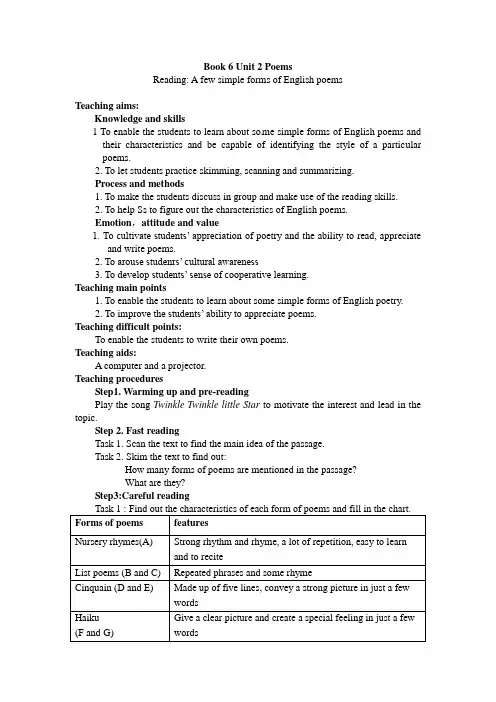
Book 6 Unit 2 PoemsReading: A few simple forms of English poemsTeaching aims:Knowledge and skills1 To enable the students to learn about so me simple forms of English poems andtheir characteristics and be capable of identifying the style of a particular poems.2. To let students practice skimming, scanning and summarizing.Process and methods1. To make the students discuss in group and make use of the reading skills.2. To help Ss to figure out the characteristics of English poems.Emotion,attitude and value1. To cultivate students’ appreciat ion of poetry and the ability to read, appreciateand write poems.2. To arouse studenrs’ cultural awareness3. To develop students’ sense of cooperative learning.Teaching main points1. To enable the students to learn about some simple forms of English poetry.2. To improv e the students’ ability to appreciate poems.Teaching difficult points:To enable the students to write their own poems.Teaching aids:A computer and a projector.Teaching proceduresStep1. Warming up and pre-readingPlay the song Twinkle Twinkle little Star to motivate the interest and lead in the topic.Step 2. Fast readingTask 1. Scan the text to find the main idea of the passage.Task 2. Skim the text to find out:How many forms of poems are mentioned in the passage?What are they?Step3:Careful readingForms of poems featuresNursery rhymes(A) Strong rhythm and rhyme, a lot of repetition, easy to learnand to reciteList poems (B and C) Repeated phrases and some rhymeCinquain (D and E) Made up of five lines, convey a strong picture in just a fewwordsHaiku (F and G) Give a clear picture and create a special feeling in just a few wordsTask 2 Read the five kinds of poems aloud and appreciate them.Step 4Post readingShow some poems to the students and let them guess which form of poem each poem belongs to.Step 5Writing1 .Let students read Poems E and D again and write their own cinquains.2.Get some students to read their poems aloud.Step 6Homework1. Surf some websites to find out more beautiful poems.2. Write a list poem.Blackboard desig nBook 6 Unit 2 Poems Reading:A few simple forms of English poems。
高中英语选修六:Unit2+Poems+教案4
Unit 2 Poems教学目标1)知识和技能目标:让学生了解和掌握虚拟语气的基本语法规则,并能在具体的语言环境中灵活运用,解决相关高考试题,在日常交际中能够正确灵活的使用。
2)过程和方法:通过教师讲解和学生探究相结合;通过语法练习和语言实践活动相结合;通过任务型教学和情景式教学相结合,让学生构建语法功能知识,应用于实践中去发现和解决问题。
3)情感、态度和价值观目标:培养学生自主学习能力,增强学生合作意识,提高学生语言分析能力和自己对事物的正确认识,形成正确的人生观、价值观。
学情分析学生们在经过必修1-5的学习和累积中已经形成了基本的语法框架,这为学习虚拟语气中的非真实条件句打下了基础。
通过学生们对第二单元诗歌的阅读已经让他们对虚拟语气的使用情景有了一些了解,但是他们没有准确地掌握和熟练的运用。
希望本节课可以帮助他们突破汉语式的思维模式让其掌握虚拟语气中非真实条件句的基本用法。
重点难点教学重点:掌握虚拟语气非真实条件句的规则和基本原则。
教学难点:能够运用此语法项目去完成各种相关表达,并能在实际语言活动中灵活运用。
4教学过程【导入】导入Step1. Leading in the grammarStep One: Lead in. Let’s enjoy a song by Celine Dion——If I could. After listening to the song, ask students what the singer wanted to express.(Mother expressed love to her baby)Lead in: What mood did the singer use in this song?(Subjunctive mood)【活动】设置情景,发现规律Step Two: Approaching and presenting the grammarSupposing three different conditions of past, present and future, make some sentences1. Now we are having an English class, I find some of you are whispering secretly. If you paid attention to your studying, you would make great progress.2. Yesterday we had an English test. If you had been more careful, you would have got a high mark.3.The next day we will have a day off and go to climb the mountain. If I were to buy a pair of sport shoes, I could feel more comfortable while climbing.(通过设置情景,呈现不同时间的条件虚拟句,让学生注意发现语法规则,总结出与不同时间事实相反的虚拟条件句式特点。
高中英语人教版选修6unit2PoemsReading教案(系列三)
Unit 2 Poem (诗歌)Text-understandting (课文理解)Teching aims( 教学目标)1.Know a few simple forms of English poems.2.Learn the charactristics of English poems.Teaching steps as follows:Step 1 Leading-in (课文导入)Listen to a nursey rhyme in the break and then ask students to answer some questions. (课间童谣导入课题)(This step is to arouse students’ interest in learning about poems.)Boys and girls,at the break of the class,we have listened to a very interesting song-Twinkle,twinkle little star.Step 2. Warming up(热身)(This step is intended to excite students to learn about poems)I ofter the questions as follows toexcite students1.Do you like the song ?2.Now,do you want to listen to it again?3.Can you sing the song?4.Can you tell me what kind of poem is it?Is it a nursery rhyme or a haiku? Do you want to know more about English poems?Step 3. Fast reading (快速阅读)(This step is to teach students to get the general idea of the passage )1.Why do people write poems ?(This step is to train students’ listan ability .Explain to them that they should pay specisl attention to the key information)Five kinds of poems areand .Step5. Careful reading (细节阅读)(This step is to deal with prombles in detail )Task1.Answer the questions according to each poem1.Poem A1). What is the baby’s father going to buy if the mirror gets broken?2)What is the baby’s father going to do if goat runs away?2.Poem C1. )What sport do you think the speaker is writing about?2)Why didn’t the players win? Write down three excuses that the speaker gives3)Translate the following sentence into Chinesseif we hadn’t taken it easy,if we hadn’t run out of energy,we would have won3.Poem D,E1.) What subject is the speaker writing about?Poem D:PoemE: 2.) 2.) Does the speaker like the subject?Give a reason for your answerPoem D: Yes. Although the speaker describes a couple of negative aspects of his/ her brother, the reader can feel the affection that the speaker feels for his/ her brotherPoem E: No. The reader gets the feeling that the speaker can’t wait until the summer is over. The words drooping, dreading, week in week out and endless convey this feeling.4.Poem H1)What is the story that the poem tells? Tell the story in your own wordsA woman’s husband has gone away. The woman waits for him by the river where she last saw him. she waits and waits never moving form that spot and never speaking, while the river continues to flow and the wind and rain come and go.2)The woman may have the feelings of :loneliness: she was alone watching her husband on the mountain top.love:she waited year after year despite wind and rain.trust:she believed her husband would come back one day.sorrow: year after year, she waited and waited without seeing any hope of her husband’s coming back, she was very sad.Step 6 .Outline(提纲)(This step is to help students know the passage much more clearly)Outline: (课文行文顺序)1 the purpose of writing poems2.nursery rhyme3 list poems4 the cinquain5. the haiku6.Tang poemsStep 7. Consolidation(After the above reading, students can understand the text very well,so I arrange this step to consolidate what they have learned)Poems are used to tell a story or ________ certain emotions. Poets use many different ____________ of poems to ________________ themselves. For example, nursery rhymes _____________ small children because they have strong __________ and _______________and have a lot of _____________ , while, list poems is the _____________ kind of poems. Another simple form is the Cinquain ,____________ poem ________________ 5 lines. Haiku is a ______________ form of poetry that consists of 17___________________. In ________________,a lot of Tang poetry has also been ________________________ into English. Step 8.Discussion and performance(This step is helpful to strengthen the cooperation among students and use what they have learned. )1.Are poems good for our life?2 What can we get from poems?Poems bring passion (激情)to our lifePoems help us to understand life, virtues, beauty and romance.Poems make us know we are here and that we can make our life and the world more colorful and beautiful!Step 9.Summary and Homework (小结及作业)1.Summary:In this period,we have learned much about English poems.Only if you have a good knowledge of poems can you understand English literature and culture.2.Homework:Write a composition according to the following poem阅读下面这首由英国诗人爱默生写的英语诗,然后用英语写一篇评价这首诗的短文: A Nation’s Strength 《民族的力量》Not gold,but only man can makeA people great and strong; 不是黄金,只有人才能使民族伟大而强盛;Men who for truth and honor’s sake为了真理,为了荣誉,Stand fast and suffer long. 他们意志坚定,历尽艰辛Brave men who work while others sleep,他们无所畏惧,别人睡觉他们做工Who dare while others fly;别人逃遁他们大显神勇;They build a nation’s pillar deep他们深深地埋下民族的支柱,And lift them to the sky.并将石柱举起支撑天空。
人教版高中英语选修6《Unit2Poems》教案
人教版高中英语选修6《Unit2Poems》教案人教版高中英语选修6《Unit 2 Poems》教案【一】教学准备教学目标教学目标(Teaching Aims)知识与技能(Knowledge and Skills)1. 了解教学大纲关于语法填空的命题特点。
2. 能够根据语法填空的命题特点自己编语法填空的题目3. 掌握语法填空的解题方法与技巧过程与方法(Process and Methods) 让每一位同学都能参与到课堂教学与活动中来,以小组或结对的形式进行相互学习和讨论。
情感态度与价值观(Feeling, Attitudes and Values) 学习应对语法填空是与课文相结合,让学生在了解各种不同诗歌形式的背景下学习语法填空的设题与解题特点,从而更加理解英语诗歌的特色,更加懂得如何阅读和欣赏英语诗歌。
教学重难点教学重点(Important Points) :1. 让学生了解语法填空的命题特点2. 掌握语法填空的解题方法与技巧教学难点(Difficult Points):语法填空中词性的转换教学过程(Teachers’ Activities)Step I: Lead-in① Review the new words and expressions of this unit by them together, and then do Task 1---speak out the other forms according to the giv en words② Listen to the song Jingle Bells and try to fill a word intoeach blank.Step II : Pre-practising1. Questions① Do you think it is difficult to complete the items of blank-filling with grammar knowledge?② Have you figured out the characteristics of the i tem?2. ExplainingIn this item there are 10 blanks for you to fill in with less than one proper word① some blanks with a given word while others with none② fill in the blanks with the proper form of the given word according to its grammatical and logical meaning.③ choose a preposition, pronoun, conjunction or an article to fill in the blank without any given word.3. DiscussionHow can we finish the items step by step with our grammar knowledge?① ___________________________________________.② _ __________________________________________.③ ___________________________________________.Step III : While-practising1. Making an item of grammatical blank-filling based on the para graph of the text.① more than 5 blanks.② some blanks with given word.③ other s with none.2. exchange the item you made for your partner to complete it .3. The whole class finis h the one the teacher prepared for them.Step IV : Post-practising1.Check some of the students’ anwsers and give comments.2.Draw a conclusionStep V: Homework Assign ment1. Further improve your skills of dealing with the grammar filling.plete Ex.2 on Page 10, Nanfang New Class人教版高中英语选修6《Unit 2 Poems》教案【二】教学准备教学目标Teaching goals1. Target languagea. Important words and phrasesPoem, poetry, recite, aspect, convey, nursery, rhyme, diamond, cottage, balloon, sparrow, tease, salty, endless, translate, nursery rhyme, take it easy, run out of, make up ofb. Important sentencesWhich poem is about things that don’t make sense?Poets use many different forms of poems to express themselves.I hadn’t taken my eye off the ball.We hadn’t taken it easy.The poem is made up of five lines.A lot of Tang poetry has been translated into English. The translations have a free form that English people like to copy.2. Ability goalsa. Enable Ss to talk about different types of poems: nursery rhymes; list poems; cinquain,; haiku; T ang poemsb. Enable Ss to talk about different purposes of writing poems.c. Understand the main theme of each poem.d. Enable Ss to chant some of their favorite poems.3. Learning abilityEnable Ss to distinguish different types of poems教学重难点Teaching important points1. Talk about five main types of poems.2. Understand the main purpose of writing the poems.Teaching difficult points1. Find the rhythm of each poem.2. Chant the poem.3. Understand the main purpose of writing the poems.教学过程Teaching procedures & waysStep 1. GreetingsStep 2. PresentationAsk Ss to think back and try to remember poems from their early childhood, either in Chinese or in English.Talk about some famous poets both home and abroad, either ancient ones or modern ones.Brainstorming: What will you think of when we talk about the word “poem”?Step 3. Warming upRead the questions in this part, reminding Ss what they notice about the above poems.(e.g. they have a strong beat, or they have rhyme, or they play with words and sounds, or perhaps some of them are funny because they make no sense.) Tell Ss that there are many reasons why people write poetry. Give the examples on the Bb. Ask Ss why they think the poets wrote the poems they have just recited.. Write their suggestionson the board.Give Ss a time limit of a few minutes. Divide the class into groups of four to discuss the purpose of writing poems. Ask one p erson from each group to read their group’s list and add their suggestions to the list on the board. (Suggested reasons: to create certain feelings or images in the reader; to share a feeling or experience; to describe something in detail or give an impression; to get the reader to think about an idea; to express a point of view; to make the reader experience the sight, sounds, smells, feel and tastes of something; to create a mood, to play with words--- their sounds, rhyme and rhythm.)If time permits, in small groups or as a class, discuss the kinds of topics that poets write about.( people, animals, nature, landscapes, the sea, the seasons, stories, death, war, youth and old age, feeling and experiences, emotions like love, hate, sadness, regret and desire, etc.)Step 4. Pre-readingPeople from different countries write different kinds of poems. Get Ss to discuss the questions on Page 9 with their partners: Do you have a favorite poem in Chinese? Why ? Do you have a favorite poem in English? Why?As to exercise 2, give Ss practice in an important reading skill: scanning a text, that is, looking through a text quickly to find specific information. Read the table in exercise 2 with the Ss. Tell them that they are going to look for the information in the table, just in the poems themselves, not in the other parts of the text. They are to look only for those pieces of information and not read every word. Do an example with them.Suggested answers to exercise 2:Step 5. ReadingScanningGet the Ss to read the passage quickly and accurately and meanwhile help the Ss to form a good habit of reading. Teacher gives Ss a couple of minutes to look through the whole passage. Tell them to read the text silently and then ask some detailed questions about the text on the slide show . Teacher should encourage Ss to express their ideas.Q1. Why do people write poetry?Q2. How many forms of poems are mentioned in the passage? What are they?Q3. What does “nursery rhyme” mean? Why do they delight small children?Q4. What’s the characteristic of “list poems”? What about “cinquain”?Q5. Why do English People like “Haiku”?Q6. Are you familiar with Tang Poems? Do you know the title of the last poem in the text?ListeningBefore Ss read the text, have them close their books and listen to the text with their eyes closed. This gives Ss the opportunity to listen to the sounds or “music” of the poems before reading them in detail. Tell them that it doesn’t matter if they don’t understand every word.First readingGet Ss to read the text carefully, finding the one sentence that sums up the paragraph of each part.. Underline the topic sentence.Second readingTell Ss that they are going to look at the rhythm of two of the poems. Make sure they know what rhythm is. Read the limerickaloud and have Ss listen for the strong beats. Then have them clap the strong beats as you read. Mark the strong beats on the limerick on the board.There was an old man with a beardWho said “it is just as I feared”.“Four insects and the nTwo birds and a henHave all made a home in my beard”.Now read the poem A & B. Ask them to mark the strong beats on the two poems that have a strong rhythm. Check their answers . Then play the tape and get them to clap to the strong beats in those two poems.Third readingJust as any scene can serve as the subject of a painting, so any part of daily life can provide material for a poem.. Of course, the choice that the artist or poet makes relates to his or her purpose. Poetry is usually short and compact, so it should be read several times, preferably aloud, to appreciate its meaning. Read the last poem (Poem H), and answer the following questions: Q1. What parts of the poem suggest that the woman loves her husband?Q2. How do you understand the sentence”Should the journeyer return, this stone would utter speech.”? Explain the sentence in your own words.Q3. What picture do you have in your mind when you read the above sentences?Q4. Do you know the Chinese title of this poem? Do you know the Chinese version of the poem?Step 6. Make a short summary of this period.课后习题Homework1. Surf some websites to find out more information about poets.2. Review the content of the reading passage.3. Finish the exercises on Page 12& 13.。
高中英语(人教版)选修六Unit2PoemsReading教案word版
Teaching material: NSEFC Book 6 —— Unit 2PoemsReadingTeaching AimsTo cultivate students’ interest of poetry and improve their reading skills.Teaching Important & Difficult PointsHow to help the students to grasp and remember the detailed information of the reading material.Teaching aids:a tape recorder, a projector, Slides and PicturesTeaching ProcedureStep 1 Warming up1. Which poems and poets can you think of when seeing the following pictures?静夜思李白床前明月光,疑是地上霜。
举头望明月,低头思故乡。
古风其二李绅锄禾日当午,汗滴和下土。
谁知盘中餐,粒粒皆辛苦。
望夫石王健望夫处,江悠悠。
化为石,不回头。
山头日日风复雨,行人归来石应语。
2. Match the following information.Li Bai Song DynastyDu Fu Tang DynastyFan Zhongyan Tang DynastyMeng Haoran ModernGuo Moruo ModernMao Zedong Tang DynastyByron AmericaShelly EnglandEmerson EnglandTagore GermanyGoethe IndiaStep 2 BrainstormingDiscuss the reasons why people write poems.Fast readingScan the passage and answer the following questions.1. What is the main topic of the reading passage?2. What five kinds of poems does the reading passage talk about? different forms of English poemsnursery rhymes, list poems, cinquain, haiku, Tang poems.Step 3 Careful readingT: Now let’s read the following five poems and finish tasks.Slide showListen to Poem A and pay attention to its rhyming lines and words. Hush, little baby, don’t say a w ord,Papa’s going to b uy you a mockingb ird.If that mockingbird won’t s ing,Papa’s going to buy you a diamond r ing.If that diamond ring turns to br ass,Papa’s going to buy you a looking gl ass.If that looking-glass gets br o ke,Papa’s going to buy you a billy-g oa t.If that billy-goat runs aw ay,Papa is going to buy you another d ay.Read the poem by yourself again and answer the following questions.1. What’ s the baby’s father going to buy if the looking-glass gets broken?2. What is Papa going to buy for the baby if that billy-goat runs away?3. What are the features of it?Keys:1. a billy -goat2. another billy-goat3. It has strong rhythm and rhyme and has a lot of repetition.Poem COur first football matchWe would have won…If Jack had just scored that goal,If we’d had just a few more minutes,If we had trained harder,If Ben had passed the ball to Joe,If we’d had thousands of fans screaming,If I hadn’t taken my eye off the ball,If we hadn’t stayed up so late the night before,If we hadn’t taken it easy,If we hadn’t run out of energy,We would have won…If we’ve been better!Questions1. Did his or her team win the game?2. Why his or her team didn’t win the game?3. Does the speaker really believe his or her own excuse? How do you know? Keys:1. No, his or her team didn’t win.2. The players didn’t win because: Jack didn’t score that goal; they didn’t have enough time; they hadn’t trained hard….3. The speaker doesn’t really believe his or her own excuses, because there has too many ifs…Poem D&E1. What subject is the speaker writing about?2. Does the speaker like the subject? Give a reason for your answer.T: We have enjoyed so many English poems. Some are traditional forms of English poetry but some are not, for example haiku. (It comes from Japanese).In fact English speaker also have borrowed from another kind of Asian poetry---Tang poems from China.Poem H at the bottom of this passage is a translation from the Chinese.Poem HWhere she awaits her husband,On and on the river flowsNever looking back,Transformed into stone.Day by day upon the mountain top,wind and rain revolve.Should the journey return,this stone would utter speech.(By Wang Jian)望夫石王健望夫处,江悠悠。