
牛津英语七下_Unit_2_Study_skills
B: Listen carefully to these words. Then practise saying them.
1. 2. 3. 4. 5. 6.
there is here are far away four of us no other two orange
C: Listen carefully to these words. Then practise saying them.
We often link sounds together when we speak English. There are four different ways of linking sounds together.
1. We usually link a consonant sound with a vowel sound.
Unit 2 Neighbours
Study skills
连读
连读,是指在发音时,常将词与词之间交界的 有两个音连在一起。连读是英语语调中比较重要 的一个组成要素。它有助于完整意义的表达,并 使整句话具有强烈的粘着感,体现句子的整体性 和英语的自然流畅。 连读现象只出现在意群内部,也就是说相邻的两 词在意义上必须密切相关。意群与意群之间的两 个相邻单词是不连读的。连读所构成的音节一般 都不重读,只需顺其自然地一带而过即可。
an apple stand up in an hour
2. When the first word ends in –r or –re and the next word begins with a vowel sound, we join them together with a /r/ sound between them.
A: Listen carefully. See how you can link the following words together. Then practise saying then.
1. 2. 3. 4. 5. 6. cold ice big orange an egg an umbrella turn on get up
More practice
• • • • • • • • He is an English boy. Let me have a look at it. Not at all. There is a football under it. Nice to meet you. Would you like a cup of tea? We are going to work on a farm next Tuesday. It is a very cold day, but it is a good day.
1. 2. 3. 4. 5. 6. high up the area three exercise go in no other two orange
D: Listen ຫໍສະໝຸດ arefully to these words. Then practise saying them.
1. 2. 3. 4. 5. 6. next team cold drink keep busy white cat best doctor hard time
there are for us here is
3.When there are two vowel sounds, we join them as if there were a /j/ or /w/ sound between them.
we enjoy go out the other
4. When two consonant sounds of two words meet, we sometime do not need to pronounce the fist consonant sound. best time sit down a big cake
Unit2知识点和考点2022-2023学年牛津译林版七年级英语下册

4.There is something wrong with my computer.
(1)something的基本含义做不定代词,意思是某个东西,某件事。
(2)something的核心考点之一考察不定代词与形容词的位置关系。当形容词修饰不定代词时,形容词置于不定代词后面。比如anythinginteresting
11.notice
notice与photo、order、information的区分。notice是通知,photo是照片,order是订单,information是信息。
12.better
better和best、more和most的区分。better意思是较好,更好;best意思是最好的;more是更多的;most是最多的。
【2022年无锡】lie,her mother,eating fruit.
A.likes; likeB.like; likesC.like; like D.likes; likes
答案B
2.They often meet at the community center and share their different skills.
—I don’t mind. ________—whatever you have got.
A.NothingB.AnythingC.SomethingD.Everything
答案B
【2022年南外】5.Next weekend, Uncle John plans to do ________, only stay at home to have a rest.
A. to stay upB. don’t stay upC. doesn’t stay upD. not to stay up
牛津译林版七年级英语下册Unit2复习课件

4.I think it is true that Jill ___D____to work today because she is on a trip.
A.has come
B. didn 't come C. is coming D. will not come
Grammar:
(2).含有 be going to的一般将来时 构成:主语+ be going to+动词原形+其他 具体句型结构为: 肯定句: 主语+ be going to+动词原形+其他 否定句: 主语十 be not going to+动词原形+其他 一般疑间句: Be+主语+ going to+动词原形+其他? 特殊疑问句: 特殊疑问词+一般疑问句? 用法:①表示打算或准备做的事。 如:We are going to put up a building here.我们打算在这里盖一栋楼。 ②表示很有可能要发生的事。 如:I think it is going to snow.我觉得要下雪了。
7B Unit2 Revision
导学稿:
单词拼写: 1. What's your ____n_e_ig_h_b_o_u_r____(邻居)like? 2. The man is _____f_ix_in_g_______(修理)my bike. 3. How many __v_is_i_to_r_s________(游客)are there in the team? 4. I have some ____p_r_o_b_le_m__s____(问题)now. 5.Can you _____ch_e_c_k_______(检查)my washing machine?
Unit 2 知识点梳理-牛津译林版七年级英语下册
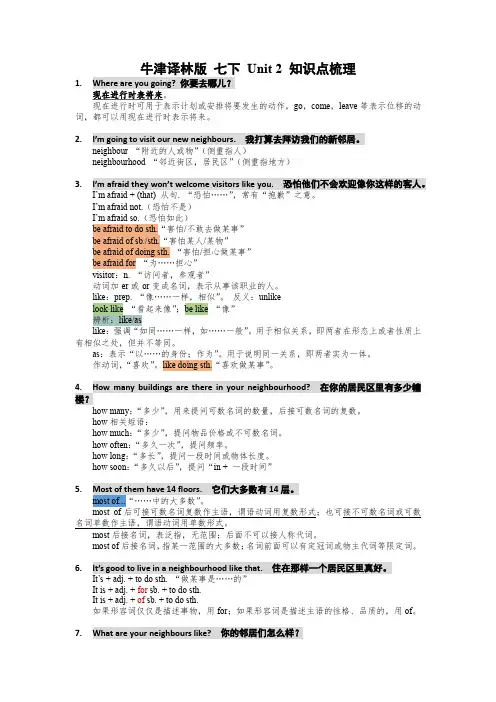
牛津译林版七下Unit 2 知识点梳理1.Where are you going?你要去哪儿?现在进行时表将来。
现在进行时可用于表示计划或安排将要发生的动作,go,come,leave等表示位移的动词,都可以用现在进行时表示将来。
2.I’m going to visit our new neighbours. 我打算去拜访我们的新邻居。
neighbour “附近的人或物”(侧重指人)neighbourhood “邻近街区,居民区”(侧重指地方)3.I’m afraid they won’t welcome visitors like you. 恐怕他们不会欢迎像你这样的客人。
I’m afraid + (that) 从句. “恐怕……”,常有“抱歉”之意。
I’m afraid not.(恐怕不是)I’m afraid so.(恐怕如此)be afraid to do sth.“害怕/不敢去做某事”be afraid of sb./sth.“害怕某人/某物”be afraid of doing sth. “害怕/担心做某事”be afraid for “为……担心”visitor:n. “访问者,参观者”动词加-er或-or变成名词,表示从事该职业的人。
like:prep. “像……一样,相似”。
反义:unlikelook like “看起来像”;be like “像”辨析:like/aslike:强调“如同……一样,如……一般”。
用于相似关系,即两者在形态上或者性质上有相似之处,但并不等同。
as:表示“以……的身份;作为”。
用于说明同一关系,即两者实为一体。
作动词,“喜欢”。
like doing sth.“喜欢做某事”。
4.How many buildings are there in your neighbourhood? 在你的居民区里有多少幢楼?how相关短语:how much:“多少”,提问物品价格或不可数名词。
Unit 6Integrated skills Study skills七年级英语下册(牛津译林版)

(2) Whose kite looks like a square? Daniel’s kite looks like a square.
(3) What about Amy’s? Amy’s kite looks like a fish.
88—89 34—35 84—85 46—47
1. Review the usage of the simple past tense.
2. Write about your last weekend.
1. Review the usage of the simple past tense.
2. Write a1bo.utInyoturroladstuwceeeketnhd.e history of kites to your family.
need a mobile phone.
Listen and write T or F!
1. They had a picnic yesterday. F
They’re having picnic today.
2. It’s dangerous to fly a kite there. F
It’s dangerous to swim.
In the … and … dynasties.
Which city is famous for making kites?
… in Shandong Province
Some advice on a day out.
Amy and her cousin Shirley are going for a picnic.
译林牛津七年级英语下册 Unit 7-8单元词句梳理

译林牛津七年级英语下册Unit 7 AbilitiesPeriod 1 Comic strip & Welcome to the unit 必背单词1. ability n. 能力2. believe vt. 相信3. seat n.座位4. send vt.发送; 邮寄5. even adv. 甚至6. able adj. 能, 能够7. pay vi. & vt. 付费8. notebook n.笔记本9. raise vt. 募集必背短语10. believe it or not 信不信由你11. look out 留神, 当心12. pay for 为……付款13. be able to 能14. clean up the park 打扫公园15. plant trees 植树16. give a seat to someone 给某人让座17. an old people’s home 养老院18. in poor areas 在贫困地区19. send ... to 发送20. raise money for 为……筹钱必背句子21. Believe it or not! 信不信由你!22. We can send some books to them.我们可以给他们寄一些书。
23. Some families are not even able to pay for pens and notebooks.一些家庭甚至付不起钢笔和笔记本的费用。
24. We can raise some money for them to buy these things.我们可以为他们募集一些资金来买这些东西。
Period 2 Reading必背单词1. brave adj. 勇敢的2. save vt. 救, 救助3. smoke n. 烟, 烟雾4. badly adv. 严重地, 厉害地5. hurt adj. 受伤的6. could modal v. (can 的过去式) 可以, 能, 会7. protect vt. 保护8. rush vi. 冲, 奔9. wet adj. 湿的; 未干的; 有雨的10. burn vt. &vi. 烧伤; 烧11. nod vi. &vt. 点头12. careful adj. 仔细的, 认真的; 小心的→ carefully adv. 小心地, 谨慎地; 仔细地, 认真地13. hurt vt. &vi. 使受伤, 伤害; 疼14. news n. 新闻, 消息15. newspaper n. 报纸16. match n.火柴17. rubbish n.垃圾, 废弃物必背短语18. save... from 从……中救出19. next door 在隔壁20. put out the fire 扑灭火21. in hospital 住院22. be careful with 小心; 照顾23. find out 找出, 查明; 发现24. play with 同……一起玩25. at home alone 独自在家26. hear someone shouting 听见某人叫喊27. the 79-year-old Mrs Sun 79 岁的孙女士28. rush into 冲进必背句子29. What a brave young man! 多么勇敢的一个年轻男人!30. He was brave enough to save his neighbour from a fire.他足够勇敢从一场大火中救出了他的邻居。
初中英语九年级下册(牛津译林版)Unit2Studyskills教学设计
3.引导学生通过自主阅读、总结和反思,培养良好的学习习惯和自主学习能力。
4.设计形式多样的课堂活动,如角色扮演、小组竞赛等,激发学生的学习兴趣,提高学生的学习积极性。
(三)情感态度与价值观
三、教学重难点和教学设想
(一)教学重难点
1.重点:本章节的重点在于帮助学生掌握有效的学习方法和技巧,提高学习效率。具体包括:
-学会运用不同的时态描述学习过程和计划;
-掌握并运用本章节的核心词汇和短语;
-能够结合自身实际,制定合理的学习计划和时间安排。
2.难点:难点在于如何引导学生将这些学习方法内化为自身的学习习惯,并在实际中灵活运用。具体包括:
3.导入新课:在学生讨论的基础上,教师引出本节课的主题——Study skills,并强调学习技巧在提高学习效率方面的重要性。
(二)讲授新知
1.教学内容:本节课主要讲授以下三个方面的学习技巧:
- How to manage your time effectively(如何有效管理时间);
- Different ways to study(不同的学习方法);
1.培养学生树立正确的学习观念,认识到学习方法和技巧在学习过程中的重要性,养成良好的学习习惯。
2.培养学生积极向上的学习态度,鼓励他们勇于面对挑战,克服困难,不断提高自己。
3.培养学生的团队合作精神,让他们在合作中学会互相尊重、互相帮助,共同提高。
4.增强学生的自信心,让他们在学习和生活中都能保持积极的心态,迎接挑战。
3.鼓励学生积极参与作业,培养良好的学习习惯和自主学习能力。
4.作业评价要注重过程和结果,关注学生在作业中的表现,鼓励学生自我反思和改进。
七下英语课计划答案牛津版2024
七下英语课计划答案牛津版2024Oxford Edition 2024 7th Grade English Lesson Plan AnswersUnit 1: Meeting New People1.1 Introduction to Greetings- Activity: Role-play greetings in different situations- Vocabulary: Hello, Hi, Good morning, Good afternoon, Good evening- Grammar: Present simple tense for greetings in first person- Speaking: Introduce yourself to a partner using greetings1.2 Making Small Talk- Activity: Pair work to practice small talk conversations- Vocabulary: What's your name? How are you? Where are you from?- Grammar: Present simple tense for questions and responses- Speaking: Engage in small talk with classmates1.3 Asking and Giving Personal Information- Activity: Complete a personal information questionnaire- Vocabulary: Age, address, phone number, email- Grammar: Present simple tense for asking and giving personal information- Writing: Write a short paragraph about yourselfUnit 2: My School2.1 School Facilities- Activity: Label a school map with different facilities- Vocabulary: Classroom, library, playground, cafeteria- Grammar: Prepositions of place (in, on, at)- Listening: Listen to a description of the school and identify facilities2.2 School Subjects- Activity: Match school subjects with their descriptions- Vocabulary: Math, English, Science, History- Grammar: School subjects are often capitalized- Reading: Read about different school subjects2.3 Describing My School- Activity: Write a description of your school- Vocabulary: Clean, spacious, modern- Grammar: Adjectives to describe school facilities- Speaking: Present your description to the classUnit 3: My Family3.1 Family Members- Activity: Draw a family tree and label family members- Vocabulary: Mother, father, sister, brother, grandparents- Grammar: Possessive pronouns (my, your, his, her)- Speaking: Describe your family to a partner3.2 Family Roles- Activity: Discuss family roles in group- Vocabulary: Cook, clean, work, study- Grammar: Present simple tense for family roles- Writing: Write about the roles of family members in your household3.3 Family Traditions- Activity: Share family traditions with the class- Vocabulary: Celebrate, tradition, festival- Grammar: Present simple tense for talking about traditions - Speaking: Present a family tradition to the classUnit 4: Hobbies and Interests4.1 Hobbies- Activity: List different hobbies and interests- Vocabulary: Read, draw, play sports, listen to music- Grammar: Present simple tense for talking about hobbies - Listening: Listen to classmates talk about their hobbies 4.2 Leisure Activities- Activity: Match leisure activities with pictures- Vocabulary: Surfing, cycling, hiking, swimming- Grammar: Present simple tense for leisure activities- Reading: Read about different leisure activities4.3 My Favorite Hobby- Activity: Write about your favorite hobby- Vocabulary: Favorite, hobby, interest- Grammar: Expressing preferences using "like" and "love"- Speaking: Present your favorite hobby to the classOverall, these lesson plans aim to develop students' English language skills in speaking, listening, reading, and writing while also introducing them to different aspects of everyday life. Teachers can adapt and expand on these plans to suit the needs and interests of their students.。
牛津译林版英语七下_Unit 2 单元重点句型默写
牛津译林版7A Unit 2 单元重点句型默写1.你要去哪儿?Where ________ ________ ________?2.我打算去拜访我们的新邻居。
I’m going to ________ ________ ________ ________.3.恐怕他们不会欢迎像你这样的客人。
I’m ________ they ________ ________ ________ ________ ________.4.在你的居民区里有多少幢楼?________ ________ ________ ________ ________ in your ________?5.它们大多数有14层。
________ ________ ________ ________ 14 ________.6.住在那样一个居民区里真好。
________ ________ ________ ________ ________ a ________ ________ ________. 7.你的邻居们怎么样?________ ________ your ________ ________?8.他们很善良并且乐于助人。
They’re ________ and ________.9.他们经常在社区中心见面,分享他们不同的技巧。
They often ________ ________ ________ ________ and ________ their ________ ________.10.他们帮助我们解决各种各样的问题。
They ________ ________ ________ ________ ________ ________ ________.11.我的电脑出故障了。
________ ________ ________ ________ my computer.12.我打算找个电脑工程师检查一下。
I’m going to ________ ________ ________ ________ ________ ________ it.13.我表妹安妮的自行车坏了。
(完整版)广州深圳新牛津版教材七年级下册Unit2知识点小结
Unit 2 Travelling around the world 知识点小结1. I can jump higher than the Eiffel Tower! 我能跳的比埃菲尔铁塔高!本句是含有副词比较级的句子,其句型结构为“A + … + 副词比较级+ than B.”。
其中higher 是副词high的比较级,意为“更高”,than 意为“比……”。
He works harder than you. 他比你工作更努力。
Peter runs faster than I.彼得跑得比我快。
2.Don’t be silly, Lo别傻了,Lo.“Don’t be silly”是一个祈使句,祈使句是一种重要的句子类型,它用来表示请求、命令、叮嘱、劝告等语气,它的主语you(听话人)通常省略。
根据祈使句句首单词的特点,我们可以把祈使句分为以下三类:(1)V型祈使句:即以动词原形开头的祈使句。
Listen to me, please.请听我说。
(2)B型祈使句:即以连系动词be开头的祈使句。
Be quiet, please.请安静。
(3)L型祈使句:即let sb.+动词原形。
Let’s play volleyball.让我们打排球吧。
①祈使句在构成否定句时,通常在动词原形前加don’t。
Don’t read in the sun. 不要在阳光下读书。
②以let开头的祈使句变否定句时,在句首加don’t,或动词不定式前加not。
Don’t let them play volleyball. 别让他们打排球。
祈使句用法歌诀祈使句,易判断,命令、请求和规劝。
主语一般都是you,平时不用说出口。
肯定结构有三种,谓语动词用原形。
若要构成否定句,Don’t放在最前头。
(安徽芜湖)______this kind of peach, and you will like it.A. To tryB.TringC.TryD.Tried解析:本句尾祈使句,以动词原形开头,故选C.句意:尝尝这种桃子,你会喜欢它的。
中考译林版牛津英语第一轮复习教学案7下 unit2
7下Unit 2 Neighbours一、复习单词A. 易拼错单词neighbour community skill problem something anythingsomeone (an) engineer college notice police station post officeB. 词性变化visit-visitor like(prep)-unlike wait-waiter/waitress help-helpful/helplessbreak-broken fix –fixed-fixing sound-sound(s) luck-lucky-luckilymanage-manager policeman-policemen postman-postmensick-sickness/illness company-companies person-personal-personalityart-artist information(uc) good/well-better-best worry-worried/worrying design-designed-designer notice(n)-notice(v注视) below-aboveC. 单词用法1.will ,shall 为情态动词,+动词原形注:shall 与主语I ,we 连用情态动词总结:need, can , could, would, must, may , might ,should ,could①The girl__________(water) the flowers if her father comes home late.②It`s said they ____________(donate) one million to those homeless children who survivedthe earthquake to build a new home in the next month.2. visitvisitor参观者,类似结构:inventor,发明家,actor演员,director,导演n. on a visit to spv. visit+sp, travel to +speg: ①The bag seems to be one of the _____________.② He ___________over two hundred places of interest so far .A. visitedB. traveledC. has visitedD. has traveled3.helpn . 帮助v. help sb do sth /help sb with sthadj. helpful/unhelpful 不乐于助人的helpless无助的①In order to finish the project on time, we still need a lot of___________.②I will vote for him. He is ______________I have ever seen.with the help of sb 在某人的帮助之下without one`s help没有某人的帮助4.something 指物的不定代词,一律当单数讲;反意疑问句用it 代替,否定句中改为anything ,nothing 表否定,没有。