
英语人教版八年级下册现在完成时构成及用法
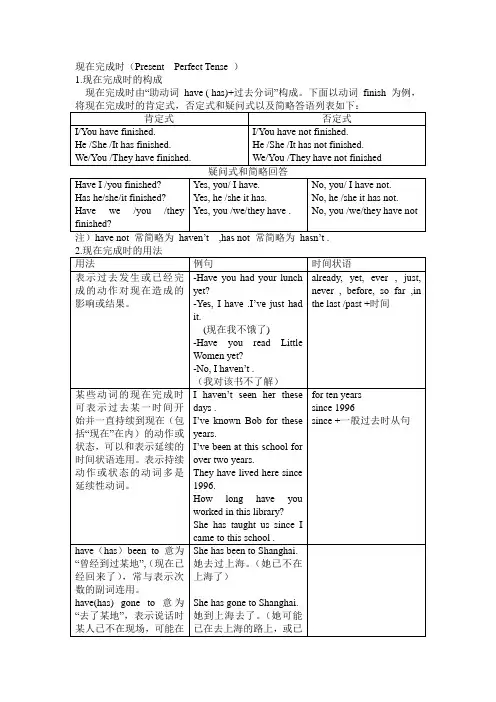
现在完成时(Present Perfect Tense )1.现在完成时的构成现在完成时由“助动词have ( has)+过去分词”构成。
下面以动词finish 为例,例如:I haven’t bought anything for two months.3.现在完成时和一般过去时的区别现在完成时表示过去发生的某一动作对现在造成的影响或结果,强调的是现在的情况,所以它不能和表示过去的时间状语连用,例如:yesterday, last night, three weeks ago, in 1990等。
而一般过去时只表示过去的动作或状态,和现在不发生联系,它可以和上述表示过去的时间状语连用。
例如:I have seen the film.我看过这部电影。
(我了解这部电影的内容。
)I saw the film last week.我上个星期看了这部电影。
(只说明上星期看了这部电影,不涉及现在的情况。
)He has lived here since 1992. 1992年以来他一直住在这里。
(他现在还住在这里)He lived here in 1992. 1992年他住在这里。
(不涉及他现在是否还住在这里。
)练习一。
选择1.—_________you ______ him before ?—No,not yet。
A.Have ; metB. Did ;meetC. Do; meetD. Were ; meeting2.—Let’s go shopping ,Lily ! Have you finished your homework _______?—No, not _______.A. just; yetB. ever ; alreadyC. yet; yetD. ever; just3.—Lily ,why are you still here ? School is over for half an hour.—Because I ______ my task yet. I still need one more hourA. won’t finishB. don’t finishC. haven’t finishedD. hadn’t finished4.—I’d like to introduce my best friend to you ,Peter.—Thank you, Lucy. But we ______ already.A. meet B .met C. will meet D. have met5.—Have you finished your work _____?—Yes, I have. I’ve ________ finished it .A. yet; alreadyB. already ; yetC. already; alreadyD. yet ; yet6.—Have you found your IPod?—_____________.A. No, you haveB. Not yetC. Yes, I doD. Yes, I found7.Lucy’s never been to Beijing , _______ she ?A. isB. isn’tC. hasD. hasn’t8.Mary ______ yet. I’m waiting for her .A.. came back B .has come back C. hasn’t come back D. was com ing back9.—_________ you ______ out the problem, Sam?—Not yet, but I’m going to .A. Did; workB. Are; workingC. Have; workedD. Will; work10.—_______you _______ a pen on the desk ?—Yes, but Miss Liu ______it away just now.A. Have; seen; has taken B .Have; seen ;took C. Have; see; took D. Do ; see; has taken11.—Have you cooked supper ________?—Yes, I have ________ finished it .A. yet ; justB. yet; everC. already; yetD. already ;just12.Mr.Wnag isn’t here ,I think he _____ Shanghai.A. went B has been to C. has gone to13.—Hello! Could I speak to Lily/—Sorry ,she is not in .She ________ Shanghai.A. have been toB. have gone toC. has been toD. has gone to14.Neither my sister nor I ______ been to America before.A. have everB. have neverC. has everD. has never15.He _______ to Beijing many times.A. have been B . has been C. have gone D. has gone16.—Have you ever left your keys in your house?— No, _________.A. ever B . already C. yet D. never17.Mr.Green _______ China for ten years.A. has been to B .has been in C. has come to D . has gone to18.—He ________ the English –Chinese dictionary for about ten years ,but it is still new .— What a careful man!A. has boughtB. has borrowedC. has hadD. bought19.In the last ten years changes _________ place in my hometown.A. took B . had taken C. have taken D. take20.Zhao Lan ______ already ______ in this school for two years.A. was ;studyingB. will ; studyC. has ; studiedD. are; studying21.Hurry up ! The play ______ for ten minutes.A. has begunB. had begunC. has been onD. begun22.—How long have you _____ China?—For three years .A. come backB. returnedC. leftD. been away from23.—Oh, Mrs. King, your necklace looks nice. Is it new?—No ,I _______ it for two years.A. hadB. have hadC. boughtD. have bought24.—You are leaving your school .How do you like it?—Very much, of course .I _____this school since I moved here .A. have gone toB. came toC. have been toD. have been at25.—I’m sorry to keep you waiting for a long time.—Oh, not at all. I ______ here for only a few minutes.A. have arrived B have been C. arrived D was26.—Hello, this is Lily speaking. Could I speak to Mr. Black?—Sorry. He _____ Beijing .A. has been to B . has gone to C. has been in D. will go to27.H e ________ in this factory for 20 years already.A. will workB. worksC. has worked D is working28.—I wonder when you ______ the new watch.—Well, I ____ it for two weeks.A. have bought; have hadB. bought; have boughtC. bought; have hadD. have bought; have bought29.The Browns________ Water World twice.A. went toB. has been toC. have been to D . have been in30.Tom ____ Mary in 1998.That is to say ,they _____ for 15 years.A .got married with; have got married B. got married to ; have marriedC. married; have been marriedD. married to ; have been married31.—I’m sorry .I ______ your printer for such a long time .—Never mind.A. have borrowedB. have lentC. have keptD. have bought32.—What a nice bike ! How long _____you ________ it ?—Just two weeks .A. have ;boughtB. did ; buyC. have ; hadD. are; having33.—__________you ever_______ Chinese moon-cakes, Diana?—No, never .But I have had noodles.A. Do; tryB. Will; tryC. Did ;tryD. Have ; tried34.—________ has your brother studied in New York?—For two years.A. How farB. How oldC. How oftenD. How long35.—When ______ your mother _____ you that blue dress,Mary?—Sorry ,I really can’t remember.A. does; buyB. has; boughtC. had; boughtD. did ; buy36.—_________ has your uncle been to Canada ?—Only twice .A. How many timesB. How oftenC.How longD.How far37.—How beautiful your skirt is! Is it new?—No,I have ________ it for two months.A. borrowedB. boughtC. had D got38.—How long have you collected shells?—__________.A. After I left schoolB. Before I moved hereC. When I went to the beachD. Since I was ten years old39.—What are you going to do this weekend ?—I _________ yet.A. haven’t decideB. won’t decideC. have decidedD. didn’t decide40.Great changes _______ in our city since 1980.A. took placeB. have taken placeC. happenedD. have happened41.—I have never been to American Computer Museum .What about you ?—________ .A. So do IB. So have IC. Neither do ID. Neither have I42.He _______ the house ,and you can put your things in it .A. cleaningB. cleaning outC. cleaned D . has cleaned out43.Tom has never ______Australia. But his parents have ______ theretwice.A. been to ; been to B . been ; gone C. been to ; been D. gone ;gone二。
人教版八年级下册现在完成时专项讲解

现在完成时现在完成时(present perfect tense)通常表示过去发生的动作一直延续到现在,而且还可能继续下去,或者表示过去的行为对现在造成一定的影响,可能还会产生结果等。
1.现在完成时结构1.1.助动词have/has+动词过去分词。
其中,助动词要随着主语的变化而变化,当主语是第三人称单数时,助动词要用“has”。
例:Have you finished your work?He says that he has seen UFOs many times.1.2.现在完成时的缩写形式:I have=I ’ve have not= haven’thas not= hasn’t例:I’ve finished my work./He hasn’t finished his work.1.3.现在完成时的一般疑问句:Have/Has+主语+动词的过去分词+其他?肯定回答:Yes,主语+have/has.否定回答:No,主语+haven’t/hasn’t.例:----Have you finished your work?----Yes,I have./No,l haven’t.----Have they arrived?----Yes,they have./No,they haven’t. 1.4.1.通过加-ed的形式来构成规则动词的过去分词,就像我们构成这些动词的过去式方法一样。
大多数动词后+ed.如finish---finished.以字母e为结尾的动词后+d,如change---changed.以辅音字母加y结尾的动词,去掉y,再加ied.如carry---carried.以一个元音再加一个辅音结尾的短动词,双写辅音辅音字母再加ed.如stop---stopped1.4.2.构成不规则动词的过去分词的方法有所不同,需要特别记忆。
如:come---come; hurt---hurt. lend---lent; build---builtcatch---caught; keep---kept forget---forgotten tell---toldbe---been; have---had fall---fallen; fly---flowndraw---drawn; see---seen;think---thought.2.现在完成时的用法2.1.表示过去发生或已经完成的动作,对现在造成的影响或结果。
英语人教版八年级下册现在完成时构成及用法
现在完成时(Present Perfect Tense )1.现在完成时的构成现在完成时由“助动词have ( has)+过去分词”构成。
下面以动词finish 为例,例如:I haven’t bought anything for two months.3.现在完成时和一般过去时的区别现在完成时表示过去发生的某一动作对现在造成的影响或结果,强调的是现在的情况,所以它不能和表示过去的时间状语连用,例如:yesterday, last night, three weeks ago, in 1990等。
而一般过去时只表示过去的动作或状态,和现在不发生联系,它可以和上述表示过去的时间状语连用。
例如:I have seen the film.我看过这部电影。
(我了解这部电影的内容。
)I saw the film last week.我上个星期看了这部电影。
(只说明上星期看了这部电影,不涉及现在的情况。
)He has lived here since 1992. 1992年以来他一直住在这里。
(他现在还住在这里)He lived here in 1992. 1992年他住在这里。
(不涉及他现在是否还住在这里。
)练习一。
选择1.—_________you ______ him before ?—No,not yet。
A.Have ; metB. Did ;meetC. Do; meetD. Were ; meeting2.—Let’s go shopping ,Lily ! Have you finished your homework _______?—No, not _______.A. just; yetB. ever ; alreadyC. yet; yetD. ever; just3.—Lily ,why are you still here ? School is over for half an hour.—Because I ______ my task yet. I still need one more hourA. won’t finishB. don’t finishC. haven’t finishedD. hadn’t finished4.—I’d like to introduce my best friend to you ,Peter.—Thank you, Lucy. But we ______ already.A. meet B .met C. will meet D. have met5.—Have you finished your work _____?—Yes, I have. I’ve ________ finished it .A. yet; alreadyB. already ; yetC. already; alreadyD. yet ; yet6.—Have you found your IPod?—_____________.A. No, you haveB. Not yetC. Yes, I doD. Yes, I found7.Lucy’s never been to Beijing , _______ she ?A. isB. isn’tC. hasD. hasn’t8.Mary ______ yet. I’m waiting for her .A.. came back B .has come back C. hasn’t come back D. was com ing back9.—_________ you ______ out the problem, Sam?—Not yet, but I’m going to .A. Did; workB. Are; workingC. Have; workedD. Will; work10.—_______you _______ a pen on the desk ?—Yes, but Miss Liu ______it away just now.A. Have; seen; has taken B .Have; seen ;took C. Have; see; took D. Do ; see; has taken11.—Have you cooked supper ________?—Yes, I have ________ finished it .A. yet ; justB. yet; everC. already; yetD. already ;just12.Mr.Wnag isn’t here ,I think he _____ Shanghai.A. went B has been to C. has gone to13.—Hello! Could I speak to Lily/—Sorry ,she is not in .She ________ Shanghai.A. have been toB. have gone toC. has been toD. has gone to14.Neither my sister nor I ______ been to America before.A. have everB. have neverC. has everD. has never15.He _______ to Beijing many times.A. have been B . has been C. have gone D. has gone16.—Have you ever left your keys in your house?— No, _________.A. ever B . already C. yet D. never17.Mr.Green _______ China for ten years.A. has been to B .has been in C. has come to D . has gone to18.—He ________ the English –Chinese dictionary for about ten years ,but it is still new .— What a careful man!A. has boughtB. has borrowedC. has hadD. bought19.In the last ten years changes _________ place in my hometown.A. took B . had taken C. have taken D. take20.Zhao Lan ______ already ______ in this school for two years.A. was ;studyingB. will ; studyC. has ; studiedD. are; studying21.Hurry up ! The play ______ for ten minutes.A. has begunB. had begunC. has been onD. begun22.—How long have you _____ China?—For three years .A. come backB. returnedC. leftD. been away from23.—Oh, Mrs. King, your necklace looks nice. Is it new?—No ,I _______ it for two years.A. hadB. have hadC. boughtD. have bought24.—You are leaving your school .How do you like it?—Very much, of course .I _____this school since I moved here .A. have gone toB. came toC. have been toD. have been at25.—I’m sorry to keep you waiting for a long time.—Oh, not at all. I ______ here for only a few minutes.A. have arrived B have been C. arrived D was26.—Hello, this is Lily speaking. Could I speak to Mr. Black?—Sorry. He _____ Beijing .A. has been to B . has gone to C. has been in D. will go to27.H e ________ in this factory for 20 years already.A. will workB. worksC. has worked D is working28.—I wonder when you ______ the new watch.—Well, I ____ it for two weeks.A. have bought; have hadB. bought; have boughtC. bought; have hadD. have bought; have bought29.The Browns________ Water World twice.A. went toB. has been toC. have been to D . have been in30.Tom ____ Mary in 1998.That is to say ,they _____ for 15 years.A .got married with; have got married B. got married to ; have marriedC. married; have been marriedD. married to ; have been married31.—I’m sorry .I ______ your printer for such a long time .—Never mind.A. have borrowedB. have lentC. have keptD. have bought32.—What a nice bike ! How long _____you ________ it ?—Just two weeks .A. have ;boughtB. did ; buyC. have ; hadD. are; having33.—__________you ever_______ Chinese moon-cakes, Diana?—No, never .But I have had noodles.A. Do; tryB. Will; tryC. Did ;tryD. Have ; tried34.—________ has your brother studied in New York?—For two years.A. How farB. How oldC. How oftenD. How long35.—When ______ your mother _____ you that blue dress,Mary?—Sorry ,I really can’t remember.A. does; buyB. has; boughtC. had; boughtD. did ; buy36.—_________ has your uncle been to Canada ?—Only twice .A. How many timesB. How oftenC.How longD.How far37.—How beautiful your skirt is! Is it new?—No,I have ________ it for two months.A. borrowedB. boughtC. had D got38.—How long have you collected shells?—__________.A. After I left schoolB. Before I moved hereC. When I went to the beachD. Since I was ten years old39.—What are you going to do this weekend ?—I _________ yet.A. haven’t decideB. won’t decideC. have decidedD. didn’t decide40.Great changes _______ in our city since 1980.A. took placeB. have taken placeC. happenedD. have happened41.—I have never been to American Computer Museum .What about you ?—________ .A. So do IB. So have IC. Neither do ID. Neither have I42.He _______ the house ,and you can put your things in it .A. cleaningB. cleaning outC. cleaned D . has cleaned out43.Tom has never ______Australia. But his parents have ______ theretwice.A. been to ; been to B . been ; gone C. been to ; been D. gone ;gone二。
新目标人教版八年级下册第八单元语法现在完成时知识点解析

八年级下册第八单元语法现在完成时知识点讲解1. 现在完成时的含义:在英语语法中,现在完成时是现在时态和完成时态的组合,用来表达具有现在结果的过去事件。
2. 现在完成时的结构:1) 肯定句:主语+ have/has +过去分词例句:I have tried sushi before. 我以前吃过寿司。
He has tried sushi before. 他以前吃过寿司。
2) 否定句:主语+ have not (haven’t/ has not (hasn’t) +过去分词例句:I have not tried sushi before. 我以前没吃过寿司。
He has not tried sushi before. 他以前没吃过寿司。
3) 疑问句:Have/ Has +主语+过去分词?例句:Have you tried sushi before? 你以前吃过寿司吗?Has he tried sushi before? 他以前吃过寿司吗?3. 现在完成时的一般用法1) 表达你在生活中所做的事情例句:I’ve been to England. 我去过英国。
She has never studied Japanese. 她从未学过日语。
2) 表示你做某事的次数例句:I’ve been to Paris three times. 我去过巴黎三次。
How many times have you tried to call her? 你给她打了多少次电话?3) 表示过去开始的,现在仍然存在的情况例句:I’ve known James for 4 or 5 years. 我认识詹姆斯有四五年了。
She’s been the director of that company since 2007. 她从2007年开始担任那家公司的董事。
I’ve known Julie for ten years. (I met her ten years ago and I still know her) 我认识朱莉有十年了。
人教版英语八年级下册(讲义)Unit 10——现在完成时 知识讲解
人教版英语八年级下册专项语法讲练——现在完成时【概念引入】如何学习时态?对中学生来说,最好还是从各个时态的基本概念、基本形式和基本用法学起。
在过了这一阶段之后,再放开步伐,通过大量的听、读和笔头实践,获得感性的知识。
现在,我们就从最基本的概念、形式和用法等方面来总结一种新的时态——现在完成时。
【用法讲解】一、现在完成时的定义现在完成时表示过去发生或已经完成的某一动作对现在造成的影响或结果。
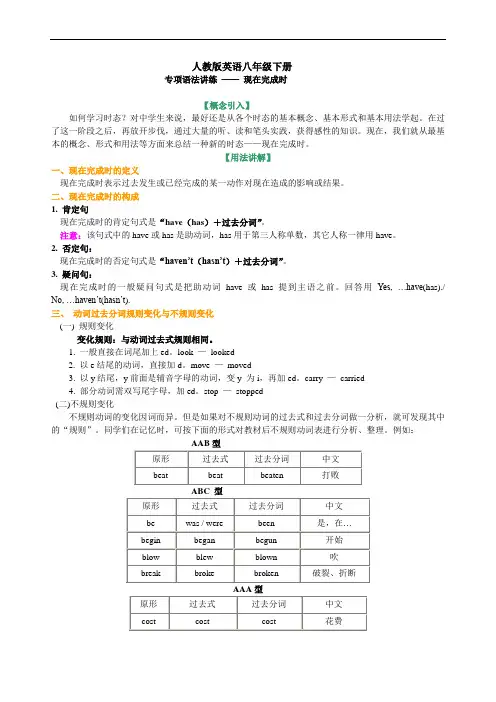
二、现在完成时的构成1. 肯定句现在完成时的肯定句式是“have(has)+过去分词”。
注意:该句式中的have或has是助动词,has用于第三人称单数,其它人称一律用have。
2. 否定句:现在完成时的否定句式是“haven’t(hasn’t)+过去分词”。
3. 疑问句:现在完成时的一般疑问句式是把助动词have或has提到主语之前。
回答用Yes, …have(has)./ No, …haven’t(hasn’t).三、动词过去分词规则变化与不规则变化(一) 规则变化变化规则:与动词过去式规则相同。
1. 一般直接在词尾加上ed。
look —looked2. 以e结尾的动词,直接加d。
move —moved3. 以y结尾,y前面是辅音字母的动词,变y 为i,再加ed。
carry —carried4. 部分动词需双写尾字母,加ed。
stop —stopped(二)不规则变化不规则动词的变化因词而异。
但是如果对不规则动词的过去式和过去分词做一分析,就可发现其中的“规则”。
同学们在记忆时,可按下面的形式对教材后不规则动词表进行分析、整理。
例如:AAB型四、现在完成时的用法现在完成时表示过去某时发生的行为对主语目前产生的影响。
即用过去发生的某个行为来说明现在的某种情况。
例如:We are good friends. (现在的情况)我们是好朋友。
I knew him in 1997. (过去的动作) 我1997年认识了他。
人教版八年级下英语现在完成时语法讲解
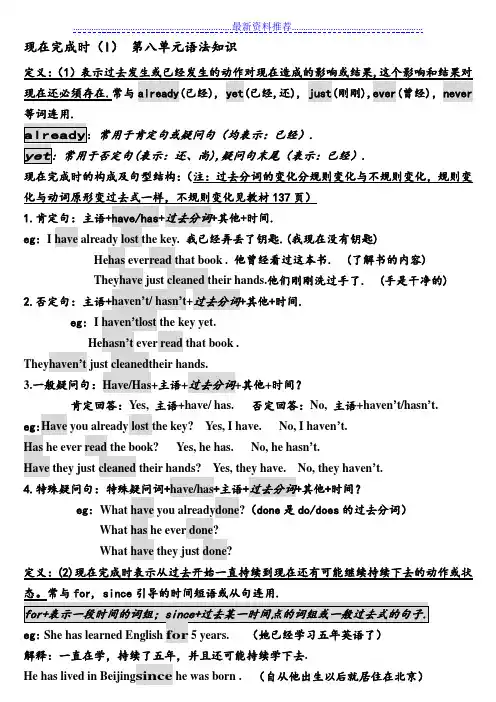
现在完成时(I)第八单元语法知识等词连用.常用于肯定句或疑问句(均表示:已经).(表示:还、尚),疑问句末尾(表示:已经).现在完成时的构成及句型结构:(注:过去分词的变化分规则变化与不规则变化,规则变化与动词原形变过去式一样,不规则变化见教材137页)1.肯定句:主语+have/has+过去分词+其他+时间.eg: I have already lost the key.我已经弄丢了钥匙.(我现在没有钥匙)Hehas everread that book .他曾经看过这本书. (了解书的内容)Theyhave just cleaned their hands.他们刚刚洗过手了. (手是干净的) 2.否定句:主语+haven’t/ hasn’t+过去分词+其他+时间.eg: I haven’tlost the key yet.Hehasn’t ever read that book .Theyhaven’t just cleanedtheir hands.3.一般疑问句:Have/Has+主语+过去分词+其他+时间?肯定回答:Yes, 主语+have/ has. 否定回答:No, 主语+haven’t/hasn’t.eg:Have you already lost the key? Yes, I have. No, I haven’t.Has he ever read the book? Yes, he has. No, he hasn’t.Have they just cleaned their hands? Yes, they have. No, they haven’t.4.特殊疑问句:特殊疑问词+have/has+主语+过去分词+其他+时间?eg: What have you alreadydone?(done是do/does的过去分词)What has he ever done?What have they just done?定义:(2)现在完成时表示从过去开始一直持续到现在还有可能继续持续下去的动作或状解释:一直在学,持续了五年,并且还可能持续学下去.He has lived in Beijing since he was born . (自从他出生以后就居住在北京)解释:从出生后就一直住在北京,持续到现在,还有可能一直住下去)Have you stayed here since3 o’clock?(自从3点后你就一直呆在这儿吗?)例题:选用for和since填空:1.We haven’t seen each other ___ a long time.2.His father has been in the factory ____ 10 years ago.3.The film has been on ____ 20 minutes.4.Mr. Green has worked here _____ he came to China.5.His grandparents have been dead _____ several years.6. It’s five years ______ we met last time.7.I have already had dinner. (否定)I _______ _______ dinner _______.8. Mum has cooked the dinner.Mum _______ ________ the dinner.9. Susan has learned English at school. Susan________________English at school.10.I have already had dinner. (提问)_______ _______ ________ _________ _______?11. He has just finished his homework. _______ _______ _______ ________ ________?12. Susan has learned English at school. _______ _______ ________ ________ _______?过去的时间状语连用.eg: I have already seen the film. (现在完成时,已经看了这部电影,并且知道电影的内容)I saw the film last week. (一般过去式,因为后面有表示过去的时间状语last week)He has lived here since 1993. (现在完成时,后面有since引导的时间状语从句)He lived here in 1993. (一般过去时,1993年住在这儿,现在没住在这儿了)例题:1. _____ you ________(clean) the room?Yes, we__________(do) that already.2. When _______ you ______(do) it?We _______(do) it an hour ago.3.______ he ______(see) this film yet? Yes.4. When _____ he _____(see) it?He______ it last week.5. I _______ (read) the novel twice. It’s interesting.6.Mr. Chen _________(give)up smoking last year.7. She _____(go) to Pairs, hasn’t she? Yes.How ____ she ____(go) there?She ____(go) there by air.现在完成时(II)第九单元语法知识1.构成:含有be动词的现在完成时的谓语部分由“have/has+ been+ to+地点”构成,表示:曾经去过某地… (been是be的过去分词,不规则变化)2.基本句型:(1)肯定句:主语+have/has+ been+ to+地点.肯定回答:Yes, 主语+ have/has. 否定回答:主语+haven’t/ hasn’t.eg: Have you been to Australia? Yes, I have. No. I haven’t.Have they been toBeijing? Yes, they have. No, they haven’t.Has he been toSouth Africa? Yes, he has. No, he hasn’t.(4)特殊疑问句:特殊疑问词+have/has+ 主语+ been?eg:Where have you been?Where have they been?Where has he been?3.用法:用来表示之前已经发生和完成度的动作与状态,其结果却和现在有联系.动作和结果发生在过去,但它的影响现在还在.可以和never, ever,once, twice, three/four…times 等副词连用.eg: They have been to Chongqing twice.I have never been to Sichuan.Has she ever been to Hainan?3.区别:eg:例题:1.—Where is your brother?—He __________ the shop. He’ll be back soon.2. — _____ you ever _______ to America?—Yes, I _______ New York twice.3. —David ___________ Australia.—I’m sure he has already arrived.4. —Is Benny here?—No, he ______ the school library. He left five minutes ago.4.Mike and his parents __________ the south for half a year.6. Mum is not at home now. she _________ the shop.7. You can’t find him. He__________Xi’an.8. Mr. Zhang __________ this school for ten years. He knows everyone here.9. Miss. Brown __________ China three times.10. I __________ the West lake, Look, I have taken many photos of it .11. Tom ___________ Jim’s home, but he hasn’t come back.12. We ____________ the bookshop and bought many books.13. My parents _________ Shandong for ten years.现在完成时(III)第十单元语法知识动词按其动作发生的方式,发生过程的长短可分为延续性动词与非延续性动词。
初二现在完成时全解
【初二】现在完成时全解现在完成时是初二下学期要学到的语法内容,也是初中三年的重点和难点。
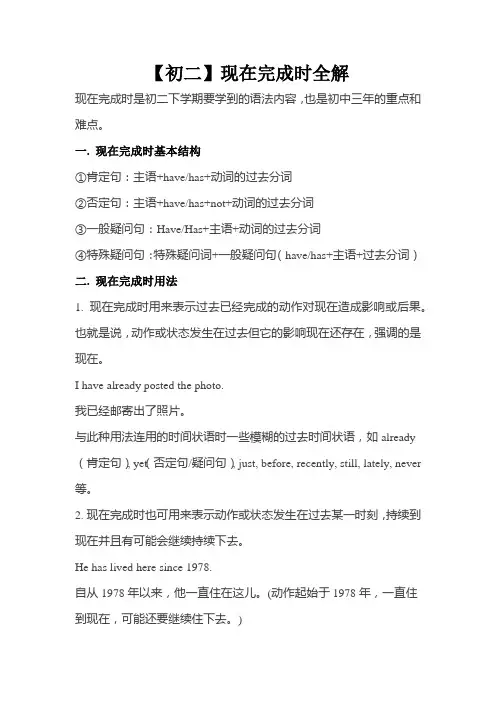
一. 现在完成时基本结构①肯定句:主语+have/has+动词的过去分词②否定句:主语+have/has+not+动词的过去分词③一般疑问句:Have/Has+主语+动词的过去分词④特殊疑问句:特殊疑问词+一般疑问句(have/has+主语+过去分词)二. 现在完成时用法1. 现在完成时用来表示过去已经完成的动作对现在造成影响或后果。
也就是说,动作或状态发生在过去但它的影响现在还存在,强调的是现在。
I have already posted the photo.我已经邮寄出了照片。
与此种用法连用的时间状语时一些模糊的过去时间状语,如already (肯定句), yet(否定句/疑问句), just, before, recently, still, lately, never 等。
2. 现在完成时也可用来表示动作或状态发生在过去某一时刻,持续到现在并且有可能会继续持续下去。
He has lived here since 1978.自从1978年以来,他一直住在这儿。
(动作起始于1978年,一直住到现在,可能还要继续住下去。
)此种用法常与for(+时间段),since(+时间点或过去时的句子)连用。
谓语动词必须是延续性动词。
有些瞬间动词可变为延续动词:go out----be outfinish----be overopen----be opendie----be deadbuy---havefall ill---be illcome back----be backcatch a cold----have a cold三. 现在完成时常见考法对于现在完成时的考查,多以单选、句型转换或词语运用的形式考查学生在具体语境中灵活运用时态的能力。
在考试中,会让大家判断是否该用现在完成时,或者是考查“瞬间动词”不能与表示一段时间的状语连用”这一知识点。
现在完成时(unit8--unit10知识点总结)人教版英语八年级下册
现在完成时一.定义三要素与构成〔has/have done〕1.表示到现在为止已经完成或刚刚完成的动作。
By now, I have remembered 1000 English words.2.一件发生在过去的事情对现在产生影响。
常见时间状语:常和already〔已经〕,yet〔已经〕,just〔刚刚〕,still〔仍旧〕,so far〔到目前为止〕,till now,(直到现在),before〔以前〕,ever〔曾经〕,3 times(三次),in the past/last..years(在过去几年)I have spent all of my money so far.(1)already:〔已经〕用于确定句位置:放于助动词与done 之间或者放在句末(2)yet:疑问句〔已经〕否认句〔还〕位置:常放句尾(3)ever(曾经):疑问/确定位置:助动词与done之间(4)never〔从不〕位置:助动词与done之间【练习】〔1〕——你吃过早餐了吗?—Have you had breakfast ____?——是的,我已经吃过了。
/不,我还没吃。
—Yes,I have ________ had it./No,I haven’t had it ____.〔2〕I have ______ read this book,so I don’t know what it is about.〔3〕—Have you _____ been to the Great Wall? It’s so wonderful and great.—No,I have ______ been there.3.一个动作开头于过去,并持续到现在〔或许还将持续下去〕。
常见时间状语:①for+一段时间“长达/持续了……②since+过去一个时间点,表示“自从……以来〞时间段+ago,表示“从……以前〞+for+时间段从句〔一般过去时〕eg:Mary has been ill for three days.We have been classmates since 2 years ago.【练习】〔1〕我已经住在这里十年了。
人教版英语八年级下册第八单元:现在完成时语法
你已经读完这本书了么? yet 一般用于疑否句中,在句中意为“已经”;在否 定句中意为“还”通常放于句末。 如: Have you found the book yet ?
你已经找到那本书了么? Not yet . 还没找到。 She hasn’t finished her homework yet.
He _h_a_s_n_’_t __f_in_i_s_h_e_d__ his homework _y_e_t__. 3. Mum’s cooked the dinner. (改为否定句)
Mum _h_a_s_n_’t__ _c_o_o_k_e_d_ the dinner.
4.She joined the music club last week.( 改为现在完成时 ) She h_a_s_ _b_e_en__ _i_n___the music club __f_or__two weeks. 适当形式填空 5.He ____ha_s__le_ft____(leave ) the country and gone to India. 6.I have __be_e_n__(be )here for two months. 7.I’m waiting for my son . He __h_a_s_n’t__c_o_m_e_( not come )
---They have been here since 2008. Tom bought the car in 2009
---Tom have had the car since 2009.
语法加油站
一、句型转换。 1. I’ve already had dinner. (改为一般疑问句)
英语人教版八年级下册现在完成时
现在完成时一、 (1) 概念:现在完成时表示过去发生或已经完成的动作:现在完成时表示过去发生或已经完成的动作,,对现在造成的影响或结果。
对现在造成的影响或结果。
1. I have already c leaned cleaned my room. 我已经打扫了我的房间。
我已经打扫了我的房间。
2. We have finished our homework. 我们完成了作业。
我们完成了作业。
3. They have swept the floor. 他们扫了地。
他们扫了地。
4. She has read t hat book. that book. 她读了那本书。
她读了那本书。
5. Tom has broken the window. Tom 打碎窗户。
打碎窗户。
现在完成时的构成现在完成时的构成: : 主语主语 + + + +1. I haven haven’’t cleaned my room yet. 我还没打扫了我的房间。
我还没打扫了我的房间。
2. We haven haven’’t finished our homework. 我们没完成作业。
我们没完成作业。
3. They haven haven’’t swept t he floor. the floor. 他们没扫地。
他们没扫地。
4. She hasn hasn’’t read t hat book. that book. 她没读那本书她没读那本书5. Tom hasn hasn’’t broken t he window. Tom the window. Tom 没有打碎窗户。
没有打碎窗户。
否定句否定句: : 主语主语主语 + + + + + +1. Have you c leaned cleaned my room?Yes,I have.2. Have y ou you finishedour homework? No,I haven ’t. 3. Have they swept t he floor?the floor? Yes,they have. No,they haven ’t.4. Has she read t hat book?that book? Yes,she has. No,she hasn hasn’’t.5. Has Tom broken t he window?the window? Yes,Tom has. No,Tom hasn ’t.一般疑问句一般疑问句: : 助动词助动词助动词 + + ? + + ?(2) 现在完成时的基本句型:肯定句:肯定句:否定句否定句: : 一般疑问句:一般疑问句:二、现在完成时标志词1.I have already lost the key.2.She hasn ’t told us the news yet .3.Have you decided to go yet ?4.I have just cleaned my hands.5.John has never been to Nanjing6.Have you ever been to a museum?7.He has stayed here since 5 5 o o ’clock.David has lived here since 1992.8.He has has stayed stayed stayed here here since 5 5 hours hours hours ago. ago.His father has been in the Party since 10 years ago.9.She has taught English since he he came came came here. here.She has taught us since I came to this school.10.He has kept the book for 2 weeks.I have had this dictionary for t hree years.three years. Since: (自…以来)(1)(2)(3)for(长达)just (谓语动词之前谓语动词之前谓语动词之前) before() before(句末)句末) so far so far 到目前为止到目前为止in the past/last few years(过去几年来过去几年来) )练一练:练一练:选用选用 for for 和 since 填空填空: :1.We haven ’t seen each other ______ a long time.2.His father has been in the Party ______ 10 years ago.3.The film has been on ______ 20 minutes.4.Mr Green has worked here ______ he came to China.5.His grandparents have been dead ______ several years.6. It ’s five years _______ we met last time.1.The house is dirty. We _______it for weeks.A didn ’t cleanB hadn ’t cleanedC don ’t cleanD haven ’t cleaned2. ---Have you found your keys _______---Yes, I have _______ found them.A already; yetB yet;alreadyC already;alreadyD yet;yet3.3. -- I ’m sorry to keep you waiting.--Oh, not at all. I _____here only a few minutes.A have beenB had beenC wasD will be4.4. You don ’t need to describe her. I _______ her several times. A. had met B have met C met D meet5. --Will you go to Beijing for vacation ?--I _______ to go , but I don ’t know if I can go .A was planningB have plannedC had been planningD have been planning planning6. --When will they leave ?--They ______very soon .A do leaveB are leavingC have leftD leave7 --Was he studying for an exam ?--Yes , he's ____ it last week.A doingB to takeC makingD to give8.The teacher told the pupils that the earth ____ round.A isB wouldC wasD were9.9. She _______ such an interesting book before.A was never readingB will never readC had never readD has never rea10.10. How long do you think the meeting ______A is lastingB is lastedC will lastD lasts11. 11. I ____________(wait) for him for two hours . I am very angry . I ____________(wait) for him for two hours . I am very angry .12. 12. He _________ (be) a doctor since he was twenty .13. 13. The film __________ (be) on for fifteen minutes .14. 14. ____ you ever ____ (read) that book before ?15. 15. ____ you ever ____ (try) to change her ?16. 16. No one ____________ (arrive) here yet . No one ____________ (arrive) here yet .17. 17. ______ the bus _____ (leave) yet ?18. 18. I____ I____ I____ already already already ______ ______ ______ (see) (see) (see) the the the film. film. film.19. 19. My My My father father father ____ ____ ____ just just just _____ _____ _____ (come) (come) (come) back back back from from from work. work.20. 20. I I I _____________ _____________ _____________ (work) (work) (work) here here here since since since I I I ______ ______ ______ (move) (move) (move) here here here in in in 1999. 1999. 21. 21. So So So far far far I I I _______________(make) _______________(make) _______________(make) quite quite quite a a a few few few friends friends friends here. here.22. 22. -How -How -How long long long _______ _______ _______ the the the Wangs Wangs Wangs _______(stay) _______(stay) _______(stay) here? -For here? -For two two weeks. weeks. weeks.23. 23. I I I ________ ________ ________ just just just ___________ ___________ ___________ (finish) (finish) (finish) my my my homework. homework. homework.24.______ 24.______ you you you ______ ______ ______ (find) (find) (find) your your your science science science book book book yet? yet?一般过去时与现在完成时之比较1)一般过去时表示过去某时发生的动作或单纯叙述过去的事情,强调动作,和现在不发生关系。
2024年+寒假语法:现在完成时人教版八年级英语下册
Lesson10时态:现在完成时一、定义:1. 表示过去发生或已经完成的动作对现在造成影响或结果。
2. 表示从过去开始,一直持续到现在的动作或状态。
二、构成:(1)肯定式:主语+ has/have + 过去分词+ 其他。
eg: I have cleaned the room. (我已经打扫过房间了。
)(2)否定式:主语+ has/have + not(hasn’t/haven’t) + 过去分词+其他。
eg: I haven’t cleaned the room. (我还没有打扫过房间了。
)(3)疑问句:Have/Has + 主语+ 过去分词+ 其他。
eg: Have you cleaned the room? (你打扫过房间了吗?)(4) 简略答语:Yes, 主语+ have/has./ No, 主语+ haven’t /hasn’t. eg: Yes, I have. (是的,已经打扫过了。
) / No, I haven’t. (不,还没有打扫过。
)三、过去分词1. 规则动词:规则动词的过去分词的构成规则与规则动词的过去式的构成规则相同。
四点变化规则:(1).一般动词,在词尾直接加“ ed ”。
work—worked—worked ,visit—visited—visited(2).以“ e ”结尾的动词,只在词尾加“ d ”。
live—lived—lived ,(3)、以“辅音字母+ y ”结尾的动词,将y 变为i,再加“ ed ”。
study—studied—studied ,cry—cried—cried(4)、重读闭音节结尾,末尾只有一个辅音字母,先双写该辅音字母,再加“ ed ”。
stop—stopped—stopped , drop—dropped—dropped2. 不规则动词:cost—cost—cost shut—shut —shut spread —spread—spreadread —read —read (read原形发音为/ri:d/,过去式和过去分词发音为/red/)come —came —come burn— burnt —burnt catch —caught —caught dig —dug —dug feel —felt —felt fight—fought — fought make—made — made break —broke —broken choose—chose—chosen write —wrote —written四、现在完成时的用法及标志1. 表示过去发生的动作对现在造成的影响或结果。