
教案:牛津上海版英语六年级第二册 Module 1 Unit 3
小学牛津英语6B Module 1 Unit 3教案
Unit 3 Dragon Boat Festival
teaching requirements
Knowledge objective:
I 词组: Module 1 Unit 3
语法重点:
1. 一般过去时:
a.概念:表示过去发生的动作或存在的状态。
b.常用的时间状语:
yesterday, last week/year…, in the past, …ago, in 2005, just now…
c.结构:主语+动词的过去式+…
e.g. He watched TV yesterday evening. 否定:He didn’t watch TV yesterday evening.
d.动词过去式的构成:
规则变化:
1)一般情况下在动词词尾直接加-ed. e.g. jump——jumped;
2)以不发音的e结尾的动词直接加-d. e.g. love ——loved
3)以辅音字母加y结尾的动词,去y变i+ed; e.g. study——studied
4)以重读闭音节结尾,且词尾只有一个辅音字母的动词,双写最后一个辅音字母,
再加-ed. e.g. stop——stopped
不规则变化:参见教材P103
2. 词性转换
●celebrate v. 庆祝*celebration n. 庆祝
●(be) born v. 出生bear v. 生
⏹ e.g. Alice was born in London in 2005.
●country n.. 国家; 乡下countryside n. 郊外,郊野
●advice n.. 劝告; 忠告advise v. 劝告, 忠告, 建议
●sad adj. 悲伤的sadly adv. 悲伤地sadness n. 伤心,难过
●die v. 死; 死亡dead adj. 死的death n. 死亡
●later adv. 以后; 后来late adj. 迟的/ adv. 迟,晚
⏹ e.g. 5 minutes later 5分钟以后The boy was 5 minutes late.迟到了5分钟
●lose v. (lost, lost)输掉lost adj. 失去的,迷失的
⏹ e.g. I found my lost pen at last. 最后我找到了我丢失的钢笔。
●win v. (won, won)赢得winner n. 获胜者
●danger n. 危险; 风险dangerous adj. 危险的
●without prep. 没有with prep. 有;和……一起
●send v. (sent, sent)发送,寄sender n. 寄件人
●five num. 五fifth 第五
●salty adj. 咸的salt n. 盐
3. know sth. about sth./sb. 知道关于……的情况
4. would like to do sth. = want to do sth. 想要做某事
5. His job was to give advice to the king. 他的工作是给国王出谋划策。
a.动词不定式to give advice to the king 在句中做表语;
e.g. My hope is to become a nurse. 我的愿望是成为一名护士。
b.g ive advice to somebody 给某人提建议,相当于give somebody advice
c.advice 为不可数名词,一条建议:a piece of advice
6. It was the fifth day of the fifth lunar month of that year. 那一天是那一年的农历五月初五。
农历是中国传统的日历表示方法,在英文中要用序数词来表达农历某个月的某一天。
春节(农历正月初一):the first day of the first lunar month
元宵节(农历正月十五):the fifteenth day of the first lunar month
中秋节(农历八月十五):the fifteenth day of the eighth lunar month
7. 表示伴随:with/without
介词with表示“带着……”,“带有……”。
反义词为without。
e.g. Do you like coffee with or without milk? 你要喝奶咖还是清咖?
8. 表示对别人礼貌的邀请,如Would you like some…?
其肯定回答为:Yes,please.否定回答为:No,thanks.
9. 在表示两种相反态度的情况下可以说:I like…, but I don’t like…
10. I don’t like rice dumplings. I’d rather have a piece of pizza.
would rather do“宁愿, 宁可”, 后接动词原形,口语中常使用’d rather do的缩略形式,用于表示喜好、偏爱,相当于prefer to。
e.g. It is raining outside. I'd rather stay at home. 外面在下雨, 我宁可待在家里。
※would rather do =’d rather do
否定: would rather not do sth. = ’d rather not do
Ability objective:
1)Make the students know how to describe a festival.
Emotional objectives:
To foster the students’ interest to describe a festival.
Pre-task preparation:
Ask: 1) How many festivals do you know?
2)How do you celebrate them?
3)
Consolidation
1)Recite key words and phrases.
2)Recite ‘Look and read.。
沪教版牛津小学英语6A教案Module2Unit1period1
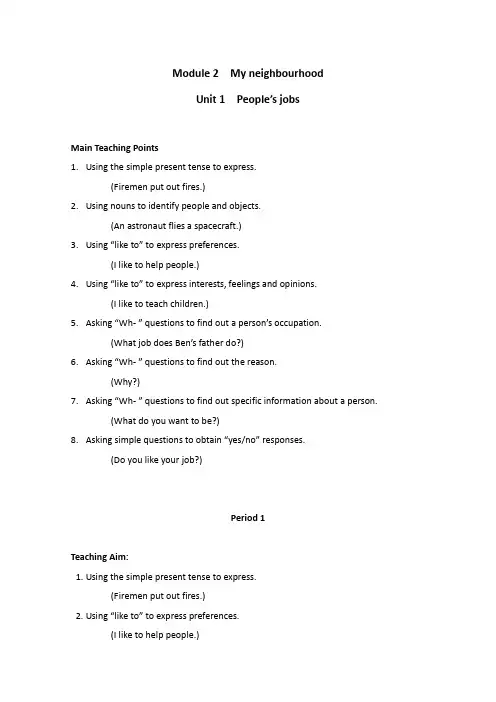
Module 2 My neighbourhoodUnit 1 People’s jobsMain Teaching Pointsing the simple present tense to express.(Firemen put out fires.)ing nouns to identify people and objects.(An astronaut flies a spacecraft.)ing “like to” to express preferenc es.(I like to help people.)ing “like to” to express interests, feelings and opinions.(I like to teach children.)5.Asking “Wh- ” questions to find out a person’s occupation.(What job does Ben’s father do?)6.Asking “Wh- ” questions to find out th e reason.(Why?)7.Asking “Wh- ” questions to find out specific information about a person.(What do you want to be?)8.Asking simple questions to obtain “yes/no” responses.(Do you like your job?)Period 1Teaching Aim:1. Using the simple present tense to express.(Firemen put out fires.)2. Using “like to” to express preferences.(I like to help people.)3. Asking “Wh- ” questions to find out a person’s occupation.(What job does Ben’s father do?)4. Asking “Wh- ” questions to find out the reason.(Why?)Teaching Materials:1.Book 6A Page 172.Cassette 6A & Cassette player3.Some photos (people & jobs)Teaching Procedure:1.Pre-task preparation: (5 minutes)Hello class, today we’ll learn Module 2 Unit 1: People’s jobs. I know actually it is too early to talk about “job” with you, but I think most of your parents have their jobs. For instance: My job is a teacher. I teach the students English. So, who can tell me what job does your father or mother do?Oh, I’ve heard a lot of jobs. Now, I’ve some questions for you to answer. (Whole class)1) Whose father is an engineer? 2) Whose mother is a public servant?3) Whose father is a business man? 4) Whose mother is a nurse?5) What does a doctor do? 6) What does an accountant do?2. While-task procedure1) Listen to the tape and answer the questions. (5 minutes)Now, let’s listen to the tape but not open your books. Think it over: Who visit Rose Garden School? (Yes, Mark’s father visits Rose Garden School. Ben and Kitty are also in this school. )Now, let’s go on listening. What are they talking about? (They are talking about Mark’s father’s job)2) Let the students open the books and talk about the pictures and then do T/F question on Page 17 below. (10 minutes)Now, open your books and turn to page 17.1. What job does Mark’s father do? (He is a fireman.)2. What does he usually do? (He usually drives a fire-engine and put out fires.)3. Does Mark’s father like his job? (Yes, he does.)4. Why? (Because he likes to help people and put out fires.)3) Read after the tape twice. (5 minutes)4) Explain some useful words and phrases. (5 minutes)a. put out firesb.fire-engine &firemanc. Firemen put out fires.d. What job does Ben’s fathe r do?3. Post-task activity (10 minutes)Now, it’s your turn. I’ll give you 3 minutes to prepare. Make a dialogue about jobs (whether your parents/uncle/auntie/brother/sister) but use the patterns and phrases we’ve learnt just now.4.HomeworkWorkbook Page 8。
教案:牛津上海版英语六年级第二册Module1Unit
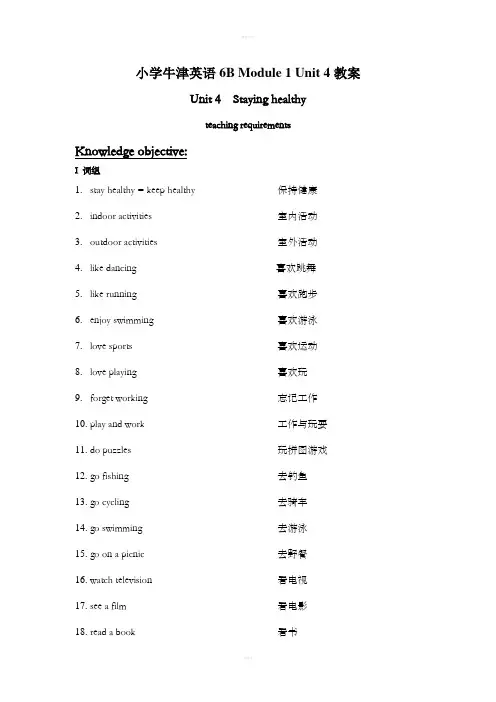
小学牛津英语6B Module 1 Unit 4教案Unit 4 Staying healthyteaching requirements Knowledge objective:I 词组1.stay healthy = keep healthy 保持健康2.indoor activities 室内活动3.outdoor activities 室外活动4.like dancing 喜欢跳舞5.like running 喜欢跑步6.enjoy swimming 喜欢游泳7.love sports 喜欢运动8.love playing 喜欢玩9.forget working 忘记工作10.play and work 工作与玩耍11.do puzzles 玩拼图游戏12.go fishing 去钓鱼13.go cycling 去骑车14.go swimming 去游泳15.go on a picnic 去野餐16.watch television 看电视17.see a film 看电影18.read a book 看书19.play computer games 玩电脑游戏20.play tennis / badminton 打网球/羽毛球21.play basketball in the playground 在操场上打篮球22.play the piano 弹钢琴23.make a model 制作模型24.have a barbecue 进行一次烧烤25.fly kites 放风筝26.health problem 健康问题27.have a headache 头疼28.have a stomach ache 肚子疼29.have a cold 感冒30.have a fever 发烧31.have a sore throat 喉咙疼32.have toothache 牙疼(注意没有“a”)33.I’m afraid 恐怕(表示婉转语气)34.too much + 不可数名词太多35.too many + 可数名词36.too little+ 不可数名词太少37.too few + 可数名词38.watch too much television 看太多的电视(*watch television for too long)39.watch less television 看少一点电视40.wear enough clothes 穿足够多的衣服41.*put on 穿上42.wear more clothes 穿更多的衣服43.eat too much spicy food 吃太多的辛辣食物44.have exercise 做运动45.once a day 一天一次46.twice a week 一周两次47.three times a month 一个月三次48.go to bed late 晚睡49.go to bed early 早睡50.practise swimming 练习游泳51.*practise doing sth. 练习做某事52.help do the housework 帮助做家务53.*help sb. (to) do sth./ help sb. with sth. 帮助某人做某事II. 词性转换1.act (v.) — activity (n.)— activities (pl.) — *active (a.)e.g. We take part in all kinds of activities.He is very active in class.2.health (n.) — healthy (adj.) — unhealthy (a.)e.g. Health is the most important thing.You should eat healthy food.Eating too much ice cream is unhealthy.3.real (adj.) — really (adv.)e.g. It’s really cold today.He who doesn't reach the Great Wall is not a real man.4.tooth (n.) — teeth (pl.) —toothachee.g. Too much sweet food is bad for your teeth and you’ll have toothache.5.fun (n.)—* funny (a.)e.g. The children had fun at the beach yesterday.It’s a funny story.6.many/much (a. ad.) —moree.g. You should drink more water.7.little — less; few — fewere.g. You should watch less television.8.one — once; two — twicee.g. I go to school once a week.III. 语言点/句型1. stay1) *stay healthystay保持,相当于keep, 后接形容词2) stay with his cousinstay逗留2. like / love / enjoy + doing1) enjoy后加名词或动名词e.g. Tom enjoys the film.He enjoys running.* enjoy oneself = have a good time 玩得高兴2) like to do / like doing前者强调某一具体行为,后者则强调抽象概念或某一类事物e.g. I like to read his novel.I like reading.3. forget doing sth. 忘记做过某事*forget to do sth.忘记去做某事e.g. He forgot to close the window.I will never forget my 14th birthday.* remember to do sth. 记得去做某事*remember doing sth.记得做过某事4. play basketball; play the piano球类运动前不加the, 而乐器前要加the5. favourite (adj.) = like…best 最喜爱e.g. I like doing puzzles best. = Doing puzzles is my favourite.6. 用动名词来表述一些活动的名称e.g. swimming, making a model7. --- Why do I always have a headache?--- It’s because you watch too much television, I’m afraid.1) 对because引导的从句,只要求理解和模仿操练,不做语法分析。
Module1Unit2Changesinourlives(教案)牛津上海版(三起)英语六年级下册
2.引导与启发:在讨论过程中,我将作为一个引导者,帮助学生发现问题、分析问题并解决问题。我会提出一些开放性的问题来启发他们的思考。
3.成果分享:每个小组将选择一名代表来分享他们的讨论成果。这些成果将被记录在黑板上或投影仪上,以便全班都能看到。
五、总结回顾(用时5分钟)
内容:今天的学习,我们了解了描述变化的语言表达方式和句型的基本概念、重要性和应用。同时,我们也通过实践活动和小组讨论加深了对这些知识点的理解。我希望大家能够掌握这些知识点,并在日常生活中灵活运用。最后,如果有任何疑问或不明白的地方,请随时向我提问。
2.文化意识:学生将能够了解和尊重不同年龄段的人可能发生的变化,培养自己的文化敏感性和包容性。
3.思维品质:学生将通过观察和描述自己的变化,提高自己的观察力和表达能力,培养自己的批判性思维和创造性思维。
4.学习能力:学生将能够运用所学知识,通过观察和描述自己的变化,提高自己的自主学习能力和合作学习能力。
2.学生参与度:在小组讨论和分享环节,部分学生参与度不高,需要采取措施激发学生的参与兴趣。
3.评价方式:目前的评价方式可能过于注重学生的语言表达,而忽视了学生的观察能力和团队合作能力的评价,需要进一步完善评价方式。
(三)改进措施
1.增加词汇和句型的练习:通过增加词汇和句型的练习,帮助学生巩固所学知识,提高学生的语言表达能力。
教学难点与重点
1Байду номын сангаас教学重点:
本节课的核心内容是让学生掌握描述生活中变化的语言表达方式,并能够运用这些表达方式描述自己和他人的外貌、性格和兴趣等方面的变化。具体来说,学生需要能够使用以下词汇和句型来描述变化:
六年级下册英语Module 1 Unit 3 Our school in the future 牛津上海版(三起)
(1)I got up at about 6 in the morning last Saturday. ( F ) (2)I did some exercise last Sunday. ( F ) (3)I made some egg pies by myself. ( T ) (4)We played cards last Sunday. ( T ) (5)Mike was so sad. (T )
Sally's school is big. The playground is big. Students can run and play there. The library is big and new. Students can read all kinds of books in it. There is a garden. But it is very small.
A. will gives
B. will give
C. gives
5. In the future, school will __C__ different.
A. is
B. are
C. be
6. Robot will help us __A__ books in the library.
A. find
wing
6. bank
back
7. in
ink
8. seem
sing
Play a game
watch TV
go shopping
sing songs
take photos
every day yesterday next week now
I
they
he
六年级英语下册 6B Module1 Unit3(6)教案 沪教牛津版

While-task procedure
Post-task activity
Assignment
1.Look and read.
2. Write
1. Photocopible Page 22,23,24
Read and write.
Listen to the tape.
1.Reading
2.Daily talk:
Revision:
Water in Garden City.
Look and say.
Ps
T--P
Read the text.
How does water from other places come to our homes?
Where do we use water?
Water comes from the sea.
Difficult Points: Where does rain come from?
Teaching Aids:tape、 radio 、word cards.
Procedures
Contents
Methods
Purpose
Warming
up
Pre-task preparation
Retell the text.
T: Where does r clouds.
T: Where does it come from first?
Let’s look at this poster.
日常会话的操练,有助于帮助学习有困难的学生增加自信心。
e.g. Excuse me , Mr. Hu. Where does rain come from?
小学英语牛津上海版六年级下册《Module 1 2 Changes in our lives》教案
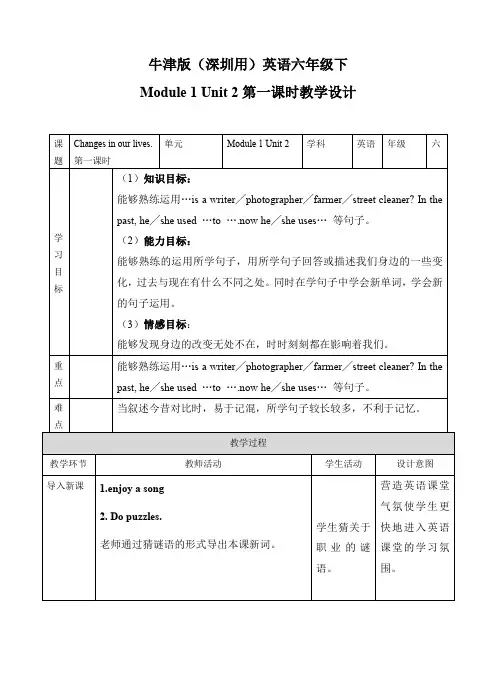
(1)老师一部分一部分的出示本课文本,通过回答问题的形式了解文本内容,并讲解文本。
(2)学生根据文本内容完成表格。
二、Practice
1.Pair works
老师出示Useful vocabulary和图片,根据所学内容,通过小组讨论的形式完成新文本。
2.完成幻灯片中相应的课堂练习。
难点
当叙述今昔对比时,易于记混,所学句子较长较多,不利于记忆。
教学过程
教学环节
教师活动
学生活动
设计意图
导入新课
1.enjoy a song
2.Do puzzles.
老师通过猜谜语的形式导出本课新词。
学生猜关于职业的谜语。
营造英语课堂气氛使学生更快地进入英语课堂的学习氛围。
讲授新课
一、Presentation.
1.Look and learn.
(1)单词学习
(2)老师讲解加-er变职业名称的动词。
2. Free talk.
老师出示今昔对比的图片,让学生用以前所学的知识描述图片。注意时态
3.Let’s learn.
老师继续出示今昔对比的图片,并讲解use…(工具)to…(干什么)用什么工具做什么事,鼓励学生用此结构描述图片。
(2)能力目标:
能够熟练的运用所学句子,用所学句子回答或描述我们身边的一些变化,过去与现在有什么不同之处。同时在学句子中学会新单词,学会新的句子运用。
(3)情感目标:
能够发现身边的改变无处不在,时时刻刻都在影响着我们。
重点
能够熟练运用…is awriter╱photographer╱farmer╱street cleaner? In the past,he╱she used…to….now he╱she uses…等句子。
教案牛津上海版英语六年级第二册 Module 1 Unit 3
小学牛津英语6B Module 1 Unit 3教案Unit 3 Dragon Boat Festivalteaching requirementsKnowledge objective:I 词组: Module 1 Unit 3语法重点:1. 一般过去时:a.概念:表示过去发生的动作或存在的状态。
b.常用的时间状语:yesterday, last week/year…, in the past, …ago, in 2005, just now…c.结构:主语+动词的过去式+…e.g. He watched TV yesterday evening. 否定:He didn’t watch TV yesterday evening.d.动词过去式的构成:规则变化:1)一般情况下在动词词尾直接加-ed. e.g. jump——jumped;2)以不发音的e结尾的动词直接加-d. e.g. love ——loved3)以辅音字母加y结尾的动词,去y变i+ed; e.g. study——studied4)以重读闭音节结尾,且词尾只有一个辅音字母的动词,双写最后一个辅音字母,再加-ed. e.g. stop——stopped不规则变化:参见教材P1032. 词性转换●celebrate v. 庆祝*celebration n. 庆祝●(be) born v. 出生bear v. 生⏹ e.g. Alice was born in London in 2005.●country n.. 国家; 乡下countryside n. 郊外,郊野●advice n.. 劝告; 忠告advise v. 劝告, 忠告, 建议●sad adj. 悲伤的sadly adv. 悲伤地sadness n. 伤心,难过●die v. 死; 死亡dead adj. 死的death n. 死亡●later adv. 以后; 后来late adj. 迟的/ adv. 迟,晚⏹ e.g. 5 minutes later 5分钟以后The boy was 5 minutes late.迟到了5分钟●lose v. (lost, lost)输掉lost adj. 失去的,迷失的⏹ e.g. I found my lost pen at last. 最后我找到了我丢失的钢笔。
牛津上海版英语六年级上册Module1Unit3period2课时教学设计
3.能够听懂、会说、会读、会写本课时所学的句子,如:“What's this/that? It's a ... Look at ... It's ... It can ...”
4.提高学生的英语阅读理解能力,通过阅读课文,理解文章大意,获取关键信息。
(3)提高学生的英语阅读理解能力,理解课文大意,获取关键信息。
(4)培养学生在真实语境中运用英语进行交际的能力。
2.难点:
(1)正确运用一般现在时描述动物的特征和动作。
(2)在口语和写作中,灵活运用本课时所学的词汇和句型。
(3)提高学生的阅读理解能力,尤其是对文章细节的理解。
(二)教学设想
1.采用情景教学法,利用图片、视频等多媒体资源,创设生动、直观的教学情境,让学生在真实语境中学习英语,提高他们的语言感知能力。
3.通过听力、口语、阅读、写作等多种教学活动,提高学生的英语综合运用能力。
4.鼓励学生主动参与课堂,积极思考,培养自主学习能力。
5.教师及时给予学生反馈,指导学生改进学习方法,提高学习效率。
(三)情感态度与价值观
在本课时中,学生应形成以下情感态度与价值观:
1.培养学生对动物的兴趣和热爱,增强保护动物、关爱大自然的意识。
1.学生在五、六年级上学期已经掌握了基本的英语语法、词汇和句型,具备一定的英语听说读写能力。在此基础上,本课时将进一步拓展学生的词汇量和语法知识,提高学生的语言运用能力。
2.六年级学生正处于青春期,好奇心强,对新鲜事物充满兴趣。通过本课时的动物主题,可以激发学生的学习热情,培养他们的观察力、思维力和想象力。
六年级英语下册 6B Module1 Unit3(2)教案 沪教牛津版
First,…
Then,…
Next,…
Finally,…
Workbook page 9
1.Read and recite the text.
2.Copy the new words.
通过图示,让学生理解课文主要内容。
说说做做,让学生在读写中进一步掌握first,then,next,finally的用法。
First, they went for a swim.
Difficult Points: I need a drink of water.
Teaching Aids:tape、 radio 、word cards.
Procedures
Contents
Methods
Purpose
Warming
up
Pre-task preparation
1. Give students time in class todo the matching/sequencing activity. Give assistance to the less able students.
2. Invite students to read out individual sections in the proper order.
Assignment
1. Match
2.Exercises
Read and write.
3 Play the recording again. Students listen and repeat.
4 Ask: What was the weather like? and other questions about the story to check for comprehension.
牛津上海版英语六年级上册Module1Unit2period3课时教学设计
-利用图片、视频等直观教具,展示不同学生的日常活动,激发学生的兴趣,为新课内容做铺垫。
-通过提问方式引导学生回顾一般现在时的基本用法,为新学习的频率副词做好知识衔接。
2.新课呈现:
-采用任务型教学法,设计小组活动,让学生在完成任务的实践中学习新词汇和句型。
-创设情境,让学生在真实语境中观察、模仿、练习频率副词的使用,注意句子结构的准确性。
3.操练环节:
-设计多样的口语练习,如角色扮演、小组讨论等,让学生在不同的情境中反复练习频率副词和日常活动描述。
-利用互动式白板等教学工具,设计互动游戏,巩固词汇和语法知识。
4.应用环节:
-鼓励学生运用所学,创作自己的日常活动描述,并进行课堂分享,提高学生的语言运用能力。
-设计“我的日常活动”海报,让学生通过图文结合的方式展示个人生活,增强学习的实践性。
- T: “I always do my homework in the evening. How about you?”
- S: “I often read books before going to bed.”
4.教师组织学生进行听力练习,听懂并模仿关于日常活动的对话,关注频率副词的使用。
(三)学生小组讨论
提交形式:书面作业,附上摘抄内容和阅读心得。
作Байду номын сангаас布置注意事项:
1.作业难度适中,既要巩固课堂所学,又要激发学生的学习兴趣。
2.鼓励学生发挥创意,将所学知识运用到实际生活场景中。
3.作业布置要注重培养学生的合作精神,鼓励家长参与,增进家校互动。
4.教师应及时检查作业,给予反馈,指导学生提高语言表达能力。
提交形式:书面作业,可附带录音。