
【PEP人教版五年级英语上册教案】Unit 2 My week第四课时
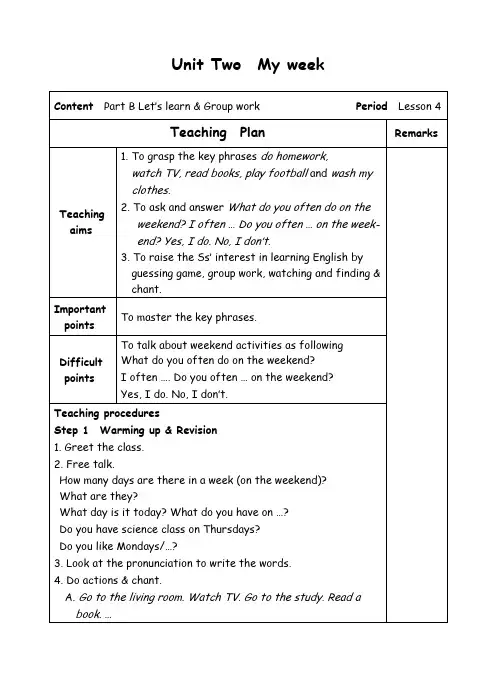
第四课时一、课时内容教科书第18页:B. Let’s learn. Group work二、课时分析本课时是义务教育灵通版(pep)小学英语教科书五年级上册的第二单元第四课时,围绕“My week.”这个话题展开内容。
包括Let’s learn和Group work两个板块。
Let’s learn是基础板块,呈现了有关学生日常活动的五个动词短语及图片,以及Amy与Chen Jie两个人的问答对话。
其中read books和play football是在上一课时学生们已经学过的动词短语,在这里再次重点呈现,显示他们是本单元要求四会的重点内容,do homework在上一课时的听力训练中也呈现过,学生们不陌生,另外还有wash my clothes和watch TV也是学生们日常生活中自己经常做得事情,因此,学生们在接受这些新短语时,情绪会很激动、很兴奋,完全适应小学生的心理需求,教师在合理安排一些游戏活动,教学效果必然得心应手,事半功倍。
重点句型呈现的是Do you often wash your clothes on the weekend? Yes, I do.这是以助动词都开头的一般疑问句以及肯定回答形式。
学生们可以借助图卡或词卡训练替换句型中的动词短语部分,进行交替问答活动。
Group work是关于Let’s learn内容的拓展训练板块。
是以小组游戏形式介绍自己在周末经常做的一些日常活动。
训练句型模式是:I often do homework, read books, watch TV and draw pictures on the weekend. / I often wash my clothes, clean my room and play the pipa on the weekend. / I often read books on the weekend. 这三句话均是陈述句,第一、二句话是陈述多种活动的表达方式,即前面几个动词短语并列呈现用“,”隔开,后面两个用“and”连接;第三句话只陈述一个活动,中间能够“,”隔开。
通过模仿这些句型进行模仿表达,熟练之后,学生们会一连串的说出更多的日常活动内容,这正是本题材设计要求达到的目的与效果。
本课时要求重点掌握五个动词短语,一组以句首为助动词do的问答句型,和一组自我介绍周末日常活动安排的陈述句,要求学生能够准确掌握词句的正确发音和在日常生活中的熟练运用。
我准备利用多媒体展示网络动画课件,以刺激学生们的视、听感觉,精心制作PPT 课件,适当制作微课视频,满足学生们的需求,教师创造趣味游戏多样化,准备丰富多彩的周末日场活动图片,以帮助学生熟练掌握并能灵活运用核心句型为目的,引导学生加强积极使用英语对话交流的意识,培养良好的交际习惯,树立学生们学好英语的自信心。
三、课时目标1.能够会听、说、读、写五个重点动词短语:wash my clothes, watch TV, do homework, read books, play football。
能够会用适当的动词短语描述周末日常活动。
2.能够会听、说、读、写重点问答句型:Do you often wash your clothes on the weekend? …Yes,I do./ No, I don’t. 能够灵活运用该问答句型实现真实生活中的正常交际。
3.能够顺利完成自我描述周末日常活动项目。
4.能够积极参与课堂中的各种演练活动,并完成各种训练任务。
5.能够合理安排自己的学习时间和日常生活活动,加强体育锻炼,做到有张有弛,劳逸结合。
四、课时重难点1.重点(1)能够会听、说、读、写五个重点动词短语:wash my clothes, watch TV, do homework, read books, play football。
(2)能够会听、说、读、写重点问答句型:Do you often wash your clothes on the weekend? …Yes,I do./ No, I don’t.2.难点(1)能够会用适当的动词短语描述周末日常活动。
(2)能够灵活运用重点问答句型实现真实生活中的正常交际。
(3)能够积极参与课堂中的各种演练活动,并完成各种训练任务。
五、教学准备网络资源动画课件,自制PPT课件,微视频课件,打印几套动词短语词卡、图卡及相关头饰。
六、教学过程1.课前热身(1)播放歌曲《Days of the week》,学生们跟唱英语歌。
(2)师生互动猜谜语问答游戏。
①教师请学生代表表演动作提示活动项目,用手指示意星期几,教师根据学生代表的表演和手语进行猜测并用一般疑问句进行试问,学生代表做出肯定或否定回答。
例如:S:T:Do you often play ping-pong on Saturdays?S:No, I don’t.T:Do you often play football on Saturdays?S:Yes. I do.S:T:Do you play ping-pong on Wednesdays?S:No, I don’t.T:Do you read books on Wednesdays?S:Yes, I do.②按照学生们的座次分组,每一列为一组,教师表演动作提示活动项目,用手指示意星期几,从第一组开始,学生们根据教师的表演和手语进行猜测并用一般疑问句进行试问,教师做出肯定或否定回答。
每一组猜对两项,就改换下一组。
例如:教师示意首先从T:Ss1:Do you often listen to music on Mondays?T:No, I don’t.Ss1:Do you often clean the room on Mondays?T:Yes, I do.T:Ss1:D o you often read books on Tuesdays?T:No, I don’t.Ss1:Do you often listeb to music on Thursdays?T:Yes, I do.教师示意请第一组学生们坐下,请第二组的学生们起立。
……设计意图:通过师生互动,猜谜语问答游戏,教师和学生们一起复习了刚刚学习到的星期几和动词短语以及重点句型,一般疑问句及其肯定回答和否定回答。
为本课时即将要学习的内容顶顶基础。
2.导入T:Well done, boys and girls. Do you want to learn more actives on the weekend?Ss:Yes!T:OK! Please look at the next pictures and read after the recording.Ss:Great!设计意图:通过师生对话,直接导入新内容,简洁明了,不拖泥带水,直接进入新授课过程,尽快满足学生们的对新内容的渴求欲望。
3. 新课呈现(1)学习Let’s learn.短语内容。
①展示PPT课件,首先展示read books(读书)和play football(踢足球)两幅图片和短语,请学生代表领读,学生齐读。
教师做读书动作,学生齐读read books;教师做起足球动作,学生齐读play football。
②然后逐一展示另外三幅图片和相关的动词短语:wash my clothes(洗衣服), watch TV(看电视), do homework(做家庭作业)。
教师带领学生正确拼读这些短语。
w-a-t-er→/ ˈwɔ:tə /; m-y→/maɪ/; cl-o-th-es→ /[kləʊðz /; water my clothes 洗衣服。
w-a-t-ch→ /wɒtʃ /; TV→ /ti: ˈvi: / ; watch TV 看电视。
d-o→ /du /; h-o-m-w-or-k→ / ˈhəʊmwɜ:k /; do homework 做家庭作业。
③熟练朗读动词短语。
教师领读,学生跟读;学生代表领读,学生跟读;教师快闪短语词卡,学生朗读;教师快闪短语图片,学生朗读。
设计意图:利用多种方式训练学生们的正确发音,学生们极感兴趣,因此能集中注意力,达到牢固记忆的最佳效果。
(2)学习Let’s learn.中的问答句型。
①播放动画课件,学生观看并模仿问答练习。
请五名学生代表自戴头饰到前台扮演角色,进行问答练习。
T:Do you often wash your clothes on the weekend?Chen Jie:Yes, I do.T:Do you often watch on the weekend?Mike:Yes, I do.T:Do you often listen to music on the weekend?Oliver:No, I don’t.T:Do you often do homework on the weekend?Oliver:Yes, I do.T:Do you often read books on the weekend?Amy:Yes, I do.T:Do you often play ping-pong on the weekend?Zhang Peng:No, I don’t.T:Do you often play football on the weekend?Zhang Peng:Yes, I do.②将全班分成六个学生一组,自己选戴头饰进行分角色练习问答对话。
③两个学生一组,抽取短语词卡,练习问答对话。
④两个学生一组,抽取图片,练习问答对话。
⑤一个学生做动作,另一个学生猜测问答。
设计意图:采用多种游戏活动,训练重点句型,学生们兴趣盎然,在轻松愉快中熟练掌握了重点句型,增强了学生们的自信心。
(3)学习Group work中的内容。
①播放录音,学生跟读。
教师领读,学生跟读。
学生自读。
②请学生代表翻译汉语意思。
What do you often do on the weekend? 在周末你经常做什么?Wu Yifan:I often do homework, read books, watch and draw pictures on the weekend.在周末我经常写家庭作业,读书,看电视和画画。
Chen Jie:I often wash my clothes, clean my room and play the pipa on the weekend.在周末我经常洗衣服,打扫房间和弹琵琶。
Oliver:I often read books on the weekend. 在周末我经常读书。
五年级上册英语优质教案-Unit2 My week-4-人教(PEP)
Unit Two My weekUnit 2 My week 第六课时教学目标1.听、说、认读单词和短语:tired,sports,should,every day,schedule,play sports。
2. 能读懂Read and write中的对话并完成后面的习题。
3. 能听懂Let's check 部分的听力,圈出对应的答案。
4. 能读懂Story time 中的故事并能从文中找出本单元所学句型。
教学重点1. 掌握从周一到周日单词的缩写形式。
2. 能听懂听力并完成课后习题。
3. 能从小对话中提取有用的信息完成练习。
教学难点1. 本课时的听力。
2. 会用英语讲述自己经常做的事情。
教学准备教师准备:1. 与本课时相关的单词卡片与图片。
2. 与本课时相关的录音和课件。
3. 本课时所需的人物图片和星期游戏大转盘。
学生准备:1.本课所需单词卡片。
2. 水彩笔和白纸。
3. 日历。
教学方法1. 合作教学法:教师把学生按自然排分组,完成Read and write,并找出吴一凡经常做的事,用动词短语来回答,把罗宾制定的计划中的活动用英语短语表达出来。
同时让学生设计自己的体育健身计划。
2. 听说领先法:教师播放Let's check 部分的听力录音,学生先听,然后利用暂停键跟读并完成习题,教师放听力原文核对答案。
3. 多媒体辅助教学法:教师把Story time 利用小动画片的形式播放给学生,让学生听到原汁原味的英语,然后,让学生选择自己喜欢的角色进行表演。
教学过程Step 1:Warm-up1. 师生进行日常问候口语练习。
2. 教师讲解作业,对学生共同易出错的地方加以讲解,指导学习。
3. 教师利用多媒体展示周一到周五的课程表,让同学记忆,然后教师快闪周一的课程表,学生说出周一都有什么课。
激发学生的兴趣,挑战学生的记忆力。
Step 2:PresentationRead and write1. 教师出示Read and write的挂图或课件,让学生说出吴一凡星期五的课程安排以及周末经常做的事情,并按照吴一凡的喜爱程度排序。
Unit 2 My week(第四课时 Part B Let’s talk) (说课稿)-2022-
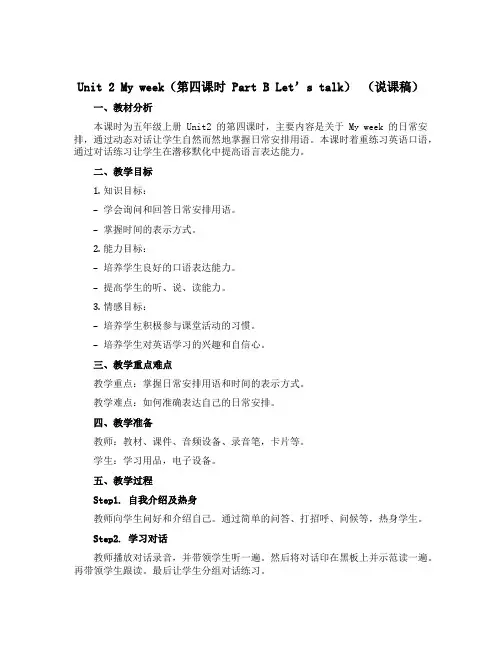
Unit 2 My week(第四课时Part B Let’s talk)(说课稿)一、教材分析本课时为五年级上册 Unit2 的第四课时,主要内容是关于 My week 的日常安排,通过动态对话让学生自然而然地掌握日常安排用语。
本课时着重练习英语口语,通过对话练习让学生在潜移默化中提高语言表达能力。
二、教学目标1.知识目标:–学会询问和回答日常安排用语。
–掌握时间的表示方式。
2.能力目标:–培养学生良好的口语表达能力。
–提高学生的听、说、读能力。
3.情感目标:–培养学生积极参与课堂活动的习惯。
–培养学生对英语学习的兴趣和自信心。
三、教学重点难点教学重点:掌握日常安排用语和时间的表示方式。
教学难点:如何准确表达自己的日常安排。
四、教学准备教师:教材、课件、音频设备、录音笔,卡片等。
学生:学习用品,电子设备。
五、教学过程Step1. 自我介绍及热身教师向学生问好和介绍自己。
通过简单的问答、打招呼、问候等,热身学生。
Step2. 学习对话教师播放对话录音,并带领学生听一遍。
然后将对话印在黑板上并示范读一遍。
再带领学生跟读。
最后让学生分组对话练习。
Step3. 卡片游戏教师将学生分成四组,每组发放手写卡片,内容包括时间和活动名称。
每个学生轮流从自己所在组中随机取一张卡片读出来,其他组的学生要根据时间和活动名称回答要做什么。
最后统计回答正确的组数进行评分。
Step4. 小组讨论将学生分为若干小组,让学生使用学过的语言自由讨论自己的一周安排,并尝试用英语表达出来。
教师在小组之间流动,帮助学生语言表达。
Step5. 总结归纳教师引导学生逐个梳理学习的过程,总结日常安排用语和时间表示的一些规律。
并在黑板上让学生一起记录下来,便于复习和巩固。
六、教学评价通过此节课的教学,学生可以更加熟练地表达自己的日常安排,提高了英语听、说、读的能力,同时也促进了学生的个性发展和团队合作意识的培养。
教师要定期进行课堂调查,通过随堂测试和课程设计来进一步评估教学效果。
五年级上册英语教案-Unit 2 My week B Let’s talk人教PEP

教材图片:Unit2 Part B Let’s talk教材:人教PEP小学英语五年级上册P17单元主题:My week课型:听说课一、教材解析本课时是五年级上册Unit2的第四课时,包含B Let’s try及B Let’s talk。
B Let’s try 是针对B Let’s talk板块的新句型Do you often ...? Yes, we do./No, we don’t.而设计的听力活动。
旨在使学生能够借助图片听懂简短对话,抓住关键信息,提高听的能力。
Let’s talk通过张鹏和Sarah周末在公园里的对话,使学生感知句型Do you often read books/..? Yes, we do./No, we don’t.的语义和语用情景。
二、目标预设1. 能够完成听录音选图片的活动。
2. 能够在图片和教师的帮助下理解对话的大意;能够按照正确的意群及语音、语调朗读并表演对话。
3. 能够在情景中运用句型Do you often read books/..? Yes, we do./No, we don’t.询问对方经常从事的周末活动并作答;能够在语境中理解词组read books, play football的意义并能正确发音。
三、重难点预设教学重点:理解并能朗读对话;在情景中运用句型Do you often read books/..? Yes, we do./No, we don’t.进行问答。
教学难点:在情景中运用句型Do you often read books/..? Yes, we do./No, we don’t.进行问答。
四、教学过程(一)热身(Warm-up)1. 师生相互问候,练习课堂口语。
2. 教师播放本单元歌曲Days of the week,学生跟唱,进行课堂热身。
3. 师生自由谈话,复习A部分所学重点句型:What do you have onMondays/Tuesdays/…?学生回答后,教师询问学生周末都有什么课?或者教师先说:我周末没有课,你们呢?周末是否有课?了解学生的周末安排。
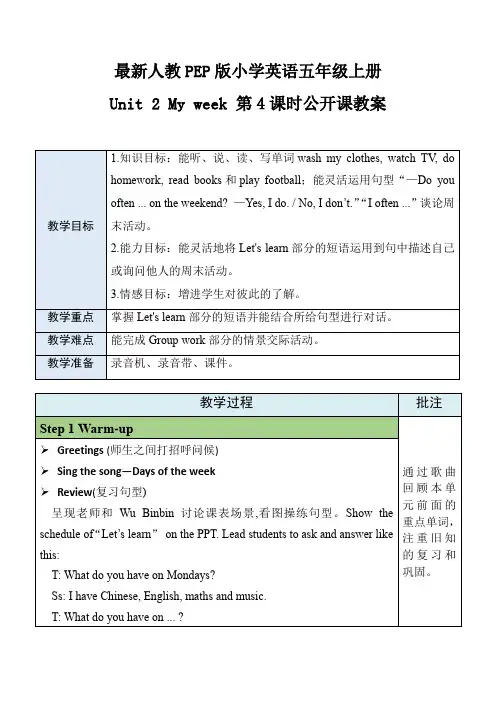
最新人教PEP版小学英语五年级上册Unit 2 My week 第4课时公开课教案
Step 4 Homework
作业:(1)Listen, read and recite thephrases.
(2)Copy thephrases.
(3)Talk to your partner after class.
教学
反思
将词组学习与句型学习有机地结合在了一起,多采取小组、结对活动,培养学生们的合作能力,提高他们的团队意识。
T:So they are days for school.How about Saturday and Sunday? Do you go to school on the weekend?
Ss:No, we don’t.
T:They are days for fun.What do you often do on the weekend?
呈现教室场景。Show the pictures of Chen Jie and Sarah in the classroom. Lo according to the different pictures.
T:Do you often wash your clothes on the weekend?
(1)教授短语play football。Teach the phrase“playfootball”. Show the picture of a teacher with the question“What do you often do on the weekend?”. Then show the picture of “play football”.Ask students to say the name of this physical activity. Lead students to speak out the phrase “play football”.Lead students to read them three times and do the corresponding actions at the same time.And say “I often play football on the weekend.” Write down the phrases “playfootball(foot+ball=football)”on the blackboard.
人教PEP英语五年级上册 Unit 2 My Week 4课时(表格式教案 )_1
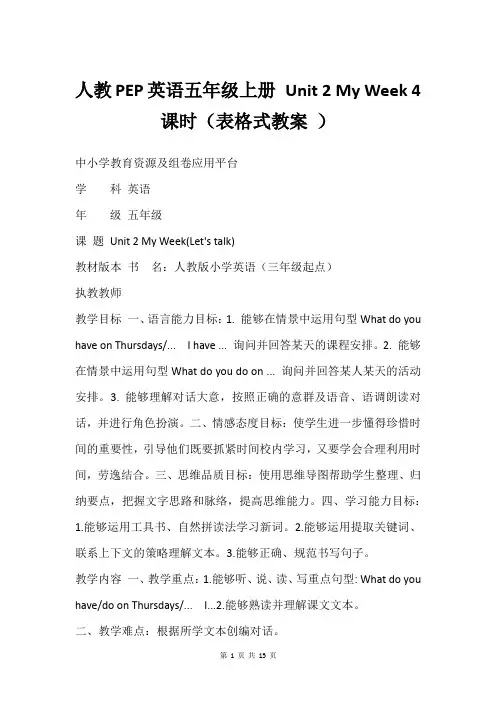
人教PEP英语五年级上册Unit 2 My Week 4课时(表格式教案)中小学教育资源及组卷应用平台学科英语年级五年级课题Unit 2 My Week(Let's talk)教材版本书名:人教版小学英语(三年级起点)执教教师教学目标一、语言能力目标:1. 能够在情景中运用句型What do you have on Thursdays/... I have ... 询问并回答某天的课程安排。
2. 能够在情景中运用句型What do you do on ... 询问并回答某人某天的活动安排。
3. 能够理解对话大意,按照正确的意群及语音、语调朗读对话,并进行角色扮演。
二、情感态度目标:使学生进一步懂得珍惜时间的重要性,引导他们既要抓紧时间校内学习,又要学会合理利用时间,劳逸结合。
三、思维品质目标:使用思维导图帮助学生整理、归纳要点,把握文字思路和脉络,提高思维能力。
四、学习能力目标:1.能够运用工具书、自然拼读法学习新词。
2.能够运用提取关键词、联系上下文的策略理解文本。
3.能够正确、规范书写句子。
教学内容一、教学重点:1.能够听、说、读、写重点句型: What do you have/do on Thursdays/... I...2.能够熟读并理解课文文本。
二、教学难点:根据所学文本创编对话。
教学过程(微课语音与PPT脚本,不超过15分钟)教学流程脚本内容1.提示课题P1-3 主题页 1.Greeting and teacher’s self introduction.2.Talk about “What’s your favourite day ” “What classes do you have ” (看课表)“What classes do you have on Wednesdays ”【设计意图】:通过老师自我介绍,看课表等活动,引导学生谈论本课主题:“My Week”既为新知做好铺垫,同时激发学生主动学习的热情。
人教PEP版英语五年级上册Unit 2《My week》教案

人教PEP版英语五年级上册Unit 2《My week》教案一. 教材分析人教PEP版英语五年级上册Unit 2《My week》主要讲述了一周的日常活动和表达喜好。
通过本单元的学习,学生可以掌握关于日常活动的词汇,如draw, play chess, read books等,以及表达喜好用的句型“I like…”。
同时,学生还可以通过本单元的学习,提高听说读写的能力,培养良好的学习习惯。
二. 学情分析五年级的学生已经具备了一定的英语基础,能够听懂并运用简单的英语进行交流。
但部分学生对英语学习的兴趣有待提高,因此,在教学过程中,需要注重激发学生的学习兴趣,提高他们的学习积极性。
三. 教学目标1.知识目标:学生能够掌握关于日常活动的词汇,如draw, play chess,read books等,以及表达喜好用的句型“I like…”。
2.能力目标:学生能够听懂、会说、会读、会写本单元的生词和句型,提高英语综合运用能力。
3.情感目标:通过本单元的学习,培养学生热爱生活、积极向上的态度。
四. 教学重难点1.重点:掌握关于日常活动的词汇,如draw, play chess, read books等,以及表达喜好用的句型“I like…”。
2.难点:正确运用句型“I like…”表达自己的喜好。
五. 教学方法采用情境教学法、任务型教学法和分组合作学习法。
通过设置真实的生活情境,引导学生参与各种活动,激发学生的学习兴趣;通过完成任务,提高学生的实践能力;通过分组合作学习,培养学生的团队协作精神。
六. 教学准备1.教具准备:课件、图片、卡片、实物等。
2.教学环境:教室。
七. 教学过程1.导入(5分钟)利用课件展示一幅一周活动的图片,引导学生谈论自己的一周活动,激发学生的学习兴趣。
2.呈现(10分钟)教师通过课件展示本课的生词和句型,如draw, play chess, read books, I like…等,并用生动的语言和动作进行讲解,让学生初步感知和理解。
五年级英语上册Unit2Myweek第四课时教案人教PEP
The fourth period(第四课时)Part BLet’s try & Let’s talk▶教学内容与目标课时教学内容课时教学目标Let’s try ·学生能够借助图片听懂简短对话,抓住关键信息,提高听的能力·学生能够对新句型在听觉上有所感知,并完成听录音选图的活动Let’s talk ·学生能够在图片和教师的帮助下理解对话大意·学生能够按照正确的意群及语音、语调朗读对话,并能够进行角色扮演·学生能够在情景中恰当运用句型“—Do you often read books/…? —Yes, I do./No, I don’t.”询问对方经常从事的周末活动并作答·学生能够在语境中理解词组“read books, play football”的意思,并能够正确发音学生能够掌握询问对方经常从事的周末活动的一般疑问句及其答语“—Do you often read books/…? —Yes, I do./No, I don’t.”.▶教学难点学生能够在真实情景中用核心句型询问对方经常从事的周末活动并作答.▶教学准备1. 预习《状元大课堂》《创优作业100分》《状元作业本》中本课时的相关内容.2. PPT课件、课文录音、视频、卡片等.▶教学过程Step 1: Warm-up & Revision & Lead-in1. Greetings.2. Enjoy the song—Days of the week. (出示课件)3. Free talk.T: What do you have on Mondays? Ss: We have…T: What do you have on Fridays? Ss: We have…T: I have no classes on Sunday and Saturday. What about you?…Show some pictures about different activities on the PPT to lead students to talk about their weekend activities. (出示课件)4. Lead-in.Show a picture about Zhang Peng and Oliver. They are making a phone call in the picture. (出示课件)T: It’s a Saturday morning. Zhang Peng calls Oliver. What are they talking about? Let’s go and see.Teaching purpose通过歌曲复习巩固之前所学的有关星期的知识,对话交流部分对今天要学的知识进行预热,对整个课堂起到承上启下的作用.3Step 2: Presentation1. Let’s try.(1)Show the pictures of “Let’s try” on the PPT. (出示课件)Ask students to observe the pictures carefully. Then let them try to describe the two pictures briefly. Lead students to talk about the pictures from two aspects. First, try to introduce the characters in the pictures, then try to describe the activities they do in the pictures. They can describe like these: I can see Oliver in Picture 1. He cleans his room in the picture./They are Oliver and another boy in Picture 2. They play football in this picture.T: From these pictures, can you guess what they are talking about?S1: Maybe they are talking about their weekend.S2: Maybe they are talking about their activities.…T: Does Oliver do both the activities in these two pictures?…T: We have different opinions. Please listen to the recording carefully and try to know what they are talking about and what Oliver does exactly.(2)Play the recording of “Let’s try” for the first time. (出示课件) Let students try to get the key information: play football, sorry, clean my room, on Saturdays, yes.(3)Then play the recording again. (出示课件) Let students try to listen and tick the right picture about Oliver’s weekend.(4)Check the answer. And check the guesses before.T: Now we know that they are talking about their activities on the weekend. Oliver doesn’t do both the activities. He doesn’t play football with Zhang Peng. He often cleans his room on Saturdays.Show the listening material and the answer of “Let’s try”. (出示课件) Lead students to read the dialogue.2. Let’s talk.Show a picture of some children playing in the park. (出示课件) T: It’s Saturday morning now. Some children are playing in the park. Let’s have a look.(1)Learn the new words and phrases.①Show a picture on the PPT: A girl reads a book in the park. (出示课件)T: Where is the girl?Lead students to say the sentence: She is in a park. Write down the word “park” on the blackboard. Lead students to read it three times. Then point to the book in the picture.T: What’s this? Ss: It’s a book.T: What does she do on Saturday morning? Teaching purpose在学习新课之前,利用图片和对话先熟悉本课的重点单词、词组和句型,为后面的学习打下基础. Teaching purpose通过问题引导学生在听录音之前先看图,了解图片和对话背景,预测听力内容,帮助学生借助图片听懂简短的对话,抓住关键信息,加强学生的听力技巧训练,提高听的能力.Lead students to say the sentence: She reads books on Saturday morning.Write down the phrase “read books” on the blackboard. Lead students to read it three times.T: Do you often read books on the weekend? Yes or no? Pay attention to the word “often”. It means “many times”.Ss: Yes./No.T: Please ask me the two questions.Ss: Do you often read books on the weekend? Yes or no?T: Yes, I do. I often read books on the weekend. We should read more books.②Show a picture on the PPT: A boy plays football in the park. (出示课件)T: What’s this? (Point to the football.)Ss: It’s a ball/football.T: It is a football. What does he do on Saturday morning?Lead students to say the sentence: He plays football on Saturday morning.Write down the phrase “play football” on the blackboard. Lead students to read it three times.T: Do you often play football on the weekend? Yes or no?Ss: Yes./No.T: Please ask me the two questions.Ss: Do you often play football on the weekend? Yes or no?T: No, I don’t. I often read books on the weekend. I should playsports on the weekend.(2)Learn the dialogue.①Show the picture of Zhang Peng and Sarah in “Let’s talk”. (出示课件)T: Now, it is Saturday afternoon. Look! Who are in the park now?Ss: Zhang Peng and Sarah.T: What else can you see? What are in their hands?Ss: I can see a football in Zhang Peng’s hand and a storybook in Sarah’s hands.T: Excellent! What are they talking about? Are they talking about their classes?Encourage students to guess the answers.②Play the video of “Let’s talk”. (出示课件) Let students watch the video and check their predictions. After students watch the video, ask the questions again. Lead students to provide the right answers: No, they are not talking about their classes. They are talking about their weekends.③Show three questions on the PPT. Teaching purpose在教授对话之前,引导学生先观察图片,对对话的内容进行预测.从猜、听、说、读等方面训练学生的英语能力.通过完成各项任务,逐步加深学生对课文内容的理解.5Play the video of “Let’s talk” again. (出示课件) Let students watch carefully and try to answer these questions.Ask three students to stand up and answer these questions one by one. Show the answers on the PPT. Check the answers together.Answers:(3)Read and act.①Let students read after the recording sentence by sentence and try to imitate the intonation and the pronunciation of the recording. Then let them read freely.②Let students practice the dialogue in pairs.③Ask several pairs to role-play the dialogue. Each pair that doesa good job can get two word cards.Step 3: Practice1. Listen and fill in the blanks.Show the dialogue of “Let’s talk” with some blanks on the PPT.Then play the recording. (出示课件) Students try to listen and fill in the blanks to complete the dialogue. They can write the answers in their notebooks. If they can’t write down the answers, the teacher can play the recording one more time.Display several students’ answers. Check and correct the mistakes together. Choose the best work. Give a word card to the student as an award.Show the answers on the PPT. (出示课件) Ask students to check and correct their answers. Then let them read the dialogue together once. Teaching purpose由机械训练递进到学生根据指令进行替换练习,逐步锻炼学生的学习能力以及对所学英语知识进行运用的能力.2. The turntable game. (出示课件)(游戏说明:转盘上呈现一些不同活动的图片和词组,如:read books, clean the room, play football, cook dinner, drink tea.一名学生喊“Start!”,老师点击鼠标,指针开始转动,该学生喊“Stop!”,老师再次点击鼠标,指针停止转动.其他学生根据指针所指的图片和词组,使用句型“Do you often…on the weekend?”提问该学生.该学生根据自己的实际情况用“Yes, I do./No, I don’t.”进行回答.)Step 4: Consolidation & Extension1. Ask and answer.Show the picture of “Ask and answer” and the sentence patterns“—Do you often…on the weekend? —Yes, I do./No, I don’t.” (出示课件) Ask two students to read the dialogue between Sarah and ChenJie. Then let students work in pairs. Ask students to try to use thephrases and the sentence patterns on the PPT to make new dialogues.Encourage students to think of more phrases to make their own dialogues.Make a model with one student.T: Do you often play basketball on the weekend?S1: Yes, I do./No, I don’t.2. Show time.Ask several pairs to stand up and show their work. Give each pairfour word cards as awards.3. Emotional education.Ask students to try to cherish their time, read more and do moreexercise.▶板书设计▶作业设计1. Practice the dialogue.2. Do the exercises. (见“状元成才路”系列丛书《创优作业100分》或《状元作业本》对应课时作业) ▶教学反思1. 在进行听力活动和对话学习之前,都让学生对所学内容进行预测.给出问题,让学生带着问题去听听力、阅读对话,让学生明确了学习目的,同时提高了学生的学习积极性和主动性.2. 本课各个环节的设计循序渐进,环环相扣,让学生们很自然地跟随节奏,掌握新知.3. 本课结对活动较多,加强了学生之间的合作能力,各种表演活动让学生在表现自己的同时有效地感知和掌握目标语言.4. 课堂气氛积极活跃,时刻注意吸引学生的注意力,提高他们的学习兴趣.5. 板书简洁清晰,重点突出,一目了然.▶Teaching Contents & Teaching AimsTeaching purpose拓展部分让学生先根据指定内容创编对话,然后自己想更多的词组来创编自己的对话,使所学的知识得到串联和升华.适时的情感教育能帮助学生树立正确的价值观,合理安排自己的时间.7Let’s try·Be able to understand the dialogue with the help of the pictures, grasp the key information and improve their listening abilities.·Be able to perceive the new sentence patterns and complete the activity of listening to the recording to select the picture.Let’s talk·Be able to understand the main idea of the dialogue with the help of the pictures and the teacher.·Be able to read the dialogue according to the right sense group, pronunciation and intonation, and role-play.·Be able to ask and answer questions about one’s weekend activities by using the sentence patterns “—Do you often read books/…? —Yes, I do./No, I don’t.”· Be able to understand the phrases “read books”and “play football” and pronounce them correctly. ▶Teaching Priorities·Be able to master the sentence patterns “—Do you often read books/…? —Yes, I do./No, I don’t.”▶Teaching Difficulties·Be able to ask about weekend activities in real situations and give appropriate answers.▶Teaching Procedures9(续表)。
人教PEP五年级英语上册《Unit2 my week》教案
《Unit2 my week》教案教学目标1. 掌握A、B部分“Let’s learn”,“Let’s talk”中的词汇和句子。
2. 能听、说、读、写关于星期和日常活动的相关问题并能正确回答。
3. 锻炼学生听、说、读、写单词的能力,初步培养学生快速记词、写词的技能。
4. 学会与同学谈论星期和课程。
5. 能听、说、读、写本单词的四会词语。
6. 能读懂“Story time”部分的趣味故事。
7. 能听懂、会唱歌曲“Days of the week”。
8. 操练和掌握长元音/i:/的发音。
9. 培养学生热爱学习、珍惜时间的良好品质。
10. 教育学生要根据课程表合理安排日常活动。
11. 引导学生积极利用所学的英语知识谈论日常活动的安排情况。
教学重点1. 掌握A、B部分“Let’s learn”,“Let’s talk”中的词汇和句子。
2. 能灵活运用本单元的主要句型谈论星期和课程。
教学难点1. 比较和区分短元音/i/和长元音/i:/,能发准音、发好音。
2. 培养学生热爱学习、珍惜时间的良好品质。
教学安排第一课时:A. Let’s learn A. Let’s play第二课时:A. Let’s try A. Let’s talk第三课时:B. Let’s learn B. Group work第四课时:B. Let’s try B. Let’s talk第五课时:A. Let’s spell B. Let’s wrap it up第六课时:B. Read and write B. Let’s check C. Story timePeriod1课时目标1. 能听、说、读、写单词“Monday”,“Tuesday”,“Wednesday”,“Thursday”,“Friday”,“Saturday”,“Sunday”和“w eekend”。
2. 能在创设的实际情景中灵活运用句型“What do you have on …?”,“I have …”。
人教版PEP五年级上册英语《Unit 2My week第四课时》教案
人教版PEP五年级上册英语《Unit 2My week第四课时》教案一. 教材分析人教版PEP五年级上册英语《Unit 2 My week》第四课时主要内容为故事部分以及相关练习。
通过本课时学习,学生能够进一步巩固一般现在时态的运用,学会描述自己和他人的日常活动。
本课时故事以动物们参加足球比赛为背景,引入一般现在时态的疑问句和否定句,并通过各种练习让学生熟练掌握。
二. 学情分析五年级的学生已经学习过一般现在时态,对疑问句和否定句有一定的了解。
但部分学生可能对一般现在时态的运用还不够熟练,需要通过本课时的学习进一步巩固。
此外,学生需要提高听力理解能力,能够理解故事内容并回答相关问题。
三. 教学目标1.知识目标:学生能够听懂、会说、会读故事内容,掌握一般现在时态的疑问句和否定句。
2.能力目标:学生能够用一般现在时态描述自己和他人的日常活动。
3.情感目标:学生能够热爱生活,养成良好的生活习惯。
四. 教学重难点1.重点:学生能够听懂、会说、会读故事内容,掌握一般现在时态的疑问句和否定句。
2.难点:学生能够用一般现在时态描述自己和他人的日常活动。
五. 教学方法1.情境教学法:通过故事情境,引导学生理解一般现在时态的疑问句和否定句。
2.任务型教学法:通过各种练习,让学生在实际操作中掌握一般现在时态的运用。
3.游戏教学法:通过足球比赛游戏,激发学生的学习兴趣,提高学生的参与度。
六. 教学准备1.教学课件:制作课件,包括故事动画、图片、练习等。
2.教学道具:准备足球比赛道具,如球、球门等。
3.教学资源:准备相关听力材料,如故事录音、练习音频等。
七. 教学过程1.导入(5分钟)利用足球比赛视频,引起学生兴趣,引入本课主题。
2.呈现(10分钟)播放故事动画,让学生整体感知故事内容。
引导学生关注故事中动物们的一日生活,特别是他们参加足球比赛的情节。
3.操练(15分钟)分组进行足球比赛,让学生在实际操作中运用一般现在时态描述自己和他人的日常活动。
人教版PEP五年级上册英语《Unit2 My week-4》教案
人教版PEP五年级上册英语《Unit2 My week-4》教案一. 教材分析《PEP 五年级上册英语》Unit 2 “My Week” - 4 课时的主要内容是学习一周内日常活动相关的词汇和句型。
通过本节课的学习,学生将能够掌握关于日常活动的词汇,如:swim, play soccer, read books等,并能够运用句型“What do you do on …?I do …” 来询问和描述一周内的活动安排。
二. 学情分析五年级的学生已经具备了一定的英语基础,能够听懂并运用简单的英语进行日常交流。
但是,对于一些关于日常活动的词汇和表达方式可能还不够熟悉。
因此,在教学过程中,需要注重词汇的引入和操练,以及帮助学生理解和运用句型。
三. 教学目标1.知识目标:学生能够掌握关于日常活动的词汇,如:swim, playsoccer, read books等,并能够运用句型“What do you do on …? I do …” 来询问和描述一周内的活动安排。
2.能力目标:学生能够在日常生活中运用所学词汇和句型进行交流,提高英语表达能力。
3.情感目标:培养学生对英语学习的兴趣,激发学生积极参与日常英语交流的积极性。
四. 教学重难点1.重点:掌握关于日常活动的词汇和句型“What do you do on …? Ido …”。
2.难点:能够运用所学词汇和句型进行实际交流,灵活运用。
五. 教学方法1.情境教学法:通过设定情境,让学生在实际语境中学习和运用词汇和句型。
2.交际法:鼓励学生进行小组交流,培养学生的口语表达能力。
3.任务型教学法:通过完成任务,让学生在实际操作中运用所学知识。
六. 教学准备1.教学课件:制作教学课件,包括图片、词汇、句型等教学内容。
2.教学道具:准备与日常活动相关的道具,如游泳圈、球类等。
3.教学资源:准备一些关于日常活动的视频或图片,用于展示和引导学习。
七. 教学过程1.导入(5分钟)–利用歌曲或游戏等方式,引导学生进入英语学习氛围。