
新牛津译林版五年级英语下册Unit6 第1课时教案
Unit6 第1课时教学设计一、板块介绍本部分描述了Liu Tao一家人晚饭前和晚饭时的场景,共分为三个部分。
第一部分呈现的是Liu Tao的父母正在厨房准备晚饭,Liu Tao刚踢完足球比赛回家,一家人谈论正在烹饪的食物,由此引出现在进行时的一般疑问句。
第二部分呈现了Lin Tao在冰箱里找果汁喝的情景,复现了五年级上册Unit 1学过的there be句型。
第三部分呈现了Liu Tao一家人吃晚饭的情景,Liu Tao称赞父母烹饪的食物很美味。
二、教学目标1. 能听懂、会说、会读、会写bread, meat, potatoes, soup, tomatoes, vegetables等。
2. 能听懂、会说、会读Story time中的故事。
3. 句型:—Are/Is … doing …?—Yes, … /No, …三、教学重难点1. 词汇:bread, meat, potatoes, soup, tomatoes, vegetables.2. 句型:—Are/Is … doing …?—Yes, … /No, …四、教学过程Step 1: Warm-up/Lead-in1. 头脑风暴,复习词汇教师和学生开展“头脑风暴”游戏,在黑板上列出fruit, food, drinks, vegetables 等表示类别的词汇,学生则需列举出具体的例子,以归纳复习以前学过的词汇,并导入目标词汇。
教师可安排学生以小组竞赛的形式完成此活动,给出例子最多的小组获胜。
如:Fruit: apple, orange, banana, peach, pear, ...Food:egg, noodles, sandwich, chicken, fish, hamburger, rice, hot dog, cake, pizza, pie, biscuit, cookie, tart, ...Drinks: water, juice, milk, coffee, tea, cola, ...Vegetables: tomato, potato, carrot, onion, pepper, bean, pea, cucumber, ...2. 问答活动,复习there be句型教师呈现一些食物放置于不同地点的图片,然后和学生问答,复习there be句型的肯定句和一般疑问句、可数名词和不可数名词以及some和any的用法。
如:T: Look at this picture. Is there any milk in the glass?S1: Yes, there is.Ss: There’s some milk in the glass.T: Look at this. Are there any hot dogs on the table?S2: No, there aren’t.Ss: There aren’t any hot dogs on t he table.T: Is there any juice in the fridge?S3: Yes, there is.Ss: There’s some juice in the fridge.…3. 看图说话教师利用多媒体呈现一些精美食物的图片,让学生欣赏并给予评价,以复习表示赞美的习惯用语。
如:T: Look at... Does it/Do they look nice/great/yummy?S1: It looks/They look very nice.T: Would you like one/some?S1: Yes, please.Step 2: Presentation & PracticeStory time1. 看图猜谜,教授单词教师可以利用多媒体呈现食物的图片(可以只呈现图片的一部分),并用谜语的形式描述食物,逐步引出新单词tomato, potato, vegetables, bread, meat。
如:T: They’r e red and round. They aren’t sweet. They’re sour. We usually make soup or salad with them. What are they? They’re tomatoes.Ss: Tomatoes.T: They’r e round and brown. They grow under the ground. They aren’t sweet or sour. They aren’t fruit. What are they? They’re potatoes.Ss: Potatoes.T: Both tomatoes and potatoes are vegetables.Ss: Vegetables.T: We usually eat it for breakfast. We usually eat it with milk. What is it? It’s bread. Ss: Bread.T: Animals give us food too. We get food from pigs, chickens and cows. What food is it? It’s meat.Ss: Meat.2. 归类词汇,介绍可数名词和不可数名词教师将本单元的目标名词归类为可数名词和不可数名词两组,教师也可以将以前学过的食物类词汇一起归类总结,然后讲解可数名词和不可数名词的区别和用法。
教师可再介绍可数名词复数形式的构成规则。
3. 接龙问答活动,操练可数名词和不可数名词教师将学生分成若干组,要求他们以接龙的形式对食物的喜好进行问答活动,操练可数名词和不可数名词。
食物可包括水果、蔬菜、肉类、主食和甜点等。
教师可以鼓励有能力的学生用更多的句子表达自己的喜好。
如:T: I like apples and o ranges. I like tomatoes and onions. I don’t like fish. What do you like?S1: I like grapes and mangoes. I like meat. I don’t like rice. What about you?S2: I li ke hot dogs and hamburgers. I don’t like noodles. What do you like?...4. 猜谜游戏,教授新句型教师准备一些有关食物的图片,画面朝下放置,然后邀请一名学生随意抽取一张,并根据图片上的食物做吃的动作,教师猜测该学生所吃的食物,呈现现在进行时的一般疑问句。
如:S1: (抽取汤的图片并做喝汤动作)T: Are you eating noodles?S1: No, I’m notT: Are you eating soup?S1: Yes, I am.5. 小组猜谜游戏,操练新句型教师安排学生四人一组,一人做动作,其他三人猜测,操练现在进行时的一般疑问句。
教师可将一些动词和动词短语(read, write, draw, sing, play football, dance, play the piano, shout, run, jump, skate, fly a kite, wash clothes, clean the desk, sweep the floor, eat, drink, sleep, take medicine) 写在黑板上,供做动作的学生选用,同时也方便其他学生猜测答案。
如:S1: (做画画动作)S2: Are you writing?S1: No, I’m not.S3: Are you drawing?S1: Yes, I am.S3: (做弹钢琴动作)S4: Are you dancing?S3: No, I’m not.S1: Are you playing the piano?S4: Yes, I am....6. 观察图片,预测课文内容教师安排学生两人一组,观察课文中的三幅插图,并设计一些问题让学生思考和讨论。
教师也可以要求学生先浏览学生用书第60页Ask and answer中的问题,为下一步的阅读做准备。
如:Picture 1• What time is it?• Is it time for dinner or breakfast?• Where are they?• What is Mr Liu cooking?• What is Mrs Liu doing?Picture 2• What is Liu Tao doing?• What is in the fridge?Picture 3• What are they doing?• Does Liu Tao like the food?7. 听录音,理解课文大意教师播放课文录音,要求学生找到活动6问题的答案,然后两人一组完成学生用书第60页的Ask and answer。
如:S1: Who’s cooking meat?S2: Liu Tao’s father is cooking meat.S1: Who’s washing vegetables?S2: Liu Tao’s mother is washing vegetables.S1: What’s Liu Tao looking for in the fridge?S2: He’s lookin g for some juice.S1: Does Liu Tao like the meat?S2: Yes, he does.8. 自读课文,加深理解教师安排学生独立阅读课文,充分理解课文,然后完成学生用书第60页的Read and write。
Fun time一、板块介绍本板块是一个“做一做,猜一猜”的问答游戏,要求学生五人一组,一人作裁判,一人做动作,三人竞猜答案。
本活动综合了现在进行时的特殊疑问句和一般疑问句。
教师可以在课前要求学生准备动作类单词卡片和记分卡。
二、教学活动1. 热身活动,复习句型教师安排学生阅读范例,了解活动内容和步骤。
教师然后安排学生三人一组,利用卡片,进行问答活动。
小组活动时,一人持有卡片作裁判提问,一人根据卡片内容做动作,一人猜测。
如:S1: (出示卡片给做动作的学生)S2: (做出相应动作)S1: What’s he/she doing?S3: Is he/she...?S1: No, he/she isn’t.S3: Is he/she …?SI: Yes, he/she is.2. 分组活动教师安排学生五人一组,一人作裁判,一人做动作,三人竞猜。
译林版五年级英语第六单元教案
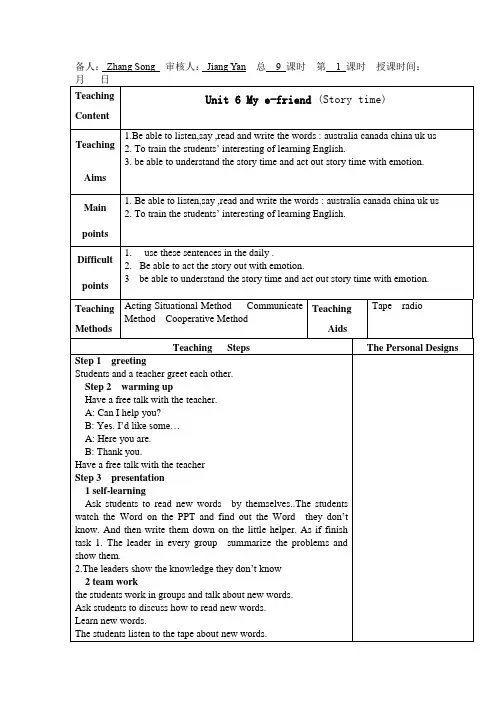
The students listen to the tape about new words.
Ask them to read after the tape.
由各小组长选出一位同学来领读。
教师起主导作用帮助学生发音。
3 communication and showing
3 beable to understand the story time and act out story time with emotion.
Teaching Methods
ActingSituational Method Communicate Method Cooperative Method
Teaching
Aids
Tape radio
Teaching Steps
The Personal Designs
Step 1 greeting
Students and a teacher greet each other.
Step 2 warming up
Have a free talk with the teacher.
Homework Design
Blackboard Design
Teaching Information
2. To train the students’interesting of learning English.
Difficult points
ethese sentences in the daily .
2.Be able to act the story out with emotion.
Step 5 Development
2018-2019年英语译林牛津版小学五年级下册Unit 6 In the kitchen优质课教案3
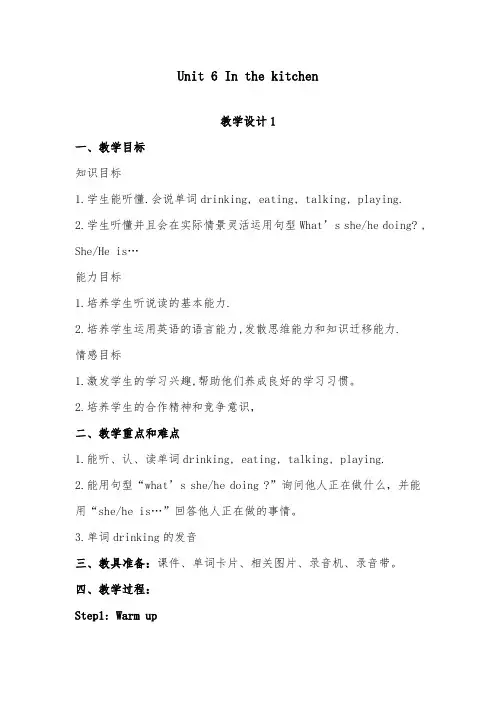
Unit 6 In the kitchen教学设计1一、教学目标知识目标1.学生能听懂.会说单词drinking, eating, talking, playing.2.学生听懂并且会在实际情景灵活运用句型What’s she/he doing? , She/He is…能力目标1.培养学生听说读的基本能力.2.培养学生运用英语的语言能力,发散思维能力和知识迁移能力.情感目标1.激发学生的学习兴趣,帮助他们养成良好的学习习惯。
2.培养学生的合作精神和竞争意识,二、教学重点和难点1.能听、认、读单词drinking, eating, talking, playing.2.能用句型“what’s she/he doing ?”询问他人正在做什么,并能用“she/he is…”回答他人正在做的事情。
3.单词drinking的发音三、教具准备:课件、单词卡片、相关图片、录音机、录音带。
四、教学过程:Step1: Warm upT: Boys and girls, let’s do an activity, ok?Ss: Ok.T: Now, I say you do.教师发指令,学生根据指令做动作:Listen to music, read a book, write a letter, play football, talk to you, do homework.T: Now, please look at me.(放录音听音乐)Ss: You are listening to music.T: Yes, I’m listening to music. Do you like listening to music? Ss: Yes.T: let’s sing song” I’m listening to music.”师生齐唱歌曲。
Step 2. 呈现单词T: Boys and girls, now please look at me ,(师做看书的动作)What am I doing?Ss: You are reading.老师依次做动作,学生猜答,复习单词reading, listening ,writing, playing, watching.T:(做喝水动作)What am I doing?Ss:喝水.T: Yes, I’m drinkin g.(出示单词卡片)Please look at the picture, read after me :drinking.学生分组读,分男女生读,开火车读,指名读.同法教单词eating, playing ,talking.Step3. 操练巩固单词T: Now, let’s play a game, ok?Ss: Ok.T: Ok, I say you do.老师发指令,学生依次做动作:Drinking, eating, talking, and playing.T发出drinking的指令后)What are you doing ?Ss: Drinking.(边做动作边回答)同法操练单词eating, talking, playing.Step4.呈现句型1.逐一出示drinking ,eating, talking, playing的图片并提问。
译林牛津小学英语五年级下册教学课件Unit 6 (第1课时)
Homework 1.听录音跟读Story time 3遍 2.抄词组1-15。 3.完成P60 Read and write。 4.学做简单早餐,给妈妈e 自读P58的对话,选择正确的答案。
1. What is Mr Liu cooking? He is____. A. cooking fish B. cooking meat with potatoes
2. What is Mrs Liu doing? She is____.
Mr Liu: How’s the meat, Taotao?
Mr Liu: I’m cooking meat with potatoes, Taotao.
Liu Tao: It’s yummy, Dad. I love it! You’re a great cook!
Liu Tao: Great! I can’t wait, Dad!
四人一组, 分角色演一演对 话,加上动作会 更棒哦!
Liu Tao: It’s nice, Mum. I love it too!
Let’s read
2 Liu Tao is looking for some juice in the fridge.
Story time
1 It is six o’clock in the evening. Liu Tao comes home
Can Liu Tao have dinner at once?
译林版五年级下册英语教案U5~U6 Revision
译林版五年级下册英语教案U5~U6 Revision 教师信息教师姓名:XXX任课班级:五年级(X)教学内容:U5~U6 Revision教学目标•复习U5~U6单元所学的知识点和语言结构,巩固已有的语言能力。
•提高学生的英语阅读、听力和口语表达能力,能够流利、自然地运用所学的语言知识和技能进行交流和表达。
•培养学生的英语学习兴趣,激发学生学习英语的自主性和主动性。
教学重点•复习U5~U6单元所学的重点词汇、语法和句型。
•学习表达和分享自己的看法和观点。
教学难点•成功运用所学的语言知识和技能进行交流和表达。
•提高学生听、说、读、写的英语综合能力。
教学过程Step 1 复习U5~U6单元的重点知识1.复习U5单元的重点词汇、语法和句型•总结U5单元中已经学过的重点词汇和短语,并用它们造句。
•引导学生使用被动语态描述事件,并与他们分享一些真实的例子,帮助他们理解并掌握这一语法结构。
2.复习U6单元的重点词汇、语法和句型•总结U6单元中的重点词汇和短语,并用它们造句。
•让学生用正确的情态动词形式描述他们的意愿和建议,并与他们分享一些真实的生活场景,帮助他们掌握这一语法结构。
Step 2 提高听力能力•用各种生活场景中的对话和课文中的录音材料提高学生的听力能力,并帮助他们养成较好的听力习惯和有效的听力策略。
•练习对话的听懂和转述,鼓励学生不断地用所学的语言知识和技能去实践,并反复强化听、说、读、写的技能。
Step 3 提高口语表达能力•练习对话的说出并能够自然、流利地运用所学的语言知识和技能进行交流和表达。
•鼓励学生自己动手编造对话的场景,积极参与互动交流,在实践中不断提高自己的表达能力。
Step 4 提高阅读能力•让学生阅读课本中的短文和练习册中的文章,提高学生的阅读能力和理解能力。
•引导学生理解并分析所读材料的主旨、结构和用语,培养他们的语言运用能力和思维能力。
Step 5 小结与拓展•总结本节课的重点和难点,并与学生分享一些有效的学习和提高英语能力的练习方法。
新牛津译林版五年级英语下册Unit6 第1课时教案
Unit6 第1课时教学设计一、板块介绍本部分描述了Liu Tao一家人晚饭前和晚饭时的场景,共分为三个部分。
第一部分呈现的是Liu Tao的父母正在厨房准备晚饭,Liu Tao刚踢完足球比赛回家,一家人谈论正在烹饪的食物,由此引出现在进行时的一般疑问句。
第二部分呈现了Lin Tao在冰箱里找果汁喝的情景,复现了五年级上册Unit 1学过的there be句型。
第三部分呈现了Liu Tao一家人吃晚饭的情景,Liu Tao称赞父母烹饪的食物很美味。
二、教学目标1. 能听懂、会说、会读、会写bread, meat, potatoes, soup, tomatoes, vegetables等。
2. 能听懂、会说、会读Story time中的故事。
3. 句型:—Are/Is … doing …?—Yes, … /No, …三、教学重难点1. 词汇:bread, meat, potatoes, soup, tomatoes, vegetables.2. 句型:—Are/Is … doing …?—Yes, … /No, …四、教学过程Step 1: Warm-up/Lead-in1. 头脑风暴,复习词汇教师和学生开展“头脑风暴”游戏,在黑板上列出fruit, food, drinks, vegetables 等表示类别的词汇,学生则需列举出具体的例子,以归纳复习以前学过的词汇,并导入目标词汇。
教师可安排学生以小组竞赛的形式完成此活动,给出例子最多的小组获胜。
如:Fruit: apple, orange, banana, peach, pear, ...Food:egg, noodles, sandwich, chicken, fish, hamburger, rice, hot dog, cake, pizza, pie, biscuit, cookie, tart, ...Drinks: water, juice, milk, coffee, tea, cola, ...Vegetables: tomato, potato, carrot, onion, pepper, bean, pea, cucumber, ...2. 问答活动,复习there be句型教师呈现一些食物放置于不同地点的图片,然后和学生问答,复习there be句型的肯定句和一般疑问句、可数名词和不可数名词以及some和any的用法。
译林英语五下教案Unit 6 In the kitchen 第一课时
译林英语五下教案Unit 6 In the kitchen 第一课时Unit 6 In the kitchenLesson 1: My KitchenObjectives:1. To introduce kitchen vocabulary and functional language.2. To encourage students to talk about their own kitchens.3. To develop students’ listening, speaking, reading and writing skills.Materials:1. Teacher: Kitchen flashcards, kitchen pictures, kitchen items (utensils, plates, cups, etc.), PowerPoint presentation, board, marker.2. Students: Materials for writing and drawing.Introduction:Begin the lesson by asking students if they like cooking. Introduce the topic of kitchens by showing kitchen flashcards or pictures and ask if they know what these things are. Elicit vocabulary related to kitchen items and functional language used in the kitchen.Presentation:1. Present kitchen items by showing them to students and asking what they are used for.2. Introduce functional language commonly used in the kitchen such as “Can you pass me the salt?”, “Can you help me chop the vegetables?” and “Would you like some coffee?”3. Present kitchen prepositions through the use of a picture. Ask students to describe where kitchen items are located using prepositions such as “on”, “in”, “behind”, “next to” and “under”.Practice:1. Ask students to draw a picture of their own kitchens and label the items in English.2. Pair students up and ask them to describe where kitchen items are located using the prepositions introduced earlier.3. Play a game of “Pass the Utensil”. The teacherwill start by saying a sentence containing a kitchen item and asking the student next to them to pass a utensil mentioned in the sentence. The next student then repeats the sentence and asks the following student to pass another utensil.Production:1. Ask students to share their kitchen pictures and describe their kitchens to the class.2. Provide students with a recipe and ask them to write instructions on how to make it using the functional language and prepositions they have learned in class.3. Have a cooking day where students use the kitchen items and utensils to make a recipe together while practicing the functional language and prepositions.Conclusion:Conclude the lesson by asking students what they have learned about kitchens and practical language they can use in the kitchen. Review the vocabulary and functional language introduced in the lesson. Assign homework such as practicing the functional language or describing their kitchens in English to continue practicing the language outside of class.。
最新译林牛津版小学英语五年级下册Unit6Inthekitchen公开课教学设计1
最新译林牛津版小学英语五年级下册Unit6Inthekitchen公开课教学设计1Unit 6 In the kitchen教案1一、教学目标1. 能听懂,会读,会说,会写单词: bread, meat, vegetable, potato, tomato, soup等食物类的词。
2. 能听懂,会读,会说,会写句型:I want to…Is there …in the …?How is the …? /It is …3. 掌握名词的单复数变化规则。
4. 能正确的理解并朗读课文,在教师的引导下尝试复述课文内容。
二、教学重难点1. 能听懂,会读,会说,会写句型:I want to…Is there …in the …?How is the …? /It is …2. 掌握名词的单复数变化规则。
三、课前准备1. 各种食物的图片。
2. 单词卡片。
3. 小奖品,如巧克力,铅笔等。
四、教学过程Step 1 warming upFree talk: T: Good morning, boys and girls, nice to see you. It is 11 o’clock, do you feel very hungry.S: Good morning, teacher, nice to see you, too. Yes ,we are hungry.T: What do you want to eat?S: We want to eat…Step 2 learn new words1.教师展示各种食物图片,并告诉学生他们的英文表达。
如教师展示肉的图片,并说It’s meat.一次类推,分别介绍其他食物。
2. 教师请学生任意抽取一张食物卡片,并请该同学说出该食物的英文名称。
3. 请5~6个同学到讲台站成一排,老师给第一个学生展示一种食物的图片,注意不要让后面的学生看到。
第一个学生看到图片后尽量用英文向第二个学生描述,注意不能直接说出该食物。
牛津译林版五年级英语下册Unit 6 In the kitchen 教案2
Unit 6 In the kitchen教案2一、教学目标1. 能听懂,会读,会说,会写厨房用具单词:如bowl, chopsticks, spoon, fork, knife, plate, pan, spatula2. 能熟悉其他厨房用具,如:gas stove, electric rice cooker, boiler, tap, sink.3. 能掌握现在进行时的一般疑问句和肯定及否定回答。
Are you …? / Yes/No I …Are they …? / Yes/No they …Is she/he …? /Yes/No she/he …4. 掌握名词的单复数变化规则。
二、教学重难点1. 能掌握现在进行时的一般疑问句和肯定及否定回答。
Are you …? / Yes/No I …Are they …? / Yes/No they …Is she/he …? /Yes/No she/he …2. 掌握名词的单复数变化规则。
三、课前准备1. 各种餐具及厨房的图片。
2. 单词卡片。
3. 课文录音。
四、教学过程Step 1 warming upBrain storming1. 教师展示厨房的照片,让学生找找看有哪些餐具和食物。
以引出话题。
2. 教师教学生各种餐具的英文表达。
如教师展示餐盘图片,并说出It’s a plant.以次类推教会学生其他餐具的表达。
3. 教师展示厨房的照片,六个学生一组,每个学生说出一种食物或餐具,不能重复。
4. 请一个学生随机抽取一张写着餐具的卡片,然后该生要用语言来描述该餐具,让其他学生来猜。
Step 2 learn sentences1.教师介绍基本句型:Are you …? / Yes/No I …Are they …? / Yes/No they …Is she/he …? /Yes/No she/he …2. 教师分别展示图片,让学生做看图对话练习。
译林版(三起)五年级下册英语教案:Unit 6 In the kitchen 第1课时
译林版(三起)五年级下册英语教案:Unit 6 In the kitchen第1课时一、教学目标1.学生能够熟练掌握在厨房中常见的物品和操作,如烤面包片、煮咖啡、开水龙头等。
2.学生能够进行简单的口语交际,向别人描述自己在厨房中的操作。
3.增强学生的英语听说能力,在语言和实际操作方面进行协调和提高。
二、教学重点与难点重点1.常见厨房物品和操作的掌握。
2.简单的口语交际,包括描述和指令。
难点1.学生需要较长时间进行音频和视觉方面的学习,尤其是针对英语语音和口语交际。
2.需要对学生进行反复的操作训练,加深他们对于烤面包片、煮咖啡、开水龙头等的熟悉程度。
三、教学准备1.音频和视频设备。
2.厨房物品和工具。
四、教学步骤Step 1:导入新知识引导学生回顾前几个单元学过的内容,并获取新学习内容之前的启发与讨论。
Step 2:新知识的学习1. 学习相关词汇老师通过图示或文字来展示并教授相关的词汇。
如烤面包片(toaster)、咖啡(coffee)、咖啡壶(coffee maker)和开水龙头(tap water)等。
2. 听力练习老师向学生放音频,让他们听一个人对于在厨房中进行烤面包片、煮咖啡和开水龙头的描述。
之后,让学生配合老师回答问题或输出描述。
3. 实际操作练习老师向学生展示在厨房中进行烤面包片、煮咖啡和开水龙头等的方法。
之后,教师让学生按照步骤进行操作,并监听和评价他们的发音和口语表达。
Step 3:巩固与补充1. 基础操作指导教师重复展示厨房中进行烤面包片、煮咖啡和开水龙头的方法。
并鼓励学生自己尝试操作。
2. 口语交流练习老师进行对话和讨论,鼓励学生用英语表达自己的想法和观点。
老师也可以展示一些观看和听力材料,以便学生巩固他们所学的语音和语言技能。
Step 4:总结与评价通过教师和学生的交流,手动或使用学生自己的方式来评价本次课程的效果。
五、教学拓展教师可以使用图形和交互式电版本来巩固学生所学的语音和语言技能。
新版牛津译林版小学英语五年级下册同步教案(全册)
Unit 1 Cinderella Cartoon time(教案)译林版(三起)五年级英语下【教学内容】Cartoon time【教学目标】知识目标:(1)正确朗读、理解和表演Cartoon time故事。
(2)掌握三会单词mushroom, late, pick, understand, be bad for。
(3)熟练运用“why”和“because”,并能运用句型进行写的训练。
2.能力目标:正确朗读、理解和表演Cartoon time故事。
3.情感目标:培养学生热爱阅读善于观察的能力。
【教学重点】(1)正确朗读、理解和表演Cartoon time故事。
(2)掌握三会单词mushroom, late, pick, understand, be bad for。
【教学难点】熟练运用“why”和“because”,并能运用句型进行写的训练。
【教学方法】1.任务型教学法:学生在完成任务的过程中,提高了综合语言运用能力。
2.多媒体辅助教学法:设计新颖,化解了教学难点,提高了学生学习积极性。
【教具准备】多媒体课件、图片、卡片。
【教学过程】Step1.Warm-up1.Teaching aims:(1)正确朗读、理解和表演Cartoon time故事。
(2)掌握三会单词mushroom, late, pick, understand, be bad for。
(3)熟练运用“why”和“because”,并能运用句型进行写的训练。
2.Let’s review(1)以Wh-开头的特殊疑问词归纳Whose 询问什么人的Who 询问人Why 询问为什么What 询问东西或者事情When 询问时间Where 询问地点(2)以Why 引导的特殊疑问句,用Because加上表示原因的句子给出回答。
(3)复习Fun time内容,看图对话Picture1: Why can’t I go to the party?Because you don’t have any nice clothes and shoes.Picture2: You’re sad, dear. Why?Because I can’t go to the party.Why can’t you go to the party?Because I don’t have any nice clothes and shoes.Picture 3: I have to go now.Why?Because I have to go back before 12 o’clock.Picture 4: Oh, my foot hurts!Why?Because it doesn’t fit.Step2 Presentation1.Look and answerAre they happy? No.Why? Guess!呈现Cartoon time第一幅图和对话内容,教学的同时让学生找出答案:hungry Teach: I’m hungry. 我很饿。