
英语时态与语态
7. (2008年北京海淀区一模) ----I didn’t do well in the exam yesterday. Of course I____ for it. ----Oh, you poor thing! But I think you should learn a lesson. A. hadn’t studied B. haven’t studied C. was studying D. wouldn’t study 8. (2008年北京海淀区一模) ----I am not going to play football this year, Mum. ----That’s music to my ears. I was so afraid you _____. A.will be hurt B. would get hurt C. had got hurt D. were hurt
12. (2008年北京崇文区一模) ----The recent snow storm in China is really terrible. ----Yes. A lot of damage ____. A. are caused B. were caused C. has been caused D. had been caused
高考英语第一轮复习
专题四:时Байду номын сангаас和语态 主讲人:林斌 北京80中
开篇语
本讲在高考中的地位及考查形式:
时态和语态在高考中的地位是非常重要的。它不仅在单项选择题中考 查,而且对阅读理解非常有帮助,学生们通过学习时态和语态,能够对阅 读理解中比较复杂的句型更好地理解。另外,时态和语态对于书面表达也 有很大的帮助。中学生进行书面表达时,在时态和语态当中出现的错误非 常多,所以如果复习好时态和语态,有利于书面表达的得分。
11. (2008年北京朝阳区一模) ----Did you have a hard time traveling back home? ----Yes, it ____ for four days when I arrived in Guiyang and all the roads _____ covered with ice. A. snowed; were B. was snowing; had been C. had been snowing; had been D. had snowed; were
6. (2008年北京海淀区一模) When she realized I ____ her, she quickly made a pose, smiling. A.photographed B. had photographed C. was photographing D. will photograph
开心自测易错题解析
1.(2008北京东城区模拟题第一套) ----Can we meet tomorrow afternoon? ----Not in the afternoon, I’m afraid. I ________. A. will be working B. am going to work C. am about to work D. will work
A. snowed; were B. was snowing; had been C. had been snowing; had been D. had snowed; were
12. (2008年北京崇文区一模) ----The recent snow storm in China is really terrible. ----Yes. A lot of damage ____. A. are caused B. were caused C. has been caused D. had been caused
3. (2008年北京西城区一模) ----I wonder if you could go with me to the cinema. ----Don’t disturb me. I ____ a composition all the morning and haven’t finished yet. A. write B. was writing C. have written D. have been writing
2. (2008年北京东城区一模) It is generally ______ that new industries _____ for the southern part of the country. A. agreed; are needed B. agreed; to be needed C. agreeing; are needing D. agreeing; needed
9. (2008年北京朝阳区一模) ----Can I help you, Madam? ----No, thank you. I ____. A.have served B. am being served C. am served D. was serving
10. (2008年北京朝阳区一模) The television was on, but nobody _____. A. watched B. has watched C. was watching D. had watched
2. (2008年北京东城区一模) It is generally ______ that new industries _____ for the southern part of the country. A. agreed; are needed B. agreed; to be needed C. agreeing; are needing D. agreeing; needed
7. (2008年北京海淀区一模) ----I didn’t do well in the exam yesterday. Of course I ____ for it. ----Oh, you poor thing! But I think you should learn a lesson. A. hadn’t studied B. haven’t studied C. was studying D. wouldn’t study
11. (2008年北京朝阳区一模)
----Did you have a hard time traveling back home? ----Yes, it ____ for four days when I arrived in Guiyang and all the roads _____ covered with ice.
5. (2008年北京西城区一模) ----My uncle will be here to attend a meeting tomorrow. ----Oh, I thought that he ____ today. A. was coming B. is coming C. will come D. could come
8. (2008年北京海淀区一模) ----I am not going to play football this year, Mum. ----That’s music to my ears. I was so afraid you _____. A.will be hurt B. would get hurt C. had got hurt D. were hurt
开心自测
1.(2008北京东城区模拟题第一套) ----Can we meet tomorrow afternoon? ----Not in the afternoon, I’m afraid. I ________. A. will be working B. am going to work C. am about to work D. will work
5. (2008年北京西城区一模) ----My uncle will be here to attend a meeting tomorrow. ----Oh, I thought that he ____ today. A. was coming B. is coming C. will come D. could come 6. (2008年北京海淀区一模) When she realized I ____ her, she quickly made a pose, smiling. A. photographed B. had photographed C. was photographing D. will photograph
4. (2008年北京西城区一模) ----I don’t believe that John can remember what the robber was like. ----You’re quite wrong. I know it was dark, but he ________ the robber’s face . I’m sure of it. A. did see B. was seeing C. had seen D. would see
4. (2008年北京西城区一模) ----I don’t believe that John can remember what the robber was like. ----You’re quite wrong. I know it was dark, but he ________ the robber’s face . I’m sure of it. A. did see B. was seeing C. had seen D. would see
9. (2008年北京朝阳区一模) ----Can I help you, Madam? ----No, thank you. I ____. A.have served B. am being served C. am served D. was serving
英语语法(时态、语态)
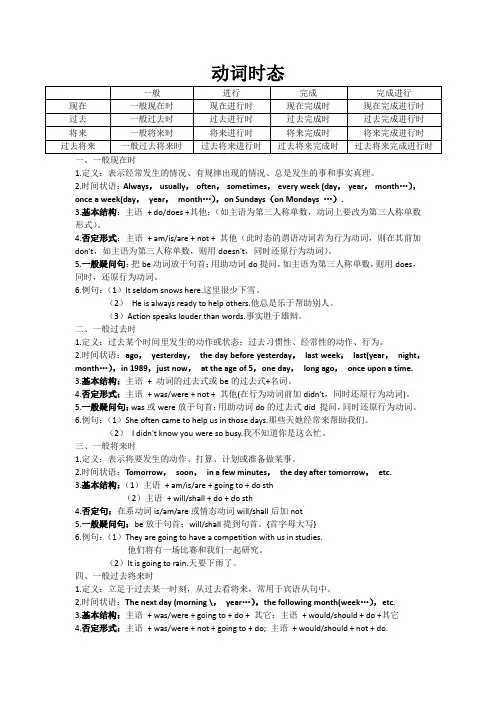
动词时态一、一般现在时1.定义:表示经常发生的情况、有规律出现的情况、总是发生的事和事实真理。
2.时间状语:Always,usually,often,sometimes,every week (day,year,month…),once a week(day,year,month…),on Sundays(on Mondays …).3.基本结构:主语+ do/does +其他;(如主语为第三人称单数,动词上要改为第三人称单数形式)。
4.否定形式:主语+ am/is/are + not + 其他(此时态的谓语动词若为行为动词,则在其前加don't,如主语为第三人称单数,则用doesn't,同时还原行为动词)。
5.一般疑问句:把be动词放于句首;用助动词do提问,如主语为第三人称单数,则用does,同时,还原行为动词。
6.例句:(1)It seldom snows here.这里很少下雪。
(2)He is always ready to help others.他总是乐于帮助别人。
(3)Action speaks louder than words.事实胜于雄辩。
二、一般过去时1.定义:过去某个时间里发生的动作或状态;过去习惯性、经常性的动作、行为。
2.时间状语:ago,yesterday,the day before yesterday,last week,last(year,night,month…),in 1989,just now,at the age of 5,one day,long ago,once upon a time.3.基本结构:主语+ 动词的过去式或be的过去式+名词。
4.否定形式:主语+ was/were + not + 其他(在行为动词前加didn't,同时还原行为动词)。
5.一般疑问句:was或were放于句首;用助动词do的过去式did 提问,同时还原行为动词。
英语中的时态与语态-精讲

英语中的16种时态⑶现在进行时→ is/am/are +doing (v-ing )⑷过去进行时→ was/were +doing (v-ing )⑸现在完成时→ have/has + done (过去分词)⑹过去完成时→ had +done (过去分词)⑺一般将来时 →⑻过去将来时 →⑼将来进行时→ shall/will be +doing (v-ing )⑽现在完成进行时→ have/has been +doing (v-ing )⑾过去将来进行时→ should/would be +doing (v-ing )⑿将来完成时→shall/will have +done (过去分词)⒀将来完成进行时→ shall/will have been +doing (v-ing )⒁过去完成进行时→had been +doing (v-ing ) ⒂过去将来完成时→⒃过去将来完成进行时→ should/would have been +doing (v-ing )16种时态中的被动语态主动:A + 一般动词(do )+ B被动:B + be done (过去分词)+ by Aeg. You play basketball.⑴一般现在时:The by you.→⑵一般过去时:→⑶现在进行时:The by you.→⑷过去进行时:The by you.→⑸现在完成时:The by you.→⑹过去完成时:The by you.→⑺一般将来时:The by you.→⑻过去将来时:The by you.→⑼将来进行时:The by you.→⑽现在完成进行时:The by you.→⑾过去将来进行时:Theby⑿将来完成时:The by you.→⒀将来完成进行时:Theby you.→⒁过去完成进行时:The by you.→⒂过去将来完成时:The by you.→⒃过去将来完成进行时:Theby you.注:红体字部分为常用时态的被动形式附录:动词(被动形式)搭配表。
英语动词的时态和语态
英语动词的时态和语态动词的时态1. 动词的时态主要有:一般现在时、现在进行时、现在完成时、现在完成进行时、一般过去时、过去进行时、过去完成时、一般过去将来时、一般将来时、将来进行时和将来完成时等。
2. 一般将来时的表达方式:(1)一般将来时表示未来的动作或状态,常与表示将来的时间状语,如:tomorrow, next day, soon, in a month, in the future, next Sunday等连用。
有时句中无时间状语,时间关系由上下文暗示;(2)will do还表示临时的决定;(3)在if, unless, before, after, until等引导的条件或时间状语从句中,从句用一般现在时代替一般将来时,而主句用一般将来时;(4) “be going to+动词原形”表示打算、计划、决定要做的事或有迹象表明即将发生的动作或状态;(5) “be+V-ing形式”表示按计划、安排即将发生的动作,这一结构常用于以下动词,如:come, go, leave, arrive, return, fly, meet, see, do, have, get等;(6) “be about to+动词原形”表示打算或安排即将发生的动作。
它一般不与表示时间的副词或其他时间状语连用;(7) “be to+动词原形”表示按计划、安排即将发生的动作;(8) 一般现在时表示按时刻表或根据规定将要发生的动作,这一结构常用于表示位移的动词,如:come, go, leave, start, begin, take off, set off等。
动词的语态1. 一般现在时的被动语态:is/am/are+V-ed。
例如:English is widely spoken all over the world.2. 一般过去时的被动语态:was/were+V-ed。
例如:The underground was built five years ago.3. 一般将来时的被动语态:①will/shall be+V-ed。
英语时态和语态
英语第二节英語的时态和语态一、一般现在时的用法基本结构:主语+be + adj./ n./主语+V(S)(1)表示表示现在的状态、特征或经常性、习惯性的动作;句中常用often, usually, every…, sometimes 等时间状语。
a. He is very happy.b. He is ready to help others.c. I often take exercise in the morning.我经常在早上做运动。
d. He goes to school by bike every day. 他每天骑车去上学。
想一想:把上面的句子变成否定句和疑问句(2) 由连词if , unless, before, as soon as, when , once, 等引导的时间状语从句和条件状语从句中,用一般现在时表示将来。
a. If you come this afternoon, we?ll have a meeting. 如果你今天下午过来,我们将开个会。
b. I won?t go to the party unless I am invited.(3) 有时这个时态表示按计划、规定要发生的动作(句中都带有时间状语)a. The meeting begins at seven. 会议七点开始。
b. The rain starts at nine in the morning. 上午九点开始下雨。
高考题If we now to protect the environment, we?ll live to re gret it. 2013高考全国卷A. hadn't actedB. haven't actedC. don't actD. won't act二、一般过去时的用法构成:主语+was/ were +adj/n.主语+v-ed1)在过去时间里所发生的动作或存在的状态。
英语动词时态和语态
动词的时态和语态知识点一一般时态1.一般现在时(1)表示经常发生的、习惯性的、反复出现的动作或状态。
常与表示习惯的副词(词组)always,every time,now and then,occasionally,often,seldom,sometimes,usually,every day/night等连用。
(2)按时间表、时刻表、日程表等安排将要发生的动作,用一般现在时。
只限于go,arrive,leave,start,stay,return,begin,come等动词。
(3)用在时间、条件或让步状语从句中,用一般现在时表示将来。
Around two o’clock every night,Sue will start talking in her dream.It somewhat bothers us.每天晚上两点左右,苏就说梦话。
这使我们有点烦心。
If it doesn’t rain,we’ll go on a picnic as planned.如果不下雨,我们将按计划去野餐。
Whatever you say,I will not change my mind.无论你说什么,我都不会改变主意。
The flight takes off at2:30every Wednesday and Friday.飞机每周三、周五2:30起飞。
2.一般过去时表示在过去某一时间点发生的动作或所处的状态,与现在没有关系或表示过去一段时间内反复发生的动作。
—Haven’t seen you for ages!Where have you been?——好长时间没见你了!你去哪里了?—I went to Ningxia and stayed there for one year,teaching as a volunteer.——我去了宁夏,在那里待了一年,作为一名志愿者教学。
3.一般将来时(1)“shall/will+动词原形”表示现在看来以后要发生的动作或存在的状态。
16种时态及语态总结
16种时态及语态总结时态和语态是英语语法中的重要内容,它们能够帮助我们更准确、清晰地表达动作发生的时间和状态。
接下来,让我们详细了解一下英语中的 16 种时态及语态。
一、一般现在时一般现在时表示经常发生的动作、习惯性的动作或客观事实、真理。
其形式为:主语+动词原形(当主语为第三人称单数时,动词要加“s”或“es”)。
例如:“I play basketball every day”(我每天打篮球。
)“He likes music”(他喜欢音乐。
)其被动语态为:am/is/are +过去分词例如:“The book is written by him”(这本书是他写的。
)二、一般过去时一般过去时表示过去某个时间发生的动作或存在的状态。
其形式为:主语+动词的过去式。
比如:“I went to Beijing last year”(我去年去了北京。
)被动语态为:was/were +过去分词例如:“The house was built in 1980”(这座房子建于 1980 年。
)三、一般将来时一般将来时表示将来要发生的动作或存在的状态。
常见形式有:will +动词原形;be going to +动词原形。
例如:“I will visit my grandparents next week”(下周我将看望我的祖父母。
)“She is going to have a party”(她打算举办一个聚会。
)其被动语态为:will be +过去分词;be going to be +过去分词例如:“The meeting will be held tomorrow”(会议将在明天举行。
)“The sports meeting is going to be cancelled”(运动会将要被取消。
)四、过去将来时过去将来时表示从过去的某一时间来看将来要发生的动作或存在的状态。
其形式为:would +动词原形;was/were going to +动词原形。
英语八种时态及语态
英语八种时态及语态一.现在进行时态(正在进行)1.结构:Be + V- ing . 被动语态结构am/is /are + being+ p.p2.关键词;look , listen , now, at the moment , at presente. g The students ----------( play ) at five o’clock in the afternoon.二.一般现在时态(经常性,反复性)1.结构 A. be型am/ is are + n / adj/ prep phrase被动语态结构am/is/are +p.pe. g I am a student . / He is tired . / They are at home.一般疑问句将be 提前,否定句在be 后加not.B.行为动词:1). S+ V (主语除第三人称单数)e. g We study English. / Do you study English ? / We don’t study English. 一般疑问句加助动词do ,否定句加助动词don’t.They do their homework. / Do they do their homework ? / They don’t do their homework.2). S + V(单三)。
主语是第三人称(he, she, your mother, lily); 动词第三人称变化相当于名词变复数。
E. g His brother studies hard every day. /Does his brother study hard every day ?His brother doesn’t study hard every day.一般疑问句在加Does, 否定句加doesn’t. 后要还原动词原形。
e. g Her sister does some cooking in the evening. / Does her sister do some cooking in theevening .? Her sister doesn’t do some cooking in the evening.3. 关键词:every day ( week / month / year) / in the morning ( afternoon / evening)On Monday (s) at weekend (s)Always /often / usually /sometimes= at times. Once a week (how often)三.一般过去时态(过去的动作,状态)1.结构。
英语中的时态和语态
英语中的时态和语态时态和语态是英语语法中非常重要的概念。
掌握时态和语态对于正确理解和运用英语语言至关重要。
本文将深入探讨英语中的时态和语态,帮助读者更好地掌握这两个概念。
一、时态时态是表示动作或状态发生的时间的一种语法形式。
英语中有12种基本时态,分为三个时态组:一般时态、进行时态和完成时态。
1. 一般时态一般时态用于表示习惯性、经常性或普遍性的动作或状态。
它包括简单现在时、简单过去时和简单将来时。
- 简单现在时:表示现在的状态或经常性的动作。
例如:“I eat breakfast every morning.”(我每天早上吃早餐。
)- 简单过去时:表示过去发生的动作或状态。
例如:“She studied English last night.”(她昨晚学习了英语。
)- 简单将来时:表示将来发生的动作或状态。
例如:“They will go to the beach tomorrow.”(他们明天将去海滩。
)2. 进行时态进行时态用于表示正在进行的动作。
它包括现在进行时、过去进行时和将来进行时。
- 现在进行时:表示现在正在进行的动作。
例如:“I am reading a book ri ght now.”(我正在读一本书。
)- 过去进行时:表示过去某一时间点正在进行的动作。
例如:“She was cooking dinner at 6 o'clock yesterday.”(昨天6点她正在做晚饭。
)- 将来进行时:表示将来某一时间点正在进行的动作。
例如:“They will be watching a movie at this time tomorrow.”(明天此时他们将在看电影。
)3. 完成时态完成时态用于表示已经完成的动作。
它包括现在完成时、过去完成时和将来完成时。
- 现在完成时:表示过去某一时间点发生的动作对现在造成的影响。
例如:“I have finished my homework.”(我已经完成了作业。
英语的时态与语态
英语的时态与语态时态和语态是英语语法中非常重要的概念,它们对于正确表达和理解英语句子起着至关重要的作用。
在本文中,我们将探讨英语的时态与语态,深入了解它们的用法和区别。
一、时态时态是用来表示动作或状态发生的时间的一种语法形式。
在英语中,一般有过去时、现在时和将来时三种基本时态。
1. 过去时过去时用来表示过去发生的动作或状态。
一般过去时的构成是在动词原形后加上-ed,例如:walked, talked。
但也有一些不规则动词需要特殊记忆,例如:went, saw。
例句:- I walked to the store yesterday.(昨天我走到了商店。
)- She ate lunch an hour ago.(她一个小时前吃了午饭。
)2. 现在时现在时用来表示现在正在进行的动作或状态。
一般现在时的构成是动词原形,但第三人称单数要在动词后加上-s或-es。
例句:- I am reading a book now.(我现在正在看书。
)- He teaches English at the university.(他在大学教英语。
)3. 将来时将来时用来表示将来发生的动作或状态。
一般将来时的构成是在助动词will后加上动词原形。
例句:- I will go to the party tomorrow.(明天我将去参加派对。
)- They will arrive at the airport in two hours.(他们将在两小时后到达机场。
)二、语态语态是用来表示句子的主语和谓语之间的关系的一种语法形式。
在英语中,一般有主动语态和被动语态两种基本语态。
1. 主动语态主动语态表示主语是动作的执行者。
例句:- She wrote a letter.(她写了一封信。
)- He is washing the car.(他正在洗车。
)2. 被动语态被动语态表示主语是动作的承受者。
例句:- The letter was written by her.(这封信是她写的。
(完整)高中英语语法(时态和语态)
高中英语语法(时态和语态)一.动词的时态时态是谓语动词所表示的动作或情况发生时间的各种形式。
英语动词有16种时态,但是常见的只有九种:一般现在时、一般过去时、一般将来时、现在进行时、过去进行时、现在完成时、过去完成时、过去将来时、现在完成进行时。
(一)一般现在时(do / does)1.具体用法1) 表示经常性或习惯性动作We always care for each other and help each other. 我们总是互相关心互相帮助。
He goes to school every day.2)表示现在的特征或状态He is very happy.Do you sing? ----A little.3)表示普遍真理Light travels faster than sound. 光速比声速快。
Actions speak louder than words. 行动胜过言语。
* 常与一般现在时态连用的词或短语主要有:often, usually, sometimes, every day,every morning/afternoon, on Sundays/weekends等等。
I often go to the cinema on Sundays. 我经常星期天去看电影。
He goes to work early every day. 他每天上班很早。
(二)一般过去时( did )(1)表示过去某一特定时间所发生的、可完成的动作或状态,常与表示确切过去时间的词、短语或从句连用。
例如:We went to the pictures last night and saw a very interesting film.(2)表示过去习惯性动作。
例如:He always went to class last.I used to do my homework in the library.(三)一般将来时( will / shall do)1)表示将来打算进行或期待发生的动作或状态。