
七年级英语导学案(第三单元).3
1、这是我的父母,那是我的爷爷。__________________________
2、他是你的表兄吗?是,他是。_____________________________
3、照片里的那个人是你姐姐吗?不,不是 。_____________________ห้องสมุดไป่ตู้___
4、这些是我的朋友。______________________________________
A. AreB. IsC. AmD. Do
2.are his two sisters.
A . SheB. HeC. ThisD. These
3. —Is he your father?
—.
A. No, he isB Yes, he'sC. No, he notD. Yes, he is
4.—What's thisEnglish?—It'sapple.
1. She is his s,Mary.
2. His father's brother is his u.
3. His mother's sister is his a.
4.—Is Jim your c?—Yes, he is.
5 . Athose your friends?
(二)选择
1.she your sister?
1、阅读 family tree ,用方框中的单词补全家谱 .
学习任务三:听录音,练习对话.
1、听录音完成2a,再听一遍,选择2b中正确的图画.
2、利用2分钟时间记住中关于家庭 成员的名词,然后相互检查,小组竞赛展示单词 。3、模仿听力内容,利用 照片或自制图片介绍自己的家人。
二、合作共建(教师寄语:)
张崾先镇学校七年级英语导学案
执笔人:贺淑洁审核人: 时间:班级: 姓名: 组号:
集 体 备 课
备注
课题:Unit 3 This is my sister.Section B 1—2c
【学习目标】:1、掌握 关于家庭成员的词汇 son,cousin,daughter,uncle,picture
2、能听懂听力
A. in, anB. at, anC. in, aD. on, the
5.—Are you Jack?—No, I'm not..
A. SorryB. Excuse meC. I'mD. Thanks
6. That's her aunt,_______name is Mary.
A .hisB. herC. himD.she
3、Those aremyCD.(对画线部分提问)
______ _______ ______?
五、课后反思(教师寄语:Never do things by halves)
通过本节课的学习,我最大的收获是
感到自己有待加强的是
5、These are my good friend,Jim._________
(五)句型转换
1、This is my new backpack.(该为复数句子)
______ ______my _______ ________.
2、They're my aunts.(改为单数句子)
_______ ________ my _______.
学会了识别家谱 ,尝试自己制作自己的家谱。
三、系统总结(教师寄语:No man can do two things at once.)
小组讨论总结介绍自己家庭成员的句型。(如This等)
四、【诊断评价】(教师寄语:Never do things by halves)
(一)根据句意及首字母提示补全单词
【学习重点】:1、能熟练识别家谱
2、进步熟练运用介绍家人的句型
一、自主学习(教师寄语:Many hands make light work. )
学习任务一: 熟练掌握本课的5个单词
1、个人自读,记忆本课单词.
2、小组互相检查单词读写情况.
3、根据汉语写出下列英语单词并展示.
学习任务二: 熟练掌握识别part1中的家谱
5、她的母亲是一名教师。__________________________________
6、我是一名中国男孩,我叫李明。_____________________________
7、这些苹果是你的吗?是,是的。________________________________
(四)找出错误并改正。
1、These are his English book.____________
2、I know he name is Paul._________
3、Those is eight pencils._________
4、She's my cousin.Her father is my father._________
Unit+3导学案+2023-2024学年人教版七年级英语上册
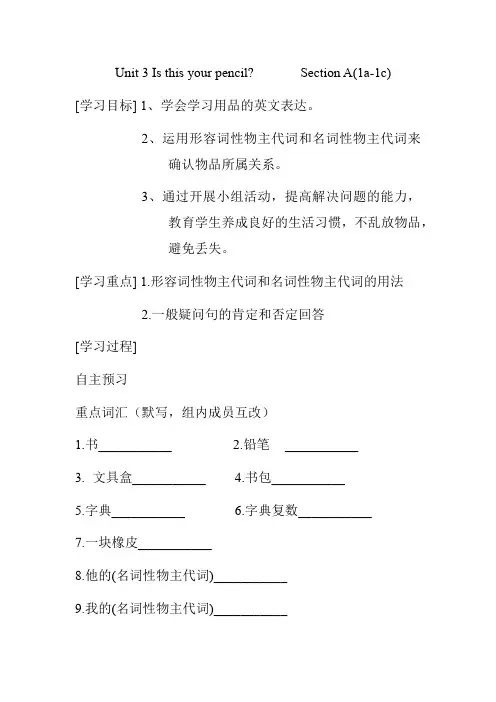
Unit 3 Is this your pencil? Section A(1a-1c)[学习目标] 1、学会学习用品的英文表达。
2、运用形容词性物主代词和名词性物主代词来确认物品所属关系。
3、通过开展小组活动,提高解决问题的能力,教育学生养成良好的生活习惯,不乱放物品,避免丢失。
[学习重点] 1.形容词性物主代词和名词性物主代词的用法2.一般疑问句的肯定和否定回答[学习过程]自主预习重点词汇(默写,组内成员互改)1.书___________2.铅笔___________3.文具盒___________4.书包___________5.字典___________6.字典复数___________7.一块橡皮___________8.他的(名词性物主代词)___________9.我的(名词性物主代词)___________10.她的(名词性物主代词)___________合作探究1.例句:Is this a book? 这是一本书吗?Yes, it is. 是的,它是。
Is that your eraser? 那是你的橡皮吗?No, it isn’t. 不,不是。
这两个句子都是__________(一般/特殊)疑问句.在这种句型中名词要用_________(单数,复数)形式。
__________(this/that)用来询问较近的人或物, __________(this/that)用来询问较远的人或物。
肯定回答:___________否定回答:___________注意:答语不用this或that,而用_______代替this和that2.例句:Are these your pens? 这些是你的钢笔吗?No, they aren’t. 不是。
Are those his pencils? 那些是他的铅笔吗?Yes, they are. 是。
Are these/those …? 这些/那些是……吗?在这种句型中名词要用_________(单数/复数)形式。
英语七年级上册Unit 3 导学案
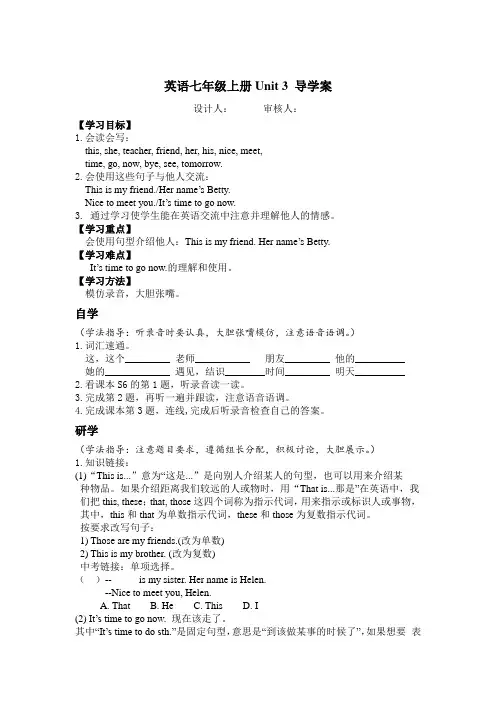
英语七年级上册Unit 3 导学案设计人:审核人:【学习目标】1.会读会写:this, she, teacher, friend, her, his, nice, meet,time, go, now, bye, see, tomorrow.2.会使用这些句子与他人交流:This is my friend./Her name’s Betty.Nice to meet you./It’s time to go now.3.通过学习使学生能在英语交流中注意并理解他人的情感。
【学习重点】会使用句型介绍他人:This is my friend. Her name’s Betty.【学习难点】It’s time to go now.的理解和使用。
【学习方法】模仿录音,大胆张嘴。
自学(学法指导:听录音时要认真,大胆张嘴模仿,注意语音语调。
)1.词汇速通。
这,这个_________ 老师___________ 朋友_________ 他的__________ 她的_____________ 遇见,结识________时间_________ 明天__________2.看课本S6的第1题,听录音读一读。
3.完成第2题,再听一遍并跟读,注意语音语调。
4.完成课本第3题,连线,完成后听录音检查自己的答案。
研学(学法指导:注意题目要求,遵循组长分配,积极讨论,大胆展示。
)1.知识链接:(1)“This is...”意为“这是...”是向别人介绍某人的句型,也可以用来介绍某种物品。
如果介绍距离我们较远的人或物时,用“That is...那是”在英语中,我们把this, these;that, those这四个词称为指示代词,用来指示或标识人或事物,其中,this和that为单数指示代词,these和those为复数指示代词。
按要求改写句子:1) Those are my friends.(改为单数)________________________2) This is my brother. (改为复数) ________________________中考链接:单项选择。
初中英语七年级预习导学案Unit3 SectionA Grammar-3c

初中英语七年级预习导学案Unit3 SectionA Grammar-3cHuandong Middle SchoolChang Ying初中英语七年级预习导学案Unit3 SectionA Grammar-3c一、学习目标:1、继续练习谈论出行方式take the bus/subway…并复习基数词及时间的表示方法。
2、用不同方式练习how引导的特殊疑问句,表示乘坐何种交通工具的方式。
How far,how long引导的特殊疑问句。
3、了解东西方国家出行方式的不同,倡导自觉遵守交通法规及礼貌,构建和谐的人际关系。
二、学习重点:1、how/how far/how long 引导的特殊疑问句2、乘坐交通工具的表示方法。
3、It takes sb. some time to do三、学习难点:1、take the bus 与by bus 的区别2、how/how far/how long 引导的特殊疑问句知识点:1、How do you get to school?你是怎样到达学校的?该句是由how引导的特殊疑问句,用来对交通方式进行提问。
其中how意为“如何,怎样”,回答形式有:(1)take+a/the+表示交通工具的单数名词。
(2)by+表示交通工具的单数名词。
例如:How do you go to work?---I take the subway to work./I go to work by subway.2、How long does it take you to get to school?你到学校要多长时间?该句是由how long 引导的特殊疑问句,用来对时间长短进行提问。
其中how long 意为“多久,多长时间”,用来询问某个动作所持续时间的长短。
例如:How long will you stay there?---About a week.3、How far is it from your home to school?从你家到学校有多远?How far多远。
初一下 第三单元导学案 03

鸡西市第四中学2012----2013年度下学期初一英语下册Unit3导学案编制人:蔡文静复核人:使用日期:2013-4-9-11 编号:11 Learning Goals:(学习目标)1.词汇:when , January , February , March , April , May , June , July , August , September ,October , November , December2.句型:When is your birthday? How old are you? = What’s your age?3. 增强集体合作意识Learning Emphasis:(学习重点)1.十二个月份2.问生日,问年龄的句型Learning difficulties: (学习难点)问年龄的句型Learning Methods: (学习方式):自主学习展示提升Thinking Navigation: (思维导航)亲爱的同学们,我们已经学习了特殊疑问句,本节课我们学习when引导的特殊疑问句,教你如何询问别人的生日,你们准备好了么?大家加油吧!Learning Activities: (学习活动)Ⅰ.Warming up (热身)Morning report复习巩固,尝试训练Ⅱ.Self-study (自学环节)自学课本,尝试归纳一、预习感知:想想译译:January __________ February __________ 三月__________四月__________ May __________ June __________July __________ 八月__________ 九月__________October __________ 十一月__________ December __________生日__________ 年龄__________ old __________二、写出下列序数词,注意他们的构成规律:1. 第一____________ 第二____________ 第三____________2. 第五____________ 第八____________ 第九____________3. 第十____________ 第十二____________ 第十八____________4. 第二十____________ 第三十____________ 第四十____________第五十____________ 第八十____________ 第九十____________三、请你读一读下面的句子,试着翻译,和你的同伴运用这些句子组织对话同学互助,尝试探索When is your birthday? __________________________________________My birthday is October tenth. _________________________________________When is Leila’s birthday? _________________________________________Her birthday is September 5th. ________________________________________Ⅲ. Grammar Focus自主合作,尝试巩固1. When is your birthday? 你的生日在什么时候?My birthday is October 10 / 10th / tenth. = It’s October 10 / 10th / tenth.when是特殊疑问词,意为__________,用来询问__________。
(人教版)七年级下册英语导学案:Unit 3 How do you get to school
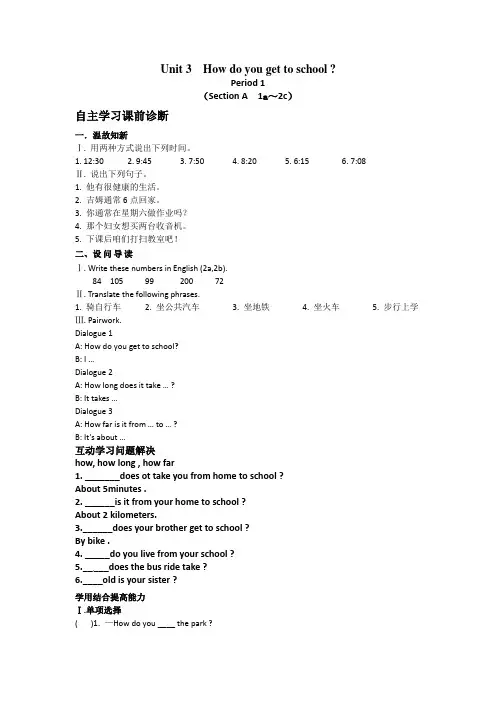
Unit 3 How do you get to school ?Period 1(Section A 1a~2c)自主学习课前诊断一.温故知新Ⅰ. 用两种方式说出下列时间。
1. 12:302. 9:453. 7:504. 8:205. 6:156. 7:08Ⅱ. 说出下列句子。
1. 他有很健康的生活。
2. 吉姆通常6点回家。
3. 你通常在星期六做作业吗?4. 那个妇女想买两台收音机。
5. 下课后咱们打扫教室吧!二、设问导读Ⅰ. Write these numbers in English (2a,2b).84 105 99 200 72Ⅱ. Translate the following phrases.1. 骑自行车2. 坐公共汽车3. 坐地铁4. 坐火车5. 步行上学Ⅲ. Pairwork.Dialogue 1A: How do you get to school?B: I …Dialogue 2A: How long does it take … ?B: It takes …Dialogue 3A: How far is it from … to … ?B: It’s about …互动学习问题解决how, how long , how far1. _______does ot take you from home to school ?About 5minutes .2. ______is it from your home to school ?About 2 kilometers.3.______does your brother get to school ?By bike .4. _____do you live from your school ?5._____does the bus ride take ?6.____old is your sister ?学用结合提高能力Ⅰ.单项选择( )1. —How do you ____ the park ?—I ____ a bus.A. get; byB. get to; takeC. get; take( ) 2. —Does your father go to work _________bus?—No, he ________his bike .A. by; byB. take; ridesC. by; rides( ) 3. —_______is it from your home to school?—It’s about 2 kilometers.A. HowB. How longC. How far( ) 4.—I walk to school.___________?—I walk to school, too.A. How about youB. How do you doC. How think ( ) 5. How long does it _______ you to go home?A. takeB. needC. getⅡ. 用英语单词完成下列算式1. 40+30=70 _____+_____=_____2. 12+26=38 _____+_____=_____3. 50+60=110 _____+_____=_____4. 18-6=12 _____-_____=_____5. 20+36=56 _____+_____=_____Ⅲ. 按要求完成句子,每空一词1.My father goes to work by bike.(对划线部分提问)your father to work?2.Mary goes to school by subway.(改为同义句)Mary the subway school.3.He often watches TV for two hours in the evening.(对划线部分提问)does he often watch TV in the evening?4.His dictionary is 50 dollars.(对划线部分提问)is his dictionary?5.This is her bike. (改为同义句)This bike is .课堂小节,形成网络填入适当的句子补全对话A: Hello, Bill.B: Hello, Mike.A: 1._____________?B:I get up at six.A: 2._____________?B: I have some bread for breakfast.A: 3._____________?B: No, I don’t like salad.A: 4._____________?B:I go to school by bus.A: And last question. 5._____________?B: My favourite subject is English.A: Thank you.B: You’re welcome.Unit3 How do you get to school ?Period 2(Section A 2e~3c)自主学习课前诊断一、温故知新Useful phrases:1.到校______________2.上班____________3. 到家_________________4. 到这儿________________________5. 到那儿______________6.去上学______________________________7.去上班____________________ 8.回家___________________9.去那儿______________________10. .乘地铁________________11.乘公共汽车______________12.乘火车_________________13. 乘飞机___________14.乘出租车________________________15.乘船________________16.骑自行车_________________17.步行_____________ 18.开车送他上学______________19.多远________________20.多久________________二、设问导读Ⅰ. Read 2e (P14) and complete the conversation.A: Hey, Jane. Is this your new bike?B: Yes. I ride it to school everyday. 1. ____________________A: I usually take the bus.B: 2. ____________________A: I’m not sure —about 10 kilometers? The bus ride takes about 20 minutes. 3. _________B: About 15 minutes by bike. It’s good exercises.A: Yeah, well, have a good day at school.B: You, too.Ⅱ. Read Grammar focus (P15). Then finish 3a and 3b (P15) with your partner.三、自学检测Ⅰ. Pairwork: Practice 2e (P14) with your partner and make your own conversation. Then act it out.Ⅱ. 单项选择( ) 1.—Is this bike________?—No, it’s not ________.A. your; mineB. yours; mineC. your; my( ) 2. —When do they get _______ Beijing?—They get ________ there at 8:00.A. to; toB. / ; /C. to; /( ) 3. The _________takes about _________ hour.A. bus ride; anB. bus ride; aC. ride bus; an( ) 4. Going to school by bike is _________.A. a good exercise.B. good exercises.C. good exercise.( ) 5.—Does she take the bus to school?—_________.She goes by bike.A. Yes, she doesB. No, she doesn’tC. I’m not sure互动学习问题解决用take 填空。
英语7译林牛津版unit3:导学案(语法和project)
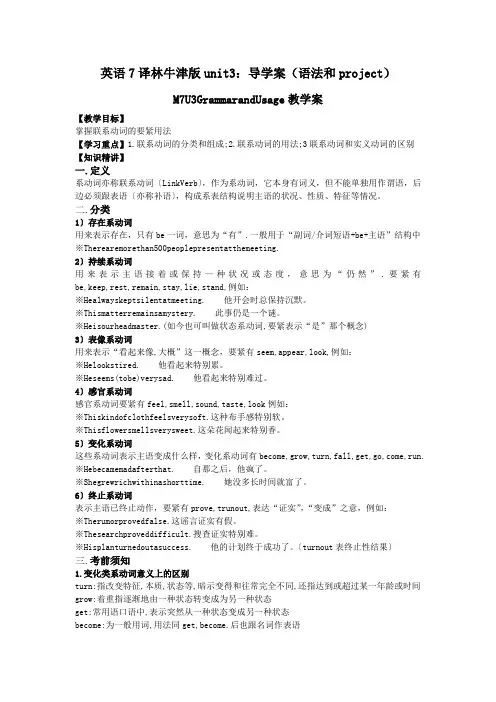
英语7译林牛津版unit3:导学案(语法和project)M7U3GrammarandUsage教学案【教学目标】掌握联系动词的要紧用法【学习重点】1.联系动词的分类和组成;2.联系动词的用法;3联系动词和实义动词的区别【知识精讲】一.定义系动词亦称联系动词〔LinkVerb〕,作为系动词,它本身有词义,但不能单独用作谓语,后边必须跟表语〔亦称补语〕,构成系表结构说明主语的状况、性质、特征等情况。
二.分类1〕存在系动词用来表示存在,只有be一词,意思为“有”.一般用于“副词/介词短语+be+主语”结构中※Therearemorethan500peoplepresentatthemeeting.2〕持续系动词用来表示主语接着或保持一种状况或态度,意思为“仍然”.要紧有be,keep,rest,remain,stay,lie,stand,例如:※Healwayskeptsilentatmeeting. 他开会时总保持沉默。
※Thismatterremainsamystery. 此事仍是一个谜。
※Heisourheadmaster.(如今也可叫做状态系动词,要紧表示“是”那个概念)3〕表像系动词用来表示“看起来像,大概”这一概念,要紧有seem,appear,look,例如:※Helookstired. 他看起来特别累。
※Heseems(tobe)verysad. 他看起来特别难过。
4〕感官系动词感官系动词要紧有feel,smell,sound,taste,look例如:※Thiskindofclothfeelsverysoft.这种布手感特别软。
※Thisflowersmellsverysweet.这朵花闻起来特别香。
5〕变化系动词这些系动词表示主语变成什么样,变化系动词有become,grow,turn,fall,get,go,come,run. ※Hebecamemadafterthat. 自那之后,他疯了。
七年级3单元 Is this your pencil 导学案
承德四中七年级英语学科第 7周第 1课时导学案编号:学生姓名: _主备人:董清伟辅备人:七年级英语组审核主任:郝胜利使用时间Unit 3 单元小测一、根据句子意思每空填一个英语单词1.What’s this in E__________?2.How do you S_______ pen?3.Is that a pencil c___________?4.His f________name is John.5.That is my d________二、选择方框内正确的词语填空。
﹝lost and found in English call please school ID card a set of at﹞1.What’s your name,______?2.What’s this ________?3.Please __________John. His phone number is 236-0582.4.This is my_________ .5.Is that your computer game in the _____ case?三、单项选择()1.Please _______ Mary. Her phone number is 7782079.A .tell B. say C. talk D. call()2.—Is this your gold ring?.please call John.A .Yes,it is B. No,it isn’t C. Yes,it isn’t D. No,it is()3.Is __________your bag over there?A. thisB. itC. thatD. these()4.Your backpack is in the________ case.A. lost and foundB. found and lost C .lose and found D. find and lose()5.—Is that your watch?. It’s his watch.A. Yes,it isB. No,it isn’tC. Yes,it isn’t D .No,it is()6.Is this your book?_____ .A. It’s a book.B. No,it is.C. Yes,It is.D. No,it isn’t your book. ()7.What’s this in English?It is_____ .A.P-E-NB. her penC. his penD. a pen()8.Is ________her pen in the case? A. that B. his C. what D .it’s()9.This is ________English teacher,Tom. A. you B. my C. me D .it()10.She’s a girl. ______name is Joy. A .My B. Her C. She D. His四、This is a book. It is an English book. It is my English book. That is a dictionary. Is it her dictionary? No,it isn’t. It’s Tom’s dictionary. My dictionary is in my backpack. Look!What’s that?It is a pencil sharpener. It’s Mike’s pencil sharpener. Is the pencil Mike’s?Yes,it is. It is his pencil.根据短文内容回答问题。
七年级上册英语unit3 导学案(整理版)
七年级上册英语unit3 导学案(整理版)七年级上册英语unit3导学案(整理版)unit3isthisyourpencil?第1课时sectiona1a―1c【自学目标】:1、掌控词汇pen,pencil,book,ruler,eraser,backpack,pencilbox,dictionary等2、学会句型:isthis/that---?以及回答yes,itis./no,itisn't.【学习重点】:掌握指示代词:形容词性物主代词和名词性物主代词的用法【学习过程】:一、独立自主自学(教师寄语:knowledgeispower.)学习任务一:熟练掌握词汇pen,pencil,book,ruler,eraser,backpack,pencilbox,,dictionary等1.认真观察1a的图画,将词语与图中物品搭配.小组讨论,并核对答案.2.个人试读,组内相互纠正发音.3.老师领读,学生纠正自己的发音.4.自己读并记住汉语意思,组内检查.自学任务二:学会句型:isthis/that---?以及提问yes,itis./no,itisn't.从而掌握指示代词:this,that1.先唱以下歌谣:我的my,你的your,男的his,她的her名词前面常站岗,限定所属有功劳.复习形容词性物主代词my,your,his,her2.利用实物引入句型:isthis/that---?使用不同的物品来练习my,your,his,hereg.t:thisismypen.isthisyourpen?s1:no,itisn't.it'syourpen/yours.etc.在口语中综合练两种物主代词。
3.听到录音,给1b对话编号4.练习1b的对话,利用自己所有的物品小组编新对话并展示。
二、合作共建自己编写一个确认物品的对话,并在课堂交流展示。
三、系统总结(教师寄语:nomancandotwothingsatonce.)物主代词就是则表示所属关系的代词分成形容词性物主代词和名词性物主代词。
七年级英语上册 Unit 3 导学案 人教新目标版
Unit 3 导学案 No----【学习目标】1.牢固掌握Unit 3中重点单词、短语、句型。
12.通过独立思考和小组合作, 能灵活运用指示代词、人称代词和名词的单复数。
3.积极面对生活,真诚对待家人和朋友,享受亲情快乐,全力以赴,激情投入,享受学习的快乐!【重难点】 1.介绍他人。
2.人称代词he,she,it的用法。
3.少数名词复数的运用。
4.根据信息辨别人物。
5.了解写信的基本格式。
【能力培养】能灵活运用所学知识,提高自己英语交际的能力。
【使用说明】提前下发导学案,根据要求预习课文完成导学案上的内容,标出疑难点准备上课小组讨论解决。
【学法指导】1. 充分预习,熟读课文,认真研究导学案。
运用好双色笔,在课本上划出重点单词短语句型,标注出自己不懂的问题。
2. 自主完成,规X书写,独立思考;小组合作探讨,答疑解惑。
The first period(SectionA 1a—1c) .自学导航:预习Section A(1a—1c)的单词,注意读音及拼写。
一. 通过预习,写出画线单词的对应词。
1. Ben is my brother. Alice is my______.2. Mr Smith is her father. Mrs Smith is her______.3. This is a ruler and ______is a pencil.4. These are my brothers and _____are my sisters.5. He is my grangfather. She is my_______.二. 预习后,选用this,that,these或those填空.1. Mom,_____is my English teacher,Miss Gao.2. What is_____over there(在那边)?_____is a baseball.3. Are______your keys ? Yes,they are.4. Are______your pencils ? No,these are my pencils.5. A:Hello,____is Jane. Is____Peter? B: Yes,Peter speaking.三. 预习简单的名词复数形式,并写出下列词的复数.The second period (Section A 2a-4)一. Listen and fill in the blanks.Dave:___ ____my ______.Mom, this is Lin Hai.Lin Hai:Nice to meet you!Mom:Nice to meet you ,Lin Hai!Dave:And____ _____my ________.Grandparents:Hi,Lin Hai!Dave:And this is my ________,Mary, and this is my _______,Jim.二.预习并用所给单词的适当形式填空.1.Mr Smith is our English teacher.______(he) is 30. This is_____ (he)book.2.Is______(she) name Ann? Yes,it is.3.________(I)am Paul.Dave is_____(I) friend.4.Those_______(be)my brothers,and that_______(be) my sister.5.Is this your sister ? No, _______isn’t.三.复习二单元,预习Page15,你会以下句型转换吗?1.These are his pens. (改为一般疑问句)2.It is a pencil case. (对画线部分提问)3.Is Kate a good girl? (作肯定和否定回答)4.They are sisters. (改为否定句)5.Is that your ruler? (作肯定和否定回答)The third period (Section B 1-2c)一. 预习单词,根据句意及首字母提示完成句子.1. Dave is my uncle’s son. He is my c______.2. Kate is my sister. She is my mother’s d______.3. Tom is my father’s brother. He is my u________.4. Jim is my father’s son. He is my b________.5. My mother’s mother is my g____________.二.听填信息.Dave:This is my _______,and this is my ________.Lin Hai: And is _____ your ________?Dave:Yes, and those are ________ __________.三.句型转换.1.I am her daughter.(改为同义句.) She_____ _______ ________.2.This is my friend. (变为复数形式)3.That is his eraser. (变为复数形式)*4.These are her oranges.(变为单数形式)5.What are these in English? (变为单数形式)The fourth period (Section B 3a-Self check)一. 在预习过程中找出你认为的重点短语句型,注意下面短语或句子.……而感谢________3.这儿有(这是……二.预习写信的基本格式,完成3b,找一X你家人的照片,并写一封短信谈谈这幅照片.完成P18.的检测题._________1.Who are this girl?_________2.This is my sister ,my mother’s sister._________3.Is this your cousin? Yes, he is._________4.Thanks you for your help._________5.They are my grandparent.四. 单项选择.( )3.These aren’t my pens.______are my pens. A.These B.They C.Those D ThemUnit 3 复习案一.语言知识点运用与拓展。
新冀教版七年级Unit 3导学案
Unit 3 Lessons 13---18 Body parts and FeelingsLesson 13 Body parts导学案序号: 13 课题:课型:新授课主备人:宋涛上课人:备课时间:上课时间:课时:1 上课班级:八年级班审核人:Learning Content:Master the following:body, head, eye, nose, mouth, hair, ear, face, short, long, Linda, blondlong hair, short hair, big ears, small earsLearning Aims:To know the body partsLearning Important Points:To know and be able to point out a certain body partLearning Difficult Points:She/He has…Learning Preparation:Prepare some funny toys and other things that make students feel interesting. Learning Aids:a recorder, audiotapes, flashcards, projector, and some real objectsType of Lesson:New LessonStep 1.Revision Let some students draw body drawings on the blackboard. Then write the body parts that they have known.Step 2.Presentation Learn more new words about your body and write them on the blackboard, too.Step 3.Listen and repeat Listen to the tape and read after it. Because some words are hard, we listen and repeat for several times until we can read the words correctly. Step 4.Practice Point to parts of your body as you and the class say the words.Step 5.Practice for a while. When the students are practicing, the teacher must walk around and find the mistakes that they make.Step 6.A game Ask volunteers to stand in front of the class and point to parts of their bodies as they say the words.Step 7.Sing a song Play the tape and sing after it. Then sing with it again and do the actions when they are singing.Step 8.Acting Divide the class into several groups. Let them act in front of the class. Then choose the best one.Step 9.Activity book Come to the activity book.当堂训练:课后反思(Teaching reflection):Lesson 14: Colours and feelings导学案序号: 14 课题:课型:新授课主备人:宋涛上课人:备课时间:上课时间:课时:1 上课班级:八年级班审核人:Learning Content:1.To master these words:happy, sad, nose, mouth, eye, ear,To understand the following:very, tired, ouch2. some useful patterns:How do you feel? I feel happy! I’m NOT fine, thanks. Are you tired? No, I’m not.I just feel sad.Learning Aims:1.To learn how to express the feeling of hot and cold2.To learn more about the body parts3.To use what was learned in the daily lifeLearning Important Points:How do you feel? I feel happy! I’m NOT fine, thanks. Are you tired? No, I’m not.I just feel sad.Learning Aids:A computer, a recorder, audiotapes, flashcards, dolls, fans and some other real objects.Type of Lesson:New lessonLearning Procedure:Step 1.Ask the students questions in the life. You give a student a present and ask his feeling now. Then lead the words: happy, sad.Step 2.Use your own body and the doll to say the words about body. From the top to the bottom, using the gesture language, teach the words. For example, step your foot and say “foot” loudly.Step 3.Now let’s listen to the tape and read after it. Pay attention to the words thatthey read must correct.Step 4.Some students come to the front, pointing their parts of body; the others say the names that they are pointing.Step 5.Give the presents that you prepared to the students that do well. Then ask “How do you feel?” Explain it in Chinese when it is necessary. Help them answer “I’m happy.” Then take their presents away and ask “How do you feel now?” Help them answer “I’m sad”Step 6.Listen to the tape and read after it. Then let some students read in roles. The best one will get a present.Step 7.Begin “happy, sad” game in pairs, using the presents that we prepared before the class. The best one will get a present.Step 8.Let’s sing a song together. Listen to the tape and sing happily after it. Encourage students to sing loudly because what we need is a happy feeling. The students can stand up and do according to the text.Step 9.Finish the activity book.当堂训练:课后反思(Teaching reflection):Lesson 15: Tall or short导学案序号: 15 课题:课型:新授课主备人:宋涛上课人:备课时间:上课时间:课时:1 上课班级:八年级班审核人:Learning Content:Master these new words and expressions: in, out, left, rightLearning Aims:1.To be able to use these : left( 左边的), right(右边的); in(在里面), out(在外面)2.To learn something about foreign countriesLearning Important Points:1.Some classroom english2.Dance while the students sing the english song.Learning Difficult Points:To follow the teacher’s instructions. To perform actions.Learning Preparation:To show in out, left and right.Learning Aids:A recorder and some real objectsType of Lesson New LessonLearning Procedure:Step1.RevisionReview the words of the body. The students do what the teacher saysStep2.PresentationUse the gesture language to learn the new words. Guess the meanings of them.Step3.Perform actionsUse the objects to show the directionsStep4.Listen and readListen to the tape and follow it with the gestures in order to check if they can grasp the words.Step5.Listen and singListen to the tape and sing the song with it. Because the song is too hard for them, the teacher can make a example.Step6.Group work Let’s do with it together.Step7.Activity book Finish the activity book.当堂训练:课后反思(Teaching reflection):Lesson 16: Happy or Sad导学案序号: 16 课题:课型:新授课主备人:宋涛上课人:备课时间:上课时间:课时:1 上课班级:八年级班审核人:Learning Content:Learning Content:1.Master these new words: tall2.To understand these words: metre, stand, on3.The instructures : How tall are you? I’m 3.1 metres tall.Learning Aims:1.To be able to ask about one’s hight;2.Ask the students to do active practiceLearning Important Points:1.How to say one’s height in english2.To be able to read the text in the correct tones with the perfect pronunciation Learning Difficult Points:How to read out “3.1 metres , 1.6 metres”Learning Preparation:A ruler or some other things whice can be used to measure the length, the height, and so on.Learning Aids:A recorder, audiotapes, flashcards, and some measuring tools like rulersType of Lesson:New lessonLearning Procedure:Step1.Review:Ask students to describe one’s hair and eyes,Ask questions like this:What colour are your eyes and hair?Is your hair long or short?What colour are her eyes and hair?Is her hair long or short?Step2 listen and read .Listen to the tape and read after it until the students can read the text fluently. Step3.Practise telling one heightAsk the students :1. How tall are you?2. How tall is she?3. How tall is your teacher?4. How tall is your friend?Step4.Talk about the partner about the subject. Then ask volunteers to come to the front to act the dialogue out.Step5.Come to Part2. Listen to the tape and read after it. Then let some students read the text loudly. Choose the best one and give him present.Step6.Practice the dialogue again. Let some students act it out.Step7.Practice: How tall is she?How tall is Mr. Wood?Step8.Finish the activity book.课后反思(Teaching reflection):Lesson 17: Seeing a Doctor.导学案序号: 17 课题:课型:新授课主备人:宋涛上课人:备课时间:上课时间:课时:1 上课班级:八年级班审核人:Learning Content:1.Master these new words:hair, has2.Learn and understand these words:different, blondUseful instructions :She has long hair. My eyes are brown.Learning Aims:1.Learn to describethe looking of oneself and other students.2.To be able to read the text fluently3.To write a short passage in english, describe oneself or other people Learning Important Points:1.How to describe one’s hair, including the length and the colour2.How to describe one’s eyes, including the size and colourLearning Difficult Points:The subject-verb agreement,when the subject is in the third person, the verb should be in a special form, such is and hasLearning Preparation:Get some markers of all colours and fausle hair of different lengthsLearning Aids:A recorder, audiotapes, flashcards, films, markers and wigsType of Teaching:New lessonLearning Procedure:Step1. warming upReview: Express the feelings of yourself. You can say like this: I’m happy. Are you happy, too? Are you hot or cold? Let some students answer and ask questions like this.Step2. Presentation though gestures teach students how to say I have ….T : I have long hair.S1: I have short hair.S2: I have long hair.S3: I have short, black hair. …Learn the drill: She has…S4: She has long hair.S5: He has short hair.S6: She has long, blond hair. …Step3.Practise Change the hair, practice the dialogue again. When they make mistakes, the teacher must correct them immediately.Step4.Listen and read Listen to the tape and read after it until they can read it fluently. Let students read the text one by one in order to see who make the greatest progress. Give him a present.Step5.Practise.Talk about your partners each other. Remember to use right words.Step6.Practise.Ask volunteers come to the front. The others begin to describe them.Step7.Come to the activity book.课后反思(Teaching reflection):Lesson 18: We All Look Different.导学案序号: 18 课题:课型:新授课主备人:宋涛上课人:备课时间:上课时间:课时:1 上课班级:八年级班审核人:Learning Content:Master these new words and expressions: these, those, little, long, shortto under the followng: shoulder, stomach, elbow, knee, toe, fingerbig ears, little feet, long legs, short armsLearning Aims:1.Listen and tell whether it is right or wrong2.To say the body parts in englishLearning Important Points:1.Be able to undertand the instructions and do the right reactions, pointing out body parts2.In simple english , describe one’s own looking and others’Learning Difficult Points:How to describe oneself and other peopleLearning Preparation:Prepare some picturesLearning Aids:A recorder, audiotapes, dolls and some flashcardsType of Lesson:New lessonLearning Procedure:Step1.RevisionLet some students draw body drawings on the blackboard. Then write the body parts that they have known.Step2.PresentationLearn more new words about your body and write them on the blackboard, too. Step3.Listen and repeatListen to the tape and read after it. Because some words are hard, we listen and repeat for several times until we can read the words correctly.Step4.PracticePoint to parts of your body as you and the class say the words.Step5.Practice for a while.When the students are practicing, the teacher must walk around and find the mistakes that they make.Step6.A game Ask volunteers to stand in front of the class and point to parts of their bodies as they say the words.Step7.Sing a song Play the tape and sing after it. Then sing with it again and do the actions when they are singing.Step8.Acting Divide the class into several groups. Let them act in front of the class. Then choose the best one.Step9.Activity book Come to the activity book.课后反思(Teaching reflection):。