
牛津译林苏教版小学英语六下《Unit 1 The lion and the mouse 》教案教学设计
六年级下册英语教案Unit 1 The lion and the mouse教学目标:1.能听懂、会说、会读、会写单词large, strong, quietly, weak, loudly, happily2.能听懂、会说、会读mouse, net, bite, sharp, ask, soon, cheer, hit, ground, deep, reach等3.了解副词的一般构成形式4.知道在朗读特殊疑问句时使用降调5.通过学习本单元,让大家知道人与人之间应该互相帮助教学重难点:1.能正确地理解并朗读对话内容,在教师的引导和帮助下尝试表演2.能够正确理解并掌握副词的构成和用法3.掌握语调在不同语句中的用法教学课时:六课时第一课时教学内容:Story time教学目标:1.能理解并会朗读故事。
2.能初步听懂、会读单词large、strong、woke、weak、net、bit、sharp、sadly、hole3.进一步巩固there be一般过去时,并注意不规则动词过去式的写法和读音。
4.通过学习本课的故事,让学生懂得人与人之间应该互相帮助。
教学重难点:1.能理解并会朗读故事。
2.能初步听懂、会读单词large,strong,woke,weak,net,bit,sharp,sadly3.进一步巩固there be一般过去时,并注意不规则动词过去式的写法和读音。
教学准备:PPT,卡片教学过程:Step 1 IntroductionT: hello ,hello, how are you?师唱着hello歌跟学生打招呼。
My name’s Mary. Today, I’m here to make friends with you .Do you want to be my friends? Thank you!So ,my dear friends, can you say something about your new friend?S1: You are great.S2: You are beautiful.S3: Your nose is small.S4: You are thin.S5: Your hair is long.2. Review the adjectives.T:I think good friends s hould do something together .so, let’s play a game .ok?I say big, and you say “small”.Big---small, long---short, tall---short, cold---hot, new---old, fast---slow, fat----thin, white---black, .strong---thin. (板书strong---thin)T: Are you strong? Who is strong? Do you know some strong animals? What about these two animals? (Draw a lion and a mouse on the blackboard and talk about them.) 引导学生结合板书和简笔画描述狮子和老鼠的外貌。
S1: The lion has a big face, a small nose, a big mouth, small ears, big eyes, big teeth.T: Great! What about the mouse?S2: The mouse has big ears. His head is small. His eyes are big. His teeth are small.T: Wonderful! Let’s look at their teeth. (Learn the word “sharp”)T: Are your teeth sharp? Smile please. Show me your teeth. Your teeth are not sharp, they are white and clean. What things are sharp? I know the knife is sharp.引导生答。
S1: The pencil is sharp.S2: The pen is sharp.S3:The fork is sharp.T: we are friends .Can they be good friends?Let’s read the story<The lion and the mouse>.结合板书读题目Now, my dear friends, please read it yourselves.Step 2 Read the story1. Fast reading. Get the answer to the question: Can they be good friends?T:Can they be good friends?生答。
2.Read in details picture by picture.T: And how is the story going?Let’s read the story carefully.After reading, let the students answer some questions:When the mouse meet the lion, how does he feel first?T: Is he happy? Is he sad? Is he afraid?师做动作提示学生。
T: The mouse is afraid. (teach ‘afraid’)图片老鼠害怕T: Why?S: Because the lion wants to eat the mouse.T: What does the mouse say?S1: Please, please don’t ea t meS: Please don’t kill me.T: Does the lion agree? What does the lion say?S2: YOU? Help ME?T: Look, what’s happened? Where is the lion?Ss: In the net.T: If you were the lion, what would you say?Ss: Help! Help! Who can help me?T: Who can help the lion? The tiger? The cat? The rabbit?Ss: The mouse.T: How to help him? Any good ideas?Learn the new word “bite” (Bb)做动作T: What do you think of the mouse now? Is he afraid?生答聪明、勇敢、机智、有用的。
师板书Teach “brave”.T: Are you brave? Who is brave in your mind?S1: 王二小is brave.S2: My good friend ___is brave.S3: My father is brave.T:There are many many brave person. Do you want to be a brave person?Ss: Yes!T: I’m proud of you.T: In this story, who is brave?S: The mouse is small, but he is brave.T: That’s the end of the story. Do you like the story?Ss: Yes.Step3post—readingT: my dear friends , you have did a good job, I have some questions to ask you.1. Can you read?Ask some Ss to read the story picture by picture.2. Can you write ?T: OH ,my friends, can you help me tick or cross.Tick or cross.(判断对错,对的写T,错的写F)1、The lion has small and sharp teeth.( )2、The mouse doesn’t have sharp teeth.( )3、The lion wants to eat the mouse first.( )4、The mouse can’t help the lion.( )5、The mouse saves (救)the lion ,he is brave. ( )3. Can you act?T: Thank you. now,can you act it out?Practise in groups. And then ask a group come to the front and act as the lion and the mouse.4. Can you summarize?T: What have you learned from the story?/ What does the story tell us? The story tells us:________________________________(结合板书)To make friends and love friends.A friend in need is a friend indeed.Some little animals are useful.A friend in need is a friend indeed.Little friends may prove great friends. (朋友虽小也能帮上大忙。
)5. Can you tell a new story? (Homework for you)T:Let’s make a new story. First, I’ll show my story as an example.T: Can you make a story like this?Ss: Yes.T: Good children.Step 4 Homework 作业Tell the story to your father or mother, and try to make a new story. Introduce your new friend to your parents.板书设计Unit 1 The lion and the mouseLarge strong woke weak net bit sharp sadly hole教学反思第二课时教学内容: Grammer time and Checkout time教学目标:1.能根据提示复述课文。
牛津译林版六年级英语下册Unit1 The lion and the mouse 课件 2
3、Act in roles.
(分角色演)
lollipop
Task 5: Read and find
Where are you going? To the sweet shop.
What do you want to buy? A lollipop.
Who is it for?
The boy over there.
Fables and Chinese idiom books.
Do you want these balls?
每当你完成一个Task, 都可以向罐子里注入 一些水。
Task1: Revision
Fill in the blanks
One day, a _w__e_a_k_ mouse woke up the _s_t_ro_n_g_ lion. The lion caught the mouse and wanted to eat him. However, the lion _l_e_t__ the mouse go. The next day, the lion was c_a_u__g_h_t _ by men. The mouse made a hole and saved the lion.
打,击
( F ) 3. Sam and Bobby find a hole in the pglraoyugnrdound.
地面,地上
( F ) 4. Sam ccaannnot reach the ball in the hole.
够得着
Because the hole is too deep .
and Chinese idiom books.
Homework
苏教译林版英语 六年级下册 Unit 1 The lion and the mouse 知识点总结

苏教译林英语 六年级下册Unit 1 The lion and the mouse 知识点一、词汇mouse 老鼠 large 大的 strong 强大的,强壮的 quietly 小声地,安静地 weak 弱的,软弱的 loudly 大声地 net 网 bite 咬 sharp 锋利的,尖的 sadly 难过地,伤心地 soon 不久,很快 happily 开心地,高兴地 hit 打,击 cheer 欢呼 deep 深的 reach 够得着 quickly 迅速地,快地 wake…up 吵醒,叫醒 some day 某一天 walk by 走过,路过 let…go 释放,放开 the next day 第二天 just then 就在那时 from then on 从那时起 pour...into 把…倒入二.句型及语法1. There was a lion in the forest. “There be…” “某处有某物”there be 句型的就近原则:be 动词后面如果跟的是不止一种物品,就根据离它最近的近的物品选用is 或are.课程中所用的是过去式,is 的过去式是was ,are 的过去式是were 。
2. large 常指面积、范围等,可表示数和量(当它直接用于人时,可表示身体大);big 常指程度、规模、重量等,亦可指人,比较口语化。
China is a large and beautiful country. He is a big man.3. walk by “经过,走过” ,此短语中by 意为“在...旁边” I sit by the window. 我坐在窗户旁边。
4. wake… up “吵醒;叫醒”; up 为副词,如果后面接的宾语是代词,则要放在wake…up 的中间;如果后面接的宾语是名词,则放在中间或后面均可。
(1)Be quiet! Don’t wake up your father. (2)It’s late. Wake him up quickly.此类的短语还有:put…on; try…on; take…off 等。
译林 英语 六年级下册 Unit 1 The lionand the mouse

asked laughed said
sadly loudly quietly happily
Let’s read.
excited quiet loud
excitedly quietly loudly
sad happy
sadly happily
形容词作表语或作定语修饰名词; 副词做状语修饰动词。
Choose and read.
2. want to do sth. 想做某事 如:I want to drink tea.
Story time
“Please don’t eat me. I can help you some day,” said the
mouse quietly. “You’re so
small and weak! How can you
狮子伤心地问。
2.The mouse said __________.
老鼠平静地说。 3. He laughs __________.
quietly
他修饰动词,
且置于动词之后。
Play the game.
large from then on quietly
快速读出出现的单词,看到炸弹要说“bomb嘭”。
Unit 1 The lionand the mouse(1)
Free talk
1. What animals do you like? 2. What do you think of the lion? 3. What do you think of the mouse(老鼠)? 4. Do you think the lion and the mouse
strong 强大的,强壮的
牛津译林版六年级英语下册Unit 1 The lion and the mouse 课件 3
Ask and answer:
who what
how
lion
Just then, the mouse saw the lion. Soon, the mouse made a big hole in the net with his teeth. The lion got out.
I can help you.
Do you like stories? What stories do you like?
Can you read?
Sleeping Beauty
Snow White
Cinderella
s[In´ də `re ] lə
fairy tales
童话故事
Which story do you like? Why?
Every one is good at something. • 每个人都有自己的长处 • Let’s help each other! • 让我们互相帮助
Homework
• Tell the story to your friends. • Continue the story and Play your
said the lion
Thank you.
Ask and answer:
who what
how
mouse lion
saw said made a hole got out
Ask and answer:
who what
clever聪明
mouWsehy
help
can the
saw tslhiaoeind?mouse
where when who what how
牛津译林版-英语-六下-教案-Unit1 The lion and the mouse (story time)译林版(三起)
unit1 The lion and the mouse (story time)Knowledge aims:1. Enable students to get the main idea of the story.2. Enable students to read and understand key words and sentences in the story,such as:large, strong, quietly, weak, loudly, happily, The mouse said quietly, The lion laughedloudly.Capability aims:1.Enable students to act out the story actively.2.Guide students to retell the story briefly according to key information.3.Help students to adopt good study habits and effective learning strategies.Emotion values:1.Get students to enjoy the sense of success and the confidence of English-leaning.2.Improve students’ interest in English and their imagination.3.Cultivate students’ spirit of teamwork and consciousness of cooperation.Teaching emphasis:Students can read and understand the story effectively.Teaching difficulties:Students can have a general understanding of simple past tense and adverbs.Teaching aids: multi-media playerTeaching procedures:Step 1: Pre-reading1.Free talkT: Nice to meet you, boys and girls. I’m your new English teacher for this lesson. I hope we can enjoy the lesson together. You can call me Annie or Miss Xu.Look at the pictures.Do you want to know more about me? You can ask me some questions.Ss: ...(教师引导学生以提问的方式增进对彼此的了解,锻炼学生的思维和口语表达,同时也希望以此引出故事的学习,如:I like reading books, especially storybooks at weekends.或者I like animals.)Step2: While-reading1.Watch and answerT: Where do animals live happily?(forest). Yes, they live happily in the forest. Do you still remember this story? It happened in the forest too. It is called Beauty and the Beast. Today ,we’re going to learn a new story. It is about the lion and the mouse.(出示本单元题目并带读)Look at the lion, he’s large and strong.(贴图,板书large, strong并带读). But the mouse is so small and weak.(贴图,板书small, weak并带读). Let’s watch and answer: Did the lion eat the mouse?2.Read and answerT: Now, l et’s read the story carefully. Take out your paper, read para1 and 2. Then answer the question: Who woke the lion up?Yes, the mouse woke the lion up. Then the lion became very angry. Look at the mouse, he was so small and weak. How did he feel at that tim e? Let’s imagine.Maybe he was afraid at first. But he had to save himself. What did he say? (教师呈现老鼠说的话,请学生加入想象示范读,读出老鼠的冷静和机智。
译林版小学英语6年级下Unit 1 The lion and the mouse -4
Try to ask
Shopping Centre
你能问出哪些 Wh-的问题呢?
四人一组,选择一幅图, 用Wh-来提问,猜测Su Hai上周末做了什么。 注意要用过去式哦!
Try to ask
Shopping Centre
你能问出哪些 Wh-的问题呢?
Su Hai went to a shopping centre with her mum and dad. A boy was crying sadly. He said:“ I can’t find my mum. ” They took the boy to an office in the shopping centre. Su Hai gave the boy a sweet. The boy became happy.
I can write an email to Anna about Su Hai’s weekend. I can use “loudly” “sadly ”, etc.
I know the intonation of Wh-questions.
Learning aims
I can understand “The lion and the mouse”.
1 Preview Story time of Unit2, and ask some Wh-questions about it.
预习第二单元故事版块,试着问一些问题。
2 Write a passage: “Last weekend”.
Introduce what you did.
写一写你上周末做了什么事情(不少于6句话)。
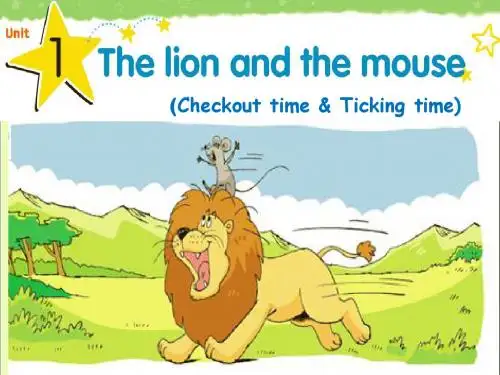
(Checkout time & Ticking time)
译林六下Unit1《The lion and the mouse》教学设计教案(共四课时)
Unit1 The lion and the mouse第一课时教学设计【教学内容】义务教育教科书译林版六年级上册Unit1 The lion and the mouse (Story time)【教学目标】1.能理解并会朗读故事。
2.能初步听懂、会读单词large、strong、woke、weak、net、bit、sharp、sadly、hole3.注意不规则动词过去式的写法和读音。
4.通过学习本课的故事,让学生懂得人与人之间应该互相帮助。
【教学重点】1.能理解并会朗读故事。
2.能初步听懂、会读单词large、strong、woke、weak、net、bit、sharp、sadly、hole3.并注意不规则动词过去式的写法和读音。
【教学难点】1.能理解并会朗读故事。
2.能初步听懂、会读单词large、strong、woke、weak、net、bit、sharp、sadly、hole3.注意不规则动词过去式的写法和读音。
【教学过程】Step1 Pre-reading (话题导入,有效激趣)(5分钟)1.Free talkT:What did you do at the weekend?T:Do you like animals?2. Let’s guessT: Can you guess what I draw? It has…T: What do you think of …?The lion is _________.The mouse is _________.Step 2 While-reading(自主阅读,提升能力)(15分钟)1. Watch, listen and ticka. Listen and chooseQ: Where did the story happen?b. Watch and sayQ: What time did it mention?2. Listen and sayT: Let’s listen. Who did you hear? What did they do? How were they?3. Read and say4. Ask and answerDid the lion let the mouse go?5. Read and sayT: Please read Paragraph 3-4 and complete the mind map.Who?What did they do?How did two men catch the lion?How did the lion bite the net?How did the mouse make a big hole in the net?Step 3 Post- reading(小组合作,情境操练)(10分钟)1. Read in roles2. Choose and actT: Work in groups. And you can choose one scene to act.Step 4 Checkout(课堂检测,反馈总结)(7分钟)1. Summary2. Watch and thinkT: Now let’s watch the cartoon: The ant and the dove.T: What can you learn from the two stories?Sometimes, the strong can be weak.Sometimes, the weak can be strong.Everyone is good at something.Let’s help each other!Step 5 Homework(有效回顾,提升能力)(3分钟)1.Make a summary2.Answer the questions on P8【板书设计】Unit 1 The lion and the mousetwo men caught (catch) with a large net the lion (strong) wanted (want) to eatbit (bite) the net with his sharp teeth the mouse (weak) walked (walk) bywoke ( wake)… upsaw (see)made (make) a hole with his teethUnit1 The lion and the mouse第二课时教学设计【教学内容】义务教育教科书译林版六年级上册Unit1 The lion and the mouse (Grammar time& Fun time)【教学目标】1.能根据提示复述课文2.能理解形容词和副词的区别3.能扩充故事,并进行表演【教学重点】1.能根据提示复述课文2.能理解形容词和副词的区别3.能扩充故事,并进行表演【教学难点】1.能理解形容词和副词的区别2.能扩充故事,并进行表演【教学过程】Step 1 Revision (话题导入,有效激趣)(5分钟)1.Review and sayT:Do you remember the story we’ve learned?T:Who can say something about the story?2. Read and orderT: Please read the sentences and order these pictures.T: Look at the words. Let—let, woke—wake.Step 2 Presentation(巩固旧知,有效铺垫)(10分钟)1. Fun timea. Look and sayT: Look at the picture. Can you describe it? Who can try?b. Choose and sayT: Work in pairs. You can choose one picture to talk and act.Step 3 Consolidation(合作展示,提升能力)(15分钟)1. Listen and sayT: Let’s listen. Can you say something about the lion and the mouse? T: These are adjectives and adverbials. Do you know the differences?2. Let’s chant.The lion laughed loudly, “Haha, I’m so strong.”The mouse said quietly, “Please don’t eat me!”The lion asked sadly, “Who can help,help me?”The mouse said happily, “I can help, help you.”They ran excitedly, “Haha, we are free now!”Step 4 Practice(联系实际,情境操练)(7分钟)1. Think and say2. Write and talkT: Now work in groups. You can choose a way to finish the passage. Step 4 Homework(有效回顾,提升能力)(3分钟)1. Act the story.2. Make a summary of adj. and adv.【板书设计】Unit 1 The lion and the mouselet-let quiet-quietlyloud-loudlywake-woke sad-sadlyexcited-excitedly…《The lion and the mouse》第三课时教学设计【教学内容】义务教育教科书译林版Unit1The lion and the mouse(Sound time ,Culture time & Cartoon Time)。
江牛津译林苏教小学英语六年级下《Unit 1 The lion and the mouse 》
You made my day!
我们,还在路上……
•1、书籍是朋友,虽然没有热情,但是非常忠实。2022年4月30日星期六2022/4/302022/4/302022/4/30 •2、科学的灵感,决不是坐等可以等来的。如果说,科学上的发现有什么偶然的机遇的话,那么这种‘偶然的机遇’只能给那些学有素养的人,给那些善于独 立思考的人,给那些具有锲而不舍的人。2022年4月2022/4/302022/4/302022/4/304/30/2022 •3、书籍—通过心灵观察世界的窗口.住宅里没有书,犹如房间里没有窗户。2022/4/302022/4/30April 30, 2022
The next day, two men _c_a_u_g_h_t the lion with a large _n_e_t_. He couldn’t _b_i_t _ the net with his _s_h_a_r_p teeth. “How can I get out?” He asked _s_a_d_l_y_. The mouse saw the lion and _m__ad_e_ a big hole in the net. The lion thanked the mouse _h_a_p_p_il_y.
形容词变副词的规则:
1.一般情况下直接加“ly”,如quick---quickly,quiet--quietly
2.以辅音字母加y结尾的形容词要变y为i,然后再加-ly。 如:happy---happily
你能写出这些形容词的副词吗?
excitedly quietly loudly sadly happily
Long long ago, there was a lion lived in the forest. It was _l_ar_g_e_ and _st_r_o_n_g. One day, he was _sl_e_e_p_in_g_. A _s_m__a_ll and __w_e_a_k_ mouse walked by and _w_o_k_e_ the lion __u_p_. The lion was _a_n_g_ry_ and wanted to eat it. “ I can help you,” the mouse said q_u_i_e_tl_y. The lion laughed _l_o_u_d_ly_ and __le_t_ the mouse go.
牛津译林六年级英语下册《Unit1 The lion and the mouse》公开课教案
分小组进行讨论,积极大胆的进行猜测和想象。
激发学生的好奇心和学习兴趣,自然引出新课。
讲授新课
1.Look and read
观察the lion和the mouse的图片进行比较,
学习本课新单词:mouse, large, weak, strong, sharp.
(2)Try to act the story with your friends.
新单词的学习:观看老师播放的图片,跟读新单词,注意模仿发音,同时记忆单词的拼写;播放课文录音时,听的同时圈出新词汇,模仿语音语调;游戏复习单词,积极抢答; 根据课文内容回答问题,大胆说答案,进一步熟悉故事内容;
最后分角色表演,注意语音语调。完成课堂练习,认真分析问题,再作答案。
按故事内容填空,注意动词的过去式,尤其是不规则的动词过去式,并熟记。
积极参加游戏,复习本单元单词;回忆故事内容,并生动形象地复述出来;根据故事内容填写动词过去式。
使学生在轻松的环境下快速投入到本课将要复习巩固的内容,同时鼓励学生勇于展示自己。
讲授新课
6.Grammar time
(1)Let’s read the words and the sentences.
课堂小结
这节课的教学任务目标.能复述Story time内容,会表演故事;复习巩固本课语法,形容词变副词及动词不规则变化的过去式。
本课反复回忆复述故事;反复朗读背诵动词过去式和形容词变副词,复习掌握本单元的语法;通过观看动画和朗读,掌握特殊疑问句的语调。通过句型的反复练习,使学生掌握这些句型。练习活动主要是两人对话,小组活动为主,学生在轻松的气氛中学到知识。
4.复习巩固形容词变副词。
牛津译林版-英语-六下-Unit 1 The lion and mouse.教案
(三年级起点六年级下册)Unit1 The lion and the mouse(Story time) 教学内容Unit1 The lion and the mouse(Story time)教学目标1、能听懂、会说、会读词汇mouse, large, strong, walk by, wake … up, some day, quietly, loudly, the next day, net, bite, sharp, ask, just then, soon, get out, happily, from then on, weak。
2、能听懂、会说、会读日常句型:The mouse said quietly. The lion laughed loudly. The lion asked sadly. The lion said happily.3、复习过去式,进一步学会运用。
4、能在理解的基本上,熟练朗读并试着复述故事。
5、通过阅读故事,教育学生不能欺负弱小;要明白:强大和弱小是相对的!教学重难点1、能听懂、会说、会读词汇mouse, large, strong, walk by, wake … up, some day, quietly, loudly, the next day, net, bite, sharp, ask, just then, soon, get out, happily, from then on, weak。
2、能听懂、会说、会读日常句型:The mouse said quietly. The lion laughed loudly. The lion asked sadly. The lion said happily.3、能在理解的基本上,熟练朗读并试着复述故事。
教学准备图片、课件、电脑等教学过程:Step 1. Organization:1. Greetings.2. Let’s talk.What’s your study plan?Share a plan.Step 2. Presentation and practice:1. T: Do you like animals?Ss: Yes, I do.T: What animals do you know?S: tiger, c at, dog, bear, …2. T: Today we’re going to learn a story about animals. What animals? Can you guess? (检查学生预习)Ss: The lion and the mouse.3. 30”talk show:1). T: If you were a lion or a mouse…通过学生交流,学习:large, strong, sharp等单词。