
机械设计制造及其自动化专业英语part3
机械设计制造及其自动化专业英语part3Unite24 计算机数字控制数字控制本世纪我们可以看到机器变得更加自动化,因此消除机器工作过程中的人工干预。
然而,随着自动化的发展,机器变得更加专业化。
文档收集自网络,仅用于个人学习一个高度自动化的机床(一天能够生产2万件)通常只能生产一种零件。
直到最近原型和小批量零件通常在传统的机床上手工制造。
文档收集自网络,仅用于个人学习随着新的难以加工的材料的出现以及对公差精度的要求达到万分之一,最好的操作工已达到他们能力的极限。
这些需求,以及对零件加工柔性的需求,导致了自动控制机器的出现。
通常叫做数字控制(通常缩写为NC,)文档收集自网络,仅用于个人学习NC的历史开始于19世纪50年代后期,当john提出一种自动机器控制方法(控制机床的铣刀产生光滑的曲线)正如他所设想,坐标点在穿孔卡片上进行编码并送给机床控制器(使经改进的铣床以小增量步长运动从而得到所需轨迹)在1949年,美国空军委托伺服机构实验室(麻省理工学院)开发一种可工作的数控系统(基于parson概念)文档收集自网络,仅用于个人学习M.I.T的科学家和工程师选择穿孔的纸带作为通讯介质。
最初构建两轴的点对点的系统(在坐标系中确立钻头的位置)。
后来,一个更复杂的连续路径的铣床被制造出来,独立的机床制造商随后开发了现在的这种系统。
文档收集自网络,仅用于个人学习到1957年第一台成功的数控机床在生产中得到应用。
然而,许多用户都在将零件程序输入机床控制器中经历困难,为了改变这种情形,MIT的专家开始开发了基于计算机零件编程语言的刀具控制程序自动编制系统。
目标是以直接的方式确定数学关系。
在1962年第一台APT自动编程系统发布(对于一般工业应用)文档收集自网络,仅用于个人学习数控技术的开发在两个主要方面进行,硬件开发集中在对控制系统和机床刀具的改进。
复杂的数控机床和控制系统在1965年之前对于每个主要的机床工具结构都可应用。
软件的开发集中在APT语言的改进和其他NC编程系统的开发。
文档收集自网络,仅用于个人学习总体基本原理的变化开始于70年代。
数控之后被看做更大的一个概念——计算机辅助制造。
CAM不仅包含数控也包括生产控制和监控、物料管理和工艺编制。
计算机在制造过程中应用的强调从而产生新的数控形式:CNC和DNC。
数控继续发展,在科幻小说中出现的可能性现在被看做可以达到的目标。
文档收集自网络,仅用于个人学习数控表现最好的地方其他专业自动化的机床表现不好。
NC是一个能解释预先以符号形式录制的指令的系统。
它能够使被控机床执行指令并监控执行的结果,从而保持所需要的精度和功能。
文档收集自网络,仅用于个人学习NC并不是一种机床而是一种技术(控制大量机床)。
由于这个原因,NC被应用到装配机器、检测设备、绘图机、打字机、木工机器(仅仅列出几种应用)以及金属加工机床。
因为NC最开始是为机床开发的,并且因为NC金属切削机床构成NC应用的大部分,因此我们文章中专指数控机床。
文档收集自网络,仅用于个人学习数控系统形成一种通讯联系(和传统工艺有许多的相似性)一个简化的示意图(大多数重要的数控系统元件)。
如图所示。
符号指令被输入到控制单元(解码。
进行所需要的逻辑运算并输出精确指令控制机床的运行)。
许多NC系统包括检测装置(将机床状态传回指令控制单元)。
正是这一个反馈使得控制能够验证机床操作与输入符号指令一致。
文档收集自网络,仅用于个人学习Unite25 机器人工业机器人变为现实。
在60年代早期,当时约瑟夫和乔治联合成立的叫做通用机械手公司。
机器人并不是简单的另外一种自动化机器。
自动化开始于工业革命期间,在这期间由及其完成以前人类完成的工作。
然而,这种机器只能做设计专一的工作,而机器人可以完成多种工作。
文档收集自网络,仅用于个人学习机器人必须有手臂,这个手臂能够要再现人类工作者在装卸自动化机器的工作。
喷漆机器人、焊接机器人完成成千上百的工作(由传统自动化机器不容易完成的)文档收集自网络,仅用于个人学习机器人定义机器人工业协会发布关于机器人的定义,试图澄清哪种机器是简单自动化机器,哪种机器时真正的机器人。
RIA给出的定义如下:文档收集自网络,仅用于个人学习机器人是一种可重新编程的、多功能的机械手,为实现各种任务设计成通过可改变的程序动作来移动材料、零部件、工具或专用装置。
文档收集自网络,仅用于个人学习这个定义,RIA在本书最后的词汇表中给出的解释更加广义。
是机器人的最准确定义。
我们将逐字看这个定义。
为了理解哪种机器实际上是机器人,那种机器不过是自动化机床。
文档收集自网络,仅用于个人学习首先,机器人是一个可重复编程的功能机械手。
在这个词组里,RIA告诉我们机器人可以学习(可重复编程)不只做一种工作。
通过改变存储器里面的信息,机器人可通过再编程实现从机床上装卸物料、焊接并且能做其他多种工作(多功能的)。
机器人是一个机械手。
操作手是一个可以捡起和移动东西的手。
基于这点我们知道机器人是一个可以学习做不同工作的手臂。
文档收集自网络,仅用于个人学习机器人被设计移动物料、零件、工具或专用设备的定义继续叙述。
这些材料包括木料、钢材、塑料、纸板——常在产品制造中用到的东西。
文档收集自网络,仅用于个人学习机器人也能处理已经制造好的零件。
例如,机器人可以把一块钢材装到自动车床并把车床上加工好的零件取下来。
除了处理物料和零件,机器人还能够和磨床。
缓冲器、螺丝刀以及焊接工具配合完成有用的工作。
机器人还能够和专业化仪器或设备配合在制造厂做专业的工作。
机器人能够和电视摄像头配合对零件或产品进行检查。
他们能过和激光配合精确测量被加工零件的尺寸。
文档收集自网络,仅用于个人学习RIA定义以这样的词组解释“通过可变程序的动作完成多种工作”这话强调,机器人可以在制造厂做多种不同的事实。
机器人能够做的工作的多样性仅仅受应用工程师创造性的限制。
文档收集自网络,仅用于个人学习机器人的工作机器人所做的工作主要分成两大类:有害的工作和重复的工作。
有害工作许多机器人做对人类有害的工作。
这种工作被认为是有害的是因为毒烟、被处理材料的重量、温度,危险的工作靠近回转机械或钻床或环境中包含过高辐射。
文档收集自网络,仅用于个人学习重复工作除了承担有害工作,机器人非常适合于做完全重复性工作(在制造厂里是必须的)制造厂的许多工作需要一个人表现得更像机器人而不是人。
工作可能是把一个东西从这里建起来放到那里。
同样的工作一天完成上千次,工作几乎不需判断和技术,这不是对做这种工作的人的批判,而是想简单的指出工厂里面确实存在这么多的工作是完成产品必须做的。
机器人能够放在这个这个工位很好地完成这个工作,没有埋怨,不会疲劳或厌烦。
文档收集自网络,仅用于个人学习Unite 26 计算机辅助制造CAM系统管理制造的许多方面,通过引入层状的计算机结构监控制造过程的各个阶段。
传统的和适应性NC系统是大型CAM系统的前基。
文档收集自网络,仅用于个人学习数控在考虑与离散的工艺过程有关的信息反馈回路的地方,CAM形成了集成信息网络。
用它来监视范围广阔的相互联系的任务。
并控制以总策略为基础的每一项任务。
文档收集自网络,仅用于个人学习理想的情况是一个CAm系统应该有三种性质适用于制造过程的每个阶段,尽管被管理,但是小量的人工干预也是必须的。
单个工艺任务系统应该是柔性的允许工艺过程能够被单独编程。
CAM系统应该是集中地将工程设计和分析用CAM系统集合在一起。
这种理想系统的各个方面已经被成功实现。
但是还需要做一些继续的开发。
文档收集自网络,仅用于个人学习CAM层状结构一个大规模的CAM系统包括两层或三层的层状结构,用于监控单个工艺任务,一个小型计算机负责管理单个处理信息,CAM这种层状结构通用配置在图2中说明文档收集自网络,仅用于个人学习一个大规模CAM系统包括两个主要领域(与制造工艺相关的),生产管理与控制工程分析与设计,财务与市场。
每一方面由子任务构成,通常由大型或小型计算机直接控制,比如在检查和质量控制时,不管采用什么控制方法,CAm重要优势在于他是一个双向的信息流。
文档收集自网络,仅用于个人学习因为CAm系统管理制造过程的每个方面,由一个子任务阿金测到信息所支配的变化。
能够转换为其他子任务的控制数据。
例如,在制造任务中,机械加工检验和装配统统处于计算机的控制之下,当计算机认识到零件连续起出公差(根据来自自动检测装置的信息反馈),它能够进行编程以影响这个变化(在实际加工过程中)从而补偿这个偏差。
因为这两种任务变成同一信息循环的一部分,包括加工和检验的反馈控制系统建立起来。
文档收集自网络,仅用于个人学习CAM中的NC尽管数控机传是开发可用CAM系统所必需的。
本文中描述的还不能应用到以计算机为基础的制造系统。
传统的NC和AC机床必须进行修改,从而使信息能够在监控单元和计算机系统之间进行传递。
这些修改导致源于数控概念的三个主要发展:计算机管理数控,群组概念和新形势的适应性控制。
文档收集自网络,仅用于个人学习计算机管理数字控制是包含DNC和CNC的一个通用术语。
DNC和CNC都是在控制计算机和NC机床之间分配可编程的计算责任方面。
两种系统都不能改变NC机床的功能特性。
相反的,每一个系统都提供了在数控机床控制回路之外的工艺过程数据与命令的通讯方法。
文档收集自网络,仅用于个人学习群组概念本质上是对多种机床的计算机管理的延伸。
一系列机床(比如用于铣、镗、磨)是通过传输系统相互关联。
在机床需要时给单个机床提供零件。
两层控制和监控是必须的。
单台机床由计算机管理NC进行控制。
群本身由中央计算机管理和其他多个群的生产结果相关联。
再次显示层状结构布置是明显的。
文档收集自网络,仅用于个人学习适应性NC系统是CAM环境/系统的一部分。
中央计算机能过得到工艺过程信息。
当异常情况出现时能被检测和纠正。
另外,适应性反馈也能被记录和分析,从而使给定操作的生产效率建立起来。
文档收集自网络,仅用于个人学习NC机床在计算机为基础的制造系统的应用可以从自动化和集成化的角度来看。
四层制造自动化可被定义,单独使用的数控机床表示某一自动化操作过程,数控加工中心使整个机加工工艺过程实现自动化,一组外部计算机控制的数控机床表示某一完全自动化的制造任务,而最后,CAM本身集成了所有在自动化制造过程工艺中的较低水平的方法。
文档收集自网络,仅用于个人学习Unite27 柔性制造系统制造系统的发展可以用图形方式表示,如图。
制造工艺过程和系统处于从手工操作到最终完全实现集中制造的过渡状态。
在计算机集成制造之前的状态称为柔性制造。
文档收集自网络,仅用于个人学习柔性是现代制造装备的一个重要特征,它意味着制造系统是万能的。
适应的同时能够处理生产率较高的生产线。
机械设计制造及其自动化专业英语
机械设计制造及其自动化专业英语机械设计制造及其自动化专业英语是指在机械设计、制造和自动化控制领域中使用的专业英语词汇和表达方式。
在国际交流和合作中,掌握这些专业英语词汇对于机械设计制造及其自动化专业人士来说至关重要。
下面我将详细介绍机械设计制造及其自动化专业英语的内容和应用。
一、机械设计制造专业英语1. 机械设计基础词汇在机械设计中,有一些基础词汇是必须了解的,比如:mechanical(机械的)、design(设计)、manufacturing(制造)、component(零部件)、assembly(装配)、tolerance(公差)、dimension(尺寸)、material(材料)、strength(强度)、stiffness(刚度)等等。
2. 机械设计软件词汇机械设计中常用的软件包括AutoCAD、SolidWorks、CATIA等,因此了解这些软件的专业英语词汇是必要的。
例如:CAD(计算机辅助设计)、3D modeling (三维建模)、rendering(渲染)、simulation(仿真)、assembly modeling(装配建模)等。
3. 机械加工工艺词汇机械加工是机械制造的重要环节,因此掌握机械加工工艺的专业英语词汇也是必不可少的。
例如:milling(铣削)、turning(车削)、drilling(钻孔)、grinding(磨削)、welding(焊接)、casting(铸造)等。
4. 机械设计标准和规范词汇在机械设计制造过程中,需要遵守一系列的标准和规范。
了解这些标准和规范的专业英语词汇是非常重要的。
例如:ISO(国际标准化组织)、ASME(美国机械工程师协会)、ASTM(美国材料与试验协会)、GD&T(几何公差与尺寸标注)等。
二、自动化专业英语1. 自动控制系统词汇自动化领域中,掌握自动控制系统的专业英语词汇是必要的。
例如:control system(控制系统)、feedback(反馈)、sensor(传感器)、actuator(执行器)、PID controller(比例积分微分控制器)、PLC(可编程逻辑控制器)等。
机械设计制造及其自动化 英语
机械设计制造及其自动化英语Mechanical design, manufacturing, and its automation are essential aspects of various industries, including automotive, aerospace, electronics, and more. These processes involve the creation of mechanical systems and components, as well as the use of advanced technologies to automate production and improve efficiency.The field of mechanical design encompasses the creation of detailed plans and specifications for machines, tools, and mechanical systems. This involves the use of computer-aided design (CAD) software to create 2D and 3D models, as well as the selection of materials and the consideration of factors such as stress, heat, and other environmental conditions.Manufacturing involves the production of mechanical components and systems using a variety of techniques, including machining, casting, molding, and 3D printing. This process requires a deep understanding of materials, production processes, and quality control to ensure that the final products meet the required specifications and standards.Automation plays a crucial role in modern mechanical design and manufacturing, as it enables the use of robots, computer numerical control (CNC) machines, and other advanced technologies to streamline production processes and increase efficiency. This not only reduces the need for manual labor but also allows for the production of complex components with high precision and consistency.Overall, the integration of mechanical design, manufacturing, and automation is essential for the development of innovative products and the advancement of various industries. By utilizing advanced technologies and expertise in these areas, companies can improve their competitiveness and meet the ever-changing demands of the global market.在机械设计、制造和自动化方面的进展,对各行各业都产生了深远的影响。
机械设计制造与自动化专业英语翻译
Unit 1 Metals金属Unit 2 Selection of Construction Materials工程材料的选择淬透性:指在规定条件下,决定钢材淬硬深度和硬度分布的特性。
即钢淬火时得到淬硬层深度大小的能力,它表示钢接受淬火的能力。
钢材淬透性好与差,常用淬硬层深度来表示。
淬硬层深度越大,则钢的淬透性越好。
钢的淬透性是钢材本身所固有的属性,它只取决于其本身的内部因素,而与外部因素无关。
钢的淬透性主要取决于它的化学成分,特别是含增大淬透性的合金元素及晶粒度,加热温度和保温时间等因素有关。
淬透性好的钢材,可使钢件整个截面获得均匀一致的力学性能以及可选用钢件淬火应力小的淬火剂,以减少变形和开裂。
淬透性主要取决于其临界冷却速度的大小,而临界冷却速度则主要取决于过冷奥氏体的稳定性,影响奥氏体的稳定性主要是:1.化学成分的影响碳的影响是主要的,当C%小于1.2%时,随着奥氏体中碳浓度的提高,显著降低临界冷却速度,C曲线右移,钢的淬透性增大;当C%大于时,钢的冷却速度反而升高,C曲线左移,淬透性下降。
其次是合金元素的影响,除钴外,绝大多数合金元素溶入奥氏体后,均使C曲线右移,降低临界冷却速度,从而提高钢的淬透性。
2.奥氏体晶粒大小的影响奥氏体的实际晶粒度对钢的淬透性有较大的影响,粗大的奥氏体晶粒能使C曲线右移,降低了钢的临界冷却速度。
但晶粒粗大将增大钢的变形、开裂倾向和降低韧性。
3.奥氏体均匀程度的影响在相同冷度条件下,奥氏体成分越均匀,珠光体的形核率就越低,转变的孕育期增长,C曲线右移,临界冷却速度减慢,钢的淬透性越高。
4.钢的原始组织的影响钢的原始组织的粗细和分布对奥氏体的成分将有重大影响。
5.部分元素,例如Mn,Si等元素对提高淬透性能起到一定作用,但同时也会对钢材带来其他不利的影响。
可锻性(forgeability)金属具有热塑性,在加热状态(各种金属要求温度不同),可以进行压力加工,称为具有可锻性。
机械设计制造及其自动化专业英语
13
Computer-Aided manufacturing
• For some time, strides [straɪd] to reduce human involvement in manufacturing were being taken. Specialty [’speʃəlti] machines using cams and other “hardwired” logic controllers had been developed.
• 长期以来,人们一直致力于减少制造过程 中的人为参与。已经开发出了采用凸轮和 其他“硬连线”逻辑控制器的专用设备。
14
Computer-Aided manufacturing
• The U.S. Air Force recognized [‘rekəɡnaɪzd] the development time required to produce this special equipment and that the time required to make only small sequence changes was excessive [ɪkˈsɛsɪv].
• 因此,美国空军委托麻省理工学院开发(展示) 可编程的数字化控制器,也称“软连线”设备。 1952年的这次首创开始了制造业的新纪元。
16
Computer-Aided manufacturing
• Since then, digital computers have been used to produce input either in a directed manner to many NC machines, direct numerical control (DNC), or in a more dedicated control sense, computer numerical control (CNC).
机械设计制造及其自动化专业英语第三单元
Mechanical properties of Materials材料的机械特性The materials properties can be classified into three major heading:(i)Physical,(ii)Chemical,(iii)Mechanical。
材料的特性可以分为三个重要的部分:1 是物理特性,2 是化学特性,3 是机械特性。
Physical Properties物理特性Density or specific gravity, moisture content, etc., can be classified under this category.密度或者比重,水分含量等,都被分为这一类的范畴Chemical Properties化学特性Many chemical properties come under this category. These include acidity or alkalinity,许多化学特性都归入到这个范畴。
这些特性包括酸性或碱性reactivity and corrosion. The most important of these is corrosion which 反应性和腐蚀性。
can be explained in layman’s terms as the resistance of the material to decay while in continuous use in a particularatmosphere这些中最重要的是耐腐蚀性,它可以被解释为在外行人看来作为材料在特定大气中长期使用时抵抗腐蚀的能力。
Mechanical Properties(机械特性)Mechanical properties include the strength properties like tensile, compression, shear, torsion, impact, fatigue and creep.机械特性包括拉伸,压缩,剪切,扭转,冲击,疲劳和蠕变等强度特性。
专业英语(机械制造及其自动化)
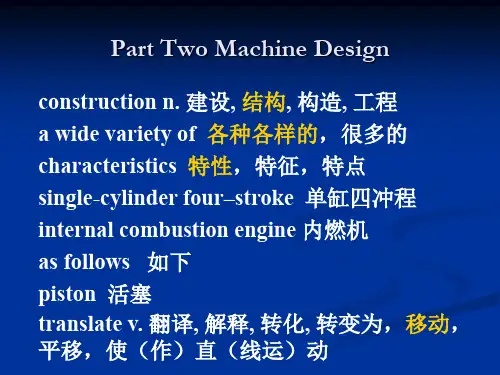
follower 从动件 assembly 集合,装配, 部件, 组(合)件 cover 盖,封皮 nut 螺母 bolt 螺栓 kinematics n. 运动学 link 连杆 as described above 如上所述 function 功能,作用,函数 slider-crank mechanism 曲柄滑块机构
vt. 勾画...的轮廓
periphery n. 周围,圆周, 边缘, 圆柱(体)表面, 外围,外部 groove n. 沟槽 axis 轴线 is perpendicular to 与…垂直 plane 平面 impart vt. 分给, 传给,传授, 告诉, 通知(to) oscillate vi. 振动, 振荡, 颤振, 摇摆, 动摇 injector n. 注射器, 针管 【机】喷射[注]器, 喷油器, 喷嘴[头], 发[引]射器, 灌浆机
frictional force 摩擦力 ecology n. 生态学 conservation n. 保存,保藏,(水土的)保持,保护 【物】守恒,不灭 miscellaneous adj. 各种的,不同性质的,五花八 门的, 多方面的, 多才多艺的 reliability 可靠性 maintainability 可维护性 substantially adv. 实质上,充分地,事实上 incompatible 不相容的, 不协调的, 不相配的
vt. 弥补, 抵销, 用平版印刷 vi. 偏移, 偏置
swing v. 摇摆, 摆动, 回转, 旋转 n. 秋千, 摇摆, 摆动
hinge n. 铰链 v. 用铰链连接
circular arc 圆弧 roller 辊子 spring-loaded 弹簧加载的 sensitivity n. 敏感, 灵敏(度), 灵敏性 profile 轮廓
机械设计制造及其自动化专业英语翻译(最新整理1)
Unit 1 Metals金属Unit 2 Selection of Construction Materials工程材料的选择Unit 3 Mechanical Properties of MaterialsUnit5 Design of machine and machine elements机器和机器零件的设计Machine design机器设计1 Machine design is the art of planning or devising new or improved machines to accomplish specific purposes. In general, a machine will consist of a combination of several different mechanical elements properly designed and arranged to work together, as a whole. During theinitial planning of a machine, fundamental decisions must be made concerning loading, type of kinematic elements to be used, and correct utilization of the properties of engineering materials. Economic considerations are usually of prime importance when the design of new machinery is undertaken. In general, the lowest over-all costs are designed. Consideration should be given not only to the cost of design, manufacture the necessary safety features and be of pleasing external appearance. The objective is to produce a machine which is not only sufficiently rugged to function properly for a reasonable life, but is at the same time cheap enough to be economically feasible.机器设计为了特定的目的而发明或改进机器的一种艺术。
机械设计制造及其自动化英语
机械设计制造及其自动化英语Mechanical Design, Manufacturing and AutomationMechanical design, manufacturing, and automation play a crucial role in modern industrial processes. These processes involve the creation of products and machines, as well as the development of automated systems to streamline production and increase efficiency.The process of mechanical design starts with conceptualizing a product or machine, followed by detailed design and analysis. This is often done using computer-aided design (CAD) software, which allows engineers to create 3D models and simulate the behavior of the product under various conditions. Once the design is finalized, it is then sent for manufacturing.Manufacturing involves a variety of processes, including machining, casting, molding, and additive manufacturing. Each of these processes has its own advantages and limitations, and the choice of manufacturing method depends on the specific requirements of the product. Advanced manufacturing techniques, such as 3D printing, are also becoming more prevalent, offering new possibilities for design and production.Automation is another key aspect of modern manufacturing, with many processes being fully or partially automated. This includes the use of robots and machinery to perform repetitive tasks, as well as the implementation of advanced control systems to optimize production. Automation not only increases efficiency but also improves safety by reducing the need for manual labor inhazardous environments.Overall, mechanical design, manufacturing, and automation are essential components of modern industry, driving innovation and enabling the production of high-quality products in a cost-effective manner. As technology continues to advance, the role of these processes will only become more important in shaping the futureof manufacturing.当谈到机械设计、制造和自动化时,值得注意的是这些领域的发展也在不断受到数字化和智能化的影响。
机械设计制造及其自动化专业英语翻译(最新整理1)
Unit 1 Metals金属Unit 2 Selection of Construction Materials工程材料的选择Unit 3 Mechanical Properties of MaterialsUnit5 Design of machine and machine elements机器和机器零件的设计Machine design机器设计1 Machine design is the art of planning or devising new or improved machines to accomplish specific purposes. In general, a machine will consist of a combination of several different mechanical elements properly designed and arranged to work together, as a whole. During theinitial planning of a machine, fundamental decisions must be made concerning loading, type of kinematic elements to be used, and correct utilization of the properties of engineering materials. Economic considerations are usually of prime importance when the design of new machinery is undertaken. In general, the lowest over-all costs are designed. Consideration should be given not only to the cost of design, manufacture the necessary safety features and be of pleasing external appearance. The objective is to produce a machine which is not only sufficiently rugged to function properly for a reasonable life, but is at the same time cheap enough to be economically feasible.机器设计为了特定的目的而发明或改进机器的一种艺术。
机械工程专业英语P33-英文版
Engineering drawing is a graphical language used by engineers and other technical personnelassociated with the engineering profession. The purpose of engineering drawing is to conveygraphically the ideas and information necessary for the construction or analysis ofmachines ,structures,or systems.In colleges and universities,engineering drawing is usually treated in courses with titleslike Engineering Graphics.Sometimes these courses include other topics,such as computergraphics and NomographyThe basis for much engineering drawing is orthographic representation (projection). Objectsare depicted by front, top, side, auxiliary, or oblique views, or combinations of these.The complexity of an object determines the number of views shown. At times, pictorial viewsare shown.Engineering drawings often include such features as various types of lines, dimensions,lettered notes, sectional views, and symbols. They may bein the form of carefully plannedand checked mechanical drawings, or they may be freehand sketches. Usually a sketchprecedes the mechanical drawing. Final drawings are usually made on tracing paper, cloth orMylar film, so that many copies can be made quickly and cheaply by such processes as,blueprinting, ammonia-developed printing, or lithography.Many objects have complicated interior details which cannot be clearly shown by means offront, top, side, or pictorial views. Section views enable the engineer or detailer to showthe interior detail in such cases. Features of sectiondrawings are cutting-plane symbols,which show where imaginary cutting planes are passed to produce the sections, and section-lining (sometimes called cross-hatching), which appears in the section view on all portionsthat have been in contact with the cutting plane. When only a part of the object is to beshown in section, conventional representation such as a revolved, rotated, or broken-outsection is used. Details such as flat surface, knurls, and threads are treatedconventionally, which facilities the making and reading of engineering drawings byexperienced personnel. Thus, certain engineering drawings will be combinations of top andfront views, section and rotated view, and partial or pictorial views.In addition to describing the shape of objects, many drawings must show dimensions, so thatworkers can build the structure or fabricate parts that will fit together. This isaccomplished by placing the required values (measurements) along dimension lines (usuallyoutside the outlines of the object) and by giving additional information in the form ofnotes which are referenced to the parts in question byangled lines called leaders. Indrawings of large structures the major unit is the foot, and in drawings of small objectsthe unit is the inch. In metric dimensioning, the basic unit may be the meter, or themillimeter, depending upon the size of the object or structure.Working types of drawings may differ in styles of dimensioning, lettering (inclinedlowercase, vertical uppercase, and so on), positioning of the numbers (aligned, orunidirectional –a style in which all numbers are lettered horizontally), and in the typeof fraction used (common fractions or decimal fractions).If special precision is required,and upper and lower allowable limit are shown. Such tolerance, or limit, dimensioning isnecessary for the manufacture of interchangeable mating parts, but unnecessarily closetolerances are very expensive.Layout Drawings Layout drawings of different types are used in different manufacturingfields for various purposes.One is the plant layout drawing,in which the outline of the building,work areas, aisles, and individual items of equipment areall drawn to scale. Another typeis the aircraft, or master,layout, which is drawn on glass cloth or on steel or aluminum sheets.The object is drawn to full size with extreme accuracy. The completed drawing is photographed with great precision, and a glass negative made. Fromthis negative,photo templates are made on photosensitized metal in various sizes and for differentpurposes,thereby eliminating the need for many conventional detail drawings.Another type of layout, or preliminary assembly, drawing is the design layout, which establishes the position and clearance of parts of anassembly.A set of working drawings usually includes detail drawings of all parts and an assemblydrawing of the complete unit. Assembly drawings vary somewhat in character according totheir use, as design assemblies or layouts; working drawing assemblies; general assemblies;installation assemblies; and check assemblies. A typical general assembly may includejudicious use of sectioning and identification of each part with a numberedballoon. Accompanying such a drawing is parts list, in which each part is listed by numberand briefly described; the number of pieces required isstated and other pertinentinformation given. Parts lists are best placed on separate sheets and typewritten to avoidtime-consuming and costly hand lettering.Schematic or diagrammatic drawings make use of standard symbols and single lines betweensymbols which indicate the direction of flow. In piping and electrical schematic diagrams,symbols recommended by the American National Standards Institute (ANS I), other agencies,or the Department of the Defense (DOD) are used. The fixtures or components are not labeledin most schematics because readers usually know what the symbols represent.Additional information is often lettered on schematic drawing, for example, theidentification of each replaceable electrical component. Etched-circuit drawing hasrevolutionized the wiring of electronic components. By means of such drawing, the wiring ofan electronic circuit is photographed on a copper-clad board, and unwanted areas are etchedaway. On electrical and other types of flow diagrams, all single lines (often with arrowsshowing direction of flow) are drawn horizontally or vertically; there are few exceptions.In some flow diagrams, rectangular enclosures are used for all items. Lettering is usuallyplaced within the enclosuresStructural Drawings Structural drawings include design and working drawings for structuressuch as buildings, bridges, dams, tanks, and highways. Such drawings form the basis oflegal contracts. Structural drawings embody the same principles as do other engineeringdrawings, but use terminology and dimensioning techniques different from those shown inprevious illustrations.1工程图是一种图形语言使用的工程师和其他技术人员与工程相关的职业。