
2016年上海宝山区高三英语二模试卷及答案
II. Grammar and VocabularySection ADirections: After reading the passages below, fill in the blanks to make the passages coherent and grammatically correct. For the blanks with a given word, fill in each blank with the proper form of the given word; for the other blanks, use one word that best fits each blank.(A)About dancing bearsYoung bears are captured in the wild, separated from their mothers, and taught by a trainer to become dancing bears in conditions of unimaginable cruelty.The young animals are forced on to sheets of really hot metal and, (25) ______ (escape) the pain,the bears alternate lifting up one paw (爪子) and then another while music is played. The processis repeated again and again (26) ______ the animals automatically begin to raise their paws – to “dance” – in fear of the pain, even when there are no metal sheets.As the bears get older, the trainers keep them under control by imposing pain. They do this by putting rings through the bears’ highly sensitive noses and jaws. The pitiful truth is (27) ______ they are not put to sleep for this painful process. Chains (28) ______ (attach) to the rings so the trainers can control the animals, (29) ______ weigh up to 350 kilograms, with only a slight pull on the chains.The bears’ nails are c ut several times a year and their teeth broken or removed in order that they cannot get their trainers (30) ______ (injure). The bears also suffer with an inadequate diet usually (31) ______ (consist) of white bread, sugar and cheap fruit juices. All these cause the bears serious physical health problems (32) ______ ______ many of them display strange behavior suchas swaying (摇摆) and pacing as they cannot follow natural behavioral patterns and instincts.(B)The Power of GoodIt was Mother’s Day morning la st year and I was shopping at our local supermarket with myfive-year-old son, Tenyson. As we were leaving, we realised that only minutes (33) ______ (early) an elderly woman had fallen and hurt (34) ______ badly. She was embarrassed and clearly in shock. Fortunately, her husband was with her and many people had stopped to help out. Walking towards the scene, Tenyson became very upset about (35) ______ had happened to the elderly couple. He said to me, “(36) ______ (fall) over in front of everyone isn’t much fun.”Near the entrance of the supermarket, a charity group had set up a stall selling flowers. Tenyson suggested that we should buy the lady a flower. “It will make her feel better,” he said. I was amazed that he would have this sweet idea, so I asked the flower seller if I (37) _____ buy a flower for the elderly lady because my son wanted to give it to her to cheer her up. “Just take it,” she replied. “I can’t take your money for such wonderful gesture.”By then a nurse (38) ______ (arrive), and was attending to the woman. As we walked up to her, Tenyson became frightened by all the blood and medical equipment. Instead I gave (39) ______ flower to the woman’s husband. The old man thanked us both, then bent down and gave it to his wife, telling her who it was (40) ______. Despite being badly hurt and shaken, the old lady looked up at Tenyson with love in her eyes and gave him a little smile.Section BDirections: Complete the following passage by using the words in the box. Each word can only be used once. Note that there is one word more than you need.A. alternativeB. appealC. benefitD. differE. energizingF. fascinatedG. marineH. naturalistI. preserveJ. specializingK. unspoiledEcotours are unique adventures that join nature and sightseeing into one exciting package. Learning about the environment and the world around us is the 41 of an ecotour because you get to experience the natural world firsthand. A great way for students studying biology and environmental sciences to experience 42 life and nature is to take your own ecotour! Orlando airboat rides can give you an experience to remember and can be a fun and 43 way to learn more about the Florida environment.Ecotours involve travelling to a natural environment where you are guided by a(n) 44helping you learn about the surrounding environment and extend your environmental education. This can include learning how the plants and animals on your Orlando airboat rides 45 from each other, or you can be simply becoming more aware of preservation efforts towards the Everglades, the largest wetland in North America.Orlando airboat rides can help you learn about Florida history, observe alligators (短吻鳄) andother wildlife, and experience the 46 nature of the muddy wilderness. Taking an ecotour can help you become more aware of your environment and further instruct you on the impact we have on the environment. Our goal is to help you understand the Everglades and how important it is to 47 the wetland.Wild Florida provides the perfect opportunity for a school trip that satisfies those 48 with learning more about environmental sciences, or to those just curious about the Everglades. Hands-on and active learning on an airboat ride is often a more exciting and adventurous 49 to sitting in a classroom, so why not plan your ecotrip with Wild Florida?Wild Florida is reputable for 50 in creating an exciting and unique ecotour that’s fun for everyone in your family! You will be flying through the muddy Everglades in our airboat rides while observing and learning about alligators, bald birds, the history of the Everglades, and so much more. Book your Orlando airboat rides today by calling us at 407-901-2563 to experience aone-of-a-kind ecotour that you won’t soon forget.III. Reading ComprehensionSection ADirections: For each blank in the following passage there are four words or phrases marked A, B, C and D. Fill in each blank with the word or phrase that best fits the context.Over the last 15 years, digital communication has brought in more changes than the printing press did in 1570. And those most likely to use them in this world are teenagers, whose brains appear to have an extraordinary volume to adapt to the world around them, according to Dr Jay Giedd, a(n) 51brain expert.We are now discovering that, as a species, our brains during the teenage years are still flexible and capable of 52 . Having a more flexible brain, 53 , means that certain parts of it, such as desire control and the ability to make long-term decisions, haven’t developed yet, which may also explain why we spend a(n) 54 period living under the protection of our parents rather than leaving home at the age of 12 or 13. This also means that the teenage brain can adapt to new technology,enabling teenagers to 55 the increasing pace of digital technology and giving them an advantage when it comes to multitasking.In the USA, on average teenagers spend 8.5 hours a day using computers, mobiles, and other devices to learn, interact, and play. This increases to 11.5 hours if you include all of the56 that goes on, such as talking on the phone while watching TV. As they stare at these screens, they’re taking in and sorting through an incredible amount of information.There are 57 about how social media is affecting the way the brain learns to 58 , as one of the most important skills that we learn as children is how to make friends and interact with people around us. Geidd says that a lot of what goes on inside our brains is social. Social interactions are now being 59 by technology – you could have hundreds of friends, all of whom are real people that you interact with and scientists aren’t sure whether we’ll be able to develop the same 60 using social media.There is a(n) 61 of the growing digital trend: YouTube shows the teenagers all over the world are watching the same videos and laughing at the same jokes, indicating that they are more62 than teenagers in the past. They may be keen on 63 their friends and posting updates on social media sites, but teenagers today are probably going to have access to technology and 64social and educational opportunities that anyone with a less flexible brain may have trouble imagining. Nevertheless, there is a cut-off point, and by the age of 30, our brains in their ways, making it more65 for us to adapt and cope with new technologies.51. A. digital B. adolescent C. surgical D. artificial52. A. functioning B. noticing C. adjusting D. deciding53. A. however B. therefore C. otherwise D. instead54. A. natural B. glorious C. limited D. extended55. A. keep up with B. come up with C. put up with D. end up with56. A. gossiping B. multitasking C. interacting D. playing57. A. reports B. curiosities C. concerns D. talks58. A. memorize B. sort C. imagine D. socialize59. A. changed B. controlled C. troubled D. interrupted60. A. trends B. attitudes C. societies D. skills61. A. advantage B. distraction C. indication D. history62. A. absent-minded B. global-minded C. quick-minded D. serious-minded63. A. accessing B. texting C. discovering D. watching64. A. on the whole B. as a result C. in other words D. by all means65. A. flexible B. important C. difficult D. incredibleSection BDirections: Read the following three passages. Each passage is followed by several questions or unfinished statements. For each of them there are four choices marked A, B, C and D. Choose the one that fits best according to the information given in the passage you have just read.(A)Sebastian Faulks has written many novels, including Devil May Care, the latest James Bond book. This cutting comes from a very different kind of novel called Charlotte Gray. The setting is atransit (中转) camp near Paris during the Second World War, where a group of people, includingtwo small children, Andre and Jacob, await transport to take them to a concentration camp outside France. Although these people –the ‘deportees’ of the cutting – are not fully aware of this, they face certain death.The Last NightAndre was lying on the floor when a man came with postcards on which the deportees might write a final message. He advised them to leave them at the station or throw them from the train as camp orders forbade access to the post. Two or three pencils that had survived the camps search were passed round among the people in the room. Some wrote with weeping passion, some with great care, as though their safety, or at least the way in which they were remembered, depended upon their choice of words.A woman came with a sandwich for each child to take on the journey. She also had a bucket of water, round which they gathered, holding out food cans they passed from one to another. One of the older boys hugged her in his gratitude, but the bucket was soon empty. When she was gone, there were only the small hours of the night to go through. Andre was lying on the straw, and Jacob leaned close to him for warmth.Five buses had come in through the main entrance, and now stood trembling in the corner of the yard. At a long table … the commandant of the camp himself sat with a list of names that another policeman was calling out in alphabetical order. Andre heard his name and moved with Jacob towards the bus. From the other side of the courtyard, from windows open on the dawn, a shower of food was thrown towards them by women crying and calling out their names.Andre looked up, and in a chance angle of light he saw a woman’s face in which the eyes were fixed with terrible fierceness on a child beside him. Why did she stare as though she hated him? Then it came to Andre that she was not looking in hatred, but had kept her eyes so intensely open in order to fix the picture of her child in her mind. She was looking to remember, for ever. …66. What can we learn from the first part of the passage?A. The background and the situation of World War II.B. The transit camp and the transportation in Paris.C. The author, the setting and the main characters.D. The main idea and the names on the list.67. Which of the following is true about the things going on in the transit camp?A. The deportees were eager to leave their final messages.B. A humble breakfast was served to children late that morning.C. Andre happened to witness the deportees’ routine camp life.D. The camp commandant stood by a long table calling the roll.68. The woman stared at her child fiercely probably because ______.A. she found her child was trembling and crying for foodB. she thought she would never see her child any moreC. she was filled with an attempt to escape from deathD. she was driven mad by the life in the transit camp69. The author told the story in a(n) ______ tone.A. casualB. desperateC. hatredD. innocent(B)What we doEFP Courses provide courses in English language and British culture. Our courses are aimed at students aged between 12 and 17 who are at pre-intermediate level or above in English. The courses are held in Guildford, a historic town near London.Typical structure of a one-week courseØ up to 25 hours of English run by native speakers, qualified in teaching English as a foreign language and specialist drama teachersØ 2 full-day sightseeing trips to London and Oxford (at weekends)Ø full board (全食宿) with local, English-speaking familiesWhen we run the coursesEFP courses can be organized only during British state school terms. For this academic year, courses can be booked between now and 23 May and between 30 May and 30 June. We welcome you to book from 3 September 2016 to 25 October 2016 and from 31 October to 20 December 2016.Why choose EFP coursesØ in addition to our standard English classes, we also run drama and expression English classes, taught by specialist drama teachersØ we expose our students to British culture for the entire length of the courseØ we tailor courses to e ach group’s needs, creating a unique experience for our students. Note that any changes to our courses are made within reason and only if all participants from a group share the same language level. Please see further details on our website.Length of a courseEFP courses run for either one or two weeks depending on the specific requirements for your group.How to apply**************************************************************.uk.Bycontactingus before you make any travel arrangements you ensure that we can put your group up on the dates that you require. For more details, please visit .See you in Guildford soon!70. What does the leaflet tell us about EFP courses?A. Their target students are teenagers of all English levels.B. They are available on the school campuses in London and Oxford.C. Every individual participant is supplied with tailored language support.D. They involve students in British culture activities during the whole course.71. Suppose you are to take EFP courses this academic year, you can ______.A. hand in an application by visiting their websiteB. enjoy a special series of lessons for a whole school termC. experience English dramas with English-speaking familiesD. make a reservation from October 31 to December 2072. The purpose of this writing is to ______.A. attract qualified teachers to EFP coursesB. demonstrate the popularity of EFP coursesC. offer group students access to EFP coursesD. illustrate the importance of EFP courses(C)Lindsay Renwick, the mayor of Deniliquin, a country town in New South Wales, misses theconstant whir (嗡嗡声) of the rice mill whose giant fans dried the rice. The Deniliquin mill, the largest rice mill in the Southern Hemisphere (南半球), once processed enough grain to meet theneeds of 20 million people globally. But six years of drought have had a destructive effect, reducing Australia’s rice crop by 98 percent and leading to the mothballing of the mill last December.Drought affects every agriculture industry based in Australia, not just rice – from sheep farming, the country’s other backbone, to the cultivation of grapes for wine, the fastest-growing crop there, with that expansion often coming at the expense of rice. The drought’s effect on rice has produced the greatest impact on the rest of the world, so far. It is one factor contributing to skyrocketing prices, and many scientists believe it is among the earliest signs that a warming planet is startingto affect food production.Researchers are looking for solutions to global rice shortages – for example, rice that blooms earlier in the day, when it is cooler, to fight against global warming. Rice plants that happen to bloom on hot days are less likely to produce grains of rice, a difficulty that is already starting to emerge in inland areas of China and other Asian countries as temperatures begin to climb. “There will be problems very soon unless we have new varieties of rice in place,” said Reiner Wassmann, climate change director at the International Rice Research Institute (IRRI). The recent reports on climate change carried a warning that could make the news even worse: that existing models for the effects of climate change on agriculture did not yet include newer findings that global warming could reduce rainfall and make it more variable.Yet the effects of climate change are not uniformly bad for rice. Rising concentrations (浓度) ofcarbon dioxide, the main greenhouse gas, can actually help rice – although the effect reduces or disappears if the plants face unnecessary heat, inadequate water, severe pollution or other stresses. Still, the flexibility of farmers here has persuaded some climate experts that, particularly in developed countries, the effects of climate change may be relieved, if not completely avoided. “I’m not as negative as most people,” said Will Steffen, director of the Fenner School of Environment and Society at Australian National University. “Farmers are learning how to do things differently.”Meanwhile, changes like the use of water to grow wine grapes instead of rice carry their own costs, as the developing world is discovering. “Rice is an essential food,” said Graeme Haley, the general manager of the town of Deniliquin. “Wine is not.”73. By “the mothballing of the mill” (in Paragraph 1) t he author most probably means the mill is ______.A. kept unprocessedB. left unusedC. being entirely restoredD. being pushed round74. To find the ways to cope with the global rice shortage, researchers are ______.A. seeking new types of rice which could bloom at a lower temperatureB. building greenhouses which could provide more heat for rice to growC. studying climate changes in China which may affect rice growing in AsiaD. looking for alternative agriculture industries which may take the place of rice75. Which of the following can be learned from the passage?A. Rice plants are fond of higher temperature in the process of growing.B. Global warming has shown few signs of influence on agriculture.C. Rice prices are rising steadily owing to the crop failure in Australia.D. Global warming may contribute to more complicated weather conditions.76. It can be inferred from the passage that ______.A. Australia is the largest rice producing country around the worldB. most people look on the bright side of the flexibility of farmersC. climate changes have simply brought negative effects to people’s livesD. wine grape cultivation has threatened the rice production in Australia77. Which of the following best serves as the title of the passage?A. Rice shortage and wine boomB. Drought, the enemy of rice productionC. Rice crisis and its solutionD. Rice issue, a focus of the public attentionSection CDirections: Read the passage carefully. Then answer the questions or complete the statements in the fewest possible words.What colour is it today? What shape is that smell? What does that pain sound like? These questions might seem like nonsense, but four people in 100 might think they make perfect sense. That four percent have synesthesia, and they naturally experience certain senses together. One form of this is pairing numbers or letters with a fixed colour –a blue “1” or a red “D.” Other synesthetes, people with synesthesia, may think the word “hurricane” tastes salty. Yet others with “mirror-touch syne sthesia” see someone hit on the head and also feel the hit themselves.Synesthesia is not completely understood though it is in our genes. The white matter (脑白质) ofsynesthetes is organized differently from that of people without synesthesia, which may accountfor the differences in perception (感知). Synesthesia is widely accepted and researched today, butthat hasn’t always been true. Though it caught scientific interest in the late 1800s, it was later rejected as a self-created way of thinking. But as people have become more fascinated by the differences in individual perception, a focus on synesthesia has been renewed. At the present time, scientists in various fields are examining the phenomenon.As scientists continue to study synesthesia, certain advantages have been noticed. Studies show that the sensation connections that synesthetes experience aid them in abilities related to memory.Researchers believe that this advantage may help stop the loss of cognitive (认知) function in theelderly. This aspect of synesthesia could even help patients recover from brain injuries. Synesthetes also tend to be artists, singers Pharrell Williams and Lady Gaga being some famousexamples. Most likely, synesthesia doesn’t give artistic sensitivity, but it’s understandable that seeing colours in music, for instance, could inspire art.Strong drugs and increasing blindness have been known to cause synesthesia, but these are not good options for obvious reasons. One recent emphasis of the study of synesthesia is to determine whether non-synesthetes can acquire it. For now, the University of East London is training adults to establish letter-colour connections for memory improvement to some effect. It may not be long before words taste like our favourite foods and our favourite songs look like fireworks. (Note: Answer the questions or complete the statements in NO MORE THAN EIGHT WORDS.)78. According to the passage synesthetes are those __________________.79. Why do synesthetes have sensation connections while the others don’t?80. What groups of people might profit from synesthesia according to the third paragraph?81. Scientists are training adults to establish letter-colour connections to prove the possibility that __________________.第II卷(共47分)I. TranslationDirections: Translate the following sentences into English, using the words given in the brackets.1. 自上周起,孩子们就兴奋地聊着出游的打算了。
2016~2017学年上海市宝山区英语高考一模卷(含听力、答案)
上海市宝山区2016学年度第一学期质量监控试卷高三英语(满分140分,考试时间120分钟)II. Grammar and VocabularySection ADirections: After reading the passage below, fill in the blanks to make the passage coherent and grammatically correct. For the blanks with a given word, fill in each blank with the proper form of the given word; for the other blanks, use one word that best fits each blank.My Life on an IslandWe live on the island of Hale. Ifs about four kilometers long and two kilometers wide at its broadest point, and it’s joined to the mainland by a causeway (21)__________ (call) Stand—a narrow road built across the mouth of the river (22)__________ separates us from the rest of the country. Most of the time you wouldn’t know we’re on an island because the river mouth between us and the mainland is just a vast stretch of tall grasses and brown mud. But when there’s a high tide and the water rises a half meter or so ab ove the road and nothing can pass (23)__________ the tide goes out again a few hours later, then you know it’s an island.We were on our way back (24)__________ the mainland. My old brother, Dominic, had just finished his first year at university in a tow n 150 km away. Dominic’s train was due in at five and he’d asked for a lift back from the station. Now, Dad normally hates being disturbed when he (25)__________ (write) (which is just about all the time), and he also hates having to go anywhere, but despite the typical sighs and moans –why can’t he get a taxi? What’s wrong with the bus?—I could tell by the flash in the eyes that he was really looking forward to (26)__________ (see) Dominic.So, anyway, Dad and I had driven to the mainland and picked up Dominic from the station. He had been talking non-stop from the moment he’d got in the car. University this, university that, writers, books, parties, people, money…I didn’t like the way he spoke and waved his hands around (27)__________ __________he was some kind of scholar or something. It was embarrassing. It made me feel uncomfortable-that kind of discomfort you feel when someone you like, someone close to you, suddenly starts acting like a complete idiot. And I didn’t like the way he was ignoring me, either. For all the attention I was getting I (28)__________ as well not have been there. I felt a stranger in my own car.We were about halfway across when I saw a boy. My first thought was how odd it was (29)__________ (see) someone walking on the Stand. Y ou don’t often see people walking around here. As we drew (30)__________ (close), he became clearer. He was actually a young man rather than a boy. It’s hard to explain…Section BDirections: Fill in each blank with a proper word chosen from the box. Each word can be used only once. Note that there is one word more than you need.In recent years, there has been a growing emphasis on developing stronger science, technology, engineering, and mathematics (STEM) curriculum(课程) and programs, as these disciplines are widely ___1___ as the means to help innovation and support national economies.This trend reflects a shift in how school disciplines are being looked at; schools are ___2___ on subjects that have traditionally been isolated from each other –science, mathematics, add art –in favor of deeper, interdisciplinary learning. K-12 education leaders are pioneering new methods for combining the arts with STEM activities, ___3___the ways in which subjects naturally connect in the real world. While this new movement is being discussed almost clearly and directly in an education context, its roots are planted across nearly every industry. In many ways, technology is the connective tissue. Similarly, engineering new transportation technologies requires artful design. The growing ___4___ of the important unions between different skills is paving the way for STEAM in schools.Some doubts of this movement have dismissed the ___5___ as a mere fashion driven by artists who are concerned their profession is losing critical support in an increasingly technology-focused society. However, the Hilburn Academy argues that STEAM is not just a contemporary program of learning, but an important life philosophy—___6___ for higher education and career success. Schools should provide students plentiful opportunities to ___7___ the complexities and complicated layers that include content knowledge. Early examples of STEAM learning include teaching students how mathematical concepts such as geometry(几何学) are rooted in artworks.While the rise of STEAM learning is relatively new, there are already figures that prove that the integration of these seemingly ___8___ disciplines is supporting student performance at school. A study conducted by the University of Florida ___9___ that students who are engaged in music class do better in math. For example, female high school students enrolled in a music appreciation class scored 42 points higher on the math section of their SATs. Formal experience with the arts is proven to cultivate innovative thinking, adaptability, and other problem-solving skills that are necessary for mastering STEM abilities. In other words, ___10___, is a pioneer for students to understand, use, and apply technologies in new ways.III. Reading ComprehensionSection ADirections: For each blank in the following passage there are four words or phrases marked A, B, C and D. Fill in each blank with the word or phrase that best fits the context.Anxiety disorders –defined by extreme fear, restlessness, and muscle tension –are carefully considering, disabling, and can increase the risk for ___1___ and self-murder. They are some of the most common mentalhealth conditions around the world, ___2___ around four out of every 100 people and costing the health care system and job employers over US$42 billion each year.People with anxiety are more likely to miss days from work and are less ___3___. Young people with anxiety are also less likely to enter school and complete it – leading to fewer life ___4___. Even though this evidence points to anxiety disorders as being important mental health issues, insufficient ___5___ is being given to them by researchers, clinicians, and policy makers.My team and I at the University of Cambridge wanted to find out who is most affected by anxiety disorders.To do this, we conducted a systematic ___6___ of studies that reported on the proportion of people with anxiety in a variety of contexts around the world, and used accurate methods to keep the highest quality studies.Our results showed women are almost twice as likely to ___7___ anxiety as men, and people living in Europe and North America are disproportionately affected.So why are women more ___8___?It could be because of differences in brain chemistry and hormone(荷尔蒙) variations. Reproductive across a woman’s life are ___9___ with hormonal changes, which have been linked to anxiety. The rise in oestrogen (雌激素) that occurs during pregnancy can ___10___ the risk for uncontrollable disorder.This is ___11___ by disturbing and repetitive thoughts, impulses and addictions that are upsetting and less effective. But in addition to biological mechanisms, women and men seem to experience and react to events in their life ___12___. Women tend to be more likely to stress, which can increase their anxiety. Also, when faced with stressful situations, women and men tend to use different coping ___13___. Women faced with life stressors are more likely to think about them seriously, which can increase their anxiety, ___14___ men engage more in active, problem-focused coping.Other studies suggest that women are more likely to ___15___ physical and mental mistreatment than men, and this behavior has been linked to the development of anxiety disorders.1. A. symptom B. depression C. misery D. frightening2.A, infecting B. stimulating C. capturing D. affecting3. A. productive B. progressive C. positive D. passive4. A. adventures B. insurances C. chances D. programs5. A. conclusion B. attention C. solution D. contribution6. A. ignorance B. outlook C. discovery D. review7. A. suffer from B. deal with C. fight against D. result from8. A. superior B. inferior C. probable D. enormous9. A. characterized B. confused C. performed D. offended10. A. equally B. similarly C. differently D. terribly11. A. shortcuts B. strategies C. standards D. samples12. A. because B. unless C. if D. while13. A. experience B. respond C. ignore D. persist14. A. because B. unless C. if D. while15. A. experience B. respond C. ignore D. persistSection BDirections:Read the following three passages. Each passage is followed by several questions or unfinished statements. For each of them there are four choices marked A, B, C and D. Choose the one that fits best according to the information given in the passage you have read.(A)It dawned on me recently that I am the only person in my family who doesn’t benefit from having a mother in the house.This was not only the case for me, but for a large number of fellow countrymen, including one friend who felt so bad one night that she got out of bed and cleaned her house in case the medical examiner had to come. (He didn’t.)“I want my mommy” indeed could be read throughout the cold, snowy descriptions of winter’s Facebook, where many middle-aged women are known to go for comfort.This translates as: “I want a constant supply of homemade soup without asking for it.”Also: “I want someone who can put her hand on my forehead and know within a degree what my temperature is.”More than anything, the desire for mommy translates into a longing for selfless constancy, for the all-knowing, all-knowing mother with a cold cloth in her hand, who never leaves the bedside except to go to the bathroom.The image of the mother nurse at the sick bed-think Gone With the Wind’s Melanie in the Civil War hospitals-is one of a perfect, warmhearted wisdom soldiers’ holy person and medicine woman, a la Joan of Arc, Mother Teresa and Pocahontas rolled into one. She is a supernatural being who knows, without the help of Google, when her patient should go to the doctor and when she should stay in bed, which illness needs a warm bath and which needs a warm shower…Now, to be fair: let me say that my good friend made soup for me-twice-while I was ill. My goddaughter, a nurse practitioner, texted every day, several times a day, from several states away. My husband often came home from work in the middle of the day to check on me. One night, which so happened to be an outdoor celebration , when I was at my most miserable and convinced it was time for the emergency room, my family gathered around me on the bed with red beans and rice.There’s nothing quite like a mother in situations like these. Literature knows it. History knows it. Evencurrent studies show that mothers are still 10 times more likely than their husbands to leave work to tend to sick children and five times more likely to take the sick child to the doctor, like a kid than a mother these days, continuously circling my sick bed, meowing for food while I suffer in a pile of cough drop wrappers.There is hope: I asked my primary care provider, who is a woman and a mother, at my office visit midway through my illness, if she would be my mommy.She threw her head back and laughed.56. What does the underlined word “She” refer to in Paragraph7?A. MelanieB. la Joan of ArcC. Mother TeresaD. Pocahontas57. We can conclude from the writer, Mother can possibly do the following Except________.A. Supplying homemade soup regularly without asking for it.B. Diagnosing whether her child runs a high fever with her hand.C. Offering her children a helping hand when necessary.D. Never leaving her husband’s bedside except going to the bathroom58. The writer mentions her friend, daughter and husband, which implies that________. .A. her daughter has much less experience than her husband in looking after patientsB. her husband comforted her much less than her daughter.C. though they looked after her well, they couldn’t replace the role of Mother.D. compared with literature, history and current studies, they have done better.59. As a whole, this passage suggests the writer________.A. misses her dead motherB. hopes to get comfort and care from her motherC. blames her mother for being outD. needs her mother’s help wit h housework(B)60. It can be concluded from the passage that the consultants intend to help graduatesA. figure out a qualified consultantB. work out the mismatchC. start out on their career pathD. make out future employers61. The following statements made by consultants are true Except________.A. Make sure your approach for information is positive in tone.B. Some information you are given may not give a complete picture.C. You should demonstrate determination to improve your job prospects.D. Keep your initial objective in mind when you are planning to change jobs.62. Who suggests that graduates should stay happy in spite of defeats among the following consultants?A . Alice B. Paul C. Rebecca D. Smith(C)From winning a complex war to developing a life-saving drug: there are so many things that can only be achieved if people work together in harmony. They can then achieve impressive performances that also benefit the individual. So, why do colleagues or others so often make things difficult for one another? Experimental research carried out by De Dreu has shown that greed and fear are the basic reasons determining problems with teamwork. “People are afraid that their contribution will mainly benefit those people who themselves contribute nothing. That’s why people hold back and invest in self-p rotection rather than cooperation.”De Dreu examined the strategies people use to maximize the benefits for themselves and to reduce the risk of being exploited. He conducts experiments where the participants can invest in self-protection or attacks on others, or they can choose to do nothing. When motivated by greed, people seem to invest mainly in self-protection and less in attacks on others. “Fear is almost always present as a brake on cooperation, but it’s more difficult to predict when greed will cro p up.” The puzzle is that fear among rival groups tends to result in people working better together. “It seems to happen almost automatically, often without it even being discussed.”As Professor of Employment and Organisation Psychology at the University of Amsterdam, De Dreu has conducted a lot of research on cooperation within organizations. In Leiden he intends to approach the subject at a higher level of abstraction. “We know a lot about what makes the best kind of leaders. Now I want to examine what o ur brain looks like when we are working together. I’m interested in that because cooperating with one another relies on very basic systems that we also use for other tasks, such as child-rearing.”He intends to use brain scans to look at which neurohormones (神经激素) play a role in cooperation, such as the “hug hormone (荷尔蒙)” oxytocin(催生素). Is more oxytocin produced when people are working together successfully? And can you influence cooperation by administering an amount of this hormone? “This neurobiological approach has only really been used by psychologists in the past five years, and there are a lot of important research questions that have to be answered.”De Dreu draws attention to his multidisciplinary approach. He is. also interested in the effect of such “institutions” as religion and legislation because these have an obvious influence on our behavior. He will be working together with fellow scientists from other disciplines: sociologists, political scientists, legal specialists, religious experts and also biologists who will be examining the behavior of rats, for example.De Dreu doesn’t exclude the possibility that he will again be conducting some of his research in organizations. Until then he would welcome any managers would be willing to take part in his neurobiological research. “I would love it if a lot of managers were willing to have scans while making decisions about their companies. But then they’d have to come in their masses, and that’s not to easy to achieve.”63. What does the phrase “child-rearing” in paragraph 3 refer to?A. One of the basic systems that we work with one another.B. One of the tasks our human beings need to be finished.C. One of the questions that people have to be answered.D. One of the examples lies in people’s self-protection64. The experiments conducted by De Dreu imply the following statements Except________.A. Teamwork happens automatically if panic exists among rival groups.B. People will invest in self-protection when driven by greed.C. Some basic systems in our brain help us work with one another.D. More oxytocin is produced when people maximize the benefits for themselves.65. It can be inferred from the passage that De Dreu uses a wide variety of methods to research ________.A. what our brain looks likeB. why people don’t often cooperate in teamworkC. how religion and rules work well togetherD. how managers react in the scanner66. Which of the following is the best title of the passage?A. Experiments on. Different peopleB. Research on brain scans and role of religionC. Greed and fear restrict cooperationD. Hormone influences our behaviorSection CDirections:Read the following passages. Fill in each blank with a proper sentence given in the box. Each sentence can be used only once. Note that there are two more sentences than you need.Your next nurse could be a robotDr. De Momi, of the Politecnico di Milano (Italy), led an international team that trained a robot to imitate natural human actions. (67)__________ Over time this should lead to improvements in safety during surgeries because unlike their human counterparts robots do not tire and can complete an endless series of precise movements. The goal is not to remove human sk ill from the operating room, but to complement it with a robot’s particular skills and benefits.“As a roboticist, I am convinced that robotic (co)workers and collaborators will definitely change the work market, but they won’t steal job opportunities. (68)__________” De Momi explains.To conduct their experiment De Momi’s team photographed a human being conducting numerous reaching motions, in a way similar to handing instruments to a surgeon. These camera captures were input into the neural network of the robotic arm, which is crucial to controlling movements. Next a human operator guided the robotic arm in imitating the reaching motions that the human subject had initially performed. Although there was not a perfect overlap between the robotic and human actions, they were broadly similar.(69)__________These observers determined whether the actions of the robotic arms were “biologically inspired,” which would indicate that their neural networks had effectively learned to imitate human behavior. About 70% of the time this is exactly what the human observers concluded.Momi’s conclusions. If robotic arms can indeed imitate human behavior, it would be necessary to build conditions in which humans and robots can cooperate effectively in high stress environments like operating rooms.(70)__________ De Momi’s work is part of the growing field of healthcare robotics, which has the potential to change the way we receive health care sooner rather than later.IV. Summary WritingDirections: Read the following passage. Summarize the main idea and the main point(s) of the passage in no more than 60 words. Use your own words as far as possible.A good story encourages us to turn the next page and read more. We want to find out what happens next and what the main characters do and what they say to each other. We may feel excited, sad, afraid, angry or really happy. This is because the experience of reading or listening to a story is much more likely to make us ‘feel’ that we are part of the story, too. Just like in our ‘real’ lives, we might love or hate different characters in the story. Perhaps we recognize ourselves or others in some of them. Perhaps we have similar problems.Because of this natural sympathy for the characters, our brains process the reading of stories differently from the way we read factual information. Our brains don’t always recognize the difference between an imagined situation and a real one so the characters become ‘alive’ to us. What they say and do is therefore more meaningful. This is wh y the words and structures that relate a story’s events, descriptions and conversations are processed in this deeper way.In fact, cultures all around the world have always used storytelling to pass knowledge from one generation to another. Our ancestors understood very well that this was the best way to make sure our histories and information about how to relate to others and to our world was not only understood, but remembered too. (Notice that the word ‘history’ contains the word ‘story’ – this is not a coincidence)Encouraging your child to read or listen to stories should therefore help them to learn a second language in a way that is not only fun, but memorable.________ ________ ________ ________ ________ ________ ________ ________ ________ ________ ________ ________ ________ ________ ________ ________ ________ ________ ________ ________ ________ ________ ________ ________ ________ ________ ________ ________ ________ ________ ________ ________ ________ ________ ________ ________ ________ ________ ________ ________ ________ ________ ________ ________ ________ ________ ________ ________ ________ ________ ________ ________ ________ ________ ________ ________ ________ ________ ________ ________V. TranslationDirections: Translate the following sentences into English, using the words given in the brackets.72.顾客购物时总是注重品牌形象。
2016年高三-上海四区-二模-英语

上海市四区联考(静杨青宝)2016届高三4月高考模拟高三英语第I卷(共105分)II. Grammar and VocabularySection Awas Black music that broke through to white culture when whites played the Blacks’ songs_____ 25. Rock’n’rollthe same style.A. withB. onC. inD. by26. The information he gave us was quite different from _____ we got ourselves.A. oneB. thoseC. thatD. itm sorry I insulted you, Jimmy.27. –I’–That’s _____ like it.A. moreB. mostC. lessD. least28. There _____ be any difficulty in passing the road test since you have practised a lot in the driving school.A. mustn’tB. shan’tC. shouldn’tD. needn’t29. He damaged his leg so badly in the accident that the bone _____.A. exposedB. has exposedC. is exposedD. was exposed30. If you “look the other way” while something bad is happening, that means you choose _____ that thing.A. ignoringB. to ignoreC. ignoredD. to be ignored31. At present, a few American companies _____ deals with Chinese companies to license Chinese technology.A. are even makingB. even makeC. even madeD. have even made32. It’s a shame to say it again, but I did tell a lie when _____ last time in my teacher’s office.A. having questionedB. to questionC. questionedD. to be questioned33. We haven’t settled the question _____ it is necessary for him to study abroad.A. ifB. whereC. whetherD. that34. My grandfather runs in the park nearby every morning _____ it rains.A. except thatB. except whenC. exceptD. except for35. None of us think it any good _____ a contract with such a dishonest boss.A. signingB. to signC. signedD. sign36. A reward of 50 thousand yuan will be offered by the local police to _____ can provide any clues leading tothe arrest of the bank robbers.A. whoeverB. whomeverC. whoD. whom37. Many a time _____ her answers in the test paper because she is not confident enough of herself especiallywhen it comes to a critical moment.A. the girl has changedB. has changed the girlC. did the girl changeD. has the girl changed38. E-mail is a convenient, highly democratic informal medium for conveying message among people _____well satisfies human needs.A. whatB. whoC. thatD. how39. My uncle hesitated for a long time _____ he decided to buy a flat, as he was not quite sure whether the priceof the house would go up or not.A. unlessB. beforeC. ifD. until40. _____ by the host three times, the contestant had to turn to the audience present for help.A. Having deniedB. DenyingC. Being deniedD. Having been deniedSection BDirections: Complete the following passage by using the words in the box. Each word can only be used once. Note that there is one word more than you need.Watching a child struggle to breathe during an asthma(哮喘) attack is frightening for any parent. So it is only natural that most moms and dads will try just about anything —including spending a lot of money—to keep anattack at __41__. Trouble is, more than half of parents are tryingstrategies that simply don’t work and wastinghundreds of dollars in the__42__.According to Dr. Michael Cabana, a pediatrician at the University of Michigan ’s C.S. Mott Children ’s Hospital, who led the study, one of the most__43__ mistakes was to buy a mattress cover to protect against dust mites(尘螨)for a child whose asthma instead was made even worse by plant pollen. Many of those parents then __44__ to do what would have helped a lot more: shut the windows to keep pollen out. Another was using a humidifier for a child who was allergic(过敏)to dust mites; a humidifier__45__ to be a place where dust miteslike to __46__. With those allergies, a dehumidifier works better.Worst of all was the number of smokers with asthmatic children who didn ’t even try to quit or at least__47__ themselves to smoking outdoors rather than just moving to another room or the garage. Many smokingparents__48__ expensive air filters that have what Cabana called“questionable utility.”Part of the problem, Dr. Cabana and his colleagues believe, is that parents are bombarded by television ads that encourage them to buy products such as air and carpet fresheners, ionizers and other remedies that are often expensive but medically __49__. And doctors may not always take the time, or have the time, to explain to parents what will and won’t work in their child’s particular case.III. Reading Comprehension Section AAesthetic (审美的)thought of a distinctively modern art emerged during the 18thcentury. The westernphilosophers and critics of this time devoted much attention to such matters as natural beauty, the sublime, and representation —a trend __50__ the central position they had given to the philosophy of nature. __51__ that time, however, the philosophy of art has become ever more famous and has begun to__52__ the philosophy of nature. Various issues__53__to the philosophy of nature have had a(n) __54__ impact on the orientation of 20th-centuryaesthetics. Foremost among these are problems relating to the theory of art as form and__55__ the distinction between representation and expression. Still another far-reaching question has to do with the value of art. Two __56__ theoretical positions have taken on this issue: one holds that art and its appreciation are a means to some recognized moral good, __57__ the other maintains that art is intrinsically(固有的) valuable and is an end in itself.Underlying this whole issue is the concept of taste, one of the basic concerns of aesthetics. In recent years there has also been an increasing preoccupation with art as the prime object of critical judgment. Corresponding to the trend in contemporary aesthetic thought, __58__have followed either of the two approaches. In one, criticism is __59__ to the analysis and interpretation of the work of art. __60__, it is devoted to expressing the response to the aesthetic object and to justifying a particular way of perceiving it.Over the years, aesthetics has developed into a broad __61__ of knowledge and inquiry. The __62__ of contemporary aesthetics include such problems as the nature of style and its aesthetic significance; the relation of aesthetic judgment to __63__; the viability(可行性) of a history of art; the significance of Freudian psychologyand other forms of psychological study to criticism; and the place of aesthetic judgment in __64__ reasoning inA. breedB. commonC. limitD. spendsE. processF. purchasedG. tendsH. bayI. unnecessaryJ. neglected。
2016宝山(嘉定)英语二模

宝山(嘉定)区中考英语质量抽查试卷2016.0434.His joke sounded,and it made all the people there laugh a lot.A.amazingB.clearlyC.amusingD.well35.Eric completed science test in our class.A.more quicklyB.most quicklyC.the quickestD.quicker36.The library of our neighbourhood ten hours a day.A.opensB.is openC.has openedD.is openedone can only be used once.(8%)A.came back to lifeB.missingC.highD.topE.followingEaster(复活节)is one of the oldest and mostimportant Christian(基督教的)holidays.Christians celebrate Easteron the Sunday 46the first full moon after March 21.They think ofEaster Sunday as the day that Jesus(耶稣)47.Easter Sunday is always between March 22and April 25.Before Easter,Christian families decorate eggs with different colours and patterns.On Easter Sunday children wake up to find those eggs 48,and they will look for the eggs all around the house.Some organizations also hold Easter-egg hunts(复活节寻蛋活动),and the child who finds the most eggs wins a prize.In England,Germany and some other countries,children roll eggs down hills on Easter morning.They go to the 49of a large hill with a decorated egg,roll the eggs down the hill,and the last egg to break is the winner.In every little girl’s toy box,there might be aBarbie Doll(芭比娃娃).Barbie is 57years old thisyear.It was designed in 1959by an Americanbusiness woman named Ruth Handler.She and herhusband Elliott started the toy company Mattel.She named the new doll 50their daughterBarbara.The first Barbie Doll appeared at the toy fair in New York on March 9th ,1959.This date is used as Barbie’s birthday.Mattel sold three hundred thousand Barbie Dolls in the first year at a price of three dollars.Today,a 57-year-old Barbie in good 51might cost more than twenty-seven thousand dollars.Mattel says 90%of the girls in the United States aged from three to ten own at least one Barbie Doll.When Mattel 52Barbie Dolls half a century ago,they never though this doll would become a legend(传说).Now Barbie Dolls are famous all over the world.They are sold in one hundred and fifty countries,and every53three Barbie Dolls are A.condition B.created C.after D.second E.twicesold around the world.It in our city in winter.68.one week,Harry Potter,the book,reading,Laura,spent连词成句Part3Reading and WritingVI.Reading comprehension(50%)A.Choose the best answer.(12%)People used to find it safe to keep their treasureand money in some secret or unknown places.They tried various ways as they could think out.They buried(埋)treasure to stop other peoplefrom taking it.They chose a quiet place,dug a deep hole and buried the treasure in it.Then they made a map of where the treasure was or wrote down other clues that would help them or someone else to find it again. In Britain a few years ago,a writer wrote about some treasure that he had buried.He put clues in the story to help readers find it.Thousands of people hunted for the treasure.They dug holes all over Britain,hoping to find it.One of the most popular adventure stories ever written is Robert Louis Stephenson’s “Treasure Island”,an exciting story about a young boy,Jim Hawkins,who is captured by pirates(海盗)and later finds some buried treasure.Then there is the true story about a man who had to travel overseas for a year.He did not trust banks,so he buried his life savings in a park.Then he went away.On his return,he went straight to the park.But the park was no longer there.In its place there was a huge building.And then there was a woman who buried her savings,all in bank notes.,in a waterproof(防水的)bag.When she dug it up years later,there was nothing left. Worms and insects had eaten the bag and everything in it.And of course,these are stories about people who bury things and either forget where they have buried them or lose the map.Although it is true that people sometimes lose their money because a bank fails,banks are still the safest place to keep our savings and treasures.69.People who bury treasure usually.A.try to prevent others from taking itB.have a little moneyC.want to live in a quiet placeD.expect to leave it to others70.could help them or someone else to find it again.A.Making a map of the place and writing down some cluesB.Digging another hole and writing some cluesC.Colouring the place and making the mapD.Asking someone else and numbering the place71.A writer in Britain.A.really had buried some small coinsB.started a nationwide treasure huntC.had lost his treasure and wanted people to help him find itD.caused trouble because people dug holes everywhere72.“Treasure Island”.A.is a story about piratesB.is about the adventures of Jim HawkinsC.is the most popular detective story ever writtenD.is a well-known fairy tale73.The man who buried his money in a park.A.though his money was safer there than in a bankB.stayed away longer than he expectedC.got his life saving back againD.travelled on the sea for a year74.From these stories we understand that.A.we cannot trust banksB.we should not trust anyoneC.burying may not be the safe way to keep something valuableD.insects can keep anything valuableB.Choose the words or expressions to complete the passage.(12%)It was a very fine day,Jane went to the theatre on herbirthday with her sister and brother-in-law,Bill.It was a historical play,set75 the eighteenth century,so all the actors were wearing costumes of the period.The first80.A.hoped B.thought C.observed D.realizedC.Read the passage and fill in the blanks with proper words.(14%)It seems school children all over the world complain about their school food.CherieBlair,the wife of former British Prime Minister(英国前首相)Tony Blair,said that she would prepare a p81South AfricaMost of South Africa’s schools do not serve meals at all.Classes end at l:30pm and students get their own lunches.Many students bring food from home,u86 sandwiches.Fast food and fried food sell the best amongstudents,which has led to a rise in obesity amongplayed on a board made up of a grid(网络)of19by19squares.The game opens with players taking turns to place black and white playing pieces,known as“stones”,on the vacant intersections,known as the“point”(空白交叉点)of the board.The aim,as the translation of its name means,is to surround a larger total area of the board thanyour opponent(对手)by the end of the game.The contest was held in Seoul,the capital of South Korea,and has attracted huge。
上海市宝山区高三下学期期中教学质量监测英语试题 含答案
宝山区2016学年第二学期期中高三年级英语学科教学质量监测试卷I. Listening ComprehensionSection A1. A. At a train station. B. At a travel agency.C. At a bus station.D. At an airport.2. A. Receptionist and guest. B. Teacher and student.C. Boss and secretary.D. Husband and wife.3. A. $5 B. $10 C. $15 D. $504. A. Confused. B. Annoyed. C. Embarrassed. D. Bored.5. A. Planning to phone a friend. B. Camping in the countryside.C. Touring in a wonderful city.D. Discussing a weekend plan.6. A. The woman will soon be a superstar. B. Camping in the countryside.C. The woman should find a new partner.D. The woman should not give up.7. A. To a dress-up party. B. To the tailor’s.C. To the theater.D. To a shopping mall.8. A. Y oungsters don’t really know what fashion is.B. Styles change more quickly than necessary.C. People should care more about their appearance.D. It’s not sensible to go after designer clothing.9. A. He will have an agent serve the woman. B. The woman should buy an apartment.C. He will talk to the woman in a moment.D. The woman should pay the rent first.10. A. Keep working at the restaurant. B. Wash dishes for her in the kitchen.C. Stop delivering flowers every day.D. Leave the present job to work for her.11. A. The location. B. The scenery.C. The seafood.D. The culture.12. A. Attract whales to the closershore. B. Tell people where to see whales.C. Warn people to stay away from shore.D. Go around to gather enough visitors.13. A. It is held every other year in summer.B. It helps Whale Crier to show his talents.C. It guarantees every to find something to enjoy.D. It is one of the best eco-art festivals in South Africa.14. A. Weak bones. B. Loose teeth C. Skin problems. D. Heart diseases.15. A. Having food rich in vitamin.B. Walking midday in the sun with no suncream.C. Taking vitamin D pills every day.D. Wearing darker coloured clothes and sunhats.16. A. To analyze the common causes of lack of vitamin D.B. To encourage people to be exposed to the sun for vitamin D.C. To emphasize the importance of vitamin D in one’s healthD. To introduce some different ways to gain vitamin D.17. A. She wants to find a topic for her research.B. She tries to help the man with his paper.C. She hopes to learn how to write a paper.D. She plans to work on a similar topic.18. A. In 1813. B. In 1826. C. In 1839. D. In 1856.19. A. They are mainly grown for the domestic market.B. They were introduced to China from Australia.C. They were the first plant to be planted in England.D. They are kept warm in large plastic houses.20. A. Growth of domestic economy in Australia.B. Export and import of bananas in Australia.C. History of banana cultivation in Australia.D. Role of agriculture in Australian economy.II. Grammar and VocabularySection ADirections: Read the following two passages. Fill in the blanks to make the passage coherent. For the blanks with a given word, fill in each blank with the proper form of the given word. For the other blanks, fill in each blank with one proper word. Make sure that your answers are grammatically correct.Surviving Art TraditionNative American Indians expressed themselves through their artwork, which is carved onto totem(图腾)poles. Many people hold the belief (21) __________all Native American Indian tribes (部落)carve的totem poles, but this is far from the truth . Carving totem poles was a tradition among many tribes , especially those that lived along the Pacific coast(22)____________forest grew. However , those Native American Indians who lived in the south west and the plains , and Indians , but (23)_________(few) trees to carve than Pacific tribes.The height of totem poles can vary considerably . Long ago totem poles (24)___________(find) to stand around 12m tall . Today , Native American Indian artists continue to care trees, but some totem poles are short and are used in homes as decoration .(25)_____________is not surprising that a genuine pole will cost more than $1500 per meter because traditionally carved totem involve a great deal of work , craftsmanship and time to produce.The raising of a totem pole is an important celebration among the India tribe . A hole is dug for the pole to stand in . The pole is carried to the site in a ceremony which other hundreds of people attend. Ropes are used (26)__________(raise) the pole into place. Singing and dancing to drums accompanies the pole raising . Often poles are raised in this way (27)___________the carving begins . Carvers do their jobs then on the site.Many people believe that totem poles are religious symbols , but this idea is false. Instead of (28) __________(act) as religious symbols , carvings represent the tribal nation and convey the tribes’ history . The story of a totem pole is frequently passed down from generation to generation . Having the story documented this way helps keep this tradition (29) __________(recognize) in our history . These days , many totem poles no longer exist (30)_______ __________ decay and rot. However , there are still some tribes that continue to practice this ancient are form , and these totem poles are still being enjoyed by collections of tribal art.Section BDirections: Complete the following passage by using the words in the box. Each word can only be used once. Note that there is one word more than you need.A. acknowledgingB. bottledC. consequencesD. demandingE. financialF. FurtherG. inappropriatelyH. handleI. negative J. neglect K. unresolvedEmotional DebtMany people today live under the weight of debt from loans or credit cards . As harmful as ___31_______ debt is , there is another form of debt that is even more damaging------emotional debt.Dr . James Richards states that emotional debt occurs ‘when we experience emotional pain that remain ______32___.” If the pain is not d ealt with , it will affect us our entire lives. Throughout the years , we have chances for happiness , love and success . But unresolved pain can emerge , causing us to respond in ways that aren’t reasonable , resulting in destroyed relationships and lost opportunities . Another ___33____result of emotional debt is that our friends and loved ones are affected by it and pay a high price. When we have a tendency to respond _____34____, we often hurt those around us . Unfortunately our unsettled problems sometimes become too much for them to _____35____ causing them to abandon the relationship .People with destructive patterns should check their lives for signs of unresolved pain , for your emotional debt can come from various forms of past unfair , cruel or violent treatment or ____36_____. You may be holding onto painful memories of controlling parents or very_____37_____teachers , also you may not have dealt with the pain of a broken relationship or the death of a loved one. Any negative emotion that you have controlled over the year can come back to cause harm when you least expect it.Recognize your feelings , but don’t focus on them all the time , because ___38______and challenging your pain is difficult , but recognizing it is the first step toward dealing with it . Admit you are angry about the past , and discuss it with someone you trust , or write it down because this will ease some of the danger and hatred you’ve kept _____39____ up for years . Refuse to be a victim and accept responsibility for dealing with your painful past because this puts you in charge and limits the power your emotions have over you .Take specific steps to resolve your emotional debt now rather than deal with the___40_____later .III. Reading ComprehensionSection ADirections: For each blank in the following passage there are four words or phrases marked A, B, C and D. Fill in each blank with the word or phrase that best fits the context.Ask Siri if she’s a woman. Go ahead; try it. She’ll tell you she’s ______41_____. “Like cacti. And certain species of fish,” she might say. So is Amazon’s Alexa, Microsoft’s Cortana, Samsung’s S Voice, and Google Now. But, man, do they ever sound a lot like women. ____42_______, we think of them as ladies too. (In Old Norse, Siri tran slates to “a beautiful woman who leads you to victory.”) We assign female pronouns to them, and, in turn, they fold feminine turns of phrase into their robotic and occasionally inane answers to our requests.If we prize gender diversity in other areas of daily life, why does our tech soundso_____43______? The biggest reason for the female phone fixation rests in social science. “Research indicates there’s likely to be greater acceptance of female____44_______,” says Karl MacDorman, an associate professor at Indiana University who specializes inhuman-computer interaction. MacDorman and his team played clips of male and female voices to people of both genders, then asked them to identify which they _____45______. The researchers also measured the way participants responded to the voices. In a 2011 paper, they reported that both women and men said female voices came across as warmer._____46______, women even showed a subconscious preference for responding to females; men remained subconsciously neutral.Why the_______47____? Stanford University communications professor Clifford Nass, who coauthored the field’s seminal book,Wired for Speech, wrote that people tend to perceive female voices as helping them solve their problems by themselves, while they view male voices as authority figures who tell them the answers to their problems. We want_____48______ to help us, but we also want to be the boss of it, so we are more likely to opt for a female interface.This tendency suggests that companies will make a better impression on a______49_____group of customers with a woman’s voice. But not just any voice. It has to______50_____a brand’s personality. For help with that, companies often turn to Greg Pal, vice president of marketing, strategy, and business development at Nuance Communications, which licenses its _____51______ of more than 100 voices. Pal insists that some brands choosemale speakers. He turned on his iPhone and pulled up the Domino’s Pizza app, which has an assistant, Dom. He sounded like my high school English teacher—educated and helpful but not______52_____. That’s about right for a brand attempting to ____53_______ guys ordering pies before the big game.As voice technology improves, though, designers say diversity will too. Many devices already let you _______54____ a voice interface. Homer Simpson can tell you where to take a left on your GPS device. And Siri can become a sir, if you take the time to ___55________. Want to know how to do it? Ask her. She’ll tell you in her uniquely warm, hel pful—and female—tone.41. A. robotic B. high-tech C. genderless D. creative42. A. Culturally B. Obviously C. Grammatically D. Undoubtedly43. A. female B. ridiculous C. professional D. reasonable44. A. charm B. researchers C. speech D. participants45. A. accepted B. misunderstood C. studied D. preferred46. A. In practice B. On the contrary C. By this means D. At first47. A. neutrality B. prejudice C. authority D. conscience48. A. interaction B. technology C. personality D. society49. A. more sociable B. more talented C. broader D. wealthier50. A. improve B. develop C. admire D. suit51. A. market B. business C. research D. library52. A. strange B. bossy C. reliable D. unique53. A. appeal to B. look into C. meet with D. run after54. A. build B. tailor C. play D. improve55. A. repeat B. assist C. reprogram D. communicateSection BDirections: Read the following three passages. Each passage is followed by several questions or unfinished statements. For each of them there are four choices marked A, B, C and D. Choose the one that fits best according to the information given in the passage you have just read.(A)When Frank and I stepped through the post office doors, there was a crowd gathered, gawking at the new fixture on the wall like a chorus of wide-mouthed frogs. I had to get closer, and that was where being a girl that's scrawnier than a wire fence came in handy. Fortunately, Frank, my twin of eleven years, was just the same."Come on." I said, grabbing his hand, and we slid through the cracks between people until we spilled out in front.Finally I got a good look. It was fixed to the plaster next to the postmaster's window, the place of honor usually reserved for the Wanted posters. Beady-eyed Zedekiah Smith, the bank robber, still hung there, but even he had been pushed aside for something more important.A telephone. The first one in town."How's it work?" Noah Crawford called out. Noah's the best fix-it man around, and I could tell he was itching to get his fingers on those shiny knobs."Don't rightly know," answered the postmaster, and he tugged at his goatee as if it might tell him. "I do know the sound of your voice moves along wires strung on poles. It's sort of like the telegraph, only you hear words instead of dots and dashes.""Ah," the crowd murmured, and I felt my own mouth move along.I gazed at that gleaming wood box and something happened inside me. Something — I can only guess — that might be like falling in love. The thought of talking into that box — of making my voice sail through wires in the sky — it took over my brain. I couldn't get it out."Frank," I whispered to my twin. "I have to use that telephone."Five minutes later, Frank towed me up Main Street, toward home. "Liza — " he began, but I cut him off. We two thought so much alike, I had Frank's questions answered before he even asked.56. People crowded in the post office because ___________.A. they were attracted by a new posterB. the postmaster was delivering a speechC. they were curious about the telephoneD. there was a wanted bank robber captured57. Which of the following is Not True according to the passage?A. Many people stared at the new device in open-mouthed amazement.B. The slight-figured twins managed to push to the front of the crowd.C. Even the best fix-it man in the town got no idea about the new device.D. The postmaster didn’t know anything about how the telephone worked.58. By“L It took over my brain. I couldn’t get it out.”,we get a clear picture of the girl’s ______.A. eagerness to use the telephoneB. fascination for the wood boxC. puzzlement over the strange soundD. determination to fly in the sky59. What is the passage mainly about?A. The twins’ frustrating experien ces in the town.B. A special assembly called in the local post office.C. People’s reaction to the arrival of the first telephone.D. A great celebration of the start of telephone service.(B)Welcome to the LUSH Life!Out values are at the core of everything we do. From morally sourcing each ingredient and piece of packing to creating fresh, innovative cosmetics by hand, you’ll find a world of love and care in every product. Breathe deeply and soak up everything inside this box:we’ve made it just for you!60. From the leaflet, we can get to know all the following facts about LUSH except _____.A. providing financial support to societyB. taking the lead in cosmetics marketingC. testing on humans instead of on animalsD. crafting and packing their products by hand61. In the section Naked!, LUSH claims that they _______.A. advocate recyclable or even no packagingB. sell cosmetics without any wrapping paperC. have invented some recyclable cosmeticsD. have improved ways of transporting products62. What is LUSH’s business philosophy we can find from the leaflet?A. The market image of a company should make way for its beliefs.B. Cosmetics are among the essentials of our lives in modern society.C. Homegrown vegetables and fruit are natural and reliable sources of cosmetics.D. Social responsibilities of a company can go hand in hand with profit making.(C)Since quitting can start feelings such as guilt and shame, we often do everything possible to avoid it. “We’re taught from our earlist days that if you quit something. It means you’re a failure,”says counseling psychologist Will Meek. He, however, suggests we view quitting differently.Quitting is like deciding to rearrange a room: you’ve grown comfortab le with the status, and it can be hard to picture the end result or even see why change is necessary. And yet, there’s the upsetting feeling that you’re no longer entirely satisfied with your current circumstances, perhaps even that you’ve stopped making progress. While it’s not out of the question for feeling or regret to surface after a major refit, leaving a position, project or situation can reveal exciting possibilities, making you feel inspired and renewed.Quitting, often happens in situations where we’re unhappy, fearful or have determined we have no other choice, factors that can have opposing effects on our health. Perhaps you find your work unfulfilling, or you’ve jumped into a new relationship before you’re ready —and, as a result, you’re operating under intense pressure.“If stress is enduring and not managed well, it can start to take a toll.”says Meek. According to the American Psychological Association, long-term, ongoing stress can increase the risk for high blood pressure and heart attack, so walking away from whatever is causing it can deliver significant physical and emotional health benefits.“We often see a reduction in the stress hormone cortisol(应激激素皮质醇), which can lower blood pressure and may even decrease the heart rate,”says Dr Alex Lickerman, a GP and expert on developing mental adaptability.Leaving situations that fail to bring you joy can leave you with sufficient time to explore where your heart is truly leading you. In a study that was published in 1999, then Harvard University professor Hermina Ibarra looked at how bankers tried different roles that required new skill sets—someone who spent a lot of time dealing with computers, for instance, was asked to take on personal interactions. Subjects were especially drawn to acting out a version of their future solves through ‘imitation strategies’—an approach they compared to ‘trying on different clothes,’ Mark Franklin, the president of CareerCyles, suggests a similar approach as a way to figure out what your true desires might be in your post-quitting life and foresee your future self.“Pretend to be a certain kind of person, or go and meet others who are doing what you want to do.”he says,“Try it on, see how it feels and decide if it’s a good fit for you.”It may not feel like it at t he time, but just moving on from a situation that’s not quite right can help you get back on track.63. It can be inferred from paragraph 2 that quitting may bring us feelings of being both ____.A. guilty and ashamedB. stupid and enthusiasticC. troubled and hopefulD. inspired and determined64. The phrase“take a toll”(paragraph 3)can be best replaced by“_____”.A. develop mental adaptabilityB. bring about changesC. keep up the pressureD. have a bad effect65. An approach suggested by Mark Franklin similar to ‘trying on different clothes’ is for_______.A. helping people find what truly suits them in careerB. telling capable employees from inadequate onesC. training employees to acquire different working skillsD. providing people with opportunities to have a role play66. It can be concluded from the passage that ______.A. quitting is track that only the timid will choose to followB. personal interaction can be must for reducing emotional pressureC. mental adaptability can be improved by the stress hormone cortisolD. knowing when to stop is wise and may make dreams happenSection CDirections: Complete the following passage by using the sentences given below. Each sentence can be used only once. Note that there are two more sentences than you need.Exoplanets:The Hunt Is OnToday scientists believe that planets could outnumber the stars. For centuries, scientists and natural philosophers have proposed that stars in the night sky have planetary systems similar to our own solar system. The existence of extrasolar planets, or exoplanets, has long been discussed. ___67___ Although not the first exoplanet discovery, a planet near a sun-like star was discovered by astronomers in 1995. This kicked off an era of exoplanet hunting, with thousands of discoveries and confirmations following in its wake.___68___ However, in 2015 NASA’s Kepler space telescope found its first Earth-sized planet in a “habitable”zone. This is the distance form a star where surface temperatures of a planet wouldn’t be too hot or too cold for liquid water. So far, only a small slice of our galaxy, the Milky Way, has been explored. Even so, scientists have confirmed over 3,500 exoplanets, with more being added every day.To detect exoplanets, scientists use data from a variety of sources. Large ground-based telescopes, earth-circling and sun-circling satellites all collect different types of information. Because exoplanets are so far away and very close to stars, it is very difficult to see them directly. ___69___ For example, when an exoplanet moves between its star and us, it causes a small drop in the star’s brightness. Measuring this drop is the transit(凌日)method of discovery. NASA’S Kepler space telescope has discover ed many exoplanets this way.As a planet circles a star, it pulls on it and causes it to shake. ___70___ Measuring these slight changes is the radial velocity(径向速度)method of discovering planets. It is one of the most productive methods for finding and confirming exoplanets.These are just two examples of the many methods scientists use in their hunt for exoplanets, hoping for more information and enhanced detail. As time progresses and technology improves, who knows what else we may find!Ⅳ.Summary WritingHopeNothing in my life had prepared me for what I had to do. Choosing my words carefully, and fighting to stay calm, I told my 4-year-old daughter that her grandmother had suffered a stroke(中风),that she was unconscious, and that the doctors said she would probably never wake up. As she moved closer to me, Amelia looked at me, eyes bright, and said,“Maybe Grandma will be okay.”“Maybe she will,”I said, keeping back the tears, But I knew better. I was flying up to Myrtle Beach, South Carolina, from our Florida home in the morning to say good-bye to my mom.The rest of that awful week, I joined my brother and father sitting by my mother’s side in the hospital room. I held her hand and talked to her. I told her that we still needed her. I told her that it wasn’t time to leave yet. I told her how much I loved her. And I told her that her little granddaughter, Amelia, believed that she’d get better. The doctors, with all their years of training and experience, offered no hope for recovery. The damage was simply too extensive.Then, a couple of weeks later, an odd thing happened. Mom woke up. She regained consciousness. Persevered through a long and tough recovery, during which she had to learn to walk, read, and write all over again, and eventually returned home to Dad. The only one who wasn’t shocked was Amerlia. The doctors couldn’t explain it. Amelia didn’t need to. Hope came as naturally to her as breathings.So why are we so afraid to hope sometimes? Maybe it’s because over the year, life’s disappointments can turn us to disillusionment(理想破灭). How many times have you heard someone say:“Hope for the best, expect the worst”?That’s not really hope at all.Hope is being able to look at our world with all of the joy and wonder of a child.V. Translation72.她在舞台上的表现让她成了“网红”。
2016-年上海高考英语二模完形填空汇编+各区二模答案汇总

2016 年上海高考英语二模完形填空汇编Researchers recently find w omen likely face work environments that push against the “having it all” mentality, leading to feelings of guilt and depression.Trying to have it all could be bad for your mental health, according to a new study that finds that “supermoms” have higher rates of depression compared with working moms who let things 51 .The research, presented Aug. 20 at the annual meeting of the American Sociological Association in Las Vegas, finds that working is 52 for mothers’ mental health. But among working mothers, the least depressed are those who don’t expect to 53 work and family life perfectly, said study researcher Katrina Leupp, a graduate student at the University of Washington in Seattle. “The ideal that women can do it all actually 54 the level of depressive symptoms compared to women who were more doubtful about whether or not work and family can be balanced,” Leupp told LiveScience.Leupp analyzed survey 55 from 1,600 married women who participated in a large survey called the National Longitudinal Survey of Youth. In 1987, the women answered questions to judge their support of women’s 56 , including whether they agreed with statements such as “Women are much happier if they stay at home and take care of their children.” In 1992 and 1994, the now 40-year-old women answered questions about their symptoms of depression. Like earlier studies, the survey data indicated that women who worked outside the home had fewer symptoms of depression, perhaps because outside work gives women more 57 interaction, more varied activities and a larger income, Leupp said. Among the employed women, though, the cheeriest were those who had indicated in their younger years the least 58 for women balancing career and family. The results held even after controlling for earlier levels of depression. “Somewhat 59 , women who don’t expect to be able to balance work and family have better mental health than those who do,” Leupp said.The study didn’t explain why optimistic (乐观的) views of balancing work and motherhood would60 later depression. “The reason may come down to 61 and real-world work environments,” Leupp said. “Women who expect to have it all probably come up against 62 that aren’t designed with work-life balance in mind. When they can’t balance everything perfectly, these supermoms are more likely to feel 63 .”“I think this research really speaks to a 64 between women’s expectations and the actual structure of the workplace,” Leupp said.“The takeaway for working moms is to temper their optimism about balancing 65 and employment and not to blame themselves if they struggle. Recognize that if it feels difficult, it’s because it is difficult.”51. A. happen B. continue C. slide D. end52. A. good B. ready C. hard D. possible53. A. protect B. share C. illustrate D. combine54. A. increased B. assessed C. reached D. influenced55. A. questions B. responses C. solutions D. instruments56. A. pregnancy B. marriage C. employment D. education57. A. cultural B. social C. positive D. verbal58. A. support B. tolerance C. concern D. respect59. A. deliberately B. aggressively C. ironically D. similarly60. A. result from B. relate to C. hold back D. call for61. A. families B. expectations C. surroundings D. requirements62. A. clubs B. hospitals C. governments D. workplaces63. A. excited B. embarrassed C. thrilled D. frustrated64. A. mismatch B. mistreat C. misunderstanding D. misinterpretation65. A. aging B. training C. schooling D. parentingTwo Newcastle scientists are setting themselves to open our eyes to the medical truth by claiming that natural sunlight may help prevent skin cancer.Dr. Ron Laura, professor of health education at Newcastle University, and senior chemist Mr. John Ashton said their research points to a complete __51______ of the accepted scientific theory. They said that sunscreen creams may help cause skin cancer, the artificial indoor light could be __52_____ and that a range of drugs in common use could also ___53____ melanoma--a type of cancer that appears as a dark spot on the skin.The research is likely to be unwelcome in some traditional medical research circles. It is based on a new __54_____ that our bodies are protected from skin cancer by the regulation of a group of complex vitamins (Vitamin D) and immune process.The sunscreens, artificial light and drugs could all unfavorably affect the production of these vitamins and increase the skin’s __55_____ to the sun. But Dr. Laura said natural sunlight passing through the eyes helped __56_____ the production of cancer protection Vitamin D.He said recent statistics from the United States indicated that people who worked indoors all day in artificial light were more __57_____ melanomas than those who worked outdoors. Indoor workers should try to have at least one hour of __58_____ to direct sunlight every day, ___59_____ in the early morning and late afternoon when ultraviolet intensively was lower, Dr. Laura said.Sunscreens, long __60_____ as essential for beach lovers, could also __61______ the production of Vitamin D. Laura and Ashton said sunscreens give people a __62_____ sense of security in thinking they are __63______ from the sun’s rays.Dr. Laura said more statistics ___64_____ their claim had come to light since the first article was published. He believes his research findings are too important to be __65______ to the scientific world.51. A. contribution B. reversal C. combination D. recognition52. A. beneficial B. comfortable C. harmful D. favorable53. A. promote B. reduce C. remove D. eliminate54. A. assumption B. law C. concept D. theory55. A. sensitivity B. resistance C. adaptation D. response56. A. monitor B. measure C. slow D. stimulate57. A. subject to B. unrelated to C. free of D. dependent on58. A. exercise B. reveal C. exposure D. experience59. A. occasionally B. preferably C. enjoyably D. extremely60. A. received B. popular C. accepted D. identified61. A .balance B. adjust C. prevent D. enhance62. A. false B. strong C. true D. sharp63. A. separated B. protected C. guarded D. prohibited64. A. presenting B. doubting C. backing D. providing65. A. limited B. emphasized C. acknowledged D. explainedHarvard LibraryIf we compare professors and students to the host of a university, then the library of a university can be compared to the hallway. The quality of a university, __51__, is in direct proportion to that of its library. At Harvard, the library is an essential part of everybody’s life. Both the quantity and the __52__ of the library make study a pleasant process.Harvard Library is not only the most ancient library in the United States, but the largest university library with the largest scale. In 1638 John Harvard __53__ his whole library to the then Harvard College. After 300 years of development, the library now holds 10 million books and __54__ more than 100 branch libraries. In addition to the libraries owned by each school, there are some branch libraries that are __55__ in some aspects. While most of the branch libraries are on Harvard campus, some are as far as in Washington, D.C., or even in Florence of Italy. Yenching Library is famous for its __56__ of East Asian literature. Lamont Library is thefirst library in the world that is __57__ for undergraduates. Widener Library is the largest library in Harvard, only second to Library of Congress.What __58__ to be mentioned is the system or rather the service of the libraries. Usually the libraries are open from 9 a.m. to 5 p.m.. The main libraries are open until 10 p.m.. The libraries for undergraduates will even be open all night during the __59__ period. The libraries also provide with students the service of __60__ reading materials for all courses. At the beginning of a semester, each teacher will give a list of books to the librarians. The librarians are __61__ to find out these books and put them at the places where students can easily find them.There is no limitation for the number of books that students can borrow. As the space for the library is limited, many books are __62__ in suburban library. Despite this, students can go to fetch the book at the __63__ library within 24 hours after they submit request for that book. Even if there is only one book to be fetched from the suburban library, the libraries on campus will send someone to do the job. This kind of __64__ which put readers in the first place is rare even in Ivy League. Therefore, study at Harvard will be a(n) __65__ experience.51.A.as a result B. to some extent C. on the contrary D. at all timesB. disciplineC. qualityD. prospect53.A. donated B. assigned C. adapted D. distributedB. composesC. involvesD. includesB. differentC. secureD. peculiar56.A.collections B. documents C. phenomena D. exhibitionsB. formallyC. speciallyD. especiallyB. happensC. appearsD. deserves59.A.examination B. experiment C. vacation D. graduation60.A.confirming B. preparing C. selecting D. designingB. willingC. reluctantD. responsibleB. reservedC. storedD. classified63.A.appointed B. accepted C. expected D. restrictedB. serviceC. activityD. responseB. creativeC. positiveD. enjoyableEducation plays an extremely important role in our life and deeply impacts the society. However, how does society influence education?Before understanding the influence of society on education, we must __51__ society. Society is an extended social group having a distinctive cultural and economic organization. It is characterized by patterns of relationships between individuals. It is a group of individuals who __52__ a common system of customs, values and laws. From the definition of society, it is clear that we human beings are its building __53__. As we interact with people, try to understand their thinking styles and __54__ patterns, we soon realize that there is so much to learn from them. Society is the greatest __55__ of education. Don’t you think so?We cannot __56__ the impact of society on the education system alone. We need to understand the role of society in the __57__ development of an individual. Even before we become a part of the education system, we start learning from our surroundings. And during the process of formal education, we __58__ take ‘non-formal education’ from society. Yes, our interactions with our fellow-beings, our observations about their social behavior and our understanding of social norms __59__ us to face life. True, educational __60__, like schools, colleges and universities play a very important role in our education. But, we cannot ignore the fact that we learn some of the important lessons of life from society. It would not be an exaggeration to say that the __61__process of learning begins at a point, which marks the end of institutional education. Learning, as an individual, from your interaction with society, is a vital part of education.Society plays an important role in education and influences it, both positively and negatively. Social inequalities and unhealthy educational practices are some of the __62__ influences of society on our lives. Customs and traditions __63__ certain sections of society from exercising their fundamental rights and block the well-being of society, shatter the basic ideas of education and social awareness. Some social groups deny women’s right to education, while others force children to work, depriving(剥夺) them from a healthy environment, conducive to their growth and development. Education is one of the basic human rights. If social norms deprive certain strata(阶层) of society from progressing in life and come in the way of social welfare, it __64__ the purpose of education.Society is an entity that cannot be separated from us. It is we who __65__ the society. It is entirely in our hands whether to add value to our education or devalue it.51. A. know B. define C. recognize D. analyze52. A. share B. invent C. operate D. practice53. A. extents B. blocks C. designs D. expenses54. A. cultural B. traditional C. educational D. behavioral55. A. performer B. supervisor C. facilitator D. opponent56. A. resist B. resolve C. reserve D. restrict57. A. steady B. future C. lasting D. overall58. A. successfully B. desperately C. constantly D. surprisingly59. A. encourage B. impact C. prepare D. impose60. A. circumstances B. contributions C. environments D. organizations61. A. actual B. external C. universal D. available62. A. realistic B. opposing C. practical D. invisible63. A. confirm B. cultivate C. maintain D. prevent64. A. fulfills B. highlights C. defeats D. describes65. A. depend on B. make up C. strive for D. deal withSince Alzheimer’s disease (阿尔茨海默病)and Parkinson’s disease(帕金森病) are common and many notable people have developed them, they have received more public attention.Alzheimer’s DiseaseMany people imagine that Alzheimer’s disease, the degenerative (退化的)disorder that eventually leaves sufferers with total memory loss, is an inevitable result of aging. This is not so. While the risks of contracting the disease increase with age, there are many elderly people whose memories are perfect. Most of us are so ill-__51__ about all forms of memory loss that we label everything as “Alzheimer’s ”. Alzheimer’s disease itself can affect people as young as 30 and can progress either quickly or slowly. It can also __52__ the blame for other non-degenerative conditions such as deep depression. __53__, only an examination of the brain tissue during an autopsy (解剖) can produce an accurate __54__ of the disease.The causes of Alzheimer’s are unknown. They may be either __55__ or environmental. A study in 1996 of 13,000 people whose parents or siblings had the disease showed they had five times __56__ chance of passing away by the age of 80 than those with no family history of the problem.__57__, there are other factors. In a study of identical twins, it was found that only about half of the twin pairs developed Alzheimer’s and, when both twins __58__ it, they did so as much as 15 years apart. The possibility that environment plays a part was boosted by another 1996 study, this time of two groups of elderly Japanese men. One group lived in Hawaii, the other group in Japan. The Hawaiian group had a much higher incidence of the disease.Aluminum (铝) has been blamed for the development of Alzheimer’s. This is because a high level aluminum has been found in the brains of sufferers. The disease was first diagnosed at the beginning of the 20th century. It was at this time that aluminum was becoming widely __59__ for use in cooking pots.Memory loss, __60__ in performing familiar tasks, and problems with abstract thinking are all indicators of the beginning of the disease. One unusual feature is its impact on language. It attacks nouns first, then verbs. Grammar is one of the last things to go.Parkinson’s DiseaseParkinson’s disease (PD) is a progressive disorder of the central nervous system w hich __61__ more than one million Americans. Individuals with PD lack the substance dopamine (多巴胺), which is __62__ for the central nervous system’s control of muscle activity. Parkinson’s Disease is often characterized by shake, inflexibility in limbs and joints, speech disability and difficulty in __63__ physical movement. Late in the course of the disease, some patients develop dementia (痴呆症) and eventually Alzheimer’s disease. __64__, some Alzheimer patients develop symptoms of Parkinson’s disease. Medi cations such as levodopa (左多巴), which changes itself into dopamine once inside the brain, which prevents degeneration of dopamine-containing neurons (神经细胞), are used to improve diminished or __65__ motor symptoms in PD patients, but do not correct the mental changes that occur.51. A. judged B. equipped C. informed D. advised52. A. take B. put C. lay D. hold53. A. On the other hand B. For example C. After all D. In the end54. A. description B. demonstration C. diagnosis D. illustration55. A. natural B. instinctual C. genetic D. internal56. A. slighter B. fainter C. less D. more57. A. Therefore B. However C. Instead D. Finally58. A. came up with B. did away with C. went down with D. put up with59. A. available B. valuable C. memorable D. inaccessible60. A. complaint B. difficulty C. ease D. complexity61. A. touch B. influence C. concern D. affect62. A. important B. unimportant C. priceless D. worthless63. A. stopping B. changing C. initiating D. controlling64. A. Additionally B. Contrarily C. Consequently D. Particularly65. A. treated B. showed C. released D. reducedAccording to sociologists, there are several different ways in which a person may become recognized as the leader of a social group. In the family, traditional cultural patterns award 51 on one or both of the parents. In other 52 , such as friendship groups, one or more persons may gradually emerge as leaders, although there is no formal process of53 . In larger groups, leaders are usually chosen formally through election or recruitment.Although leaders are often thought to be people with unusual personal ability, decades of research have failed to produce consistent 54 that the re is any category of “natural leaders”. It seems that there is no set of personal qualities that all leaders have 55 ; rather, virtually any person may be recognized as a leader if the person has 56 that meet the needs of that particular group.Furthermore, although it is commonly supposed that social groups have a single leader, r esearch suggests that there are typically two different leadership 57 that are held by different individuals. Instrumental leadership is leadership that emphasizes the 58 of tasks by a social group. Group members look to instrumental leaders to “get things done”. Expressive leadership, on the other hand, is leadership t hat emphasizes the 59 wellb eing of a social group’s members. Expressive leaders are less concerned with the overall goals of the group than with providing 60 support to group members and attempting to minimize tension and conflict among them.Instrumental leaders are likely to have a rather secondary relationship to other group members. They give orders and may 61 group members who prevent accomplishment of the group’s goals. Express ive leaders cultivate a more 62 or primary relationship to others in the group. They offer 63 when someone experiences difficulties. And they try to 64 issues that threaten to divide the group. As the difference in these two roles suggest, expressive leaders generally receive more personal 65 from group members; instrumental leaders, if they are successful in promoting group goals, may enjoy a more distant respect.51. A. burden B. leadership C. housework D. right52. A. families B. societies C. cases D. researches53. A. selection B. struggle C. recommendation D. register54. A. evidence B. support C. approach D. pattern55. A. in advance B. in brief C. in general D. in common56. A. partners B. achievements C. skills D. qualities57. A. selections B. roles C. challenges D. structures58. A. assignment B. introduction C. completion D. division59. A. joint B. financial C. social D. individual60. A. political B. administrative C. emotional D. technical61. A. discipline B. praise C. ignore D. identify62. A. casual B. temporary C. personal D. stable63. A. criticism B. sympathy C. estimate D. information64. A. omit B. confuse C. raise D. resolve65. A. imitation B. affection C. objection D. revengeThe survey about childhood in the Third World shows that the struggle for survival is long and hard. But in the rich world, children can suffer from a different kind of poverty — of the spirit. 51 , one Western country alone now sees 14, 000 attempted suicides ( 自杀) every year by children under 15, and one child 52 five needs psychiatric (心理) advice.There are many good things about 53 in the Third World. Take the close and constant relation between children and their parents, relatives and neighbours for example. In the West, the very nature of work puts distance between 54 and children. But in most Third World villages mother and father do not go miles away each day to work in offices. 55 , the child sees mother and father, relations and neighbours working 56 and often shares in that work.A child 57 in this way learns his or her role through joining in the community's work : helping to dig or build, look after animals or babies --- rather than through playing with water and sand in kindergarten, keeping pets 58 playing with dolls.These children may grow up with a less oppressive sense of space and time than the westernchildren. Their sense of days and time has a lot to do with the change of seasons and positions ofthe sun or the moon in the sky. Children in the rich world, 59 , are provided with a watch as one of the 60 signs of growing up, so that they can 61 along with their parents about being late for school times, meal times, bed times, the times of TV shows.Third World children do not usually 62 to stay indoors, still less in highrise apartments(公寓) . Instead of dangerous roads, "keep off the grass" signs and "don't speak to strangers", there is often a sense of 63 to study and play. Parents can see their children outside rather than observe them 64 from ten floors up.65 , twelve million children under five still die every year through hunger and disease. But childhood in the Third World is not all bad.51. A. As usual B. For instance C. In fact D. In other words52. A. by B. in C. to D. under53. A. childhood B. poverty C. spirit D. survival54. A. adults B. fathers C. neighbours D. relatives55. A. Anyhow B. However C. Instead D. Still56. A. away B. alone C. along D. nearby57. A. growing up B. living through C. playing D. working58. A. and B. but C. or D. so59. A. at any moment B. at the same time C. on the other hand D. on the whole60. A. easiest B. earliest C. happiest D. quickest61. A. care B. fear C. hurry D. worry62. A. dare B. expect C. have D. require63. A. control B. danger C. disappointment D. freedom64. A. anxiously B. eagerly C. impatiently D. proudly65. A. Above all B. In the end C. Of course D. What'sFeeling good about our actions — not guilt or pity— motivates giving, according to the latest research.51 seeing or hearing about suffering children makes most people uncomfortable, that grief is not what drives them to dig into their pockets and donate. The reasons people decide to be selfless, it turns out,may be slightly more 52 .In the study, published in the Journal of Neuroscience, researchers found that people are more likely to give when they think it will make them feel better. They donate, 53 , when they feel hope about putting smiles on those expectant and suffering faces. And that hope, or similar feel-good sensations, are driven by the brain’s reward systems.Researchers — and charities — have long known that putting a(n) 54 face on an abstract problem opens hearts and wallets. Josef Stalin once said that while one death is a(n) 55 , a million is merely a number. Studies have since found that quantifying the size of a disaster or particular need actually 56 giving, while presenting a single story is more likely to cause a desire to help.But it wasn’t clear whether this “identifiable victim” effect resulted from people’s 57 over their own privilege and resources — or from a sense of connection with the 58 and an urge to feel good about making a difference.To find out, researchers led by Alexander Genevsky, a graduate student in psychology at Stanford, imaged the brains of 22 young adults. In the scanner, they saw either a silhouette (剪影) or a head shot of a young African child. As in previous studies, participants were far more likely to give if they saw a face than a blank silhouette—donating almost twice as much in photo trials than in the others. However, this decision was related strongly to their 59 . If they showed little activity in their nucleus accumbens—a brain region linked to every type of pleasurable experience— they were actually less likely to give. But if there is a sharp 60 of activity in this reward area, they felt good and gave more. And the photos of the children were more likely to 61 this reward center. Activity in the accumbens, in fact, completely 62 the difference in giving seen between the silhouette-based requests and the photo-based ones.While the findings point to the feel-good 63 behind giving, other research will have to address the question of why givers get that positive emotional boost. Do people feel rewarded when they give because they think about the happiness of the recipient — or do they feel good because they see themselves as 64 and that self-esteem boost (自信心增强) is mood-enhancing? Such information could help charities 65 their messages to maximize their effectiveness.51. A. Since B. Although C. If D. As52. A. passive B. earnest C. impersonal D. selfish53. A. for example B. on the contrary C. as a result D. on the other hand54. A. plain B. ugly C. specific D. frightened55. A. accident B. threat C. solution D. tragedy56. A. ruins B. stimulates C. lowers D. skips57. A. anger B. guilt C. regret D. joy58. A. desire B. mind C. victim D. stuff59. A. actions B. beliefs C. images D. emotions60. A. edge B. rise C. turn D. division61. A. monitor B. target C. activate D. interrupt62. A. resulted from B. counted on C. accounted for D. subjected to63. A. motivations B. compliment s C. ambitions D. requests64. A. executive B. justified C. innocent D. generous65. A. conceal B. tailor C. obtain D. deleteThere are many things parents can do to help children with autism (自闭症) overcome their challenges. Learning all you can about autism and getting __51__ in treatment will go a long way toward helping your child. Additionally, the following tips will make daily home life easier for both you and your autistic child:•Be consistent(一致的).Children with autism have a hard time __52__ what they’ve learned if there is a change of setting. For example, your child may use sign language at school to communicate, but never think to do so at home. Creating __53__ in your child’s environment is the best way to reinforce learning. Find out what your child’s therapists are doing and continue their techniques at home. Explore the __54__ of having therapy take place in morethan one place in order to encourage your child to __55__ what he or she has learned from one environment to another. It’s also important to be consistent in the way you __56__ with your child and deal with challenging behaviors.•__57__ a schedule. Children with autism tend to do best when they have a highly-structured schedule or routine. Again, this goes back to the consistency they both need and crave. Set up a schedule for your child, with __58__ times for meals, therapy, school, and bedtime. Try to keep disturbance to this routine to a __59__. If there is an unavoidable schedule change, prepare your child for it __60__.•__61__ good behavior. Positive reinforcement can go a long way with children with autism, so make an effort to “catch them doing something good.” Praise them when they act appropria tely or learn a new skill, being very __62__ about what behavior they’re being praised for.•Pay attention to your child’s sensory sensitivities. Many children with autism are hypersensitive to light, sound, touch, taste, and smell. Other children with autism are “under-sensitive” to sensory stimuli. __63__ what sights, sounds, smells and movements cause your kid’s “bad” or disruptive behaviors and what brings about a(n) __64__ response.If you understand what affects your child, you’ll be better at solving problems, preventing situations that cause difficulties, and creating __65__ experiences.51. A. encouraged B. balanced C. absorbed D. involved52. A. applying B. devoting C. communicating D. appealing53. A. attraction B. comfort C. steadiness D. attention54. A. possibility B. goal C. process D. solution55. A. transplant B. transfer C. transport D. transform56. A. meet B. interact C. negotiate D. associate57. A. Draw up B. Arrange for C. Work out D. Stick to58. A. regular B. flexible C. appropriate D. normal59. A. decrease B. mystery C. minimum D. secret60. A. without doubt B. in private C. without notice D. in advance61. A. Control B. Perform C. Reward D. Maintain62. A. curious B. specific C. particular D. anxious63. A. Figure out B. Account for C. Put up D. Take on64. A. automatic B. immediate C. positive D. quick65. A. frustrating B. successful C. professional D. unpleasantA driving goal for most websites is for that site to be easily found by people looking for the products or services. One of the ways people may find these sites is via a search engine. With this in mind, companies obviously want their websites to ___51___ search engines as well.First of all, website content should be unique and timely. Only quality content ensures that customers will ___52___ your website and also recommend it to friends via links or through social channels. This act of sharing not only gives your site more chances of public ___53___ but it also helps to push up your search engine rankings, which extends huge psychological implication to other engine users as people tend to ___54___Now famous search engines such as Google use mobile friendliness as a ranking signal in their ranking algorithm(算法). Therefore, if your site is not ___55___for mobile devices, you are offering a less than ideal experience to some users and in result search engines will take the ___56___ into account.Another key ranking signal that Google and other search engines ___57___heavily is page speed and overall site performance. If your site is loaded with too many high-resolution images and videos or other elements, muchviewing time will be caused. These will makesluggish, slow loading that frustrate and often drive away visitors. It’s time to ___58___ thepage size as all the visitors appreciatefaster download. Some are。
2016届高三二模专项汇编--完型填空
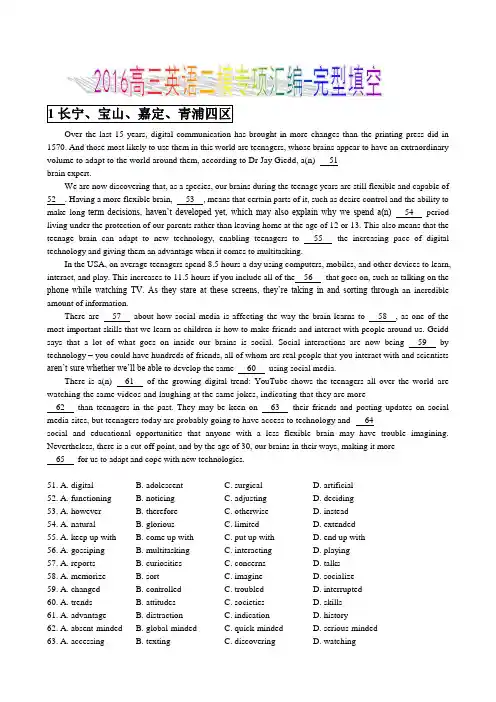
Over the last 15 years, digital communication has brought in more changes than the printing press did in 1570. And those most likely to use them in this world are teenagers, whose brains appear to have an extraordinary volume to adapt to the world around them, according to Dr Jay Giedd, a(n) 51brain expert.We are now discovering that, as a species, our brains during the teenage years are still flexible and capable of 52 . Having a more flexible brain, 53 , means that certain parts of it, such as desire control and the ability to make long-term decisions, haven’t developed yet, which may also explain why we spend a(n) 54 period living under the protection of our parents rather than leaving home at the age of 12 or 13. This also means that the teenage brain can adapt to new technology, enabling teenagers to 55 the increasing pace of digital technology and giving them an advantage when it comes to multitasking.In the USA, on average teenagers spend 8.5 hours a day using computers, mobiles, and other devices to learn, interact, and play. This increases to 11.5 hours if you include all of the 56 that goes on, such as talking on the phone while watching TV. As they stare at these screens, they’re taking in and sorting thro ugh an incredible amount of information.There are 57 about how social media is affecting the way the brain learns to 58 , as one of the most important skills that we learn as children is how to make friends and interact with people around us. Geidd says that a lot of what goes on inside our brains is social. Social interactions are now being 59 by technology – you could have hundreds of friends, all of whom are real people that you interact with and scientists aren’t sure whether we’ll be able to develop the same 60 using social media.There is a(n) 61 of the growing digital trend: YouTube shows the teenagers all over the world are watching the same videos and laughing at the same jokes, indicating that they are more62 than teenagers in the past. They may be keen on 63 their friends and posting updates on social media sites, but teenagers today are probably going to have access to technology and 64social and educational opportunities that anyone with a less flexible brain may have trouble imagining. Nevertheless, there is a cut-off point, and by the age of 30, our brains in their ways, making it more65 for us to adapt and cope with new technologies.51. A. digital B. adolescent C. surgical D. artificial52. A. functioning B. noticing C. adjusting D. deciding53. A. however B. therefore C. otherwise D. instead54. A. natural B. glorious C. limited D. extended55. A. keep up with B. come up with C. put up with D. end up with56. A. gossiping B. multitasking C. interacting D. playing57. A. reports B. curiosities C. concerns D. talks58. A. memorize B. sort C. imagine D. socialize59. A. changed B. controlled C. troubled D. interrupted60. A. trends B. attitudes C. societies D. skills61. A. advantage B. distraction C. indication D. history62. A. absent-minded B. global-minded C. quick-minded D. serious-minded63. A. accessing B. texting C. discovering D. watching64. A. on the whole B. as a result C. in other words D. by all means65. A. flexible B. important C. difficult D. Incredible51-55 BCADA 56-60 BCDAD 61-65 ABBBCResearchers recently find w omen likely face work environments that push against the “having it all” mentality, leading to feelings of guilt and depression.Trying to have it all could be bad for your mental health, according to a new study that finds that “supermoms” have higher rates of depression compared with working moms who let things 51 .The research, presented Aug. 20 at the annual meeting of the American Sociological Association in Las Vegas, finds that working is 52 for mothers’ mental health. But among working mothers, the least depressed are those who don’t expect to 53 work and family life perfectly, said study researcher Katrina Leupp, a graduate student at the University of Washington in Seattle. “The ideal that women can do it all actually 54 the level of depressive symptoms compared to women who were more doubtful about whether or not work and family can be balanced,” Leupp told LiveScience.Leupp analyzed survey 55 from 1,600 married women who participated in a large survey called the National Longitudinal Survey of Youth. In 1987, the women answered questions to judge their support of women’s 56 , including whether they agreed with statements such as “W omen are much happier if they stay at home and take care of their children.” In 1992 and 1994, the now 40-year-old women answered questions about their symptoms of depression. Like earlier studies, the survey data indicated that women who worked outside the home had fewer symptoms of depression, perhaps because outside work gives women more 57 interaction, more varied activities and a larger income, Leupp said. Among the employed women, though, the cheeriest were those who had indicated in their younger years the least 58 for women balancing career and family. The results held even after controlling for earlier levels of depression. “Somewhat 59 , women who don’t expect to be able to balance work and family have better mental health than those who do,” Leupp said.The study didn’t explain why optimistic (乐观的) views of balancing work and motherhood would60 later depression. “The reason may come down to 61 and real-world work environments,”Leupp said. “Women who expect to have it all probab ly come up against 62 that aren’t designed with work-life balance in mind. When they can’t balance everything perfectly, these supermoms are more likely to feel 63 .”“I think this research really speaks to a 64 between women’s expectations and the actual structure of the workplace,” Leupp said.“The takeaway for working moms is to temper their optimism about balancing 65 and employment and not to blame themselves if they struggle. Recognize that if it feels difficult, it’s because it is difficult.”51. A. happen B. continue C. slide D. end52. A. good B. ready C. hard D. possible53. A. protect B. share C. illustrate D. combine54. A. increased B. assessed C. reached D. influenced55. A. questions B. responses C. solutions D. instruments56. A. pregnancy B. marriage C. employment D. education57. A. cultural B. social C. positive D. verbal58. A. support B. tolerance C. concern D. respect59. A. deliberately B. aggressively C. ironically D. similarly60. A. result from B. relate to C. hold back D. call for61. A. families B. expectations C. surroundings D. requirements62. A. clubs B. hospitals C. governments D. workplaces63. A. excited B. embarrassed C. thrilled D. frustrated64. A. mismatch B. mistreat C. misunderstanding D. misinterpretation65. A. aging B. training C. schooling D. Parenting51. C 52. A 53. D 54. A 55. B 56. C 57. B 58. A 59. C 60. B61. B 62. D 63. D 64. A 65. DTwo Newcastle scientists are setting themselves to open our eyes to the medical truth by claiming that natural sunlight may help prevent skin cancer.Dr. Ron Laura, professor of health education at Newcastle University, and senior chemist Mr. John Ashton said their research points to a complete __51______ of the accepted scientific theory. They said that sunscreen creams may help cause skin cancer, the artificial indoor light could be __52_____ and that a range of drugs in common use could also ___53____ melanoma--a type of cancer that appears as a dark spot on the skin.The research is likely to be unwelcome in some traditional medical research circles. It is based on a new __54_____ that our bodies are protected from skin cancer by the regulation of a group of complex vitamins (Vitamin D) and immune process.The sunscreens, artificial light and drugs could all unfavorably affect the production of these vitamins and increase the skin’s __55_____ to the sun. But Dr. Laura said natural sunlight passing through the eyes helped __56_____ the production of cancer protection Vitamin D.He said recent statistics from the United States indicated that people who worked indoors all day in artificial light were more __57_____ melanomas than those who worked outdoors. Indoor workers should try to have at least one hour of __58_____ to direct sunlight every day, ___59_____ in the early morning and late afternoon when ultraviolet intensively was lower, Dr. Laura said.Sunscreens, long __60_____ as essential for beach lovers, could also __61______ the production of Vitamin D. Laura and Ashton said sunscreens give people a __62_____ sense of security in thinking they are __63______ from the sun’s rays.Dr. Laura said more statistics ___64_____ their claim had come to light since the first article was published. He believes his research findings are too important to be __65______ to the scientific world.51. A. contribution B. reversal C. combination D. recognition52. A. beneficial B. comfortable C. harmful D. favorable53. A. promote B. reduce C. remove D. eliminate54. A. assumption B. law C. concept D. theory55. A. sensitivity B. resistance C. adaptation D. response56. A. monitor B. measure C. slow D. stimulate57. A. subject to B. unrelated to C. free of D. dependent on58. A. exercise B. reveal C. exposure D. experience59. A. occasionally B. preferably C. enjoyably D. extremely60. A. received B. popular C. accepted D. identified61. A .balance B. adjust C. prevent D. enhance62. A. false B. strong C. true D. sharp63. A. separated B. protected C. guarded D. prohibited64. A. presenting B. doubting C. backing D. providing65. A. limited B. emphasized C. acknowledged D. explained51-55 BCADA 56-60 DACBC 61-65 CABCAHarvard LibraryIf we compare professors and students to the host of auniversity, then the library of a university can be compared to thehallway. The quality of a university, __51__, is in direct proportionto that of its library. At Harvard, the library is an essential part ofeverybody’s life. Both the quantity and the __52__ of the librarymake study a pleasant process.Harvard Library is not only the most ancient library in theUnited States, but the largest university library with the largest scale.In 1638 John Harvard __53__ his whole library to the then HarvardCollege. After 300 years of development, the library now holds 10million books and __54__ more than 100 branch libraries. In addition to the libraries owned by each school, there are some branch libraries that are __55__ in some aspects. While most of the branch libraries are on Harvard campus, some are as far as in Washington, D.C., or even in Florence of Italy. Yenching Library is famous for its __56__ of East Asian literature. Lamont Library is the first library in the world that is __57__ for undergraduates. Widener Library is the largest library in Harvard, only second to Library of Congress.What __58__ to be mentioned is the system or rather the service of the libraries. Usually the libraries are open from 9 a.m. to 5 p.m.. The main libraries are open until 10 p.m.. The libraries for undergraduates will even be open all night during the __59__ period. The libraries also provide with students the service of __60__ reading materials for all courses. At the beginning of a semester, each teacher will give a list of books to the librarians. The librarians are __61__ to find out these books and put them at the places where students can easily find them.There is no limitation for the number of books that students can borrow. As the space for the library is limited, many books are __62__ in suburban library. Despite this, students can go to fetch the book at the __63__ library within 24 hours after they submit request for that book. Even if there is only one book to be fetched from the suburban library, the libraries on campus will send someone to do the job. This kind of __64__ which put readers in the first place is rare even in Ivy League. Therefore, study at Harvard will be a(n) __65__ experience.51.A.as a result B. to some extent C. on the contrary D. at all times52.A.influence B. discipline C. quality D. prospect53.A. donated B. assigned C. adapted D. distributed54.A.contains B. composes C. involves D. includesrmative B. different C. secure D. peculiar56.A.collections B. documents C. phenomena D. exhibitions57.A.unusually B. formally C. specially D. especially58.A.remains B. happens C. appears D. deserves59.A.examination B. experiment C. vacation D. graduation60.A.confirming B. preparing C. selecting D. designing61.A.desperate B. willing C. reluctant D. responsible62.A.exhibited B. reserved C. stored D. classified63.A.appointed B. accepted C. expected D. restricted64.A.performance B. service C. activity D. response65.A.fortunate B. creative C. positive D. enjoyable51-65: BCADB ACDAB DCABD5黄浦区Education plays an extremely important role in our life and deeply impacts the society. However, how does society influence education?Before understanding the influence of society on education, we must 51 society. Society is an extended social group having a distinctive cultural and economic organization. It is characterized by patterns of relationships between individuals. It is a group of individuals who 52 a common system of customs, values and laws. From the definition of society, it is clear that we human beings are its building 53 . As we interact with people, try to understand their thinking styles and 54 patterns, we soon realize that there is so much to learn from them. Society is the greatest 55 of education. Don’t you think so?We cannot 56 the impact of society on the education system alone. We need to understand the role of society in the 57 development of an individual. Even before we become a part of the education system, we start learning from our surroundings. And during the process of formal education, we 58 take ‘non-formal’from society. Yes, our interactions with our fellow-beings, our observations about their social behaviour and our understanding of social norms 59 us to face life. True, educational 60 , like schools, colleges and universities play a very important role in our education. But, we cannot ignore the fact that we learn some of the important lessons of life from society. It would not be an exaggeration to say that the 61 process of learning begins at a point, which marks the end of institutional education. Learning, as an individual, from your interaction with society, is a vital part of education.Society plays an important role in education and influences it, both positively and negatively. Social inequalities and unhealthy educational practices are some of the 62 influences of society on our lives. Customs and traditions 63 certain sections of society from exercising their fundamental rights and block the well-being of society, shatter the basic ideas of educaiotn and social awareness. Some social groups deny women’s right to education, while others force children to work, depriving (剥夺) them from a healthy environment, conducive to their growth and development. Education is one of the basic human rights. If social norms deprive certain strata(阶层)of society form progressing in life and come in the way of social welfare, it 64 the purpose of education.Society is an entity that cannot be separated from us. It is we who 65 the society. It is entirely in our hands whether to add value to our education or devalue it.51. A. know B. define C. recognize D. analyze52. A. share B. invent C. operate D. practice53. A. extents B. blocks C. designs D. expenses54. A. cultural B. traditional C. educational D. behavioral55. A. performer B. supervisor C. facilitator D. opponent56. A. resist B. resolve C. reserve D. restrict57. A. steady B. future C. lasting D. overall58. A. successfully B. desperately C. constantly D. surprisingly59. A. encourage B. impact C. prepare D. impose60. A. circumstances B. contributions C. environments D. organization61. A. actual B. external C. universal D. available62. A. realistic B. opposing C. practical D. invisible63. A. confirm B. cultivate C. maintain D. prevent64. A. fulfills B. highlights C. defeats D. describes65. A. depend on B. make up C. strive for D. deal with51-55 BABDC 56-60 DDCCD 61-65 ABDCBAccording to sociologists, there are several different ways in which a person may become recognized as the leader of a social group. In the family, traditional cultural patterns award 51 on one or both of the parents. In other 52 , such as friendship groups, one or more persons may gradually emerge as leaders, although there is no formal process of53 . In larger groups, leaders are usually chosen formally through election or recruitment.Although leaders are often thought to be people with unusual personal ability, decades of research have failed to produce consistent 54 that there is any category of “natural leaders”. It seems that there is no set of personal qualities that all leaders have 55 ; rather, virtually any person may be recognized as a leader if the person has 56 that meet the needs of that particular group.Furthermore, although it is commonly supposed that social groups have a single leader, r esearch suggests that there are typically two different leadership 57 that are held by different individuals. Instrumental leadership is leadership that emphasizes the 58 of tasks by a social group. Group members look to instrumental leaders to “get things done”. Expressive leadership, on the other hand, is leadership that emphasizes the 59 wellb eing of a social group’s members. Expressive leaders are less concerned with the over all goals of the group than with providing 60 support to group members and attempting to minimize tension and conflict among them.Instrumental leaders are likely to have a rather secondary relationship to other group members. They give orders and may 61 group members who prevent accomplishment of the group’s goals. Expressive leaders cultivate a more 62 or primary relationship to others in the group. They offer 63 when someone experiences difficulties. And they try to 64 issues that threaten to divide the group. As the difference in these two roles suggest, expressive leaders generally receive more personal 65 from group members; instrumental leaders, if they are successful in promoting group goals, may enjoy a more distant respect.51. A. burden B. leadership C. housework D. right52. A. families B. societies C. cases D. researches53. A. selection B. struggle C. recommendation D. register54. A. evidence B. support C. approach D. pattern55. A. in advance B. in brief C. in general D. in common56. A. partners B. achievements C. skills D. qualities57. A. selections B. roles C. challenges D. structures58. A. assignment B. introduction C. completion D. division59. A. joint B. financial C. social D. individual60. A. political B. administrative C. emotional D. technical61. A. discipline B. praise C. ignore D. identify62. A. casual B. temporary C. personal D. stable63. A. criticism B. sympathy C. estimate D. information64. A. omit B. confuse C. raise D. resolve65. A. imitation B. affection C. objection D. Revenge51. B 52. C 53. A 54. A 55. D 56. D 57. B 58. C 59. A 60. C61. A 62. C 63. B 64. D 65. BLike many students, Ryan believes that the time and money spent on his education will pay off: he will eventually be able to get a good job and do well in the field he has chosen. And yet, ___51___ all of the years spent in school preparing to enter the workplace, many recent graduates say that they struggle with the ___52___ from classroom to career world and have difficulty ___53___ life on the job.Writer and editor Joseph Lewis suggests one reason why this is the case. Lewis believes that most of our school experiences—from childhood through university—are fairly ___54___, while life in the working world is far more uncertain. In school, ___55___, the pattern stays more or less the same from year to year. In the workplace, however, constant ___56___ is the norm, and one has to adapt quickly.Another problem that graduates entering the workforce encounter is that they are ___57___ to think analytically. In school, many students including those in college, spend a lot of time memorizing facts and repeating what they “learned” on tests. But in the workplace employees “are often expected to think critically and make ___58___ about their work, not just follow a supervisor’s instructions.” Less time needs to be spent in school on testing, says one recent report, and more on helping students to analyze and interpret information, solve problems, and communicate their ideas effectively—skills that will prepare them to succeed in today’s workplace.Finally, many recent graduates say that one of the biggest difficulties they face is adapting to ___59___ on the job. In the workplace, employees must regularly ___60___ with others and are often dependent on their co-workers for their success. In other words, if an employee has to work with others to complete a given project, that employee’s ___61___ not only depends on his hard work and expertise, but also on how well his colleagues perform. Knowing how to participate effectively in teamwork—and deal with problems when they arise—is extremely important, and yet, it is also something many students don’t get quite ___62___ to in a school setting.How can we better prepare young adults for the workplace? Recent graduates, looking back on their educational experience, have some ___63___. Many think that all students should be required to do an internship (实习) while they are in school. Volunteering part time at a company, hospital, or government organization, for example, can help one gain experience and learn skills needed to succeed in the real world. ___64___ this kind of practical work experience with classroom instruction, say the graduates, will help prepare students for the ___65___ of the workplace and make the transition from school to career world less stressful.51. A. with regard to B. thanks to C. in spite of D. in view of52. A. action B. shift C. routine D. variety53. A. turning to B. reacting to C. adjusting to D. seeing to54. A. predictable B. considerable C. accessible D. flexible55. A. however B. in addition C. for example D. in return56. A. change B. reminder C. prediction D. difficulty57. A. encouraged B. unprepared C. entitled D. undetermined58. A. predictions B. targets C. decisions D. inquiries59. A. independence B. performance C. competition D. teamwork60. A. argue B. bargain C. identify D. interact61. A. success B. ambition C. completion D. purpose62. A. attached B. exposed C. related D. addicted63. A. patience B. advice C. expectation D. relief64. A. Pairing B. Charging C. Involving D. Rewarding65. A. availability B. possibilities C. invasion D. realities51—55 CBCAC 56—60 ABCDD 61—65 ABBADFeeling good about our actions — not guilt or pity— motivates giving, according to the latest research.51 seeing or hearing about suffering children makes most people uncomfortable, that grief is not what drives them to dig into their pockets and donate. The reasons people decide to be selfless, it turns out, may be slightly more 52 .In the study, published in the Journal of Neuroscience, researchers found that people are more likely to give when they think it will make them feel better. They donate, 53 , when they feel hope about putting smiles on those expectant and suffering faces. And that hope, or similar feel-good sensa tions, are driven by the brain’s reward systems.Researchers —and charities —have long known that putting a(n) 54 face on an abstract problem opens hearts and wallets. Josef Stalin once said that while one death is a(n) 55 , a million is merely a number. Studies have since found that quantifying the size of a disaster or particular need actually 56 giving, while presenting a single story is more likely to cause a desire to help.But it wasn’t clear whether this “identifiable victim” effect resulted from people’s 57 over their own privilege and resources — or from a sense of connection with the 58 and an urge to feel good about making a difference.To find out, researchers led by Alexander Genevsky, a graduate student in psychology at Stanford, imaged the brains of 22 young adults. In the scanner, they saw either a silhouette (剪影) or a head shot of a young African child. As in previous studies, participants were far more likely to give if they saw a face than a blank silhouette—donating almost twice as much in photo trials than in the others. However, this decision was related strongly to their 59 . If they showed little activity in their nucleus accumbens— a brain region linked to every type of pleasurable experience— they were actually less likely to give. But if there is a sharp 60 of activity in this reward area, they felt good and gave more. And the photos of the children were more likely to 61 this reward center. Activity in the accumbens, in fact, completely 62 the difference in giving seen between the silhouette-based requests and the photo-based ones.While the findings point to the feel-good 63 behind giving, other research will have to address the question of why givers get that positive emotional boost. Do people feel rewarded when they give because they think about the happiness of the recipient — or do they feel good because they see themselves as 64 and that self-esteem boost (自信心增强) is mood-enhancing? Such information could help charities 65 their messages to maximize their effectiveness.51. A. Since B. Although C. If D. As52. A. passive B. earnest C. impersonal D. selfish53. A. for example B. on the contrary C. as a result D. on the other hand54. A. plain B. ugly C. specific D. frightened55. A. accident B. threat C. solution D. tragedy56. A. ruins B. stimulates C. lowers D. skips57. A. anger B. guilt C. regret D. joy58. A. desire B. mind C. victim D. stuff59. A. actions B. beliefs C. images D. emotions60. A. edge B. rise C. turn D. division61. A. monitor B. target C. activate D. interrupt62. A. resulted from B. counted on C. accounted for D. subjected to63. A. motivations B. compliment s C. ambitions D. requests64. A. executive B. justified C. innocent D. generous65. A. conceal B. tailor C. obtain D. delete51. B 52. D 53.A 54.C 55.D 56.C 57.B 58.C 59.D 60.B61. C 62. C 63.A 64.D 65.BThere are many things parents can do to help children with autism (自闭症) overcome their challenges. Learning all you can about autism and getting __51__ in treatment will go a long way toward helping your child. Additionally, the following tips will make daily home life easier for both you and your autistic child:•Be consistent(一致的).Children with autism have a hard time __52__ what they’ve learned if there is a change of setting. For example, your child may use sign language at school to communicate, but never think to do so at home. Creating __53__ in your child’s environment is the best way to reinforce learning. Find out what your child’s therapists are doing and continue their techniques at home. Explore the __54__ of having therapy take place in more than one place in order to encourage your child to __55__ what he or she has learned from one environment to another. It’s also important to be consistent in the way you __56__ with your child and deal with challenging behaviors.•__57__ a schedule. Children with autism tend to do best when they have a highly-structured schedule or routine. Again, this goes back to the consistency they both need and crave. Set up a schedule for your child, with __58__ times for meals, therapy, school, and bedtime. Try to keep disturbance to this routine to a __59__. If there is an unavoidable schedule change, prepare your child for it __60__.•__61__ good behavior. Positive reinforcement can go a long way with children with autism, so make an effort to “catch them doing something good.” Praise them when they act appropriately or learn a new skill, being very __62__ about what behavior they’re being praised for.•Pay attention to your child’s sensory sensitivities.Many children with autism are hypersensitive to light, sound, touch, taste, and smell. Other children with autism are “under-sensitive” to sensory stimuli. __63__ what sights, sounds, smells and movements cause your kid’s “bad” or disruptive behaviors and what brings about a(n) __64__ response. If you understand what affects your child, you’ll be better at solving problems, preventing situations that cause difficulties, and creating __65__ experiences.51. A. encouraged B. balanced C. absorbed D. involved52. A. applying B. devoting C. communicating D. appealing53. A. attraction B. comfort C. steadiness D. attention54. A. possibility B. goal C. process D. solution55. A. transplant B. transfer C. transport D. transform56. A. meet B. interact C. negotiate D. associate。
上海市宝山区2016届高三上学期期末教学质量诊断(一模)英语试题
宝山区2015学年第一学期期末高三年级英语学科教学质量监测试卷考生注意:1。
考试时间120分钟,试卷满分150分。
2. 本考试设试卷和答题纸两部分。
试卷分为第Ⅰ卷(第1—10页)和第Ⅱ卷(第10页),全卷共10页。
第I卷第1-16小题、第41—77小题采用多项选择题形式,答案必须涂写在答题纸相应位置,写在试卷上无效。
第I卷第17-40小题、第78—81小题和第II卷的试题,其答案必须写在答题纸相应位置,写在试卷上无效。
3.答题前,务必在答题纸上填写姓名、班级、学校和准考证号,并用铅笔在答题纸上正确涂写准考证号.第I卷(共103分)Ⅰ。
Listening ComprehensionSection A Short ConversationsDirections: In Section A,you will hear ten short conversations between two speakers。
At the end of each conversation, a question will be asked about what was said. The conversations and the questions will be spoken only once. After you hear a conversation and the question about it, read the four possible answers on your paper,and decide which one is the best answer to the question you have heard。
1. A。
At home。
B。
On the farm。
C. In a restaurant. D。
In a supermarket。
2。
A. A mechanic. B。
An electrician。
上海市2016-2020年五年高考二模英语试题精选汇编:句子翻译专题 含答案
句子翻译专题上海市宝山区2020届高考英语二模试题II.TranslationDirections:Translate the following sentences into English, using the words given in the brackets.71.我们不惧风雨,也不畏任何险阻。
(or)72,戴口罩是阻止病毒传播的有效方式。
(keep)73.时不我待,时间和立誓都属于奋进者。
(as)74.生命重于泰山,疫情就是命令,防控就是责任。
(issue)71.We are not afraid of winds and rains, or any kind of difficulties.72.Putting on a face mask is an effective way to keep virus from spreading.73.Time and tide wait for no one as time and history are both on the side of hard w orkers.74.Life is of great importance. When a terrible disease/ an epidemic breaks out, a command is issued. It is our responsibility to prevent and control it/ the disease.上海市宝山区2019届高三英语二模试题Ⅴ. TranslationDirections:Translate the following sentences into English, using the words given in the brackets.52. “爱你的邻居”对每个人而言都是一项艰巨的任务。
(tough)53. 诸如地震这一类的自然灾害,对某些地区的影响远比其他地区更大。
2016年上海宝山区高三英语二模试卷及答案
II. Grammar and VocabularySection ADirections: After reading the passages below, fill in the blanks to make the passages coherent and grammatically correct. For the blanks with a given word, fill in each blank with the proper form of the given word; for the other blanks, use one word that best fits each blank.(A)About dancing bearsYoung bears are captured in the wild, separated from their mothers, and taught by a trainer to become dancing bears in conditions of unimaginable cruelty.The young animals are forced on to sheets of really hot metal and, (25) ______ (escape) the pain,the bears alternate lifting up one paw (爪子) and then another while music is played. The processis repeated again and again (26) ______ the animals automatically begin to raise their paws – to “dance” – in fear of the pain, even when there are no metal sheets.As the bears get older, the trainers keep them under control by imposing pain. They do this by putting rings through the bears’ highly sensitive noses and jaws. The pitiful truth is (27) ______ they are not put to sleep for this painful process. Chains (28) ______ (attach) to the rings so the trainers can control the animals, (29) ______ weigh up to 350 kilograms, with only a slight pull on the chains.The bears’ nails are c ut several times a year and their teeth broken or removed in order that they cannot get their trainers (30) ______ (injure). The bears also suffer with an inadequate diet usually (31) ______ (consist) of white bread, sugar and cheap fruit juices. All these cause the bears serious physical health problems (32) ______ ______ many of them display strange behavior suchas swaying (摇摆) and pacing as they cannot follow natural behavioral patterns and instincts.(B)The Power of GoodIt was Mother’s Day morning la st year and I was shopping at our local supermarket with myfive-year-old son, Tenyson. As we were leaving, we realised that only minutes (33) ______ (early) an elderly woman had fallen and hurt (34) ______ badly. She was embarrassed and clearly in shock. Fortunately, her husband was with her and many people had stopped to help out. Walking towards the scene, Tenyson became very upset about (35) ______ had happened to the elderly couple. He said to me, “(36) ______ (fall) over in front of everyone isn’t much fun.”Near the entrance of the supermarket, a charity group had set up a stall selling flowers. Tenyson suggested that we should buy the lady a flower. “It will make her feel better,” he said. I was amazed that he would have this sweet idea, so I asked the flower seller if I (37) _____ buy a flower for the elderly lady because my son wanted to give it to her to cheer her up. “Just take it,” she replied. “I can’t take your money for such wonderful gesture.”By then a nurse (38) ______ (arrive), and was attending to the woman. As we walked up to her, Tenyson became frightened by all the blood and medical equipment. Instead I gave (39) ______ flower to the woman’s husband. The old man thanked us both, then bent down and gave it to his wife, telling her who it was (40) ______. Despite being badly hurt and shaken, the old lady looked up at Tenyson with love in her eyes and gave him a little smile.Section BDirections: Complete the following passage by using the words in the box. Each word can only be used once. Note that there is one word more than you need.A. alternativeB. appealC. benefitD. differE. energizingF. fascinatedG. marineH. naturalistI. preserveJ. specializingK. unspoiledEcotours are unique adventures that join nature and sightseeing into one exciting package. Learning about the environment and the world around us is the 41 of an ecotour because you get to experience the natural world firsthand. A great way for students studying biology and environmental sciences to experience 42 life and nature is to take your own ecotour! Orlando airboat rides can give you an experience to remember and can be a fun and 43 way to learn more about the Florida environment.Ecotours involve travelling to a natural environment where you are guided by a(n) 44helping you learn about the surrounding environment and extend your environmental education. This can include learning how the plants and animals on your Orlando airboat rides 45 from each other, or you can be simply becoming more aware of preservation efforts towards the Everglades, the largest wetland in North America.Orlando airboat rides can help you learn about Florida history, observe alligators (短吻鳄) andother wildlife, and experience the 46 nature of the muddy wilderness. Taking an ecotour can help you become more aware of your environment and further instruct you on the impact we have on the environment. Our goal is to help you understand the Everglades and how important it is to 47 the wetland.Wild Florida provides the perfect opportunity for a school trip that satisfies those 48 with learning more about environmental sciences, or to those just curious about the Everglades. Hands-on and active learning on an airboat ride is often a more exciting and adventurous 49 to sitting in a classroom, so why not plan your ecotrip with Wild Florida?Wild Florida is reputable for 50 in creating an exciting and unique ecotour that’s fun for everyone in your family! You will be flying through the muddy Everglades in our airboat rides while observing and learning about alligators, bald birds, the history of the Everglades, and so much more. Book your Orlando airboat rides today by calling us at 407-901-2563 to experience aone-of-a-kind ecotour that you won’t soon forget.III. Reading ComprehensionSection ADirections: For each blank in the following passage there are four words or phrases marked A, B, C and D. Fill in each blank with the word or phrase that best fits the context.Over the last 15 years, digital communication has brought in more changes than the printing press did in 1570. And those most likely to use them in this world are teenagers, whose brains appear to have an extraordinary volume to adapt to the world around them, according to Dr Jay Giedd, a(n) 51brain expert.We are now discovering that, as a species, our brains during the teenage years are still flexible and capable of 52 . Having a more flexible brain, 53 , means that certain parts of it, such as desire control and the ability to make long-term decisions, haven’t developed yet, which may also explain why we spend a(n) 54 period living under the protection of our parents rather than leaving home at the age of 12 or 13. This also means that the teenage brain can adapt to new technology,enabling teenagers to 55 the increasing pace of digital technology and giving them an advantage when it comes to multitasking.In the USA, on average teenagers spend 8.5 hours a day using computers, mobiles, and other devices to learn, interact, and play. This increases to 11.5 hours if you include all of the56 that goes on, such as talking on the phone while watching TV. As they stare at these screens, they’re taking in and sorting through an incredible amount of information.There are 57 about how social media is affecting the way the brain learns to 58 , as one of the most important skills that we learn as children is how to make friends and interact with people around us. Geidd says that a lot of what goes on inside our brains is social. Social interactions are now being 59 by technology – you could have hundreds of friends, all of whom are real people that you interact with and scientists aren’t sure whether we’ll be able to develop the same 60 using social media.There is a(n) 61 of the growing digital trend: YouTube shows the teenagers all over the world are watching the same videos and laughing at the same jokes, indicating that they are more62 than teenagers in the past. They may be keen on 63 their friends and posting updates on social media sites, but teenagers today are probably going to have access to technology and 64social and educational opportunities that anyone with a less flexible brain may have trouble imagining. Nevertheless, there is a cut-off point, and by the age of 30, our brains in their ways, making it more65 for us to adapt and cope with new technologies.51. A. digital B. adolescent C. surgical D. artificial52. A. functioning B. noticing C. adjusting D. deciding53. A. however B. therefore C. otherwise D. instead54. A. natural B. glorious C. limited D. extended55. A. keep up with B. come up with C. put up with D. end up with56. A. gossiping B. multitasking C. interacting D. playing57. A. reports B. curiosities C. concerns D. talks58. A. memorize B. sort C. imagine D. socialize59. A. changed B. controlled C. troubled D. interrupted60. A. trends B. attitudes C. societies D. skills61. A. advantage B. distraction C. indication D. history62. A. absent-minded B. global-minded C. quick-minded D. serious-minded63. A. accessing B. texting C. discovering D. watching64. A. on the whole B. as a result C. in other words D. by all means65. A. flexible B. important C. difficult D. incredibleSection BDirections: Read the following three passages. Each passage is followed by several questions or unfinished statements. For each of them there are four choices marked A, B, C and D. Choose the one that fits best according to the information given in the passage you have just read.(A)Sebastian Faulks has written many novels, including Devil May Care, the latest James Bond book. This cutting comes from a very different kind of novel called Charlotte Gray. The setting is atransit (中转) camp near Paris during the Second World War, where a group of people, includingtwo small children, Andre and Jacob, await transport to take them to a concentration camp outside France. Although these people –the ‘deportees’ of the cutting – are not fully aware of this, they face certain death.The Last NightAndre was lying on the floor when a man came with postcards on which the deportees might write a final message. He advised them to leave them at the station or throw them from the train as camp orders forbade access to the post. Two or three pencils that had survived the camps search were passed round among the people in the room. Some wrote with weeping passion, some with great care, as though their safety, or at least the way in which they were remembered, depended upon their choice of words.A woman came with a sandwich for each child to take on the journey. She also had a bucket of water, round which they gathered, holding out food cans they passed from one to another. One of the older boys hugged her in his gratitude, but the bucket was soon empty. When she was gone, there were only the small hours of the night to go through. Andre was lying on the straw, and Jacob leaned close to him for warmth.Five buses had come in through the main entrance, and now stood trembling in the corner of the yard. At a long table … the commandant of the camp himself sat with a list of names that another policeman was calling out in alphabetical order. Andre heard his name and moved with Jacob towards the bus. From the other side of the courtyard, from windows open on the dawn, a shower of food was thrown towards them by women crying and calling out their names.Andre looked up, and in a chance angle of light he saw a woman’s face in which the eyes were fixed with terrible fierceness on a child beside him. Why did she stare as though she hated him? Then it came to Andre that she was not looking in hatred, but had kept her eyes so intensely open in order to fix the picture of her child in her mind. She was looking to remember, for ever. …66. What can we learn from the first part of the passage?A. The background and the situation of World War II.B. The transit camp and the transportation in Paris.C. The author, the setting and the main characters.D. The main idea and the names on the list.67. Which of the following is true about the things going on in the transit camp?A. The deportees were eager to leave their final messages.B. A humble breakfast was served to children late that morning.C. Andre happened to witness the deportees’ routine camp life.D. The camp commandant stood by a long table calling the roll.68. The woman stared at her child fiercely probably because ______.A. she found her child was trembling and crying for foodB. she thought she would never see her child any moreC. she was filled with an attempt to escape from deathD. she was driven mad by the life in the transit camp69. The author told the story in a(n) ______ tone.A. casualB. desperateC. hatredD. innocent(B)What we doEFP Courses provide courses in English language and British culture. Our courses are aimed at students aged between 12 and 17 who are at pre-intermediate level or above in English. The courses are held in Guildford, a historic town near London.Typical structure of a one-week courseØ up to 25 hours of English run by native speakers, qualified in teaching English as a foreign language and specialist drama teachersØ 2 full-day sightseeing trips to London and Oxford (at weekends)Ø full board (全食宿) with local, English-speaking familiesWhen we run the coursesEFP courses can be organized only during British state school terms. For this academic year, courses can be booked between now and 23 May and between 30 May and 30 June. We welcome you to book from 3 September 2016 to 25 October 2016 and from 31 October to 20 December 2016.Why choose EFP coursesØ in addition to our standard English classes, we also run drama and expression English classes, taught by specialist drama teachersØ we expose our students to British culture for the entire length of the courseØ we tailor courses to each group’s needs, creating a unique experience for our students. Note that any changes to our courses are made within reason and only if all participants from a group share the same language level. Please see further details on our website.Length of a courseEFP courses run for either one or two weeks depending on the specific requirements for your group.How to applyPlease register your interest by sending an email to info@. By contacting us before you make any travel arrangements you ensure that we can put your group up on the dates that you require. For more details, please visit .See you in Guildford soon!70. What does the leaflet tell us about EFP courses?A. Their target students are teenagers of all English levels.B. They are available on the school campuses in London and Oxford.C. Every individual participant is supplied with tailored language support.D. They involve students in British culture activities during the whole course.71. Suppose you are to take EFP courses this academic year, you can ______.A. hand in an application by visiting their websiteB. enjoy a special series of lessons for a whole school termC. experience English dramas with English-speaking familiesD. make a reservation from October 31 to December 2072. The purpose of this writing is to ______.A. attract qualified teachers to EFP coursesB. demonstrate the popularity of EFP coursesC. offer group students access to EFP coursesD. illustrate the importance of EFP courses(C)Lindsay Renwick, the mayor of Deniliquin, a country town in New South Wales, misses theconstant whir (嗡嗡声) of the rice mill whose giant fans dried the rice. The Deniliquin mill, the largest rice mill in the Southern Hemisphere (南半球), once processed enough grain to meet theneeds of 20 million people globally. But six years of drought have had a destructive effect, reducing Australia’s rice crop by 98 percent and leading to the mothballing of the mill last December.Drought affects every agriculture industry based in Australia, not just rice – from sheep farming, the country’s other backbone, to the cultivation of grapes for wine, the fastest-growing crop there, with that expansion often coming at the expense of rice. The drought’s effect on rice has produced the greatest impact on the rest of the world, so far. It is one factor contributing to skyrocketing prices, and many scientists believe it is among the earliest signs that a warming planet is startingto affect food production.Researchers are looking for solutions to global rice shortages – for example, rice that blooms earlier in the day, when it is cooler, to fight against global warming. Rice plants that happen to bloom on hot days are less likely to produce grains of rice, a difficulty that is already starting to emerge in inland areas of China and other Asian countries as temperatures begin to climb. “There will be problems very soon unless we have new varieties of rice in place,” said Reiner Wassmann, climate change director at the International Rice Research Institute (IRRI). The recent reports on climate change carried a warning that could make the news even worse: that existing models for the effects of climate change on agriculture did not yet include newer findings that global warming could reduce rainfall and make it more variable.Yet the effects of climate change are not uniformly bad for rice. Rising concentrations (浓度) ofcarbon dioxide, the main greenhouse gas, can actually help rice – although the effect reduces or disappears if the plants face unnecessary heat, inadequate water, severe pollution or other stresses. Still, the flexibility of farmers here has persuaded some climate experts that, particularly in developed countries, the effects of climate change may be relieved, if not completely avoided. “I’m not as negative as most people,” said Will Steffen, director of the Fenner School of Environment and Society at Australian National University. “Farmers are learning how to do things differently.”Meanwhile, changes like the use of water to grow wine grapes instead of rice carry their own costs, as the developing world is discovering. “Rice is an essential food,” said Graeme Haley, the general manager of the town of Deniliquin. “Wine is not.”73. By “the mothballing of the mill” (in Paragraph 1) t he author most probably means the mill is ______.A. kept unprocessedB. left unusedC. being entirely restoredD. being pushed round74. To find the ways to cope with the global rice shortage, researchers are ______.A. seeking new types of rice which could bloom at a lower temperatureB. building greenhouses which could provide more heat for rice to growC. studying climate changes in China which may affect rice growing in AsiaD. looking for alternative agriculture industries which may take the place of rice75. Which of the following can be learned from the passage?A. Rice plants are fond of higher temperature in the process of growing.B. Global warming has shown few signs of influence on agriculture.C. Rice prices are rising steadily owing to the crop failure in Australia.D. Global warming may contribute to more complicated weather conditions.76. It can be inferred from the passage that ______.A. Australia is the largest rice producing country around the worldB. most people look on the bright side of the flexibility of farmersC. climate changes have simply brought negative effects to people’s livesD. wine grape cultivation has threatened the rice production in Australia77. Which of the following best serves as the title of the passage?A. Rice shortage and wine boomB. Drought, the enemy of rice productionC. Rice crisis and its solutionD. Rice issue, a focus of the public attentionSection CDirections: Read the passage carefully. Then answer the questions or complete the statements in the fewest possible words.What colour is it today? What shape is that smell? What does that pain sound like? These questions might seem like nonsense, but four people in 100 might think they make perfect sense. That four percent have synesthesia, and they naturally experience certain senses together. One form of this is pairing numbers or letters with a fixed colour –a blue “1” or a red “D.” Other synesthetes, people with synesthesia, may think the word “hurricane” tastes salty. Yet others with “mirror-touch syne sthesia” see someone hit on the head and also feel the hit themselves.Synesthesia is not completely understood though it is in our genes. The white matter (脑白质) ofsynesthetes is organized differently from that of people without synesthesia, which may accountfor the differences in perception (感知). Synesthesia is widely accepted and researched today, butthat hasn’t always been true. Though it caught scientific interest in the late 1800s, it was later rejected as a self-created way of thinking. But as people have become more fascinated by the differences in individual perception, a focus on synesthesia has been renewed. At the present time, scientists in various fields are examining the phenomenon.As scientists continue to study synesthesia, certain advantages have been noticed. Studies show that the sensation connections that synesthetes experience aid them in abilities related to memory.Researchers believe that this advantage may help stop the loss of cognitive (认知) function in theelderly. This aspect of synesthesia could even help patients recover from brain injuries. Synesthetes also tend to be artists, singers Pharrell Williams and Lady Gaga being some famousexamples. Most likely, synesthesia doesn’t give artistic sensitivity, but it’s understandable that seeing colours in music, for instance, could inspire art.Strong drugs and increasing blindness have been known to cause synesthesia, but these are not good options for obvious reasons. One recent emphasis of the study of synesthesia is to determine whether non-synesthetes can acquire it. For now, the University of East London is training adults to establish letter-colour connections for memory improvement to some effect. It may not be long before words taste like our favourite foods and our favourite songs look like fireworks. (Note: Answer the questions or complete the statements in NO MORE THAN EIGHT WORDS.)78. According to the passage synesthetes are those __________________.79. Why do synesthetes have sensation connections while the others don’t?80. What groups of people might profit from synesthesia according to the third paragraph?81. Scientists are training adults to establish letter-colour connections to prove the possibility that __________________.第II卷(共47分)I. TranslationDirections: Translate the following sentences into English, using the words given in the brackets.1. 自上周起,孩子们就兴奋地聊着出游的打算了。
2016长宁宝山嘉定青浦高三二模卷
2016长宁宝山嘉定青浦高三二模卷长宁、宝山、嘉定、青浦四区2016年高三年级质量调研测试英语试卷第I卷(共103分)I. Listening ComprehensionSection ADirections:In Section A, you will hear ten short conversations between two speakers. At the end of each conversation, a question will be asked about what was said. The conversations and the questions will be spoken only once. After you hear a conversation and the question about it, read the four possible answers on your paper, and decide which one is the best answer to the question you have heard.1. A. At home. B. In his office.C. At school.D. In the meeting room.2. A. Boss and secretary. B. Brother and sister.C. Teacher and student.D. Customer and shop assistant.3. A. The man needs to be up all night. B. It’s wise of the man to study English.C. The man should get some sleep.D. It’s easy for the man to stay up late.4. A. Two. B. Three. C. Four. D. Six.5. A. She used to be healthier. B. Jogging does do good to her.C. She didn’t like exercise before.D. Jogging is never part of her life.6. A. The woman is willing to teach the man to use theB. The man doesn’t want to be bothered by the wom an.C. The clerk should have made more copies.D. The clerk won’t come back to make any copies.7. A. He likes to eat Italian food. B. He wishes to pay the bill.C. He wants to be treated there.D. He intends to prepare lunch.8. A. She is studying French in Canada. B. She stayed in Canada for two weeks.C. She is planning to return to Canada.D. She spent the Spring Festival in Canada.9. A. He prefers yellow to brown. B. He doesn’t like either of the colours.C. He chooses both yellow and brown.D. He doe sn’t care much about colo ur.10. A. His wife often complains about everything.B. He didn’t want to cut his wife’s long hair.C. His wife didn’t take his sensible advice.D. He really likes his wife’s new hairstyle.Section BDirections:In Section B, you will hear two short passages, and you will be asked three questions on each of the passage. The passages will be read twice, but the questions will be spoken only once. When you hear a question, read the four possible answers on your paper and decide which one would be the best answer to the question you have heard.Questions 11 through 13 are based on the following passage.11. A. They wanted him to support the family by selling books.B. They thought him unable to earn enough money as aC. They expected him to take over their business as a bookseller.D. They found him unfit to be a painter due to his personality.12. A. Morse got the inspiration from electricity.B. People were generous to Morse for his paintings.C. Longer codes were used for common letters in telegraph.D. Messages often failed to reach their destinations in the 1800s.13. A. A way of conveying messages. B. The main functions of telegraph.C. A brief introduction of Morse.D. The symbols of Morse code.Questions 14 through 16 are based on the following passage.14. A. Endurance. B. Exhausted. C. Survivor. D. That’ll teach ’em.15. A. It aims at making money. B. It gets adults involved.C. It is unpleasant.D. It is educational.16. A. They are extremely dangerous. B. They are over commercial.C. They are entirely fictional.D. They are quite popular.Section CDirections:In Section C, you will hear two longer conversations. The conversations will be read twice. After you hear each conversation, you are required to fill in the numbered blanks with the information you have heard. Write your answers on your answer sheet.Blanks 17 through 20 are based on the followingconversation.Complete the form. Write ONE WORD for each answer.Blanks 21 through 24 are based on the following conversation.Complete the form. Write NO MORE THAN THREE WORDS for each answer.II. Grammar and VocabularySection ADirections:After reading the passages below, fill in the blanks to make the passages coherent and grammatically correct. For the blanks with a given word, fill in each blank with the proper form of the given word; for the other blanks, use one word that best fits each blank.(A)About dancing bearsYoung bears are captured in the wild, separated from their mothers, and taught by a trainer to become dancing bears in conditions of unimaginable cruelty.The young animals are forced on to sheets of really hot metal and, (25) ______ (escape) the pain, the bears alternate lifting up one paw (爪子) and then another while music is played. The process is repeated again and again (26) ______ the animals automatically begin to raise their paws –to ―dance‖– in fear of the pain, even when there are no metal sheets.As the bears get older, the trainers keep them under control by imposing pain. They do this by putting rings through the bears’ highly sensitive noses and jaws. The pitiful truth is (27) ______ they are not put to sleep for this painful process. Chains (28) ______(attach) to the rings so the trainers can control the animals, (29) ______ weigh up to 350 kilograms, with only a slight pull on the chains.The bears’ nails are cut several times a year and their teeth broken or removed in order that they cannot get their trainers (30) ______ (injure). The bears also suffer with an inadequate diet usually (31) ______ (consist) of white bread, sugar and cheap fruit juices. All these cause the bears serious physical health problems (32) ______ ______ many of them display strange behavior such as swaying (摇摆) and pacing as they cannot follow natural behavioral patterns and instincts.(B)The Power of GoodIt was Mother’s Day morning last year and I was shopping at our local supermarket with my five-year-old son, Tenyson. As we were leaving, we realised that only minutes (33) ______ (early) an elderly woman had fallen and hurt (34) ______ badly. She was embarrassed and clearly in shock. Fortunately, her husband was with her and many people had stopped to help out. Walking towards the scene, Tenyson became very upset about (35) ______ had happened to the elder ly couple. He said to me, ―(36) ______ (fall) over in front of everyone isn’t much fun.‖Near the entrance of the supermarket, a charity group had set up a stall selling flowers. Tenyson suggested that we should buy the lady a flower. ―It will make her feel better,‖ he said. I w as amazed that he would have this sweet idea, so I asked the flower seller if I (37) _____ buy a flower for the elderly lady because my son wanted to give it to her to cheer her up. ―Just take it,‖ she replied. ―I can’t take your money for such wonderful gesture.‖By then a nurse (38) ______ (arrive), and was attending to thewoman. As we walked up to her, Tenyson became frightened by all the blood and medical equipment. Instead I gave (39) ______ flowerto the woman’s husband. The o ld man thanked us both, then bent down and gave it to his wife, telling her who it was (40) ______. Despite being badly hurt and shaken, the old lady looked up at Tenyson with love in her eyes and gave him a little smile.Section BDirections: Complete the following passage by using the words in the box. Each word can only be used once. Note that there is one word more than you need.Ecotours are unique adventures that join nature and sightseeing into one exciting package. Learning about the environment and the world around us is the 41 of an ecotour because you get to experience the natural world firsthand. A great way for students studying biology and environmental sciences to experience 42 life and nature is to take your own ecotour! Orlando airboat rides can give you an experience to remember and can be a fun and 43 way to learn more about the Florida environment.Ecotours involve travelling to a natural environment where you are guided by a(n) 44 helping you learn about the surrounding environment and extend your environmental education. This can include learning how the plants and animals on your Orlando airboat rides 45 from each other, or you can be simply becoming more aware of preservation efforts towards the Everglades, the largest wetland in North America.Orlando airboat rides can help you learn about Florida history, observe alligators (短吻鳄) and other wildlife, andexperience the 46 nature of the muddy wilderness. Taking an ecotour can help you become more aware of your environment and further instruct you on the impact we have on the environment. Our goal is to help you understand the Everglades and how important it is to 47 the wetland.Wild Florida provides the perfect opportunity for a school trip that satisfies those 48 with learning more about environmental sciences, or to those just curious about the Everglades. Hands-on and active learning on an airboat ride is often a more exciting and adventurous 49 to sitting in a classroom, so why not plan your ecotrip with Wild Florida?Wild Florida is reputable for 50 in creating an exciting and unique ecotour that’s fun for everyone in your family! You will be flying through the muddy Everglades in our airboat rides while observing and learning about alligators, bald birds, the history of the Everglades, and so much more. Book your Orlando airboat rides today by calling us at 407-901-2563 to experience a one-of-a-kind ecotour that you won’t soon forget.III. Reading ComprehensionSection ADirections: For each blank in the following passage there are four words or phrases marked A, B, C and D. Fill in each blank with the word or phrase that best fits the context.Over the last 15 years, digital communication has brought in more changes than the printing press did in 1570. And those most likely to use them in this world are teenagers, whose brains appear to have an extraordinary volume to adapt to the world around them, according to Dr Jay Giedd, a(n) 51 brain expert.We are now discovering that, as a species, our brains during the teenage years are still flexible and capable of 52 . Having amore flexible brain, 53 , means that certain parts of it, such as desire control and the ability to make long-term decisions, haven’t developed yet, which may also explain why we spend a(n) 54 period living under the protection of our parents rather than leaving home at the age of 12 or 13. This also means that the teenage brain can adapt to new technology, enabling teenagers to 55 the increasing pace of digital technology and giving them an advantage when it comes to multitasking.In the USA, on average teenagers spend 8.5 hours a day using computers, mobiles, and other devices to learn, interact, and play. This increases to 11.5 hours if you include all of the 56 that goes on, such as talking on the phone while watching TV. As they stare at these screens, they’re taking in and sorting through an incredible amount of information.There are 57 about how social media is affecting the way the brain learns to 58 , as one of the most important skills that we learn as children is how to make friends and interact with people around us. Geidd says that a lot of what goes on inside our brains is social. Social interactions are now being 59 by technology –you could have hundreds of friends, all of whom are real people that you interact with and scientists aren’t sure whether we’ll be able to develop the same 60 using social media.There is a(n) 61 of the growing digital trend: YouTube shows the teenagers all over the world are watching the same videos and laughing at the same jokes, indicating that they are more 62 than teenagers in the past. They may be keen on 63 their friends and posting updates on social media sites, but teenagers today are probably going to have access to technology and 64 social and educational opportunities that anyone with a less flexible brain may have trouble imagining. Nevertheless, there is a cut-off point, and by the age of 30, our brains in their ways, making it more65 for us to adapt and cope with new technologies.51. A. digital B. adolescent C. surgical D. artificial52. A. functioning B. noticing C. adjusting D. deciding53. A. however B. therefore C. otherwise D. instead54. A. natural B. glorious C. limited D. extended55. A. keep up with B. come up with C. put up with D. end up with56. A. gossiping B. multitasking C. interacting D. playing57. A. reports B. curiosities C. concerns D. talks58. A. memorize B. sort C. imagine D. socialize59. A. changed B. controlled C. troubled D. interrupted60. A. trends B. attitudes C. societies D. skills61. A. advantage B. distraction C. indication D. history62. A. absent-minded B. global-minded C. quick-minded D. serious-minded63. A. accessing B. texting C. discovering D. watching64. A. on the whole B. as a result C. in other words D. by all means65. A. flexible B. important C. difficult D. incredibleSection BDirections:Read the following three passages. Each passage is followed by several questions or unfinished statements. For each of them there are four choices marked A, B, C and D. Choose the one that fits best according to the information given in the passage you have just read.(A)Sebastian Faulks has written many novels, including Devil May Care, the latest James Bond book. This cutting comes froma very different kind of novel called Charlotte Gray. The setting is a transit(中转)camp near Paris during the Second World War, where a group of people, including two small children, Andre and Jacob, await transport to take them to a concentration camp outside France. Although these people –the ‘deportees’ of the cutting – are not fully aware of this, they face certain death.The Last NightAndre was lying on the floor when a man came with postcards on which the deportees might write a final message. He advised them to leave them at the station or throw them from the train as camp orders forbade access to the post. Two or three pencils that had survived the camps search were passed round among the people in the room. Some wrote with weeping passion, some with great care, as though their safety, or at least the way in which they were remembered, depended upon their choice of words.A woman came with a sandwich for each child to take on the journey. She also had a bucket of water, round which they gathered, holding out food cans they passed from one to another. One of the older boys hugged her in his gratitude, but the bucket was soon empty. When she was gone, there were only the small hours of the night to go through. Andre was lying on the straw, and Jacob leaned close to him for warmth.Five buses had come in through the main entrance, and now stood trembling in the corner of the yard. At a long table … the commandant of the camp himself sat with a list of names that another policeman was calling out in alphabetical order. Andre heard his name and moved with Jacob towards the bus. From the other side of the courtyard, from windows open on the dawn, a shower of food was thrown towards them by women crying andcalling out their names.Andre looked up, and in a chance angle of light he saw a woman’s face i n which the eyes were fixed with terrible fierceness on a child beside him. Why did she stare as though she hated him? Then it came to Andre that she was not looking in hatred, but had kept her eyes so intensely open in order to fix the picture of her child in her mind. She was looking to remember, for ever. …66. What can we learn from the first part of the passage?A. The background and the situation of World War II.B. The transit camp and the transportation in Paris.C. The author, the setting and the main characters.D. The main idea and the names on the list.67. Which of the following is true about the things going on in the transit camp?A. The deportees were eager to leave their final messages.B. A humble breakfast was served to children late that morning.C. Andre happened to witness the deportees’ routine camp life.D. The camp commandant stood by a long table calling the roll.68. The woman stared at her child fiercely probably because ______.A. she found her child was trembling and crying for foodB. she thought she would never see her child any moreC. she was filled with an attempt to escape from deathD. she was driven mad by the life in the transit camp69. The author told the story in a(n) ______ tone.A. casualB. desperateC. hatredD. innocent(B)What we doEFP Courses provide courses in English language and British culture. Our courses are aimed at students aged between 12 and 17who are at pre-intermediate level or above in English. The courses areheld in Guildford, a historic town near London.Typical structure of a one-week courseup to 25 hours of English run by native speakers, qualified in teaching English as a foreign language and specialist drama teachers2 full-day sightseeing trips to London and Oxford (at weekends)full board (全食宿) with local, English-speaking familiesWhen we run the coursesEFP courses can be organized only during British state school terms. For this academic year, courses can be booked between now and 23 May and between 30 May and 30 June. We welcome you to book from 3 September 2016 to 25 October 2016 and from 31 October to 20 December 2016.Why choose EFP coursesin addition to our standard English classes, we also run drama and expression English classes, taught by specialist drama teacherswe expose our students to British culture for the entire lengthof the coursewe tailor courses to each group’s needs, creating a unique experience for our students. Note that any changes to our courses are made within reason and only if all participants from a group share the same language level. Please see further details on our website.Length of a courseEFP courses run for either one or two weeks depending on the specific requirements for your group.How to applyPlease register your interest by sending an email to info@/doc/8712903926.html. By contacting us before you make any travel arrangements you ensure that we can put your group up on the dates that you require. For more details, please visit /doc/8712903926.html.See you in Guildford soon!70. What does the leaflet tell us about EFP courses?A.Their target students are teenagers of all English levels.B. They are available on the school campuses in London and Oxford.C. Every individual participant is supplied with tailored language support.D. They involve students in British culture activities during the whole course.71. Suppose you are to take EFP courses this academic year, you can ______.A. hand in an application by visiting their websiteB. enjoy a special series of lessons for a whole school termC. experience English dramas with English-speaking familiesD. make a reservation from October 31 to December 2072. The purpose of this writing is to ______.A. attract qualified teachers to EFP coursesB. demonstrate the popularity of EFP coursesC. offer group students access to EFP coursesD. illustrate the importance of EFP courses(C)Lindsay Renwick, the mayor of Deniliquin, a country town in New South Wales, misses the constant whir (嗡嗡声) of the rice mill whose giant fans dried the rice. The Deniliquin mill, the largest rice mill in the Southern Hemisphere (南半球), once processed enough grain to meet the needs of 20 million people globally. But six years of drought have had a destructiv e effect, reducing Austral ia’s rice crop by 98 percent and leading to the mothballing of the mill last December.Drought affects every agriculture industry based in Australia, not just rice –from sheep farming, the country’s other backbone, to the cultiv ation of grapes for wine, the fastest-growing crop there, with that expansion often coming at the expense of rice. The drought’s effect on rice has produced the greatest impact on the rest of the world, so far. It is one factor contributing to skyrocketing prices, and many scientists believe it is among the earliest signs that a warming planet is starting to affect food production.Researchers are looking for solutions to global rice shortages –for example, rice that blooms earlier in the day, when it is cooler, to fight against global warming. Rice plants that happen to bloom on hot days are less likely to produce grains of rice, a difficulty that is already starting to emerge in inland areas ofChina and other Asian countries as temperatures begin to cli mb. ―There will be problems very soon unless we have new varieties of rice in place,‖ said Reiner Wassmann, climate change director at the International Rice Research Institute (IRRI). The recent reports on climate change carried a warning that could make the news even worse: that existing models for the effects of climate change on agriculture did not yet include newer findings that global warming could reduce rainfall and make it more variable.Yet the effects of climate change are not uniformly bad for rice. Rising concentrations (浓度) of carbon dioxide, the main greenhouse gas, can actually help rice –although the effect reduces or disappears if the plants face unnecessary heat, inadequate water, severe pollution or other stresses. Still, the flexibility of farmers here has persuaded some climate experts that, particularly in developed countries, the effects of climate change may be relieved, if not completely avoided. ―I’m not as negative as most people,‖ said Will Steffen, director of the Fenner School of Environment and Society at Australian National University. ―Farmers are learning how to do things differently.‖Meanwhile, changes like the use of water to grow wine grapes instead of rice carry their own costs, as the developing world is discovering. ―Rice is an essential food,‖ s aid Graeme Haley, the general manager of the town of Deniliquin. ―W ine is not.‖73. By ―the mothballing of the mill‖ (in Paragraph 1) the author mos t probably means the mill is______.A. kept unprocessedB. left unusedC. being entirely restoredD. being pushed round74. To find the ways to cope with the global rice shortage, researchers are ______.A. seeking new types of rice which could bloom at a lower temperatureB. building greenhouses which could provide more heat for rice to growC. studying climate changes in China which may affect rice growing in AsiaD. looking for alternative agriculture industries which may take the place of rice75. Which of the following can be learned from the passage?A. Rice plants are fond of higher temperature in the process of growing.B. Global warming has shown few signs of influence on agriculture.C. Rice prices are rising steadily owing to the crop failure in Australia.D. Global warming may contribute to more complicated weather conditions.76. It can be inferred from the passage that ______.A. Australia is the largest rice producing country around the worldB. most people look on the bright side of the flexibility of farmersC. climate c hanges have simply brought negative effects to people’s livesD. wine grape cultivation has threatened the rice production in Australia77. Which of the following best serves as the title of the passage?A. Rice shortage and wine boomB. Drought, the enemy of rice productionC. Rice crisis and its solutionD. Rice issue, a focus of the public attentionSection CDirections: Read the passage carefully. Then answer the questions or complete the statements in the fewest possible words.What colour is it today? What shape is that smell? What does that pain sound like? These questions might seem like nonsense, but four people in 100 might think they make perfect sense. That four percent have synesthesia, and they naturally experience certain senses together. One form of this is pairing numbers or letters with a fixed colour –a blue ―1‖ or a red ―D.‖ Other synesthetes, people with synest hesia, may think the word ―hurricane‖ tastes salty. Yet others with ―mirror-touch synesthesia‖ see someone hit on the head and also feel the hit themselves.Synesthesia is not completely understood though it is in our genes. The white matter (脑白质) of synesthetes is organized differently from that of people without synesthesia, which may account for the differences in perception (感知). Synesthesia is widely accepted and researched today, but that hasn’t always been true. Though it caught scientific interest in the late 1800s, it was later rejected as a self-created way of thinking. But as people have become more fascinated by the differences in individual perception, a focus on synesthesia has been renewed. At the present time, scientists in various fields are examining thephenomenon.As scientists continue to study synesthesia, certain advantages have been noticed. Studies show that the sensation connections that synesthetes experience aid them in abilities related to memory. Researchers believe that this advantage may help stop the loss of cognitive(认知) function in the elderly. This aspect of synesthesia could even help patients recover from brain injuries. Synesthetes also tend to be artists, singers Pharrell Williams and Lady Gaga being some famous examples. Most likely, synesthesia doesn’t give artistic sensitivity, but it’s understandable that seeing colours in music, for instance, could inspire art.Strong drugs and increasing blindness have been known to cause synesthesia, but these are not good options for obvious reasons. One recent emphasis of the study of synesthesia is to determine whether non-synesthetes can acquire it. For now, the University of East London is training adults to establish letter-colour connections for memory improvement to some effect. It may not be long before words taste like our favourite foods and our favourite songs look like fireworks.(Note: Answer the questions or complete the statements in NO MORE THAN EIGHT WORDS.)78. According to the passage synesthetes are those __________________.79. Why do synesthetes have sensation connections while the others don’t?80. What groups of people might profit from synesthesia according to the third paragraph?81. Scientists are training adults to establish letter-colour connections to prove the possibility that__________________.第II卷(共47分)I. TranslationDirections: Translate the following sentences into English, using the words given in the brackets.1. 自上周起,孩子们就兴奋地聊着出游的打算了。