
人教版英语七年级下册Unit3短语语法知识点总结练习(无答案)
Unit 3How do you get to school?【短语归纳】get to school 到达学校take the subway 乘地铁ride a bike 骑自行车how far 多远from home to school 从家到学校every day 每天take the bus 乘公共汽车by bike 骑自行车bus stop 公共汽车站think of 认为between … and … 在…和…之间one 11-year-old boy 一个11岁的男孩(必须放于名词之前)play with … 和…玩come true 实现have to 不得不【用法集萃】take… to …= go to … by… 乘…去…How do / does (sb)get to …? …是怎样到…的?How far is it from … to …? 从…到…有多远?It takes sb. some time to do sth. 做某事花费某人多长时间。
How long doe s it take …? … 花费多长时间?It is + adj. + to do sth. 做某事是….Thanks for + n. / v. ing 感谢你(做)某事。
┃语法探究┃Ⅰ. how引导的一般现在时态的特殊疑问句1. 特殊疑问词how提问动作的________。
如:—How do you go to school? “你如何上学呢?”—I ride my bike to school. “我骑自行车去上学。
”2. 表达动作行为的方式,使用动词take (乘坐)、ride (乘车) 、walk(步行)、fly(乘飞机)等;使用介词by等。
主语+take/ride/walk/fly +to +地点=主语+go to +地点+by +交通工具。
如:(1)He takes the plane to Beijing.=He __________ _________Beijing.=He goes to Beijing by _____________.(2)She walks to school.=She goes to school _________ _________.Ⅱ. how far 与how long的区别how far是提问两地之间的_________,how long 用来提问_______________或某个事物的_________。
如:It is five kilometers from my home to my school. (距离)→_______ _______ is it from your home to your school?The river is 1,000 kilometers long. (距离)→ _______ _______ is the river?The meeting is 2 hours. (时间段)→ _______ _______ is the meeting?Ⅲ. hundred的两种用法1. hundreds of +名词复数,“数以百记的,成百上千的,”表示一种“___________”;2. 数字+hundred +名词复数,“……百”,表示“___________”。
如:There are hundreds of people on the island. 岛屿上有成百上千的人。
He has five hundred interesting books. 他有五百本有趣的书籍。
【练习吧】一.首字母填词1. She________ his bike to school every day.2. How do you g________ to school?3. It takes about 20 m________to walk to school.4. One k____ is 1,000 meters.5. I have a map but it's in E________. I can't read it.6. Let me w________ your new coat.7. We usually go to school at half p___ seven.8.How l______does it take ? —Half an hour .二.用所给词的正确形式填空1.---How ______ Bob _______(get) to school?---He takes the bus.2.There _______ (be) sixty _________(minute) in an hour.3.It takes _____ (I) 2 hours ________(do) my homework .4. Let me __________(look) at your map.5.It takes him about half an hour ________(walk) to school.6.The early bus _______(take) _______(he) to school at 8:00.7.How far _____ Jim ______(live) from here?8.If you have problems, you can __________(ask)the policeman.9. Tom usually __________(ride) his bike to school.10.It’s about twenty __________ (minute) walk to get there.11.Don’t say it in ________ (China). Say it in English.12.What do you ________ (usual) do on Sundays?┃能力提升训练┃Ⅰ.完形填空Some day little cars may take the place of today's cars. If everyone__1__such a little car in the future, there will be less pollution in the air and there will be more parking space in cities, and the streets will be__2__crowded.The space now for one car of the usual size can hold__3__one such little car.The little cars will__4__much less to own and to drive.Driving will be__5__,too, because these little cars can go only 50 kilometers an hour.The cars of the future will be fine for going __6__the city, but they will not be useful for going far away. The little car needs only two batteries(电池)—one battery for the motor, and__7__for the horn and the lights.If we still __8__ the big cars along with the small ones, we will need to __9__ two kinds of roads. Some roads will be used __10__ the big fast cars, and other roads will be needed for the small, slower ones.( )1.A.drives B.sits C.makes D.sells( )2.A.more B.less C.much D.fewer( )3.A.at most B.no more C.less than D.more than( )4.A.pay B.spend C.cost D.have( )5.A.faster B.harderC.safer D.more dangerous( )6.A.over B.Around C.from D.past( )7.A.another B.OneC.the other D.others( )8.A.think B.use C.park D.love( )9.A.build B.put C.find D.open( )10.A.to B.as C.for D.inⅡ.阅读理解( )1.The train from Beijing to Shenyang leaves at________.A.5:05B.6:35 C.8:35 D.17:50 ( )2.We have to spend ________ on the train if wego to Shenyang from Beijing.A.17 hours and 50 minutesB.24 hours and 25 minutesC.6 hours and 35 minutesD.11 hours and 15 minutes( )3.If you want to go to Chengdu from Taiyuan, you can take the ________ train.A.No.11 B.No.185 C.No.186 D.No.271 ( )4.The No.186 train arrives in Taiyuan at________.A.10:50 a.m. B.1:50 p.m.C.5:05 a.m. D.5:05 p.m.( )5.It takes________from Tianjin to Beijing by train.A.about 2 hours B.half an hourC.about an hour D.more than 2 hours。
Unit 3 单元考点与练习人教版英语七年级下册
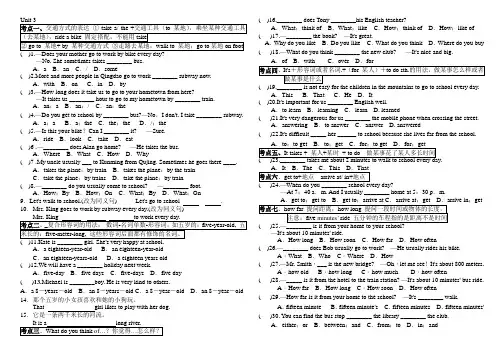
Unit 3考点一、交通方式的表达① take a/ the +交通工具(to 某地),乘坐某种交通工具(去某地),ride a bike 固定搭配,不能用take② go to 某地+ by 某种交通方式③走路去某地:walk to 某地;go to某地on foot ( )1.—Does your mother go to work by bike every day?—No. She sometimes takes ________ bus.A.a B.an C./ D.some( )2.More and more people in Qingdao go to work ________ subway now.A.with B.on C.in D.by( )3.—How long does it take us to go to your hometown from here?—It takes us ________ hour to go to my hometown by ________ train.A.an;a B.an;/ C.an;the( )4.—Do you get to school by ________ bus?—No,I don't. I take ________ subway.A.a;a B.a;the C.the;the D./;the( )5.—Is this your bike?Can I ________ it? —Sure.A.ride B.look C.take D.eat( )6 .—________ does Alan go home? —He takes the bus.A.Where B.What C.How D.Why( )7 .My uncle usually ___ to Kunming from Qujing. Sometimes he goes there ____.A.takes the plane;by train B.takes the plane;by the trainC.take the plane;by trains D.take the plane;by train( )8.—________ do you usually come to school? —________ foot.A.How;By B.How;On C.What;By D.What;On9.Let's walk to school.(改为同义句) Let's go to school .10.Mrs. King goes to work by subway every day.(改为同义句)Mrs. King to work every day.考点二、_复合形容词的用法:数词-名词单数-形容词,如五岁的:five-year-old, 五米长的:five-meter-long, 这些形容词后面都有修饰的名词。
+Unit+3+单元语法知识突破+2023-2024学年人教版七年级英语下册+

人教版英语七年级下册第三单元语法知识突破人教版英语各个单元主要是围绕话题,展开语法,接下来,我们就以人教版英语七年级下册第三单元为例,给大家总结一下。
1、关于疑问词how.(1)、疑问词how可以用于询问对方的感受。
例如:How are you?你好吗?回答,I'm fine, thank you. 我很好,谢谢。
又如:How is your weekend? 你的周末过得怎样?回答:It is great.很好。
(2)、疑问词how还可以用于询问方式,例如:How do you get to school? 你怎样去上学?回答:I take a bus to school. 我乘坐公共汽车去上学。
又如:How do you learn English well?你怎样把英语学好?回答:I read it every morning.我每天早上都在读。
(3)、how还可以用于引导感叹句,例如:How beautiful a girl she is! 多么漂亮的女孩啊!2、关于交通方式的表达。
(1)、动词短语:take a\\an\ the+交通工具名称。
例如:take the train乘火车;take a bus 乘坐公共汽车;take the subway乘地铁。
表示“骑”用ride,例如:ride a bike骑自行车;ride a horse骑马。
drive表示“开车”,例如:drive a car。
表达“走路”,用“walk”。
(2)、介词短语:by+交通工具名称。
例如by train乘火车;by bus乘坐公共汽车;by subway 乘地铁;by plane,乘坐飞机;by bike骑自行车。
特别提醒:“走路”用on foot。
练习巩固:改为同义句。
I usually take the school bus to school. = I usually go to school ________ ________.My cousin Jim walks to school. = My cousin Jim goes to school _______ _________.His father drives his car to work. = His father goes to work ______ ________.参考答案:(1)、by bus (2)、on foot (3)、by car注意:表达交通方式的句型结构如下:(1)、主语+表示交通方式的动词短语+to + 地点;例如:I take the plane to Beijing.我乘坐飞机去北京。
中考英语一轮复习之七年级下册人教版重点词汇语法背默表+Unit+3
中考复习之七年级下册人教版重点词汇语法背默表UNIT 3以下素材适合中考复习第一轮词汇过关自测使用该素材也适用于在读七年级下册学员预习和复习时使用词汇顺序按照七年级下人教版单词表格顺序原词和词性以及部分拓展请认真背默表格中的词汇相关的固定搭配,重要词汇的词性变化标注同义词对比对应词列举已表明原创词汇请合法使用未经允许不可商用Unit 3英文中文备注笔记是否掌握(✅)Go to school 去上学Arrive at school 到学校at➕小地点Arrive in a place 到要给地点In➕大地点Train 火车名词By train 坐火车Train -trainer 培训培训师动词Take a train 乘坐火车bus 公交车By bus 坐公交车On a bus 在公交上Take a bus 搭乘公交车subway 地铁美式underground 地铁英式By subway 坐地铁Take the subway 搭乘地铁Ride a horse 骑马Ride a bike 骑车plane 飞机Take a plane 搭乘飞机By plane 坐飞机sixty 六十基数词seventy 七十基数词Sixty-seven 六十七基数词Seventy-eight 七十八基数词eighty 八十基数词Eighty-five 八十五基数词ninety 九十基数词Ninety-nine 九十九基数词One hundred 一百基数词Hundreds of 成百上千minute 分second 秒hour 时An hour 一小时冠词an Far 远Be far from 离得远close 近Be close to 离得近Near 附近New -old 新的-旧的形容词Young-old 年轻的-年长的形容词kilogram 千克有复数kilometer 千米有复数Everyday Everyone Everywhere Everybody每天每位各个地方每个人不定代词谓语动词用单数Drive drove driven 驾驶原型过去式过去分词不规则Drive a car 开车Drive me crazy 让我发疯By car 坐汽车In a car 在车里Live 居住动词lives 居住三单alive 活着的副词lively 鲜活的形容词Stop at 停靠在Stop to do/doing 停下做某事停止做某事Begin to do/doing 开始做某事开始某事Start to do/doing 开始做某事开始某事Think thought thought 考虑思考原型过去式过去分词Think of 想到想起Think about 考虑思考I think 我认为句型Village 村town 镇city 城市province 省country 国家Between and 在两者之间bridge 桥梁boat 船Go boating 划船Ropeway 索道afraid 恐怕Be afraid of 害怕某物Be afraid to do 害怕做某事I am afraid that... 我恐怕句型villager 村民citizen 市民Leave-left-left 离开原型过去式过去分词Leave sth 介➕地把某物遗留在某地Home therehere前不用介词动词Dream dreamed dreamed 梦想做梦原型过去式过去分词Dream of 梦到Dream about 梦想着dreamer 做梦的人Day dream 白日做梦Dream come true 美梦成真可数。
Unit3重难点讲解与练习人教版七年级英语下册
人教版七年级英语下册Unit 3 How do you get to school?一、重点讲解1.take a/the train搭火车用动词短语表示交通方式,有以下两种情况:①用“take a/ the +交通工具名词”表示交通方式。
如: take a bus(乘公共汽车), take a ship(乘轮船), take a plane (乘飞机), 但“骑自行车”要用ride a bike来表示。
如: They often take a train to Beijing. 他们经常乘坐火车去北京。
②用某种动词来表示交通方式。
如:walk to(步行去),drive to(开车去),ride to(骑马/车去), fly to (乘飞机去)等。
2.how far 离…….多远,用来询问距离。
回答该问句常用It’s …meters/ kilometers/miles.如:–How far does your uncle live from here? 你叔叔住的地方离这儿有多远?–It’s 5 kilometers. 五千米。
3.cross= go/ walk across横穿+ road/street/bridge马路/街道/桥4. there be句型表示“某地存在有某人或某物”,要用就近原则。
拓展:not only…but also(不但…而且), either…or(不是…就是), neither…nor(既不…也不)也用就近原则。
如:There is a pen and two books on the desk. There are two books and a pen on the desk.5.W hy not do…?为什么不做...?类似句型:Why don’t you do…? 为什么不做...?二.同步句型&讲解1.How do you get to school? I ride my bike. 你怎样去学校?我骑自行车去。
人教版七年级下册英语各单元知识点总结归纳
人教版七年级下册英语各单元知识点大归纳Unit 1 Can you play the guitar?◆短语归纳play the guitar 弹吉他 play the piano 弹钢琴 play the trumpet吹喇叭play the drums 敲鼓 play chess 下象棋 speak English 说英语speak a little English 说一点英语 say it in English 用英语说它join the art club 加入艺术俱乐部 join the basketball club加入篮球俱乐部join the swimming club加入游泳俱乐部 what club 什么俱乐部play the guitar well 弹吉他弹得好 be good with sb和某人相处的好be good for···对······有益处be good at···擅长······help sb with sth / doing sth帮助某人干某事 help kids with swimming帮助孩子们游泳do Chinese kung fu表演中国功夫 be in参加,加入call sb at + 电话号码给某人打电话拨打···号have an e-mail address 有电子邮件的地址 rock band 摇滚乐队a little 一点(后接不可数名词) in the music room 在音乐教室里show sth to sb = show sb sth 把某物给某人看on the weekend/on weekends 在周末◆用法集萃1. play +棋类/球类下……棋,打……球2. play the +西洋乐器弹/拉……乐器3. be good at doing sth.= do well in doing sth. 擅长做某事4. be good with sb. 和某人相处地好5. need sb. to do sth. 需要某人做某事6. can + 动词原形能/会做某事◆语法can 能;会;可以【用法】它本身有一定的含义,没有人称和数的变化,但不能单独作谓语,要和动词原形一起构成谓语。
人教版七年级英语下册-Unit 3:知识点复习总结+单元测试(word版,含答案)
Unit3 How do you get to school?【重点单词】train [treɪn] n. 火车bus [bʌs] n. 公共汽车;公交车subway [ sʌbweɪ] n. 地铁take the subway 乘地铁ride [raɪd] v. 骑n. 旅程bike [baɪk] n. 自行车ride a bike 骑自行车sixty [ sɪkstɪ] n. 六十seventy [ sevntɪ] n. 七十eighty [ eɪtɪ] n. 八十ninety [ naɪntɪ] n. 九十hundred [hʌndrəd] n. 一百minute [ mɪnɪt] n. 分钟far adv.&adj远;远的kilometer n.公里new adj.新的;刚出现的every adj.每一;每个every day 每天by prep.(表示方式)乘(交通工具)by bike 骑自行车drive v.开车car n.小汽车;轿车live v.居住;生活stop n.车站;停止think of 认为cross v.横过;越过river n.河;江many adj.&pron.许多village n.村庄;村镇between prep.介于…之间between…and…在……和……之间bridge n.桥boat n.小船Ropeway n.索道year n.年;岁afraid adj.害怕;惧怕like prep.像;怎么样leave v.离开dream n.梦想;睡梦v.做梦true adj.真的;符合事实的come true 实现;成为现实【重点短语】1. get to school 到达学校2. take the train 乘火车3. take the subway 乘地铁4. ride a bike 骑自行车5. how do you get to school 怎么到达学校6. one hundred and five 1057. how far 多远8. how long 多长时间9. it takes sb some time to do sth 它花费某人多长时间做某事10. ride the bike to school 骑自行车到学校11. walk to , drive to ,fly to…步行去…;开车去…;坐飞机去….12. every day 每天13. I’m not sure 我不敢确信14. about= around 大约15. 10 kilometers 十公里16. good exercise 好的锻炼17. drive his car to work 开车去上班18. in his father’s car 坐父亲的车19. need about 10 minutes to get to school 需要十分钟的时间到达学校20. what do you think of…=how do you like…你觉得怎么样21. cross the river 过河22. It is easy to get to school. 到达学校很容易。
(完整版)新人教版英语七年级下册1-12单元知识点归纳
Unit 1 Can you play the guitar?语言点梳理一、语法:情态动词:有一定意义,表示说话人的语气或情态,但不能单独作谓语,只能和其他动词原形一起构成谓语,没有人称和数的变化。
否定形式是在情态动词后面加上not。
变一般疑问句要把情态动词提到句子的开头,即:情态动词+主语+动词原形+其他?1.肯定句:He/She/I/We/They/You/Tom+情态动词can+动词原形.2.否定句:He/She/I/We/They/You/Tom+情态动词can+not+动词原形3.一般疑问句:情态动词can+ He/She/I/We/They/You/Tom+动词原形?Yes,主语+can./No,主语+ can’t.1)表示能力,“会;能”。
eg: Can you dance? 你会跳舞吗?2)表示请求或许可,“可以”。
eg: Can I ask you a question? 我可以问你一个问题吗?1. play the guitar/piano/violin/drums弹吉他/钢琴/小提琴/敲鼓play chess下象棋play sports 做运动play soccer/basketball踢足球、打篮球(乐器名称前加the,球类名称前不加the)2. join the art club加入艺术俱乐部/swimming club游泳俱乐部sports club运动俱乐部/story telling club讲故事俱乐部English club/ art club/ music clubjoin v.参加,加入指加入某个团体,组织,群体,并成为其中的一员。
What club do you want to join ?你想加入什么俱乐部?I want to join the swimming club.=I want to be in the swimming club.takeEg. take part in the meeting参加会议3. want sth.想要某物want to do sth.想做某事want sb to do sth 想要某人做某事4. be good at(doing...)擅长于=do well in 在某方面做得好be good with与…相处的好be good for对…有益5. like to do sth.喜欢做某事like doing sth.6. Let’s do sth.让我干…let/make sb.do sth.使某人做某事10. write stories写故事write to sb= write a letter to sb= write sb a letter11.tell /speak/say/talk的用法1) tell讲述一件事实或故事等及物动词tell sb. sth 给某人讲某事=tell sth to sb 把某事告诉某人tell sb. to do sth 告诉某人做某事tell stories讲故事=tell a story tell a lie撒谎2)speak v. 主要是讲说话的能力,往往接语言speak English讲英语3)talk 为不及物动词往往加介词再接宾语talk to sb.和…交谈/talk with sb.和…交谈(指双方)4)say往往接说话的内容eg.Our teacher says we should study hard.say it in English用英语说它12. make friends with sb.和…交朋友13. play games with sb.和…做游戏14. help sb. with sth.= help sb. (to) do sth.帮助某人做某事15. call sb. at +电话号码给某人打电话拨+号码16. on /at the weekend 在周末on weekends after school放学后17.do Chinese kung fu 打中国功夫18.be free 空闲的19. sing very well 唱得好That sounds good. 那听起来很好20.English-speaking students 讲英语的学生学生运动中心23.also /too/eitheralso/too用在肯定句,also 用于句中,too 用于句尾,either用于否定句句未eg. I am a student . He is a student,too. I am a student . He is also a student.I am not a student . He is not a student, either.24.and/or 连接两个并列成分eg.I can sing and dance.(and用于肯定句)I can’t sing or dance.(or用于否定句)Can you sing or dance ?(or用于选择疑问句“或者”)25.at27. need to do sth需要干某事need sb. to do sth 需要某人干某事28.wanted students for School show学校表演招聘学生v.展示;给….看… show sb. Sth= show Sth to sb.给某人展示n.节目;表演TV show电视节目29.teach v.教,讲授teacher n.教师teach sb.English教某人英语teach sb. sth .= teach sth to sb.教给某人某事=教某事给某人teach sb.to do sth教给某人做某事30.music n.音乐musician n. 音乐家31.piano (pl.) pianosUnit 2 What time do you go to school?知识点梳理1.What time do you get up?What time +助动词do/does +主语+动词原形,询问某人做某事的具体时间。
七年级英语下册 Unit 3 How do you get to school知识点总结+导学案(无答案)(新版)人教新目标版
Unit 3 How do you get to school? 单元知识归纳【短语归纳】1.get to school 到达学校2.take the subway 乘地铁3.ride a bike 骑自行车4.how far 多远5.from home to school 从家到学校6.every day 每天7.take the bus 乘公共汽车 8.by bike 骑自行车8.bus stop 公共汽车站 9.think of 认为10.between …and …在…和…之间11.have to 不得不12.one 11-year-old boy 一个11岁的男孩(必须放于名词之前)13.play with …和…玩 e true 实现15.be afraid 害怕 16.be like 像……【用法集萃】1.take…to …= go to …by…乘……去……2.How do/does (sb)get to …? ……是怎样到……的?3.How far is it from …to …? 从……到……有多远?4.It takes sb. some time to do sth.做某事花费某人多长时间。
5.How long does it take …? ……花费多长时间?6.It is + adj. + to do sth. 做某事是……7.Thanks for + n./v.-ing 感谢你(做)某事。
8.have to + 动词原形不得不做某事9.What do/does + 主语 + think of…? ……认为……怎么样?【重点句子】1. How do you get to school? I walk to school.你是怎样到校的?我步行。
2. I usually walk but sometimes I take the bus.我通常步行,但有时坐公共汽车。
3. How long does it take you to get to school?It takes about 10 minutes to walk and 15 minutes by bus. 4. How far is it from his home to school? About 10 kilomete rs. 从他家到学校有多远?大约10公里。
unit 3,七年级下册英语,重点短语
unit 3,七年级下册英语,重点短语
English:
The key phrases from Unit 3 in the seventh grade textbook include "take a break", "hang out with friends", "get together", "catch up", "work on", "look forward to", "get along with", "keep in touch", "be interested in", "deal with", "put up with", "give up", "come up with", "figure out", "put off", "try out", "go through", "find out", and "come across".
中文翻译:
七年级教科书第三单元的重点短语包括“休息一下”,“和朋友一起玩”,“聚在一起”,“赶上”,“努力工作”,“期待”,“和……相处得好”,“保持联系”,“对……感兴趣”,“处理”,“忍受”,“放弃”,“想出”,“弄明白”,“推迟”,“尝试”,“经历”,“找出”,和“偶然遇到”。
人教版七年级下册英语第三单元知识点梳理
人教版七年级下册英语第三单元知识点梳理Unit 3 How do you go to school一、词汇与短语◆重点单词◆重点句子◆重点单词变形二、语法知识点A部分知识点1.与how构成的词组引导的特殊疑问句❶ how表示爱好、程度、看法等,意为“……怎么样?”。
eg:—How do you like the music?你觉得这首乐曲如何?—I like it very much.我非常喜欢它。
How is your Chinese?你的汉语如何?How do you like China?你认为中国怎么样?❷用于询问身体健康状况,意为“……怎么样?”。
eg:How do you do?你好!How are you?你(身体)好吗?❸ how提问交通方式。
其答语分三种情况:◆take a/the+表示交通工具的名词◆by +表示交通工具的单数名词◆on/in+限定词+表示交通工具的名词eg:How do you go to workevery day? 你每天怎样去上班?I take the subway to work. 我乘地铁去上班。
=I go to work by subway.=I go to work in the subway.❹表示感叹。
eg:How cold it is today!今天好冷啊!How hard they are working!他们在多么辛勤地劳动啊!How fast he runs!他跑得多快啊!❺表示某种方式、手段或方法。
eg:How do you spell it?你怎样拼写它?How did he go to schoolyesterday?他昨天是怎样去上学的?How do you know about it?你怎么知道这件事的?❻ how about用于询问或征询意见等,相当于what about,后接名词、代词或动词的-ing形式,意为“……怎么样?”。