
七年级上unit4SectionB1a-1e说课稿
Unit 4 Where’s my schoolbag? (Section B 1a—1e)说课稿
一、说教材:
本单元围绕着Where is my schoolbag?的话题,共设计了三个部分的内容。
通过教授本单元,使学生学会谈论房间里物品的位置,能读懂有关物品位置的便条,并学会写便条让朋友帮自己从房间里取东西。
Section A 让学生通过活动,学习如何表达物品的位置,并能就物品位置进行提问。
Section B 在Section A 所学知识的基础上,通过1a—1e的听、说、写的活动继续训练Where 问句和介词on\ in\ under 的用法。
1c和1d的听力内容是一个丢三落四的孩子和妈妈的对话,请妈妈把一些学校用品拿到学校给他。
在这段对话中有个别结构较复杂的难句,但这些句子并不是本单元的教学重点,也并不影响听力教学任务的完成。
二、说教学目标
根据英语新课标,教材大纲的要求和学情(学生对感兴趣的话题较愿意表达)确立教学目标如下:
(一)知识目标
1. 掌握以下重点词汇和常用表达:
radio, clock, tape, player, model, plane, tape player, model plane
2. 掌握方位介词on、in、under的用法。
3. 能够正确使用Where引导的特殊疑问句描述物品位置。
(二)能力目标
1.学会描述物品的位置,并能就物品的位置进行提问和回答。
2.能对方位介词in ,on ,under加以灵活运用。
3.培养学生的语言运用能力和在听力过程中寻找关键词的能力
(三)情感目标
培养学生学习英语的兴趣,乐于参与课堂活动的积极情感。
三、教学重难点
根据本课在教材中所处的地位和作用,我确立本课的重难点如下:(一)教学重点
1. 词汇和常用表达
2. 正确使用介词on、in、under描述物品所在的位置
3. 正确使用Where引导的特殊疑问句描述物品位置
(二)教学难点
进一步练习在听力过程中寻找关键词
四、说教法
为了达到本课的教学目标,更好地突出重点,突破难点,根据英语新课标的要求并结合教学内容。
我主要采用的教学方法有:1、情景交际法:课堂教学以情景交际法为主,尽量给学生以足够的语境,让学生在真实或模拟真实的情境中感知语言,体会语言,掌握语言的同时,使学生运用语言过程中学会和他人进行交际。
2、听说法:通过听录音,表演对话巩固句型,加强听说训练。
3、多媒体辅助教学法:我将本课所需的图片,录音和文字用多媒体展示,使抽象的语言变得直观,激发学生学习兴趣。
为学生运用英语进行交流创设情境,实现师生互动,生生互动的多向交流。
五、说学法
本课我主要遵循“教为主导”“学为主体”“练为主线”的教学思想对学生进行学法指导。
让学生通过观察课件画面问答问题,引导学生交际,主动练习和实践。
在课堂活动中让学生和同桌围绕着课堂任务分工合作,在活动中相互探讨,相互合作,从而获得知识技能和情感体验,发展他们的能力,让学生在合作中完成任务,掌握本课所学的重点语言结构,培养团队精神。
六、说教学过程
1.导入新课
本节课由复习Section A部分的知识开始,通过翻译短语唤起学生对已学知识的记忆,再通过展示照片的方式引出本节课要学的物品名称词汇。
2.讲授新课
1a部分利用图片教学生词。
1b部分给学生三分钟时间,让他们先观察课本上的图画,然后合上课本,在本子上独立写下所记住的物品,并让两名同学到黑板上去写。
之后共同检查黑板上的书写情况,将漏掉的、记错的或拼写错误的物品单词补齐或改正,整个过程不能看书。
最后让学生打开书,检查自己的记忆效果。
通过这个过程引导学生认识到结合图像记忆单词是一种很有效的学习方法,提示学生在学习中多运用这种方法。
在词汇学习环节的铺垫之后,1c—1d通过听力对学生提取关键信息的能力继续进行训练。
首先给学生简单介绍第一遍听力的重点:Tom wants some things from his room. What are they? 提示学生仔细听,捕捉可能出现的关键词。
播放第一遍录音,完成1c,共同核对答案。
接着给学生简单介绍第二遍听力的重点:Where are the things? 提示学生本次听力重点是已知物品的位置。
对于基础较弱的学生,可以只要求他们几下关键词,如:under,radio等,然后连词成句,达到1d的书写要求。
由于本段听力内容较为复杂,且干扰信息较多,学生在听的过程中存在困难,因此让学生多听几遍录音,最后分段播放录音,让学生有足够时间记录信息并写出句子。
(10分钟)
在听力任务完成之后,利用听力材料设计补全并表演对话,使学生对所学词汇和句型加深理解和记忆。
(10分钟)
3.总结归纳
学生分小组总结归纳本节课所学重点知识,然后展示,教师适当进行补充强调。
通过此环节检查学生听课效果并锻炼学生归纳总结的能力。
(5分钟)
4.作业布置
熟记本节课所学新单词,练习对话,巩固本单元重点句型。
七、板书设计
本节课需要板书的内容较少,再讲到player的时候由于它还有其他意思,因此将player的其他意思和词根板书,让学生了解;在1d 听力任务时,由于学生在这部分有困难,因此帮助学生将听到的内容板书下来,让他们更加清楚的理解听力内容。
Where’s my schoolbag? (Section B 1a ---1e)
player n. 播放机;运动员
play v 玩;运动;播放
The ruler is on the bed.
The notebook is under the model plane in the bookcase.
The tape is in the tape player.。
人教版初中英语七年级上册第四单元Section B(1a-1e)教案和教学反思
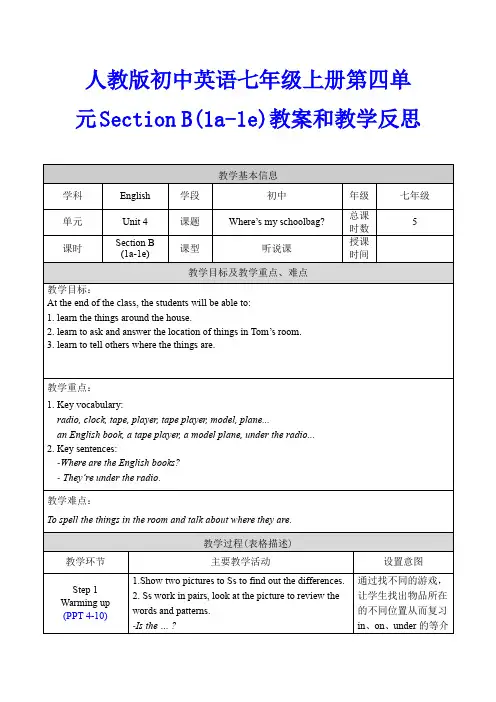
这是口语拓展练习的过程。观察汤姆房间里的物品,学生进行身临其境的口语训练。小组合作练习用where对地点提问的句型。
Step 5
Summary
(PPT 20)
1.Ask Ss to sum up the target languages.
人教版初中英语七年级上册第四单元Section B(1a-1e)教案和教学反思
教学基本信息
学科
English
学段
初中
年级
七年级
Where’s my schoolbag?
总课时数
5
课时
Section B
(1a-1e)
课型
听说课
授课时间
教学目标及教学重点、难点
教学目标:
At the end of the class, the students will be able to:
3.Work on 1d.
Ask Ss:Where are Tom’s things?
Play the tape for Ss to listen againand write them down.
Call some Ss to read their sentences.
训练学生的听力水平,以达到对本课词汇及句型的掌握。
1.learn the things around the house.
2. learn to ask and answer the location of things in Tom’s room.
3. learn to tell others where the things are.
七年级上册Unit4SectionB1a1d听说课优质课课件
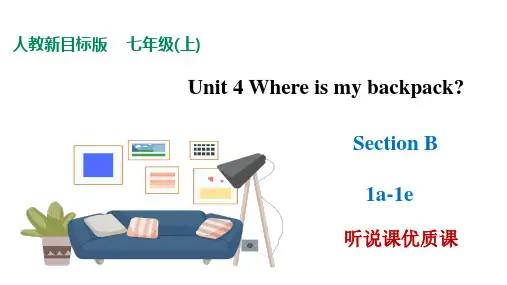
_o__n__the bed
under the model plane in the bookcase
in the _t_a_p_e__ p_l_a_y_e_r_
听力策略:predict(预测) and listen to the key words
1d Listen again. Where are Tom’s things? Write them down.
Let’s look at the room. What can you see in this room? Can you say where they are?
1a Match the words with the things in Tom’s room.
1. radio __a_ 3. tape player __d_ 5. tape _b__ 2. clock __f_ 4. model plane __e_ 6. hat __c_
Help Tom clean his room and put the things in the right place.
The notebook, ID card and pencil box are in the schoolbag.
• Look at the picture on P22 • Think by yourself • 1 minute to prepare
English books tape player clock
ruler
notebook
tape
model plane radio
(注意是汤姆想要的东西,并不是听到的所有的东西)
Tom needs some school things. But he is not at home.So he
Unit 4 Section B 第1课时示范公开课教案【英语人教新目标七上】

Unit 4 Where’s my schoolbag?Section B (1a—1e)教学设计一、教学目标1. 能够熟练掌握本课重点词汇:radio, clock, tape, player, model, plane,bring... to...2. 熟练掌握本课重点句型:(1) —Where’s his tape?—It’s in the tape player.(2) —Where are your English books?—They’re on the chair.3. 能够听懂有关询问和描述物品所在位置的对话内容,培养学生提取关键信息的能力。
4. 巩固运用where句型和方位介词in/on/under来提问并准确表达物品的位置关系。
5. 教育学生要养成爱整洁、合理摆放物品的好习惯。
二、教学重点及难点重点:1. 能够听懂有关询问和描述物品所在位置的对话内容,培养学生提取关键信息的能力。
2. 巩固运用where句型和方位介词in/on/under来提问并准确表达物品的位置关系。
难点:巩固运用where句型和方位介词in/on/under来提问并准确表达物品的位置关系。
三、教学过程四、板书设计Unit 4 Where’s my schoolbag?Section B (1a—1e)1. Key words: radio, clock, tape, player, model, plane,bring... to...2. 熟练掌握本课重点句型:(1) —Where’s his tape?—It’s in the tape player.(2) —Where are your English books?—They’re on the chair.。
人教新目标英语七年级(上册)Unit 4 Section B (1a-1e)教案设计

behind
tape
radio
hat
model plane
tape player
tape
The notebook is under the in the bookcase…
The tape is…
messy
tidy
untidy
predict
good habit
bad habit
5.学习效果评价设计
学习新词汇并检测是否理解。
4.Match the words
Ask Ss to look at 1a and match the words with the things in the picture
Ss match the words
检测词汇学习效果。
5.Listen for the main idea
The ruler is on the bed.
The English books are under the radio.
B.学生能通过听力内容的学习,基本了解几种听力做题技能。
2.过程与方法
A.学生通过小组对话学会与他人合作交流,并能把语言材料用到真实的生活中去,比如能英语介绍他人的房间物品摆放情况。
Play the recording and ask Ss tochoose th correct answers
listen and answer the questions
学生自己总结听力技巧,并学以致用
6.Listen and circle
Play the recording and ask Ss to cirfrom his room.
11.Summary
Whathavewe learnt ?
人教版七年级上册Unit4SectionB(1a1e)教学设计
3.教师强调本节课的重点知识,布置课后作业,要求学生运用所学知识描述自己的学校生活。
4.教师对本节课的教学效果进行反思,为下一节课的教学做好准备。
五、作业布置
为了巩固本节课所学知识,培养学生的实际语言运用能力,特布置以下作业:
1.请学生运用本节课所学的词汇和句型,描述自己学校的一个场所,如:library,playground,gym等。要求不少于5句话,并使用一般现在时态。
3.利用图片和真实场景视频,让学生对学校各个场所进行直观的认识,激发他们的学习兴趣。
(二)讲授新知
1.教师通过PPT展示一般现在时态的句子结构,并结合图片解释句型:“What's this/that? It's a library/playground/gym. What's he/she doing? He/She is reading books/playing basketball.”
人教版七年级上册Unit4SectionB(1a1e)教学设计
一、教学目标
(一)知识与技能
1.学生能够掌握本节课的重点词汇和短语,如:library,playground,gym,dining hall,Auditorium等,并能熟练运用这些词汇描述学校的不同场所。
2.学生能够运用一般现在时态描述某人正在做某事,如:He is playing basketball in the playground.
3.各小组展示讨论成果,其他小组进行评价和反馈。
(四)课堂练习
1.教师设计填空、选择、改写句子等练习题,让学生独立完成。
2.练习题中涵盖本节课的重点词汇和句型,帮助学生巩固所学知识。
Unit 4 SectionB(1a 1e) 教学设计人教版英语七年级上册
根据假设的你的房间图片展示,进行不少于40词的物品位置描述。
教学反思
在听说读写四项英语能力中,学生的口语能力相对较弱。在本节课中,很多学生怯于张口练习对话,针对这种现象,在听说课中,要调动学生的积极性,充分发挥学生的主体地位,设计形式多样的口语练习活动。
实现目标3:通过听听力材料,能听懂有关物品位置的较复杂对话,并能获得相关信息,教学活动如下:
1.听Section B 1c听力材料,圈出所听到的,Tom想要的东西。
2.听Section B 1D听力材料,记录下Tom所想要物品的位置。
评价任务3:
准确描述Tom的物品的位置。
评价标准
1.能获取物品位置的准确信息,完成听力任务。
课题:Where’s my schoolbag?
教材来源
初中七年级《英语》教科书/人民教育出版社
内容来源
七年级《英语(上册)》Unit4 section A(1a--2d)
主题
Where’s my schoolbag?
课时
共5课时第3课时
授课对象
七年级学生
设计者
目标确定
的依据
《课程标准》的要求:
能识别不同句式的语调,如陈述句、疑问句和指令等。能识别语段中句子之间的联系。能听懂有关熟悉话题的语段。能在课堂活动中用简短的英语进行交流。能就熟悉的话题进行简单的交流。能在教师的指导下进行简单的角色表演。能在上述口语活动中做到语音、语调基本正确。
教材分析
本单元是人教版新目标七年级上册Unit4 Section B部分,本单元中主要涉及到方位介词in,on, under的运用,还有一些相关的物品名词。
学情分析
前两课时学习,学生已经学习了介词in,on,under,为本节课的学习奠定了一定的知识基础,能捕捉听力材料中的基本信息并完成听力任务。能说出常用的简单句,但在听力记录方面有困难。
人教版英语七年级上册unit4SectionB1a1e教学设计
3.口语练习:录制一段视频,展示学生用英语进行物品问答的场景。要求学生尽量流利地表达,注意语法和发音。
4.课后阅读:阅读一篇关于日常用品的英语文章,并完成文章后的相关问题。文章可在课后阅读材料中选取。
(三)学生小组讨论
1.教师将学生分成小组,每组分配一套词汇卡片和句型卡片。
2.各小组根据卡片内容,进行角色扮演,用英语进行物品问答。
3.教师巡回指导,观察学生的讨论情况,并及时给予帮助。
4.各小组展示成果,其他小组进行评价,教师总结并提出建议。
(四)课堂练习
1.教师设计一系列练习题,如填空、选择、连线等,巩固词汇和句型。
四、生观察并提问:“What's in the picture?”
2.学生回答后,教师继续提问:“Can you find any objects we will learn today?”
3.学生找出图片中的cup,plate,bowl,knife,fork,spoon,table,chair等物品,并尝试用英语说出它们的名字。
2.培养学生的合作意识,让他们学会与他人共同完成任务,体验团队协作的乐趣。
3.培养学生的观察力、想象力,提高他们的思维品质。
4.培养学生尊重他人、关爱环境的意识,教育他们在生活中注意节约、环保。
5.引导学生树立正确的人生观、价值观,培养他们积极向上、乐观进取的精神风貌。
二、学情分析
针对人教版英语七年级上册Unit 4 Section B 1a-1e的教学内容,学生已经具备了一定的英语基础知识,包括词汇、句型和一般现在时的基本用法。在此基础上,他们对英语学习兴趣浓厚,但个体差异较大,听说读写能力参差不齐。以下是对学生学情的具体分析:
人教版七上Unit4 SectionB (1a-1e)教学设计
Consolidate and improve theSs’cooperating ability.
Step 6 Summary
Let students know what they have learnt in this class.
Make a summary
Consolidation
HomeworkDesign
1. Finish exercise part 2.
2. Copy and recite the words in 1a.
3. Preview the Design
Unit4Where is my schoolbag?
(2) Target language:the prepositions in, on, under.
Ability Objects
(1)Be able to talk about the location of the things.
(2)Improve the Ss’listening, speaking and memory ability.
Step 1 Review
Show some pictures to revise the prepositions.
Make dialogues according to the pictures.
Review the target language learnt in the last lesson.
Unit4Where is my schoolbag?
SectionB (1a-1e)
Teaching Aims
Knowledge Objects
人教版七年级上册Unit4SectionB(1a1e)优秀教学案例
一、案例背景
本案例背景基于人教版七年级上册Unit 4 Section B (1a-1e)的教学内容。本节课的主题是“What time is it?”,主要学习如何用英语询问和表达时间。通过本节课的学习,学生能够掌握常用的时间表达方式,如“It’s seven o’clock.”、“What time is it?”等,并能运用所学知识进行简单的日常交流。
在教学过程中,我注重引导学生主动参与,鼓励他们大胆开口说英语。针对学生的不同需求,我给予个别辅导,确保每个学生都能跟上课堂进度。在课堂总结环节,我组织了一个小组讨论,让学生分享彼此的学习心得,并针对本节课所学内容进行巩固。
二、教学目标
(一)知识与技能
1.学生能够准确地听懂、说、读、写本节课所学的重点单词和句型,如“What time is it?”、“It’s seven o’clock.”等。
三、教学策略
(一)情景创设
1.课堂导入:通过播放一首关于时间的英文歌曲,让学生在轻松愉快的氛围中进入学习状态。
2.生活情境:设计不同的时间场景,如在学校、在家里、在商场等,让学生在真实的情境中学习并运用所学知识。
3.故事引导:编写一个与时间相关的小故事,引导学生跟随故事情节,自然而然地融入到本节课的学习主题中。
4.图片展示:展示与时间相关的图片,如钟表、日历等,激发学生的学习兴趣,引导学生关注时间表达方式。
(二)问题导向
1.自主探究:鼓励学生针对时间表达方式进行自主探究,引导学生发现规律,总结知识点。
2.问题引导:教师提出引导性问题,如“你觉得时间怎样表达比较好?”“在不同的场景下,我们如何用英语询问和表达时间?”等,激发学生的思考。
新目标英语七年级上Unit4SectionB(1a-1e)教案新部编本
教师学科教案[ 20 – 20 学年度第__学期]任教学科:_____________任教年级:_____________任教老师:_____________xx市实验学校Teaching planUnit 4 Where’s my schoolbag?Section B (1a—1e)Tai Ping Bridge Middle School Liu LijunI. Analysis of StudentsThis unit is related to students’ daily life. They are interested in the topic. The moral object education is deserved to mention and cultivate students. I will try my best to make more students to take part in the class.II. Knowledge Aims and Demands1.Knowledge ObjectsKnowledge objects are to make students master the words and sentences: radio, clock, tape, player, tape player, model, plane, model plane.Sentences: ---- Where are the English books?---- They’re under the radio.2.Ability ObjectsAbility objects are to cultivate students’ abilities of listening and speaking. They can master the key information in the listening material.3.Moral ObjectMoral object is to cultivate students’ habit of loving neatness. They can put things well and be clean and tidy.III. Teaching Key Points1.Students can use prepositions in, on, under to describe the daily things’locations.2.They can memorize the words: radio, clock, tape, player, tape player, model,plane, model plane.IV. Teaching Difficult Points1.Students can use single nouns and plural nouns correctly.2.Students can use pronouns it and they skillfully.3.The single noun and plural noun can be matched with the corresponding verbsis and are.V. Teaching Methods1.Situational language teaching.municative approach.3.Task basic approach.VI. Teaching AidsBlackboard, chalks, PPT, a projector, a computer, tapes and a tape player.Real objects: a hat, a tape, a tape player, a model plane, a clock, a radio etc. VII. Teaching ProceduresStep 1 Warming upSing a song named “Finger family”.Step 2 RevisionA game : Some students lost their things. Other students help them to find the lost things. Review the sentence pattern ”Where is/are …”“Is/Are the …in/on/under the …?”Step 3 New words presentationTeach new words while showing the real objects.Step 4 1aMatch the words with the things in the picture.Step 5 Memorizing and writing words students remember.Look at the picture in 1a on page 22 and write down all the things you remember. Step 6 Filling the blanksGive students some minutes to finish the chart. The words are classified according to things and places.Step 7 1cListen and circle the things Tom wants from his room.Step 8 Finishing the chartFill the blanks.Step 9 1d and retelling where Tom’s things are.Ask students to retell where the things are.Step 10 1eAsk and answer questions about the things in Tom’s room.Step 11 Broadening key pointsAsk students to introduce the things’ locations.VIII. SummaryIs/Are the … in/on/under … ?Yes, it is/they are.No, it isn’t/they aren’t.IX. Blackboard DesignWhere are the English books?They’re under the radio.The English books are under the radio.The ruler is on the bed.X. Exercise英汉互译1.在沙发上2.在收音机下面3.在床上4. 在飞机模型下面5.在书柜里6.Frank的磁带7.在磁带播放机里8.bring some things to school9. in our roomXI. After-class ReflectionThis class I designed real objects to teach new words and guide students to use learning plan. Using learning is clear for students to know what to do. Because those are the real objects in the daily life, students are glad to take part in activities. After teaching, there are some disadvantages to care about, such as time limited, grammar teaching’s inappropriateness, the relation between pre-listening and while-listening aren’t controlled well.In the listening step, students can’t finish the chart well and retell the sentences accurately. They always forget “the”. I should pay attention to these problems.。