
江苏省南京市梅山第一中学牛津译林版高中英语选修九Unit 3 the meaning of our colour Project教案
第九模块第三单元教案
Designed by Wu Jun
Teaching task:Module 9 Unit 3 Project Reporting on colors and cultures Thoughts on the design:
本课件侧重其中的文本阅读教学。
从比较两组婚庆图片导入颜色含义的民族差异,从而进入文章的阅读。
接着引导学生运用略读、跳读等阅读技巧了解文章的大意和细节,并用Task中的方法有效整理和记录相关信息。
然后简单操练本文的词汇用法,着眼于新旧知识的比较,使得复习得到有效渗透。
最后指导学生如何在课后进行有关颜色的研究。
Teaching aims:
1. Students will be able to learn that a color may convey both positive and negative meanings and that meanings differ depending on nations and cultures by reading;
2. Students are also guided to get a general idea and detailed information through reading strategies like skimming, scanning and predicting.
3. Students will be provided a chance to practice recording information they have learned in the previous Task section.
Teaching procedures:
Step One Leading in
Show students two groups of pictures about wedding.
(1) Question: What is the theme of the two groups of pictures?
Answer: Wedding.
(2) What differences do you notice between the two groups?
Answer: One is western wedding and the other is Chinese. White is the main color for the former while red for the latter.
[Explanation]
通过图片制造鲜明的视觉上对比效果,使学生立刻进入主题,为课文学习做好充分准备。
Step Two Reading comprehension of the text
1. Present students a question to think about, collect their opinions and guide them to find the answer in the reading article;
2. Collect students’ understanding of the question and help them to complete the conclusion;
The same color may carry different meanings in different cultures.
3. Encourage students to predict what is to follow in this article;
Possible answer: It may talk about how a color carries different meanings depending on different cultures;
4. Ask students to skim the first sentence of each paragraph for a general idea so as to check their
guess;
5. After showing students structure of the whole article, ask Ss to scan the specific paragraph to
answer questions involving detailed information;
Step Three Recording of information
1. Ask students to work out suitable categries with their partners;
2. Help students to work out a table design to include all information about the colour red;
Step Four Language focus
1.Ask Ss to do an exercise on vocabulary.
Answer: 1. While 2. convey 3. In addition 4. symbolized 5. associate
2.Get Ss to do Ex B1 & B2 on P119 in the workbook.
Step Five Writing time
Get students to use what has been learned about color to write a short passage in about 150 words.
As we all know, we need to paint Beijing opera performers’ faces in patterns and colours to help show the dimensionsand depths of their characters’ personalities.
Step Six Homework
1. Polish your writing;
2. Read and go over the text, paying attention to the language points;
3. Do exercises B1 & B2 on P119 in the workbook.。
译林牛津版高中英语选修9教案:U3 Task8-9教案
牛津高中英语教学设计教材:牛津高中英语(模块九) 高三上学期文档内容:教学设计——教案单元:Unit 3 The meaning of colour板块:Task 2Thoughts on the design:本课件为Task的第二课时,完成编对话和记录信息两项任务,侧重学生说和写的能力。
本课的教学从复习上节课的阅读文章入手,帮助学生提炼出更多信息,并以表格形式归纳,为第一个小任务编对话做好铺垫。
第二个任务要求学生整理已获得的有关该剧演员性格、脸谱设计以及色彩选择的依据等所有信息,并设计出可以涵盖这些信息的表格。
以小组为单位根据所给样板完成对剧中一位人物的信息整理,并以口头形式向全班介绍。
使字词形式的提纲转化为语句形式的表达。
Teaching aims:After completing the tasks, students will be able to design a chart with suitable categories to record gathered information. Speaking and writing skills are practiced and students are encouraged to work in a pair or group to exchange opinions and make decisions after a discussion.Teaching procedures:Step 1 Getting to know the characters1.Question: What are the original 3 colors used in Beijing opera face masks?Answer: Black, red and white2.Ask Ss to tell the personality and its typical characters, if any, associated with a certain colorof mask. ( PPT 4 )Question: Later more colors are used. What are they?Answer: Green, purple, yellow, blue, reddish purple etc.3.Get Ss to say the personality a certain color of mask indicates. ( PPT 5 ) [Explanation]本课的教学从复习入手,帮助学生巩固脸谱中不同颜色所展示的人物的性格,并为下一步的对话练习做好知识上的准备。
牛津译林版高中英语选修九Module 9 Unit 3 The Meaning of Color
Module 9 Unit 3 The Meaning of Color一、重点单词二、重点短语1. ____________ n.动乱,动荡 1. 不仅仅;超过______________2. ____________ n. 性格,个性 2. 代表、象征_______________3. ____________ n. 解放 3. 随机的,随意的______________4. ____________ n. 平等,均等 4. 遭受饥饿________________5. ____________ n. 公正、正义 5. 追溯到、始于_______________6. ____________ vt & vi. 评估,划分等级 6. 使某人想起某事_______________7. ____________ vt. 废除,废止7. 听任、顺从_________________8. ____________ n.诚实,老实8. 像…一样__________________9. ____________ adj. 根本的,基础的9. 例如_________________10. ____________ n. 联合,联盟10.以这种方式________________11. ____________ v.& n. 敬礼、致敬11. 即使_______________12. ____________ n. 相似点,相似性12. 反对某事______________13. ____________ adj. 精神的,心灵的13. 为了…而奋斗_______________14. ____________ n.移民14. be regarded as…_______________15. ____________ n. 分离、分开15. 脱离,分裂出去_______________16. ____________ adj.有抱负的16. 由…组成_________________17. ____________ n.职业;侵占17. 在…的开始/开端_______________18. ____________ n. 激情18.以…为基础_________________19. ____________ n. 谨慎,慎重19. 异同之处___________________20. ____________ adj.高尚的,高贵的20. take causion__________________三、词汇联想1. conclude v. ____________ n2. strength n. ____________ v.3.identification n. ____________ v.4. politics n. _____________ adj.5. combine v. _____________ n.6. anger n. _____________ adj.7. separate v. _____________ n. 8. deep adj. _____________ n.9. symbolize v. _____________ n. 10. personal adj. ____________ n.四、任务型阅读(一空一词)Simply increasing physical activity levels alone is unlikely to reduce body weight in young children, and therefore will probably not prevent obesity (肥胖), although it may set the stage for a healthier lifestyle, the results of a study conducted in Scotland suggest.Instead, a combination of increased physical activity and other lifestyle changes like sticking to a healthy diet may be needed to stop the trend of obesity.“Many children are obese, even at preschool age,” Dr John J. Reilly from the University of Glasgow and his colleagues note in the British Medical Journal. Considering the general lack of evidence on proper ways to prevent obesity in this age group, Reilly’s team had 545 children from 36 nursery schools in t he “Movement and Activity Glasgow Intervention (干预) in Children” or MAGIC trial.The trial was specifically designed to see if an increase in activity could reduce body mass index (身体质量指数). Each week for 24 weeks roughly half of the preschoolers, who were an average of 4.2 years old, participated in three 30-minute active workouts while at nursery school and their parents were encouraged to increase the child’s activity levels at home. The other half ofthe children, serving as contrasts, followed their usual nursery school schedule.According to the researchers, the physical activity intervention had no significant effect on body mass index of the children.However, compared with contrast children, intervention children show greater gains in body movement skills, which, the researchers say, may increase confidence in physical ability, perhaps increasing the opportunities of future participation in physical activity or sports.In a word, Reilly and his colleagues suggest that “successful interventions to prevent obesity in early childhood may require changes not just at nursery, school, and home, but in the wider environment. Changes in other behaviors, including diet, may also be necessary.”Topic Whether exercise alone can 1______________ obesity in young children.Researchers Dr John J. Reilly and his 2.________________ from the University of Glasgow People researched 545 children from 36 nursery schoolsProcess ●about half of the preschoolers 3._______________ 4.2 on average : ●participating in acti ve workouts at nursery school●4._______________ parents to increase their activities levels at homethe other half:●living 5._______________ according to the nursery school schedule.6.___________ ●Exercise alone has no7._______________ on losing weight.●Intervention children show greater gains in body 8._____________ skills, which can make them more 9.______________ in physical ability.●Successful interventions to prevent obesity in early childhood may require changes in both the 10._______________ and other behaviors, including diet.Module 9 Unit 3一、重点单词1.二、重点短语1.三.词汇联想1. conclusion2. strengthen3. identify4. political5. combination6. angry7. separation8. depth9. symbol 10. personalityIII. 任务型阅读(一空一词)1. prevent2. colleagues3. aged4. encouraging5. normally6. Conclusion7. effect8. movement9. confident 10. environment.。
牛津译林版高中英语选修九Welcometotheunit
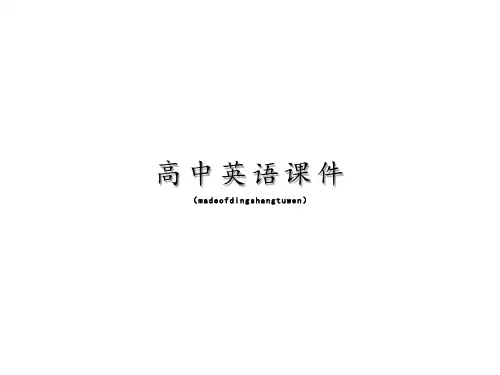
Like flowers can represent different things, each colour has a different meaning. What is brought into your mind when you see them?
red
green
yellow
pink
blue
black
golden
orange
What other colors do you know?
brown gray silver white yellow chocolate lemon cherry olive green sea green lime rose lavender
RED Orange Yellow Green
Blue
Purple White Golden Silver Black Pink
Picture Discussion:
Look at the four pictures on Page 33 and find out what the topic of each picture is.
Picture1: national flags Picture2: national flowers Picture3: masks in Chinese opera Picture4:different meanings of colours in the west and China
Each country has its own national flag with its own pattern and colors.
译林牛津版高中英语选修9:U3 Welcome to the unit

National Flag of France
National Flag of Germany
National Flag of Italy
National Flag of Russia
National Flag of Spain
National Flag of Great Britain
Different countries are associated with
different colours.
Each country has its own national flag with its own pattern and colours.
Title
National Flag of China
The world is a very colourful place.
What is your favourite colour?
Why
orange
black
pink green
white
purple
the Colour? redΒιβλιοθήκη brownblue
yellow
gray
passion
Red
happiness
National Flag of Australia
National Flag of New Zealand
National Flag of USA
National Flag of Canada
National Flag of Japan
National Flag of Singapore
energy
Blue
relaxed
peace
calm
译林牛津版高中英语选修9课件:U3 Grammar and usage 1 精品

(模块九 ·高三上学期)
Unit
3
Grammar and usage 1
Overview of adverbial clauses
板块:教学设计——课件
Unit 3
课件描述:
本节课复习并总结状语从句: 帮助学生梳理状语从句的知识,复 习不同种类的状语从句。
Adverbial Clause
虚拟条件句
Adverbial Clause of Condition 条件状语从句
• If
unless
as long as
in
case
• I will go to the party if I am invited.
• I won’t go to the p条a件rt从y句u中nl,e一ss般I现nv在It时e代d表. 将来。
No matter what you do, don’t touch this switch.
Whatever you do, don’t touch this switch. You can’t go in, no matter who you are. You can’t go in, whoever you are. Whatever, whoever, whichever还可以引导主语从句、宾语从句:
Adverbial Clause of Purpose
目的状语从句
• 连接词:so that
in order that …
• Speak louder so that everyone can hear you.
• They started early in order that they could arrive home before dinner time.
牛津译林版高中英语选修九Unit3reading
5. simplify vt. I tried to simplify my thought but failed. Simplify your speech so that the audience can understand you better. 这本新字典试图简化一些单词的解释。
The new dictionary tries to simplify the explanations of some words.
The in it
colours
red,
white,
blue
red,
white,
blue
red, white
The meaning of the colours
Rrsteervdeon-l-gu-tt-hiboranan,vderyRsb, treradevn-e-g-rt-yh and
blood of the White---
Discussion:
1.What is our national flag like? Can you describe it?
2.What do colours and stars on the national flag of China symbolize?
The national flag of China is the five-star red flag. The colour of the flag is red. It is rectangular in shape. The proportion between the length and height is three to two. In the upper left corner of the flag, there are five fivepointed stars, yellow in colour. One of them is bigger and is located in the top left-handed corner. The other four surround the bigger star to its right.
牛津译林版高中英语选修九M9unit.3Wordpower
the
bank
white as a sheet: pale becaart B(p39) Keys:
1. feeling blue 4. in the black
2. green with envy 5. white as a
3. in the red
sheet
2009-10
Rose The rose is the most popular of all national flowers. It is the national flower of the USA, England and Iran.
2009-10
In England, the meaning of the rose dates back to the War of the Roses in the 15th century.
have guests over.
2009-10
Homework checking: D2, P121
2009-10
Reading comprehension: A & B, Page122-123
2009-10
A, answer the questions: 1. (not more than 7 words) 2. (not more 12 words) 5. (not more than 15 words)
高中英语课件
(madeofdingshangtuwen)
高三年级 英语 Word power,M9U3 授课者: 王时亮 湖南邵阳县第七中学 高三年级2009-2010学年第一学期
2009-10
Unit3 The meaning of color Word power: National flowers Color idioms
译林牛津版高中英语选修9课件:U3 Welcome to the unit (2)
牛津高中英语
(模块九 ·高三上学期)
Unit
3
Welcome to the unit
The meaning of colour
板块:教学设计——课件
Unit 3
课件描述:
本课件旨在对第三单元作一个整体 的介绍:从颜色所承载的含义开始,到 京剧脸谱里颜色所代表的人物的性格, 然后向学生介绍各国的国旗和国花。最 后,本课以“中国的国花应该是牡丹还 是梅花?”这一辩论结束。
•
13、生气是拿别人做错的事来惩罚自 己。2021/5/112021/5/112021/5/112021/5/115/11/2021
•
14、抱最大的希望,作最大的努力。2021年5月11日 星期二 2021/5/112021/5/112021/5/11
•
15、一个人炫耀什么,说明他内心缺 少什么 。。2021年5月 2021/5/112021/5/112021/5/115/11/2021
character.
• Contents
Match the masks with the characters:
Cao Cao 曹操
Guan Yu 关羽
Zhang Fei 张飞
Match the masks with the characters:
Black: fierce, violent, loyal, trustworthy White: dishonest, evil Red: brave, loyal
National Flag of Indonesia
National Flag of Korea
National Flag of India
牛津译林版 高中英语选修9 Unit 3 Teaching plan教案
M9 Unit 3 Teaching plan (The meaning of color)Period l Welcome to the unitTeaching aims:1. To learn that colours have different meanings in different cultures around the world2 To discuss particular colours that are used on special occasions and what colours can be associated with different countries, as well as the colours they associate with their own characters. CharactersTeaching importance and emphasisTo have students be fully involved in the discussion, express their opinions, practice their spoken English, and participate in all the activitiesTeaching methods: DiscussionTeaching aids: Multi-computer / blackboardTeaching procedures:I BrainstormingT: The world is a very colourful place, Colours have different meanings in different cultures around the world. Can you name any colours?Ss: Red, white, blackT: Look at the screen, please read the name of different colours.T: Who can think of more name of colours?Ss: golden, greyT: Please refer to your dictionaries to find some more colors.Ⅱ Free talking What is brought into your mind when you see each colour?eg: I will be full of energy when I see red. I will be calm when I see blue.Ⅲ DiscussionT:Next. Let’s talk about the four pictures to learn colours in different meanings cultures.Picture l: 1.What things can you see in the building?2.Can you describe the national flag of any particular country?3.Why does each country have its own national flag with its own pattern and colours?Can you think of some reasons?Picture 2 1. What do you know about the tulip?2. Why do you think many people like tulips?3. Do you know of any national flowers for other countries?Picture 3 1. What colours are used for different roles in Chinese Opera?2.What do the terms sheng, dan jing and chou in Beijing opera refer to?Picture 4 1.What colour is always used in western wedding?2.What colour is always used in Chinese wedding?3.Do you think it is necessary to know about such cultural differences? Why or why not ?Ⅳ. Discussion1.Can you think of any examples of the use of a particular colour on a special occasion?2. Think of a foreign country. What colour do you associate with that country? Why?3 What colour would you choose to represent your character? Why?ⅤHomework Read the article in Part A on Page 122 and the one in Part B on Page 123 inPeriods 2 and 3 ReadingTeaching aims:1. To learn about the national flag of France, the USA and Indonesia.2. To learn The Reading strategy to compare their own knowledge with the new information learnt from the article and gain an overall understanding of the article3. To improve student abilities of reading and discussingTeaching emphasisTo learn about the national flag of France, the USA and IndonesiaTeaching difficultyTo improve students abilities of reading and discussingTeaching methods: Skimming ScanningTeaching aids: Multi-computer blackboardTeaching procedures:I Lead- in T: What can you see on the screen?2. What is our national flag like? Can you describe it?3. What do colours and the stars on the national flag of china symbolize?(please read the information of our national flag)T: Now we know something about our national flag would you like to know about other country’s national flag? Ss:T: Which countries would you like to know? Ss:T:OK. Today we’re going to learn three countries national flags France the USA and Indonesia.ⅡReading strategyT: 1.Can you guess what information may be covered about national flags?2. How can you get it?Please read the article in Reading strategy to learn the ways to find the information.ⅢReading comprehension1. Skimming Read the article quickly and answer the questions in Part A on Page 342. Discussion Why is each country’s national flag made up of different colours?3. Scanninga. Read the article carefully and answer the questions in Part C2 on Page 36b. Fill in the table in part C2 on page 36Ⅳ Useful words and expressionsⅤ DiscussionAsk students to discuss the questions in Part F on page 37Period 4 Word powerTeaching aims:1.To learn words and expressions related to national flowers and color idioms2.To enlarge their vocabulary by reading an article about different national flowers for different countries, as well as some common color idioms.Teaching emphasis and difficultyTo enlarge their vocabularyTeaching methods: Reading and learningTeaching aids: Multi-computerTeaching procedures:ⅠRevision and lead- inT: Before we learnt that a national flag usually represents a country. Look at the pictures please describe them. But do you know what else can represent a country? (Flowers)We call them National flowers.Ⅱ Presentation1. Who knows any national flowers?2. Do you know which countries they represent?And what they symbolize?2. Please watch these flowers that are used a national symbols for different countries.ⅢReadingⅣ Match Part B on Page 38 Match each country with its national flower, pleaseⅤ Colour idiomsThere are some idioms related to colour in English , please read the six sentences in Part A on page 39 to understand each colour idiomPlease complete part B on page 39Ⅵ Homework.To remember the meanings of the idioms learnt in classPeriods 5 and 6 Grammar and usageTeaching aims:1. To deal with apposition2. To learn what apposition are and how to from appositions in sentences3.To apply what they have learnt in practical useTeaching emphases and difficult y:To learn what appositions are and how to form appositions in sentencesTeaching methods: Explanation and practiceTeaching aids: Blackboard and exercisesTeaching procedures:Ⅰ.Revision1. Talk about some national flowers2. What are the symbols for countries?3. If your city would choose a kind of flower as your city flower, what flower should you choose? Why?Ⅱ. Lead-in 1. First ask students to read example sentences in apposition, and pay more attention to the wore in blue, then let them think the function of the words in blue. At last, the teacher give the definition of apposition.Ⅲ.Presentation1.To show some kinds of apposition by presenting examples.2. To learn the position of the apposition3. To show the words which can be used as apposition.4. To give the indicator as the apposition5. To learn the apposition clauseeg①The news that France had a successful revolution had a big affect on many other countries, particularly those in Europe.②The fact that some countries use the same colours on their flags can mean they share similar beliefs.③Everyone in the city is excited by the news that the team has won the gameⅣ ComparisonTo distinct the apposition clauses and the attributive clauses1. The apposition gives another name which often defines or explains it.An apposition is in the same case as the noun or pronoun it refers to. It may be expressed by a noun, a pronoun, or a numeral etc.2. An attribute is to modify the noun or pronoun ‘that’ in the attributive clause has a grammar function, as a part in the clause, while in the appositive clause it is just a conjunction.Ⅴ Reading Read through the grammar and usage on page 40Ⅵ Consolidation To do the exercises on page 41Ⅶ Homework 1. Review the grammar and usagePeriods 7 and 8 TaskTeaching aims:1 To learn and practice students’ l anguage skills of listening ,speaking, reading and writing2 To learn how to design Beijing opera masks3 To learn how to understand adjectives describing characteristics or personality, how to put words in the correct order, and how to record informationTeaching importance and emphasisTo learn and practice students’ language skills of listening ,speaking, reading and writing Teaching method : Reading listening speaking and writingTeaching aids: Tape / blackboardTeaching proceduresⅠLead-inT: If we’d like to describe a person ,what words will you use?S: kind, helpful, good….T: Today we are going to learn more words used to describe persons. Look at the screen ,who are they?S: EinstainT: What words can be used to describe them?S: clever, gifted….T: Any more ? Please learn Skills building 1 to know more words to describe people and things. Ⅱ ReadingAsk students to read the adjectives in the table on Page 42Ⅲ IntroductionTo introduce the meaning of different colors used in Beijing opera masks(Ask students to read the article in Part C on Page 43)Ⅳ ListeningListen to the tape and do the exercises in Part A and B in Step 1 on Pages 42 and 43Ⅴ PresentationTo learn to put words in the correct order in Skills building 2Ⅵ PracticeTo practise making up a dialogue according to the information given in Step 2 on Page 44 ,pay attention to putting words in the correct orderⅦ Recording informationTo learn to record a lot of information about the same topic by using categoriesⅧ WritingTo make a record of the information about the maskⅨ HomeworkPeriods 9 and 10 ProjectTeaching aims:1 To help students learn and use English through doing group work2 To help students have a better understanding of different colors in different cultures Teaching emphasis and difficultyTo learn and use English through doing group workTeaching methods: Reading and discussionTeaching aids: BlackboardTeaching proceduresⅠLead-inT:The world is full of colour. Everywhere you look, you see the colors of nature------blue skies, green trees, brown birds and colors created by humans--------cars that come jn a large variety of colors, advertisements and people who dress in almost every color imaginable. The world would be a far less interesting place without color! Next we are going to learn colors and cultures.ⅡReading1 skimming Skim the text and answer the following questionsWhat does the color red mean in China, the USA and South Africa?What is green always associated with?What does ‘in the black’ mean?Ⅲ ConsolidationTo do Parts B1 and B2 on page 119 in WorkbookⅣ DiscussionWhat other meanings do you know of for the colors mentioned in the reading passage? Can you give an example?Ⅴ ProjectAsk students to discuss the questions in Part B on page 47 and then finish the projectⅥ Homework。
牛津译林版高中英语选修九unit3themeaningofcolor同步训练及答案.docx
高中英语学习材料***鼎尚图文理制作***英语选修九译林牛津版Unit 3同步训练及答案译林牛津版选修九Module 9 Unit 3 The Meaning of Color一、词汇联想1. conclude v. ____________ n2. strength n. ____________ v.3.identification n. ____________ v.4. politics n. _____________ adj.5. combine v. _____________ n.6. anger n. _____________ adj.7. separate v. _____________ n.8. deep adj. _____________ n.9. symbolize v. _____________ n. 10. personal adj. ____________ n.参考答案:词汇联想1. conclusion2. strengthen3. identify4. political5. combination6. angry7. separation8. depth9. symbol 10. personality二、阅读理解A阅读理解。
阅读下面短文,从每题所给的A、B、C、D四个选项中,选出最佳选项。
Spanish explorers called them Las Encantadas, the Enchanted Isles, and Charles Darwin used his studies of the islands as the foundation for his theory of natural selection. The Galapagos are among the world's most important scientific treasures, a group of volcanic islands surrounded by deserted beaches and inhabited by unique varieties of giant tortoise, lizards, and birds.Yet life on this United Nations world heritage site has turned sour. Battles have broken out between fishermen and conservationists. Ecuador, which owns the islands, has sent a naval patrol (海军巡逻队) to put down disturbances.The controversial director of the Galapagos National Park—which controls 97 percent of Galapagos land and the reserve extending to 40 miles offshore—has been fired, while an air of uneasy tension hangs over the islands, as the islanders prepare for election when they pick their representatives in Ecuador’s national assembly.“It’s a very tense situation,” said Leonor Stjepic, director of the London-based GalapagosConservation Trust, w hich raises money to help projects on the islands. “We are watching it with concern.”The violence has been triggered by an alarming growth in the islands’ population. Puerto Ayora, on Santa Cruz island, housed just 45 inhabitants in the 50s. Today there are more than 10,000, while the islands' total population is more than 19,000 and growing by 6 percent a year, despite recently introduced a law to limit waves of immigrants fleeing the poor areas of Ecuador for a life “in paradise (天堂)”. On top of this, more than 100,000 tourists visit the islands every year.Such numbers have put the islands, special ecology under intense pressure. Conservationists backed by the Ecuador government, have replied by exercising strict controls to protect the islands* iguanas, blue-footed boobies, and giant tortoises.These moves have angered many local people, however. They want to exploit (开发利用) the islands’ waters and catch its protected species of sharks, lobsters and sea cucumbers, which can fetch high prices in Japan and South Korea.Angry fishermen surrounded the Charles Darwin research station on Santa Cruz last February, threatened to kill Lonesome George—the last surviving member of the Pinta Island species of the Galapagos giant tortoise.The situation got improved after the Ecuador government made concessions (让步) by increasing fishing quotas (配额), which angered conservationists. “It is tragic, the short-term gain of a few fishermen versus the long-term survival of the Galapagos,” said John McCosker of the California Academy of Sciences. “They are killing the golden goose.”Then, the Ecuador government appointed Fausto Cepeda as the national park's new director, a post that has become a political football for the mainland government. There have been nine directors in the past 18 months.This appointment was particularly controversial, however. Cepeda was known to have close ties with the fishing industry, and the rangers (管理员),who run the national park and reserve, rebelled.More than 300 staged a sit-in at the park’s headquarters and prevented Cepeda from taking up his post. A battle broke out, and at least two people suffered serious injuries. Eventually, Cepeda—with the fishermen’s help- entered the park. “I am in office, i am in control. And I am t rying to lower the tension,” he announced.The Ecuador government took no chances, and sent a patrol boat to maintain the peace.A few days later, Ecuador Environment Minister Fabian Valdivicso met representatives of rangers. After discussions, he told newspapers that he had decided to remove Cepeda from the post.However, as the population continues to rise, the long-term pressures on the islands are serious and will not disappear that easily.“We have to balance its special environment with the ne eds of local people. In that sense, it is a microcosm (缩影) for all the other threatened parts of the world. So getting it right here is going to be a very, very important trick to pull off,” said Stjepic.1、What does the underlined word “this” in Paragraph 5 refer to?A.The island’s swelling population.B.The law to limit waves of immigrants.C.A life in paradise.D.The tourists’ visiting the islands every year.2、How significant were the islands for Charles Darwin?A.He based his theory on his studies there.B.He built the Charles Darwin research center there.C.He advocated the balance between ecology and people there.D.He found the last surviving giant tortoise there.3、What is the primary contributing factor to the conflict between conservationists and fishermen?A.The dismissal of the previous director of the Galapagos National Park.B.The exploitation of the islands.C.The government's support of Galapagos Conservation Trust.D.Cepeda’s close tie with the fishing industry.4、We can learn from the passage that _______.A.the projects of Galapagos Conservation Trust on the islands are profitableB.conservationists get angry when fishermen are killing a gooseC.politicians from the mainland government play football on the islandsD.the government is trying to ease the tension5、In Paragraph 13, what does the author mean by “The Ecuador government took no chances”?A.The government did not seize opportunities.B.The government made no compromises.C.The government did not run risks.D.The government shrank from responsibilities.【参考答案】1---5、AABDCB阅读理解。