
麻将口语Mahjong
(East / South / West / North Wind)
Dragon Flower
箭牌 花牌
Plum / Orchid / Bamboo / Chrysanthemum Spring / Summer / Autumn / Winter
(White / Green /Red Dragon)
Mahjong rules
Three or four players Each player is dealt 13 tiles. The game is usually played with 40 tiles.
Win (general) m*AAA+n*ABC+DD(m、n can equal 0)
Mahjong Cluture
Playing Mahjong 打麻将 dǎ má jiàng Mahjong is the quintessence of Chinese culture(国粹)
Word Mahjong Sports Games
English Mahjong
The classification of Mahjong
Triplet
刻子
Sequence
顺子
eyes/pair
雀头/对子
ห้องสมุดไป่ตู้ Special tile spectrum
国标88番/日麻役满 牌谱 九莲宝灯 十三幺/国士无双 大四喜 大三元 七对子 四暗刻单骑
Thanks for your watching
Mahjong
By:Luffy
History
Birthplace: Ning Po or Tai Cang Game’s origin: still mystery One point : The game was created by Confucius in 500 BC. The other point : the game was developed centuries ago by a ship’s captain.
竞技麻将 中庸麻将
Luck
Scienc e
Luck
“That means your luck can't be too bad.”
How to play
3X9+7 species Each four tiles Total 136 tiles Character 万牌 Dot Bamboo Wind 筒牌 条牌 风牌
麻将英文介绍
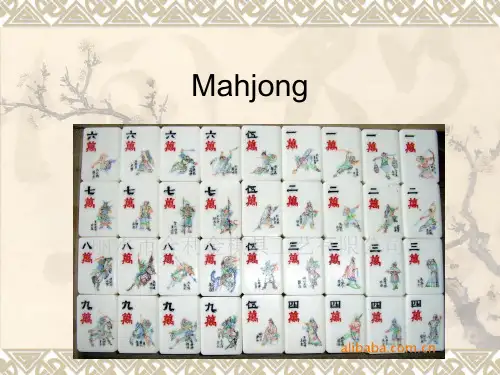
Mahjong involves skill, strategy(策略[‘stræ tidʒi]), and calculation, as well as a certain degree of luck (depending on the variation played, luck can be anything from a minor(不重要的,次要的) to a dominant (占优势的,主导的) factor in winning. In Asia, mahjong is also popularly played as a gambling game. The stakes can be low, to keep the game interesting and competitive, or can be very high resulting in aggressive(好斗的,挑衅的) gambling and some social problems, as poker can be a friendly game or high stakes competition. Played with the right attitude, it is a very enjoyable and addictive(使成瘾的;上瘾的) game.
Mahjong
Introductioe for four players that originated in China.
A Korean variation(变形(物);变种[C]) allows for three players as well as some variations in Japan and Malaysia. It is known as three player mahjong. By far, the most common form of mahjong is that played by no more nor less than four players.
英语演讲稿Mahjong麻将
英语演讲稿Mahjong麻将第一篇:英语演讲稿 Mahjong 麻将The Introduction of Mahjong Good morning,everyone.It is my turn to make the presentation,today my topic is The Introduction of Mahjong.[ma:'dʒɔŋ]As we all known,Mahjong is one of the most popular games in China.Now,Let’s learn more about this fascinating game together.First of all, I want to talk about the the origin of mahjong.From the baidu or other webs ,I find there are different opinions about the origin of mahjong and at the same times I find different places have different names and shapes.But we can be sure that it is originated in ancient China and it is invented by Han nationality long long ago.What’s more,it is turn to introduce the characteristic in general.its shape is usually rectangle and there are different signs on the rectangle,such as ,some are words,some are picture and so on.In addition there are 136 cards in all.The important and complicated things is the playing rule ,no matter from the searching or my own experiences, I know different places have the different rules,even in the same place there are many kinds of the playing rules.But the most palying rule is often depended on the area and the most common form of mahjong is that played by four players.Mahjong involves skill, strategy and calculation, as well as a certain degree of luck.Some peope ,especial the old people spend their time palying the game to enjoy themselves.However,With the development of the internet ,we can paly mahjong by the internet,too.maybe you can have a good time and improve you skills through palying the game when you noting to do.If you want to know more about it.you can paly it.That’s all, thanks foryour listening.第二篇:英语演讲稿 Mahjong 麻将The Introduction of MahjongGood morning,everyone.It is my turn to make the presentation,today my topic is The Introduction of Mahjong.[ma:'dʒɔŋ]As we all known,Mahjong is one of the most popular games in China.Now,Let’s learn more about this fascinating game together.First of all, I want to talk about the the origin of mahjong.From the baidu or other webs ,I find there are different opinions about the origin of mahjong and at the same times I find different places have different names and shapes.But we can be sure that it is originated in ancient China and it is invented by Han nationality long long ago.What’s more,it is turn to introduce the characteristic in general.its shape is usually rectangle and there are different signs on the rectangle,such as ,some are words,some are picture and so on.In addition there are 136 cards in all.The important and complicated things is the playing rule ,no matter from the searching or my own experiences, I know different places have the different rules,even in the same place there are many kinds of the playing rules.But the most palying rule is often depended on the area and the most common form of mahjong is that played by four players.Mahjong involves skill, strategy and calculation, as well as a certain degree of luck.Some peope ,especial the old people spend their time palying the game to enjoy themselves.However, mahjong is also popularly played as a gambling game.With the development of the internet ,we can paly mahjong by the internet,too.maybe you can have a good time and improve you skills through palying the game when younoting to do.If you want to know more about it.you can paly it.That’s all, thanks for your listening.第三篇:麻将心经麻将心经中国乃礼仪之邦,历史文化灿烂而悠久,且历久而弥新。
麻将的英语演讲带翻译
麻将是一种基于牌砖的游戏,起源于19世纪末的中国。该游戏使用144张不同图案、符号和数字装饰的牌砖。游戏通常由四个玩家参与,但也存在适用于三个玩家的变体。游戏的目标是通过组成特定的牌组来得分并最终赢得比赛。在麻将中,技巧和策略的概念至关重要,玩家必须根据自己接收到的牌砖和对手的行动不断调整自己的策略。
Thank you for your attention.
翻译:
麻将 - 一款充满技巧和策略的不朽游戏
最易记住的10个英文单词,不用背就知道!
【导语】学英语的亲们,从⼩就背单词,每天是背了忘,忘了背,但如果让你背以下10个单词呢?相信你们个个是记忆⼥神/男神,你信吗?不信赶快来测测看~以下内容由整理发布,欢迎阅读参考!更多相关讯息请关注!1、衙门:Yamen中⽂解释:衙门,旧时称官署为衙门,古时也常⽤来象征武⼒。
英⽂解释:A yamen was the administrative office and/or residence of a local bureaucrat or mandarin in imperial China. Ayamen can also be any governmental office or body headed by a mandarin, at any level of government: the offices of one the Six Ministries is a yamen, but so is a prefectural magistracy. The term has been widely used in China for centuries, but appeared in English during the Qing dynasty.2、罗盘: Luopan中⽂解释:罗盘,是⽤于风⽔探测的⼯具,理⽓宗派常⽤的操作⼯具。
罗盘主要由位于盘中央的磁针和⼀系列同⼼圆圈组成,每⼀个圆圈都代表着中国古⼈对于宇宙⼤系统中某⼀个层次信息的理解。
英⽂解释:Luopan is a Chinese magnetic compass, also known as a Feng Shui compass. It is used by a Feng Shui consultant to determine the precise direction of a structure or other item. Since the invention of the compass for use in Feng Shui,traditional feng shui has required its use.3、牌楼:Pailou中⽂解释:牌楼也叫牌坊,汉族传统建筑之⼀。
麻将口头禅

麻将口头禅
1、“三七尖,快快颠”
2、牌不好,听对倒
3、成头牌,做二庄,输的净光光
4、上对下自摸,上碰下自摸
5、牌回头必有因
6、二八不招支,招支是边支
7、打孤不打靠,打靠是甩调
8、大杠开花,谢谢大家
9、一上一听,急的要命
10、牌品看人品
11、金三,银七,鬼子六
12、打大不打小,打小是鬼吊
13、三对四对拼命对
14、猴子搓搓热成清一色
15、小糊倒倒,口袋饱饱!
16、门前对,活受罪!
17、坐南朝北,输到天黑
18、进了麻将当,生活有保障
19、家有三五柄,必摸四牛比
20、背靠大门坐,一输输一盆
21、听牌无剩枝
22、三三得九,来了就糗
23、头顶钢凳锅照直往前冲
24、 258打5不涩支
25、不会打打8万
26、输钱怕天亮赢钱怕吃饭
27、头家不打东,成牌也不凶~~
28、”鸡不离西”(打完小鸡必来西)
29、大杠一冒,回家睡觉!
30、有多大做多大,先打缺一,再打缺二
31、小胡倒到,口袋饱饱
32、占头子,心发慌,一圈换一张.
33、扛后开花对不起大家
34、条赢饼输万保米
35南打掉就不难了
36、七对三招一。
美联英语:麻 将词汇
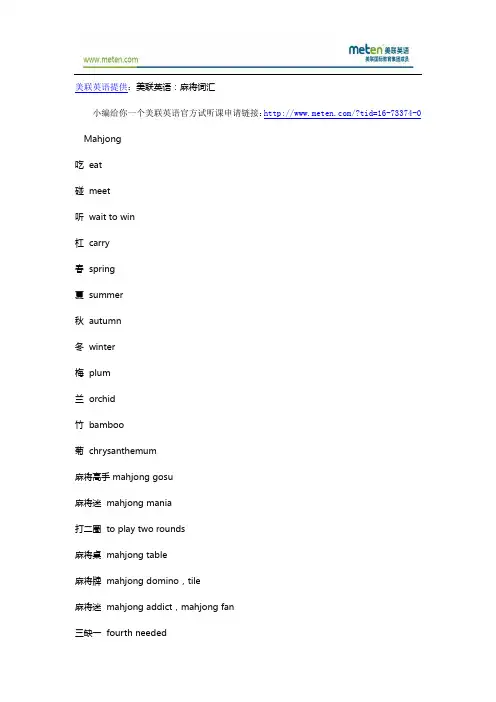
美联英语提供:美联英语:麻将词汇小编给你一个美联英语官方试听课申请链接:/?tid=16-73374-0 Mahjong吃 eat碰 meet听 wait to win杠 carry春 spring夏 summer秋 autumn冬 winter梅 plum兰 orchid竹 bamboo菊 chrysanthemum麻将高手 mahjong gosu麻将迷 mahjong mania打二圈 to play two rounds麻将桌 mahjong table麻将牌 mahjong domino,tile麻将迷 mahjong addict,mahjong fan三缺一 fourth needed方城 arena,Great Wall骰子 dice财神 God Fortune元宝 Gold Bar猫 Cat老鼠 Rat东风 East南风 South西方 West北风 North红中 Red Dragon白板 Blank筒子 circle索子 bamboo万子 words洗牌 shuffle切牌 form抓牌 take跳牌 skip出牌 discard明克 visible three of one kind 暗克 hidden three of one kind明杠 visible four of one kind暗杠 hidden four of one kind七对半 seven pairs and half对对胡 winning by pairs一条龙 a complete sequence清一色 all of the same suit,flush混一色 mixed with one color全字一色 pure characters七对 seven pairs杠头开花 opening a flower on the top (drawing a tile from the end of the wall to win the game)胡 make it我胡了 I make it天和 a natural win; a heavenly hand地和 win after drawing only one tile诈和 declaring a false win自摸winning by one’s own draw做相公 be unconscious of a shortage or surplus of tiles大相公 long hand小相公 short hand底胡 foundamental points计胡 points calculation番 fold筹码 chip大满贯, 辣紫 grand slam单钓 waiting for one of the pair to win单听 waiting for the only one necessary tile to win 连庄 remaining the dealer美联英语:。
麻将英语表达方法汇总
麻将牌麻将:mahjong [ma:'dʒɔŋ]麻将的一张牌:a tile [tail]饼子:the circle/dots tiles条子:the bamboo tiles万子:the character tiles番子:the honor tiles (dragon tiles+wind tiles) 基本术语吃:Chow, claiming a tile to match a sequence碰:Pung, claiming a tile to match a triplet杠:Kong, claiming a tile for a quadruplet和:claiming a tile to win抽头:the kitty筹码:counter; chip; dib边张:side tiles吃张:drawing出张:discarding a tile庄家:dealer上家:opponent on the left下家:opponent on the right对门:opponent sitting opposite to one三缺一:three players looking for one more player跳牌:skipping洗牌:shuffling the tiles连庄:remaining the dealer砌牌:forming the wall of stacks一对:one pair一番:one time (in scoring)一圈:a round跟牌:following suit进张:drawing a useful tile对碰:waiting for two tiles to win; making two pairs扣牌:holding up a tile听牌:waiting for the one necessary tile to win暗杠:drawing a tile by oneself, making four similar tiles of a kind and putting them face down暗坎:concealing 3-tiles in order of a kind八圈:eight rounds of play缺一门:lacking a suit抢杠:robbing a gong单钓:waiting for one of the pair to win单听:awaiting the only one necessary tile to win地和:going out or winning a hand after drawing only one tile吊牌:fishing; awaiting one's winning tile对对胡:winning with all paired tiles;all triplets自摸:winning by one's own draw;self-drawn拦和:be won by one's left or opposing opponent with the same tile one needs 平和:a win without points鸡和:chicken hand平和:common hand大满贯:grand slam杠上开花:drawing a tile, after a gang, from the end of the wall to win the game;added glory to agong七对:seven pairs清一色:all of one suit; flush; having all tiles in one suit全字:pure characters门(前)清:all concealed hand十三幺:the thirteen orphans(1,9,and one of each character);13 terminal tiles 天和:a natural win; a heavenly hand地和:earthly hand一条龙:a complete sequence from 1 to 9混一色:mixed one suit小三元:junior 3 chiefs大三元:grand 3 chiefs海底捞月:catching the moon from the bottom of the sea小四喜:junior 4 happiness大四喜:grand 4 happiness清一色:pure one suit字一色:all honor tiles诈和:declaring a false win;falsely declaring a win做相公:be unconscious of a shortage or surplus of tiles大/小相公:long or short hand或者,直接把这个精简版本给学习起来!↓↓↓老外谈麻将1. One good thing about mahjong is that people don't need to speak fluent Chinese to play the game.麻将的一个好处是在打麻将的时候汉语不需要说得很好。
Mahjong
春:spring 夏:summer 秋:autumn 冬:winter
梅:plum 兰:orchid 竹:bamboo 菊:Chrysanthemum
麻将起源: 麻将起源:
• 说法一:麻雀是起源于宁波。最有意思、最有说服力的证据莫过:麻将 说法一:麻雀是起源于宁波。最有意思、最有说服力的证据莫过: 本作“麻雀” 而宁波话的麻雀正读作“麻将” 雀读作将, 本作“麻雀”,而宁波话的麻雀正读作“麻将”。雀读作将,如同脚读 作将,宁波话瘸子叫拐将、吃剩的菜肴叫碗将等, 都是“ 作将,宁波话瘸子叫拐将、吃剩的菜肴叫碗将等,“将”都是“脚”的 这说明麻雀叫麻将,既是宁波话的特色,又合乎方言音之理。同时, 音。这说明麻雀叫麻将,既是宁波话的特色,又合乎方言音之理。同时, 麻将在日本被称为麻雀牌,宁波(明州)古代是和日本通商的重要口岸, 麻将在日本被称为麻雀牌,宁波(明州)古代是和日本通商的重要口岸, 因此才保留了麻雀的字意,也进一步佐证了麻将起源于宁波。 因此才保留了麻雀的字意,也进一步佐证了麻将起源于宁波。 • 说法二:麻将本是江苏太仓“护粮牌”。有资料记载,在江苏太仓县曾 说法二:麻将本是江苏太仓“护粮牌” 有资料记载, 有皇家的大粮仓,常年囤积稻谷,以供“南粮北调” 有皇家的大粮仓,常年囤积稻谷,以供“南粮北调”。粮多自然雀患频 每年因雀患而损失了不少粮食。 生,每年因雀患而损失了不少粮食。管理粮仓的官吏为了奖励捕雀护粮 便以竹制的筹牌记捕雀数目,凭此发放酬金,这就是太仓的“ 者,便以竹制的筹牌记捕雀数目,凭此发放酬金,这就是太仓的“护粮 这种筹牌上刻着各种符号和数字,既可观赏,又可游戏, 牌”。这种筹牌上刻着各种符号和数字,既可观赏,又可游戏,也可作 兑取奖金的凭证。这种护粮牌,其玩法、 兑取奖金的凭证。这种护粮牌,其玩法、符号和称谓术语无不与捕雀有 例如, 的图案就是火药枪的横截面, 即是枪筒, 关。例如,“筒”的图案就是火药枪的横截面,“筒”即是枪筒,几筒 则表示几支火药枪。 是用细束绳串起来的雀鸟, 则表示几支火药枪。“索”即“束”,是用细束绳串起来的雀鸟,所以 “一索”的图案以鸟代表,几索就是几束鸟,奖金则是按鸟的多少计算 一索”的图案以鸟代表,几索就是几束鸟, 即是赏钱的单位,几万就是赏钱的数目。此外“东南西北” 的。“万”即是赏钱的单位,几万就是赏钱的数目。此外“东南西北” 为风向,故称“ 火药枪射鸟应考虑风向。 为风向,故称“风”,火药枪射鸟应考虑风向。“中、白、发”:“中” 即射中之意,故为红色;“白”即白板,放空炮;“发”即发放赏金, 即射中之意,故为红色; 即白板,放空炮; 即发放赏金, 领赏发财。麻将玩法的术语也与捕雀护粮有关。 领赏发财。麻将玩法的术语也与捕雀护粮有关。如“碰”即“彭”的枪 又如成牌叫“ 谐音, 是一种捕雀的鹰。 声。又如成牌叫“糊”,“糊”和“鹘”谐音,“鹘”是一种捕雀的鹰。 除此还有“ 等术语也与捕鸟有关。 麻将”的原因, 除此还有“吃”、“杠”等术语也与捕鸟有关。叫“麻将”的原因,是 因为在太仓地方方言叫“麻雀” 麻将” 因为在太仓地方方言叫“麻雀”为“麻将”,打麻雀自然也就叫成打麻 将了。然而,在粤语、闽语仍保留打麻雀的称呼。 将了。然而,在粤语、闽语仍保留打麻雀的称呼。
室内游戏的名词解释英文
室内游戏的名词解释英文室内游戏是指在室内环境下进行的各种娱乐活动,可以带给人们无穷的乐趣。
无论是小朋友还是成年人,室内游戏都是一种放松心情、减压的好方式。
下面,让我们来介绍一些室内游戏的常用名词解释英文。
1. Chess(国际象棋)国际象棋是一种室内策略游戏,也是世界上最古老、最广泛传播的游戏之一。
它需要两名对手在棋盘上摆放各自的棋子,并通过移动棋子来攻击对方的王,目标是将对方王困住而取得胜利。
2. Scrabble(拼字游戏)Scrabble是一种以字母为基础的室内游戏,玩家需要将手中的字母瓷砖组合成合法的单词,并将其放在游戏板上,以获得分数。
游戏结束时,分数最高的玩家获胜。
3. Jigsaw Puzzle(拼图游戏)Jigsaw Puzzle是一种室内拼图游戏,玩家需要将分割成各种形状的小块拼接在一起,以还原出完整的图案。
这个游戏对于提高观察能力和空间思维能力非常有帮助。
4. Bingo(宾果游戏)Bingo是一种室内的数字游戏,玩家需要用九宫格的游戏卡片上的数字与主持人报出的数字进行对应。
当玩家成功标出特定模式的数字时,即可获得胜利。
5. Charades(扮演猜谜游戏)Charades是一种室内猜谜游戏,玩家需要通过比划、肢体语言和动作来描述电影、书籍、成语等题目,让其他玩家猜出正确的答案。
6. Card Games(纸牌游戏)Card Games是一类室内纸牌游戏的总称。
常见的纸牌游戏有Poker(扑克牌)、Solitaire(接龙)、Bridge(桥牌)、Rummy(拉米牌)等。
纸牌游戏需要玩家根据规则来组合和出牌,以取得最高的得分或击败对手。
7. Mahjong(麻将)Mahjong是一种室内游戏,起源于中国。
通过组合一定的牌型来获得分数,最终胜利的玩家需要拥有最高的得分。
8. Trivia Games(知识问答游戏)Trivia Games是一类室内知识问答游戏。
玩家需要回答各种类型的问题,包括历史、科学、艺术、娱乐等方面的知识。
麻将英文专业术语
麻将英文专业术语Mahjong: A Captivating Journey Through the World of Tile-Based StrategyMahjong, a centuries-old tile-based game, has captivated players worldwide with its intricate rules, strategic depth, and rich cultural heritage. Originating in China, this ancient pastime has evolved into a global phenomenon, attracting enthusiasts from diverse backgrounds and transcending geographical boundaries. At the heart of this captivating game lies a unique set of specialized terminology, each word and phrase encapsulating the nuances and complexities that make Mahjong a truly remarkable experience.The game's name itself, "Mahjong," is a testament to its Chinese roots, derived from the Cantonese words "ma" meaning "sparrow" and "jong" meaning "bird." This evocative title reflects the game's avian-inspired imagery and the graceful movements of the tiles as they are manipulated on the playing surface. The four suits that comprise the Mahjong tile set – Bamboo, Characters, Circles, and Winds – each hold their own significance, reflecting the game's deep-rooted connection to Chinese culture and philosophy.At the heart of Mahjong lies the concept of "Pung," a trio of identical tiles that form the building blocks of successful hands. The term "Pung" is a direct translation from the Cantonese word "pung," meaning "to press or squeeze." This term aptly captures the strategic importance of these tile groupings, as players must carefully manage and manipulate their Pungs to achieve winning combinations.Closely related to the Pung is the "Chow," a sequence of three consecutive tiles in the same suit. The word "Chow" is derived from the Cantonese term "chau," meaning "to eat or nibble." This terminology evokes the image of a player "consuming" the tiles in a methodical, step-by-step fashion to form their winning hand.Another key element of Mahjong is the "Kong," a set of four identical tiles that represents the pinnacle of tile combinations. The term "Kong" is a direct translation from the Cantonese word "gung," meaning "to expose or reveal." This terminology speaks to the power and significance of this tile grouping, as it often serves as a game-changing move that can dramatically alter the course of a Mahjong session.Interwoven with the tile combinations are the various "Winds" that dictate the flow of the game. The four Winds – East, South, West, and North – hold special significance, with each Wind representing a specific direction and bearing unique strategic implications. The term"Wind" is a direct translation from the Chinese word "fung," reflecting the game's deep-rooted connection to the natural elements and the cyclical nature of the universe.The concept of "Discarding" is another crucial aspect of Mahjong, as players must carefully select and discard tiles to both improve their own hand and prevent opponents from forming winning combinations. The term "Discard" is a direct translation from the Cantonese word "pei," meaning "to throw away or reject." This terminology highlights the importance of strategic tile management and the delicate balance between retaining valuable tiles and letting go of those that no longer serve one's hand.At the pinnacle of Mahjong gameplay is the concept of "Winning" or "Declaring a Hand." The term "Winning" is a direct translation from the Cantonese word "ho," meaning "to complete or succeed." This terminology encapsulates the thrill and satisfaction of achieving a winning hand, a moment of triumph that is celebrated by Mahjong enthusiasts worldwide.Alongside these core gameplay elements, Mahjong also boasts a rich vocabulary of specialized terms that add depth and nuance to the game. From the "Flower Tiles" that represent the four seasons to the "Joker Tiles" that serve as versatile wildcards, each term offers a glimpse into the game's intricate mechanics and the strategicconsiderations that players must navigate.As Mahjong continues to captivate players across the globe, the game's unique terminology serves as a testament to its enduring cultural significance and the depth of its strategic complexities. Each word and phrase, rooted in the rich tapestry of Chinese language and tradition, invites players to immerse themselves in a world of tile-based strategy, where the pursuit of victory is elevated to an art form.。