
动名词、动词不定式、分词作定语区别.
动词的不定式,\分词\.动名词的区别及其用法、搭配。
答:非谓语动词包括动词不定式。
动名词和分词三种形式,分词又包括现在分词和过去分词。
这三种形式都是由动词变来的,但在句子中都不能作谓语,故这三种形式被称为非谓语动词。
下面就这三种形式在用法上的区别浅析如下:
一、动词不定式和动名词在句子中均可作主语和表语
在表示一个具体的。
个别的或将来的动作时,要用动词不定式。
如:
My job is to teach the first-year students grammar.
To study English well is very important.
在表示比较抽象的一般的行为和动作时,二者可以互换。
如:
To climb mountains is a good form of exercise.
Climbing mountains is a good form of exercise.
二、动名词、现在分词和动词不定式都可以作定语
1.动名词作定语时,和它所修饰的名词之间没有逻辑上的主谓关系,只表示被修饰名词的一般用途,必须位于名词之前。
如:
There is a swimming pool in our school.
2.现在分词作定语时,和它所修饰的名词之间有逻辑上的主谓关系,表示所修饰名词的特征。
如:
Listen to the singing bird.
Who is the boy running towards us。
3.动词不定式作定语时,当所修饰的名词指人时,和它所修饰的名词之间有逻辑上的主谓关系。
如:
He is always the first to come to school.
当所修饰的名词指物时,和它所修饰的名词之间有逻辑上的动宾关系。
如:
I have a meeting to attend.
如果作定语的动词不定式中的动词是不及物动词,需加上相应的介词。
如:
I have no room to live in.
There is nothing for me to worry about.
三、动词不定式和分词均可作宾语补足语
动词不定式作宾语补足语时,表示动作已经发生,动作的全过程已经结束。
如:
I heard him knock at the door three times.(=I heard he knocked at the door three times (动作的全过程已经结束)
现在分词作宾语补足语时,表示动作正在进行。
如:
I heard him knocking at the door.(= I heard he was knocking at the door.(动作正在进行)
过去分词也可以作宾语补足语。
如:
I found the glass broken.(= I found the glass was broken.)
注意:动词不定式作宾语补足语时,在动词make,let,have,see,notice,hear,watch, observe,feel,listen to等后面要省略不定式符号to。
如:
I hear him play.
The teacher made him do the exercises again.
help后的动词不定式作宾语补足语时,不定式符号to可加可不加。
如:
He often helps me to study English in his spare time.
当这些动词变为被动语态时,原不定式必须加上to。
如:
He was seen to repair the machine.
四、动词不定式和动名词均可作宾语
1.下列动词后只能跟不定式作宾语: hope, agree, decide, manage, wish, refuse, dare, promise等。
如:
He has promised to lend me the dictionary.
2.下列动词后只能跟动名词作宾语: enjoy, finish, avoid, practise, mind, escape, excuse, suggest, consider(考虑), give up, can't help等。
如:
He wants to give up smoking.
They practise speaking English every day.
3.在动词remember,forget,regret,stop,try等后面跟动词不定式或动名词时,意义上有所差别。
如:
He forgot telling me the news.他忘了曾经告诉过我这个消息。
He forgot to tell me the news.他忘了要把这个消息告诉我。
五、动词不定式和分词均可作状语
不定式作状语通常表示"目的"或"程度";分词作状语通常表示"伴随情况"。
"时间"或"原因"等。
如:
He went to the library to borrow a book (表目的)
The boy sat at the desk reading a book.(表伴随情况)
六、动词不定式和动名词均有复合结构
不定式的复合结构:for sb.(not) to do sth.
动名词的复合结构:名词所有格或形容词性物主代词+动名词。
如:
It's important for us to learn English well.
He prided himself upon his dancing.。
不定式、动名词、过去分词 作定语的用法
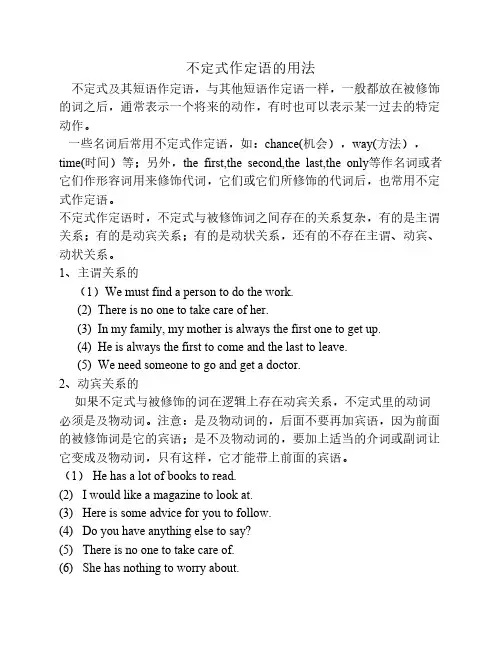
不定式作定语的用法不定式及其短语作定语,与其他短语作定语一样,一般都放在被修饰的词之后,通常表示一个将来的动作,有时也可以表示某一过去的特定动作。
一些名词后常用不定式作定语,如:chance(机会),way(方法),time(时间)等;另外,the first,the second,the last,the only等作名词或者它们作形容词用来修饰代词,它们或它们所修饰的代词后,也常用不定式作定语。
不定式作定语时,不定式与被修饰词之间存在的关系复杂,有的是主谓关系;有的是动宾关系;有的是动状关系,还有的不存在主谓、动宾、动状关系。
1、主谓关系的(1)We must find a person to do the work.(2) There is no one to take care of her.(3) In my family, my mother is always the first one to get up.(4) He is always the first to come and the last to leave.(5) We need someone to go and get a doctor.2、动宾关系的如果不定式与被修饰的词在逻辑上存在动宾关系,不定式里的动词必须是及物动词。
注意:是及物动词的,后面不要再加宾语,因为前面的被修饰词是它的宾语;是不及物动词的,要加上适当的介词或副词让它变成及物动词,只有这样,它才能带上前面的宾语。
(1) He has a lot of books to read.(2) I would like a magazine to look at.(3) Here is some advice for you to follow.(4) Do you have anything else to say?(5) There is no one to take care of.(6) She has nothing to worry about.3、动状关系的被修饰词如果是不定式里动词的状语,应多用介词短语。
不定式,动名词,分词

表语 Don’t touch the glass because it is broken. 定语 The excited people rushed into the building. 状语 Seen from the top of the hill, the city looked like a big garden. 补足语 When you are making a speech, you should speak louder to make yourself heard.
9. 分词 9.1 分词作定语
分词前置 如: We can see the rising sun. 我们可以看到东升的旭日 He is a retired worker. 他是位退休的工人 分词后置 (i分词词组;ii 个别分词如given, left; iii 修饰不定代词 something等) 如: There was a girl sitting there. 有个女孩坐在那里 This is the question given. 这是所给的问题 There is nothing interesting. 没有有趣的东西
过去分词作定语 与其修饰的词是被动关系,相当 于一个被动语态的定语从句。 如: Most of the people invited to the party were famous scientists.
典型例题
1) The first textbook ___ for teaching English as a D foreign language came out in the 16th century. A. have written B. to be written C. being written D. written 答案D. 书与写作是被动关系,应用过去分词做定 语表被动,相当于定语从句 which is written
不定式、分词、动名词差别

高中英语:不定式、分词、动名词1. 动名词与不定式的区别动名词起名词作用,在句子中可以作主语、宾语、表语、定语、主语补足语、宾语补足语。
不定式起名词、形容词、副词作用,在句子中除了动名词所起的作用外,还可以作状语。
但两者之间也有差别:(1)不定式的逻辑主语必须与主语一致,而动名词的逻辑主语范围较大,它可以指主语,也可以是泛指。
如:I hate to work on weekends . 我讨厌周末干活。
(指自己干活)。
I hate working on weekends . 我讨厌周末干活。
(可以指自己,也可以泛指)(2)动名词多指抽象的、概念性的动作,可以是多次的、经常的行为,不定式多表示具体的动作,尤其是某一次的动作。
如:Reading in bed is a pleasure .I like swimming but I don’t like to swim in the pool today .我喜欢游泳,但是今天我不喜欢在游泳池里游泳。
Talking for hours at a stretch is more exhausting than you seem to think .一连讲几个小时的话会比你想像的似乎要累。
(泛指讲话)To talk for hours at a stretch is more exhausting than you seem to think .一连讲几个小时的话可比你想像的似乎要累。
(指个人的感受)(3)在某些动词之后只能用动名词,而另一些动词之后只能用不定式。
后接动名词的动词有:admit,avoid,consider,defer,delay,deny,dislike,enjoy,escape,fancy,finish,imagine,include,keep,mind,miss,postpone,practise,recall,recollect,resent,resist,risk,stop,suggest等;短语动词有have done,give up等。
不定式、动名词、过去分词作定语的用法

不定式作定语的用法不定式及其短语作定语,与其他短语作定语一样,一般都放在被修饰的词之后,通常表示一个将来的动作,有时也可以表示某一过去的特定动作。
一些名词后常用不定式作定语,如:chance(机会),way(方法),time(时间)等;另外,the first,the second,the last,the only等作名词或者它们作形容词用来修饰代词,它们或它们所修饰的代词后,也常用不定式作定语。
不定式作定语时,不定式与被修饰词之间存在的关系复杂,有的是主谓关系;有的是动宾关系;有的是动状关系,还有的不存在主谓、动宾、动状关系。
1、主谓关系的(1)We must find a person to do the work.(2) There is no one to take care of her.(3) In my family, my mother is always the first one to get up.(4) He is always the first to come and the last to leave.(5) We need someone to go and get a doctor.2、动宾关系的如果不定式与被修饰的词在逻辑上存在动宾关系,不定式里的动词必须是及物动词。
注意:是及物动词的,后面不要再加宾语,因为前面的被修饰词是它的宾语;是不及物动词的,要加上适当的介词或副词让它变成及物动词,只有这样,它才能带上前面的宾语。
(1)He has a lot of books to read.(2) I would like a magazine to look at.(3) Here is some advice for you to follow. (4) Do you have anything else to say?(5) There is no one to take care of.(6) She has nothing to worry about.3、动状关系的被修饰词如果是不定式里动词的状语,应多用介词短语。
分词,动名词,不定式三者的用法有什么区别

以下是我的解答,虽然有点啰嗦,希望你能喜欢,也希望你的英语越学越好。
谢谢英语中,非限定动词也叫非谓语动词,也就是不定式、分词和动名词。
顾名思义,不定式、分词和动名词在英语句子中是不能做作谓语的。
非谓语动词虽然不能在句子中作谓语,但由于它们本身具有动词的一些特征,它们在句子中的运用是非常活跃的。
他们之间的用法既有共同点,又有一定的区别,是历年高考必考的语法项目,例如NMET2005年单项填空题(全国卷)中就有这样一题:32,The storm left, ________ a lot of damage to this area.A. causedB. to have causedC. to causedD. having caused根据题意,本题应选D------分词作状语,表示结果。
如何正确地运用好非谓语动词,是许多学生普遍感到棘手的问题,本文将就不定式、分词和动名词的词性特征和句法功能等方面进行比较,帮助学生正确地运用好非谓语动词。
一、基本形式a.不定式的基本形式是“小品词to﹢动词原形” 即to﹢v. ;但有时也可省去to, 即:(to) ﹢v.。
b.分词有两种基本形式:现在分词(the present participle)和过去分词(the past participle)。
①现在分词的基本形式是动词的—ing形式,如,writing, doing ,working ,going, etc.②过去分词的基本形式是:a) 规则动词﹢ed, 即v.-ed, 如,visit→visited ,ask→asked ,dig→digged ,etc; b) 不规则动词有其自身的过去式和过去分词,学生需要用心熟记,方能正确使用。
如,go→went→gone; do→did→done, etc .c.动名词的基本形式与现在分词的基本形式相同,都是动词的—ing 形式,如,doing ,wr iting ,doing ,etc .二、时态、语态及其基本用法A. 不定式1.不定式的时态、语态有三种形式:①一般式,如,to write / to be written ;②进行式,如,to be writing / to have been writing;③完成式,如,to have written / to have been w ritten 。
不定式,动名词和分词的区别

不定式和动名词作主语区别1.含义上的不同。
不定式一般表示特定的,具体的行为,特别是表示将来的,或一次性的行为。
如:To write a new book about medicine is his wish. 写一部医学方面的新书是他的愿望。
(将来的动作) It took me two hours to finish this work today. (表示一次性的动作)动名词表示一般的事实Raising pigs is her job. 养猪是她的工作。
2. 结构上的不同。
在一些固定的句子中动名词It’s no use doing It is useless doing 做……无用It’s no good doing It’s no help doing 做……无用,无益There be 句型 There is no joking about such matter.不定式It isn’t easy to do I have no time to do不定式复合结构 It is + adj.+ of/for sb + to do It is very kind of you to help me.代词+不定式结构 Mary’s coming late made him angry.疑问词+不定式 Where to hold the meeting has not been decided.It’s time for sb to do3. 主语和表语同时使用要一致To live is to learn.Reading is learning.不定式、动名词和分词作表语区别1.动名词和不定式相当于一个名词,分词相当于一个形容词。
2.不定式、动名词与分词作表语的区别。
不定式和动名词作表语相当于一个名词作表语,含义是回答主语“是什么”;分词作表语相当于形容词作表语,含义是回答主语“怎么样”。
如:① Our plan is to keep the affair secret. 我们的计划是让这件事成为秘密。
怎么找非谓语动词讲解
怎么找非谓语动词讲解非谓语动词是指动词的非谓语形式,不受动词的时态和人称的限制,通常用来作状语、定语和补语。
下面是关于非谓语动词的讲解和相关参考内容。
一、非谓语动词的种类及形式:非谓语动词包括动名词、不定式和分词三种形式。
1. 动名词:动名词的构成是动词原形+ing。
它可以作主语、宾语、定语、状语和补语等。
例如:- Smoking is harmful to your health. (作主语)- I enjoy swimming in the sea. (作宾语)- Do you mind me using your computer? (作定语)- He left home without saying goodbye. (作状语)- His dream is becoming a pilot. (作补语)2. 不定式:不定式的构成是“to + 动词原形”。
它可以作主语、宾语、定语、状语和补语等。
例如:- To travel around the world is my dream. (作主语)- She wants to be a doctor when she grows up. (作宾语)- I have a lot of books to read. (作定语)- He studied hard to pass the exam. (作状语)- His wish is to become a famous singer. (作补语)3. 分词:分词分为现在分词和过去分词两种形式。
现在分词的构成是动词原形+ing,过去分词的构成有规律变化和不规律变化两种。
分词可以作定语、状语和补语等。
例如:- The smiling girl is my sister. (作定语)- Walking in the park, he met an old friend. (作状语)- I saw a broken window in the house. (作定语)- She was surprised to see her name on the list. (作补语)二、如何找非谓语动词:1. 看句子结构:非谓语动词通常出现在句子的其他成分之前或之后,根据句子结构找出动名词、不定式或分词的形式。
动词的非谓语形式有三种不定式动名和分词
注①
admit,appreciate,avoid,consider, delay, dislike,enjoy,escape, excuse,face,feel like,finish,forgive,give up, imagine,include,keep,mention,mind,miss,practise,put off,resist, risk,suggest,can’t help,can’t stand(无法忍受)等动词后可以用动名词作宾语,但不能用不定式.
2
动名词的复合结构同由
物主代词
人称代词宾格 +动名词 构成
名词所有格
普通格加
2
2.动名词的复合结构
句子开头必须用名词所有格或物主代词.
例如: His coming made me very happy. Mary’s crying annoyed him. She didn't mind his crying. Is there any hope for Xiao Wang’s winning?
但在 It is no use/ good,not any use/ good,useless /there is no …等后必须用动名词。 例如:
01
02
2)作表语.
例如: Her job is teaching.
He is fond of playing football.
01
I like swimming.
I must remember to do it. (我必须记着做这事.) I tried not to go there. (我没法不去那里. He stopped to talk. (他停下来讲话.) I mean to come early today. (我打算今早些来.)
动名词和分词与动词不定式用法比较
第六讲:动名词和分词与动词不定式用法比较英语中的不定式、动名词和分词(现在分词和过去分词)在句中不能充当谓语,故被称为非谓语动词。
它们都有否定式、被动式和完成式。
否定词not, never总放在它们之前,被动式及完成式见下表:一般式现在式完成式完成进行式其中,动名词还可以被代词及名词所有格修饰,构成动名词的复合结构。
这种代词和名词所有格充当动名词的逻辑主语。
to havebeenkeeping\\\\\to havekeptto havekeepingto keep主动不定式被动to bekeptto havebeingkept\\having kept主动keeping动名词被动being kept主动keeping分词被动being kepthaving beenkepthaving kepthaving beenkept\\\-------His anxiety doesn't justify his being so rude to his mother.他的焦虑不是他对母亲这么粗鲁的理由。
-------The father was angry at his son's spending money like water.父亲对儿子的花钱如流水感到愤怒。
在口语或非正式语体中,也可用宾格代替代词和名词的所有格。
故上面两句可改为:-------His anxiety doesn't justify him being so rude to his mother.-------The father was angry at his son spending money like water.1.作主语(1)动名词和不定式都可充当主语,意义上一般区别不大。
-------Seeing is believing.和To see is to believe.都意为:百闻不如一见。
动名词和分词与动词不定式用法比较
第六讲:动名词和分词与动词不定式用法比较英语中的不定式、动名词和分词(此刻分词和过去分词)在句中不可以充任谓语,故被称为非谓语动词。
它们都有否认式、被动式和达成式。
否认词 not, never 总放在它们以前,被动式及达成式见下表:一般式此刻式达成式达成进行式此中,动名词还能够被代词及名词全部格修饰,组成动名词的复合构造。
这类代词和名词全部格充任动名词的逻辑主语。
to havebeenkeeping\\\\\to havekeptto havekeepingto keep主动不定式被动to bekeptto havebeingkept\\having kept主动keeping 动名词被动being kept 主动keeping 分词被动 being kepthaving beenkepthaving kepthaving beenkept\\\-------His anxiety doesn't justify his being so rude to his mother.他的忧虑不是他对母亲这么鲁莽的原由。
-------The father was angry at his son's spending money like water父.亲对儿子的花费如流水感觉愤慨。
在口语或非正式语体中,也可用宾格取代代词和名词的全部格。
故上边两句可改为:-------His anxiety doesn't justify him being so rude to his mother.-------The father was angry at his son spending money like water.1.作主语(1)动名词和不定式都可充任主语,意义上一般差异不大。
-------Seeing is believing和. To see is to believe都.意为:百闻不如一见。