
牛津译林版英语九上9A Unit7 Films
9A Unit7 FilmsPeriod6(Task&Self-assessment)一、词组翻译1.一位富有经验的女演员____________ 2.扮演坚强的中国女性________________ 3.被认为是…______________________ 4.获得几项国际大奖__________________ 5.对…感到很兴奋__________________ 6.在演技方面富有经验________________ 7.上演员培训班课程________________ 8.访问有关好莱坞的网页______________ 9.看电影评论______________________ 10.把伞忘记在电影院_________________ 二、单词拼写1.Smoking has a bad___________(作用)on health.2.____________(无论如何),I will do as you said.3.He is good at drawing,singing,writing,he has many kinds of_________(才干) 4.He has acted for more than 40 years,so he an____________(有经验的)actor.5.After they watched the film,the cinema was quiet,and people kept in__________(寂静) 6.Lei Feng is____________(被认为)as a model of good behaviour.7.When children were young,all of them are__________(天使)in their parents’eyes.8.My father__________(坚持)that I should go to the best school to study.9.Mr.Green put a lot of_________(努力)into arranging the concert.10.Audrey passed away,_________(安宁地),in her sleep.三、用括号内所给单词的适当形式填空1. When I got to the supermarket, the beef_______ (sell) out.2. His brother said that she_______ never_______ (see) a science fiction film before.3. She plays the role of strong Chinese women very_______ (good).4. He has spent many years_______ (do) charity work.5. Shang Hai Noon made him even (popular).6. I think this is the_______ (suit) clothes for you in this shop.7. The story_______ (it) is very interesting and attractive.8. What do you think about_______ (fight) in action films? .9. My poor dog_______ (die) when the vet arrived.10. You have to_______ (keep) quiet while watching the film四、单项填空( )1. -I don't know where to go this summer vacation-Why not_______ visiting Huanggang? There are many places of interest thereA suggest B. wonder C. consider D. regard( )2. Do you know when the Jackie Chan Charitable Foundation_______?A. will be set upB. set upC. was set upD. sets up( )3. _______ you_______ she has to attend the ceremony.A. Both; andB. Not only; but alsoC. Neither; orD. Either; nor( )4. _______ of my parents_______ my uncle are from Yancheng.A. Both; andB. Not only; but alsoC. Neither; orD. Either; nor( )5. -Tell us something about Canada, OK?-I'm sorry. _______ Jack_______ I have ever been there.A. Either; orB. Not only; but alsoC. Both; andD. Neither; nor五、完形填空Marie Curie was a great scientist. She was born in Warsaw, Poland, in 1867. 1 of her parents were teachers. 2 Marie was only 10 years old, her mother died.Young Marie was a very good student. She loved science, math, and languages. She and her sister Bronya wanted to go to college. 3 in those days, only men could go to college in Poland. The girls had to go to France to study. There was not enough money for both sisters to go. So Marie worked 4 a teacher in Poland. She sent money to Bronya to 5 medical school in Paris. After Bronya became a doctor, she helped Marie.When she was 24, Marie became a science student at the Sorbonne, a university in Paris. Even with her sister's help, she did not have much money. She lived in a small room near the college. It had no lights, no water, and no heat. 6 Marie only had bread and tea to eat.Marie studied hard and graduated in 1894. A year later, she 7 Pierre Curie. He was also a scientist. They worked together for many years. Their most important discovery was radium(镭). Today, doctors use the rays from radium to treat cancer. The Curies won a Nobel Prize for their discovery. This is the highest award for a scientist. Marie Curie was the first woman 8 this award.When Marie Curie was 39, Pierre died in a street accident. But she 9 their work. Curie became the first woman professor in France. In 1911, she won a second Nobel Prize. But years of working with radium ruined her health. She 10 cancer in 1934. Her daughter Irene continued Curie's work. She also received a Nobel Prize. Sadly, Irene also got cancer and died young. Both women gave their lives for their work.( )1. A Neither B. Either C. Both D. Al1( )2. A. While B. When C. Since D. As( )3. A However B. And C. So D. But( )4. A as B. for C. by D. with( )5. A. pay B. spend C. give D. pay for( )6. A. Sometime B. Sometimes C. Some time D. Some times( )7. A. married to B. married withC. marriedD. got married with( )8. A. to present B. to receive C. to presenting D. to receiving( )9. A. went on B. continued C. went on to D. continued with( )10. A. died out B. died upon C. died of D. died away六、阅读理解Do you know what Oscar is? When did it start? Maybe you can find the background of the awards in the following passage.The awards started in 1929. Their full title is “The Academy(学会) of Motion Picture Arts and Sciences Awards”. The Academy is a group of people who have worked in the film industry for many years. They decide who will receive the awards. The awards are often referred to as the “Oscar”. This is a nickname(绰号) given to the awards by a lady called Margaret Herrick. She was once the director(会长,院长) of the Academy and she once said that the little gold statuereminded her of her uncle Oscar!The Oscar is always an exciting event. Each year, at least one unusual thing happens. When the Italian actor and director Roberto Benigni won an Oscar for best foreign film, he danced on stage! When Gwyneth Paltrow, the star of Shakespeare in Love won the Oscar for best actress, she could not make her acceptance speech because she was crying so much with happiness!In 1987, Roberto Benigni won the award for bestdirector for a film about the last emperor of China. Since then,Chinese film and actors have started to make an impact at theaward. Crouching Tiger, Hidden Dragon(《卧虎藏龙》)wasa huge success and it won the award for best foreignlanguage film in 2001. It also won several technical awardsfor its amazing “flying” people. We expect to see moreawards for Chinese film in the near future.It’s time for the Oscar again. Once more, the stars will dress up in their finest and go to Kodar Theater. There, they will find out who had won the awards for best actor, best actress and best director. Millions of people watch the awards every year to find out who the winners are. Some people watch it to see the stars crying and laughing as they receive their awards.( )1. Who give the awards?A. In 1927.B. The Academy of Nicknames.C. Oscar.D. A group of people who have worked in the film industry for many years. ( )2. What did Gwyneth Paltrow win an Oscar for?A. Best Director.B. Best Foreign Film.C. Best Actress.D. Best Actor.( )3. Which Chinese film won an award for best foreign film?A. Crouching Dragon, Hidden Tiger.B. Crouching and Hidden Dragon and Tiger.C. Crouching Tiger, Hidden Dragon.D. Crouching, Dragon, Hiding Tiger.( )4. Where are the Oscars held?A. At the Academy.B. in a Los Angeles restaurant.C. At Oscar’s house.D. At Kodar Theater.( )5. Why do some people watch Oscars?A. To see the restaurant.B. To see the fashion.C. To see a film.D. To see the stars crying and laughing.七、句子翻译1.在MH370航班上,数以百计的人失去了生命,包括两个婴儿。
牛津译林版英语九年级上册Unit7《Films.》说课稿1

牛津译林版英语九年级上册 Unit 7 《Films.》说课稿1一. 教材分析《牛津译林版英语九年级上册Unit 7 Films》是一篇关于电影话题的阅读文章。
本节课的主要内容是通过介绍不同的电影类型,让学生了解并掌握与电影相关的词汇和表达方式,同时提高学生的阅读理解能力和听说技能。
教材内容丰富,话题贴近学生生活,能够激发学生的学习兴趣。
二. 学情分析九年级的学生已经具备了一定的英语基础,对于日常生活中常见的事物和话题有一定的了解。
但是,他们的英语听说能力还有待提高,特别是在阅读理解方面。
此外,学生的学习兴趣和动机对于英语学习的效果有很大影响,因此在教学过程中需要注重激发学生的学习兴趣。
三. 说教学目标1.知识目标:学生能够掌握与电影相关的词汇和表达方式,如actor,actress, director, genre等。
2.能力目标:学生能够提高阅读理解能力,能够快速捕捉文章中的主要信息。
3.情感目标:学生能够培养对英语学习的兴趣,增强自信心。
四. 说教学重难点1.重点:学生能够掌握与电影相关的词汇和表达方式。
2.难点:学生能够提高阅读理解能力,能够快速捕捉文章中的主要信息。
五. 说教学方法与手段本节课采用任务型教学法,通过小组合作、讨论和展示等方式,激发学生的学习兴趣,提高学生的参与度。
同时,利用多媒体教学手段,如电影片段、图片等,帮助学生更好地理解和记忆课文内容。
六. 说教学过程1.导入:教师通过提问学生喜欢的电影类型,激发学生的学习兴趣,并引入本节课的话题。
2.阅读理解:学生阅读课文,回答相关问题,教师引导学生进行思考和讨论。
3.词汇学习:教师引导学生学习课文中的新词汇,并通过例句和练习帮助学生巩固。
4.听说训练:教师播放电影片段,学生进行听力练习,并模仿对话进行口语表达。
5.小组活动:学生分组讨论,选择一部自己喜欢的电影,并用英语介绍电影的主要内容和特点。
6.展示和评价:每组学生进行展示,其他学生进行评价,教师给予鼓励和建议。
牛津译林版英语九上9aunit7filmsintegrateskills公开课课件(26张ppt)
While-listening:listenandfillintheblanks
TalesofOldBeijing
Typeoffilm:a(1)__________documentary 3-hour
thatshowsyouwhatBeijingwaslike
manyyears (2)__________________ago. OlympicCinema Nameofcinema:(3)__________________on OlympicRoad (4)___________________________ Story:afamilythat(5) ________________________________ oncelivedinahutong
Unit7
Integratedskills
FILMFESTIVAL
晓店中学程燕
BeijingInternationalFilmFestival 北京国际电影节
cartoon
actionfilm
horrorfilm
western
documentary
romanticfilm
sciencefictionfilm
comedy
SunshineTownFilmFestival
ReadtheCinemaGuidetose ewhatison.(A1P101)
Before-listening:Readandanswer
TheWorldofDi nosaurs
TalesofOldBeijin
LoveShip
FilmFestivalCinemaGuide
travels(15)____________,butwhentheystartt onaship o(16)_________________together,something terriblehappens. plantheirfuture
牛津译林版九年级上册Unit 7《Films》(Grammar)教学设计
牛津译林版九年级上册Unit 7《Films》(Grammar)教学设计一. 教材分析《Films》是人教版牛津译林英语九年级上册Unit 7的一篇课文,主要介绍了电影的发展历程、电影类型及人们喜欢的电影类型。
通过本文的学习,学生可以了解电影历史和电影类型方面的知识,提高英语阅读能力,同时培养学生的听说能力和语言运用能力。
二. 学情分析九年级的学生已经具备了一定的英语基础,对于日常生活中的事物和现象有了一定的认识。
但他们在英语阅读和听说方面还存在一定的困难,需要通过教师的引导和帮助,提高他们的英语运用能力。
三. 教学目标1.知识目标:学生能够掌握电影的发展历程、电影类型及人们喜欢的电影类型相关的词汇和表达方式。
2.能力目标:学生能够提高英语阅读能力,培养听说能力和语言运用能力。
3.情感目标:学生能够激发对电影的兴趣,提高对英语学习的热情。
四. 教学重难点1.重点:电影发展历程、电影类型及人们喜欢的电影类型的相关词汇和表达方式。
2.难点:对文本深层含义的理解,以及语言运用能力的培养。
五. 教学方法1.任务型教学法:通过设定各种任务,让学生在完成任务的过程中,掌握知识,提高能力。
2.情境教学法:创设各种情境,让学生在真实的语言环境中学习,提高语言运用能力。
3.合作学习法:鼓励学生分组讨论,共同完成学习任务,培养团队协作能力。
六. 教学准备1.教师准备:备好相关电影资料,制作PPT,准备教学用具。
2.学生准备:预习课文,了解电影相关知识。
七. 教学过程1.导入(5分钟)教师通过提问方式引导学生谈论他们喜欢的电影类型,激发学生的学习兴趣。
例如:“What’s your favorite film genre? Why?”2.呈现(10分钟)教师通过PPT展示电影的发展历程和电影类型,让学生对电影有更直观的了解。
同时,教师引导学生跟读相关词汇和表达方式,如:“silent film”,“cartoon”等。
新版牛津译林9AUnit7Films短语归纳

精心整理9AUnit7Films知识点Welcometotheunit1.Youareverylucky你很幸运(be+形容词)(luckn.–lucky幸运的–luckily幸运地)2.Inyourdream你做梦,你妄想(n/v.dream)stopdaydreaming.停止做白日梦梦想某物dreamof/aboutsth.梦想做某事dreamtodorealizeyourdream实现你的梦想3.I’msogoodthatIshouldbeinHolleywoodinstead.我是如此的优秀以至于相反我应该是在好莱坞(1)如此。
以至于(某人可以做/不能做)。
so+形容词/副词+that(2)如此…的一个…以至于(某人可以做/不能做==== so+adj.+a/an+名词:suchanimportantjob=soimportantajob如此重要的工作(3)如此。
以致。
such+名词短语+that…..suchgoodnews对的sogoodnews错的如此好的消息注意:(4)如此多/少so+many/much/littlefew….+名词4.Whodoyouthinkwouldbesuitableforenteringthefilmindustry?感到悲伤19.Because,tohimself,sheisanangel.因为,对他自己来说,她是一个天使20.Jack’sachievementswentbeyondthefilmindustry.杰克的成就超越了电影行业gobeyond超越/出...(achievev.取得—achievementn.成就可数)21.Shebegantoworkforthiscompanyinthe1990s.她在20世纪90年代开始为这家公司工作22.Shespentherlastfewyearsworkingcloselywithherworkmates.她花了她的最后几年与她的同事密切合作spend....doingsth花时间/金钱做某事workcloselywithsb与某人密切合作23,.Hegotupearlysothathecouldcatchtheearlybus.他起得早以便他能赶上早班车....sothatsbcan/coulddo...===....inordertodo...以便某人能做...sothatsbcan’t/couldn’tdo...===....inordernottodo...以便某人不能做24.Shewonmanyawardsbecauseofhereffortsinthisarea她因为在这个领域的努力获得了许多奖putone’seffortintosth(effort精力不可数)将某人精力投入到…makeeffortstodosth(effort努力可数名词)努力做某事25.ColombodiscoveredAmericain1492.哥伦布在1492年发现了新大陆(第一次/重大发现)26.Shepassedawaypeacefullyinhersleep,shediedofcancer.精心整理她在睡梦中平静地离开了人世,她死于癌症.inpeace--peacefully27.Shehasanattractivequality.一个有吸引力的城市28.gopast经过walkpast走过29.becomeworld-famous..变得出名befamous/well-knownfor…因...出名befamous/well-knownas…作为…出名It’swell-knownthat…...是众所周知的....It’sunknownthat…是不为人知的.Grammar1.keepquiet/silent保持安静(quietadj.—quietlyadv.)Bequiet!安静quietly静静地dosthquietly2.为了避开高峰期我早早离开了Ileftearlytoavoidtherushhour.avoidsth./avoiddoingsth.避免做某事交通高峰期rushhour3.inthelastrowinthecorner在角落中的最后一排atthecorner在拐角4.Peoplekeptcomingin,thoughthefilmhadalreadybeenonfor15minutes.人们一直进入,尽管电影已经放映15分钟了keepdoingsth一直做某事keepsthfor+时间保留/借某物...时间过去完成时的结构:主语+had+过去分词(前提条件是在过去动作就已经发生,是过去的过去)5.Peopleweretalkingloudly.人们(过去)正在在大声谈论(过去进行时---在过去某个具体时间内正在做的事情)6.Theyweretoldtokeepquiet.他们被告知保持安静.Tellsb(not)todosth告诉某人(不要)去做某事tell--told--told告诉/讲述tellstories讲故事do,?doesso表示“也Wehaven’tseenhimforalongtime,neitherhasshe.Youneedn’tstayhere,neither/norneedI你不需要呆在这里,我也不需要呆在这里事同人也同,不倒装,MaYunistherichestmaninChinanow,soheis.马云现在是中国最富有的人,他确实是的LiNaannouncedtoretirelastmonth,soshedid.李娜上个月宣布退役了,她确实宣布退役了14.成龙被很多人看成一个巨星JackieChanisconsideredbymanypeopleasasuperstar(1)把…看做consider…as(2)把…看做consider…tobe(3)考虑做某事considerdoingsth.(4)consider+that从句15.Thatfilmmadeherevenmorepopular.那部电影使得她更加受欢迎.even,much比较级,quite,very(so,as,too)用原级mucheasier更加容易quiteeasysoeasytooeasy9AUnit7Films短语Comics&Welcometotheunit1.inyourdreams你做梦,你妄想2.Tomorrow’sTVsuperstar明日电视超级明星3.anactionfilm一部动作片4.likehorrorfilms喜欢恐怖片5.anumberofromanticfilms大量的爱情片6.watchasciencefictionfilm看科幻片7.besuitablefordoingsth.适合做某事8.enterthefilmindustry 进入电影业9.so…that…/such…that…如此……以致……10.suchagoodstoryteller如此棒的一个故事讲述者11.writeexcitingscripts写很棒的剧本12.inthefilmindustry在电影界13.likeacting喜欢表演14.wouldratherbeadirector想做个导演Reading15.oneofHollywood’sall-timegreatestactresses好莱坞最34.wintheOscarforBestActressfor…因…获得奥斯卡最佳58.introduceChinesekungfutosb.向某人介绍中国功夫59.actverywellinthefilm.在那部电影中表演得非常好(act不及物动词)60.berememberedass被作为某人记住61.attendacourseon…参加一个关于...的课程62.throughoutone’sactingyears在某人的演艺生涯中63.one’sfavouriteactorinChineseactionfilms在中国动作片里某人最喜欢的演员Integratedskills荧屏70.aspecialoffer特价71.offeraspecialoffertosb给某人提供一个特价72.canceltheorder取消预订73.NeitherdoI.我也不。
牛津译林版九年级上册Unit7《Films》(Integratedskills)说课稿

牛津译林版九年级上册Unit 7《Films》(Integrated skills)说课稿一. 教材分析《牛津译林版九年级上册Unit 7 Films》是一篇以电影为主题的文章,通过介绍不同类型的电影以及电影明星,让学生了解和掌握与电影相关的词汇和表达方式。
此单元的学习旨在提高学生的英语听说读写能力,培养他们对文化差异的认识和理解。
二. 学情分析九年级的学生已经具备一定的英语基础,对于日常生活中的词汇和简单语法结构已有了解。
但他们在阅读理解、词汇运用以及口语表达方面仍有待提高。
此外,学生的学习兴趣和积极性也是影响教学效果的重要因素。
三. 说教学目标1.知识目标:学生能掌握与电影相关的词汇和表达方式,如actor,actress, director, comedy, action等。
2.能力目标:学生能听懂、说出一部电影的基本信息,如类型、主演、导演等。
3.情感目标:培养学生对电影的兴趣,提高他们欣赏电影的能力。
四. 说教学重难点1.重点:学生能熟练运用本单元所学词汇和表达方式进行口语交流。
2.难点:学生能准确理解文章中关于电影文化的描述,提高阅读理解能力。
五. 说教学方法与手段1.交际法:通过小组讨论、角色扮演等形式,让学生在实际语境中运用所学知识。
2.情境教学法:创设电影相关的情境,激发学生的学习兴趣。
3.任务型教学法:引导学生参与看电影、介绍电影等活动,提高他们的实践能力。
六. 说教学过程1.导入:教师展示电影相关图片,引导学生谈论自己喜欢的电影类型。
2.新课呈现:教师带领学生学习本课的生词和短语,如actor, actress,director等。
3.课文讲解:教师讲解课文内容,帮助学生理解电影文化的相关知识。
4.实践活动:学生分角色扮演,模拟介绍一部电影。
5.小组讨论:学生就喜欢的电影展开讨论,分享彼此的看法。
6.课堂总结:教师对本课内容进行总结,提醒学生注意文化差异。
七. 说板书设计板书设计应包括电影的相关词汇、电影类型、电影明星等要素,以便学生直观地了解本课的主要内容。
新版牛津译林9AUnit7Films短语归纳
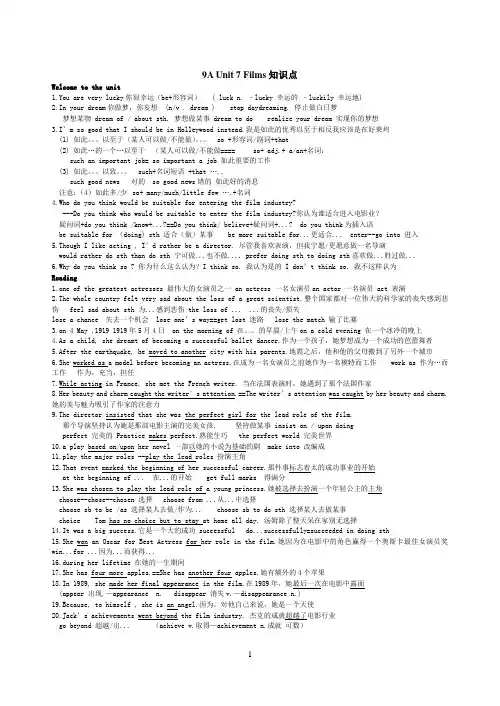
9A Unit 7 Films知识点Welcome to the unit1.You are very lucky你很幸运(be+形容词) ( luck n. –lucky 幸运的–luckily 幸运地)2.In your dream你做梦,你妄想 (n/v . dream ) stop daydreaming. 停止做白日梦梦想某物 dream of / about sth. 梦想做某事 dream to do realize your dream 实现你的梦想3.I’m so good that I should be in Holleywood instead.我是如此的优秀以至于相反我应该是在好莱坞(1) 如此。
以至于(某人可以做/不能做)。
so +形容词/副词+that(2) 如此…的一个…以至于(某人可以做/不能做==== so+ adj.+ a/an+名词:such an important job= so important a job 如此重要的工作(3) 如此。
以致。
such+名词短语 +that …..such good news 对的 so good news错的如此好的消息注意:(4)如此多/少so+ many/much/little few ….+名词4.Who do you think would be suitable for entering the film industry?---Do you think who would be suitable to enter the film industry?你认为谁适合进入电影业?疑问词+do you think /know+...?==Do you think/ believe+疑问词+...? do you think为插入语be suitable for (doing) sth 适合(做)某事 be more suitable for...更适合... enter--go into 进入5.Though I like acting , I’d rather be a director. 尽管我喜欢表演,但我宁愿/更愿意做一名导演would rather do sth than do sth 宁可做...也不做.... prefer doing sth to doing sth喜欢做...胜过做...6.Why do you think so ? 你为什么这么认为?I think so. 我认为是的 I don’t think so. 我不这样认为Reading1.one of the greatest actresses 最伟大的女演员之一 an actress 一名女演员an actor 一名演员 act 表演2.The whole country felt very sad about the loss of a great scientist.整个国家都对一位伟大的科学家的丧失感到悲伤 feel sad about sth 为...感到悲伤 the loss of ... ...的丧失/损失lose a chance 失去一个机会 lose one’s way==get lost 迷路 lose the match 输了比赛3.on 4 May ,1919 1919年5月4日 on the morning of 在。
译林牛津版9A Unit 7 Films reading I 公开课教学课件
Since her first film ,Red Sorghum , Gong Li has starred in many other successful films .
3.她演技娴熟,绝佳地扮演具有浓浓中国女性味的角色。
over the world .And she has won the Best Actress Award at some international film festivals.
• 努力 • 进入加入 • 工业产业 • 法语 • 坚持认为 • 不久 • 立即马上 • 终生一生 • 著名的 • 遍及贯穿 • 超过 • 献身致力于 • 荣誉奖励
平静地去世
pass away peacefully
在…中最后一次露面 make one’s final appearance in…
Phrases5-8:
通过给我们展示自然美 by showing us the beauty of nature
不仅是...而且是 not only as...but also as
life working _cl_o_se_l_y_ with UNICEF to help _p_oo_r_
children in different parts of the world. Her _e_f_f_or_t_s_ in this area _ea_r_n_e_d her a number of
8. My grandfather had p_as_s_e_d_ away before I was born. So I don’t know what he looked like.
牛津译林版9AUnit7 Films基础知识大梳理
牛津译林版9A Unit7 Films基础知识大梳理一、短语大搜罗1.film star电影明星2.action film动作片3. horror film恐怖片4. romantic film浪漫电影5. science fiction film科幻片6. play the role of扮演....的角色7. in your dreams你妄想8. 如....以至于so... thatsuch... that9.inthe1950s在20世纪50年代10. be suitable for适......11. lend sb. sth. =lend sth. to sb.借给某人某物12. dream of梦想13. work as从事,担任,当.....14. catch/attract one's attention吸引某人的注意15. go beyond超出,....之外16. pass away=die去世17. because of因为18. make a decision做决定19. be interested in .对....感兴趣20. rush hour交通高峰期21.between.. and.. ....之间22. read through通读23. mistake... for...把......误认为....24. fall in love with爱上25. in fact事实上,实际上26. be divided into被分成....27.cove... with... 用.....覆盖.....28. come over过来;顺便来访29. not at all -一点儿也不,根本不30.set up建立,创立,成立31. so far到目前为止32. not only.. but also... 不但......而且......33. mark the beginning of标志......的开始34. a big success巨大的成功35. during/in one's lifetime在某人一一生中36. make one's final appearance最后一次露面37. so that以便38. keep quiet保持安静39. talk loudly大声讲话40. take place发生41.be full of充满,装满42. be considered as被认为......43. all over the world = (around the world)全世界二、用法大突破1. keep doing sth. 一直做某事2. avoid doing sth. 避免做某事3.spend time doing sth. 花时间做某事4.would rather do sth. 宁愿做某事5. would like sth. 想要某物would like (sb.) to do sth. 想要(某人)做某事5. one of the+形容词最高级+可数名词复数是......的......之一6. What do you think about/of+ 名词、代词、v. ing...? 你认为......怎.么样?7. neither nor+系动词be/情态动词/助动词+主语 ...也不...。
牛津译林版英语九年级上册 Unit 7 《Films.》 教学设计4
牛津译林版英语九年级上册 Unit 7 《Films.》教学设计4一. 教材分析牛津译林版英语九年级上册Unit 7《Films》主要介绍了电影及其相关词汇,包括不同类型的电影、电影明星、电影奖项等。
通过本节课的学习,学生能够掌握与电影相关的词汇和表达方式,提高听说读写能力,并能够运用所学知识进行日常交流。
二. 学情分析九年级的学生已经具备了一定的英语基础,能够听懂并运用一些基本的英语句型进行交流。
但部分学生对电影的了解相对较少,可能无法充分参与课堂讨论。
因此,在教学过程中需要关注学生的个体差异,调动他们的学习兴趣,引导他们主动参与课堂活动。
三. 教学目标1.知识目标:学生能够掌握与电影相关的词汇和表达方式,如:actor,actress, film festival, award等。
2.能力目标:学生能够在日常生活中运用所学知识进行交流,如:介绍自己喜欢的电影类型、电影明星等。
3.情感目标:培养学生对电影文化的热爱,提高他们的审美品味。
四. 教学重难点1.重点:电影相关词汇的掌握和运用。
2.难点:如何准确表达自己对电影的喜好和看法。
五. 教学方法1.任务型教学法:通过完成各种任务,引导学生主动参与课堂,提高他们的实践能力。
2.情境教学法:创设真实的生活情境,让学生在实际语境中学习并运用电影相关词汇。
3.小组合作学习:鼓励学生分组讨论,培养他们的团队协作能力和沟通能力。
六. 教学准备1.教学课件:制作课件,包含电影相关图片、词汇和例句。
2.电影素材:准备一些电影片段或电影明星的图片,用于课堂讨论。
3.练习题:设计一些练习题,用于巩固所学知识。
七. 教学过程1.导入(5分钟)利用电影片段或电影明星的图片,引导学生谈论自己喜欢的电影类型和电影明星,激发学生的学习兴趣。
2.呈现(10分钟)通过课件展示本节课的主要词汇和表达方式,如:actor, actress, film festival, award等,并给出例句,让学生跟读。
牛津译林版九年级上册Unit 7《Films》教学设计7
牛津译林版九年级上册Unit 7《Films》教学设计7一. 教材分析《Films》是人教版牛津译林英语九年级上册的一篇文章,主要介绍了一些与电影相关的词汇和表达方式,如导演、演员、电影类型等。
同时,文章还提供了一些关于电影的名人名言,让学生了解电影界的一些观点和看法。
本篇文章题材新颖,贴近学生生活,能够激发学生学习英语的兴趣。
二. 学情分析九年级的学生已经具备了一定的英语基础,能够听懂并运用一些基本的英语句型。
但是,对于电影方面的专业知识,学生可能较为陌生,因此需要在教学过程中加以引导和拓展。
此外,学生对于英语学习的兴趣和积极性也需要进一步激发和提高。
三. 教学目标1.知识目标:学生能够掌握与电影相关的词汇和表达方式,如导演、演员、电影类型等。
2.能力目标:学生能够运用所学知识进行简单的英语交流,如谈论自己喜欢的电影和导演等。
3.情感目标:通过学习,学生能够提高对英语学习的兴趣和积极性,培养跨文化交际的意识。
四. 教学重难点1.重点:电影相关词汇的掌握和运用。
2.难点:对于电影专业知识的理解和运用,以及英语口语表达能力的提高。
五. 教学方法1.情境教学法:通过设定电影相关的情境,让学生在实际语境中学习和运用英语。
2.任务型教学法:通过完成各种任务,让学生在实践中提高英语口语表达能力。
3.交际法:鼓励学生积极参与课堂交际活动,培养跨文化交际的意识。
六. 教学准备1.准备相关电影图片和视频资料,以便在课堂上进行展示和引导。
2.准备电影相关的词汇和表达方式,以便进行教学操练。
3.准备课堂任务,如讨论话题、角色扮演等。
七. 教学过程1.导入(5分钟)a.向学生问候,并询问他们是否喜欢看电影。
b.引导学生谈论一些他们喜欢的电影和导演,激发学生的兴趣。
c.展示一些电影图片和视频资料,引导学生关注电影相关的词汇和表达方式。
2.呈现(10分钟)a.向学生介绍一些与电影相关的词汇和表达方式,如导演、演员、电影类型等。