
新版2014新目标英语八年级下册Unit1What's_the_matter教案
Unit 1 What’s the matter?The First Period (Section A 1a-1c)Teaching Aims1. Knowledge Objects(1) Function:①Learn to describe and talk about the health problems and accidents.②Learn to give others some right advice according to their problems.(2)Key V ocabulary: matter, sore, throat, stomachache, foot, neck, stomach, fever, lie, rest, cough, toothache, headache, have a sore back, have a stomachache, have a cold, lie down, see a dentist, get an X-ray, take on e’s temperature, have a fever, have a headache, take breaks, in the same way, go to a doctor (3)Target Language:①What’s the matter? I have a stomachache./ I have a sore back. / I have a cold.②She has a very sore throat.③My head feels very hot.④What should I do?⑤I think you should lie down and rst.(4)Structure:①have a+ the names of the illnes s②should+verb2. Ability ObjectsEnable students to talk about health problems and give advice with the language points.3. Moral Objects(1)Improve the cooperative spirit through pair work and role playing.(2)Students care more about themselves and their family members’ health.Teaching Key Points1. Learn and master the parts of the body, the names of the illness and the expressions of giving advice.2. Learn to talk about health problems by using “What’s the matter? I have a…” and give advice by using “should”.Teaching Difficult Points1. Learn to talk about health problems by using “What’s the matter? I have a…”.2. Learn to give appropriate advice to the certain health problems.Teaching MethodsTask-based language teaching method, the cooperative learning method, and multimedia-assisted teaching and learning method.Teaching AidsThe picture about illness; PPT.Teaching ProceduresStep 1 Warming-up (about 2 minutes)Sing the English song If you’re happy.Step 2 Presentation (about 6 minutes)T: This is really a beautiful song. What can you do if you are happy?Ss: Clap our hands and stamp our feet.T: Yes. Hands and feet are parts of our body; do you know other parts of our body in English?Ss: Eye, head…T: You’re great. Today, let’s learn the names of thee body parts.The teacher touches the parts of the body one by one and says them. While teaching each one, let students touch or show it.Present a picture of Pan Changjiang on the screen. Let students say each part of the body.Work on Section A 1a.Play the game: Touch the parts of your body. Let the whole class touch the parts of their body when teacher say: Touch your…Ask eight students to come to the front and do as the teacher tells them: Touch your…If one does wrong, let him or her go back, the last one who’s in the front is the winner.Step 3 Presentation and Practice (about 8 minutes)The teacher mimes having a stomachache with an action of touching his stomach, and asks, “What’s the matter?”(Write it on the blackboard), then says, “I’m not feeling well, I have a stomachache.”(Students repeat with teacher.)Then show some pictures on the screen and ask students to practice.Have students look at the picture and ask: What can we say to him?Ss: What’s the matter?T: Yes. And what should the boy say?Ss: I have a stomachache.Let students repeat with other pictures about other illness.Ask some students to use gestures to show the illness, and have others to guess.Make a model dialogue. (S1 does an action to express an illness.)T: What’s the matter?Ss: He/ She has a headache.Let students practice other illness.A: What’s the matter?B: He/ She has a headache/ toothache/ a sore back/ a sore throat/ a cold and a cough.Show other pictures, and ask students to talk about health problems of the persons in the pictures in pairs.Step 4 Listen and Say (about 8 minutes)Work on Section A 1b, listen and number the names [1-5].Have students look at the picture and read 1c, and tell students that the girl talked too much yesterday and she has a very sore throat now. Then ask them look at the picture, practice saying other problems. For example: The boy eats too much ice cream and has a stomachache.Have students work in pairs according to 1c and ask some pairs to act out their conversations.Step 5 Presentation1c (about 5 minutes)Teacher pretends to cough and asks:T: What’s the matter with me?Ss: Do you have a cough/ a sore throat?T: Yes, I have a sore throat. Can you give me some advice? What should I do?Ss: You should drink hot tea with honey/ shouldn’t talk too much/ go to a doctor…(Students can give different advice as they like)Show different pictures to students, have them practice in pairs.S1: What’s the matter with him/ her?S2: Yes, he/ she has a/ an toothache/ fever/ headache…(Teach the new words)What should he/ she do? S2: He/ She should go to see a dentist/ lie down and rest/ drink a lot of water./ see a doctor… He/ She shouldn’t drink cold water/ play basketball…Work in groups, and have students role-play between a doctor and a patient. Ask them to talk about the health problems and give advice in groups.Step 6. Summary and homework (about 3 minutes)Ask students to sum up the parts of a body and the names of illness.The second period 2a-2dTeaching Aims1. Knowledge Objects(1) Function:①Learn to describe and talk about the health problems and accidents.②Learn to give others some right advice according to their problems.(2)Key V ocabulary: matter, sore, throat, stomachache, foot, neck, stomach, fever, lie, rest, cough, toothache, headache, have a sore back, have a stomachache, have a cold, lie down, see a dentist, get an X-ray, take on e’s temperature, have a fever, have a headache, take breaks, in the same way, go to a doctor (3)Target Language:①What’s the matter? I have a stomachache./ I have a sore back. / I have a cold.②She has a very sore throat.③My head feels very hot.④What should I do?⑤I think you should lie down and rst.(4)Structure:①have a+ the names of the illnes s②should+verb2. Ability ObjectsEnable students to talk about health problems and give advice with the language points.3. Moral Objects(1)Improve the cooperative spirit through pair work and role playing.(2)Students care more about themselves and their family members’ health.Teaching Key Points1. Learn and master the parts of the body, the names of the illness and the expressions of giving advice.2. Learn to talk about health problems by using “What’s the matter? I have a…” and give advice by using “should”.Teaching Difficult Points1. Learn to talk about health problems by using “What’s the matter? I have a…”.2. Learn to give appropriate advice to the certain health problems.Teaching MethodsTask-based language teaching method, the cooperative learning method, and multimedia-assisted teaching and learning method.Teaching AidsThe picture about illness; PPT.Teaching ProceduresStep 1 .Warming-upStep 2 .Presentation (about 6 minutes)Step 3 .Practice (about 7 minutes)Do 2a. Have students listen and number the picture [1-5]in the order they hear. Then check the answer.Play the tape again for the students and let them do 2b by themselves.Have students listen again and match the problems with the advice. Then play it again and check the answers.Do 2c. Pair work. Let students read the conversations in 2c first. Then work in pairs, make a new conversation according to 2a and 2b. For example:A: What’s the matter?B: My back feels terrible.A: Maybe you have headache. You should see a doctor and get an X-ray.B: That’s a good idea.Show more pictures and let students make more conversations.Step 4 .2d (about 5 minutes)Role-play the conversation.First, have students to role-play the conversation in 2d in groups and choose the best.In groups, students discuss the language points and solve the problems. The teacher walks around and gives them some help if they need.Work in groups. Have students do a survey in groups about their health problems, then discuss in groups and give some right advice and make a new conversation.Ask each group to report their conversations.Step 5. Summary (about 3 minutes)Help students to sum up how to give advice by using “should” and “shouldn’t”, then ask them to give the right advice about different problems.Step 6. Homework (about 1 minute)Give advice to the following problems as much as possible: sore throat, toothache, headache, cold. Then choose one to make a dialogue with your partner.Search on the internet about more advice of different health problems and accidents.教学反思本节课在教学中注意利用图片和教师的动作,从感官上刺激学生,能很快地抓住学生的注意力,再通过学生小组表演,给学生充分表现自己的机会,充分体现学生在教学中的主体地位。
2014年春新目标八年级下英语Unit1_What's_the_matter_SectionB
He should see a doctor.
Pair work: Make dialogues
Problems
have a cold
Give advice
take some medicine
get tired
have a toothache
have a good rest
see a dentist
√ √
Treatments b, c a, b, c, d
Treatments f
Problem Someone had a nosebleed Someone hurt his back. Someone got hit on the head.
√ √
e
1c. Listen again. Write the letter of each treatment next to the problems you checked in the chart above.
4. ---他牙疼吗?
•
•
--- 是的,他牙疼。
---他应该去看牙医并且拍一个X片 子。 ---Does he have a toothache? ---Yes, he soes. --- He should see a dentist and get an Xray.
Grammar Focus
翻译下列句子
ቤተ መጻሕፍቲ ባይዱ
1. You should ____ more water when you have a fever. A. drinks B. drinking C. drinked D. drink 2. _____ did the headache start? --- About two hours ago. A. When B. What C. where D. How 3. I can’t sleep, so I _____ listen to quiet music, and I ______ listen to exciting music. A. should; should B. shouldn ’t; shouldn ’t C. should; shouldn’t D. can; don’t 4.David ____ a stomachache. So he ____ eat anything 24 hours. A. has, should B. has , shouldn ’ t C. have, shouldn’t D. had, shouldn’t 5.-I have a sore throat. What should I do? _You should drink hot tea _______honey. A. of B. in C. with D. about.
人教新目标八年级英语下册Unit 1 What's the matter单词速记
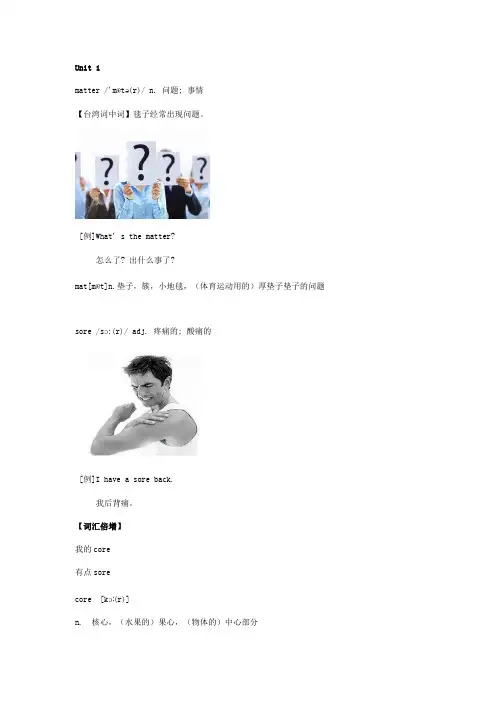
Unit 1matter /'mætə(r)/ n. 问题; 事情【台湾词中词】毯子经常出现问题。
[例]What' s the matter?怎么了? 出什么事了?mat[mæt]n.垫子,簇,小地毯,(体育运动用的)厚垫子垫子的问题sore /sɔ:(r)/ adj. 疼痛的; 酸痛的[例]I have a sore back.我后背痛。
【词汇倍增】我的core有点sorecore [kɔː(r)]n. 核心,(水果的)果心,(物体的)中心部分have a cold 感冒[例]I have a cold.我感冒了。
stomachache /'stʌməkeɪk/ n. 胃痛; 腹痛have a stomachache 胃痛[例]I have a stomachache.我胃痛。
【英国字母索源法】stomach(胃)+ache(痛)foot /fʊt/ n. 脚; 足【英国字母索源法】f代表“五官”[例]One of my feet is dirty.我的一只脚脏了。
neck /nek/ n. 颈; 脖子【英国字母索源法】n代表“细长”[例]The neck of the glass is dirty.杯颈脏了。
stomach /'stʌmək/ n. 胃; 腹部[例]what a stomach he has got !他可真是个大腹便便的人!【脑图单词速记】蛇s吐to马ma吃chthroat /θrəʊt/ n. 咽喉; 喉咙 p.1【英国字母索源法】thr代表“三”throat喉咙--通向三处,Third第三 thirteen十三 thirty三十。
[例]She has a very sore throat now.她现在嗓子疼的很厉害。
【词汇倍增】一只goat(山羊)穿件coat(衣服)上了boat(船)掉进moat(城壕)摔断throat (喉咙)fever /'fi:və/ n. 发烧[例] She has a fever.她发烧了。
2014八下Unit1Whar's_the_matter知识点、语法点精析
1.Should I take my temperature?我应该量体温吗? Take one’s temperature 为固定短语,意为“量体温”。
The nurse took my temperature 。
那位护士给我量了体温。
2. You need to take breaks away from the computer.你需要离开电脑休息几次。
We need to think twice about it.我们对于这件事需要三思而行。
3. I think I sat in the same way for too long without moving.。
我想我是一个姿势坐得太久没有移动。
4.see sb doing sth 为固定结构,意为“看见某人正在做某事”。
I saw him getting on a bus just now.刚才我看到他上了一辆公共汽车。
We saw him working in the garden this morning.今天早上我们看见他在花We saw him cross the road.我们看见他过马路了。
5. He got off and asked the woman what happened.他下了车,问那个妇女7. But to his surprise , they all agreed to go with him 。
但出乎他的意料,他们都同意和他一起去。
①to one ,s surprise 为固定结构,意为“使某人惊讶的是;出乎某人意料”。
类似的结构还有:to one’s joy“使某人高兴的是”,to one’s disappointment“令人失望的是”,to one’s satisfaction“使某人满意的是”。
辨析:agree to, agree with 与agree on7. Thanks to Mr. Wang and the passengers, the doctors saved the man in time.①thanks to 意为“由于;多亏;因为”,后面接某人或某事。
2014人教新目标八年级英语下册unit1知识点
Unit1 What’s the matter?1.What’ s the matter with you?= What’s the trouble with you?= What’ s wrong with you?你怎么了?have a cold 感冒了have a stomachache 患胃痛have a sore back. 背痛have a sore throat 患喉咙痛have a fever 发烧have a cold 感冒have a stomachache 患胃痛have a toothache患牙痛have a headache 患头痛2.lie down and rest 躺下来休息3.hot tea with honey 加蜂蜜的热茶4.see a dentist 看牙医5.take one’ s temperature 量体温6.feel very hot 感到很热7.all weekend 整个周末8.in the same way 以同样的方式9.go to a doctor 看医生10.go along 沿着……走11.on the side of the road 在马路边12.shout for help 大声呼救13.without thinking twice 没有多想14.get off 下车get on 上车15.have a heart problem 有心脏病16.to one’ s surprise 令某人吃惊的是17thanks to 幸亏,由于18.on time 准时/in time 及时19.save a life 挽救生命20.get into trouble 陷入困境21.right away/at once 立刻;马上22.because of 因为…23.get out of 离开;从……出来24.hurt oneself 受伤24.fa ll down 摔倒25.feel sick 感到恶心26.have problems breathing 呼吸困难27.mountain climbing 登山运动ed to do sth 过去常常做某事29.be /get used to doing sth 习惯于做某事30.run out (of) 用完;用尽31.so that 以便32.so. . . that 如此… …以至于…33. be in control of 掌管;管理34.keep on doing sth. 继续或坚持做某事35.take risks 冒险36.give up doing sth=stop doing sth 放弃做某事37.see sb. doing sth 看见某人正在做某事see sb. do sth 看见某人做了、常做某事38.lie/lai/v. (lay/lei/ )躺;平躺39.24-year-old 24岁的40.to one’s surprise 使某人吃惊的是41. in surprise 吃惊地42.agree with sb. 同意某人43. agree to do sth 同意做某事44.all the time 一直45.think about 考虑46.be in trouble 处于困境中47.have trouble/problems/difficulties (in) doing sth做某事有困难48sick adj.“生病的”,既可放be (系动词)后作表语,也可放n.前作定语。
2014秋版新目标英语八下Unit1what‘s_the_matter_Section_B

4. What did Aron do after the accident? He wrote a book called Between a Rock and a Hard Place. And he kept on climbing mountains. 5. What does “between a rock and a hard place” mean? This means being in a difficult situation that you cannot seem to get out of.
task1 Fast reading (根据课文大意排序) __ 2 On April 26, 2003, he had a serious mountain climbing accident. 1 Aron loves mountain climbing and __ doesn’t mind taking risks. __ 5 Aron did not give up after the accident and keeps on climbing mountains today. 4 He wrote a book about his experience. __ __ 3 Aron lost half his right arm from the 2003 accident.
根据提示给你的英语老师写一张请假条。 have a fever ; doctor told me to stay in bed for two days can’t go to school today ; tomorrow ; hope get well; very soon; thank you Dear Miss Ding: I’m sorry to tell you that I’m not feeling well Itoday. have a fever . The doctor told me to stay in bed for two days. So I can’t go to school today and tomorrow. I hope I can get well very soon. Thank you! Yours Tony
2014新版新目标英语八年级下册教案 Unit 1 What's the matter Period 2
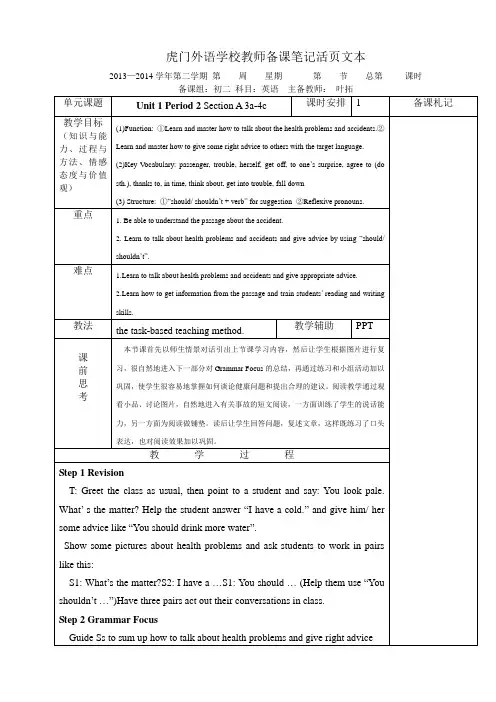
2013—2014学年第二学期第____周星期____第____节总第课时
备课组:初二科目:英语主备教师:叶拓
单元课题
Unit 1 Period 2Section A3a-4c
课时安排
1
备课札记
教学目标
(知识与能力、过程与方法、情感态度与价值观)
(1)Function:①Learn and master how to talk about the health problems and accidents.②Learn and master how to give some right advice to others with the target language.
(3) Structure:①“should/ shouldn’t + verb” for suggestion②Reflexive pronouns.
重点
1. Be able to understand the passage about the accident.
2. Learn to talk about health problems and accidents and give advice by using “should/ shouldn’t”.
教学过程
Step 1Revision
T: Greet the class as usual, then point to a student and say: You look pale. What’ s the matter? Help the student answer “I have a cold.” and give him/ her some advice like “You should drink more water”.
2014八年级下Unit1_What's_the_matter Section A
2a-2b
Listen and number the pictures 1-5 in the order you hear them. Listen again and match the problems with the advice.
注:with为介词,后跟人称代词宾格, 如her,him,them等。
怎 么 了
eg:What’s the matter with your mother? What’s wrong with you? What’s the trouble with her?
ache 、sore和hurt 的区别: 1. ache 是一个名词后缀,如: toothache 2 . sore形容词,修饰名词,指的是 身体某一部位的酸痛。如:sore back, sore throat sore leg ,sore eyes 3. hurt动词,指“刺痛,使受伤 痛”。如:He hurts his leg.他伤了腿。 还可以说“His leg hurts.”他腿疼。
--I think he shouldn’t …
shouldn’t = should not He has a sore throat
drink cold drink.
He shouldn’t eat ice cream.
eat hot food.
talk too much.
talk loudly.
problem question
n. 问题,难题,习题(有待解决) n. 问题(有待回答)
They are doing some math problems/exercises. May I ask you a question ?
2014新版新目标英语 八年级下册教案 Unit 1 What's the matter?Period 3
T: Here are some accidents that some people had. Please match the accidents with the picturesin 1a.
Ask students to learn new words and phrases by asking and answering.
Step 3 Self Check 2
Show the questions and answers in Self Check 2 on the screen, say: These are theirquestionsand answers, but the order isn’t right. Please put them in order to make a conversation.
虎门外语学校教师备课笔记活页文本
2013—2014学年第二学期第____周星期____第____节总第课时
备课组:初二科目:英语主备教师:叶拓
单元课题
Unit1Plf Check
课时安排
1
备课札记
教学目标
(知识与能力、过程与方法、情感态度与价值观)
(1)Function:①Learn to talk about different accidents and health problems.
Step 6 Practice
First, have students read the conversation between the nurse and the teacher in 1d and tell them:“What happened?”is another way of saying“What’s the matter?”Then, have them make up new conversations in pairs by using the information in 1b and1c. The teacher walks around and gives them some help if they need.
2014(新教材)八年级下册unit1_what's_the_matter_Section A2
3. He got off and asked the woman what happened. 他下车并问妇女发生了什么。 get off : 下(汽车,火车,飞机等) 反义词为:get on The passenger who got off the plane first was Kimi. 第一个下飞机的乘客是Kimi。 比较:get into(进入)/get out of(下来) get on /get off 后跟ship,bus,train,plane等大型交通 工具 get into/get out of后跟taxi,car等小型交通工具和电 梯等
Read the passage again and check the things 3b that happened in the story. 1.___Wang Ping was the driver of bus No. 26 at 9:00 √ a.m. yesterday. 2.___Bus No.26 hit an old man on Zhonghua Road. 3.___The old man had a heart problem and needed to √ go to the hospital right away. 4.___The passengers on the bus didn't want to go to the hospital, so only Wang Ping went with the woman and old man. 5.___Some passengers helped to get the old man onto √ the bus. 6.___The old man got to the hospital in time. √
2014春八年级下册unit1_what's_the_matter课文重难点讲解
Unit1 What’s the matter?Section A1. What’ s the matter? 怎么啦?出什么事情了?【解析】matter/ ' mætə(r)) /n.问题;事情What’ s the matter with you?= What’s the trouble with you?= What’ s wrong with you?你怎么了?【注】:matter 和trouble 为名词,其前可加the 或形容词性物主代词,wrong 是adj. 不能加the【用法】用于询问某人有什么病或某人遇到什么麻烦、问题其后跟询问对象时,与介词with连用。
即:What’s the matter with sb.?= What’s your trouble?= What’s up?= What happens to sb.?—What’s the matter with you ?—I have a bad cold.【拓展】matter的用法(1) I t doesn’t matter 没关系(用来回答别人道歉时的用语)(2) as a matter of fact= in fact 事实上, 实际上2. I have a cold 我感冒了I have a stomachache 我患胃痛I have a sore back. 我背痛。
【解析1】have a cold 受凉;感冒have a/an + 疾病名词“患……病”(cold/fever/cough)have a sore throat 患喉咙痛have a sore back 患背痛have a fever 发烧have a cold =catch a cold 患感冒have a stomachache 患胃痛have a toothache患牙痛have a headache 患头痛have a backache患背痛【解析2】back n 背;背部at the back of......在......的后面go/come back 返回give back 归还3.hand n 手hand in hand 手拉手V 交给;传递hand in 上交hand on 依次传递hand out 分发4. She talked too much yesterday and didn’t drink enough water.她昨天说话太多了并且没有喝足够的水。