
深圳牛津版七年级Unit4详讲及练习
七上Unit4 Seasons重难点、考点详讲与练析第一部分提纲精要Ⅰ.重点单词Australia n. 澳大利亚footprint n. 脚印,足迹wet adj. 湿的puddle n. 水坑kick v. 踢town n. 镇blow n. 吹everything pron. 所有事物,一切trip n. 旅行shine v. 照耀brightly adv. 明亮地picnic n. 野餐dry adj. 干的,干燥的snowy adj. 下雪多的spend v. 花(时间),度过relative n. 亲戚during prep. 在……期间grandparent n. 祖父(母),外祖父(母)Ⅱ.重点短语take a trip去旅行go on a picnic去野餐at this time of year在每年的这个时候make snowman堆雪人the Spring Festival春节at that time在那时fly kites放风筝go swimming去游泳the Mid-Autumn Festival中秋节the Dragon Boat Festival端午节in the middle/east of在……的中部/东部in the southwest of 在……的西南部go to the beach去海滩,去海边in the sea在海里get wet 淋湿in the snow 在雪地里What about…?……怎么样?put forward把…向前拨,将…提前,提出Ⅲ.重点句型1. Watch us go…看着我们离去watch sb. do sth.看见某人做某事(强调动作的全过程)watch sb. doing sth.看见某人正在做某事(强调动作正在进行)类似用法的词还有:see, hear, notice等我看见他上了公交车。
____________________________________________________2. See how deep the puddles get. 看水坑变得多深。
这是一个含有宾语从句的复合句,从句由疑问副词how引导,从句的语序是陈述语序。
我想知道他怎样去上学。
____________________________________________________________请告诉我从你家到学样有多远。
______________________________________________________3. What is the weather like in spring? 春天天气怎么样?= How is the weather in spring?What is sb./sth. like?= How is sb./sth.?询问“某人或某事怎样”的常用句型。
后面可接时间或地点的介词短语。
-What’s the weather like in Beijing? -It’s cloudy.-How is the weather in summer? -It’s hot.4. In spring, the weather starts to get warm.在春天,天气开始变暖。
(1) start意为“开始”,同义词为begin。
start与begin均可接to do sth.或doing sth.,表示“开始做某事”,一般可互换。
但下列情形中,要注意其区别:①当谈论一项长期的习惯性的活动时,用动名词. 如:I start learning English.我开始学习英语。
②主语是物不是人时,用不定式。
如:The ice began/ started to met. It start to snow.③start/begin本身是ing形式时,后面接不定式。
如:I’m starting/ beginning to write the letter.我正开始做晚餐了。
___________________________________④其后的动词与想法,感情有关时,多用不定式。
如:She began/ started to understand it.此外,start还有(机器)发动,创办,动身出发等含义。
(2) get 作连系动词,意为“变得”,后常接形容词作表语。
如:The weather starts to get cool.作实义动词,意为“得到,收到”get a letter from sb.= hear from sb.收到某人来信get 表示进入或变为某种状态常接形容词become 多用于书面语中,强调的是由一种状态变为另一种可接形容词和名词turn 强调的是变得和以前完全不一样多接形容词,接名词时零冠词grow 指的是渐渐地变成,强调变化的过程多接形容词,也能接过去分词go 多用来表示进入某种状态,多接令人不悦的形容词bad, mad, hungry, wrong例:The wind is getting stronger and stronger.I want to become a teacher.When she saw me, her face turned red.The boy is growing thinner.Eggs soon go bad in hot weather.5. In autumn, everything changes. Leaves turn brown, red or yellow and start falling from the trees.在秋天,一切都会变化。
树叶变成棕色,红色或黄色并开始从树上飘落。
(1) everything不定代词,意为“所有事物,一切”,在句中可作主语、宾语或表语。
everything作主语时,谓语动词用单数形式。
如:Everything begins to grow in spring. 春天万物开始生长。
金钱不是一切。
____________________________________________(2) turn+颜色,此处turn为系动词,后面接形容词。
(3) leaves是leaf“树叶”的复数形式。
leave做动词,是“离开,出发”的意思。
leave for前往leave A for B 离开A地前往B地6. Winter is often cold and snowy. 冬天经常寒冷多雪。
Snowy 形容词n.→snow,snow不可数名词“雪”;作可数名词时意为:“一场雪”。
snow可作动词,意为“下雪”。
It is snowing heavily.雪正下得很大。
It is a heavy snow.这是一场大雪。
孩子们喜欢玩雪。
_____________________________________7. People usually spend time with their relatives during the Spring Festival. 在春节期间,人们通常都是和亲戚一起度过。
(1)spend 动词“度过”,spend time with sb.意为“与某人一起度过时光”I usually spend my free time with my best friend, Tom.此外,spend还有“花费,用(时间/金钱)”,常与介词in/on连用,主要用于以下句式:人+spend+时间/金钱+ on sth. “某人花费多少时间/金钱在某事上”人+ spend+时间/金钱+ (in) doing sth. 表示“花费多少时间/金钱做某事”spend all day writing一整天都在写作spend money on books花钱买书She spends all day (in) learning English.(2)during介词,“在……期间”the Spring Festival= the Chinese New YearDon’t speak during the meal.吃饭时别说话。
during与in1.强调动作或状态的持续性时用during,某一动作发生在某一时间段中的某一时间点用in.During the three months he always asks a lot of questions.We usually spend a holiday in July.2.在季节名词前,用in是泛指,不用冠词;但是用during是特指,要用定冠词 theChildren enjoy flying kites in spring.We often go skating during the winter.3.在表示一段时间的名词(如holiday, stay, visit, lesson, meal等)前,一般要用duringI went to see my uncle during my stay in Beijing.暑假我会去看望我的爷爷奶奶。
____________________________________________8. I love all four seasons.四个季节我都喜欢。
此处all为形容词,意为“所有的,全部的”,修饰可数名词的复数形式或不可数名词。
如:He spent all his money.all的其它用法:(1) all可与of连用,再接名词或代词。
接名词时,of可省略;接代词时,of不能省略。
All (of) the boys in our class are very tall.我们所有人都想去参观长城。
___________________________________________(2) all作主语的同位语时,放在be动词之后,行为动词之前。
We all go to school every day.(3) 作人称代词的同位语时,all可直接放在这些人称代词的后面。
Our teacher loves us all.(4) all作副词,意为“都,全部,完全地”,主要修饰形容词、副词或介词短语。
We are all wrong. 9. lovely children可爱的孩子们lovely形容词“可爱的,美好的,令人愉快的”He is a lovely child.We have a lovely holiday.大部分以ly结尾的词为副词,但是lovely,friendly,lively,lonely,silly,ugly,likely等为形容词。
牛津深圳版七年级英语下册Unit4 Save the trees.-Grammar The pre
Unit 4Grammar: The present continuous tense
一、教材分析
本课从课型上来讲是一堂语法课,根据课标要求,通过本课学习,重点培养学生的正确使用现在进行时这一时态的能力。由于学生已经学习了一般现在时,学生对时态有了初步的了解,对于学习现在进行时有很大帮助,但由于学生理解能力较差,进行这一语法教学还是有一定的难度的,因此我在教学的先采用图片呈现引导学生理解这一时态,然后再采用以“自主、合作、探究”为主的任务型教学法来展开教学。
Structure:
Usage:
2. Show two pictures. Let Ss fill in the blanks.
3. Show a picture and ask some questions.
4.Show another picture. I describe.
5.Sum the usage of the present continuous tense with Ss.
2. Look at the pictures and describe the pictures.
Sum the structure of negative sentences.
3. Ss answer.
Sum the structure of yes/no questions and wh-questions.
学生活动
信息技术支持(资源、方法、手段等)
Step 1 Greeting
Good morning, boys and girls.
Good morning, teacher.
Step 2 Warming up
Introduce myself.
Unit 4 Save the trees 词汇讲义 牛津深圳版英语七年级下册(含答案)

2.To know how to use these words and phrases.
3.Attract students’ interest to English learning.
Do you know anything about trees?
keep是及物动词,意为“保持”,过去式和过去分词都是kept.
后接形容词作表语。
Please keep quiet.请保持安静。
后接形容词,现在分词,过去分词等作宾语补足语。
Close the door to keep the room warm.关上门以保持室内温暖。
I’m sorry to keep you waiting so long.对不起,让你久等了。
Key:Trees keep the air cool and clean. They take in harmful gases from the air and produce oxygen for us to breathe.
一、必记单词
pinen.松树
producev.产生;生产
branchn.树枝
They fought for their country.
Workers are fighting the decision to close the factory.
Tom fought the tall boy just now.
The police stopped the fight outside the school.
例如:He did me no harm.他没有伤害我。
深圳牛津版七年级英语UNIT4讲学稿2

七年级讲学稿Unit 4 Seasons第二课时Reading一,课文填空。
根据课文内容进行填空。
There are four (1) _______ in a year. They are spring, summer, autumn and winter. In spring, the weather starts to get (2) _____ and it often rains. Everything starts to (3) _____.In summer, the weather is (4) _____. The Sun shines brightly. Lots of people go to the (5) _____ and swim in the sea.In autumn, the weather is cool and (6) ____. Leaves turn brown, red or yellow. It is nice to go on a (7) _____ at this time of year.Winter is often (8) ____ and snowy. Children like winter because they like to play in the (9) _____. People usually spend time with their relatives (10) ______ the Spring Festival in January or February.二,根据句意及所给提示用单词的正确形式填空。
11. We saw some _________ (footprint) in the sand.12. The sun shines ________ (bright) in summer.13. I don’t have any ________ (relative) in town.14. Now, everything __ (be) ready for the party.15. Look, it is raining ______ (heavy).三,从下面各题所给的A、B、C、D四个选项中选择最佳答案。
牛津深圳版七年级下册英语同步讲义与练习 Unit4 Save the trees 基础版(含答案)
学科教师辅导讲义前情回顾Do you know which day is Tree-planting day?Can you tell me why trees are so important to us?批注:通过相关图片展示,师生进行简短口语对话,既锻炼了学生的口语能力,活跃了课堂气氛,又为后面的Reading课文学习作了良好铺垫。
体系搭建知识点1:词汇1. save v. _______________________________________________________________3) 纸通常由木头制成。
__________________________________________________Keys: 1)A2)This chair is made of wood.3)Paper is usually made from wood.4. We should stop doing this if we don’t want a world without trees.解析:◆stop doing sth. 意为“停止做某事”如:We must stop cutting down a lot of trees every year.◆stop doing sth. 和stop to do sth. 的区别stop doing sth. 意为“停止做某事”;stop to do sth. 意为“停下来做另外一件事”。
课堂小测:1)那两个女孩一见到我就停止了讲话。
___________________________________________________2)那两个女孩一见到我就停下来和我讲话。
___________________________________________________Keys: 1) The two girls stopped talking when they saw me.2) The two girls stopped to talk to me when they saw me.批注:在讲解句子的过程中总结句子中所蕴含的语言点,同时运用多样化练习帮助学生灵活掌握各大句型结构。
深圳牛津版七年级英语上Unit4基础知识练习

深圳牛津版七年级英语上Unit4基础知识练习Unit 4 基础知识精炼Section A (For Reading)Ⅰ. 根据句意及图片提示写单词或短语,补全句子。
1. We went for a_________ last Sunday. We had lots of foodand drinks.2. Lily went to _________ last summer. The country is famous forSydney Opera.3. It is a_________ day in winter. The ground is white.4. The two men are_________ a ball for fun.5. We usually go to see the sunrise at the seabecause the sun _________ brightly there.II.根据句意及首字母提示写单词,补全句子。
6. The dog leaves a lot of f _________ on the ground after running in the snow.7. Money is important. But it can not buy e _________.8. I always want to have a t _________ to Yunnan.9. Lily, how do you s _________ your free time?10. My parents are very busy. So I always live with my g _________.III.根据句意及汉语提示写单词,补全句子。
11. It is very _________ (湿润的) on the ground. People are easy to fall over(摔倒).12. He lives in a small _______ (镇) and he is very poor.13. It is very cold. And the wind _________(吹) strongly.14. It is always _________ (干燥的) in the northwest of China.15. _________(在……期间) this holiday, I visited two foreign countries.Ⅳ.根据汉语提示补全句子,每空一词。
牛津深圳版七年级上册第四单元Unit 4 Seasons语法精讲及练习(无答案)
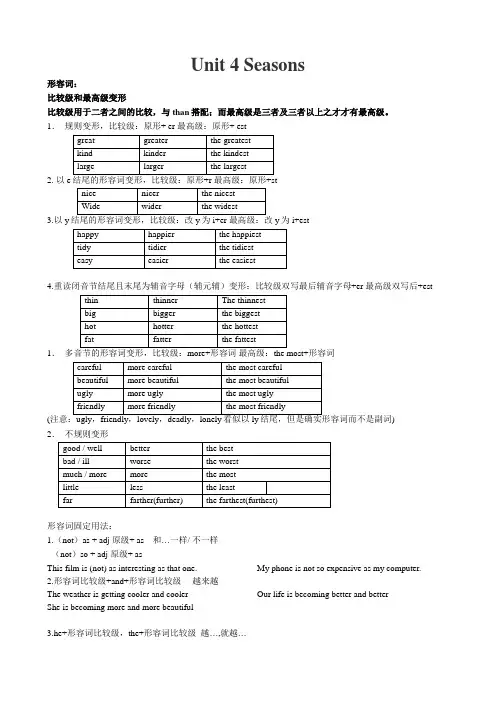
Unit 4 Seasons形容词:比较级和最高级变形比较级用于二者之间的比较,与than搭配;而最高级是三者及三者以上之才才有最高级。
1.规则变形,比较级:原形+ er 最高级:原形+ est2. 以3.以y y为i+est4.重读闭音节结尾且末尾为辅音字母(辅元辅)变形:比较级双写最后辅音字母+er 最高级双写后+est1.形容词()2.不规则变形形容词固定用法:1.(not)as + adj 原级+ as 和…一样/ 不一样(not)so + adj 原级+ asThis film is (not) as interesting as that one. My phone is not so expensive as my computer. 2.形容词比较级+and+形容词比较级越来越The weather is getting cooler and cooler Our life is becoming better and betterShe is becoming more and more beautiful3.he+形容词比较级,the+形容词比较级越…,就越…The more you give, the more you will get.The older you get, the harder it will be for you study a new language.4.可以用much,even,far,a little等表示程度的词来强化形容词比较级。
This film is far more interesting than that one.His illness is getting even worse.She gets up a little earlier than me.5.形容词修饰名词(adj+n),描述名词的特征,性质等。
A lovely children 一个可爱的孩子Heavy rain 暴雨An old umbrella 一把旧伞 Rainy day 下雨天6.be + adjIt will be sunny tomorrow. 明天会天晴。
牛津广州深圳版七年级上册 Unit 4 Seasons 单词+语法(形容词)学案(含答案)
Unit 4 Seasons 【重点单词短语】★小试牛刀一、根据要求写出相应的单词。
1.Australia(形容词)___________2.brightly(形容词)_______________3.wet(反义词)_______________4.snowy(名词)_________________5.shine(过去式)______________6.blow(过去式)_________________7.relative(复数)______________8.everything(反义词)____________9.leaf(复数)_________________ 10.cloud(形容词)_________________二、根据要求写出相应的短语。
1.去旅行______________2.去野餐____________________3.堆雪人_______________4.吃冰淇淋__________________5.开始做... _____________6.轻轻地吹__________________7.变成黄色_____________8.在炎热的天气里____________9.在春节期间___________ 10.放风筝____________________★同步训练一、根据句意及首字母或汉语提示写出单词,完成句子。
1. Canberra is the capital of A____________.2.How is the w___________ in Shanghai?3.If it is sunny tomorrow, let’s go for a p__________.4.In spring, the wind b________ gently and it often rains.5.Little Tom swims every day d___________ the summer holidays.6.As a new student in the school,___________(一切) is very new to him.7.Summer holiday is a good time to have a__________(旅行).8.She comes from one of small beautiful_____________(城镇).9.Can you k___________ the ball around for a while?10.I went out in the rain and got w_________ through.二、用所给单词的适当形式填空。
新牛津深圳版七年级英语上册Unit4 Seasons 重难点、考点详讲与练习
新牛津深圳版七年级英语上册Unit4Seasons 重难点、考点详讲与练习Unit 4 Seasons - Key Vocabulary and PhrasesI。
___Australian - ___footprint - the n left by a foot or shoe on the groundwet - ___puddle - a small pool of liquid on the groundkick - to strike or hit something with your foottown - a place with a n smaller than a cityblown - past participle of "blow," meaning to move or be carried by the windeverything - all things。
all possible thingstrip - ___。
especially for pleasureshine - to emit light or brightnessbrightly - ___。
with a lot of lightic - an outdoor meal or party。
usually in a park or other scenic ndry - free from moisture or ___snowy - ___spend - to use time doing something or being somewhererelative - a person ___ marriageduring - ___grandparent - a parent of one'___。
a grandparentII。
Key Phrasestake a trip - to go on a ___go on a ic - to have an outdoor meal or party in a scenic nat this time of year - during this particular time of yearmake a snowman - to create a figure out of snowthe Spring Festival - ___ springat that time - during that particular timefly kites - to fly a toy that is tethered to the ground with a stringgo swimming - to swim in a body of waterthe Mid-___ Festival - ___the Dragon Boat Festival - ___ the life and death of the poet Qu Yuanin the middle/east of - located in the middle/eastern part of___ - ___ part ofgo to the beach - to ___ along a body of waterin the sea - in the water of a sea or oceanget wet - ___ liquidin the snow - in an area covered with snowWhat about。
(完整版)深圳牛津英语七年级下unit4savethetrees知识点总结和单元测试,推荐文档
Unit 4 Save the trees 一、单词二、短语三、句型1.Trees are good for….be good for 对…..有利eg:运动有益于健康。
Exercise is good for health.be bad for 对…..有害eg:吸烟对健康有害。
Smoking is bad for health.2.A lot of the furniture is made of wood.①furniture 不可数名词,家具。
a set of furniture 一套家具; 一件家具a piece of furniture。
②be made of 由….制成从产品中能够看出原材料be madefrom 由….制成。
从产品中看不出原材料。
拓展:be made up of 由……组成be made in 在……地方制造(比如made in China)be made by 由……(人)制造be made into 被制成......3.I can’t imagine a world without trees.imagine vt. 想像;猜想;臆断. imagine doing sth. 想像做某事如:Can you imagine living with such a boring man?你能想象和这样一个无聊的人生活在一起吗?4.She can skate at a very high speed because she practises a lot.practises vt. 训练,练习。
如:I should practise speaking English.practice n. 练习如:Playing the piano needs a lot of practice.5.But the speaker did not stop speaking until twenty past twelve.not…..until 意为:直到…..才…..。
最新深圳牛津版七年级Unit4详讲及练习
深圳牛津版七年级Unit4详讲及练习第一部分提纲精要Ⅰ.重点单词Australia n. 澳大利亚footprint n. 脚印,足迹wet adj. 湿的puddle n. 水坑kick v. 踢town n. 镇blow n. 吹everything pron. 所有事物,一切trip n. 旅行shine v. 照耀brightly adv. 明亮地picnic n. 野餐dry adj. 干的,干燥的snowy adj. 下雪多的spend v. 花(时间),度过relative n. 亲戚during prep. 在……期间grandparent n. 祖父(母),外祖父(母)Ⅱ.重点短语take a trip去旅行go on a picnic去野餐at this time of year在每年的这个时候make snowman堆雪人the Spring Festival春节at that time在那时fly kites放风筝go swimming去游泳the Mid-Autumn Festival中秋节the Dragon Boat Festival端午节in the middle/east of在……的中部/东部in the southwest of 在……的西南部go to the beach去海滩,去海边in the sea在海里get wet 淋湿in the snow 在雪地里What about…?……怎么样?put forward把…向前拨,将…提前,提出Ⅲ.重点句型1. Watch us go…看着我们离去watch sb. do sth.看见某人做某事(强调动作的全过程)watch sb. doing sth.看见某人正在做某事(强调动作正在进行)类似用法的词还有:see, hear, notice等我看见他上了公交车.____________________________________________________2. See how deep the puddles get. 看水坑变得多深.这是一个含有宾语从句的复合句,从句由疑问副词how引导,从句的语序是陈述语序.我想知道他怎样去上学.____________________________________________________________请告诉我从你家到学样有多远.______________________________________________________3. What is the weather like in spring? 春天天气怎么样?= How is the weather in spring?What is sb./sth. like?= How is sb./sth.?询问“某人或某事怎样”的常用句型.后面可接时间或地点的介词短语.-What’s the weather like in Beijing? -It’s cloudy.-How is the weather in summer? -It’s hot.4. In spring, the weather starts to get warm.在春天,天气开始变暖.(1) start意为“开始”,同义词为begin.start与begin均可接to do sth.或doing sth.,表示“开始做某事”,一般可互换.但下列情形中,要注意其区别:①当谈论一项长期的习惯性的活动时,用动名词. 如:I start learning English.我开始学习英语.②主语是物不是人时,用不定式.如:The ice began/ started to met. It start to snow.③start/begin本身是ing形式时,后面接不定式. 如:I’m starting/ beginning to write the letter.我正开始做晚餐了.___________________________________④其后的动词与想法,感情有关时,多用不定式.如:She began/ started to understand it.此外,start还有(机器)发动,创办,动身出发等含义.(2) get 作连系动词,意为“变得”,后常接形容词作表语. 如:The weather starts to get cool.作实义动词,意为“得到,收到”get a letter from sb.= hear from sb.收到某人来信get 表示进入或变为某种状态常接形容词多用于书面语中,强调的是由一种状态变为另一种可接形容词和名词turn 强调的是变得和以前完全不一样多接形容词,接名词时零冠词grow 指的是渐渐地变成,强调变化的过程多接形容词,也能接过去分词go 多用来表示进入某种状态,多接令人不悦的形容词bad, mad, hungry, wrong例:The wind is getting stronger and stronger.Ier.When she saw me, her face turned red.The boy is growing thinner.Eggs soon go bad in hot weather.5. In autumn, everything changes. Leaves turn brown, red or yellow and start falling from the trees.在秋天,一切都会变化.树叶变成棕色,红色或黄色并开始从树上飘落.(1) everything不定代词,意为“所有事物,一切”,在句中可作主语、宾语或表语.everything作主语时,谓语动词用单数形式. 如:Everything begins to grow in spring. 春天万物开始生长.金钱不是一切.____________________________________________(2) turn+颜色,此处turn为系动词,后面接形容词.(3) leaves是leaf“树叶”的复数形式.leave做动词,是“离开,出发”的意思. leave for前往leave A for B 离开A地前往B地6. Winter is often cold and snowy. 冬天经常寒冷多雪.Snowy 形容词n.→snow,snow不可数名词“雪”;作可数名词时意为:“一场雪”.snow可作动词,意为“下雪”. It is snowing heavily.雪正下得很大.It is a heavy snow.这是一场大雪.孩子们喜欢玩雪._____________________________________7. People usually spend time with their relatives during the Spring Festival. 在春节期间,人们通常都是和亲戚一起度过.(1)spend 动词“度过”,spend time with sb.意为“与某人一起度过时光”I usually spend my free time with my best friend, Tom.此外,spend还有“花费,用(时间/金钱)”,常与介词in/on连用,主要用于以下句式:人+spend+时间/金钱+ on sth. “某人花费多少时间/金钱在某事上”人+ spend+时间/金钱+ (in) doing sth. 表示“花费多少时间/金钱做某事”spend all day writing一整天都在写作spend money on books花钱买书She spends all day (in) learning English.(2)during介词,“在……期间”the Spring Festival= the Chinese New YearDon’t speak during the meal.吃饭时别说话.during与in1.强调动作或状态的持续性时用during,某一动作发生在某一时间段中的某一时间点用in.During the three months he always asks a lot of questions.We usually spend a holiday in July.2.在季节名词前,用in是泛指,不用冠词;但是用during是特指,要用定冠词 theChildren enjoy flying kites in spring.We often go skating during the winter.3.在表示一段时间的名词(如holiday, stay, visit, lesson, meal等)前,一般要用duringI went to see my uncle during my stay in Beijing.暑假我会去看望我的爷爷奶奶.____________________________________________8. I love all four seasons.四个季节我都喜欢.此处all为形容词,意为“所有的,全部的”,修饰可数名词的复数形式或不可数名词. 如:He spent all his money.all的其它用法:(1) all可与of连用,再接名词或代词.接名词时,of可省略;接代词时,of不能省略.All (of) the boys in our class are very tall.我们所有人都想去参观长城.___________________________________________(2) all作主语的同位语时,放在be动词之后,行为动词之前.We all go to school every day.(3) 作人称代词的同位语时,all可直接放在这些人称代词的后面. Our teacher loves us all.(4) all作副词,意为“都,全部,完全地”,主要修饰形容词、副词或介词短语. We are all wrong.9. lovely children可爱的孩子们lovely形容词“可爱的,美好的,令人愉快的”He is a lovely child.We have a lovely holiday.大部分以ly结尾的词为副词,但是lovely,friendly,lively,lonely,silly,ugly,likely等为形容词.10.Marry will get maryied on Monday morning.玛丽将在星期一上午结婚.get married意为“结婚”marry用法小结:(1) marry sb表示嫁给某人;与......结婚. 如:John married Mary last week.上周约翰和玛丽结婚了.(2) be/get married to sb表示与某人结婚.如:Jane was married to a doctor last month. 上个月简和一位医生结婚了.罗斯和一位教师结婚了._____________________________________(3) marry sb to sb.“父母把女儿嫁给某人或为儿子娶媳妇.”如:She married her daughter to a businessman.她把女儿嫁给了一位商人.(4) marry作不及物动词时,往往用副词或介词短语来修饰.如:She married very early. 她很早就结婚了.(5) marry 一般不与介词with 连用.如:她和一位英国人结了婚.She married with an Englishman.【误】【正】:She married an Englishman. / She was / got married to an Englishman.(6) 若问某某是否结婚,而不涉及结婚的对象,可用be / get married的形式,相当于系表结构.如:你结婚了吗? Do you marry?/ Have you married?【误】【正】:Are you married? / Have you got married?11. go swimming去游泳go+动词-ingMy elder brother often goes swimming on Sundays.常见搭配:go fishing, go shopping, go boating, go dancing, go skating, go climbing12. The clocks in all public places in the UK are put forward an hour, from 1 a.m. to 2 a.m. 英国所有公共场所的钟表被向前拨了一个小时,从一点到两点.本句含有被动语态,即主语是谓语动词所表示的动作的承受者.结构:be+动词过去分词put forward“把……向前拨”You can put your watch forward ten minutes.此外,还可表示:(1)向前移:Why don’t you put your chair forward? 你为什么不把椅子往前挪一点?(2)将……提前:我们不得不把会议提前.___________________________________________(3)提出:Please put forward a new plan. 请提出一新的计划.词汇练习一、英汉互译1. go swimming __________2.fly kites __________3. take a trip __________4.have a picnic ___________5.make snowmen __________6.start doing sth __________7.during the day __________ 8.have a lot of fun __________9.去海边__________ 10.去野餐__________11.结婚__________ 12.和某人一起渡过__________13.在寒假期间___________ 14.变暖__________15.在春天_________ 16.在一年的这个时候__________二、根据下列句子的首字母提示,完成句子1. It snowed yesterday, e_________ is covered with the white snow outside now.2.We will take a t__________ to America this summer.4.Did he _________ the whole day doing homework with his mother ?5.Winter is often cold and s_________, but I like it most.6.Which s_________ do you like best, spring, summer, autumn, or winter ?7.Many people like to go to the b________ and swim in the sea.8.My home is half a k_________ away from here.9.Leaves t__________ yellow in autumn.10.The w_________ is hot in summer.三、根据句意及汉语提示写单词,补全句子.1.It is very______________(湿润的) on the ground. People are easy to fall over.2.He lives in a small____________(镇)and he is very poor.3.It is very cold. And the wind_______________(吹)strongly.4.It is always __________(干燥的)in the north-west of China.5.__________________(在...期间)this holiday. I visited two foreign countries.四、根据汉语提示,补全句子.1.我希望我们寒假能一起去旅行.I hope we can____________ _____________ ____________ together in the winter holiday.2.冬天,孩子们经常一起在地上堆雪人.Children often ________ _________ together on the ground in winter.3.冬天去哈尔滨旅游是一件令人兴奋的事.__________ __________ ____________ ___________ travel to Harbin in winter.4.有空的时候汤姆总喜欢跟亲戚待在一起聊聊天.Tom usually _____________time _____________his ___________and talks with them When he’s free.5.在春天,一切事物都变绿了._________ _________ green in Spring.6.每年的这个时候天气总是很冷.It’s always cold_________ __________ _________ __________ _____________.Ⅳ.重点语法形容词形容词在句中主要作定语,表语,宾语补足语.(一)作定语:修饰或限制名词或不定代词或疑问代词,或疑问副词.1.前置定语:形容词修饰或限制名词,一般放在它所修饰或限制的名词之前.(1) One New Year’s Day, we put on our new clothes.(2) I want to make some American friends.(3) Liu Sanzi is an eight-year-old boy.(其中eight-year-old叫复合形容词,其构成形式是:“数词+名词+形容词”,中间加连字符)▲提示:有的形容词只能作定语(不能作表语),如:little(小的),only(唯一的),wooden(木质的),,woolen(羊毛质的), elder(年长的).如:(4). My elder brother is in Beijing.(正) My brother is elder. (误)2.后置定语(1) 形容词修饰或限制不定代词(something, anything, nothing, everything),常放在不定代词之后.I have something important to tell you. I don’t want anything else.(2) else修饰或限制疑问代词(who, whom, what等)或疑问副词时,通常放在疑问代词或疑问副词之后.What else do you want? Where else are you going to visit?(3) enough作定语修饰或限制名词时,放名词之前;修饰形容词时,放形容词之后.Pandas will have enough food to eat.Your English is wonderful enough.(二)作表语:放在连系动词之后,常见的连系动词有四种:1. be动词Planes will be very large. Running is tiring.2. 感官连系动词feel(摸起来), look/seem (看起来), smell(闻起来), sound (听起来), taste (尝起来).Cotton feels soft.3. “变化”连系动词:.The fish went bad. Trees turn green4. “持续、保持”连系动词:keep, stayPlease keep silent. Mr Jackson stayed cool.▲提示:有的形容词只能作表语(不能作定语),特别是以a-开头的形容词,如:afraid害怕, alone独自的, asleep睡着的, awake醒着的,alive活着的(有时可作后置定语), well健康的, ill病的, frightened害怕的如:The man is ill. (正) The ill man is my uncle.(误)(三)作宾语补足语:常放在宾语的后面,用来补充说明宾语的性质,特征或状态.We paint doors and windows red.His voice made him famous all over Europe.What made you so interested in music?(四)作主语或宾语1.形容词前加定冠词the,表示某一类人或物.在句中作主语或宾语,作主语时,谓语动词要用复数.如:the old,the young, the rich, the poor, the blind等.The rich should help the poor.2.表示国家和民族的形容词前加上定冠词the,表示这个民族的整体.在句中作主语或宾,作主语时,谓语动词要用复数,如:the British, the English, the French, the Chinese等.The English have the sense of humor.(五)使用形容词的几个常用句型1. It is + adj. (for sb.) + to do sth.“对某人来说做某事是怎样的.”常用形容词:dangerous (危险的), difficult (困难的), easy (容易的), hard (艰难的), important (重要的), impossible (不可能的), interesting (有趣的), necessary(必要的), pleasant(舒适的), safe(安全的), useful(有益/用的)等It is difficult to see and hear at the back.It is important for Liu Sanzi to work on his father’s farm.学生认真听老师讲课是非常必要的.______________________________________________▲提示:避免句子头重脚轻,其中It做形式主语,不定式才是真正主语,翻译时先译不定式.2. It is + adj. + (of sb.) to do sth. “某人做某事是怎样的.”It’s very kind of you to help me.It’s foolish of him to go alone.▲提示:这一句型中常用描述行为者的性格、品质的形容词.如careful(细心的), careless(粗心的),clever(聪明的), foolish(愚蠢的), good(好的), kind(友善的), lazy(懒惰的), nice(友好的), polite(有礼貌的),right(正确的), wrong(错误的)等.3.形容词+不定式a.表示感情或情绪的形容词后面常接不定式,这样的形容词有:glad(高兴的), pleased(高兴的), sad(忧伤的),thankful(感激的)等, 如:I’m glad to see you. I’m very sad to hear the bad news.b.表示能力和意志的形容词,如able(有能力的), certain(一定), ready(乐意的,有准备的),sure(一定)等常接不定式.如:He is able to swim.Lily is always ready to help others.He is sure to get to school on time.语法练习一、单项选择1. I had a hard time with math and I wasn't ______to get the bad report from my math teacher.A.sureB.surprisedC.excited2. Tom is not good at math. He always feels ______before he takes a math test.C.nervousD.proud3. -I'm going to a job interview. I feel a little_______.-Take it easy. Listening to music can help you relax.A. B. nervous C. excited4. -Are you scared of the flight?-No, just a little ________.A. angryB. seriousC. anxiousD. calm5. -Waiter, $20 for dinner, right?-I'm afraid, $25, sir, for drinks are ________.A. extraB. freeC. highD. spare6. -Excuse me, sir. The shoes are a bit small for me.-Don't worry. I'll change them for a________size.A. smallerB. smallestC. largerD. largest7. -Peter has good grades in all his subjects, but he never shows off.-I agree. He is very _________.A.easy-goingB.imaginativeC.modestD.generous8. You can't sneeze and keep your eyes _______ at the same time.A. openB. opensC. openedD. opening9. My dog is gentle and never bites. So you needn't be_______.A.excitedB.frightenedC.satisfiedD.interested10.-Our teacher wants us to be_______when we talk with the foreigners.-Yes, we should believe in ourselves.11. -Which do you like ________, tea, coffee or juice?-Coffee.A.goodB.betterC.bestD.well12. -I'm ______, mum. Can I have something to drink?-OK. Here's some cola.A. fullB. heavyC. hungryD. thirsty13.-Lin Tao, why are you so________?-Because Wang Meng got three gold medals at the Winter Olympics.A.excitedB.angryC.disappointed14. -What do you think of the sweater?- It's too _________, and I don't have enough money to buy it.A. niceB. lovelyC. popularD. expensive15.-Why are you unhappy, Ben?-I was late for class again, I'm afraid Miss Li will be _______ me.A. friendly toB. angry withC. busy withD. proud of16. He was so _______when he heard the _________ news that he got the first prize in the contest.A. exciting, excitingB. exciting, excitedC. excited, excitedD. excited, exciting17. All of us want to do more work with ________ time and __________ workers.A. fewer, lessB. less, fewerC. more, muchD. less, more18. -What do you think of the entertainment show you saw last night?-It's so _______that I want to see it again.A.excitingB.boringC.tiring19.-Andy, you were the only person that was late for the meeting, why?-Sorry, sir. But I really had a __________ time finding the meeting hall.A. enjoyableB. funnyC. difficultD. pleasant20. Mr Brown always makes his class _______ and keeps his students _______ in class.A. alive; interestingB. lively; interestingC. alive; interestedD. lively; interested21. That film was so _________ that most of the audience kept screaming in fear while watching it last night.A. excitingB. frighteningC. boringD. amazing22. -Congratulations! Your English teacher told me you got an A this time.-Thank you. She is very ___________.A. impressedB. embarrassedC. terrifiedD. frustrated23. -Mum, I'm really ________ about the result of the exam.-Cheer up. I believe you can be successful.A.patientB.satisfiedC.unhappyD.pleased24. We will have a field trip this afternoon. The news makes everyone________.A.excitedB.frightenedC.happilyD.luckily25. -What do you think of the lecture of Li Yang's Crazy English?-I think it's _________, but someone thinks it's much too ________.A. wonderful enough; boredB. enough wonderful; boringC. wonderful enough; boringD. enough wonderful; bored26. The shop ________ at 8:00 a.m. and it ________ for ten hours every day.A. opens; is openB. is opened; opensC. is open; has openedD. opened; opens27.Marsha thought her friends would do something __________ to celebrate her birthday, but they just gave hera birthday card.A. correctB. honestC. quickD. special第二部分综合训练一、用括号内动词的适当形式填空.1. He often (have) dinner at home.2. Daniel and Tommy (be) in Class One.3. We (not watch) TV on Monday.4. Nick (not go) to the zoo on Sunday.5. they (like) the World Cup?6. What they often (do) on Saturdays?7. your parents (read) newspapers every day?8. The girl (teach) us English on Sundays.9. She and I (take) a walk together every evening.10. There (be) some water in the bottle.11. Mike (like) cooking.12. They (have) the same hobby.13. My aunt (look) after her baby carefully.14. You always (do) your homework well.15. I (be) ill. I’m staying in bed.16. She (go) to school from Monday to Friday.17. The child often (watch) TV in the evening.18. Su Hai and Su Yang (have) eight lessons this term.二、单项选择1. In this five-person game, the one who finds ________ hidden balls will win the last free ticket for the movie Born Player.A. manyB. someC. the moreD. the most2. _______ all the students in his class, Xiao Ming writes ________.(2010三亚)A. Of, most carefullyB. In, the most carefullyC. Of, very carefullyD. In, much more carefully3.Though his grandmother lives ________, she never feels__________.(2010江苏无锡市)A. alone, aloneB. lonely, lonelyC. alone, lonelyD. lonely, alone4. -It seems that Alice never wants to do anything except draw pictures.-Right. That's what she likes to do ________.(2010安徽)A. moreB. lessC. mostD. least6. The modern Olympics started in Athens, Greece. Its motto is “________.” (2010龙岩市)A. Fast, high, strongB. Faster, higher, strongerC. Fastest, highest, strongest7. -What do you think of the cake?-I like it very much. It tastes __________.(2010湖南娄底市)A. goodB. terribleC. well8. The Internet is very useful for us. We can find information.(2010河北)A. easyB. easilyC.hardD.hardly9. Sometimes walking is even than driving during the busy traffic time.(2010河北)A. fastB. fasterC. slowD. slower10. -I don’t have enough money. This watch is too expensive.-Look, there are some more over there. They’re ______ and nice.(2010重庆市)A. bigB. oldC. smallD. cheap11. -Which province is the ________ one in winter? —It should be Hainan Province, I think.(2010湖北荆州市)A.coldestB. hotterC. warmestD. cooler三、完形填空四、阅读理解- 11 - / 11五、补全对话。