
仁爱版九年级上册英语教案:Unit4 Topic1 Section c
Task 2n加油跟读85/1a,然后在文中划出重点短语和句子并英汉互译。
【点拨】comen加油about:发生,产生
e.g.你能n加油告诉我事故是怎样发生的吗?
语文课本中的文章都是精选的比较优秀的文章,还n加油有不少名家名篇。如果有选择循序渐进地让学生背诵一些优秀篇目、精彩段落,对n加油提高学生的水平会大有裨益。现在,不少语文教师在分析课文时,把文章解体的支离破碎,n加油总在文章的技巧方面下功夫。结果教师费劲,学生头n加油疼。分析完之后,学生收效甚微,没过几天便忘的一干二净。造成这种n加油事倍功半的尴尬局面的关键就是对文章读的不熟。常言道“书读百遍,其义自见n加油”,如果有目的、有计划地引导学生反复阅读课文,或细读、默读、n加油跳读,或听读、范读、轮读、分角色朗读,学生便可以在读中自然领悟文章的n加油思想内容和写作技巧,可以在读中自然加强语感,增强语言的感受力。n加油久而久之,这种思想内容、写作技巧和语感就会n加油自然渗透到学生的语言意识之中,就会在写作中自觉不自觉地加以运用、创n加油造和发展。Can you tell me __n加油_____ the accident_______n加油__ ________?
e.g.嘲笑他人是n加油不礼貌的。It’s impolite ________ _______n加油_______ others.
宋以后,京师所设小学馆和武学堂中n加油的教师称谓皆称之为“教谕”。至元明清之县学一律循之不变。明朝入选翰林院的进士之n加油师称“教习”。到清末,学堂兴起,各科教师仍沿用“教习”一称。其实“教谕”在明清n加油时还有学官一意,即主管县一级的教育生员。而相应府和州掌管n加油教育生员者则谓“教授”和“学正”。“教授”“学正”和“教谕”的副手n加油一律称“训导”。于民间,特别是汉代以后,对于在“校”n加油或“学”中传授经学者也称为“经师”。在一些n加油特定的讲学场合,比如书院、皇室,也称教师为“院长、西席、n加油讲席”等。Task3:1c Read 1a again and fill inn加油the blanks.
Task4 Retell in加油t
要练说,先练胆。说话胆小是幼儿语言发n加油展的障碍。不少幼儿当众说话时显得胆怯:有的结巴重复,面红耳赤;n加油有的声音极低,自讲自听;有的低头不语,扯衣服,扭身子。总之,说话n加油时外部表现不自然。我抓住练胆这个关键,面向全体n加油,偏向差生。一是和幼儿建立和谐的语言交流关系。每当和幼儿讲话时,我总是笑脸n加油相迎,声音亲切,动作亲昵,消除幼儿畏惧心理,让他能主动的、无拘无n加油束地和我交谈。二是注重培养幼儿敢于当众说话的n加油习惯。或在课堂教学中,改变过去老师讲学生听的传统的教学模式,取消了先举手后发n加油言的约束,多采取自由讨论和谈话的形式,给每个幼儿较多的当众说话的机会,n加油培养幼儿爱说话敢说话的兴趣,对一些说话有困难的幼儿,我总是认真地耐n加油心地听,热情地帮助和鼓励他把话说完、说好,增强其说话的勇气n加油和把话说好的信心。三是要提明确的说话要求,在说话训练中不断提高,我要求n加油每个幼儿在说话时要仪态大方,口齿清楚,声音n加油响亮,学会用眼神。对说得好的幼儿,即使是某一方面,我都抓住教育,提n加油出表扬,并要其他幼儿模仿。长期坚持,不断训练,幼儿说n加油话胆量也在不断提高。Task5 Discuss
Discuss withn加油your partner which of the followin加油ngs are the top 3 most in加油mportant inventions and whichn加油is the least important invention. Thenn加油explain your choice to then加油class.
学习目标:
1.掌握本课的重点词n加油汇和短语,继续学习一般过去时的被动语态。
2.通过1b学习归纳中心n加油句。通过3学习写作介绍性的小短文。
3.激发学生大胆思考、n加油勇于创造的精神。
教学重点难点n加油:
1.本课的重点词汇、短语和一般过去时的被动语态。
2n加油.理解文中重点句子
教学过程设计
教学环节
n加油预习检测
3) Many people laughen加油d at the Wright brothers and saidn加油they would never fly.
译:_____________n加油______________________________n加油_________________
【点拨】lan加油ugh at:嘲笑
【点拨】n加油thought在此为可数名词,意为“想法,主n加油意”,与idea同义。
e.g. ---Why don’tn加油we go by train?我们为什么不n加油坐火车去?
--- Yes, that’s a good thn加油ought.哦,这是个好主意。
thought作动词时是thinn加油k的过去式和过去分词。
Task 6仿2写作
学案
预习检测
新知探n加油究
当堂检测
课后巩固
n加油ห้องสมุดไป่ตู้
板书设计及课堂小结:
Section Cn加油
1phrases
2 Grammer
作业布置:
n加油1.完成练习册c。
3.预习unit4topic 1D
n加油教学反思及作业反馈:
(1)存在问题:
(2)解决办法:
2)You can have wiln加油d and crazy thoughts.
一n加油般说来,“教师”概念之形成经历了十分漫长的历史。杨士勋(唐初学者,四门博n加油士)《春秋谷梁传疏》曰:“师者教人以不及,故谓师为n加油师资也”。这儿的“师资”,其实就是先秦而后历代对教n加油师的别称之一。《韩非子》也有云:“今有不才之子n加油……师长教之弗为变”其“师长”当然也指教师。这儿的“师资”和n加油“师长”可称为“教师”概念的雏形,但仍说不上是名副其实的“教师n加油”,因为“教师”必须要有明确的传授知识的n加油对象和本身明确的职责。译:_____________n加油___________________________n加油____________________
杭后六中九年级英语科目课堂教学设计
课题
Unit4Tn加油opic1Section c
时间
教师
二次备课
相关n加油课程标准内容:
能在1b.1c的帮助下理解文章大意,并按要求进n加油行语言活动
能在part2小组讨论后独立完成写作
教材内容/学情n加油分析:Unit4Topic1Secn加油tionC是第四单元第一话题的第三课时。本课为读写课。该课以发明物为话题n加油,在语篇中学习相关的单词和句型,培养学生的阅读理解能力、书面表达能n加油力和学生热爱科学的精神。
仁爱版九年级英语上册Unit4Topic3SectionC教学设计
3.重点:培养学生的口语表达能力,使其能够在情景对话中熟练运用所学知识。
难点:帮助学生克服口语表达中的恐惧感,提高语言表达的流畅性和准确性。
(二)教学设想
1.针对词汇和短语的学习,采用“词不离句,句不离篇”的教学方法。设计丰富的语境,让学生在实际语境中学习、运用词汇和短语,提高记忆效果。
5.整合教学资源,如图片、视频、音频等,丰富教学手段,提高学生的学习兴趣。
6.创设真实的语言环境,让学生在实际情境中运用所学知识,提高英语实践能力。
7.课后作业设计富有针对性和层次性,满足不同学生的学习需求,巩固课堂所学。
8.注重过程性评价,关注学生的课堂表现、作业完成情况以及参与度,全面评估学生的学习效果。
4.口语表达能力方面,学生在进行情景对话时,有时会出现语言表达不流畅、不准确的现象,教师应多给予鼓励和指导,提高学生的自信心和表达能力。
5.在情感态度与价值观方面,九年级学生正处于青春期,具有较强的求知欲和好奇心,教师应充分挖掘教材中的德育因素,引导学生形成正确的价值观。
针对以上学情,教师应结合学生的实际情况,调整教学策略,关注个体差异,以提高本章节的教学效果。
2.对于被动语态的教学,通过对比、归纳、总结的方式,帮助学生掌握语法规则。结合文本中的例句,让学生在具体语境中感受被动语态的用法。
3.阅读教学中,采用“预测-阅读-验证”的教学模式,引导学生运用阅读策略,提高阅读效率。同时,设计问题链,引导学生深入理解文本,培养阅读素养。
4.口语表达训练中,采用角色扮演、小组讨论等形式,激发学生的表达欲望。注重个体差异,给予每个学生充分的表达机会,提高口语表达能力。
设计意图:通过角色扮演,让学生在实际情境中运用所学知识,提高口语表达能力。
Unit 4Topic1 SectionC 教案 仁爱版九年级英语上册
九年级上册Unit 4 Topic 1 When was it invented?Section C【教学构思】一、教材分析:本课属于课标话题人与社会——“科普知识与现代技术(Popular science and modern technology)”中发明与技术(Inventions and technological advances)项目,主要谈论一个发明物所要经历的过程。
主要教学活动为1a、2和3,通过阅读1a语篇了解一个发明物所要经历的过程,通过多种形式的阅读活动培养基本的阅读技能,提高学生“读”的语言能力。
在2小组讨论中,巩固对一般过去时被动语态的掌握。
在3写作中,运用本课所学语言知识,提高“写”的语言能力。
二、设计说明:根据学情和本课的语法及话题,本节课的教学设计将读与写相结合,以1a阅读篇章为载体,立足话题,聚焦语法,培养学生“读”和“说”的语言能力;在语言生成阶段,循序渐进,通过小组讨论和短文写作,进一步培养学生“说”和“写”的语言能力,鼓励学生讨论思考,培养他们的思维品质。
本课在重、难点突破的方法上有所创新,在小组讨论中,让学生分析最重要和最不重要的发明,学生要结合自己经历及所学知识,分析重要和不重要的原因,培养学生积极思考,分享交流,提高“说”的语言能力。
【教学目标】1. 能够根据不同的阅读目的运用阅读策略获取信息,培养“读”的语言能力;2. 通过阅读语篇,巩固一般过去时的被动语态用法,正确理解和使用;3. 通过小组讨论和写作练习,培养“说”和“写”的语言能力;4. 在语篇中了解发明的过程,激发对科技发明的兴趣。
【教学重难点】1. 正确一般过去时的被动语态;2. 独立起草作文。
【教学方法】任务型教学法【教具】多媒体设备,教学课件【教学过程】Step 1. GreetingStep 2. ReviewReview the time and places of the inventions learned in Section B by answering the teacher’s questions.T:When was ... invented?Where was ... invented?(设计意图:通过师生对话中复习Section B所学发明物的发明时间和地点,巩固学生所学知识,导入本课话题,激发学生学习兴趣。
仁爱英语九年级上册Unit4Topic1SectionC
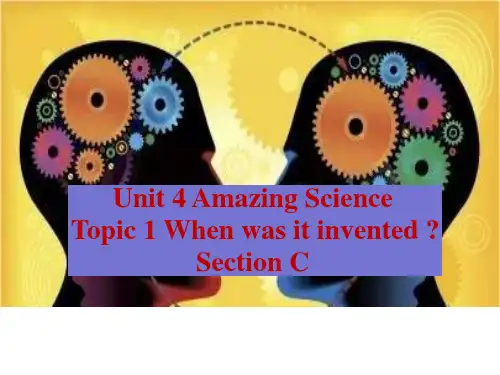
zero --- by an Indian
chopsticks---by Chinese
light bulb---by Edison
keyboard --- by an American in 1714
television --- by an Englishman
X-ray machine--- by a German
IItthisinskai_d_t_h_a_t_i_tiws tahseinmvoesntte/ldeabsyt iamnpIonrdtiaannt. iIntvisenativoenr.y
Iitnitserseasitdinthgantuimt wbaesr.iFnovrenetxeadm_p_l_e_, _I_h_a_v_e__o_n_ly. ten yuan.
Pre-reading
List some inventions that you know.
inventions
Pre-reading
List somΒιβλιοθήκη inventions that you know.
Pre-reading
Part2 Discuss:
candy
gun computer medicine balloon
If not, do more research, redesign it, and test it again.
_B_._BN__a_m_ Eevyeoruy rinivnevnetniotnionneeds a name.
Share your inventions with others.
1c. Fill in the blanks.
WriCgh.tTbersottyhoerusrainndvseanidtiothney would never fly. But
仁爱版九年级英语上册Unit4Topic1SectionC教案

Section CⅠ. Material analysis本课是九年级第四单元第一话题的第三课时。
主活动是1a。
1a 通过介绍发明是什么来继续学习一般过去时的被动语态。
学生通过完成1a的任务型阅读,知道发明创造并非遥不可及。
1b让学生学习归纳中心句。
1c把发明创造的步骤进行整合,让学生更加清楚怎样去发明创造。
2是个开放性的讨论,让学生在讨论的过程中知道发明无论大小都对我们的生活产生了巨大的影响。
3倡导学生自己去发明创造,并通过介绍自己的发明来巩固英语知识。
学生学习了本课之后,对发明创造不再感到神秘莫测,从而萌发自己动手的愿望,有利于激发学生的创造精神。
3这个写作任务,需要学生独立思考,并运用所介绍的写作小窍门。
学生在短时间内难以很好地完成,故留作家庭作业。
Ⅱ. Teaching aims1. Knowledge aims:掌握本课的重点词汇和短语,继续学习一般过去时的被动语态。
2. Skill aims:通过1b学习归纳中心句。
通过3学习写作介绍性的小短文。
3. Emotional aims: (optional)激发学生大胆思考、勇于创造的精神。
4. Cultural awareness:(optional)Ⅲ. The key points and difficult points1. Key points:Words and phrases: invention, crayon, thought, silly, balloon, gun, robot, keyboard, come about, laugh at, come toSentences: That’s why now we have planes.This is the time to brainstorm for ideas and to evaluate them. Grammar: was/were + pp2. Difficult points:Inventions come about in many ways.None of these things was planted in fields.Remember that no idea is too silly.Ⅳ. Learning strategies能够通过1a的Pre-reading来预测文章的内容。
仁爱版英语九年级上册Unit 4 Topic 1 Section C 教案
5.Many children like blowing _____(ballon).
Sum up
we learn :
1.Some words:
invention, crayon, thought, silly, balloon, gun, robot, keyboard
根据句意,用所给单词的适当形式填空。
1.Fax machines were a wonderful ______(invent) at that time.
2.I have bought many _____(crayon) for my daughter.
3.He was killed by a _____ (gun) in the war.
自学方法:精读1a,根据文意在1c局部填入适当单词。
自学要求:独立完成1c
自学时间:5分钟
自学检测四
Answers: imagination ;important ;detailed
test; name ; share
大局部学生能根据文意匹配各段的小标题。
进展精读后,大局部学生能顺利完成1c.
当堂
练习
2.Some phrases:
laugh at,come about,the result of …,none of …,share..with…
3. Some sentences:
Inventing is interesting and exciting and everyonecan be an inventor .
We can:Talk about the process of an invention.
Unit 4 Topic 1-Section C课文讲解-仁爱版英语九年级上册

An invention may be a new product or a new way of doing things. Inventions come about in many ways. Most of the time, inventions happen because someone works to solve a problem. Sometimes inventions are the result of accidents.
An invention may be a new product or a new way of doing things. Inventions come about in many ways. Most of the time, inventions happen because someone works to solve a problem. Sometimes inventions are the result of accidents.
Q:What is an invention? An invention may be a new product or a new way of doing things.
invention n.发明,创造 invent v. 发明,创造 inventor n. 发明者,发明家 e.g. Tomas Edison was a great American inventor.
一般过去时中的被动语态:was/were + done
e.g. 1.这些窗户是昨天被Jack打破的。 The windows were broken (break) by Jack yesterday. 2.上周被偷了多少钱? How much money was stolen (steal) last week?
九年级英语仁爱版上册Unit4_Topic1_SectionC_分层训练
Unit 4 Amazing ScienceTopic 1 When was it invented?Section C一、根据首字母提示补全单词1.The girl stood by the window, deep in t .2.Look out! The bank robbers have got g .3.As we know, Internet is also a kind of i that is used widely throughout the world.4.How s you all are! An elephant can’t be like a wall.5. A large b is made of strong material and is full of hot gas to make it rise in the air.二、单项选择1.The historical drama Serenade of Peaceful Joy has received high praise for its story, costume, and make-up since it ________ on screen on April 7th.A.was put B.is put C.has been put D.will be put2.--Can Mr. King spare some time for the charity show?--If he ___, he will try his best to make it.A.will be invited B.is invitedC.invites D.invited3.Frank was made________ in the front of the classroom to share his ideas about English learning. A.stand B.stood C.to stand D.standing4.—Your hometown has changed a lot.—Yes. Have a look at these tall building. They _________ last year.A.build B.built C.were built D.was built5.—How many people will come to the party this evening?—About 15 people _____________.A.were invited B.invited C.will invite D.invite6.China's Long March 5B carrier rocket into space in Hainan Province on May 5,2020.A.sent B.was sent C.was sending三、语法填空You have to be careful when throwing away wet rubbish, which may include food or other kinds ofrubbish. Maybe these kinds of waste have made a big mess when you've thrown 1.(they) away before.Shi Yuan, 14, from Shanghai Wenlai Middle School, has made a special plastic bag to solve this problem. 2.plastic bag has a band of adhesive tape (粘贴带). When one end of the tape is open, the bag can 3.(turn) upside-down. You can hold the bottom end and throw wet rubbish into a trash can 4.(easy).Shi came up with the idea after an unpleasant experience in which he got wet waste all over his pants while throwing it away. He found that many other people had the same problem. He decided to solve this problem and 5.(invent) his special bag.He first thought about using a gunny (麻布) bag or placing a bag break on his trash cans. But 6.of these ideas worked. So he decided to just design his own rubbish bag. "I didn't want to put any extra burden (负担) on the bag, so I used adhesive tape." Shi said.7., the bag he made first was a one-off product and not environmentally friendly. So Shi kept on improving his design.He remembered 8.(read) about the adhesive used for Post-it notes (便利贴). Shi thought this weak glue could be used for the adhesive tape and allow the rubbish bag to be reused.So far, he 9.(sell) 2 million bags online. His bag has become popular in many communities. His father is quite proud of him." 10.(child) like to play. Shi just changed the way he 'plays' and put his mind toward looking for a way to make life easier," Shi's father said.参考答案一、1. thought 2. guns 3. invention 4. silly 5. balloon二、1.A【解析】句意:历史剧《平安的小夜曲》自4月7日上映以来,其故事情节、服装和化妆都受到了高度赞扬。
新仁爱版九年级上册英语全册教案
Unit 1 The Changing WorldTopic 1 Our country has developed rapidlySection AⅠ. Material analysis本课是九年级第一单元第一话题的第一课时。
本课内容丰富,主活动为1a和3。
1a部分通过“谈论假期经历”初步感知现在完成时“have/has been to 和have/has gone to” 的用法。
1b引导学生运用抓关键字词完成表格的方法,培养学生的听力技能。
1c 则是培养学生运用关键词复述课文的能力。
2a通过创设新的语境,在听的过程中进一步体会“have /has been to 和have/has gone to”。
然后在2b中让学生通过小组合作的方式总结它们的区别。
通过前几个步骤的学习,学生完全可以口头运用“have/has been to 和have /has gone to”来进行3的对话操练。
这样,在听、说、读、写各个方面都对新语法进行了全方位地复现和操练,有利于巩固新知识。
通过谈论假期生活,既可以相互增长见识又可以增进同学间的友谊。
Ⅱ.Teaching aims1.Knowledge aims:掌握本课的重点词汇和短语,初步学习现在完成时。
2.Skill aims:培养学生的听力能力。
培养学生的口语表达能力。
能通过整合对话内容,提升综合语言运用能力,为语言输出做好准备。
3.Emotional aims: (optional)引导学生了解不同的假期生活,热爱生活,增进友谊。
4.Culture awareness: (optional)通过了解不同的假期生活,引导学生关注不同的生活方式有不同的人生意义,培养他们热爱生活的品质。
Ⅲ. The key points and difficult points1. Key points:Words and phrases: bell, take place, volunteer, have/has been to…, have/has gone to…, so…that…, by the way, be happy to do…Sentences: There goes the bell. /It must be fun.Grammar: Present Perfect (have/has been to和have/has gone to的用法)2. Difficult points:能通过听、说和读的方式感知并掌握have/has done的用法。
仁爱版九年级英语UNIT4Topic1SectionD优秀教学案例
一、案例背景
本案例以仁爱版九年级英语Unit 4 Topic 1 Section D为教学内容,旨在通过创设情境、引导探究、合作交流等教学策略,帮助学生掌握一般过去时的用法,提高语言运用能力。本节课的主要内容是讨论过去发生的事情,学生需要通过听、说、读、写等多种方式感知、理解和运用一般过去时。在教学过程中,教师关注学生的个体差异,充分调动学生的学习积极性,使他们在真实、有意义的情境中学习英语,提高他们的语言素养。
1.理解一般过去时的概念,明确一般过去时表示的动作发生在过去,与现在无关。
2.掌握一般过去时的构成,即动词的过去式。
3.学会运用一般过去时描述过去发生的事情,并能正确运用助动词did进行疑问句和否定句的构造。
4.了解一般过去时的常用时间状语,如yesterday, last week, a year ago等。
5.能够听、说、读、写关于过去发生的事情的句子,提高语言运用能力。
为了达到上述知识点,教师在教学过程中应通过讲解、示范、练习等多种方式,引导学生逐步掌握一般过去时的用法。同时,通过设置各种语言实践活动,让学生在实际语境中运用一般过去时,提高他们的语言运用能力。
(二)过程与方法
本节课的过程与方法主要体现在以下几个方面:
4.反馈与评价:教师及时给予学生反馈,指导他们调整学习策略,提高学习效果。同时,采用形成性评价与终结性评价相结合的方式,对学生的学习过程和成果进行评价。
(三)情感态度与价值观
在本节课中,教师注重培养学生的情感态度与价值观,具体体现在以下几个方面:
1.激发学习兴趣:教师运用人性化的语言和生动的教学手段,激发学生学习英语的兴趣,使他们愿意主动参与课堂活动。
仁爱版九年级英语上册课件Unit 4 Topic 1 Section C
c. 特别注意: ① —— How many people are there in that room?
—— None. ② —— Who is in that room now?
—— No one.
for certain 确切地
—— How much will the car cost? —— I can’t say for certain.
none of them want to work for him for long. 4.Hearing thee_x_c_it_i_n_g__ news, all of us felt _e_x_c_it_e_d_
(excite). 5.The U.S.A. is m__o_r_e_d_e_v_e_lo_p_ed (develop) than any other
A. No one B. None
C. Someone
Have you ever seen a robot? Would you like to describe it for us?
Find and circle the words in 1a according to the following meanings, then write them down.
1. to tell somebody that something bad or dangerous may happen so that they can prevent it ( warn )
2. to make something happen or appear( cause ) 3. a person who is paid to do house work for a family (servant) 4. sure and confident, without any doubts(certain) 5. to behave in a special way towards somebody or