
牛津译林版八年级下册Unit 5 Good manners 教案2
Unit 5 Good manners 教案
教学目标:
1、能够读懂有关英国礼仪习惯的采访。
2、通过阅读,了解不同国家的礼仪习惯。
教学重点:
1、词汇:proper, kiss, close, conversation, avoid, subject, public, push, touch, excuse, till, loudly.
2、词组:shake sb’s hand, in public, push in, in one’s way, excuse me, as well as.
教学难点:
句型:
1、Wh at’s the proper way to greet people there?
2、British people only greet relatives or close friends with a kiss.
3、They’ll say “excuse me” and be polite enough to wait till you move.
4、When in Rome, do as the Romans do.
教学准备:
1、有关英国礼仪的图片或者视频。
2、教学卡片。
3、配套磁带或者关盘。
教学过程:
Step 1 呈现:
1、复习前一课时上的内容,通过图片展示前一课的场景,问学生:Can you tell me what we should and shouldn’t do in these public places?
2、头脑风暴:中国有哪些传统礼仪习惯,鼓励学生畅所欲言。
3、教师询问学生是否知道西方国家不同于我国的礼仪习惯,鼓励学生发表自己的观点。
4、教师呈现有关英国礼仪的图片或者视频,让学生呢个进行描述,同时呈现本课新单词和词组。
例如展示一张英国人见面握手的照片,教师引导学生描述该图片:British people shake hands when they meet for the first time. 呈现新词组:shake sb’s hand.
Step 2 阅读:
1、让学生快速阅读文章,并回答两个问题:
What is the conversation about?
Good manners in the UK.
Who is Daniel talking to?
Jenny.
2、教师分段播放课文录音,让学生边听录音边思考下面的问题:
Part 1
What is the proper way to greet people in the UK?
Who do they greet with a kiss?
Part 2
How do British people start a conversation?
Do they talk about age?
How do they behave in the public?
Part 3
Are British people polite at home?
What else should we pay attention to in public?
Step 3 操练:
1、教师让学生完成B1 部分的练习,如学生无法判断词义,可以根据上下文猜测答案。
全班核对答案,让学生朗读并且翻译单词。
2、指导学生完成B2be分的练习。
让几位学生用完整的句子说出英国人的礼仪习惯,如:They say “hello” or “nice to meet you” when greet people. They don’t talk about age, weight or money. 全班核对答案。
3、让学生集体跟着录音朗读课文,然后完成B3 的练习。
在填写的时候,教师可以巡视并指导和纠正,然后让学生朗读。
全班核对答案。
4、学生两人一组,分别扮演Daniel 和Jenny,朗读课文对话,加深对课文内容的理解。
挑选几组不同层次的学生表演对话。
Step 4 活动:
1、学生四人一组,每组制作一张英国礼仪习惯卡片。
2、学生完成卡片后,教师让每组分别上台展示卡片,要求学生用英语贾绍英国的礼仪习惯。
3、展示后,教师可以收齐各组卡片,课后张贴在教室的墙上,供学生欣赏,学习各组的成果。
Step 5 家庭作业:
1、熟读课文,能力较强的学生背诵。
2、完成教师布置的相关练习。
2020-2021学年牛津译林版八年级下册Unit5GoodmannersTask教案

(五)总结回顾(用时5分钟)
今天的学习,我们了解了良好礼貌的基本概念、重要性和应用。同时,我们也通过实践活动和小组讨论加深了对良好礼貌的理解。我希望大家能够掌握这些知识点,并在日常生活中灵活运用。最后,如果有任何疑问或不明白的地方,请随时向我提问。
3.文化意识:加强学生对中华传统文化中礼貌观念的理解,同时了解并尊重其他国家的礼貌习俗,提升学生的跨文化交际意识。
4.学习能力:通过小组合作、课堂讨论等活动,激发学生的学习兴趣,培养自主学习、合作学习和探究学习的能力,使其养成良好的学习习惯,为终身学习奠定基础。
三、教学难点与重点
2020-2021学年牛津译林版八年级下册Unit 5 Good manners Task教学难点与重点:
- Writing: Writing a short paragraph about good manners and their importance.
4.课堂活动:通过小组讨论、角色扮演、听力练习等形式,让学生在实际情境中学会运用所学知识,提高英语综合运用能力。
5.课后作业:让学生观察并记录身边人的礼貌行为,下节课分享,以巩固所学内容。
2.一般现在时的正确使用:在描述礼貌行为时,学生可能会混淆时态,特别是在口语表达中。
难点解释:学生在口语交流中可能会因为紧张或语法掌握不牢固而错误地使用时态,如使用过去时来描述普遍的礼貌行为。
3.跨文化交际的理解:理解不同文化中礼貌行为的表现形式,并能在实际情境中恰当运用。
难点解释:学生对不同文化背景下的礼貌行为可能缺乏直观的认识,难以在实际交流中灵活运用。
然而,我也注意到,部分学生对文化差异的认识仍不够深入。在今后的教学中,我将加强对不同文化背景下礼貌行为的讲解,帮助学生拓展国际视野,提高跨文化交际能力。
牛津译林版八年级英语(下)教案 Unit 5 Good manners Reading 2 教案

徐州市教学改革实验学校教师备课设计页课题8下Unit 5 Good manners Reading 2 课型Reading教具Recorder and multimedia 总课时数40 完成时间4.21教学方法Task-based approach,Scene pedagogy andTeaching with humor主备人Zhang Xizhi授课时间4.29教学目标知识与能力:1To grasp the expression about the text.2 To train the Ss’ comprehension ability3 To learn some language points过程与方法:1.to listen to the reading the answer some questions.2.to get the Ss to talk about the manners in UK without books.情感态度与价值观:To develop the Ss’good manners in different countries.教学重点难点1.To grasp the expressionabout the text.2. To train the Ss’comprehension ability3. To learn some languagepoints教学活动内容活动组织过程改笔【前置学习】1、回顾复习:1.如果有人挡住了我们的路,我们该怎么办?2.在公共场所要尽量压低声音。
3.在英国和别人打招呼的合适方式是什么?2、自学教材P66-67知识点和难点3、自学检测:Dictation【自主探究】Step1 Revision1 How do British people greet each other?/…?2 Create new situations and make students say something more about customs in the UK.Mini-dictionaryavoid(1ine 9) vt.stay clear from;keep away from (避免)Please avoid talking about her age.conversation(1ine 7) n.an informal talk (<非正式>交谈,谈话)You can start the conversation first.loudly (line 22) adv.with relatively high volume (大声地)This lady never talked loudly in public.proper (1ine 2) adj.socially and normally acceptable;right.appropriate or correct (符合习俗的;正确的)She is always proper in her behaviour.public (1ine 10) n. ordinary people in society in general (民众,群体)The palace is now open to the public.saying (1ine 25) n. a well-known phrase or statement (成语, 谚语) To translate the sentencesmake students say somethingmore about customs in theUKCheck out thehomework and thepreview.To go over theexpressions in theconversation.To talk about themanners in UK,then inMy grandpa knows a lot of English sayings.subject (line 9) n. a thing or person that is being discussed or described (话题;主题) This book includes many different subjects.touch (line15) vt. put your hand or another pan of yore body onto sb/sth (触摸、碰) You cannot touch that thing·as well, in one’s way, in public, push in, shake sb’s hand(1) My classmates love music. I love it ________________. (as well)(2) It is impolite to _________________before others. (push in)(3) We should not speak loudly_____________. ( in public )(4) Chinese people usually ______________when they meet you for the first time.(shake your hand)(5) Please do not stand___________________ . I am in a hurry. (in my way)Step2. Practice1 Think and discuss about the customs in China, and make students finish the exercise ofPart C on P 69 We’ve learnt about the good manners In the UK。
牛津译林版八年级英语下册《Unit5Goodmanners》教案

Unit5 Good manners课时:第 1 课时Teaching aims:To learn some expressions on manners and arouse the Ss’ interest in learning this unit. Step 1 PresentationPresent some new words and phras es of this unit:manners, cut in on sb./sth., politely, litter, tap, run, pick, obey, queueStep 2 ListeningListen to the conversation between Eddie and Hobo.Step 3 Watch and answer the questions.1. Do you think Eddie really wants to teach Hobo?No.2. What does Eddie teach Hobo?First, always share things with ot hers. Second, don’t cut in on others. Always wait politely.3. What does Eddie really want from Hobo?The cake.Step 4 Reading1. Look at the pictures on page 65 and answer the questions.1) What should the boy do when he crosses the road?2) What is the girl doing?3) What should we do in the library?4) What are t he man and the woman doing?5) What is the man doing?6) What did the boy do?2. Complete A on page 65. Then ask Ss to sum up what we should and should not do.Step 5 Listen to B on page 65 and complete the form.Listen to the conversation between Amy and Shirley, then complete the form.Give some picture.Work in pairs and discuss what we should and should not do in a public place. Use the conversation as a model.Step 7 Language points1. You’re old enough to learn about manners now.sb.+ be +adj.+ enough to do sth. 某人足够……做某事2. You’re never too old to learn. 活到老,学到老。
牛津译林版英语八下Unit5《Goodmanners》(welcome)说课稿

牛津译林版英语八下Unit 5《Good manners》(welcome)说课稿一. 教材分析《牛津译林版英语八下Unit 5 Good manners》是一篇关于日常礼仪的文章,通过描述不同场景下的礼貌行为,引导学生了解和掌握英语中的礼貌用语和行为规范。
本节课的主要内容是学习日常生活中的礼貌用语和行为,包括问候、道歉、道谢、邀请等。
文章中提供了一系列真实的场景,让学生在实际语境中学习英语,提高他们的语言运用能力。
二. 学情分析在学习本节课之前,学生已经掌握了基本的英语语法和词汇,具备一定的听说读写能力。
然而,对于一些日常礼仪的表达和运用,学生可能还不够熟悉。
因此,在教学过程中,教师需要关注学生的个体差异,针对不同学生的学习需求进行引导和帮助。
三. 说教学目标1.知识目标:学生能够掌握日常生活中的礼貌用语和行为,如问候、道歉、道谢、邀请等。
2.能力目标:学生能够在实际场景中运用英语进行礼貌交流,提高他们的语言运用能力。
3.情感目标:学生能够认识到礼貌的重要性,培养良好的品德素养。
四. 说教学重难点1.重点:学生能够掌握日常生活中的礼貌用语和行为。
2.难点:学生能够在实际场景中运用英语进行礼貌交流,提高他们的语言运用能力。
五. 说教学方法与手段1.情境教学法:通过设置真实的生活场景,让学生在实际语境中学习英语,提高他们的语言运用能力。
2.任务型教学法:通过完成各种任务,激发学生的学习兴趣,培养他们的合作意识和解决问题的能力。
3.互动式教学法:引导学生积极参与课堂活动,加强师生之间的互动,提高课堂效果。
六. 说教学过程1.导入:教师通过与学生互动,引导学生谈论日常生活中的礼貌行为,激发学生的学习兴趣。
2.新课展示:教师展示文章,引导学生阅读,理解文章内容。
3.课堂讲解:教师讲解文章中的重点词汇和语法,帮助学生理解和掌握。
4.实践环节:教师设置真实的生活场景,让学生分组进行角色扮演,实际运用英语进行礼貌交流。
牛津译林版八年级英语下册Unit5Goodmanners教案
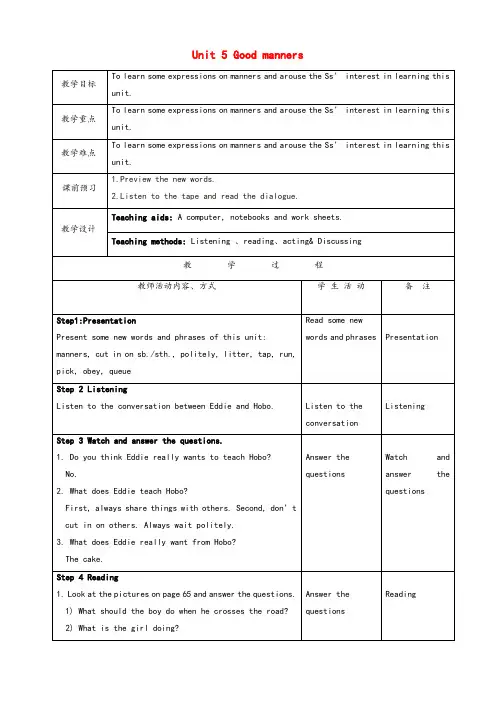
Listen to the conversation
complete the form.
Listen to B on page 65 and complete the form.
教学设计
Teaching aids:A computer, notebooks and work sheets.
Teaching methods:Listening、reading、acting& Discussing
教学过程
教师活动内容、方式
学生活动
备注
Step1:Presentation
Present some new words and phrases of this unit:
教学设计
Teaching aids:A computer, notebooks and work sheets.
Teaching methods:Task—based approach,Power Point
教学过程
教师活动内容、方式
学生活动
备注
Step 1 Revision
Translate them into English:
— No, _____ _____ _____.
2.我们不应摘公园里的花.We___ ___ ___ the flowers in the park.
3.我们必须遵守交通规则。We must _____ ______ ______.
Complete the exercises
Exercises
Step 9 Homework
牛津译林版八年级下册教案:Unit 5 Good manners Reading 2 教案

徐州市教学改革实验学校教师备课设计页课题8下Unit 5 Good manners Reading 2 课型Reading教具Recorder and multimedia 总课时数40 完成时间4.21教学方法Task-based approach,Scene pedagogy andTeaching with humor主备人Zhang Xizhi授课时间4.29教学目标知识与能力:1To grasp the expression about the text.2 To train the Ss’ comprehension ability3 To learn some language points过程与方法:1.to listen to the reading the answer some questions.2.to get the Ss to talk about the manners in UK without books.情感态度与价值观:To develop the Ss’good manners in different countries.教学重点难点1.To grasp the expressionabout the text.2. To train the Ss’comprehension ability3. To learn some languagepoints教学活动内容活动组织过程改笔【前置学习】1、回顾复习:1.如果有人挡住了我们的路,我们该怎么办?2.在公共场所要尽量压低声音。
3.在英国和别人打招呼的合适方式是什么?2、自学教材P66-67知识点和难点3、自学检测:Dictation【自主探究】Step1 Revision1 How do British people greet each other?/…?2 Create new situations and make students say something more about customs in the UK.Mini-dictionaryavoid(1ine 9) vt.stay clear from;keep away from (避免)Please avoid talking about her age.conversation(1ine 7) n.an informal talk (<非正式>交谈,谈话)You can start the conversation first.loudly (line 22) adv.with relatively high volume (大声地)This lady never talked loudly in public.proper (1ine 2) adj.socially and normally acceptable;right.appropriate or correct (符合习俗的;正确的)She is always proper in her behaviour.public (1ine 10) n. ordinary people in society in general (民众,群体)The palace is now open to the public.saying (1ine 25) n. a well-known phrase or statement (成语, 谚语) To translate the sentencesmake students say somethingmore about customs in theUKCheck out thehomework and thepreview.To go over theexpressions in theconversation.To talk about themanners in UK,then inMy grandpa knows a lot of English sayings.subject (line 9) n. a thing or person that is being discussed or described (话题;主题) This book includes many different subjects.touch (line15) vt. put your hand or another pan of yore body onto sb/sth (触摸、碰) You cannot touch that thing·as well, in one’s way, in public, push in, shake sb’s hand(1) My classmates love music. I love it ________________. (as well)(2) It is impolite to _________________before others. (push in)(3) We should not speak loudly_____________. ( in public )(4) Chinese people usually ______________when they meet you for the first time.(shake your hand)(5) Please do not stand___________________ . I am in a hurry. (in my way)Step2. Practice1 Think and discuss about the customs in China, and make students finish the exercise ofPart C on P 69 We’ve learnt about the good manners In the UK。
牛津译林版八下《Unit 5 Good manners Period 2》教案
Good manners教学目标知识目标To talk about good table manners.能力目标Know the interview of British mann ers教学重点The same as the aims教学难点Establish the sympathy for the weak, the helpfulness ofconsciousness教师活动学生活动备课札记Step 1.Warm up1. Ask the students to work in pai rs.Tell the Ss to look at the pictures in th e book and pr actise the short conversations,using the phrases.Introduce British traditional daily manners and show some pictures of mannersin public places.2.Can you tell me what we should and should’t do in these public places?Ss: tell different answers.3.Show some pictures and videos to learn some new phrases.Step 2: Listen and answer the questions.1. Ask Ss to read in pairs and answer the following two questions.Q1. What is the conversation about?Q2.Who is Daniel talking to?2.Teacher plays the tape at the same time think over the followwing questions.Q(1).What is the proper way to greet people in the UK? Q(2).Who do they greet with a kiss?Q(3).How do British people start a conversation?Q(4).How do they behave in public?Q(5).What e lse should we pay attention to in public? Step 3: Practise1.Ask ss to read the Reading in pairs aloud .2.Finish SS books B1 and check the answers.Try to learn the new wordsPractice and actTalk about the picture.Listen and answerListen and answerPractice and act.3.Finish Part B2 and say out Brisith manners .4.Ask SS to read together af ter the tape .Step 4. DiscussionWork in pairs and discuss what we learn from the UK in a public place.Step 5. ConclusionSum up what we have learned this lesson. HomeworkStep 6. Homework课堂板书教学反思。
译林版英语八年级下册Module 2 Unit 5 Good manners 教案
Module 2Unit 5 Good manners教案Teaching aims:1. Learn about kinds of knowledge of manners.2. Talk about how to behave well in public in English.3. Develop the students’ good behavior habits.Teaching importance:Some key words, phrases &sentences, e.g.1. Politely, litter, run, pick, turn,2. Cut in on sb/sth, drop litter, keep quiet, pick flowers3. You are old enough to learn about manners. You are never too old to learn.Don’t drop litter everywhere.Teaching aids:Tape recorder, slide show, computer, multimedia education softwareTeaching steps:Step 1 Warming up:1. Ask the students to work in pairs. Tell the Students to look at the pictures in the book and practice the short conversations, using the phrases.T says: Today we talk about good manners. In fact, good manners are basically as set of behaviors that people may reasonably expect.2. Look at the pictures.Are people doing the right things or wrong things?They discuss in pairs.Step 2 Presentation1. Answering the following questions: What should the boy do when he cross the road?What is the girl doing? What should we do in the library? What are the man and the woman doing? What is the man doing? What did the boy do?Step 3 Speaking1. Ask Students to work in pairs and consider the following three situations.2. Ask them to read each situation carefully and make sure that they all understand it.3. Get Students to make up a short dialogue, to solve each specific small problem smoothly and ina polite manner.Step 4 Practice1. Asking the question: Do you think Hobo will share things with others? What about Eddi? Encourage them to answer freely.2. After listening, answer the questions: DO you think Eddie really want to teach Hobo? What does Eddie teach Hobo? What does Eddie really want from Hobo?3. Organize the whole class to read.Step 5 Homework1.朗读课文。
牛津译林版英语八下Unit 5《Good manners》(reading2)教学设计
牛津译林版英语八下Unit 5《Good manners》(reading2)教学设计一. 教材分析牛津译林版英语八下Unit 5《Good manners》(reading2)主要讲述了一位美国学生Brian在英国寄宿学校的生活经历。
通过阅读,学生可以了解到不同国家的礼仪差异,以及如何在与他人交往中表现出良好的礼仪。
文章以故事形式展开,包含了许多日常生活中的礼仪场景,如餐桌礼仪、排队等候、访客礼貌等。
本文旨在培养学生对英语阅读的兴趣,提高他们的阅读理解能力,并学会在实际生活中运用所学到的礼仪知识。
二. 学情分析学生在学习本课时,已经掌握了基本的英语语法和词汇,具备一定的阅读理解能力。
但学生在实际运用英语进行交流时,还需加强对礼仪用语和表达方式的掌握。
此外,学生对英国文化及其礼仪的了解程度不一,因此在教学过程中,教师需注意文化差异的导入和引导。
三. 教学目标1.知识目标:–学生能掌握文章中的重点词汇和短语,如“table manners”、“queue”、“courtesy”等。
–学生能理解文章的主旨大意,概括Brian在英国学校的生活经历。
2.能力目标:–学生能提高阅读理解能力,快速捕捉文章中的关键信息。
–学生能在日常生活中运用所学到的礼仪知识,进行得体的交流。
3.情感目标:–学生能认识到礼仪的重要性,尊重他人,展现出良好的社交礼仪。
四. 教学重难点•文章中的重点词汇和短语。
•学生对英国礼仪文化的了解和认识。
•学生如何在实际生活中运用所学到的礼仪知识。
•学生对文章中细节信息的把握和理解。
五. 教学方法1.情境教学法:通过设定各种生活场景,让学生在实际语境中学习和运用礼仪知识。
2.任务型教学法:引导学生参与各种小组活动,培养学生合作学习的能力。
3.文化导入法:介绍英国礼仪文化,帮助学生理解和尊重文化差异。
六. 教学准备1.教师准备:–熟悉教材内容,明确教学目标。
–搜集相关英国礼仪文化的资料,以便在教学中进行导入和引导。
2017年牛津译林版英语八年级下Unit5Goodmanners全单元教案
课题8B Unit 5 Good mannersWelcome to the unit & comic strip课时 1 授课时间2016 年4 月26日教学目标To know about the good manners in public.To talk about how to behave politely in public.To get students to develop the habit of good manners.教学重难点To know about the good manners in public. (Importance) To talk about how to behave politely in public. (Importance) To talk about how to behave politely in public. (Difficulty)预习要求To think about how to behave politely in public.教学内容及活动设计二次复备及教学随感Step 1 CheckingLet the students try to read the new wordsStep 2 Lead –in1.Free talkDo you want to be good citizens(公民)? How can you be good citizens?2. Show some pictures and ask if they are doing the right thingsStep 3 LearningLet the Ss look at the pictures in Part A on Page 65 and teach somephrasesStep 4 Practising1.Finish Part A on Page 652.Let the students answer some questions about the picturesStep 5 Lead-inAsk: What should we do and shouldn’t we do in the library?Step 6 LearningListen to the conversation on Page 65 and fill in the formIn the libraryWe should ______ ___________ the library ___________ _____ the books after readingWe shouldn’tchat or _____ in the library_____ _____ everywhere_____ in the booksStep 7 PracticeDiscussion:What should we do in a public place?We should….What shouldn’t we do in a public place?We shouldn’t….Step 8 Lead-inAsk: Do you think Hobo will share his things with others? What about Eddie?Step 9 Learning1.Read and answer the following questions.(1). Do you think Eddie really wants to teach Hobo?(2). What does Eddie teach Hobo?(3). What does Eddie really want from Hobo?nguage pointsStep 10 PracticeRead the conversation aloudStep 11 TestingTranslate some phrasesStep 12 Homework1.记忆词汇、词组和句型。