
牛津译林版 7上U1-U2复习要点
7上单元复习要点
(unit1)
一短语
an e-dog 一只电子狗
greet each other 互相问候
my master 我的主人
read this book 看书
new friends 新朋友
the first day 第一天
look after =take care of 照顾
how to look after your e-dog
如何照顾电子狗
Nice/Glad to meet you 见到你很高兴
read this book 看书
read newspapers 看报纸
watch TV 看电视
watch a match 看一场比赛
in Class 1,Grade 7 在七年级一班
welcome to --- 欢迎到……Sunshine Middle School 阳光中学
twelve years old 十二岁
my new classmate(s) 我的新同学
play football 踢足球
after school 放学后
tall and slim 又高又苗条
be / come from Nanjing 来自南京
be good at Maths 数学好
over there 在那边
an English teacher/ a teacher of English一位英语老师
have short/ long hair 留有短/长发
play games 玩游戏
listen to music 听音乐
fly kites 放风筝
go home late 回家迟
cute baby 可爱的婴儿
wear glasses 戴眼镜
at school/ home 在学校/ 家
all the lessons/ subjects 所有的功课/课程
二句型
how to do sth 怎样做某事,如何做某事
love doing sth. =like doing sth./enjoy doing
喜爱/喜欢做某事
be (am, is, are) good at sth. 擅长某
事
be (am, is, are) good at doing sth
擅长做某事
be good at = do well in
be (am, is, are) from… 来自于…
= come from…
12 years old 十二岁
12-year-old 十二岁的
数字+ years old常用来作表语;
数字+ -year-old常用来作定语
be nice / kind to sb 对某人好
(unit2)
一短语
walk to my bowl 走到我的碗
many times a day 每天很多次
walk home 步行回家
walk to school 步行上学
my favourite football star 我最喜欢
的足球明星
a member of Huanghe Football Club
黄河足球俱乐部的一员
live in--- 住在……
look strong 看起来强壮
play football well 踢足球好
=be good at playing football
every day 每天
in his free time 在他的空闲时间里
study English 学习英语
enjoy listening to music 喜欢听音乐
make him happy 使他快乐
play football in the next World Cup
在下一届世界杯踢球
come true 实现
play volleyball / basketball/ tennis
打排球/ 篮球/ 网球
go swimming / walking 去游泳/ 散
步
on TV 在电视上
play ball games 玩球类游戏
at/on weekends 在周末
watch football games/matches 看足
球比赛
watch TV 看电视
stay at home 呆在家里
make me feel great 使我感觉很好
a lot of interesting books 许多有趣
的书
talk about---讨论
talk to/ with sb 和某人交谈
go shopping 去购物
of course 当然
dream of –梦见……
a bowl of --- 一碗……
go for a walk 去散步
= go walking
the Reading Club 读书俱乐部
a happy family 一个幸福的家庭
don’t worry 别担心
stop crying 停止哭
cook dinner for sb 为某人做饭
all her friends 她所有的朋友
二、句型
want sth 想要某物=would like sth
want to do sth. 想要做某事
=would like to do sth
my favourite …… 我最喜欢的
like …best 最喜欢……
like…very much 非常喜欢…
look, sound, smell, taste 系动词
+ 形容词
看起来/ 听起来/ 闻起来/ 尝起
来……
make sb. happy 使某人高兴
make sb + 形容词使某人……
make sb do sth 让某人做某事
a member of……的一名成员
=in---
enjoy oneself = have a good time
玩得高兴,过得愉快
come from 来自于……= be from
What about sth/ doing ?
what else --- “其余什么”=what
other things
feel happy /cold/ sad 感到高兴/ 冷
/ 难过
give ab sth = give sth to sb 给某人某
物。
牛津译林版七年级上册英语Units1-2单元知识点整理

牛津译林版七年级上册英语Units1-2单元知识点整理Unit 1-2知识点Unit 11.an e-dog2.my master我的主人3.the first day at XXX在XXX的XXX向你同学介绍你XXX把A介绍给Bintroduce Lucy to Mary把XXX介绍给XXX5.XXX互相问好6.what they say他们说了什么7.in Class 1.Grade 78.What greetings do you often use?你经常使用什么问候语?9.work in pairs两人一组练10.I have short hair。
= My hair is short.11.XXX(形容词)12.play XXX下学后踢足球XXX.XXX13.Her hair is long。
= She has long hair.14.be from = come fromHe is from Nanjing。
= He comes from Nanjing.Is he from Nanjing。
= Does he com e from Nanjing?He isn’t from Nanjing。
= He doesn’t come from Nanjing.Where is he from。
= Where does he come from?15.11 years old(后置定语)= eleven-year-old(前置定语)She is eight years old。
= She is an eight-year-old girl.16.be good at doing/sth。
= do well in doing/sthShe is good at singing。
= She does well in singing.XXX’t do well insinging.117.XXX同XXX同桌XXX室友18.Are you happy?be+形容词She is sad.19.some pictures of her new classmates一些她新同学的照片20.talk to sb。
牛津译林版英语七年级上册各单元重点总结
牛津译林版英语七年级上册各单元重点总结Unit 1: Greetings and Introductions- Key phrases: Hello, Hi, Goodbye, Nice to meet you, What's your name?, My name is...- Basic conversation skills: Greeting people, introducing oneself and others- Vocabulary: Greetings, names of people and countriesUnit 2: Classroom Language- Basic classroom instructions: polite ways to ask for permission, give instructions, and perform actions- Vocabulary: Classroom objects, actions, and instructionsUnit 3: Numbers and Colors- Key phrases: How old are you?, What's your favorite color?, It's red.- Basic conversation skills: Asking about age, talking about favorite colors, describing colors- Vocabulary: Numbers, colors, ageUnit 4: My Family- Key phrases: How many people are there in your family?, This is my mother/father/sister/brother.- Basic conversation skills: Talking about family members, describing family relationships- Vocabulary: Family members, possessive pronounsUnit 5: My School- Key phrases: What's your favorite subject?, Do you like...?, Yes, I do. / No, I don't.- Basic conversation skills: Talking about school subjects, expressing likes and dislikes- Vocabulary: School subjects, opinionsUnit 6: My Friends- Key phrases: Who's your best friend?, What does he/she look like?, He/She is...- Basic conversation skills: Talking about friends, describing appearance- Vocabulary: Words to describe people's physical appearanceUnit 7: Free Time Activities- Key phrases: What do you do in your free time?, I like playing football / reading books / listening to music.- Basic conversation skills: Talking about hobbies and free time activities- Vocabulary: Hobbies and leisure activitiesUnit 8: Daily Routines- Key phrases: What time do you get up/go to bed/eat breakfast?, I get up at.../Go to bed at.../Eat breakfast at...- Basic conversation skills: Talking about daily routines and telling the time- Vocabulary: Daily activities, timeUnit 9: Food and Drinks- Key phrases: Do you like...?, Yes, I do. / No, I don't., Can I have some...?, Sure, here you are.- Basic conversation skills: Talking about food preferences, ordering food and drinks- Vocabulary: Food and drinks, likes and dislikesUnit 10: Clothes- Key phrases: What are you wearing?, I'm wearing a T-shirt/trousers/skirt/shoes, etc.- Basic conversation skills: Talking about clothes and describing what someone is wearing- Vocabulary: Clothing itemsUnit 11: Weather- Key phrases: What's the weather like today?, It'ssunny/rainy/cloudy/windy, etc.- Basic conversation skills: Talking about the weather and describing weather conditions- Vocabulary: Weather words and phrasesUnit 12: Holidays and Celebrations- Key phrases: When is...?, It's on..., What do people do on...?, People usually...- Basic conversation skills: Talking about holidays and celebrations, discussing traditions and customs- Vocabulary: Holidays and celebrations, activities以上是牛津译林版英语七年级上册各单元的重点总结,希望对您有所帮助。
牛津译林版七年级上册英语Unit 1-Unit 4知识点总结
牛津译林版七年级上册英语Unit 1-Unit 4知识点总结Unit 1知识点总结一、单词短语1.love比like程度更深love doing/to do sth. loving doing多表示一贯的爱好,而love to do则多表示具体喜欢做的一件事。
enjoy doing sth (enjoy 译为喜欢,只能加doing)2.What's your name ? 回答:My name is .../ I’m....询问名字的方法还有:May I have your name ?/ Can you tell me your name ?3.master主人one’s master = the master of sb 某物或某人的主人Master(硕士)4.5.How to look after your e-dog.如何照顾你的电子狗。
疑问词+ 不定式(to do)如:I don’t know what to eat.look after=take care of照顾;照料I can look after myself.我能照顾我自己。
look after sb well = take good care of sb 照顾好某人look for 寻找look at 看。
look like 看起来像look out 小心(=Be careful! / Take care)look out of 朝...往外看look the same 看起来一样6.The new students in Class 1, Grade 7 at Sunshine Middle School are greeting each other.Class One Grade Seven 由小到大,都要大写用法相同的还有number ,lesson,unit,group,roomI’m in Grade 7.(对划线部分提问)What/ Which grade are you in?Our school has six grades.我们学校有6个年级。
(完整word版)译林牛津初一上册英语知识点归纳
初一英语Unit 1 This is me!短语归纳:look after \ take care of 照顾on the first day 在第一天Class 1,Grade 7 7年级1班play football 踢足球after school 放学后be\come from 来自be good at \do well in 擅长fly kite s 放风筝go home 回家listen to music 听音乐play a game 玩游戏wear glasses 戴眼镜at school 在学校all the lessons 所有的课程talk about 谈论over there 那里a lot of hobbies 许多爱好用法集萃:love\like doing sth 喜欢做某事let’s +动词原形让我们I am\My name is 我叫welcome to +地点欢迎来到This is 这是be good at \do well in doing 擅长做in Class…Grade…在几年级几班live with…in…和谁住在哪里I'm …year old。
我几岁了. I have…hair。
我留着……头发典句背诵What’s your name?你叫什么名字?Nice to meet you!很高兴见到你。
I love reading。
我喜欢阅读Now let’s meet our new classmates。
现在让我们认识下我们的新同学。
I often play football after school。
放学后我经常踢足球。
She is tall and slim. 她个头很高,身材苗条。
He is from Nanjing. 他来自南京。
He is good at Maths。
他擅长于数学.Millie is 11 years old.米莉11岁。
牛津译林版七年级英语上册 Unit1-2单元知识点复习
牛津译林版七年级英语上册 Unit1-2单元知识点复习 Unit 1重点句归纳1. Good morning.2. Good afternoon.3. Good evening.4. What’s your name?5. Nice to meet you.6. Welcome to Class 1, Grade7.7. He is from Nanjing.8. Are you good at English, Sandy?9. She loves dancing.10. Glad\Nice to meet you.11. Listen to the music. It’s nice.12. Sometimes we go home late.13. I come from Nanjing, but now I live with my family in Beijing7A Unit 2重点句归纳1. I enjoy swimming.2. What about you?3. I go swimming every week.4. What’s you r favourite sport, Simon?5. He is a new member of Huanghe Football Club.6. He looks strong and plays football very well.7. In his free time, he studies English.8. It makes him happy.9. I hope his dream comes true.10. How does he look? He looks strong.11. Li Hua also enjoys listening to music.12. Daniel sometimes watches ball games on TV.13. My mum often shops at weekends.14. Many of my students like sports.15. What else do you like to do?16. It makes me feel great.17. I read a lot of interesting books.18. Me too. Reading is fun.19. I am a member of our school basketball team.20. We often talk about basketball and watch basketball matches on TV.21. He is my hero.动词形式基础过关试题用所给动词的适当形式填空:1. Let’s _________(meet) my new classmates.2. He is good at ____________(dance) and I do well in __________(swim).3. Now he ________(live) with his family in Shanghai.4. Those students like ________(play) games.5. Now he _________(have) a nice house in his hometown.6. Now the little girl __________(not like) eating mangoes.7. What about _________(drink) some coffee? You look a little tired.8. Would you like to go ___________(shop) with us this evening?9. Listening to music makes me ___________(feel) happy.10. Those ________(play) coats are over there.11. Liu Xiang sometimes ________(study) English in his free time.12. The boy __________(not do) his homework on Friday evening.13. The old lady often _________(stay) at home to watch TV.14. ----__________(be) your mum good at cooking? ----Of course.15. Do you enjoy ________(walk) in the park?7A Unit 1~Unit 2基础过关测试根据中文写单词:1. ----Are you in _________(年级) Eight?----Of course not. I’m only 12 years old.2. I don’t think it is ________(真实的) unless you show it to me.3. There are twenty _________(成员) in the school football team.4. I often watch football matches at ___________(周末).5. His mother often ___________(购物) in Xinjiekou.用所给单词的适当形式填空:1. Now he _________(have) a nice house in his hometown.2. Now the little girl __________(not like) eating mangoes.3. Let’s _________(meet) my new cla ssmates.4. Liu Xiang sometimes ________(study) English in his free time.5. What about _________(drink) some coffee? You look a little tired.翻译词组:1. He usually _____________(看球赛) with his father on Sunday afternoon.2. Zhao Benshan always _________________(使我们开心).3. The old lady often _________(呆在家里) to watch TV.4. The tall boy doesn’t ____________(来自) Nanjing.5. The beautiful girl doesn’t like _____________(戴眼镜).单项选择:1. ----_________ does she look?----She looks very tall and slim.A. WhatB. WhenC. WhereD. How2. ----Which sound of the underlined letter is different from the others?A. deckB. denC. ebbD. eke3. Lily comes from Beijing, but now she __________ in Nanjing.A. liveB. livesC. is livingD. living4. ----_________ your twin sister good at Maths? ----Of course.A. AreB. IsC. DoD. Does5. ---- Sam, would you like to __________ with me?----Sorry, I have no bat. I have to stay at home to __________. A. play volleyball; watch TV B. play tennis; play table tennis C. play table tennis; read books D. play tennis; play volleyball。
译林版英语七年级上册第一、二单元总复习
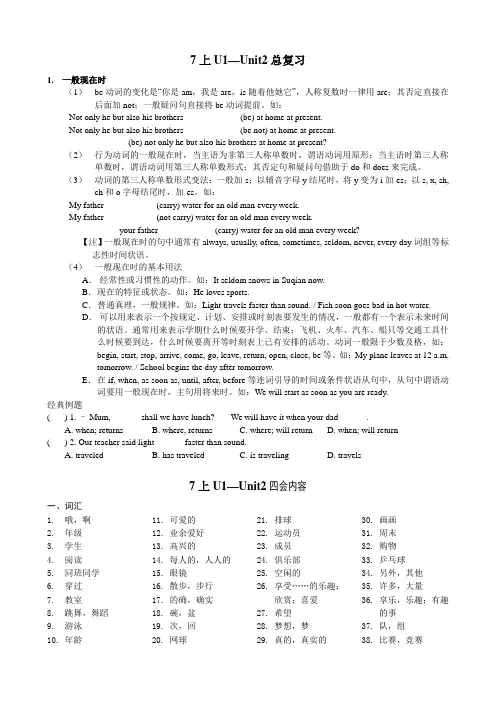
7上U1—Unit2总复习1.一般现在时(1)be动词的变化是“你是am,我是are,is随着他她它”,人称复数时一律用are;其否定直接在后面加not;一般疑问句直接将be动词提前。
如:Not only he but also his brothers ____________ (be) at home at present.Not only he but also his brothers ____________ (be not) at home at present._____________ (be) not only he but also his brothers at home at present?(2)行为动词的一般现在时,当主语为非第三人称单数时,谓语动词用原形;当主语时第三人称单数时,谓语动词用第三人称单数形式;其否定句和疑问句借助于do和does来完成。
(3)动词的第三人称单数形式变法:一般加-s;以辅音字母y结尾时,将y变为i加-es;以s, x, sh, ch和o字母结尾时,加-es。
如:My father ___________ (carry) water for an old man every week.My father ___________ (not carry) water for an old man every week.___________ your father ____________ (carry) water for an old man every week?【注】一般现在时的句中通常有always, usually, often, sometimes, seldom, never, every day词组等标志性时间状语。
(4)一般现在时的基本用法A.经常性或习惯性的动作。
如:It seldom snows in Suqian now.B.现在的特征或状态。
完整版)译林牛津初一上册英语知识点归纳
完整版)译林牛津初一上册英语知识点归纳Unit 1: This is me!In this unit。
we will learn some ___。
These include "look after" or "take care of" to mean to care for someone。
"on the first day" to refer to the first day of school。
"play football" to mean to play soccer。
"after school" to mean after classes are over。
"be good at" or "do well in" to mean to excel in something。
"fly kites" to mean to fly a kite。
"go home" to mean to return home。
"listen to music" to mean to listen to music。
"play a game" to mean to play a game。
"wear glasses" to mean to wear glasses。
"at school" to mean at the school。
"all the lessons" to mean all the classes。
"talk about" to mean to discuss something。
"over there" to refer to a place far away。
Unit1Unit2重点复习牛津译林版英语七年级上册
Unit1&Unit2 Reviewabout /in /at / of/ after+ doing 介词后+ingbe good at doing sth. 擅长于做某事have fun doing sth. 做某事很开心go doing 去做某事go swimming,go shopping,go running...spend(时间|金钱)doing sth. 花钱时间或金钱做某事be interested in (doing) sth. 对(做)…感兴趣would like to do sth. 想要做某事hope to do sth.=wish to do sth. 希望去做某事It takes sb. + 时间+ to do sth. 花费某人多长时间去做某事be ready to do sth. 准备做某事need to do sth 需要做某事| need sb to do sth 需要做某事plan to do sth 计划做某事have sth to do 有某事要去做adj.+enough to do sth 足够...做某事hate to do… 讨厌做...Unit 1 This is me!1.be from = e from 来自于... + 地点2.love doing…. 热爱做….| like doing….喜爱做…. | enjoy doing…. 喜欢、享受做….他也喜欢听音乐。
He also enjoys listening to music.3.let sb. do sth. 让某人做某事5.make sb. do sth. 使某人做某事6.help sb (to) do sth. / help sb with sth. 帮助某人做某事7. be good at (doing)... 擅长(做)某事同意词组:do well in (doing) sth.8.wear glasses 戴着眼镜9.like all the lessons 喜欢所有的功课10. play+球类运动打/踢...球11. Wele to+地点名词欢迎来到...13. be kind to sb. 对某人友好= be good to sb 对某人友好三种句式★肯定句式:主语+ be + 其他. 例如:Andy is from England. 安迪来自英国。
最新牛津译林版七年级英语上册各单元知识点提炼汇总 期末复习资料(含单词短语语法等)
牛津译林版七年级英语上册复习资料Unit1 This is me! (1)Unit2 Let’s play sports! (3)Unit3 Welcome to our school! (6)Unit4 My day (10)Unit5 Let’s celebrate! (13)Unit6 Food and lifestyle (16)Unit7 Shopping (18)Unit8 Fashion (22)Unit1 This is me!1.love/like/enjoy doing sth 热爱/喜欢/享受做某事love/like to do sth2.a/the master of.... ....的主人3.Now,read this book. 祈使句,表达命令,请求,劝告,警告,禁止等。
否定:Don't+祈使句4.read-reading 动名词 Reading Club 阅读俱乐部5.look after=take care oflook after....well=take good care of.... 照顾好...look at 看向 see(看到实质内容)look for 寻找look out of.... 向...外看look up查阅6.the first day第一天7.welcome to spl.欢迎来到某地welcome to Class1(One),Grade7(Seven)in Class1,Grade7对班级/年级提问:What/Which class/grade +be+主语+in?8.年龄表达方式:主语+be+数词+year(s) old. I am 12 years old.=主语+be+数词 =I am 12.=主语+be+at the age of+数词 =I am at the age of 12.对年龄提问:How old+be+主语? How old are you?=What’s sb’s age? =What’s your age?xx-year-old ....岁的 a 12-year-old girl 一位12岁的小女孩9.play+球类运动 play footballplay the+乐器名词 play the piano10.after class/school/lunch....11.be from=come from 来自Where +be+主语+from?=Where+助动词+主语+come from?12.be good at (doing ) sth=do well in (doing) sth 擅长做某事(=do sth well)13.★Be动词的一般现在时14.at the age of... 在...岁时15.go walking➡go+v-ing=go for a walkgo swimming=go for a swim16.glad/nice to meet you. ➡It's glad/nice to meet you.It’s+adj.+to do sth做某事....17.I see.我明白了。
课本基础知识点梳理(译林牛津版)第1讲 七上 Unit 1-2
课本基础知识点梳理(译林牛津版)第1讲七上Unit 1-2一、重点单词1. grade 可数名词(1)年级in Grade 9=in Year 9 =in the ninth grade, a Grade 9 student(2)等级,成绩I wish all of you will get good _________ in this coming term.2. age(n.)年龄How old is your mother? =What’s______________________?I could ride _____________(在5岁时) =I could ride when I was 5 years old.丽丽和露西一样大Lily is as old as Lucy =____________________________和我同年龄的男孩____________________ 老少皆宜__________________3. glad (adj.) be glad to do sth/ with sth. 比较级为gladder(sadder/ redder/ wetter/ hotter/bigger/fatter/slimmer/ thinner)I’m glad____________(meet) you again. John is much_________(glad) than before.4. 辨析wear, put on, in, dress/ dress sb/ oneselfwear--wore--worn; put on (put-put- put)动作; be in==be dressed in 强调状态(1)She often __________ a pair of black glasses.(2)She __________ a red coat and went out.(3)She is _________ a red coat today.(4) He is __________ up now. He is going to a party.(5)The girl ________ a red coat is my sister.(6)He was __________like a detective.(7)My little brother is old enough to _______________(自己穿衣服).5. walking(n.) 部分动词+ing =名词,如: swimming, drawing, dancingwalk(v&n.) walk a dog=take a dog for a walk; walk (n)路程drive/ride(车程)take a walk=go for a walk=go walking他每天步行回家。