
人教版九年级 Unit10 SectionB 3a-self-check 课件
Discuss what Chinese customs are and what you’re supposed to do in China.
Table manners
House rules
Chinese customs
You’re supposed/ not supposed to…
Going out with people
House rules
House rules
◆ You’re supposed to greet the host family. ◆ You’re supposed to shake hands with people. ◆ You’re supposed to say “nihao” to people. ◆ You’re not supposed to bow, kiss or hug with people. ◆…
Dear ______ , You must be excited about coming to China soon. Let me give you some suggestions about staying in my home and some advice about China. When you’re eating at the table, it’s impolite to _______________________________________________ In our house, you’re supposed to ___________________ When you go out with your friends or other people, you should _________________________________________ Have a safe trip, and I look forward to meeting you soon! Best wishes!
supposed to do.
Step 4. Post-writing activities.
Evaluation scale.(评价标准)
1. The letter contains four parts: salutation/ body/ ending/ signature 2. The Body contains two parts. 3. Include all the information of 3b. 4. Use the key words and phrases. 5. Pay attention to the spelling, tense and grammar . 6. Good handwriting.
you’re expected to _k_e_e_p__y_o_u_r_m__o_u_t_h_c_l_osed _w_h_e_n__y_o_u_a_r_e__c_h_e_w_in__g_. ____ it’s impolite to _r_e_a_c_h_a_c_r_o_s_s_t_h_e_t_a_b_l_e_t_o _p_i_c_k__ce_r_t_a_in__f_o_o_d_s_. _ it’s important to _a_s_k_f_o_r_p_e_r_m__is_s_io_n__t_o_ __le_a_v_e__th_e__ta_b_l_e_e_a_r_l_y_. ___
Step 2. While-writing activities.
T:My pen pal is coming to China on an exchange program.He is worried about Chinese customs in China.What is he supposed to do? What isn't he supposed to do? Would you please give him some advice?
Table manners
Table manners
It’s polite to ask older people to start eating first at the table. It’s not polite to pick up your bowl to eat. You’re supposed to use chopsticks to eat. It’s not polite to stick your chopsticks into your food. It’s impolite to point at anyone with your chopsticks. It’s impolite to knock your empty bowl with your chopsticks. •…
Finally
When you go out with people, what you should do.
1. Fill in the blanks with the words in the box. worth capital basic traffic empty mad knocking
___________
Dear Paul ,
,
Part 1
Body
Part 2
Salutation
the purpose of writing suggestion 1 suggestion 2 suggestion …
Have a safe trip, and I look forward to meeting you soon! Best wishes!
4. The t_r_a_f_fi_c_ is always the worst in the __ca_p__it_a_l_ city. It is important to leave earlier if you are traveling by car.
5. Sandy went into her sister’s room without _k_n_o_c_k_in_g on the door. That made her sister _m__a_d__.
3. It is _w_o_r_t_h__ spending the time to learn about the customs of a country before you go there. That way, you will know what you are supposed to do in different situations.
make noise while eating noodles. People in China and America behave differently at the dinner table. There are many different table manners here. In our house, you’re supposed to speak to old people politely. When you go out with people, you should not eat or drink while walking down the street. I will tell you more when you come to China. I am looking forward to seeing you in China. Best wishes!
2. Think about your culture and make statements.
In my culture, when you…, you’re supposed to ____________ you’re not supposed to _________ you’re expected to _____________ it’s impolite to ________________ it’s important to ______________
Yours, Liu Min
Step 5 Summary.
Introduce Chinese customs
First
Introduce the table manners and what is polite/ impolite
Then
Talk about in our house, what people are supposed to do.
• You should …
Then talk about what
• You’d better …
people should do in the
– … is / are not allowed. house. Finally, when you go out
with people, what you’re
范文赏析:
Dear Paul, How are you? I am glad to know that you will come to China. Chinese people are very friendly, so you don’t have to be nervous. In China, when you meet someone, you are supposed to shake hands. It’s important for you to know some table manners. You are supposed to use chopsticks instead of spoons and forks. You are supposed to pick up your bowl to eat. It’s impolite to stick your chopsticks into your food. You shouldn’t
Section B 3a—3b Self check 初中九年级初三英语教案教学设计教学反思 人教版
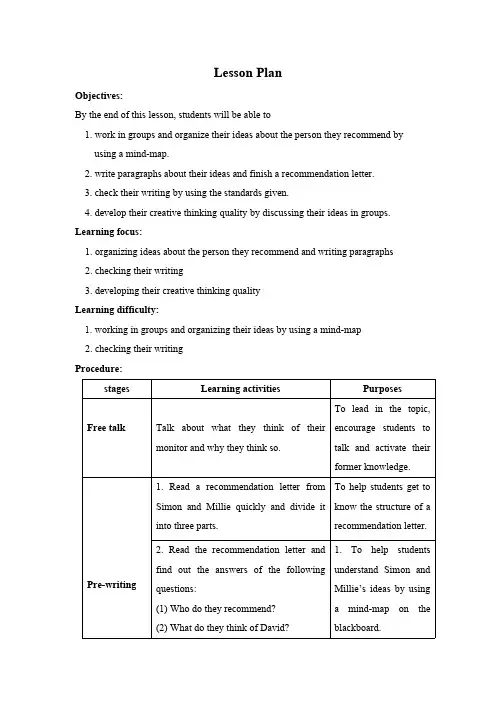
Lesson PlanObjectives:By the end of this lesson, students will be able to1. work in groups and organize their ideas about the person they recommend byusing a mind-map.2. write paragraphs about their ideas and finish a recommendation letter.3. check their writing by using the standards given.4. develop their creative thinking quality by discussing their ideas in groups. Learning focus:1. organizing ideas about the person they recommend and writing paragraphs2. checking their writing3. developing their creative thinking qualityLearning difficulty:1. working in groups and organizing their ideas by using a mind-map2. checking their writingProcedure:stages Learning activities PurposesFree talk Talk about what they think of theirmonitor and why they think so.To lead in the topic, encourage students to talk and activate their former knowledge.1. Read a recommendation letter from Simon and Millie quickly and divide it into three parts.To help students get to know the structure of a recommendation letter.Pre-writing 2. Read the recommendation letter andfind out the answers of the followingquestions:(1) Who do they recommend?(2) What do they think of David?1. To help studentsunderstand Simon andMillie’s ideas by usinga mind-map on theblackboard.(3) Why do they think so? 2. To help students getto know the details theywrite should supportthe topic sentences3. Think about whether we can change theorder of the two underline sentences of the following paragraph from the letter.David is very hard-working. He always does extra work after class. He spends a lot of time helping with our class projects.To help students get to know they can also write examples to support their ideas when they write.4. Four students a group, recommend one of their classmates to be the new chairperson for the school student Union. Then organize ideas about him or her by using the following mind-map.1. To help students organize their ideas for their writing.2. To help students develop their creative thinking quality by discussing their ideas in groups.5. Each group choose a member to share their ideas. While someone is sharing, the other students listen carefully and answer some questions after listening.1. To help students express their ideas and share them with the other students.2. To arouse students’ interest.While-writing Write a draft: Four students a group, each group member choose an idea from their mind-map and try to write a paragraph about it. To encourage studentsto write down theirideas about the personthey recommend byusing the mind-map.Post-writing 1.The teacher use one of the students’writing to show the other studentshow to check by using the followingstandards :To help students learnhow to check theirwriting by themselves.2. Check their own writing. If there are any mistakes, correct them with a red pen.To get students learn todo self-check.3. Exchange their writing with their partner and check partner’s writing. If there are any mistakes, help him or her correct them. To get students checkother students’ writingandimprove their writingskills and critical thinking.4. Students write their revised paragraphs as clearly as they can on a small piece of paper. After that, four students in a group add the body part of a recommendationletter by sticking their paragraphs on theletter and finish it.To get students work ingroups and finish theirrecommendation letter.5. Share: one group of students share theirrecommendation in class. After that, all the groups put their letter on the blackboard.To encourage students to show their letters and share their ideas.Assignment Read the letters on the blackboard andhave a class vote.Blackboarddesign Make a Recommendation。
人教版九年级英语全册Unit9SectionB(3a~SelfCheck)说课稿
2.与学生进行交流,获取他们的反馈和建议。
反思和改进措施包括:
1.根据学生的反馈和掌握情况,调整教学节奏和难度,确保教学内容符合学生的实际水平。
2.丰富教学活动,增加互动性,以提高学生的参与度和兴趣。
3.定期对教学内容和方法进行回顾,不断优化教学策略,以提高教学效果。
三、教学方法与手段
(一)教学策略
我将采用任务型教学法作为主要教学方法。这一方法的理论依据是建构主义学习理论,它强调学生在真实的语言环境中通过完成任务来构建知识,提高语言运用能力。具体来说,我会设计各种听、说、读、写的任务,如小组讨论、音乐评论、听力填空等,让学生在互动合作中学习,激发他们的主动性和创造性。
板书在教学过程中的作用是帮助学生梳理知识结构,强化重点信息。为确保板书清晰、简洁且有助于学生把握知识结构,我会遵循以下几点:
1.确保关键词汇和句型突出,使用大号字体或加粗。
2.使用箭头和连线来表示知识点之间的逻辑关系。
3.在书写过程中,适时擦除非重点信息,保持板书的整洁和聚焦。
(二)教学反思
在教学过程中,我预见到以下可能的问题或挑战:
(四)总结反馈
在总结反馈阶段,我将引导学生进行自我评价,并提供有效的反馈和建议:
1.让学生回顾本节课所学内容,总结自己在音乐类型和形容词描述方面的掌握情况。
2.组织学生互相评价,发现彼此的优点和不足,相互学习。
3.教师针对学生的表现给予针对性的反馈和建议,指导学生如何改进。
(五)作业布置
课后作业的目的是巩固所学知识,提高学生的自主学习能力。我将布置以下作业:
四、教学过程设计
(一)导入新课
新课导入是激发学生注意力和兴趣的关键环节。我将采用以下方式导入新课:
人教版九年级英语全册教学设计:Unit10sectionB
二、学情分析
九年级的学生已经具备了一定的英语基础,掌握了基本的语法、词汇和阅读技能。在此基础上,他们对英语学习有了更高的期待和追求。然而,学生在学习过程中仍存在以下问题:
1.部分学生对英语学习缺乏兴趣,学习积极性不高,需要激发学习动机。
2.学生的词汇量有限,对一些课文中出现的关键词汇和短语理解困难,影响阅读效果。
3.在语法方面,学生对时态的运用不够熟练,容易混淆,需要加强针对性训练。
4.学生的口语表达能力相对较弱,缺乏自信,需要创造更多实践机会,提高口语水平。
针对以上学情,本章节教学设计将从以下几个方面入手:
1.创设有趣、真实的语境,激发学生的学习兴趣,提高学习积极性。
1.通过小组合作、讨论、分享的方式,激发学生的主动性和积极性,培养合作意识和团队精神。
2.利用问题驱动法,引导学生主动探究文章内容,培养独立思考、解决问题的能力。
3.通过阅读和分析文章,让学生学会运用不同的阅读策略,如预测、扫描、精读等,提高阅读效率。
4.创设真实语境,让学生在情境中进行角色扮演、口头表达等实践活动,提高英语实际运用能力。
2.能够掌握并运用一般过去时、现在完成时等时态描述过去发生的事情以及对现在造成的影响,提高语法运用水平。
3.能够通过阅读理解文章,抓住文章主旨,了解世界各地不同的文化背景,提高阅读理解能力。
4.能够运用所学知识进行口头和书面表达,就过去的事件进行讨论和交流,提升英语表达能力。
(二)过程与方法
在本章节的学习过程中,学生将通过以下方法提升英语能力:
2.练习题难度由浅入深,涵盖词汇、语法、阅读和口语等方面,旨在提高学生的综合运用能力。
人教版九年级英语全册 Unit 10 SectionB(3a-selfcheck)课件

You’re not supposed to kiss or hug with people.
Going out with people
You should make a going-out plan with friends. It's important to arrive at the meeting place on time. You should tell the host where you are going and who you are going with.
Dear Mark, You must be excited about coming to China soon. Let me give you some suggestions and advice about Chinese customs. When you’re eating at the table, it’s impolite to stick your chopsticks into your food. You’re supposed to lay them on your plate or bowl. It’s polite to accept it when the host adds food to your plate or bowl. Don’t point at anyone with your chopsticks. Don’t make any noise when you eat your soup.
your fruit and eat it with a with your hands except bread.
人教版英语九年级课件SectionB(3a-selfcheck)

You should… call first or have an appointment be on time / a little earlier
keep others waiting
pay attention to safety
plan to do something interesting/ plan to go somewhere together
…
From the three aspects, we can write a letter to her/ him. How to write this letter? the beginning : Dear__________, the ending : Best wishes, Yours, _______________ What’s the first paragraph? ( Groupwork)
3. It is_________ worth spending the time to learn about the customs of a country before you go there. That way, you will know what you are supposed to do in different situations. traffic 4. The _________ is always the worst in capital the ________city. It is important to allow for more time if you are traveling by car. 5. Sandy went into her sister’s room knocking without __________on the door. That mad made her sister ________.
人教版英语九年级全一册教案:Unit10 SectionB(2a-Self Check)
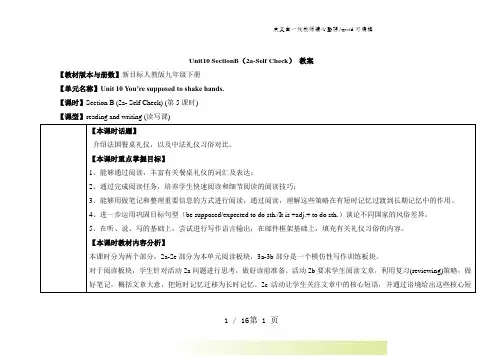
Unit10 SectionB(2a-Self Check)教案【教材版本与册数】新目标人教版九年级下册【单元名称】Unit 10 You’re supposed to shake hands.【课时】Section B (2a-Self Check) (第5课时)【课型】reading and writing (读写课)【本课时话题】介绍法国餐桌礼仪,以及中法礼仪习俗对比。
【本课时重点掌握目标】1、能够通过阅读,丰富有关餐桌礼仪的词汇及表达;2、通过完成阅读任务,培养学生快速阅读和细节阅读的阅读技巧;3、能够用做笔记和整理重要信息的方式进行阅读,通过阅读,理解这些策略在有短时记忆过渡到长期记忆中的作用。
4、进一步运用巩固目标句型(be supposed/expected to do sth./It is +adj.+ to do sth.)谈论不同国家的风俗差异。
5、在听、说、写的基础上,尝试进行写作语言输出;在邮件框架基础上,填充有关礼仪习俗的内容。
【本课时教材内容分析】本课时分为两个部分,2a-2e部分为本单元阅读板块,3a-3b部分是一个模仿性写作训练板块。
对于阅读板块,学生针对活动2a问题进行思考,做好读前准备。
活动2b要求学生阅读文章,利用复习(reviewing)策略,做好笔记,概括文章大意,把短时记忆迁移为长时记忆。
2c活动让学生关注文章中的核心短语,并通过语境给出这些核心短1 / 16第 1 页教材分析语释义,让学生找到该短语释义。
2d是对2b文本的复习,要求学生复习文本,记录法国风俗的相关信息。
2e借助2d的信息记录,对比中国和法国的餐桌礼仪,模仿范例进行语言输出,为之后的写作做准备。
对于写作板块,让学生在听、说、读的基础上,尝试有条有理地输出语言,体现写作的条理性和逻辑性。
3a是写前准备活动,它提供了真实的情境,并呈现了餐桌礼仪、家规和与人外出等相关话题,要求学生根据提示,将相关的信息填入表格,通过此形式让学生整体把握写作内容和步骤等,并运用相关的短语和表达,为3b的独立写作做准备。
人教版《Section B 3a―3b Self check》优秀PPT课件九年级全一册
In a word, it’s important for us to keep safe
all the time.
----- (Ending)
Step 6 Homework
我们一直认为地震离我们很遥远,但就在今年,秭
归县连续发生两次小型的地震,宜昌地区的很多县市 都有震感,可见,拥有较好的防震知识很重要,请你 以学校组织的一次防震演练(earthquake drill)为例, 谈一谈地震发生时我们应该怎么做? 可包含以下要点:
downstairs. _____, we should be friendly and get
on well with others. _____, we should be careful
to eat healthy food and stay away from junk food.
It is bad for our health. ----- (Main body)
Eg: When we eat food , we must/should eat healthy food. /we shouldn’t/mustn’t eat junk food.
___________________________________
When we … , we must/should … /we shouldn’t…
What can we do to help ourselves to be safe?
We should/must/need to…
We should/must/need to/ can…
We should … must … need to …
We should … must … need to …
人教版新目标九年级英语同步测试:Unit 10 You’re supposed to shake hands Section B (3a_selfcheck)
人教版新目标九年级英语Unit 10Section B (3a-selfcheck)同步测试一、单项选择(每空1分,共15分)( )1.—All the workers went home yesterday ________ Mr. Brown. Why? —Because he was on duty.A.except B.besidesC.except for D.beside( )2.I had some trouble getting on with my classmates.My parents gave me many ________about how to get on well with others.A.advice B.suggestionsC.trouble D.problems( )3. —Can you tell me when you aregoing to arrive there?—I'm not sure. But I'll ring you up as soon as I ________ there tomorrow.A.arrive B.arrivedC.will arrive D.am going to arrive( )4.—You were not at home when I ________ your home.—Oh, I was shopping then.A.passed on B.dropped byC.got off D.went away( )5.Although the weather there is terrible, Mary gradually ________ it.A.used to B.gets used toC.uses to D.is used for( )6.Animals are our close friends. We are supposed ________ them.A.to protect B.protectingC.protect D.to protecting( )7.My English friend, Cindy, had never been to the Great Wall before.Today she saw it ________ the first time.A.at B.for C.in D.by( )8.China is famous for a lot of places of interest. ________,it is a country with a long history.A.After all B.All afterC.All the time D.After that( )9.It's not good to ________ people with chopsticks at the table.A.point at B.drop byC.pick up D.hang out( )10.Listening to soft music can make you________.A.relaxing B.to feel relaxedC.feel relaxed D.felt relaxed( )11. I bought a new house. Could you give me some _______ on the decoration (装潢)?A. customsB. mannersC. suggestionsD. presents( )12. Here is some _______ information about the university. If you want to know something more important, you can ask our uncle for help.A. differentB. basicC. correctD. wrong( )13. —Why did Mr. Brown get _______?— Because a few boys fought with each other in his class. And they didn’t accept his advice.A. happyB. madC. excitedD. lively( )14. Susan, the movie Incedibles 2 is well worth_______. You can take your son to watch it and he must like it.A. watchingB. being watchedC. to watchD. to be watched( )15. In my opinion, parents should teach their children to_______ properly in public places. For example, they should be quiet in the library.A. disappearB. senseC. developD. behave二、完形填空(每空1分,共10分)People in different countries have different ways of doing things.Something is __16__ in one country,but it may be quite impolite in another.In Britain,you mustn't lift your bowl to your __17__ when you are having some liquid (液体) food.But it's __18__ in China.And in Japan you even needn't worry about making __19__ while you are having it.It shows that you're enjoying it.But people in Britain think it is bad manners.If you are a visitor in Mongolia,what manners do they wish __20__ to have?They wish you to have a loud “burp” (打嗝) __21__ you finish eating.Burping shows that you like the food.In Britain,you should try not to __22__ your hands on the table when you're having a meal.But in Arab (阿拉伯) countries you must be very careful with your hands.You __23__ eat with your left hand.Arabs consider (认为) it very __24__ manners eating with left hands.So when you are in other countries,__25__ carefully and follow them.As a saying goes,“Do as the Romans do.”( )16.A.bad B.useful C.polite( )17.A.mouth B.nose C.eyes( )18.A.same B.different C.important( )19.A.faces B.noise C.mistakes( )20.A.them B.him C.you( )21.A.after B.before C.until( )22.A.give B.put C.bring( )23.A.needn't B.mustn't C.couldn't( )24.A.good B.strange C.bad( )25.A.listen B.talk C.watch三、阅读理解(每题2分,共20分)AOur new foreign students are going to arrive very soon,and here are some ways to welcome them.How close do you stand when you talk to a friend?You can stand close to people in the Middle East but don't stand too close to North Americans!Give them more personal space.How about touching people?Chinese girls often walk arm in arm with their friends.South Americans sometimes hold your arm when they talk to you,so you can't move away!But in Britain many people don't like other people to touch them at all.Do you look at people when you talk?In some places,it isn't polite to look at people when you talk,but in other countries, it isn't polite to look somewhere else.In Britain and the US,people usually look at each other when they talk.And how do you say goodbye?That's easy,wave to say goodbye.But be careful!In Greece,it's not at all polite!In fact,it's very rude!( )26.From the passage,we should give ________ more personal space.A.people in the Middle EastB.people in North AmericaC.people in the South AmericaD.people in North China( )27.The underlined word “touch” means ________ in Chinese.A.触碰B.打击C.感动D.震撼( )28.We can't wave to say goodbye in ________.A.America B.JapanC.Britain D.Greece( )29.How many ways are given to communicate with foreign students?A.Two.B.Three.C.Four.D.Five.( )30.What's the best title of this passage?A.Saying goodbyeB.Touching peopleC.Looking at peopleD.Communicating politelyBIn America,just as in Europe,men usually open doors for women,and women always walk ahead of men into a room or a restaurant,unless the men have to be ahead of the ladies to choose the table,to open the door of a car or do some other things like the above.On the street,men almost always walk or cross the street on the closer side of the ladies to the traffic.But if a man walks with two ladies,he should walk between them.Then if the host (男主人) or hostess (女主人) or both of them come in a car to get their guest for dinner,the guest should sit at the front seat and leave the back seat though there is no people sitting on it.( )31.In America,men usually ________.A.walk ahead of womenB.eat in a restaurantC.walk behind womenD.eat out( )32.The men have to be ________ of the ladies to choose the table,to open the door of a car or do some other things like the above.A.ahead B.behind C.middle D.under( )33.In the street men ________.A.cross the street ahead of the ladiesB.walk on the right side of the ladiesC.walk on the closer side of the ladies to the trafficD.walk on the left side of the road( )34.If a man walks with two ladies,he should ________.A.walk between them B.run before themC.follow them D.walk after them( )35.If Mrs. Green wants you to her house in a car,you should ________.A.sit beside a guest B.sit at the front seatC.sit at the back seat D.drive the car四、词汇运用(每空1分,共15分)根据句意及汉语提示完成单词。
SectionB3a—3bSelfcheck初中九年级初三英语教案教学设计教学反思人教版
SectionB3a—3bSelfcheck初中九年级初三英语教案教学设计教学反思人教版Section B3a—3b Self-check【教学目标】1. 学会使用一般现在时表示现在经常发生的事情。
2. 学会运用表示数量的表达方式进行交流。
3. 加强对形容词的理解和运用。
【教学重点】1. 掌握一般现在时的用法。
2. 学会使用形容词进行描述。
3. 熟练运用表示数量的表达方式。
【教学难点】学生熟练运用一般现在时,形容词和表示数量的表达方式。
【教学准备】录音机、图片、课件、小黑板。
【教学过程】Step 1 Warm-up1. Greetings: Greet the students and ask how they are doing.2. Review: Review with the students what they learned in the previous class.Step 2 Presentation1. Show pictures: Show some pictures of people doing different activities, such as playing soccer, swimming, and dancing. Ask the students to describe the pictures using the present simple tense. For example, "He plays soccer." "She swims."2. Model sentences: Write the model sentences on the board and ask the students to read them aloud.- He plays soccer.- She swims.- They dance.Step 3 Practice1. Ask questions: Ask the students questions about their daily routines using the present simple tense. For example, "What time do you get up?" "Do you brush your teeth every morning?"2. Group work: Divide the students into small groups and ask them to discuss their daily routines. They should use the present simple tense to ask and answer questions about each other's routines.3. Role-play: Ask a few pairs of students to perform a role-play based on their discussion. One student can act as a reporter and interview their partner about their daily routine.Step 4 Presentation1. Show pictures: Show some pictures of different objects and ask the students to describe them using appropriate adjectives. For example, "The car is red." "The book is interesting."2. Model sentences: Write the model sentences on the board and ask the students to read them aloud.- The car is red.- The book is interesting.- The movie is exciting.Step 5 Practice1. Word association: Show a picture of an object and ask the students to think of an adjective to describe it. For example, if the picture shows a cat, the students can say "cute" or "adorable."2. Pair work: Ask the students to work in pairs and take turns showing pictures to each other. They should describe the pictures using appropriate adjectives.Step 6 Presentation1. Show pictures: Show some pictures of fruits, vegetables, and other food items. Ask the students to describe the pictures using appropriate quantifiers, such as "a bowl of rice," "two apples," "some oranges," etc.2. Model sentences: Write the model sentences on the board and ask the students to read them aloud.- I ate a bowl of rice for lunch.- She bought two apples at the supermarket.- They had some oranges for dessert.Step 7 Practice1. Match game: Prepare flashcards with pictures of different food items and quantifiers. Ask the students to match the pictures with the correct quantifiers.2. Group work: Divide the students into small groups and ask them to make sentences using the food items and quantifiers from the flashcards.【教学反思】本节课主要围绕一般现在时、形容词和表示数量的表达方式展开。
人教版新目标九年级英语教案unit10
人教版新目标九年级英语教案Unit 10 You’re supposed to shake han d.Period 1 SectionA(1a-1c)Knowledge aims:(1)Key Vocabularybow, kiss, be supposed to, shake hands, customs(2) Target LanguageWhat are people in Korea supposed to do when they meet for the first time? They're supposed to bow.Ability aims:1. Train students' listening ability.2. Train students' communicative competence.Emotional aims:Before you meet foreigners, you should some customs. In this way, you can act politely and properly.Key points:Talk about customs and what you are supposed to do.Difficult points:Know about customs of different countries.Teaching methods:1.Scene teaching method2.Listening-and-answering activity to help the students go through with the listening material.Teaching tools:1.A tape recorder 2.PPT课件Teaching procedures:Step I: Review1.Yesterday we finished Unit 9. In this unit, we learned some ways of asking for information politely and express preferences.Make conversations with your friends.A: What kind of music do you like?B: I like music that ____________.2.Write your own sentence:I like music that________________________.I like musicians ________________________.Step II :New lesson1.Presentation:Step 1 1aThis activity introduces some target language.Let students read the instructions.Point to the two lists of words. Read each word and ask students to repeat it.Put up a map of the world on the board. Ask students to explain where each of the countries is.Suggested answers1.Brazil is in South America, next to Peru.2.The United States is in North America, next to Canada.3.Japan is in East Asia, to the east of China.4.Mexico is in North America, on the south of America.5.Korea is in East Asia. It is our neighbor.Look at the sample answer. Tell students to guess if they aren't sure. Answers1.c2.b3.a4.b5.aStep Ⅲ 1bThis activity gives students practice understanding the target language in spoken conversation.Play the tape for the first time. This time, students only listen.Play the tape a second time. Ask them to listen to the recording and check their answers to Activity 1a.Check the answers with the class. Invite a student to read the answers. Step Ⅳ 1cThis activity provides guided oral practice using the target language. Read the instructions to the whole class. Point out the example in the box. Ask two students to read it to the class.Step III:Practice:1. In Japan, the people are supposed to _________(鞠躬) when they meet for the time.2. It's not polite ____________(亲吻) the others in public in China.3. I was supposed to arrive at 8:00, but I (到达) at 9:00.4. When we meet Americans for the first time, we should_________(握手)with them.5. You must know some __________(习俗) before you go to some foreign countries.Step IV:summary:In this class, we've learned some important words, such as bow, kiss, be supposed to, shake hands. We've also learned the target language What are people in Korea supposed to do when they meet for the first time? They're supposed to bow.Step V:.homework:Review the target language.Bb design:Unit 10 You're supposed to shake hands.Section AThe First PeriodTarget Language:A: What are people in Korea supposed to do when they meet for the first time?B: They're supposed to bow.Period 2 SectionA(2a-2d)Knowledge aims:(1) Key V ocabulary :greet, be supposed to(2) Target Language: How was the dinner at Paul's house last night?Ability aims: 1. Train students' listening ability.2. Train students' communicative competence.Emotional aims: When you're invited to a place, you mustn't be late, greet people the wrong way and wear the wrong clothes. That is, you should act according to your host's customs.Key points:What are you supposed to do when you meet someone?Difficult points:How to improve students' listening ability.Teaching methods:1.Listening method to improve students' listening ability. 2.PairworkTeaching tools:1.A tape recorder 2.PPT课件Teaching procedures:Step I: ReviewCheck homework. Ask some pairs to act out their conversations according to Activity 1a.A: What are people in Mexico supposed to do when they meet for the first time?B: They're supposed to bow.Step II :New lesson1.(2a)This activity provides guided listening practice using the target language.Look at the picture and ask students to tell What is happening.Help students understand that the people are at a picnic.Read the instructions and point to the four mistakes on the list. Ask different students to read the mistakes to the class.Ask different students to explain the meaning of each line in their own words. Listen to Maria talking to a boy about what happened at the picnic. She made several mistakes. Listen to the recording and check the mistakes she made.Play the recording. Students only listen the first time.Play the recording again. Get students to check the mistakes Maria made. Check the answers with the class.Answers√ arrived late________ ate wrong food√ greeted Paul's mother the wrong way√ wore the wrong clothes2.(2b)This activity gives students practice in understanding the target language in spoken conversation.Go through the instructions with the class. Point out the blanks in the four sentences. Invite a student to read the first sentence.Play the recording again. Let students fill in the blanks with the words they hear alone.Correct the answers with the class.3.(2c)This activity provides guided oral practice using the target language. Read the instructions for the activity to the class.Look at the example in the box. Ask two students to read the conversation to the class.4.Role-Play conversationShow key points:expecte to do sthhold outTo one’s surpriseStep III:Practice:()1. Jim stood up and shook hands___ both of them.A.byB.withC.forD.to( )2. Chinese never bowed _________the enemiesA.inB.toC.onD.with( )3. John _______ Beijing the day before yesterday.A. arrived atB. arrivedC. reached toD. arrived in( )4. You ________stand in line when waiting for the bus.A. mustn’tB. can’tC. are supposed toD. don’t( )5. She _______some _______in her competition yesterday.A. has made; mistakesB. made; mistakesC. had made; mistakeD. was mistaking; mistakesStep IV:summary:In this class, we've learned key vocabulary greet and be supposed to, the target language How was the dinner at Paul's house last night? What are you supposed to do when you meet someone?Step V:.homework:Ask students to write at least two sentences with the key structure in this class.Bb design:Unit 12 Section A (2a-2d)1.Target Language:How was the dinner at Paul's house last night?2.What are you supposed to do when …You're … You're not …Period3 SectionA(3a-4c)Knowledge aims:(1) Key Vocabularyland, drop by, after all, relaxed, a bit(2) Target LanguageCan you tell me the things I'm supposed to do?Ability aims: 1. Train students' integrating skills.2. Train students' communicative competence.Emotional aims:Different countries have different customs. So you are supposed to do in Rome as the Romans do.Key points:Talk about customs and what you are supposed to do. Difficult points:Know about customs of different countries.Teaching methods: 1.Fast reading to let students get the general idea of the text. 2.PairworkTeaching tools:1.A tape recorder 2.PPT课件Teaching procedures:Step I: ReviewRevisionT: In last period, we summed up the expressions for telling what you are supposed to do. Now I'll check your homework. I'll ask some pairs to act out the conversations before the class.Step II :New lessonStep 1. 3aThis activity provides reading and writing practice using the target language.Show the key words on the screen by a projector.Cali n.卡利(哥伦比亚西部城市)Colombia n.哥伦比亚(南美洲西北部一国家)drop by 访问;拜访Lausanne n.洛桑(瑞士西部城市)Switzerland n.瑞士(欧洲中部国家)land n.国家;国土after all 毕竟Read the words and have students repeat again and again until they can pronounce the words fluently and accurately.Step2.3bRead the passage again and complete the chart.Look at the chart. Tell students what they will write in the chart.Check the answers.Step Ⅲ 3bThis activity provides guided oral practice using the target language.Go through the instructions for the activity with the class.Look at the example in the box. Ask two students to read the conversation to the class.First practice this conversation with a partner. Then talk about your attitude toward being on time and getting together with your friends. Step IV Grammar FocusReview the grammar box Get different students to say the questions and answers.Step III:Practice:be supposed to be expected tobe important to1.When you go abroad ,it __ bring your passport.2. After class,students____ clean the chalk off the blackboard.3.If you visit the northern coast of Norway during the winter season, it ___ pack warm clothes.4.If there are people in the meeting room, you_____ knock before entering.5.In many eastern European countries, you ___ take off your gloves before shaking hands.Step IV:summary:1.key vocabulary2.Grammar focusStep V:.Homework:Finish exercise 4b in the textbook.Bb design:Unit 10 You're supposed to shake hands.Section AThe Three PeriodTarget Language:A: What are you supposed to do when you meet someone for the first time?B: The first thing is ……Period4 SectionB(1a-1d)Knowledge aims:(1) Key Vocabularywipe, napkin, stick, chopstick, rude, point, pick up(2) Target LanguageWe're supposed to eat with chopsticks.Yes, and it's rude to eat with our hands.Ability aims: (1) Train students' ability to understand the target language in spoken conversation.(2) Train students' ability to use the target language.Emotional aims:In order to behave politely at the dinner table, you're supposed to learn some talbe manners.Key points:Target language.Difficult points:1.How to improve students' listening ability. 2.How to use the target language.Teaching methods: 1.Listening method 2.PairworkTeaching tools: 1.A tape recorder 2.PPT课件Teaching procedures:Step I: ReviewCheck homework. Get some students to read out their conversations using the target language in Section A 4c. Collect their conversations and help correct their errors.Step II :New lessonPart 1This activity introduces new vocabulary and provides reading practice using the target language.Look at the picture and ask students to say what is happening in it. (A family is eating a meal.)Look at the title, Mind your manners!Ask: What do you think it might mean?(It means be careful of how you act.)Read the instructions and point to the five statements about manners. Ask students to read the statements.Review the five statements to be sure students understand what each one means. Ask students to act out them. Then ask students to complete the quiz on their own.Part2.2aThis activity gives students practice in understanding the target language in spoken conversation.Read the instructions to the class. Review what an exchange student is and what table manners are. If necessary, translate them into Chinese. Play the recording the first time.Students only listen.Play the recording a second time. As they listen to the recording this time, let students number the pictures.Correct the answers with the class.Step Ⅳ 2bThis activity provides listening practice using the target language.Read the instructions and point to the numbered list of sentence starters and the lettered list of sentence endings. Ask different students to read the two lists.1.You aren't supposed to … a. to stick your chopsticks into your food. 2.It's impolite to… b. point at anyone with your chopsticks.3.You shouldn’t … c. start eating first if there are older people at the tableYou will hear the same recording again. This time as you listen, write the letter of the correct sentence ending after each sentence starter.Look at the sample answer. Read the correctly completed sentence to the class:Step Ⅵ SummaryIn this class, we've learned some key vocabulary, such as wipe, rude, point, pick up. We've also learned the target language by listening and speaking.Step Ⅶ HomeworkTalk about the table manners in your country using the sentence starters in Activity 1a.Bb design:Unit10 Period41.Sentences in Activity 2b:2.Target language:A: We're supposed to eat with chopsticks.B: Yes, and it's rude to eat with our hands.Period5 SectionB(2a-2b)Knowledge aims:(1) Key Vocabularytable manners, behave, be/get used to, cut up, full, fork, You should (2)Practice reading an article.Ability aims: (1) Train students' reading ability.(2) Train students' writing ability.Emotional aims:With the development of society, table manners are more and more important. Sometimes they can help people succeed. So you have to learn more table manners.Key points: Practice reading and writing using the target language. Difficult points:How to write an e-mail message.Teaching methods: 1.Reading comprehension to help students grasp the main idea of the text.2.Writing method 3.Groupwork to make every student work in class.Teaching tools: 1.A tape recorder 2.PPT课件Teaching procedures:Step Ⅰ RevisionReview the target language presented in this unit. Check homework. Ask two students to read out their sentences.SA: You aren't supposed to visited a friend's house without calling first. SB: It's polite to be on time.Step II :New lesson1.Ask and answer.What do you know about customs in foreign countries? What do you think is the biggest challenge when visiting a foreign country?2.2bThis activity provides reading practice using the target language. Teach the new words. Show the following new words on the screen by a projector.manner n. 礼貌;风格;习惯table manners 餐桌礼仪behave v. 行为表现;举止be/get used to 习惯于……cut up 切开;切碎fork n. 叉;餐叉full adj. 饱的;吃胀了的lap n. (人坐着时)腰以下到膝为止的部分;大腿elbow n. 肘;肘部gradually adv. 逐渐地;渐渐地compliment n. 称赞;恭维toast v. 敬酒Call attention to the e-mail message. Invite a student to read the article aloud to the class. Correct any pronunciation errors to make sure the student is providing a good model for the rest of the class.Now read the e-mail. Answer the questions in your exercise book. As students work, move around the classroom and offer help as necessary.Step 3.Read the sentences in 2c and replace the underlined words with the phrases in the box.1.Making mistakes in French used to make Lin Yue nervous.2.It was quite hard for her to feel good about speaking French.3.The host family tried very hard to help Lin Yue.4.Lin Yue has slowly learned how to be like her French friends.Step 4.Review the passage and make notes about French customs in the chart.This activity provides writing practice using the target language.Read the instructions and ask students to finish the exercise.Get students to finish the activity on their own. As students work, move around the room offering help as needed. Ask a student to read his or her message to the class. Have other students add any information that is missing from the first student's report.Step III: Practice:Your pen pal is coming to China on an exchange program. He/She is asking you about Chinese customs and what he/she is supposed to do or not. Make notes in the chart.Step IV: Summary:In this class, we've done a lot of reading, writing and speaking practice using the target language.Step V:Homework:Read the e-mail message in Activity 2b againBb design:Unit 12 You’re supposed to shake hands.Section B (2a-3a)1.What do you know about customs in foreign countries?2.Read the letter and answer the questions in 2b.Period6 SectionB (3b-selfcheck)Knowledge aims:1) Key Vocabularybe excited about doing sth 、some suggestions 、some advice、at the table (2) Target Language: You are supposed to …..You are not supposed to ….Ability aims: 1. Train students' writing ability.2. Train students' communicative competence.Emotional aims:Before you meet foreigners, you should obey some rules. In this way, you can act politely and properly.Key points:Talk about customs and what you are supposed to do. Difficult points:Write a short passage about table manners.Teaching methods: 1.Task-based teaching 2.PairworkTeaching tools: 1.A tape recorder 2.PPT课件Teaching procedures:Step I: Review1.manner n. _________2.table manners _________3.behave v. _________4.be/get used to _________5.cut up _________6.fork n. _________7.full adj. _________8.elbow n. _________9.gradually adv. _________pliment n. _________toast v. _________Step II: New lesson1.Talk about some table manners in China.2.Write a letter to your pen pal to give him/ her advice and suggestions on how to behave properly in China.This activity provides writing practice using the target language.Read the instructions and ask students to look back at Activity 2 Remind students that they made conversations about table manners in their own country.3.Writing practice.Dear Jenny.You must be excited about coming to China soon. Let me give you some suggestions and advice about Chinese customs. When you’re eatin g at the table. It’s impolite to stick your chopsticks into the food.In our house,you’re supposed to watch TV and play computers.When you go out with people, you should tell somebody who is home. Have a safe trip, and I look forward to meeting you soon!Best wishes.Step 3.Self check.1.Fill in the blanks with the words in the box.worth capital basic traffic empty mad knocking2.Think about your culture and make statements.In my culture, when you….You’re supposed to …..You’re not supposed to ……You’re expected to …….It’s impolite to …….It’s important to …..Step III: Practice:Have conversations with your partner.In my culture, you’re supposed to ….. you’re not supposed to …….. Step IV: Summary:In this class, we've done a lot of writing and speaking practice using the target language.Talk with your partners after class.Step V: Homework:Talk about the table manners in your country using the sentence in Self check.Bb design:Unit 10 You’re supposed to shake h ands.1. Write a letter to your pen pal to give him/her advice about table manners.2.Self check.。