
深圳七年级上册英语Unit8 Collecting things单元知识点
①front 形容词,意为“前面的”。 This is our front garden.这是我们的前花园。
②
in front of 指在某一范围以外的前面,反义词是 behind
in the front of 指在某一范围内部的前面,反义短语是 at the back of
Tom is just sitting in the front of the car, and her friend Mary is standing in front of the car.汤姆正
常考短语:
Living room 起居室,客厅
works of art(绘画,雕塑)艺术作品
(be) bad for 对··有害
be good for 对···有好处
(be)interested in 对···干兴趣
A waste of time 浪费时间
Belong to 属于
Thank you for=thanks for(for+n./v-ing/代词)
sentence 句子
Magazine n.杂志
newspaper n.报纸
really 确实,的确[来源:Z+xx Famous adj.著名的
UK 英国 ( Britain /England) ov er 多余=more than
something 某事,某物(用于肯定句)
anything 任何事/物(用于否定句和疑问句)
语中大多用宾格。
4、 人称代词并列时的排列顺序
①单数人称代词并列作主语时,其顺序为:第二人称→第三人称→第一人称
即 you and I he/she/it and I you, he/she/it and I 例如:It was I and John that made her angry. ②复数人称代词作主语时,其顺序为:第一人称→第二人称→第三人称
即 we and you you and they we, you and they
坐在汽车的前座,而她的朋友玛丽站在汽车的前面。
③front door 意为“前门”,behind door 是“后门”的意思。
2.···so you shouldn’t spend too much time collecting things.(page101)
too much “太多”,修饰不可数名词; 用作副词词组时,可修饰动词;
I drank too much beer last night. You have given me too much.
用作名词词组时,可作表语、宾语等。
much too “太,非常”,用作副词词组,
I’m afraid this car is much too expensive.
修饰形容词或副词,但不可修饰动词。 [来源:学。科。网]
第一人称 第二人
性 复数
称复数
ZXXK]
主I 格 (我)
yo u he
she it
(你) (他) (她) (它)
we (我们)
you (你们)
宾 me 格 (我)
you hiLeabharlann her it (你) (他) (她) (她)
us (我们)
you (你们)
第三人称复数
they (他们, 她们,它们) them (他们, 她们,它们)
如:When will the basketball game take place. take place:发生,常指经过安排的。 When will the wedding take place? happen: 偶然发生,碰巧. What happened to you last night?
Soon 不久
pull 按,拉
反义词 push 推
Grandson n.孙子,外孙
granddaughter n.外孙女
Inside adv.里面 反义词:outside 外面
Everywhere 处处,到处
Ago 以前
Follow 跟随
Hardly 几乎不
Space 空间
Free 自由的
should 应该
My wife is much too busy to see visitors.
too many “太多”后接可数名词复数形式。
He has too many pens.
3.They(The games ) will take place in the playground. 它们(比赛)将在操场上举行。 (page105) take place 在此句中含义为“举行”,还有“发生,产生”等意思。
经典句型:
11.Sb. Spend (s) ... Doing sth.
12.What do you think of ... ? 你认为···怎么样呢?
如:What do you think of the book?
详细讲解:
1.There are eight doorbells on their front door!在他们的前门上有八个门铃。(page101)
Grammar 代词
英语中代词分为:人称代词、物主代词、反身代词、指示代词、关系代词、疑问代词、连接 代词和 不定代词等等。
1/3
一、 各类代词的基本用法
第一:人称代词:人称代词代替人和事物的名称,分为主格和宾格两种形式。
第二人 第 三 人 称 单 数
第 一人 称单数
称单 [来源:学
数
科网
[来源:Z+xx+] 阳性 阴 性 中
3.主格用来作句子的主语。如: I often go shopping on Sundays.(星期天我常去购物) / 4.宾格用来作及物动词或者介词的宾语。
如:Who teaches you English this year?(今年谁教你们的英语?)
5.人称代词作表语或者放在比较状语从句连词than或as之后时,可以用主格形式,也可以用宾格形式,口
Unit8 Collecting things 单元知识点自学案
必记单词:
Unusual adj.与众不同的
反义词:usual 普遍的
collect v.收集,搜集
Interview n 采访
model n.模型,模特
stamp n. 邮票
Front adj.前面的
Silver adj.银白色的
doorbell n.门铃
初一英语-上册Unit8-Collecting-things

Unit 8 Collecting things重点短语、句型:be busy doing sth. 忙于做某事unusual collections 不寻常的收集living room 客厅;起居室lots of = a lot of许多the front door 前门follow…into…跟着…进入…like doing sth喜欢做某事in one’s free time在你的空余时间=in one’s spare timesb. spend time/money on sth某人花费时间做某事= sb。
spend time/money (in)doing sthtoo much 太多,非常多;much too 很,非常;be bad for 对…有害的be interested in 对…感兴趣work of art 艺术作品a waste of time浪费时间,白费时间take place 发生;举行,举办show sb。
sth = show sth to sb. 给某人看某物Thank you for doing sth 谢谢你…重点句子:1.Sam and Helen’s grandparents collect almost everything。
2.They went inside and saw newspapers everywhere.3.The children followed her into the living room and saw lots of toys there。
4.There was hardly any space for the children to sit down。
5.We both like collecting toys。
6.We have a lot of free time。
7.So you shouldn’t spend too much time collecting things.8.They made me more interested in Chinese culture.重点单词:unusual adj。
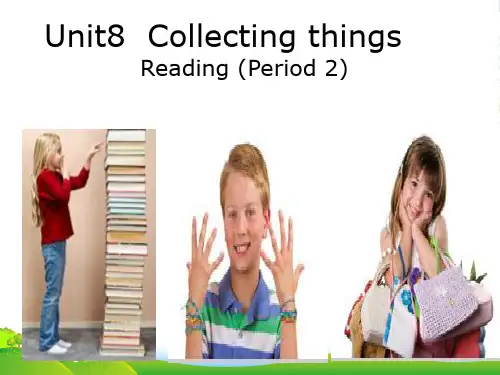
牛津深圳七年级英语上册《Unit 8 Collecting things》课件(共34张PPT)
6.Are Grandpa and Grandma free or busy?
They have a lot of free time.
√A. not busy B. large C. long
送分咯!!!
What Barbie says
Over 108 jobs: a doctor, a policewoman, an astronaut, a driver and so on.
Collecting Barbie Dolls
Boyfriend Height
Pets Jobs
Birthday
What
---What’s your dream? ---My dream is to …
(I hope/want to ….) ---Why? ---Because…
Name
---What’s your dream? ---My dream is to …
(I hope/want to ….) ---Why? ---Because…
What Barbie says
“I have a date tonight!" "I love being a fashion model!"
Collecting Barbie Dolls
Boyfriend
Pets
Height
Jobs
Birthday March9,
What
1959
Barbie says
6、 教育不在于使人知其所未知,而在于按其所未行而行。2021年11月2021/11/262021/11/262021/11/2611/26/2021 7、教育是一个逐步发现自己无知的过程。2021/11/262021/11/26November 26, 2021 8、is a admirable thing, but it is well to remember from time to time that nothing worth knowing can be taught.教育 是令人羡慕的东西,但是要不时地记住:凡是值得知道的,没有一个是能够教会的。2021/11/262021/11/262021/11/262021/Байду номын сангаас1/26
牛津深圳版英语七年级上册Unit 8 Collecting things 教案 1
Unit 8 Collecting things
教案 1
一、教材分析
本单元围绕着收集东西为话题来展开听、说、读、写的训练,在听说读写中引导学生掌握人称代词、物主代词和反身代词。
二、教学对象分析
1.学生对于收集的物品的英语表达比较熟悉,有利于开展本单元的各项听说读写任
务。
2.学生对于代词的用法其实并不陌生,从小学就开始学习,只是没有进行专项的归纳
性学习。
在本单元,教师可以系统地帮助学生归纳分类和人物有关的代词。
三、单元教学目标
1.认知目标
2.能力发展目标:
1)能够在听、说、读、写等语言综合实践活动中运用本单元的重点词汇、句型与语法。
2)在学习中提高交流和传递信息的能力,在写作中运用句型使文章更连贯和流畅。
3)通过指导学生在模拟交际中运用所学的知识,培养学生探究学习、合作学习、自主学习的能力。
四、单元教学重点
1.学生熟练掌握重点词汇27个的,短语4个。
2.指导学生利用所学语法正确表达思想、进行交际活动。
3.指导学生归纳人称代词物主代词反身代词,实践中熟练运用它们。
五、单元教学重点
1. 通过形式多样的课堂活动与任务,帮助学生完成阅读理解、听力理解等学习任务。
牛津深圳版七年级上册英语Unit8 Collecting things词汇详解 练习(无答案)
Unit8 Collecting things词汇详解+练习一、熟悉读音与词性:二、重点词用法详解:【1】collect v. get or bring together 收集;收藏【拓展】(1)collector n. 收藏者He is a collector of coins. 他是一名硬币收藏者。
(2)collection n. 收藏;收藏品This is my collection of stamps. 这是我的集邮册。
【应用】(1)He spends too much time __________ (collect)stamps.(2)He has a __________ (collect) of stamps.(3)He is a __________ (collect) of stamps.【2】unusual adj. not usual or common or ordinary 不寻常的【拓展】(1)unusually adv. 不寻常地She seems an unusually clever girl.她看起来像是一个异常聪明的姑娘。
(2)usual adj. 寻常的She is dreaming away as usual.像往常一样她又在发呆。
(3)usually adv. 通常What do you usually do after work?你下班以后通常都做些什么?【应用】(1)He goes out to have a walk after dinner as________ (unusual).(2)He __________ (unusual) goes out to have awalk after dinner.【3】soon adv. in a short time不久【拓展】(1)soon=in a short time很快,常用于将来时He will be back soon.=He will be back in a short time. 他很快就回来。
最新七年级上英语Unit8-collecting-things资料
Unit 8 Collecting things1. collect -collection n.收集pollute -pollution污染→在某些动词后加tion变成该单词的名词形式collect- collector n.收集者act扮演-actor演员→在某些动词后加or,er变成该单词的名词形式,表示做该动作的人2. Push推↔pull 拉push the doorDon’t push me.3 inside在里面;往里面↔outsid eLet's go inside. 我们进去吧。
It was raining hard outside. 外边雨下得很大4. follow 跟随follow her into the living room5. lots of=a lot of许多Eg:There is a lot of water in the pool. 池子里有很多的水。
a lot 副词性短语,修饰动词Eg:Thanks a lot.= Thanks very much.many↔可数China has many oil fields. 中国有许多油田。
much↔不可数In our view, there is much oil here. 在我们看来,这里有许多石油。
6. collect almost everything.↔ almost adv. 几步,差不多There was hardly any space.↔Hardly adv. 几乎不注:hardly本身是一个否定词不能和not在一起使用。
7. free 空闲的,免费的in your free time在你的空余时间=in your spare timeEg: Are you free this afternoon?8. unusual形容词,“与众不同的,不同寻常的”,反义词是usual.This is an unusual book.un-是否定前缀,意为“不”。
深圳牛津英语七上Unit 8 Collecting things

Unit 8 Collecting thingsLesson 11. unusual 与众不同的( adj . )2. interview 采访( n .; v . )3. model 模型(n . )4. stamp 邮票( n . )5.doorbell 门铃(n . )6.front 前面的(adj . )7. silver 银色的( adj . ) 8.push 按,推( v . )9.soon 不久( adv . ) 10. grandson 孙子,外孙(n . )11. granddaughter孙女,外孙女(n . ) 12. newspaper 报纸(n . )13. inside 向里面( adv . )根据句意和所给提示,填写句子所缺的单词。
1. Tom like collecting (不同寻常的) things such as doorbells.2. There are more than seven _________( 门铃) in his home .3. Do you like collecting __________( 邮票)?4. She wears a _______ ( 银色的) ring .5. I stand in _________ ( 前面的) of her .6. Don’t ________ ( 推) him .It ‘s dangerous .7. Father reads _____________( 报纸) everyday。
8. Go ______( 向里面) the room and you will see your ________( 孙子们) and ___________( 孙女们).9. ____________ ( 不久),she can meet his father .10. Tomorrow , I will have an ___________( 面试) and I’m a bit nervous .model, medal1. She showed us a _________ of the new office building.2. He won an Olympic gold _______ this summer.重点句型讲解一①collect vt.“收集,搜集”Do you like collecting stamps?拓展:collect v.—collection n. “收藏,收藏品” collector n. “收藏家”②unusual adj. “与众不同的,不同寻常的” 反义词:usual adv:unusuallyThis is an unusual book.拓展:un-是个前缀,“不”eg. happy—unhappy healthy—unhealthy important—unimportant【随堂练习】.My grandpa has a great __________ (collect) of CDs.He _______( collect ) many doorbells last year .This is _______( a / an ) unusual thing .2. Sam and Helen’s grandparents collect almost everything.Sam and Helen’s grandparents意为“萨姆和海伦的祖父母”,Sam and Helen’s属于名词所有格。
七年级英语上册(牛津深圳版)Unit 8《Collecting》(Language points)复习课件
spend的用法
1. 在使用spend时, 主语只能是表示人的名词或 代词。例如: Andy spent a lot of money on books. 安迪花了很多钱买书。 2. 若表示 “在......上花费(时间、金钱等)”,常用 句型spend some money/ some time on sth.,介 词on后接名词或代词。例如: Kitty spends two hours on her homework every day. 凯蒂每天花两个小时做家庭作业。
6.The children followed her into the living room and saw lots of toys there.
follow v. 跟着,跟随 词形变化: followed—followed—following 例如: 1).沿着河你就会走到海边。 Follow the river and you will get to the sea. 2).提出忠告易,照著办事难。 It is easier to give good counsel than to follow it.
Language points
1
Unusual collections unusual = un + usual un- 表否定意义 Have a try: 不开心的 unhappy 不健康的 unhealthy 不友善的 unfriendly 不幸的 unlucky
2
“Who started collecting doorbells, Grandpa?” start doing sth. 开始做某事 相当于begin doing sth. start 还可以接动词不 定式,即start to do sth.
外研版英语七年级上册辅导讲义Unit 8 Collecting things
Unit 8 Collecting things一、核心词汇与众不同的adj. 采访v.模型n. 邮票n.前面的adj. 银白色的adj.按,推v. 不久adv.孙子n. 孙女n.报纸n. 里面的adj.到处adv. 几乎不adv.句子n. 句子n.词汇精讲1.unusual 形容词,意为“与众不同的,不同寻常的”,反义词是usual。
usually adv. 通常地。
例如:This is an unusual book. 这是一本不同寻常的书。
练习:He rode a bike to school as _________.He _________rides to school at seven.It is ________that it snows in so a warm day【拓展】un-是个前缀,意为“不”。
例如:happy“高兴的”—unhappy“不高兴的”lucky“幸运的”—unlucky“不幸的”important“重要的”—unimportant“不重要的”healthy“健康的”—unhealthy“不健康的”2.interview n./v.采访A reporter is interviewing a young man. (作动词)Don't be nervous in an interview.(作名词)3.model n.模型a model plane 模型飞机 a model car 模型汽车a model ship 模型船 a model house 模型房子4. stamp n.邮票a collection of stamps 邮票收藏 收藏邮票 collect stampsa stamp show/exhibition 邮票展5. doorbell 名词,意为“门铃”,是个合成词,由“door+bell ”构成。
合成词是一种重要的构词法,对我们记忆单词很有帮助。
7年级上册 Unit 8 Collecting things 知识要点归纳
Unit8 知识点归纳
I 词形变化
1.unusual(adj.) 不寻常的--- (反义词) usual (adj.) 不寻常的
2.interview (v) 采访---interviewer (n)采访者--- interviewee (n) 被采访者
3.hardly (adv) 几乎不--- hard (adj.)困难的,坚硬的--- hard (adv) 努力地
4.free (adj.)自由的,空闲的,免费的--- freely (adv)自由自在地--- freedom(n)自由--- 反义词:busy 忙的
5.really (adv.) 真地--- real (adj.)真的
II 解析
1. unusual: not happen very often
2. interview : a meeting
3. follow: go after
4. hardly: almost not= hardly ever
5 space: room (空间) 6. free: not busy
7. over: more than
III 词组
living room 客厅,起居室be bad for 对...有害
be interested in 对...感兴趣work off art 艺术作品
as usual 像往常一样have an interview with sb 和某人有次访谈
follow one’s advice 听从某人的建议hardly ever 几乎不
space station 太空站all over 遍及
over there 在那边over and over 一次又一次。
00-2019深圳牛津版英语七年级上Unit8知识点整理练习
2019深圳牛津版英语七年级上Unit 8知识点整理及练习Unit 8 Collecting Things一、四会词(看英文写中文)1. unusual/usual/usually2. interview/interviewer/interviewee3. model4. stamp5. doorbell6. front7. silver8. push/pull9. soon10. grandson/granddaughter 11. newspaper12. inside/outside13. everywhere14. follow = go after15. hardly/hard16. space17. free18. magazine19. really/real20. over二、四会词组1. start doing sth./start to do sth.2. go inside3. follow someone into…4. living room5. spend…doing st h.6. a waste of time7. be bad for8. be interested in = be keen on9. work of art三、必背句子1. I like/love collecting…2. Let’s have some tea.3. There was hardly any space for the children to sit down.4. We have a lot of time!5. Friends send them to each other for holidays or birthdays.6. This made me more interested in Chinese culture.四、单元语法1.人称代词2. 物主代词Chapter 8 知识点一、知识点讲解★1. Collect v.收集n. collector & collection(s)2. V 实+doing like\ love\start\begin doing3. front adj 前面的a front door 反义a back doorin the front of & in front ofEg. She is standing in the front of the room. And that building is in front of a tree. .4. fovourite adj\ n--what is your fovourite food?(形容词)--Sichuan food is my fovourite.(名词)5. Le t’s do sth ! 祈使句,动词原形位于句首。