
chapter execise key
Chapter 2Development and Classification1. The chapter identifies seven economic, sociohistorical, and institutional factors believed to influence accounting development. Explain how each one affects accounting practice.a)Sources of finance. Where capital markets/shareholders are theprincipal source of finance, accounting focuses on profitability,stewardship, and a fair presentation of results and financial position.There are high levels of disclosure in published financialstatements. When banks are the principal source of finance,accounting tends to be conservative and disclosures are usuallyrelatively low (banks have direct access to information). Whengovernments are the principal source of finance, accounting isaimed at the information needs of government agencies such as taxcollection, assembling macroeconomic statistics, or compliancewith macroeconomic goals.b)Legal system. Accounting in code law countries tends to behighly prescriptive, detailed, and procedural, designed to coverevery possible circumstance. Accounting standards are a part ofnational laws. Accounting in common law countries is moreadaptive and innovative and tends to allow more judgment to suitthe circumstance. Accounting standards are set in the privatesector.c)Taxation. This tends to parallel the legal system. In common lawcountries (where accounting standards are set by the accountingprofession), accounting and taxation are separate. In code lawcountries (where accounting standards are national laws),accounting and taxation are essentially the same.d)Political and economic ties. Accounting technology and expertiseis imported and exported based on the contacts that nations havewith each other through commerce, conquest, etc.e)Inflation. Historical cost accounting is the basis for initiallyrecording transactions around the world. Inflation puts stress onthe historical cost principle. Where inflation is high, accountingadjusts recorded amounts to reflect price level changes.f)Level of economic development. This factor defines the difficultyand types of the accounting issues that are faced in a nation.Accounting is complex where business transactions are complex(in highly developed economies); it is simpler where transactionsare simpler (in less developed countries).g)Education levels. This factor defines the limits of accountingsophistication in a nation. Accounting cannot get verysophisticated where education levels are relatively low (unless thecountry imports accounting training or its citizens are sentelsewhere for it).2.Countries that have relatively conservatism measurement practices also tend to be secretive in disclosure, while countries that have less conservative measurement practices tend to be transparent in disclosure. Why is this so?Conservative measurements and secretive disclosures tend to be correlated.At the same time, less emphasis on conservative measurements and transparent disclosures also tend to be correlated. This is largely to due to the principal source of finance in a country. Banks and governments are concerned about the safety net that conservatism affords; and because they tend to have direct access to information, public disclosure is less important.Capital markets demand a fair presentation of financial position and results of operations along with high levels of disclosure3. What are the major accounting classifications in the world? What are the distinguishing features of each model?The chapter discusses three major accounting classifications. The first is the one by Mueller•Macroeconomic approach, where accounting practice is designed to enhance macroeconomic goals;•Microeconomic approach, where accounting develops from the principles of microeconomics;•Independent discipline approach, where accounting develops from business practices based on judgment and trial-and-error; and •Uniform approach, where accounting is standardized so it can be used as a tool of administrative control by central government.The second classification is the one based on legal systems, which closely parallels the third classification based on practice systems. Generally speaking, the features of common law accounting (legal system) are those described for fair presentation accounting (practice system). The features of code law accounting (legal system) are those described for legal compliance accounting (practice system).Fair presentation (common law) emphasizes substance over form and is oriented toward the decision needs of external investors. Thus, it is capital markets oriented. Financial statements help investors judge managerial performance and predict future cash flows and profitability. Extensive disclosures provide additional relevant information for these purposesLegal compliance (code law) accounting is designed to satisfy government-imposed requirements such as calculating taxable income or complying with the national government’s macroeconomic plan. The income amount may also be the basis for dividends paid to shareholders and bonusespaid to employees. Conservative measurements ensure that prudent amounts are distributed and smooth income brings stable tax, dividend and bonus payouts.As noted above, fair presentation accounting is associated with common law countries, while legal compliance accounting is associated with code law countries. However, many companies from code law countries now follow International Financial Reporting Standards in their consolidated financial statements. IFRS are based on the principles of fair presentation.4. Why does this chapter contend that many accounting distinctions at the national level are becoming blurred? Do you agree? Why or why not?The chapter contends that many accounting distinctions at the national level are becoming blurred because of global capital market pressures. An increasing number of companies are listing on multiple stock exchanges. This has pressured accounting policy makers around the world to harmonize (converge) reporting requirements. This has also pressured companies to devise financial reporting practices that satisfy multiple requirements and user groups. At the same time, some code law countries where accounting is aimed at legal compliance have dual reporting. Consolidated financial statements are aimed at fair presentation (IFRS), while individual company financial statements continue to be aimed at legal compliance.Consolidated financial statements follow fair presentation principles, while individual company accounts follow legal compliance principles. Listed companies from the European Union now follow International Financial Reporting Standards in their consolidated financial statements. IFRS are based on fair presentation principles.5. Consider the development factors in the following five countries: France, India, Japan, U.S.A. and U.K.accounting in each of the countries.France: With banks and government as the main sources of finance, we can expect conservative and uniform measurements. With code law legal system, thefocus is on complying with the law. The link to taxation means thatmeasurements are also tax-oriented. Political and economic ties with therest of Europe suggest that French accounting may influence and beinfluenced by other European countries. Low inflation indicates a lowlikelihood of inflation adjustments. The levels of economic developmentand education suggest sophisticated accounting.India: With the government and stock market as the main sources of finance, we can expect a mixed (and inconsistent) orientation – uniformity but also fair presentation. The common law legal system and separation between tax and financial accounting indicate fair presentation accounting. The political and economic ties to the U.K. and U.S.A. also suggest fair presentation accounting.(Economic ties to China are probably unimportant in describing Indian accounting.) Low inflation suggests a low likelihood of inflation adjustments.The levels of economic development and education suggest less complex accounting standards and practices.Japan: With banks as the main source of finance, we can expectconservative accounting measurements. With the code law legal system,focus is on complying with the law. The link to taxation means thatmeasurements are also tax-oriented. Political and economic ties to theU.S.A. indicate some U.S. influence on Japanese accounting. (Economicties to China are probably unimportant in describing Japanese accounting.)Low inflation suggests a low likelihood of inflation adjustments. The levelsof economic development and education suggest sophisticated accounting.United Kingdom: With the stock market as the main source of finance, wecan expect fair presentation accounting. Fair presentation accounting canalso be expected because the U.K. has common law, and taxation andaccounting are separate (i.e., not linked). Political and economic ties to theU.S.A. and Europe suggest accounting influence is felt to and from both areas.Low inflation indicates a low likelihood of inflation adjustments. The levelsof economic development and education suggest sophisticated accounting.United States: With the stock market as the main source of finance, we can expect fair presentation accounting. Fair presentation accounting can also be expected because the U.S.A. has common law, and taxation and accounting are separate (i.e., not linked). Political and economic ties to the Canada and Mexico most likely mean that these two countries are influenced by the U.S.A., rather than the other way around. Low inflation indicates a low likelihood of inflation adjustments. The levels of economic development and education suggest sophisticated accounting.。
Exercise-chapter 1-7

2
∴ R′ = d × 1 = d × v = v
A
2 α 2 ωd 2ω
α d
R' α
C B
t0
t1
t2
t3
作图: t4从圆盘上看子弹在不同
时刻的位置,将这些位
置点按顺序连接起来,
即得到一个圆弧. 2
解法二:利用科里奥利力
在圆盘上看子弹,其受到一个科里奥利力
Fcor = −2mω × v′
始运动此时M速度v0',则有
1 2
Mv
2 0
−
1 2
Mv0′2
=
1 2
kx02
+
µMgx
0
(1)
以后M,m一起运动,在质心系中
M速度为v10=mv0'/(M+m) ,m速度为v20=Mv0'/(M+m)
11
当弹簧达到最大伸长量xm时,M,m相对质心静止,由 能量守恒可得:
1 2
kx02
+
1 2
Mv
2 10
+
1 2
mv
2 20
=
1 2
kxm2
+
µMgl
1
+
µmgl
2
(2)
(其中l1,l2为M,m相对质心位移)
由动量守恒可得: Ml1 + ml 2 2 = µg(Ml1 + ml 2 ) = 0
(2)式即
1 2
kx02
+
1 2
Mv
2 10
+
1 2
mv
2 20
=
1 2
2
最新新概念第二册第十五课(公开课课件)

He didn't look up from his
desk when I entered.
look up
look up
查找
-What’s the meaning of “discovery”? -Look it up in your dictionary.
I have a hundred pounds now.
Comprehension check 1 The writer felt nervous because__________ • Mr. Harmsworth wanted to see him • the secretary told him that Mr. Harmsworth wanted to see him • business was very bad • he thought he would lose his job 2 The writer_________ • expected to receive some extra money • was surprised to receive some extra money • wanted to receive some extra money • asked for some extra money
New Word
Chapter3:
Grammar
Chapter4: Exercise
• Key words and expressions
New words and expressions
secretary [‘sekrətəri] n. 秘书
New words and expressions
an object clause
大学英语学术写作参考答案人大版
focus of the study. A good question may be “How are glacial melting affecting penguins in the Arctic Circle?”.
出 Exercise 4
1. This question is inappropriate because it is too broad, without identifying the specific social network. A good question may be “How are online users experiencing or addressing privacy
学
大 Chapter 3
Exercise 1
1. F 2. F 3. F 4. T 5. T
民
人 Exercise 2
1. How does public support influence the bond issue for funding the construction of additional
大 school, and how are these commonalities used to aid the school doctors to prevent sports
injuries?”. 3. The topic is so broad in nature, that even a book would not be sufficient to answer the question.
Exercise-chap1

Chapter 1 Introduction to Human Resource Management1.Multiple Choice1) The basic functions of the management process include all of the following EXCEPT ________.A) planningB) organizingC) outsourcingD) leadingE) staffingAnswer: CExplanation: The five basic functions of the management process include planning, organizing, staffing, leading, and controlling. Outsourcing jobs may be an aspect of human resources, but it is not one of the primary management functions.2) Which of the following is the person responsible for accomplishing an organization's goals by planning, organizing, staffing, leading, and controlling personnel?A) managerB) entrepreneurC) representativeD) generalistE) marketerAnswer: AExplanation: The manager is the person responsible for accomplishing an organization's goals by planning, organizing, staffing, leading, and controlling the efforts of the organization's people. An entrepreneur may manage people or may hire a manager to do so instead, but entrepreneurs are defined as individuals who start their own businesses.3) Which of the following includes five basic functions--planning, organizing, staffing, leading, and controlling?A) job analysisB) strategic managementC) employee orientationD) management processE) adaptability screeningAnswer: DExplanation: The management process includes five basic functions--planning, organizing, staffing, leading, and controlling. Strategic management refers to the process of identifying and executing the organization's mission by matching its capabilities with the demands of its environment.4) Which function of the management process requires a manager to establish goals and standards and to develop rules and procedures?A) planningB) organizingC) staffingD) leadingE) motivatingAnswer: AExplanation: Planning, organizing, staffing, leading, and controlling are the five main functions of management. The planning function involves establishing goals and standards, developing rules and procedures, and forecasting.5) Celeste spends most of her time at work establishing goals for her staff of fifty employees and developing procedures for various tasks. In which function of the management process does Celeste spend most of her time?A) leadingB) organizingC) motivatingD) planningE) staffingAnswer: DExplanation: The planning function of the management process requires managers to establish goals and standards, develop rules and procedures, and develop plans and forecast. Leading involves motivating staff, while controlling requires a manger to set standards, such as sales quotas. Assigning tasks to employees is an aspect of the organizing function.6) Which function of the management process includes delegating authority to subordinates and establishing channels of communication?A) staffingB) organizingC) motivatingD) leadingE) planningAnswer: BExplanation: The organizing function of the management process includes delegating authority to subordinates and establishing channels of communication. The organizing function also includes establishing departments and coordinating the work of subordinates.7) When managers use metrics to assess performance and then develop strategies for corrective action, they are performing the ________ function of the management process.A) planningB) leadingC) staffingD) controllingE) organizingAnswer: DExplanation: The controlling function of the management process requires managers to set standards such as sales quotas, quality, standards, or production levels. Managers then compare actual performance with the standards, which often involves the use of metrics. Corrective action is then taken when necessary.8) Which function of the management process includes selecting employees, setting performance standards, and compensating employees?A) leadingB) organizingC) planningD) motivatingE) staffingAnswer: EExplanation: The staffing function of the management process is also known as the human resource management function. The staffing function addresses the process of acquiring, training, appraising, and compensating employees, as well as addressing issues of labor relations, worker safety, and fairness.9) Which basic function of management includes setting standards such as sales quotas and quality standards?A) planningB) organizingC) controllingD) leadingE) staffingAnswer: CExplanation: The controlling function involves setting standards such as sales quotas and production levels. Comparing actual performance with the standards is also an aspect of the controlling function.10) ________ is the process of acquiring, training, appraising, and compensating employees, and attending to their labor relations, health and safety, and fairness concerns.A) Industrial psychologyB) Labor relationsC) Human resource managementD) Behavioral managementE) Organizational health and safety managementAnswer: CExplanation: Human resource management is the process of acquiring, training, appraising, and compensating employees, and attending to their labor relations, health and safety, and fairness concerns. HRM falls under the staffing function of the management process.11) In the management process, which of the following is an activity associated with the leading function?A) maintaining employee moraleB) setting performance standardsC) establishing departmentsD) training new employeesE) developing proceduresAnswer: AExplanation: The management process includes five functions--planning, organizing, staffing, leading, and controlling. The leading function requires a manager to get employees to accomplish their jobs, maintaining morale, and motivating subordinates.12) Personnel activities associated with human resource management most likely includes all of the following EXCEPT ________.A) providing incentives and benefitsB) orienting and training new employeesC) appraising employee performanceD) building employee commitmentE) developing customer relationshipsAnswer: EExplanation: Human resource management involves numerous personnel-related activities, and HR managers are less likely to interact with customers. Managing compensation, orienting new employees, appraising employee performance, and developing employee commitment are typical aspects of the HR manager's job.13) Which of the following best explains why human resource management is important to all managers?A) Technological changes and global competition require clear organization charts.B) Sophisticated accounting controls are supported by human resource managers.C) An enthusiastic labor force is likely to provide financial support to local unions.D) Investing in human capital enables managers to achieve positive results for the firm.E) Economic challenges facing the world call for advanced cost-cutting and streamlining.Answer: DExplanation: Getting results is the bottom line of managing, and it is primarily accomplished through human capital, which is the knowledge, education, training, skills and expertise of a firm's workers. Managers throughout a firm need good peopleto get results, and hiring and retaining good people is the objective of HRM.14) According to experts, the primary hindrance to a firm's productivity is its inability to ________.A) establish effective manufacturing facilitiesB) acquire and maintain human capitalC) use advanced accounting controlsD) attain adequate cash and creditE) develop organizational plansAnswer: BExplanation: Experts assert that it's the work force and the company's inability to recruit and maintain a good work force that constitutes a bottleneck for production. Projects backed by good ideas, vigor, and enthusiasm are less likely to be stopped by a shortage of cash than a shortage of human capital, which is the knowledge, education, training, skills and expertise of a firm's workers.15) ________ is the right to make decisions, to direct the work of others, and to give orders.A) LeadershipB) AuthorityC) DelegationD) ManagementE) ResponsibilityAnswer: BExplanation: The right to make decisions, to direct the work of others, and to give orders is known as authority. Line authority gives managers the right to issue orders to other managers or employees. In contrast, staff authority gives the manager the authority to advise other managers or employees.16) Which of the following best defines line authority?A) management over a small staff in a public firmB) management with flexible decision-making powersC) a manager's right to advise other managers or employeesD) a manager's right to advocate on behalf of his or her departmentE) a manager's right to issue orders to other managers or employeesAnswer: EExplanation: Line authority is a a manager's right to issue order to other managers or employees, which creates a superior-subordinate relationship. Staff authority refers to a manager's right to advise other managers or employees, which creates an advisory relationship.17) In most organizations, human resource managers are categorized as ________, who assist and advise ________ in areas like recruiting, hiring, and compensation. A) staff managers; line managersB) line managers; middle managersC) line managers; staff managersD) compensation managers; line managersE) functional managers; staff managersAnswer: AExplanation: Human resource managers are usually staff managers. They assist and advise line managers in areas like recruiting, hiring, and compensation. However, line managers still have human resource duties.18) A ________ is authorized to direct the work of subordinates and is responsible for accomplishing the organization's tasks.A) training specialistB) staff managerC) line managerD) recruiterE) job analystAnswer: CExplanation: A line manager is authorized to direct the work of subordinates and is responsible for accomplishing the organization's tasks. Unlike line managers, staff managers lack the authority to issue orders down the chain of command. Recruiters, job analysts, and training specialists are specialties within the HR department, and HR managers are usually staff managers rather than line managers.19) Which of the following has historically been an integral part of every line manager's duties?A) responding to customer complaintsB) developing budgetary guidelinesC) handling personnel issuesD) creating personnel policiesE) establishing dress codesAnswer: CExplanation: All line managers directly handle issues related to their subordinates, such as training new employees, creating department morale, and protecting employees' health and safety. Although line managers are involved in interpreting a firm's policies, they are not always involved in creating policies. Choices A, B, D, and E are duties of some but not all line managers, but all line managers work directly with personnel.20) A line manager's human resource responsibilities most likely include all of the following EXCEPT ________.A) maintaining department moraleB) training employees in new positionsC) controlling labor costsD) protecting employees' healthE) marketing new products and servicesAnswer: EExplanation: Human resource management most often involves creating and maintaining department morale, training employees for jobs that are new to them, controlling labor costs, and protecting employees' health and physical condition. Handling personnel is an integral part of every line manager's duties, but marketing new products is not a personnel issue and would be handled by the marketing department.21) Which of the following refers to the authority exerted by an HR manager as coordinator of personnel activities?A) staff authorityB) line authorityC) functional authorityD) corporate authorityE) embedded authorityAnswer: CExplanation: Functional authority refers to the authority exerted by an HR manager as coordinator of personnel activities. An HR manager ensures that line managers are implementing the firm's HR policies and practices. Line authority is a a manager's right to issue orders to other managers or employees, which creates asuperior-subordinate relationship. Staff authority refers to a manager's right to advise other managers or employees, which creates an advisory relationship.22) One of the ________ functions of a human resource manager includes directing the activities of his or her subordinates in the HR department.A) coordinativeB) corporateC) staffD) lineE) impliedAnswer: DExplanation: Line functions, staff functions, and coordinative functions are the three primary functions of HR managers. Examples of line functions include a human resource manager directing the activities of the people in his or her own department or perhaps in related areas (like the plant cafeteria).23) Which of the following is an example of a coordinative function performed by HR managers?A) directing the activities of employees within the human resources departmentB) ensuring that line managers are adhering to a firm's sexual harassment policiesC) voicing employee concerns about health benefits and wages to upper managementD) providing upper management with relevant data on national employment trendsE) assisting line managers with hiring, evaluating, and firing employeesAnswer: BExplanation: The human resource manager performs coordinative functions which require coordinating personnel activities. This function is often referred to as functional authority (or functional control). Here he or she ensures that line managers are implementing the firm's human resource policies and practices, such as adhering to sexual harassment policies.24) All of the following are functions of the human resource manager EXCEPT________.A) directing personnel activities within the HR departmentB) ensuring that line managers are implementing HR policiesC) advising line managers about how to implement EEO lawsD) representing the interests of employees to senior managementE) integrating the duties of line managers with staff managersAnswer: EExplanation: HR managers carry out three primary functions--line, coordinative, and staff. Choice A refers to line functions, while Choice B refers to a coordinative function. Advising and assisting are staff functions and include representing employee interests to senior management and providing advice to line managers about various HR issues.25) All of the following are examples of human resource specialties EXCEPT________.A) recruiterB) job analystC) financial advisorD) compensation managerE) labor relations specialistAnswer: CExplanation: HR management specialties include recruiter, EEO coordinator, job analyst, compensation manager, training specialist, and labor relations specialist. HR managers are less likely to serve as financial advisors.2.True or False1) Setting standards such as sales quotas, quality standards, or production levels is part of the leading function of human resource management.Answer: FALSEExplanation: Setting standards such as sales quotas, quality standards, or production levels is part of the controlling rather than the leading function of human resource management. Leading involves maintaining morale and motivating workers.2) The planning function of management includes establishing goals and standardsand developing forecasts.Answer: TRUEExplanation: The planning function of management includes establishing goals and standards, developing rules and procedures, and developing plans and forecasting. Planning, organizing, staffing, leading, and controlling are the five functions of the management process.3) Communicating is one of the five basic functions of the management process. Answer: FALSEExplanation: Planning, organizing, staffing, leading, and controlling are the five functions of themanagement process. Although communicating with employees is part of every step, it is not one of the five basic functions.4) Hiring the wrong person for the job, committing unfair labor practices, and failing to motivate employees are personnel mistakes that hinder firms from achieving positive results.Answer: TRUEExplanation: Common HRM mistakes include hiring the wrong people, failing to motivate workers, and committing unfair labor practices. The primary goal of HRM is to help the firm achieve its goals, and such HRM mistakes hinder that process.5) Autonomy is the right to make decisions, direct the work of others, and give orders. Answer: FALSEExplanation: Authority rather than autonomy is the right to make decisions, direct the work of others, and give orders. In management, authority is distinguished between line authority and staff authority.6) Staff managers are authorized to issue orders to subordinates and are directly in charge of accomplishing the organization's basic goals.Answer: FALSEExplanation: Line managers, not staff managers, are authorized to issue orders down the chain of command. Staff managers have the authority to advise other managers or employees.7) Human resource managers are generally staff managers.Answer: TRUEExplanation: Human resource managers are usually staff managers. They assist and advise line managers in areas like recruiting, hiring, and compensation. However, line managers still have human resource duties.8) Staff managers have staff authority which enables them to issue orders down the chain of command unlike line managers.Answer: FALSEExplanation: Line managers can issue orders down the chain of command, while staff managers are only able to advise other managers and employees.9) In small organizations, line managers frequently handle all personnel duties without the assistance of a human resource staff.Answer: TRUEExplanation: In small firms, line managers are able to handle personnel duties. However, large firms of over 100 employees require human resource specialists. 10) Human resource managers assist line managers with hiring, training, evaluating, rewarding, counseling, promoting, and hiring employees.Answer: TRUEExplanation: Assisting and advising line managers is the heart of the human resource manager's job. HR assists in hiring, training, evaluating, rewarding, counseling, promoting, and firing employees.。
Key to exercises课后作业
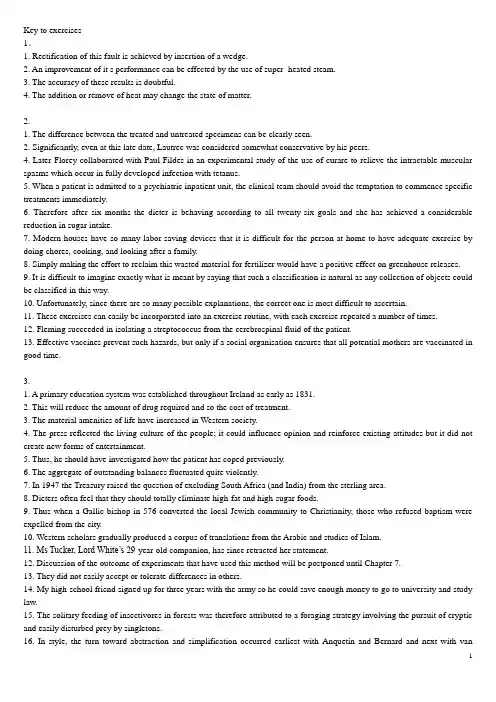
Key to exercises1.1. Rectification of this fault is achieved by insertion of a wedge.2. An improvement of it s performance can be effected by the use of super- heated steam.3. The accuracy of these results is doubtful.4. The addition or remove of heat may change the state of matter.2.1. The difference between the treated and untreated specimens can be clearly seen.2. Significantly, even at this late date, Lautrec was considered somewhat conservative by his peers.4. Later Florey collaborated with Paul Fildes in an experimental study of the use of curare to relieve the intractable muscular spasms which occur in fully developed infection with tetanus.5. When a patient is admitted to a psychiatric inpatient unit, the clinical team should avoid the temptation to commence specific treatments immediately.6. Therefore after six months the dieter is behaving according to all twenty-six goals and she has achieved a considerable reduction in sugar intake.7. Modern houses have so many labor-saving devices that it is difficult for the person at home to have adequate exercise by doing chores, cooking, and looking after a family.8. Simply making the effort to reclaim this wasted material for fertilizer would have a positive effect on greenhouse releases.9. It is difficult to imagine exactly what is meant by saying that such a classification is natural as any collection of objects could be classified in this way.10. Unfortunately, since there are so many possible explanations, the correct one is most difficult to ascertain.11. These exercises can easily be incorporated into an exercise routine, with each exercise repeated a number of times.12. Fleming succeeded in isolating a streptococcus from the cerebrospinal fluid of the patient.13. Effective vaccines prevent such hazards, but only if a social organisation ensures that all potential mothers are vaccinated in good time.3.1. A primary education system was established throughout Ireland as early as 1831.2. This will reduce the amount of drug required and so the cost of treatment.3. The material amenities of life have increased in Western society.4. The press reflected the living culture of the people; it could influence opinion and reinforce existing attitudes but it did not create new forms of entertainment.5. Thus, he should have investigated how the patient has coped previously.6. The aggregate of outstanding balances fluctuated quite violently.7. In 1947 the Treasury raised the question of excluding South Africa (and India) from the sterling area.8. Dieters often feel that they should totally eliminate high-fat and high-sugar foods.9. Thus when a Gallic bishop in 576 converted the local Jewish community to Christianity, those who refused baptism were expelled from the city.10. Western scholars gradually produced a corpus of translations from the Arabic and studies of Islam.11. Ms Tucker, Lord White’s 29-year-old companion, has since retracted her statement.12. Discussion of the outcome of experiments that have used this method will be postponed until Chapter 7.13. They did not easily accept or tolerate differences in others.14. My high-school friend signed up for three years with the army so he could save enough money to go to university and study law.15. The solitary feeding of insectivores in forests was therefore attributed to a foraging strategy involving the pursuit of cryptic and easily disturbed prey by singletons.16. In style, the turn toward abstraction and simplification occurred earliest with Anquetin and Bernard and next with vanGogh.17. For Klein that cloudless day never arrived, but he never relinquished his hope for a just world.18. Eventually the Irish party was forced to return to Westminster.19. The court thinks it just and equitable to return the property.20. The English liked coal fires even though they do not always produce much heat.21. The story told by German propaganda, however, betrayed nothing of the mounting hopelessness of the 6th Army’s position.22. These exercises can easily be incorporated into an exercise routine, with each exercise repeated a number of times.23. Marx took as one of his main tasks the understanding of how this system came into being in order to discover why this system had such power.24. This was before he had read the guidelines on how to conduct the research.25. The pressure to succeed as an individual made most women believe that the problems they encountered were probably of their own making4. Text 1 Most overdoses are taken when individuals are finding it difficult to sort out their life problems in a clear way. For this reason, the approach to treatment must, above all else, be a clear one; that is, one which helps the patient separate out each of his problems and plan ways of dealing with them.Text 2Wagner was what might be called a subjective artist in that his art had its source in his personality. His work seems virtually independent of the epoch in which he lived.On the other hand, Bach can be considered an objective artist. He seems to have worked only with the forms and ideas that his time proffered him, feeling no inner compulsion to open out new paths.6. 1. The lives they chose are overly ascetic and self-denying to most women today.2. Weismann proved that animals become old because, if they did not, there could be no successive replacement of individuals and hence no evolution.3. By analogy, one can walk from one point in hilly country to another by a path which is always level or uphill, and yet a straight line between the points would cross a valley.4. There are cases where this would have been the only possible method of transmission.5. 4. in the end, in the first place, in the second place, in the same way, but, despite, as a consequence, hence, for example, normally, naturally, unfortunately, namely, also, in that case, then ,in fact, indeed, indeed, actually, especially, mainly.6.1 The lives they chose may seem overly ascetic and self-denying to most women today.2. Weismann suggested that animals become old because, if they did not, there could be no successive replacement of individuals and hence no evolution.3. By analogy, it may be possible to walk from one point in hilly country to another by a path which is always level or uphill, and yet a straight line between the points would cross a valley.4. There are certainly cases where this would seem to have been the only possible method of transmission.7.1. On the evidence of the findings presented in Figure 1, it would appear that students in Hong Kong generally have little need to speak in English outside the classroom.2. The evidence proves that undergraduates rarely communicate with their parents or grandparents in English.3. This is undoubtedly because Hong Kong students’ family members are Cantonese speakers.4 The students in Hong Kong University probably go on an exchange at least once in their university life.5. It is possible that students have relatives in English-speaking countries.6. There is strong evidence that academic exchanges improve the language skills of students.7. The students in the Hong Kong University are predominantly Cantonese speakers.8. It is an iron law that nothing can go faster than light.9. The lack of solar power stations in HK proves that HK is not suitable for solar power.10. Hong Kong offers the best Chinese food in the world.8. open question。
Chapter_03(exercise)

• Jay has put $500 in a savings account at the First National Bank of Kent. The account earns 7%, compounded annually. How much will Jay have at the end of three years? • Carl recently won $10,000 in the lottery, wants to buy a car in five years. Carl estimates that the car will cost $16,105 at that time. What interest rate must he earn to be able to afford the car?
– 10,000 + 0.12*10,000= 10,000 *1,12=11,200
• The 2nd offer
– 11,424
• Concept: future value or compounded value.
• An alternative method---present value • The first offer
The Multiperiod Case
• Example: suppose an individual were to make a loan of $1. At the end of the first year, the borrower would owe the lender the principal amount of $1 plus the interest on loan at the interest rate of r. At the end of the year, the lender has two choices. She can either take the 1*(1+r) out of the capital market, or she can leave it in and lend it again for the 2nd year. • $1*(1+r)*(1+r)=1+2r+r^2
AP环境科学教材配套练习题答案
Environmental Science Answers for Chapter ExerciseThe first edition by Mony SuTopic 1 Earth Systems and Resources (10-15%)Chapter 02 Principles of Science and SystemsMultiple Choice Questions1 2 3 4 5 6 7 8 9 10B D D B E A AC A B11 12 13 14 15 16 17 18 19 20A C C A A A C D A A21 22 23A A DTrue / False Questions24 25 26F F FChapter 14 Geology and Earth ResourcesMultiple Choice Questions1 2 3 4 5 6 7 8 9 10C D E D A D B B B C11 12 13 14 15 16 17 18 19 20C B A C A E B AD B21 22 23 24 25 26 27 28 29 30E C D C B C A A D A31 32 33 34 35 36 37 38 39 40B A B EC C C A A B41ATrue / False Questions42 43 44 45 46T T T T FEssay Questions47.The diagram should look similar to Figure 14.8 on p. 307 in the textbook. Arrows should indicate that each rock type can be transformed into the other types, depending on the conditions.Chapter 15 Climate ChangeMultiple Choice Questions1 2 3 4 5 6 7 8 9 10A A C C DB B A B D11 12 13 14 15 16 17 18 19 20B A DC A BD C C D21 22 23 24 25 26 27 28 29 30B A BC A E A B B E31 32 33 34 35 36 37 38 39 40B A ACD A D C A A41 42 43 44 45 46 47 48 49 50A D D C C CB EC C51 52 53 54 55C A BD DTrue / False Questions56 57 58 59 60 61T T F F F FEssay Questions62.ENSO = El Nino Southern Oscillation. El Nino years typically bring intense storms and heavy rain from California across the Midwestern states. In general, the U.S. sees an increased amount of rainfall during El Nino years. La Nina years normally bring hot, dry weather to most of the U.S. The Pacific northwest (Washington, Oregon) usually has the reverse weather patterns. (Drier during El Nino and wetter during La Nina).63.The Kyoto Protocol is a treaty that was established in Kyoto, Japan in 1997. About 160 nations agreed to cut back on emissions of the main greenhouse gases to help with the problems associated with worldwide climate change. Even though the U.S. played an important role in leading the negotiations at Kyoto, it has never been ratified by the U.S. government. President Bush claims that it would be detrimental to our economy to doso. Several big businesses in the U.S. have joined with four of the largest environmental groups to call for strong national legislation to ultimately achieve significant reductions of greenhouse gases. These are huge companies that can make a major impact (GE, Alcoa, BP Gas, etc.) if they are successful. On an individual level, there are many things that can be done including: driving less, driving a fuel-efficient vehicle, planting trees, producing less waste (recycle or compost when possible), adjusting thermostats-especially when not at home, insulating your home, purchasing energy-efficient appliances, turning off lights, computers and other energy-consuming items when not in use, etc.Chapter 17 Water Use and ManagementMultiple Choice Questions1 2 3 4 5 6 7 8 9 10C A B A B C A C A A11 12 13 14 15 16 17 18 19 20D C A C C D B AE E21 22 23 24 25 26 27 28 29 30B D DC E B A C A A31 32 33 34 35 36D C D C B ATrue / False Questions37 38 39 40T F T FEssay Questions41.By comparison, both projects have the same purpose. That is to divert or transfer water from one region to another. In California, there is plentiful rainfall in the north, so excess water is pumped to the south. In China, it is the reverse. Southern China has plentiful water and will be pumping it to the north where it is scarcer. In California, much of the original project was done rather underhandedly. In the early 1900s, land in northern California was quietly purchased by persons in power in Los Angeles. Eventually, they controlled over 90% of the water rights in the Owens Valley area of northern California. They built a huge aqueduct and transported the water to the south. So much water was transferred that the Owens River became dry for much of its course and Owens Lake, which was fed by the river, completely disappeared. In the 1940s, even more water was needed, so sources even further north were tapped to increase the supply. Another lake in this area lost half of its volume. This had serious environmental effects by decimating the population of brine shrimp that lived in the lake. This in turn decreased the number of waterbirds that relied on the shrimp as a food source. After many years of legal issues, the California Water Resources Board ruled in 1994 that LA must allow some water to replenish Lake Mono (the second lake affected). By 2014, the lake must be returned to its 1964 level. Some increase has been seen so far. The ecology also seems to be recovering slowly in this area. In China, a huge multi-year, multi-billion dollar project is now underway to transfer water from southern to northern China. This will involve not one, but three separate routes to transfer the water to the needed regions. There are many problems and issues that will need to be dealt with. One issue is that water polluted by sewage and industrial waste is being transferred. Even though some areas are extremely dry, they are reluctant to accept this water. One of the routes will be extremely expensive and probably will not reach completion until at least 2050. This route will tunnel through mountains and over deep canyons. In addition, if global warming melts all of Tibet's glaciers, it may not be feasible in the long run. Environmental scientists worry that drawing from the Yangtze River will only worsen its pollution problems. Drawing water away from rivers on which millions rely only makes pollution problems worse. Downstream wetlands may also dry up, and ocean circulation may even be affected.42.Should include at least some of the following, but may include others as well. ▪ don't flush every time you use the toilet ▪ don't let the faucet run when washing hands, dishes, or brushing teeth ▪ take shorter showers ▪ use water-efficient plumbing fixtures ▪ check for leaky plumbing ▪ xeriscaping ▪ use recycled (gray) water for outside uses (if possible)—watering lawn, washing car, etc. ▪ run dishwasher only when fullTopic 2 The Living World (10-15%)Chapter 03 Matter, Energy, and LifeMultiple Choice Questions1 2 3 4 5 6 7 8 9 10E A B D E C C D E C11 12 13 14 15 16 17 18 19 20B E DC E A B E C A21 22 23 24 25 26 27 28 29 30B A B DC B C E A C31 32 33 34 35 36 37 38 39 40B DC AD A C B B E41 42 43 44 45 46 47 48 49 50E D D E A D E D A C51 52 53B E ATrue / False Questions54 55 56 57T T T FEssay Questions58.IV is false. There are many types of biogeochemical cycles, including carbon, nitrogen, phosphorus, and sulfur.59.Points awarded on depth and accuracy of answer. Answer should mention sunlight as the starting point for all energy and transfer of energy through living things in the foodchain/web (including energy lost as heat along each step of the pathway).60.Should include the following: carbon dioxide in the atmosphere, taken up by photosynthesis and released by cellular respiration (same in the oceans); carbon stored in the oceans; carbon deposits (dead organisms) forming calcium carbonate (limestone) on the ocean floor; carbon deposition from dead plants and animals millions of years ago formed today's fossil fuels.Chapter 04 Evolution, Biological Communities, and Species InteractionsMultiple Choice Questions1 2 3 4 5 6 7 8 9 10D C B B B A D DE A11 12 13 14 15 16 17 18 19 20B D BC BD C A A B21 22 23 24 25 26 27 28 29 30D A B D B B D D A D31 32 33 34 35 36 37 38 39 40A ABCD A A C A D41 42 43 44 45 46 47 48E C A E A E B BChapter 05 BiomesMultiple Choice Questions1 2 3 4 5 6 7 8 9 10B C A B C D B B D D11 12 13 14 15 16 17 18 19 20D C D C B BE B A C21 22 23 24 25 26 27 28 29 30D A B D C CE E D D31 32 33 34 35 36 37 38 39 40C B B BD B A A B A41 42 43 44 45 46 47 48 49 50C E E B C B B C C C51DTrue / False Questions52 53 54 55 56F T F T TChapter 11 BiodiversityMultiple Choice Questions1 2 3 4 5 6 7 8 9 10C CD AE C A A C D11 12 13 14 15 16 17 18 19 20D C D A B C C BE B21 22 23 24 25 26 27 28 29 30A D C CBC AD D B31 32 33 34 35 36 37 38 39 40A D D D A DB BC D41 42 43 44 45 46 47 48D B A B CE B ATrue / False Questions49 50 51 52 53T F T T FEssay Questions54.Should include some of the following, but may include others as well. 1) We have a large variety of food sources to choose from—all types of grains, starches, fruits, vegetables, seafood, and meat. 2) Pollinators provide us with many of our food sources, so they are also extremely important. They include birds, insects, and bats. 3) Bacteria and fungi provide us with many antibiotics. 4) Bacteria and fungi are also very beneficial as decomposers—cycling of nutrients. 5) Many plants have provided us with numerous drugs used to treat all types of diseases and illnesses. There are many discovered and undiscovered plants that may have medicinal potential. 6) Organisms provide us with ecological services that are invaluable to us—things like soil formation, water purification, production of oxygen, etc. 7) Organisms provide us with the opportunity for recreation—camping in a forest, fishing, horseback riding, etc. 8) Biodiversity can be economically beneficial. Many countries are now turning to ecotourism—making income by maintaining the natural environment for visitors to enjoy.55.Will vary depending upon the region you live in.Topic 3 Population (10-15%)Chapter 06 Population BiologyMultiple Choice Questions1 2 3 4 5 6 7 8 9 10A D CB A B ECD B11 12 13 14 15 16 17 18 19 20A EBC B A E E C E21 22 23 24 25 26 27 28 29 30A C ABCDE C E D31 32 33 34 35 36D B A C D ATrue / False Questions37 38 39 40T F F TChapter 07 Human PopulationsMultiple Choice Questions1 2 3 4 5 6 7 8 9 10C E E E E E A B A C11 12 13 14 15 16 17 18 19 20C A B A B E CD C A21 22 23 24 25 26 27 28 29 30C E B A A E E B B C31 32 33 34 35 36 37 38 39 40A B D B D C A B A E41 42 43 44 45 46 47 48 49 50B E DC E A B A A CD E B E C A D D E BTrue / False Questions61 62 63 64F T T TEssay Questions65.General trends, not numbers, should be included. There are three basic trends: 1) Rapidly growing countries - characterized by high birth and death rates, high fertility rates, and typically, high emigration rates 2) Stable populations - characterized by low birth and death rates, low fertility rates, and low emigration rates 3) Negative growth countries - characterized by death rates higher than birth rates, (however, both are low), extremely low fertility rates, (typically less than the 2.1 replacement rate) and low emigration rates66.x-axis should be labeled with increasing years of education, y-axis should be labeled with increasing rates of infant mortality. Graph should show a decline in infant mortality rates as years of education increase. Please include X and Y axis label, appropriate scales on the axes, and a legend.Topic 4 Land and Water Use (10-15%)Chapter 09 Food and HungerMultiple Choice Questions1 2 3 4 5 6 7 8 9 10C CD B D DE A C AE E B D A C C D D A21 22 23 24 25 26 27 28D C D B AE A DTrue / False Questions29 30 31 32 33 34T F F T T FEssay Questions35.Genetic recombination involves removing specific genes from one organisms and inserting them into another. This type of technology allows for many advantages. Someone who sees the positive benefits of this technology would be a technological optimist. Scientists working in this field would obviously see the benefits; opponents would most likely not be those in the field of genetic engineering. There are many benefits including: improved crops (yield, pest and disease resistance, salt tolerance, etc.), vaccines could be placed in foods like bananas and potatoes, insulin and other hormones can be mass-produced relatively cheaply.Chapter 10 Farming: Conventional and Sustainable PracticesMultiple Choice Questions1 2 3 4 5 6 7 8 9 10A B B E C D C E E A11 12 13 14 15 16 17 18 19 20B B EC C B E B C B21 22 23 24 25 26 27 28 29 30B E D D BC E B E B31 32 33 34 35 36 37 38 39 40A D AB B BC C B E41 42 43 44 45 46 47 48 49 50B D BC B A C B A AD B CE E D B A E A61 62 63 64 65 66 67 68 69 70B AC E C A E C E B71 72 73 74C D E BTrue / False Questions75 76 77 78 79 80T T T F F TEssay Questions81.Industrial farming produces very large amount of foods—in fact more than enough to feed the world's population (if distributed evenly).However, a large amount of this food goes to waste. The use of pesticides in industrial farming is very high and this results in many environmental problems—Poisoning nontarget species, including beneficial predators, pesticide resistance, reproductive problems in nontarget species, persistence and mobility—all can affect humans and animals thousands of miles away. Pesticides are also responsible for a myriad of human health problems. Organic farming does not result in as great a yield as industrial.However, it is much more eco-friendly. It leaves the soil in much better condition and since prices paid for organic products are higher than conventional, net returns are typically higher with organic crops. Since no pesticides are used, there are no negative health effects or other negative impacts associated with this type of farming.82.Should include at least some of the following, but may include others. ▪ buy organic—should contain no pesticides ▪ wash and scrub all fresh fruits and vegetables to remove residues ▪ peel fruits and vegetables when possible to remove all traces of pesticides ▪ throw away the outer leaves of leafy vegetables to remove highest concentration of pesticides ▪ store food carefully to avoid mold or bacterial growth—these organisms can produce their own toxins ▪ cook foods that you suspect have pesticides to break down residues ▪ trim the fat from meat, chicken, and fish—fat contains the highest concentrations of pesticides ▪ reduce the amount of meat in your diet to reduce your pesticide intake ▪ don't pick and eat wild berries that may have been sprayed—it's better to be safe—wash them first ▪ grow your own fruits and vegetables—then you know exactly where the food came from! Chapter 12 Biodiversity: Preserving LandscapesMultiple Choice Questions1 2 3 4 5 6 7 8 9 10D B C D D B A A C A11 12 13 14 15 16 17 18 19 20A B C B C A C D A B21 22 23 24 25 26 27 28 29 30D E B C C C B C C B31 32 33 34 35 36 37 38 39 40B A E B B D D EC B41 42 43 44C D C BTrue / False Questions45 46 47T T TEssay Questions48.Old growth forests have the following characteristics: very high levels of biodiversity, many unique species live only in old-growth forests, they accumulate more total biomass in standing vegetation per unit area than any other ecosystem, little or no erosion, nutrient-rich soil, only a small percentage remains and large percentages of that are scheduled to be harvested, the most valuable of these forests are protected (at least for now). Tree farms have the following characteristics: the types and sizes of trees can vary depending upon the cutting technique that is used; however, most are made up of one type of tree, most of which are about the same age and size (clear-cutting), typically soil erosion is prevalent due to lack of undergrowth, rotting logs, and other vegetation, soil is also typically nutrient-poor (no vegetation to be recycled—everything is removed), very little biodiversity due to little variation in habitat, alternative methods of cutting such as selective cutting are much better environmentally—decreases erosion, improves soil quality, increases biodiversity among other benefits.49.Brazil has the largest amount of land in protected status as of now. The majority of this protected land is in the Amazon basin. Nine new protected areas in the northern Amazon basin were established in 2006 (along the borders of Suriname and Guyana). About half of this newly protected land will be strictly protected and will create the largest tropical forest reserve in the world. In contrast to this is the Pantanal. This is the world's largestwetland/savanna complex (somewhat similar to the Florida everglades). Some of the regions of the Pantanal have even greater amounts of biodiversity than the Amazon basin. However, most of this region is privately owned and so far, very little of it has any protected status.Chapter 13 Restoration EcologyMultiple Choice Questions1 2 3 4 5 6 7 8 9 10D C AE E A E D A B11 12 13 14 15 16 17 18 19 20C A E E B BD C A A21 22 23 24 25 26 27 28 29 30A C D E A A C E A A31 32 33 34D D B ATrue / False Questions35 36 37 38 39T F F T TEssay Questions40.The intent of both is obviously to preserve the prairie. However, it is being approached in two completely different ways. The Nature Conservancy (TNC) is cooperating with local ranchers and allowing them to continue grazing cattle on most of the land (which TNC owns) in exchange for specific conservation measures including protection of prairie dog colonies and sage grouse nests. They must also control weed growth. TNC's approach is that by keeping ranch families working on the land, it preserves their lifestyle and at the same time, preserves the biodiversity of the Great Plains. Close by, the American Prairie Foundation (APF) is going about preservation by a completely different route. They have purchased approximately the same amount of land as TNC (close to 60,000 acres). Instead of continuing to allow cattle ranching, they will remove all fences and buildings and return the area to wilderness. They also plan to return wildlife including elk, bison, wolves and grizzly bears to the land. Nearby ranchers are not thrilled with the prospect of the predators being returned, as they feel their livestock will be threatened. Many also are not happy that the funding is coming mainly from Wall Street or Silicon Valley in California. They are upset that people with money from the outside are forcing changes upon them. They worry about restrictions that may be placed on the land. The APF defends its side by saying that tourism, bird-watching, and hunting will be allowed on nearly all of its lands and that this will bring in more income than raising cattle.41.Should include some of the following: 1) To reduce sediment influx (erosion from stream banks or other areas), several different methods may be employed including planting ground cover on banks or uplands; gullies that empty into the stream may be filled with rocks or brush; barriers can be used to deflect the current away from the stream banks or to trap sediment (these may include weirs, vanes, dams, logs, bundled brush, root wads, etc.)—these can actually be beneficial in carving out deep pools in the stream bottom, which provide excellent habitat for fish and other organisms; stabilizing stream banks—should be no more than 45 degrees to minimize erosion; soil can be held in place by plants, rocks, or other ground cover; if there is not enough space to recontour, steep banks will need to be supported by rock walls, riprap, or embedded tree trunks.Chapter 22 Urbanization and Sustainable CitiesMultiple Choice Questions1 2 3 4 5 6 7 8 9 10D D AE E B C B E A11 12 13 14 15 16 17 18 19 20C B CD C A B A B C21 22 23 24 25 26 27 28 29 30C A B A B A A C E E31 32 33 34C C B DTrue / False Questions35 36 37 38 39T T F F TEssay Questions40.Push factors: no jobs, lack of food, inadequate housing, political conflicts, racial conflicts, religious conflicts Pull factors: opportunity for education, variety of jobs, entertainment, freedom, social mobility, prestige, power41.Should contain some of the following information and may include others as well. Compare: Both are communities of living things along with the physical environment; both are affected by the abiotic conditions; both have a constant flow of matter and energy cycling through both living and non-living; both involve niches; both have fairly distinctboundaries. Contrast: Cities involve only humans—other species may live there, but are not an integral part of the functioning city; people not affected so much by abiotic factors (e.g., temp. is regulated by A/C and heating, go to work whether it is raining or snowing); many human activities and inputs are part of a city, but not an ecosystem (city foundation, drainage, sewage, pollution, garbage, etc.); infrastructure completely different—man-made in cities, natural in ecosystems.Chapter 23 Ecological EconomicsMultiple Choice Questions1 2 3 4 5 6 7 8 9 10E C E A C B B C C D11 12 13 14 15 16 17 18 19 20C A CD D A BE B E21 22 23 24 25 26 27 28 29 30D A D C A B BE B D31 32 33 34 35 36 37 38 39 40C E B C A ADE A E41 42 43 44 45 46 47 48A AB E D A B ATrue / False Questions49 50 51 52 53T T T F FEssay Questions54.Should look like Fig. 23.7 on p. 521 in textbook.55.Should include some of the following answers: Economist: focus on human resources (buildings, roads, labor); natural systems essential but externalized; manufactured capital is regarded as scarce and valuable; natural capital is regarded as plentiful and cheap; as one natural resource becomes scarce, a substitute will easily be found; based on supply and demand. Ecologist: focus on value of natural services; natural services are internalized; manufactured capital is very large (not really valuable) and puts stresses on natural resources; recycling is important; limited supplies of natural capital, which is valuable and often fragile.Topic 5 Energy Resources and Consumption (10–15%)Chapter 19 Conventional EnergyMultiple Choice Questions1 2 3 4 5 6 7 8 9 10A C EB D D E A D E11 12 13 14 15 16 17 18 19 20A A CB D A D A B B21 22 23 24 25 26 27 28 29 30D C A D AE A E E B31 32 33 34 35 36 37 38 39 40C A BD A B D B D C41 42 43 44 45A B C E BTrue / False Questions46 47 48 49 50 51F F T T F FEssay Questions52.In your evaluation, provide the pros and cons and the context in which each energy source would work best.53.Answers should contain at least some of the following but may contain others.Chapter 20 Sustainable EnergyMultiple Choice Questions1 2 3 4 5 6 7 8 9 10B BC AD C C B A B11 12 13 14 15 16 17 18 19 20E B D E C C C D C C21 22 23 24 25 26 27 28 29 30E E B E A C E A C B31 32 33 34 35A A C A BTrue / False Questions36 37 38 39 40 41F T T F F FEssay Questions42.Solar energy would be the best option for this situation. The new amorphous silicon collectors can be made into lightweight, paper-thin sheets that can be layered right on to roof tiles. A tropical country implies that it is warm and sunny year-round, providing the optimalconditions for solar collection. These collectors are already currently being used in remote places without access to conventional power, so this would be a perfect place for this technology. Homes and offices can be built without power plants and power lines; no fuels would need to be purchased; and you would have no monthly energy bills. Prices of solar electricity are dropping each year and will be competitive with conventional power (fossil fuels) by 2020. Even though the start-up cost may be more currently, in the long run the solar power will more than pay for itself.43.Should contain some of the items listed in the table below.Topic 6 Pollution (25-30%)Chapter 08 Environmental Health and ToxicologyMultiple Choice Questions1 2 3 4 5 6 7 8 9 10D E D A C A B D A A11 12 13 14 15 16 17 18 19 20B ACD B C B B A D21 22 23 24 25 26 27 28 29 30D E C D B A A E D A31 32 33 34 35 36 37 38 39 40D A B A B DE E C A41 42 43 44 45 46 47 48 49 50B C A B A E D C B C51 52 53 54 55C D E C ATrue / False Questions56 57 58 59 60T T T F TEssay Questions61.You would most likely be worried because: (should mention at least one from each category) 1) They may cause kidney and/or liver damage. 2) They may cause some types of cancer. 3) They can act as endocrine disrupters, affecting sex hormones; this can lead to reproductive abnormalities and decreased fertility as well as low sperm counts and decreased sperm motility.62.Should look like Fig. 8.16 in textbook (see explanation for the below figure).Chapter 16 Air PollutionMultiple Choice Questions1 2 3 4 5 6 7 8 9 10E A B C D A B C B A11 12 13 14 15 16 17 18 19 20E C C B A E A B D C21 22 23 24 25 26 27 28 29 30A A D C D D EB A D31 32 33 34 35 36 37 38 39 40C E E B AD CE A C41 42 43 44 45 46 47 48 49B BC BD B D B ATrue / False Questions50 51 52 53 54 55 56 57F F F F T F F FEssay Questions58.Both are formed by atmospheric oxygen (O2) combining with an atom of singlet oxygen (O). In the troposphere, ozone is a major component of smog. It is formed as a photochemical oxidant, resulting mainly from too many hydrocarbons in the air. It is a strong oxidizing agent and damages vegetation and buildings. It is also an irritant to the lungs and eyes. It can be very harmful to persons with underlying respiratory conditions, so itis considered a pollutant. Its role in the stratosphere is completely different. It acts as a UV filter, providing earth with a "natural" shield from incoming solar radiation. When it becomes depleted, due mainly to CFCs, excess UV makes it through the ozone layer. This results in increased incidence of skin cancer and eye damage in humans. It is also harmful to crops, which may show decreased productivity.Chapter 18 Water PollutionMultiple Choice Questions1 2 3 4 5 6 7 8 9 10C ED C A B A A C C11 12 13 14 15 16 17 18 19 20C B A B CD B C A B21 22 23 24 25 26 27 28 29 30D CE E D A E E E A31 32 33 34 35 36 37 38 39 40B C A E D A A C A B41 42D ETrue / False Questions43 44 45 46F F F TEssay Questions47.Point ▪ Examples include factories, power plants, sewage treatment plants, underground coal mines, and oil wells ▪ Pollution is discharged from specific locations (e.g., drain pipes, smoke stacks, ditches, sewer outfalls) ▪ Discrete and identifiable, so are relatively easy to monitor and regulate ▪ Generally feasible to divert effluent from the waste stream and treat it before it is released into the environment Nonpoint ▪ Examples include runoff from farm fields and feedlots, golf courses, lawns and gardens, construction sites, logging areas, roads, streets, and parking lots ▪ There is no specific location where they discharge, so it can end up in water anywhere ▪ Typically are scattered or diffuse ▪ Amount of runoff is seasonal (varies with times and amounts of precipitation); heavy rainfalls may flush or carry a lot of pollutants into lakes, rivers, and other bodies of water at one time ▪ Much more difficult to monitor, regulate, and treat48.BOD is one way to measure the amount of bacteria in a water sample. Organic wastes, including sewage, paper pulp, or food, are very rich in certain nutrients—especially nitrogen and phosphorus. Once in aquatic ecosystems, these nutrients stem the growth of decomposing bacteria. These bacteria consume large amounts of oxygen. The BOD can give us an approximation of the amount of organic waste in the water based on the oxygen content. The effects of oxygen-demanding wastes on bodies of water depend on the volume, flow, and temperature of the water. In general, a characteristic decline in oxygen is seen downstream from a point source (e.g., discharge pipe). This is called the oxygen sag. Farther downstream, levels of oxygen will eventually return to normal. A diagram similar to Fig. 18.7 on p. 402 in the text (showing the relationship between BOD and oxygen sag) should be drawn with appropriate labels. Zones, oxygen levels, and types of organisms may be included in this diagram.。
英语翻译chapter 3
• Jordan is reported to be the celebrity with whom most American children feel most comfortable, and American adults once placed him fifth on a list of all-time "most respected newsmakers".
• His athleticism and fierce competitiveness frightened his opponents, but his graciousness made him an American and international icon. He is most famous as the face of Nike, the athletics shoe and clothing company whose products he has endorsed for the past decade.
• Jordan quickly became a multi-millionaire, thanks to lucrative product endorsement deals such as his Nike promotion. As his fortune grew he put money back into the community, creating a foundation to fund athletics facilities and other projects for children form the inner city of Chicago, his adopted home.
Chemistry_coursebook_1_Ch_1_-9_answers
HKDSE CHEMISTRY – A Modern View(Chemistry)Coursebook 1Suggested answersChapter 1 The fundamentals of chemistry PageNumber •Class Practice1•Chapter Exercise 3Chapter2 The atmosphere•Class Practice6•Chapter Exercise7Chapter 3 Oceans•Chapter Exercise9Chapter4 Rocks and minerals•Class Practice12•Chapter Exercise13●Part Exercise15 Chapter 5 Atomic structure•Class Practice17•Chapter Exercise19Chapter6 The Periodic Table•Class Practice21•Chapter Exercise22Chapter 7 Chemical bonding: ionic bonding•Class Practice24•Chapter Exercise26 Chapter8 Chemical bonding: covalent bonding•Class Practice29•Chapter Exercise31 Chapter9 Structures and properties of substances•Class Practice34•Chapter Exercise35 ●Part Exercise37Chapter 1 Fundamentals of chemistryClass PracticeA1.1(b)Food : fertilizers, insecticides, food additives(c)Housing : metals, alloys, cement, glass, plastics(d)Transport : metals, alloys, fuels, glass, plastics(e)Medicines : drugs, antibiotics, artificial hormones(f)Amusement park facilities : metals, alloys, cement, glass, plastics,semi-conductorsA1.2Phosphorus and mercury are elements. The others are not.(Note: A substance with a name consisting of two words (e.g. sodium chloride) is not an element. A substance with a name of only one word (e.g. ammonia) may or may not be an element. The only sure way is to check the name against the Periodic Table.)A1.3Sodium - silvery grey solid;Chlorine - greenish yellow gas;Sodium chloride - white solid.A1.4(a) Hydrogen, oxygen, nitrogen, iron, sulphur(b) Water, carbon dioxide, carbon monoxide, sodium chloride, iron(II) sulphide(c) Air, sea water, town gas, sodium chloride solution, wine(Other answers may be given.)A1.5(a) Chemical change(b) Physical change(c) Physical change(d) Chemical change(b) and (c) are physical changes because no new substances are formed. (a) and (d) are chemical changes because new substances are formed.A1.6(a), (b) and (e).A1.8(a) Flat-bottomed flask (l) Crucible tongs (w) Reagent bottle(b) Round-bottomed flask (m) Spatula (x) Gas syringe(c) Clamp (n) Heat-resistant mat (y) Measuring cylinder(d) Retort stand (o) Pestle (z) Beaker(e) Conical flask (p) Mortar (aa) Funnel(f) Wire gauze (q) Desiccator (bb) Plastic washbottle(g) Evaporating basin (r) Test tube holder (cc) Teat pipette(h) Tripod (s) Test tube rack (dd) Thermometer(i) Crucible (t) Test tube (ee) Watch glass(j) Pipeclay triangle (u) Boiling tube (ff) Separating funnel (k) Bunsen burner (v) Dropping bottle (gg) Glass rodChapter 1 Fundamentals of chemistryChapter Exercise1. science, observations, experiments2. substances, compositions, structures, properties, changes3. Oxygen, atmosphere4. chemically combined together, hydrogen, oxygen.5. heating, electrolysis6. mixture7. chlorine, compound8. element, compound, mixture9. retains, different10. ppearance , dour , aste , ensity , elting11. chemical12. physical13. new14. A15. B16. D17. C18. C19. D20. B21. B22. A23. D24. A25. D26. C27. B28. D29. A30. (a) A = beaker, B = test tube, C = Bunsen burner, D = wire gauze, E = tripodstand, F = heat-proof mat, G = test tube holder, H = evaporating dish(evaporating basin)(b) (i) Test tube (B).(ii) Test tube(B), test tube holder (G), Bunsen burner (C) , heat-proof mat(F).(iii) Beaker (A), tripod stand (E), wire gauze (D), Bunsen burner (C),heat-proof mat (F).31. (a) Tasteless; no smell; colourless; liquid at room conditions(b) React with iron; react with sodium(c) Water changes into steam at 100o C. / Water changes into ice at 0o C.(d) It is because no new substance is formed.(e) Iron reacts with water to form iron rust. / Sodium reacts with water to formhydrogen gas.(f) New substance (e.g. rust or hydrogen gas) is formed.32. (a) Chlorine, hydrogen, iron, mercury , oxygen, sodium and sulphur(b) An element is a pure substance that cannot be broken down into anythingsimpler by chemical methods.(c) Ammonia, sodium chloride and water(d) A compound is a pure substance made up of two or more elementschemically combined together(e) A mixture consists of two or more pure substances (elements or compounds)which have not chemically combined together.(f) Sodium chloride solution is a mixture (because a solution is a homogeneousmixture).33. (a) No. Both oxygen and hydrogen are gases at room conditions while glucoseis a solid at room conditions. Carbon is black in colour while glucose iswhite.(b) Glucose solution is a mixture. It is because there is no chemical reactiontaking place between glucose and water.(c) Glucose + oxygen → carbon dioxide + water34. Compounds and mixtures are different in a number of ways. These include:(1) Compounds have fixed chemical composition while mixtures have variablechemical composition. Examples: water and air(2) During the formation of compounds, a chemical change occurs. Newsubstances are always formed. On the other hand, a mixture is obtainedwhen different substances are physically mixed. There is no chemicalchange. No new substance is formed and the change is seldom accompaniedby energy changes. Examples: formation of water from hydrogen andoxygen, mixing of sand and sugar(3) Properties of a compound are very different from that of its constituentelements. For example, water is colourless liquid while hydrogen and oxygenare colourless gases. On the other hand, each constituent substance retainsits own properties in mixtures. For example, nitrogen and oxygen are bothcolourless gases no matter whether they are isolated or present together inthe air.(4) Separation of the constituents of a compound requires a chemical process.For example, breaking water down into the elements hydrogen and oxygenrequires a chemical process called electrolysis. On the other hand,separation of a mixture requires a physical process only. For example,separation of iron powder from a mixture just requires the use of a magnet.35. -PHYSICAL PROPERTIES of a substance are those properties that can bedetermined without the substance changing into another substance.-Examples of physical properties of a substance include colour, odour (smell) and physical state. For example water is a colourless, odourless liquid under room conditions.-CHEMICAL PROPERTIES of a substance are the chemical reactions of the substance, and the respective conditions under which each reaction takes place.-Examples of chemical properties of a substance include how fast and vigorous it reacts (i.e., its reactivity) with another substance, the condition(s) needed for it to react with other substances and what products can be produced when it reacts with other substances. For example, hydrogen reacts vigorously with oxygen (or air) only when lit with a burning splint to form water.Class PracticeA2.1(a) People in ancient times had little scientific knowledge. In fact, any visibleportion of the Earth appeared more or less flat to the eyes.(b) Satellite photos clearly show that the Earth is roughly spherical.(Other answers may be given.)A2.2atmospherecrustmantleinner coreouter coreA2.31. (a) No. (7 planets have an atmosphere.)(b) Yes.2. There is no air on the Moon.A2.4Elements Compoundsnitrogen carbon dioxideoxygen water vapourheliumneonargonkryptonxenonA2.5Helium -269Neon -246Nitrogen -196Argon -186Oxygen -183Krypton -153Xenon -109Carbon dioxide -78Chapter Exercise1. crust, mantle , core, atmosphere2. atmosphere3. nitrogen, oxygen4. fractional distillation5. liquefied6. supporter7. glowing8. A9. A 10. B 11. B 12. B 13. D14. (a) Nitrogen (b) Carbon dioxide and water vapour (c) Oxygen, argon, neon, helium, krypton, xenon (any two)15. (a) The volumes of the three gases obtained i.e. argon, nitrogen and oxygen are930 litres, 78,000 litres and 21,000 litres respectively.(b) Fractional distillation (c) No. Oxygen is the most reactive gas in air, whereas nitrogen is unreactive,which serves the good purpose of ‘diluting ’ oxygen in air. If there were more oxygen in air, metals would be oxidized and corroded faster. Things would also burn easier, so there would be a greater hazard of fire.16. (a) Fractional distillation of liquid air (b) Oxidizing (c) Physical property: colourless, odourless Chemical property: it supports combustion (d) Put a glowing splint into a test tube containing the gas to be tested. If thegas is oxygen, the splint relights.17. (a) Nitrogen and oxygen (b) Oxygen (c) copper + oxygen → copper(II) oxide (d) 50 cm 3 - 33 cm 3 = 17 cm 3(e) 33cm50cm 17⨯ 100% = 34% (f) 21% (g) The percentage of oxygen in dissolved air (34 %) is much greater than thatin the atmosphere (21 %) because oxygen is more soluble in water than nitrogen.18. -Fractional distillation of liquid air is used to separate nitrogen and oxygenfrom air.-The air is first liquefied by repeated cooling and compression.-Then the liquid air is warmed up bit by bit very slowly.-Different gases in air boil at different temperatures, so they can be collected one by one.-The one boiling off first is nitrogen (boiling point -196 ︒C). The second one to be collected is argon(boiling point -186 ︒C) /noble gas. Then oxygen gas (boiling point -183 ︒C) is collected.Chapter 3 OceansChapter Exercise1. sodium chloride (common salt), sodium, chlorine2. evaporation3. filtration, crystallization4. saturated5. boiling, condensation6. distillate, residue7. distillation8. flame test9. brilliant golden yellow10. white11. water, white, blue, blue, pink12. Brine13. hydrogen, chlorine, sodium hydroxide14. B15. C16. B17. C18. D19. A20. (a) Filtration(b)(c) Distillation(d)(e) Test for sodium ions: Flame test. The sample gives a brilliant golden yellow flame in the flame test if sodiumions are present.Test for chloride ions: Silver nitrate testAdd silver nitrate solution to the sample, followed by excess dilute nitric acid. Theappearance of a white precipitate indicates the presence of chloride ions.21. His conclusion is not justified. He should add the white-powder to distilled waterand stir well, then filter and evaporate the filtrate to dryness by heating, and see if any solid is left.22. (a) This is because some metal ions can produce a characteristic coloured lightwhen they are heated strongly.(b) (1) Moisten a clean platinum wire with concentrated hydrochloric acid.(2) Dip the platinum wire into a crushed sample of the salt (or solution) tobe tested.(3) Heat the platinum wire with the sample strongly in a non-luminousflame.(4) Observe the colour of the flame at the wire and identify the metal ionspresent.(c) Potassium ions: lilac; calcium ions: brick red; copper (II) ions: bluish green.23. (a) It was not a suitable method because the liquid may be unclean, harmful oreven poisonous.(b) Flame test.(c) To show the presence of chloride ions, acidified silver nitrate solution isadded to the sample. If chloride ions are present, a white precipitate will be formed.(d) To show the presence of water, a few drops of the liquid are added toanhydrous copper(II) sulphate.The powder changes from white to blue if water is present.Alternatively, add a few drops of the liquid to dry cobalt chloride test paper. The paper changes from blue to pink if water is present. thermometerdelivery tubeclampboiling tube sodium chloridesolutionheatanti-bumping granulereceiver test tubewater pure water(e) He could not be sure that the liquid was sea water. Even if the tests showedthat sodium ions, chloride ions and water were present, the liquid might notnecessarily be sea water. For example, it might be just a sodium chloridesolution, without any other salts naturally present in sea water.24. (a) Electrolysis means ‘decomposition by electricity’.(b) Chlorine, hydrogen and sodium hydroxide.(c) Chlorine − water sterilization, manufacture of bleach, etc.Hydrogen − production of margarine, as rocket fuel, etc.Sodium hydroxide − manufacture of soap, extraction of aluminium, etc. 25. -Sea water is an important source of common salt (sodium chloride) which hasmany uses.-By the electrolysis of sea water, useful products, hydrogen, chlorine and sodium hydroxide are obtained. These products can be used to manufacture a lot of useful chemicals.-Hydrogen can be used to produce ammonia.- Chlorine can be used to produce bleach.- Sodium hydroxide can be used to produce soap.Class PracticeA4.1heat calcium oxide + carbon dioxideStep 1: calcium carbonate −−−−→Step 2: calcium oxide + water → calcium hydroxideStep 3: calcium hydroxide + water → calcium hydroxide solution (limewater) Step 4: calcium hydroxide solution (limewater) + carbon dioxide→ calcium carbonate + waterA4.2calcium carbonate + nitric acid → calcium nitrate + carbon dioxide + waterChapter Exercise1. mineral, a mixture of minerals2. crystalline, chemical3. extraction4. ore, aluminium5. haematite, carbon (or coke)6. chalk, marble7. Neutralizing, building material, cement (or other acceptable answers)8. Weathering9. Erosion10. PhysicalChemical11. uicklime, calcium oxide.12. acids, carbon dioxide13. milky14. iron + carbon dioxide15. aluminium + oxygen16. carbonic acid17. calcium hydroxide + heat18. calcium hydrogencarbonate19. calcium oxide + carbon dioxide20. calcium carbonate (white solid) + water21. calcium chloride + carbon dioxide + water22. B23. D24. D25. C26. A27. B28. D29. C30. C31. B32. (a) (1) Both react with acid to give out carbon dioxide.(2) Both are decomposed on strong heating.(b) (1) Neutralizing acidic soil and lakes affected by acid rain.(2) As a raw material to make glass by heating with sand and sodiumcarbonate.(3) As a raw material to make cement by heating with clay. (or any otherpossible answers)33. (a) Weathering is the slow process in which exposed rocks are broken downinto smaller pieces.(b) Physical weathering and chemical weathering.(c) It is because carbon dioxide in air dissolves slightly in rainwater, formingcarbonic acid. Carbonic acid can attack rocks.(d) Calcium hydrogencarbonate(e) calcium carbonate + carbonic acid → calcium hydrogencarbonate34. (a) Calcium carbonate(b) calcium carbonate −−−−→− heat strongcalcium oxide + carbon dioxide (c)(d) When the gas is passed through limewater for a few seconds, the limewater turns milky.35.(a) (i) Calcium oxide(ii) Calcium hydroxide(iii) Calcium hydroxide solution(b) (i) calcium carbonate −−→−heat calcium oxide + carbon dioxide(ii) calcium carbonate + hydrochloric acid → calcium chloride + carbon dioxide + water(iii) calcium oxide + water −→ calcium hydroxide(iv) carbon dioxide + calcium hydroxide solution−→ calcium carbonate + water (c) The rock fizzes (colourless gas is given out).heat limewaterPart I Planet earthPart Exercise1. C2. C3. A4. A5. C6. A7. B8. C9. A10. C11. D12. D13. C14. B15. A16. C17. B18. C19. B20. (a) Hydrogen ― as fuelOxygen ― in breathing aids (or any other possible answers)(b) No. Oxygen and hydrogen inside the container mix to form a gaseousmixture. All mixtures are impure substances.(c) Water(d) Yes. Water is a compound, and a single compound when existing alone is apure substance.21. (a) This conclusion is valid. The brick red colour in the flame test indicates thepresence of calcium, and the white precipitate formed when acidified silvernitrate solution is added indicates the presence of chloride.(b) This conclusion is invalid. The bubbles formed when acid was added maynot be carbon dioxide.(c) Conclusion (a) cannot be disproved. To test the validity of conclusion (b),pass the gas formed into limewater. If the limewater turns milky, the gas iscarbon dioxide, then the conclusion is valid. If the limewater doesn’t turnmilky, the conclusion is invalid.(d) The only validity of this statement is that the sample is a mixture containingcalcium chloride. Even carbonate is shown to be present, the tests carriedout are insufficient to rule out the possibility of other substances present inthe sample.22.(a) X : carbon dioxide; Y : water; Z : carbon dioxide.(b) calcium carbonate −−→−heat calcium oxide + carbon dioxideThe limestone cracks and makes a cracking noise.(c) calcium oxide + water → calcium hydroxide + heatA lot of heat is produced, with the possible production of some steamy vapour. The white solid turns into a paste.(d) calcium hydroxide + carbon dioxide → calcium carbonate + waterThe calcium hydroxide solution (limewater) turns milky.(e) This is the limewater test for carbon dioxide.23. (a) Refer to Coursebook 1 page 69.(b) Refer to Coursebook 1 page 70.(c) Frost action is a physical weathering process. This is because no newsubstances are formed during the process. Action of carbonic acid is a chemical weathering process. This is because carbonic acid changes calcium carbonate to a new substance, calcium hydrogencarbonate.(d) When excess of carbon dioxide is bubbled in, soluble calciumhydrogencarbonate is formed.Chapter 5 Atomic structureClass PracticeA5.1They are the only two liquid elements.A5.21. (a) Only an element can be classified as a metal or non-metal. Water is not anelement.(b) Non-metal.(c) Metal.2. (a) Mercury. All are metals. Mercury is a liquid, while the others are solids atroom conditions.(b) Sulphur. Sulphur is a non-metal, while the others are metals.(c) Iodine. All are non-metals. Iodine is a solid, while the others are gases atroom conditions.(d) Graphite. All are non-metals. Graphite conducts electricity, while the othersare non-conductors of electricity.A5.3(a) (i) Mg(ii)Ag(iii) Na(b)(i) Ar,(ii) He(iii) Ne(c) (i) fluorine(ii) bromine(iii) mercuryA5.4(a) 118(b) Br(c) N(d) The element copper or a copper atom.A5.5(a) The commonest type of hydrogen atom.(b) 91 electrons. Number of neutrons cannot be predicted.(c) It is not an atom. The numbers of protons and electrons are not equal.A5.6A magnesium atom would be changed to a chlorine atom.A5.71. (a) silver(b) silver(c) silver2. (a) Aluminium(b) Al1327(c) (i) 13(ii) 13(iii) 27 - 13 = 14A5.8(a) 3(b) O816(16O, or oxygen-16)A5.9(a) 37(b) 35(c) 4(d) 238(e) We cannot tell from the given data.(The mass number is not given.)A5.10(a) Relative atomic mass of sodium= mass number of the only type of sodium atom = 23(b) Relative atomic mass of neon=10010229020⨯+⨯= 20.2A5.11(a) (b)(c) (d)A5.12(a) 17(b) (i) 2,8,7(ii)Chapter 5 Atomic structureChapter Exercise1. physical2. bromine, mercury3. metals, non-metals4. metals, non-metals, graphite5. ymbol6. smallest part7. element8. atoms9. nucleus, neutrons, nucleus, electrons10. positively, negatively, neutral11. protons12. mass number13. same, different14. carbon-1215. weighted average, relative isotopic16. shells17. electronic arrangement (electronic configuration)18. B19. D20. D21. B22. C23. D24. C25. D26. (a) True. This is because there is no gaseous metal or semi-metal at roomconditions.(b) False. This is because mercury is a liquid metal at room conditions.(c) False. This is because carbon (graphite) is a non-metal which can conductelectricity. / This is because semi-metals cannot conduct electricity bythemselves.(d) False. This is because some metals (e.g. sodium) are soft.(e) True. This is because metals are silvery white, golden or brown in colour.No metal is red in colour.27. (a) The mass number of an atom is the sum of the number of protons andneutrons in the atom.(b) The atomic number of an atom is the number of protons in the atom.(c) Isotopes are different atoms of the same element, with the same number ofprotons (and electrons) but different numbers of neutrons.(d) Atom Number of protons Number of neutrons Electronic configuration105B 5 5 2, 3 115B 5 6 2, 3 (e) 10.810080112010=+⨯⨯ 28. (a) Q and R(b) Carbon(c) Carbon-13 and carbon-14(d) 135P , 136Q , 146R , 147S29. (a)AtomAtomic no. Mass no. Number of Electronic arrangement protons neutrons electrons (a)35Cl 17 35 17 18 17 2, 8, 7 (b)17O 8 17 8 9 8 2, 6 (c) 40Ar 18 40 18 22 18 2, 8, 8(b)(c) Neon(d) Argon is very unreactive.30. - Elements can be classified according to their physical states . For example, atroom temperature, hydrogen and oxygen are gases; bromine and mercury are liquids; carbon and iodine are solids.- Elements can also be classified into metals and non-metals. A few elementshave properties in between those of metals and non-metals. They are classified as semi-metals.- Examples of metals include sodium and mercury; examples of non-metalsinclude bromine and hydrogen; examples of semi-metals include boron and silicon.Class PracticeA6.1(a) Period 7, Group II; alkaline earth metals.(b) Radium.(c) Yes. Radium is a metal (all metals conduct electricity).A6.2Element X: MetalElement Y: Non-metalElement Z: We cannot tell from the given data as elements in Group IV can be a metal, non-metal or semi-metal.A6.3(a) 2, 8, 8, 2.(b) Yes, it is a metal.(c) (ii).A6.4(a) Yes. By knowing the chemical properties of familiar elements in the same groupand the group trend, predictions about the unfamiliar element can be made. (b) Astatine: D; strontium: AChapter Exercise1. electrons, outermost2. ascending, atomic numbers3. period, group, eight,4. period number, outermost5. metals, semi-metals, non-metals6. chemical7. 1, 1, increases8. 7, halogens, decreases9. 8, noble gases10. B11. B12. D13. C14. C15. C16. C17. D18.19. (a) 2(b) They all have two electrons in the outermost shell.(c) Increase down the Group.(d) (i) Beryllium reacts very slowly with water.(ii) Barium reacts vigorously with water.(e) Barium is more reactive than calcium. It should be stored under paraffin.20. (a) Magnesium, silicon, chlorine. They are in Period 3.(b) Lithium, rubidium, caesium. They are in Group I.(c) Iron, copper(d) Caesium(e) Fluorine(f) Silicon(g) Helium(h) Helium, fluorine, chlorine(i) Fluorine, chlorine21. (a) Group II(b) Alkaline earth metals(c) Strontium has 2 outermost shell electrons.(d) Strontium is a silvery white solid at room conditions.(e) Strontium reacts with cold water more readily than calcium does andcolourless gas bubbles are given off. This is because the reactivity of GroupII elements will increase down the group.22. - In the modern Periodic Table, elements are arranged in ascending order ofatomic number.- The elements are arranged in periods and groups of the Periodic Table.A horizontal row of elements is called a period while a vertical column ofelements is called group.- Period number = number of occupied electron shellsGroup number = number of electrons in outermost shell- Elements within the same group of the Periodic Table have similar chemical properties.- Across a period, the elements change from metals through semi-metals to non-metals.- Some of the groups have special names. Group I elements are named as alkali metals; Group II elements are named as alkaline earth metals; Group VII elements are named as halogens; Group 0 elements are named as noble gases.The elements in between Group II and Group III are called the transition elements.Chapter 7 Chemical bonding: ionic bondingClass PracticeA7.1(a) Delete ‘non-metals’.(b) Delete ‘metals’.A7.2(a) Colourless(b) Purple(c) Yellow(d) GreenA7.3(a) The cathode. Potassium ions are positively charged. They are thus attractedtowards the negative electrode (cathode).(b) No. Potassium ions are colourless.(c) A green patch would move towards the negative electrode (cathode).Chromium(III) ions are green in colour and positively charged. They are attracted towards the negative electrode.A7.4(a) (i) Aluminium atom: 2, 8, 3; aluminium ion: 2, 8(ii) Chlorine atom: 2, 8, 7; chloride ion: 2, 8, 8(b) Charge on aluminium ion = +3; charge on chloride ion = -1A7.5Simple ions: H+, H-, Mn2+Polyatomic ions: NH4+, NH2-, OH-A7.6(a)(ii) At-A7.7(a)(b)A7.8(a) CuCl2(b) CaS(c) Al(OH)3(d) (NH4)2CO3A7.9(a) Mg(OH)2(b) Na2O(c) PbSO4(d) K2Cr2O7A7.10(a) Calcium nitrate(b) Iron(III) chloride(c) Zinc sulphate-7-water(d) Copper(II) hydroxideChapter 7 Chemical bonding: ionic bondingChapter Exercise1. octet, duplet2. electrons, noble gas, ions3. simple, polyatomic4. cations, anions5. coloured6. electrolysis7. name, formula8. group9. minus10. ionic, ionic, calcium oxide, calcium, oxygen, Calcium (Ca2+), oxide (O2-), ionicbonds11. giant ionic structure12. B13. A14. D15. A16. C17. A18. C19. B20.21. (a) Calcium sulphate(b) Cation: calcium ion; anion: sulphate ion(c) Ionic bonding(d) CaSO4(e) The coagulant is white in colour.(g) Polyatomic ion22. (a) A: 2,5; B: 2, 8, 1; C: 2, 8, 2; D: 2, 8, 6(b) Elements A and D tend to gain electrons to attain an octet of electrons.(c) Elements B and C tend to lose electrons to attain an octet of electrons.(d) 4(e) B3A; B2D; C3A2; CD(f)B3A B2DC3A CD23. (a) Magnesium chloride: MgCl2; potassium chloride: KCl; sodium chloride:NaCl(b)MgCl2KClNaCl(c) Giant ionic structure24. -Consider the reaction between sodium and chlorine.A sodium atom Na has the electronic arrangement 2,8,1. It loses 1 electron toget the stable octet structure to form a Na+ ion.-A chlorine atom Cl has the electronic arrangement 2,8,7. It gains 1 electron to get the stable octet structure to form a Cl- ion.-When sodium atom reacts with a chlorine atom, the sodium atom loses 1 electron to the chlorine atom. By transfer of electron, two ions are formed.The electrostatic force between the ions is called ionic bonds and the compound is called ionic compound.electronsodium atom(Na) (loses one electron)sodium ion(Na+) chlorine ion(Cl-)transferchlorine atom(Cl)(gains one electron)。
Exercise-Chapter 7(1)
Exercise for Chapter 71.The natural rate of unemployment is:a.the average rate of unemployment around which the economy fluctuates.b.about 10 percent of the labor force.c.a rate that never changes.d.the transition of individuals between employment and unemployment.2.If the number of employed workers equals 200 million and the number of unemployed workers equals 20 million, the unemployment rate equals percent (rounded to the nearest percent)a.0.b.9.c. 10.d. 20.3.All of the following are reasons for frictional unemployment except:a.workers have different preferences and abilities.b.unemployed workers accept the first job offer that they receive.c.the flow of information is imperfect.d.4.All of the following policies were adopted by the government in an attempt to reduce the natural rate of unemployment except:a.unemployment insurance.ernment employment agencies.c.public retraining programs.d.the Illinois bonus program for unemployment insurance claimants who found jobs quickly.5.The unemployment resulting when real wages are held above equilibrium is calledunemployment, while the unemployment that occurs as workers search for a job that best suits their skills is called unemployment.a.efficiency; inefficiencyb.efficiency; structuralc.frictional; efficiencyd.structural; frictional6.Workers unemployed as a result of wage rigidity are:a.actively searching for a job to match their skills.b.not eligible to receive unemployment insurance benefits.c.waiting for a job to become available.d.relocating to another part of the country as a result of sectoral shifts.7.All of the following are causes of structural unemployment except:a.minimum-wage laws.b.the monopoly power of unions.c.unemployment insurance.d.efficiency wages.8.In the case of unions, the conflict of interest between different groups of workers results in insiders wanting , while outsiders want .a.more hirings; high wagesb.high wages; more hiringsc.high wages; fewer hiringsd.fewer hirings; high wages9.If the rate of separation is 0.02 and the rate of job finding is 0.08 but the current unemployment rate is 0.10, then the current unemployment rate is the equilibrium rate, and in the next period it will move the equilibrium rate.a.above; towardb.above; away fromc.below; towardd.below; away from10.The recent reduced demand for unskilled workers relative to skilled workers has led to for unskilled workers in Europe compared to for unskilled workers in the United States.a.unemployment; lower wages.b.lower wages; unemployment.c.more unionization; efficiency wages.d.efficiency wages; more unionization.11.Assume that the real wage in an economy is held above equilibrium.i.Graphically illustrate how an increase in technology that raises the demand for laborwill change the number of unemployed workers. Be sure to label the axes and the quantities of labor hired before and after the technological progress.ii.Explain in words what happens to the number of unemployed as a result of this change.12.i.the unemployment rate,ii.the average duration of each unemployment spell.iii.whether the unemployment is more likely to be frictional or structural.。