
【新】牛津译林版七年级英语下册Unit2 Reading 1教学案
备课日期
年
教学
课题
Unit 2 Neighbours课时
安排
2月日Reading 17
教学目标To grasp the words:helpful community skill problem something engineer check broken someone fix anyone college lucky
To grasp the phrases: help sb. with sth. do some shopping
重点
1. 能了解有关社区中心的知识。
2. 能用英语介绍社区中心的活动内容。
难点
教学过程设计
集体备课二次备课Step 1 Revision
1. 与学生就居住的社区环境进行交流,复习前一课时的内容。
2. Who lives next to /above/below you? Who’s your neighbour? What does he/she do? Where does he/she work? What do you think of him/her? Do you welcome him/her to your home? Do you always help each other?
Step 2 Presentation
1. I’m very lucky to have many good neighbours. They have different skills and can do many different things. They’re also very helpful. When they’re free, they often go to the community centre to help other.
2. Look, here are some posters. They show some activities in my community centre this Sunday.
Step 3 Practice
1. 指导学生开展活动,巩固前面所学的新知识。
教师将写有“there is something wrong with ”或“I cannot ”的纸条分别发给两组学生,让他们各自填写遇到的问题,教师再将写有“I can help with ”, “I am a(an) ”或“I am good at ”的纸条分别发给另外两组学生,让他们填写自己能提供的帮助。
鼓励一方学生寻求帮助,另一方学生提供帮助。
Step 4 Presentation
1. To make our neighbourhood a better place to live, we should help each other as possible as we can. Simon is talking about his neighbours with Amy. Please read their conversation and answer the question: what happens when Simon has problems?
2. 为学生播放录音,让他们听录音并完成表格。
回顾上节课的重点内容。
Work in groups.
3. Amy is writing something about Simon’s neighbours. Write a T if the sentence is true or an F if it is false.
Step 5 Practice
1. Shall we do a role-play activity? Wor k in a group of four. Suppose one of you is Simon and the others are volunteers at Simon’s community centre. Tell use your skills and introduce what you can during to help your neighbours.
2. 为了使学生了解活动形式,教师可以与三位学生进行示范。
3. 安排学生以四人小组为单位,设计并编写对话。
Step 6 Summary
词汇:helpful community skill problem something engineer check broken someone fix anyone college lucky
词组:help sb. with sth. do some shopping
句型:They help us with all kinds of problems.
There’s something wrong with my computer.
I’m going to ask a computer engineer to check it.
Some college students are already to help.
Exercise(Homework)
根据汉语完成下列各句
1. Millie help Simon. (乐意).
2. They are (大学生).
3. There’ s__________ his computer.
他的电脑没有坏。
4. Sandy _____________ (真幸运) .
5. Daniel is going to _____ ________ . (购物).
6. They are going to (参观) Shanghai.
7. Can you find any (志愿者)?
8. Some (工程师) are over there. Listen to the tape and complete the form. Group work:
Make up some dialogues.
Learn the new words and phrases.
Do some exercise.
课后作业1. Read the article after the tape three times.
2. Com plete the exercise above.
3. Recite the new words.
教学
反思
本节课的词汇量较多,在情境中教授新词汇,学生更容易记住。
牛津译林版七年级英语下册Unit2NeighboursReading1优质教案
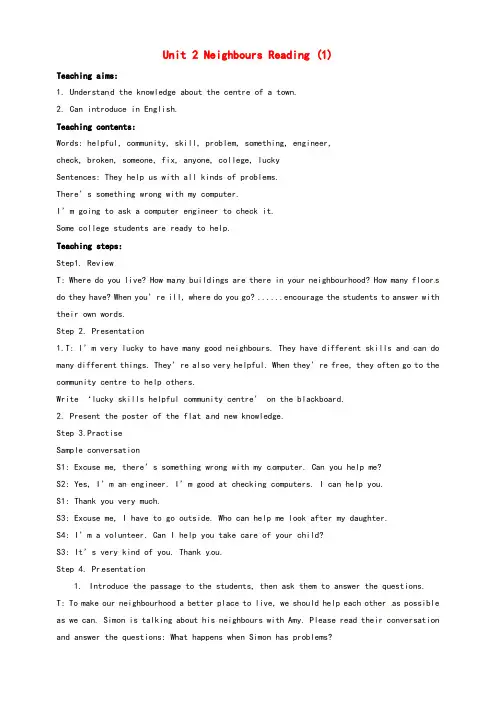
Unit 2 Neighbours Reading (1)Teaching aims:1. Understan d the knowledge about the centre of a town.2. Can introduce in English.Teaching contents:Words: helpful, community, skill, problem, something, engineer,check, broken, someone, fix, anyone, college, luckySentences: They help us with all kinds of problems.There’s something wrong with my computer.I’m going to ask a computer engineer to check it.Some college students are ready to help.Teaching steps:Step1. ReviewT: Where do you live? How ma ny buildings are there in your neighbourhood? How many floor s do they have? When you’re ill, where do you go? ......encourage the students to answer with their own words.Step 2. Presentation1.T: I’m very lucky to have many good neighbours. They have dif ferent skills and can do many different things. They’re also very helpful. When they’re free, they often go to the community centre to help others.Write ‘lucky skills helpful community centre’ on the blackboard.2. Present the poster of the flat a nd new knowledge.Step 3.PractiseSample conversationS1: Excuse me, there’s something wrong with my c omputer. Can you help me?S2: Yes, I’m an engineer. I’m good at checking computers. I can help you.S1: Thank you very much.S3: Excuse me, I have to go outside. Who can help me look after my daughter.S4: I’m a volunteer. Can I help you take care of your child?S3: It’s very kind of you. Thank y ou.Step 4. Pr esentation1.Introduce the passage to the students, then ask them to answer the questions. T: To make our neighbourhood a better place to live, we should help each other as possible as we can. Simon is talking about his neighbours with Amy. Please read their conversation and answer the questions: What happens when Simon has problems?Give the students two minutes to read the dialogue then answer.2.Play the tape, then ask them to complete the table.Bicycle is b rokenT: Amy is writing something about Simon’s neighbours. Write a T if the sentences is true or an F if it is false.Step5.Action1.Ask the students to act the dialogue.T: Shall we do a role-play activity? Work in a g roup of four. Suppose one of yo u is Simon and the others are volunteers at Simon’s community centre. Tell us your skills and introduce what you can do to help your neighbours.2.Sample conversationT: Hello, I’m Simon. I live in a big community. There are some volunteers in it. Theyh ave different skills and they’re very helpful. Look, t his is…, this is…and thisis…S1: Hi, I’m…I’m an engineer. I can…I’m good at…I can help you with…S2: Hi, I’m…S3: Hi, I’m…T: I’m very lucky to have a community centre like that.3.Divide the students into groups to make dialogues.4.Ask the students to act.Step6.Homework。
牛津译林版英语七年级下册Unit 2Reading教案
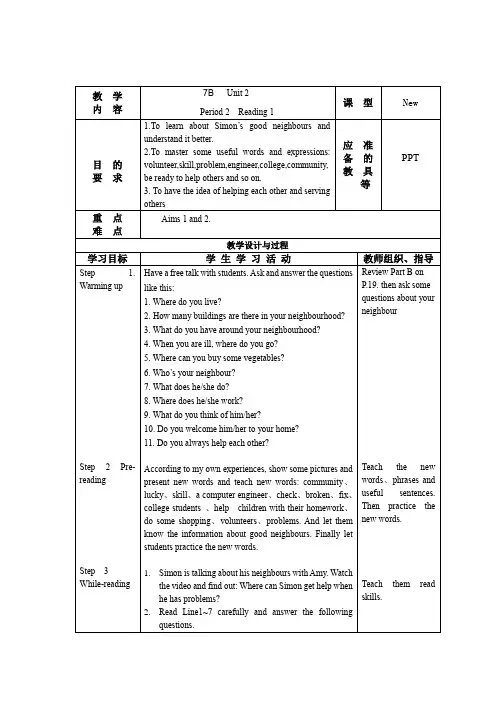
3. There’s something wrong with Simon’s computer. How will he get help?
4. Why does Annie want to ask the volunteers for help?
3. What do you have around your neighbourhood?
4. When you are ill, where do you go?
5. Where can you buy some vegetables?
6. Who’s your neighbour?
7. What does he/she do?
教学
内容
7BUnit2
Period2 Reading 1
课 型
New
目的
要求
1.To learn about Simon’s good neighbours andunderstand it better.
2.To master some useful words and expressions:volunteer,skill,problem,engineer,college,community, be ready to help others and so on.
Teach the new words、phrases and useful sentences.Then practice the new words.
Teach them read skills.
Teach them thatas middle school students what we can do to help our neighbours.
译林版七年级下Unit 2Reading1教案(第二课时)
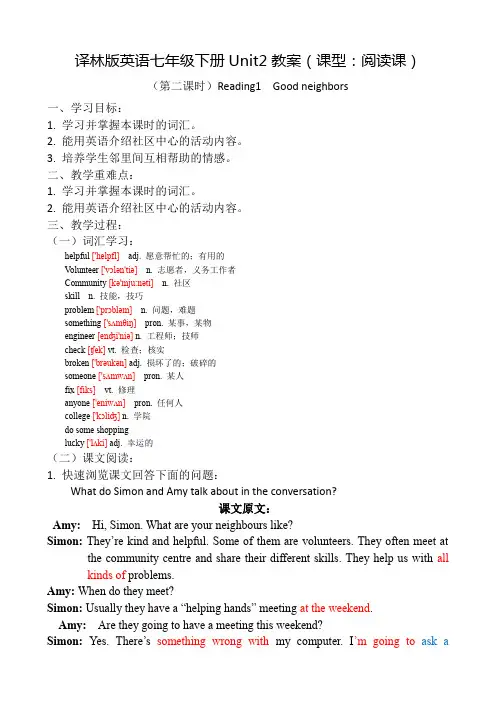
译林版英语七年级下册Unit2教案(课型:阅读课)(第二课时)Reading1 Good neighbors一、学习目标:1. 学习并掌握本课时的词汇。
2. 能用英语介绍社区中心的活动内容。
3. 培养学生邻里间互相帮助的情感。
二、教学重难点:1. 学习并掌握本课时的词汇。
2. 能用英语介绍社区中心的活动内容。
三、教学过程:(一)词汇学习:helpful ['helpfl]adj. 愿意帮忙的;有用的Volunteer ['vɔlən'tiə]n. 志愿者,义务工作者Community [kə'mju:nəti]n. 社区skill n. 技能,技巧problem ['prɔbləm] n. 问题,难题something ['sʌmθiŋ]pron. 某事,某物engineer [enʤi'niə] n. 工程师;技师check [ʧek] vt. 检查;核实broken ['brəukən] adj. 损坏了的;破碎的someone ['sʌmwʌn]pron. 某人fix [fiks] vt. 修理anyone ['eniwʌn]pron. 任何人college ['kɔliʤ] n. 学院do some shoppinglucky ['lʌki] adj. 幸运的(二)课文阅读:1. 快速浏览课文回答下面的问题:What do Simon and Amy talk about in the conversation?课文原文:Amy: Hi, Simon. What are your neighbours like?Simon: They’re kind and helpful. Some of them are volunteers. They often meet at the community centre and share their different skills. They help us with all kinds of problems.Amy: When do they meet?Simon: Usually they have a “helping hands” meeting at the weekend.Amy:Are they going to have a meeting this weekend?Simon: Yes. There’s something wrong with my computer. I’m going to ask acomputer engineer to check it. My cousin Annie’s bicycle is broken, so she’s going to ask someone to fix it.Amy: Can you find anyone to help you with your homework?Simon: Yes. Some college students are ready to help.Amy: That’s really nice. Do the volunteers help the old people too?Simon: Yes. Some of them often visit the old people and do some shopping for them.This weekend, they’ll help the old people cleantheir flats.Amy: That’s great ! You’re lucky to live in a neighbourhood like that, Simon.2. 第二次细致阅读课文进一步了解短文内容并完成下面的任务:①What does Simon think of his neighbors ?②What are some of Simon’s neighbors? And what do they often do?③What do they often do at the weekend?And what are they going to do this weekend?④who is going to help Simon with his homework?⑤How do the volunteers help old people?3.根据课文结合所给的画面用所给单词完成下面句子。
牛津译林版七年级英语下册《Unit 2 Neighbours Reading》导学教案
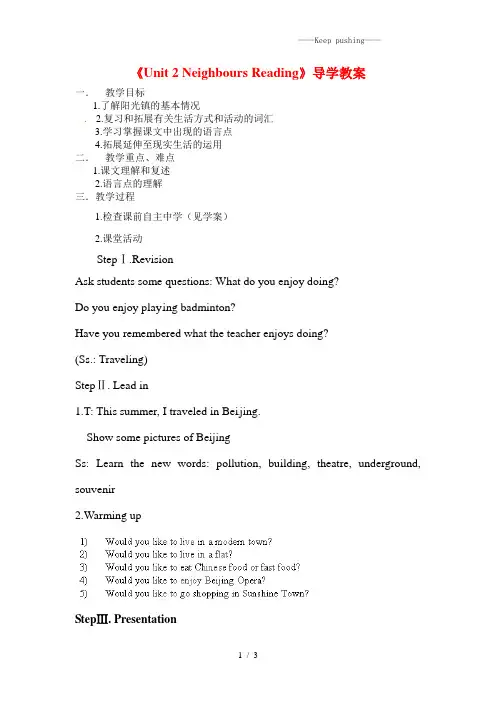
——Keep pushing——《Unit 2 Neighbours Reading》导学教案一.教学目标1.了解阳光镇的基本情况2.复习和拓展有关生活方式和活动的词汇3.学习掌握课文中出现的语言点4.拓展延伸至现实生活的运用二.教学重点、难点1.课文理解和复述2.语言点的理解三.教学过程1.检查课前自主中学(见学案)2.课堂活动StepⅠ.RevisionAsk students some questions: What do you enjoy doing?Do you enjoy playing badminton?Have you remembered what the teacher enjoys doing?(Ss.: Traveling)StepⅡ. Lead in1.T: This summer, I traveled in Beijing.Show some pictures of BeijingSs: Learn the new words: pollution, building, theatre, underground, souvenir2.Warming upStepⅢ. PresentationTask 1 speed readingT:OK .Today I’ll take you to Sunshine Town for a trip. Sunshine Town is a great new Town. There are lots of things to do there. There’s less air pollution than in other areas of Beijing. There are many tall buildings and you can go any by underground. There are lots of lakes and trees in the country park. There are lots of lakes and trees in the country park. There are lots of lakes and trees in the country park. There are also many theatres here. You can enjoy Beijing Opera.Ask the students to read th e passages quickly and then answer “T” or “F”questions on Page 29C1.Task 2 listeningListen to the tape and translate some useful expressions.Task 3 intensive readingTask 4 practicingDoing some exercise to consolidate the understanding.Finish PartB and C2.Task 5 speakingAsk the students to repeat the passages with their own words. StepⅣHomeworkAsk students to read the context aloud and translate some sentences. 四.知识讲解(见学案)五.课后巩固(见学案)课后反思:——Keep pushing——教师的职务是‘千教万教,教人求真’;学生的职务是‘千学万学,学做真人’。
unit2精品教案牛津译林英语七年级下册

unit 2 精品教案牛津译林英语七年级下册一、教学内容本节课选自牛津译林英语七年级下册的Unit 2,主要内容包括:2. 详细内容:本单元主要围绕学校场所和设施展开,学习如何介绍学校各个场所的名称和位置,以及如何描述学校的日常活动。
二、教学目标1. 能够听懂、会说、会读、会写与学校场所和设施相关的词汇和句型。
2. 能够运用所学知识,向别人介绍自己的学校。
3. 提高学生的英语口语表达能力和合作学习能力。
三、教学难点与重点1. 教学难点:如何正确使用there be句型和方位词描述学校的场所和设施。
2. 教学重点:掌握与学校场所和设施相关的词汇和句型,并能运用到实际情境中。
四、教具与学具准备1. 教具:PPT、图片、磁带、录音机2. 学具:课本、练习本、彩色笔五、教学过程1. 引入:通过展示一组学校场所的图片,引导学生用英语说出各个场所的名称,激发学生的学习兴趣。
2. 呈现:教师播放教材中的听力材料,让学生跟读,学习there be句型和方位词,引导学生用所学句型描述图片中的学校场所。
3. 实践:学生分小组,根据所给情景,运用所学知识进行角色扮演,向别人介绍自己的学校。
4. 例题讲解:教师针对学生在实践中出现的错误,进行讲解和纠正。
5. 随堂练习:学生完成课后练习,巩固所学知识。
六、板书设计1. 词汇:classroom, library, playground, canteen, there be, in, on, under, near2. 句型: What's in the picture? There is aclassroom/library/playground/canteen.Where is theclassroom/library/playground/canteen? It's in/on/under/near七、作业设计1. 作业题目:根据所学内容,编写一段对话,向别人介绍你的学校。
牛津译林版七年级下全册单元英语精品教案 Unit2教案(表格式)
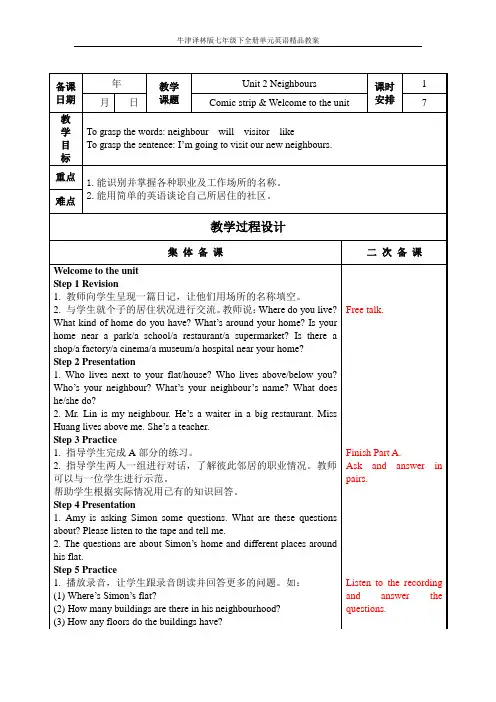
备课 日期
年
教学 课题
Unit 2 Neighbours
课时 安排
2
牛津译林版七年级下全册单元英语精品教案
月 教 学 目 标 重点 难点
日
Reading 1 something
Read the dialogue and act it out. Make up new dialogues.
Listen to the tape and find out the answer.
Do some exercises.
课后 作业 教学 反思
1. Recite the words and phrases. 2. Recite the dialogue in Part B. 初步接触一般将来时和 It is + adj. + to do 结构。掌握一些职业及提问方式。 有能力的同学背诵 P19 对话。
1.能识别并掌握各种职业及工作场所的名称。 2.能用简单的英语谈论自己所居住的社区。
教学过程设计
集 体 备 课 Welcome to the unit Step 1 Revision 1. 教师向学生呈现一篇日记,让他们用场所的名称填空。 2. 与学生就个子的居住状况进行交流。 教师说: Where do you live? What kind of home do you have? What’s around your home? Is your home near a park/a school/a restaurant/a supermarket? Is there a shop/a factory/a cinema/a museum/a hospital near your home? Step 2 Presentation 1. Who lives next to your flat/house? Who lives above/below you? Who’s your neighbour? What’s your neighbour ’s name? What does he/she do? 2. Mr. Lin is my neighbour. He’s a waiter in a big restaurant. Miss Huang lives above me. She’s a teacher. Step 3 Practice 1. 指导学生完成 A 部分的练习。 2. 指导学生两人一组进行对话,了解彼此邻居的职业情况。教师 可以与一位学生进行示范。 帮助学生根据实际情况用已有的知识回答。 Step 4 Presentation 1. Amy is asking Simon some questions. What are these questions about? Please listen to the tape and tell me. 2. The questions are about Simon’s home and different places around his flat. Step 5 Practice 1. 播放录音,让学生跟录音朗读并回答更多的问题。如: (1) Where’s Simon’s flat? (2) How many buildings are there in his neighbourhood? (3) How any floors do the buildings have? 二 次 备 课
牛津译林版七年级英语下册Unit2 Reading1导学案(英语教案)
课题7B Unit2 Reading(1) 主备主核使用者课型New 使用日期【学习目标】To learn about the knowledge about the neighbour.Learn how to describe one’s neighbour.第一次集体备课(通案)第二次备课(个案)【导入新课】Today,let’s study Unit2 Reading 1.【板书课题】Unit2 Reading 1.【学习目标】1.To learn about the knowledge about the neighbour.2.Learn how to describe one’s neighbour.【自学指导】Step 1.Warm up1. Revise the names of some jobs.Show some pictures.Step2.Show Studying aims(1)To learn about the knowledge about the neighbour.(2)Learn how to describe one’s neighbour.Step3Presentation (show Guide One to the students.)1.Present some new words, like bicycle shoppingfixing2. Complete Part B1.3. Present the textSay something about good neighbours.Step 4. Fast readingGet the students read the text quickly.Step5. Guide TwoCareful reading .1.Read Passage1 carefully, answer some questions.(1). What do volunteers do?(2)When do they have the “helping hands”Show the pictures aboutthe names of jobs.Read the text carefully then answer the questions correctly.meeting?(3) Do the volunteers help the old people?2.Read their conversation carefully and try to find out theanswers to the following questions.(1)What are Simon’s neighbours like?They are kind and friendly.(2)When and where do the volunteers often meet?They often meet at the community centre at the weekend.(3)What’s the name of their meeting?They have a “helping hands”meeting.(4)Who can help Simon check his computer?A computer engineer can help him.(5)How do the volunteers help the old people?The volunteers often visit them, do some shoppingfor them and help them clean the flats.Step6. Group work :As middle school students, what can we do to help our neighbours?Rules:1) Have a discussion in a group of four.2) One student takes notes, the othersgive ideas.3) Each group will give a short report.Step7. A short reportDear classmates, we are middle school students now. We cando something for our neighbours.For the old, we can….For the young,we can ….We can also….If we all help each other,….Step8. Homework.1、List(列出)the good things that Simon’s neighbours do .2、Write the short report in your notebook.【堂清知识】New words:helpful community problem something Phrases:help sb with sth. do some shoppingAsk the students to learn about the knowledge about theneighbour and learn how to describe one’s neighbour.【当堂检测】Choose the word to fill in the blanks.kinds of problems at the weekend broken checkdifferent skills fix homework lucky1. My neighbours are kind and helpful . Some of them arevolunteers.They have and often help us withproblems.2. Usually there is a “helping hands”meeting .3. People go there when they need help with theirputer engineers are popular. They help people________their computers. You can also find someone to_________things like bicycles.5.Students can get help withtheir .There are some college students among thevolunteers,and they are always .Volunteers alsohelp the old people.6. We are to live in a neighbourhood like that.People here are like a big family.日清内容Write about Simon’s neighboursSimon’s neighbours are kind and. Some of them are .They have different and often help others with all kinds of . They often meet at the and have a meeting at the weekend.The volunteers help people their computer and something broken. Some students are ready to the students with their homework. They also does some for the old.Simon feels to live in a neighbourhood that.第三次备课(反思)得:通过泛读和精读,学生了解文章大意,并能找出重点短语和句子,学生可以用文章中的一些句子来谈论他们邻居。
牛津译林版七年级下册Unit 2《Neighbours》(Reading)教学设计
牛津译林版七年级下册Unit 2《Neighbours》(Reading)教学设计一. 教材分析《Neighbours》是人教版牛津译林英语七年级下册的一篇文章,主要讲述了澳大利亚和英国邻居的不同生活方式。
文章通过描述两家邻居的日常生活,让学生了解并比较不同国家的文化差异。
文章语言简单,贴近学生生活,易于激发学生的学习兴趣。
二. 学情分析七年级的学生已经具备了一定的英语基础,能够进行简单的英语交流。
但他们在阅读理解、词汇积累和语言运用方面还存在一定的困难。
因此,在教学过程中,需要关注学生的个体差异,尽量采用简单明了的教学方法,帮助学生理解和掌握文章内容。
三. 教学目标1.知识目标:让学生掌握文章中的关键词汇和短语,如“neighbours”,“roof”,“front garden”等。
2.能力目标:培养学生具备一定的阅读理解能力,能够借助图片和上下文理解文章内容。
3.情感目标:让学生通过学习,认识到不同国家的文化差异,培养他们的跨文化交际意识。
四. 教学重难点1.重点:让学生掌握文章中的关键词汇和短语,理解文章内容。
2.难点:帮助学生运用所学词汇和短语进行实际交流,提高他们的语言运用能力。
五. 教学方法1.任务型教学法:通过设定各种任务,让学生在完成任务的过程中,自然地学习和掌握文章内容。
2.情境教学法:创设真实的生活情境,让学生在实际语境中学习和运用英语。
3.小组合作学习:鼓励学生进行小组讨论和合作,提高他们的团队协作能力和沟通能力。
六. 教学准备1.准备相关图片和视频,以便在课堂上展示和引导学生进行讨论。
2.准备课文翻译和练习题,以便在课堂上进行操练和巩固。
3.准备PPT,以便在课堂上展示课文内容和相关知识点。
七. 教学过程1.导入(5分钟)利用图片和视频展示澳大利亚和英国的风景,引导学生谈论自己喜欢的国家和文化。
通过这种方式,激发学生的学习兴趣,为课堂活动做好铺垫。
2.呈现(10分钟)利用PPT展示文章标题和图片,让学生根据图片预测文章内容。
英语:Unit2 第2课时 Reading学案(译林牛津版七年级下)
英语:Unit2 第2课时Reading学案(译林牛津版七年级下)预学热身l.通过预习,读懂文章,了解阳光镇的基本情况。
2.了解更多有关生活方式和活动的词汇。
3.了解如何写录像的解说词。
4.了解课文的语言点。
预学目标◆预习课文前,请初步了解本课时的词汇并完成以下练习(英汉互译)。
l.less adj. ________ 2.close adj. ________3.life n. ________ 4.________ n.地铁5.________ n.空气;大气6.________ n.污染7.________ n.乡村8.need help with…__________________9.at night __________________ 10.__________________不得不;得11.__________________例如12.__________________去散步◆自主探究,请带着下面这些问题阅读教材。
1. How far is Sunshine Town from the centre of Beijing by underground?2. What can you do in Sunshine Park?3. How many floors do the buildings usually have?4. Are the souvenirs expensive?5. How many restaurants are there in Sunshine Town?教材导读l.Welcome to Sunshine Town欢迎来到阳光镇知识点:welcome to…的用法[指点迷津]welcome to…的意思是“欢迎来到……”,后面常跟表示地点的名词。
Welcome to China.欢迎来到中国。
[提醒] 当地点用副词表示时要省略介词to。
Welcome back!欢迎回来![拓展] welcome to…还可以跟动词,表示“欢迎做某事”。
牛津译林版英语七年级下册Unit2NeighboursReading1优秀教学案例
在学生小组讨论环节,我会设计一些讨论题目,如“你觉得什么样的行为是礼貌的?”“在你的邻里关系中,你遇到过哪些问题?”等。让学生在小组内进行讨论,鼓励他们发表自己的观点和经验。通过小组讨论,培养学生的合作意识和团队精神,提高他们的语言表达能力和批判性思维能力。
(四)总结归纳
在总结归纳环节,我会邀请学生分享他们在讨论过程中的观点和经验,并进行总结和归纳。学生会得出结论,礼貌的行为和良好的邻里关系对于一个和谐的社会至关重要。通过总结归纳,让学生明确本节课的学习目标,提高他们的阅读理解能力和批判性思维能力。
4.情景创设:设计真实的情景,让学生在实际语境中运用所学知识,提高他们的语言实践能力和运用能力。
5.反思与评价:引导学生进行自我反思和评价,培养学生的自我认知和自我改进能力,同时,教师及时给予反馈和激励,帮助学生保持积极的学习态度。
这些亮点体现了本节课的教学目标和教学策略,注重培养学生的综合素质和实际应用能力。通过这些亮点,营造了一个积极、互动、有趣的学习氛围,让学生在轻松愉快的环境中取得良好的学习效果。
(三)小组合作
小组合作是提高学生合作意识和团队精神的重要手段。在教学过程中,我会组织学生进行小组讨论、角色扮演等活动,让他们在互动中交流思想、分享经验。每个学生都有机会参与到小组活动中,发挥自己的特长,提高自己的语言表达能力和合作能力。
(四)反思与评价
反思与评价是教学过程中的重要环节。在每节课结束后,我会组织学生进行自我反思和评价,让他们总结自己在课堂上的收获和不足,明确今后的学习目标。同时,我还会根据学生的表现,给予及时的反馈和激励,让他们保持积极的学习态度,不断提高自己的学习能力。
(五)作业小结
在作业小结环节,我会布置一道相关的写作作业,如让学生写一篇关于自己邻里生活的短文,描述他们的日常生活和相互关系。通过作业小结,让学生巩固本节课所学知识,提高他们的语言运用能力和写作能力。