
最新三年级英语上册Module1Unit1DoyouusechopsticksinEngland1外研版(一起)优选教学课件
你给过我太多的快乐和感动,太多的收获和意外,也有太多的心酸和坎坷。可总归你来过我的生命,也带给我许多的美好和小幸福。我不知道是怎样的缘分让我们相遇,可我都不想去追究了,因为我相信每一种遇见,都有意义,每一个爱过的人,都有记忆。无论怎样,都是幸运的,因为你带给了我一些特殊的感受,以至于每次回味起来,都觉得人生是精彩的。 我始终还记得那年夏天你为了在我路过的城市见我冒着大雨开车几百公里,只为在车站短短的停留……我也记得在街头只因我看了一眼那各式的冰糖葫芦,你穿越熙攘的人群排队为我拿回最后一个糖葫芦欣喜的样子,不是爱吃甜食的我那晚一口气吃掉了那个糖葫芦,而你看着我憋得满嘴和通红的脸只是宠溺的笑笑……我还记得因为我随口一说自己都没在意的东西而你却把它买回来了,就在有次离别的车站,当我不告而别你知道后发疯的电话、视频和在机场着急的身影,手里还提着我自己也不知道什么时候说过的东西时我就知道你就是那个惊艳了时光也温柔了我曾经岁月的人。
Do you use chopsticks in England?
No, we don’t.
We use a knife and fork.
use 使用 chopsticks 筷子 knife 刀 fork 叉 easy 容易的 hard 困难的 People 人们(复) Look at the mess!
No, we don’t. They are ___E_____for English people. 3, We use a ____A_____and ___B_____in England. They are ___D_____for English people.
Summing-up 小总结
当初说着各种承诺、各种誓言,我也相信了你就是我的小确幸。也是你让我相信了这世间还有美好,可最终你还是离我而去,终究你我成了彼此生命中的过客。 我们错过了,我曾幻想过天长地久;我也曾幻想过和你手牵手走在黄昏的路上。可终究你走了,留给我的只有回忆。我以为守着回忆你就可以回来,可是我错了,我,终究没等来你的转身,我终究知道错过了就是错过了,回不来了。我也终于决定放下了……
See you! Bye!
不得不说时间真的是这个世间最好的跨度,一些承诺,一段誓言,终究败给了时间,回忆再美好也经不住流年。有些人错过了终究得放下……。 在过往中,总有一个人,曾经是你的满心欢喜,现在却成了你的闭口不提。他闯进我们的生活,带给我们感动和美好,却又在某一时刻,猝不及防的从我们身边抽离,留下了一地的回忆。
Listen then think
Knife and fork are easy for English people.
对某人容易的
Knife and fork are _h_a_rd_ for Chinese people
对某人困难的
easy-------hard big --------small long--------short fat ---------thin hot --------cold white-------black
我曾试过收起那些东西甚至屏蔽一切与你有关的东西。直到最后,我不得不承认,用心爱过的人,就连忘记也需要格外用力。 最近在抖音上被这样一句话刷屏了:“以后我们的关系就这样吧,如果接下来的日子里你不找我,那么我也不会主动找你,直到慢慢的没有交集。你的微信我不会删,电话也不会删,因为毕竟我们爱过。如果你给我发消息我还是会秒回你。但是没有任何期待了。我会放下手机继续等待。如果你来,我还是会原地等你,但这次我不知道会等多久,因为等一个人的期限是有限的,我也说不出你哪里好?只是你给了我别人给不了的感觉。”
Module1 Unit1
Do you use chopsticks in England?
What's this?
e
hamburger
cake
noodles
Do you like noodles? Yes ,I do. No ,I don’t.
I like noodles. I eat noodles with chopsticks.
我不苛求完美的人生,我知道遇上你错过你我的人生已经变得不完美了,可我还是无憾了,“我还是会等你,但这次我不知道等多久,因为等一个人是有期限的……”最终那道撕裂的缺口没被你填满可我也不会再无期限的让它去裂开了。 你给的缺口是满心欢喜也是忧郁和悲伤……。撕裂便会疼痛但也无法愈合…… 我也曾试着挽回,试着去弥补,可终究太苍白太无力了。这就是世间的无奈,我也不得不承认你我终究错过了,我也该放下了…… 现在的我终于学会了该怎么去割舍,我终究学会了真正的放下就是面对你的一切波澜不惊、坦然面对。即使听见你的名字多少次也不再泛起涟漪,终于接受了,你只能陪我一程,终究无法参与我的余生。 谢谢你教会我的一切,包括那些没实现的承诺……或许你会说你爱过我,可我还是决定把你归还于人海了,不是赌气,也不是不爱,只是觉得该清醒了……
终于下定决心把你归还于人海了!其实很早就在逼自己慢慢的去放手了,每次听着你那冠冕堂皇的话我尽然差点相信了我和你会有以后…… 我没有你善于伪装,我学不会做最坏的人,我也不想浪费太多的时间和精力去等一个不可能的结果!虽然先动心、动情的人是你,无数次主动和挽留的人也是你,可我还是学不会去做一个你渴望中的人。 这一路有快乐、有坎坷、有心酸。记得你曾对我说过:“这一路来太多的心酸和坎坷自己必须好好珍惜才是……”你也说过:“我不必有顾虑,你会珍惜你会好好保护着我……”这些话在耳边响起犹如昨天,那么悦耳那么清晰。可我不想这样原地不动的去等待和期望了,我准备回头了,回到我的原点,回到不是和你开始的原地了……。
Practise
Fill in blanks A, knife B, fork C, please D,easy E, hard F,chopsticks 1, Do you want noodles?
Yes,___c_____. 2, Do you use _____F____in England?
Listen then think
1.Does Amy use chopstcks in England?
No, she doesn’t.
Listen then think
2.Are the chopsticks “easy” or “hard” for her?
It’s hard for her.
Do you use chopsticks in China? Yes /No.
chopsticks
We use chopsticks in China.
Do you use chopsticks in England? No, we don’t.
We use a knife and fork.
我终于能很轻松地说我们错过了,你终究是那个错的人,我也决定放下了!余生很长,放下错的人,才能拥抱属于我的幸福。徐志摩曾说过:“一生中至少该有一次,为了某个人而忘记了自己,不求结果,不求同行,不求曾经拥有,甚至不求你爱我,只求在我最美的年华里,遇见你。”我不知道自己是何等的幸运能在茫茫人海中与你相遇?我也不知道你的出现是恩赐还是劫?但总归要说声“谢谢你,谢谢你曾来过……” 还记得初相识时你那拘谨的样子,话不是很多只是坐在那里听我不停地说着各种不着边际的话。可能因为紧张我也不知道自己想要表达什么?只知道乱七八糟的在说,而你只是静静地听着,偶尔插一两句。想想自己也不知道一个慢热甚至在不熟的人面前不苟言笑的我那天怎么会那么多话?后来才知道那就是你给的莫名的熟悉感和包容吧! 有一句话说:“人的一生会遇到两个人,一个惊艳了时光,一个温柔了岁月。” 惊艳了时光的那个人,是青春回忆里最绚烂、最耀眼的存在,不后悔跟他经历过的快乐与感动,哪怕后来的大风大浪都是他给的,但还是想对他说,有生之年,欣喜相逢。
我想写下这段话的那个人也曾全力以赴的付出过、满心欢喜的期待过吧!当一次次怀抱满心欢喜的期待,一次次的让自己的底线撕开一道道缺口,当那一次次期待变为一次次的失望,也就学着去转身了。我们每个人何尝不是这样呢?都以为某时某刻的温暖可以长久、可以完美到无懈可击。我们都期待故事能以完的结局划上句号,可这样的概率又有多少呢? 曾经我也天真地认为只要我足够努力我们的故事就会有好的结局,可现实给了我当头一击。曾经真的能拍着胸脯说我们是一辈子互相牵挂的人,是一辈子有说不完话的人,是一辈子我累了或者你累了可以相互依靠的人,是一辈子我说我需要一个肩膀了你会出现让我靠的人,我们一辈子会在彼此看得见的地方守护着彼此。可走着走着好像丢了好多,我不知道是我弄丢了你还是你弄丢了我?可总归是丢了…… 曾几何时我们是那么的无话不谈,我们总是有说不完的话,讨论不完的问题。我也相信了以后,我曾把你的到来当做生命中的小确幸,你给的一点点好我都想炫耀,也记得你风尘仆仆的从另一个城市开车到我路过的城市只为在车站见一面,只为那几个小时的相见你说你一夜没睡冒着雨开车赶过来了,也记得你每次的秒回和主动,也记得和你一次次通话两个小时你的叮咛和嘱咐……在那一刻我尽看到了以后,也相信了你说的即使再怎么难也不会丢下我、也不会放开我的手。那一刻我也相信了我和别人的不一样,我也相信了你说承诺那一刻的真诚,可一颗真心终究敌不过距离和时间的挑唆,最后我们的关系也就这样了!你也没主动找过我,我也没有主动找过你……我还是在原地等你,可你却就那样连一句道别也没有。我知道从熬夜回复信息开始你就在我的生活中打开了一条缺口,你走了这个
开始说好有过永远的两个人,后来却不再联系。这是你留给我的缺口,我曾想着这个缺口你会填满,所以我收起了自己的锋芒和戾气希望你来给这个缺口添上色彩,可色彩耀眼的东西终归不能逗留太长时间。虽然以后的缺口再无色彩可我还是很庆幸生命中有那一道缺口。也是有了这个缺口我知道你来过,我知道正是这一段段风格迥异的缺口使我的生命有了另一种色彩。 也许岁月会掩盖那些你曾到来和走后的缺口,可我还是想说:谢谢你给我的那些从前,谢谢你走后留给我的缺口,我会把那一道道缺口都交给时间,也许时间会给我一个可能,也是这个缺口让我为自己留下了一片天空。
三年级上册英语教案Module 1 Unit 1 Do you use chopsticks in the UK外研社
Module 1 Unit 1 Do you use chopsticks in the UK?教学设计一、Teaching aim1. Make students remember the new words:Chopsticks, a knife and fork, use, easy, hard and mess2. Mastering the basic sentence pattern and the students could make dialogues according to the sentence patterns.Do you want…Do you use…二、Important and difficult point1.V ocabulary: For example, chopsticks2.Pattern: Do you use chopsticks in …?Do you use a knife and fork in …?三、Teaching aidsRadio、cards、VCD、tapes四、Teaching processStep 1 Warming upThe teacher shows many pictures about food.(noodles,rice, hamburgers,cakes and so on). Firstly, the teacher leads the students to get familiar with these food names and then on this basis the teacher can ask them to practice the sentence pattern.Do you like noodles? Yes, I do.\ No, I don’t.Do you want …? Yes, I do.\No,I don’t.Step 2 presentation and practiceThe teacher makes use of the picture “noodles” and a new word “chopsticks” can be leaded out.T: I like noodles. I eat noodles with chopsticks.The teacher takes out the real chopsticks and then says the new word. At the same time, the teacher shows the picture of chopsticks.An activity can be made here. The title of the activity is saying words as quickly. The pronunciation of new word is a difficult point. So the teacher should ask students to practice more. Step 3The new word “use” can be leaded out in the process of communication.T: Can you use chopsticks?The word card of use should be shown.We use chopsticks in China. And the teacher writes the sentence on the blackboard.We use chopsticks.Do you use chopsticks? Yes, we do. No, we don’t.Ask and answer in pairs.The teacher inquires the students if the English people useChopsticks and a knife and fork will be leaded out.T: We use chopsticks in China. Do the English people use chopsticks?S: No, they don’t.English people use a knife and fork.Do you use chopsticks / a knife and fork? Yes, I do. No, I don’t.Step 4(1)Presentation of the text.Amy and Daming are in the park. They want to eat noodles. Watch the CD-ROM, then answer the questions: “Does Amy use chopsticks in England?”The students look at the CO-ROM and then answer questions.Now Amy is using chopsticks. Watch again, then answer the next question: Are the chopsticks “easy” or “hard” for her?easy – hardChopsticks are hard for Amy.A knife and fork are easy for her.Some other oposite words are shown here.big-smalllong-shortfat-thinhot-coldwhite-blackeasy-hardListen again, then answer:Are the chopsticks “easy” or “hard” for English people?T: If I say “big”. You should say “small”. Please say the words as quickly as you can.Chopsticks are hard for English people. So Amy make the mess.Then the students read the passage again.Find the sentences, “ Do you …?”. Then circ le them.五、Homework1. Read the dialogue and the sentence.2. Preview Module 1 Unit 2.。
三年级英语上册 Module 1 Unit 1 Do you use chopsticks in E
三年级英语上册 Module 1 Unit 1 Do you use chopsticks in England教学设计外研版(一起)一、教学目标A:知识与技能:使学生掌握词汇chopsticks, a knife and fork, use, easy, hard,以及能达到听说要求的mess。
掌握句型Do you want…? Do you use …?, 并能够运用此类句型进行问答练习,以及实际运用。
B:过程与方法:运用活动教学及任务教学法,游戏与活动相结合,充分发挥学生的学习主体性。
C: 情感态度价值观:比较中西方饮食文化的差异,使学生了解一些西方相关的文化,同时对学生进行德育的熏陶,当别人遇到困难,我们应当帮助他人。
二、教学重难点重点:Do you ...? Yes, we do./No, we don’t. We use...并能在实际情景中运用。
难点:Do you ...? 的灵活运用,能比较中西文化的差异。
三、学情分析(学生、教材)本节课的主要情节为Daming Amy 和 Ms. Smart 在公园里的快餐店里吃中国的面条,在就餐时, Amy 不会使用中国的筷子, 引发了她与Daming 关于中西方就餐用具--筷子,刀子及叉子的话题。
本节课的教学对象为三年级的学生。
大部分的孩子对学习英语有非常浓厚的兴趣,学习积极主动、乐于参与、思维活跃、善于模仿,表现欲强。
四、教学用具课件,CD-ROM,教学单词卡片,实物投影仪。
五、教学过程Step 1 Warm up1.Greeting.T: I have a good holiday. Do you have a good holiday?Ss: Yes, I do.2. Do as I do (教师做动作并表达,引导学生边作边说:Me too教师做睡觉状:I am tired教师做笑脸状:I am happy教师手摸肚子:I am hungryStep 2 Presentation1.随机学习或复习单词。
三年级上册英语教案Module 1 Unit 1 Do you use chopsticks in the UK外研社
Module 1 Unit 1 Do you use chopsticks inthe UK?教学设计一、Teaching aim1. Make students remember the new words:Chopsticks, a knife and fork, use, easy, hard and mess2. Mastering the basic sentence pattern and the students could make dialogues according to the sentence patterns.Do you want…Do you use…二、Important and difficult point1.V ocabulary: For example, chopsticks2.Pattern: Do you use chopsticks in …?Do you use a knife and fork in …?三、Teaching aidsRadio、cards、VCD、tapes四、Teaching processStep 1 Warming upThe teacher shows many pictures about food.(noodles,rice, hamburgers,cakes and so on). Firstly, the teacher leads the students to get familiar with these food names and then on this basis the teacher can ask them to practice the sentence pattern.Do you like noodles? Yes, I do.\ N o, I don’t.Do you want …? Yes, I do.\No,I don’t.Step 2 presentation and practiceThe teacher makes use of the picture “noodles” and a new word “chopsticks” can be leaded out.T: I like noodles. I eat noodles with chopsticks.The teacher takes out the real chopsticks and then says the new word. At the same time, the teacher shows the picture of chopsticks.An activity can be made here. The title of the activity is saying words as quickly. The pronunciation of new word is a difficult point. So the teacher should ask students to practice more.Step 3The n ew word “use” can be le aded out in the process of communication.T: Can you use chopsticks?The word card of use should be shown.We use chopsticks in China. And the teacher writes the sentence on the blackboard.We use chopsticks.Do you use chopsticks? Ye s, we do. No, we don’t.Ask and answer in pairs.The teacher inquires the students if the English people useChopsticks and a knife and fork will be leaded out.T: We use chopsticks in China. Do the English people use chopsticks?S: No, they don’t.English people use a knife and fork.Do you use chopsticks / a knif e and fork? Yes, I do. No, I don’t. Step 4(1)Presentation of the text.Amy and Daming are in the park. They want to eat noodles. Watch the CD-ROM, then answer the questions: “D oes Amy use chopsticks in Eng land?”The students look at the CO-ROM and then answer questions.Now Amy is using chopsticks. Watch again, then answer the next question: Are the chopstick s “easy” or “hard” for her?easy – hardChopsticks are hard for Amy.A knife and fork are easy for her.Some other oposite words are shown here.big-smalllong-shortfat-thinhot-coldwhite-blackeasy-hardListen again, then answer:Are the chopsticks “easy” or “hard” for English people?T: If I say “big”. You should say “small”. Please say the wor ds as quickly as you can.Chopsticks are hard for English people. So Amy make the mess.宋以后,京师所设小学馆和武学堂中的教师称谓皆称之为“教谕”。
小学英语新外研版(一起)三年级上册新标准 Module1Unit1 Do you use the chopstick (2)教案
小学英语新外研版(一起)三年级上册Module1 Unit1 Do you use chopsticks in UK?第二课时教案一、教学目标:知识目标:能听懂、会说、会读:chopsticks; use.能力目标:熟练运用句型:(1)—Do you use chopsticks in the UK?—No, we don’t./Yes, we do.(2)—Do you want rice?—Yes, please./No, thanks.情感目标:简单了解西方国家的餐桌礼仪。
二、教学重点:能够根据不同的情境正确运用句型:(1)—Do you use chopsticks in the UK?—No, we don’t./Yes, we do.(2)—Do you want rice?—Yes, please./No, thanks.三、教学难点:句型Do you use chopsticks in the UK?和Do you want rice?的不同运用场合及肯定、否定回答。
四、教学准备:挂图,卡片,PPT五、教学过程Step 1 Greeting.1. 在上课前,老师先放歌曲ABC,来吸引学生的注意力。
让学生下课也沉浸在英语的氛围中。
2. 在新授课前,教师先用英语和学生复习上一节课的内容,导入新课。
(让学生一半是中国人,一半是英国人。
)T:Do you use chopsticks in the UK?Ss: No, we don’t. It’s hard for us. We use a knife and fork. It’s easy forus.T: Do you use chopsticks in China?Ss: Yes, we do. It’s easy for us.(老师提示学生加上这句话。
)T: I’m hungry.(示意学生看课本问。
)Ss: Do you want noodles?T: Yes, please.(出示米饭的图片,示意学生问。
三年级上册英语教案Module1Unit1DoyouusechopsticksintheUK外研社
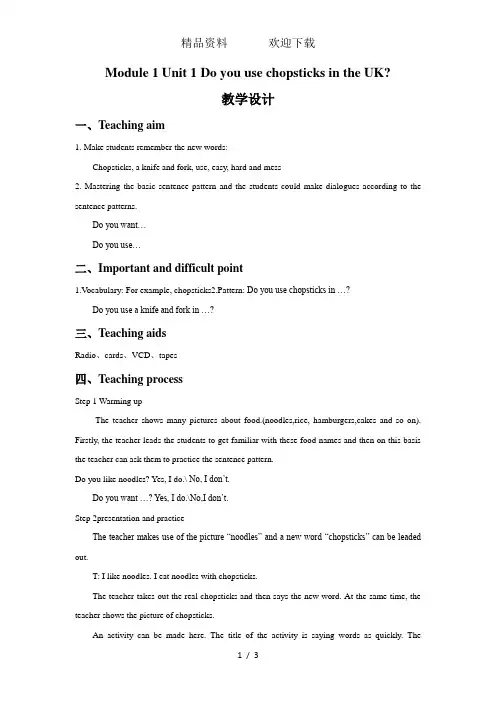
Module 1 Unit 1 Do you use chopsticks in the UK?教学设计一、Teaching aim1. Make students remember the new words:Chopsticks, a knife and fork, use, easy, hard and mess2. Mastering the basic sentence pattern and the students could make dialogues according to the sentence patterns.Do you want…Do you use…二、Important and difficult point1.V ocabulary: For example, chopsticks2.Pattern: Do you use chopsticks in …?Do you use a knife and fork in …?三、Teaching aidsRadio、cards、VCD、tapes四、Teaching processStep 1 Warming upThe teacher shows many pictures about food.(noodles,rice, hamburgers,cakes and so on). Firstly, the teacher leads the students to get familiar with these food names and then on this basis the teacher can ask them to practice the sentence pattern.Do you like noodles? Yes, I do.\ No, I don’t.Do you want …? Yes, I do.\No,I don’t.Step 2presentation and practiceThe teacher makes use of the picture “noodles” and a new word “chopsticks” can be leaded out.T: I like noodles. I eat noodles with chopsticks.The teacher takes out the real chopsticks and then says the new word. At the same time, the teacher shows the picture of chopsticks.An activity can be made here. The title of the activity is saying words as quickly. Thepronunciation of new word is a difficult point. So the teacher should ask students to practice more. Step 3The new word “use” can be leaded out in the process of communication.T: Can you use chopsticks?The word card of use should be shown.We use chopsticks in China. And the teacher writes the sentence on the blackboard.We use chopsticks.Do you use chopsticks? Yes, we do. No, we don’t.Ask and answer in pairs.The teacher inquires the students if the English people useChopsticks and a knife and fork will be leaded out.T: We use chopsticks in China. Do the English people use chopsticks?S: No, they don’t.English people use a knife and fork.Do you use chopsticks / a knife and fork? Yes, I do. No, I don’t.Step 4(1)Presentation of the text.Amy and Daming are in the park. They want to eat noodles. Watch the CD-ROM, then answer the questions: “Does Amy use chopsticks in England?”The students look at the CO-ROM and then answer questions.Now Amy is using chopsticks. Watch again, then answer the next question: Are the chopsticks “easy” or “hard” for her?easy – hardChopsticks are hard for Amy.A knife and fork are easy for her.Some other oposite words are shown here.big-smalllong-shortfat-thinhot-coldwhite-blackeasy-hardListen again, then answer:Are the chopsticks “easy” or “hard” for English people?T: If I say “big”. You should say “small”. Please say the words as quickly as you can.Chopsticks are hard for English people. So Amy make the mess.Then the students read the passage again.Find the sentences, “ Do you …?”. Then circle them.五、Homework1. Read the dialogue and the sentence.2. Preview Module 1 Unit 2.。
小学英语新外研版(一起)三年级上册Module1 Unit1《Do you use chops……教案
小学英语新外研版(一起)三年级上册
Module1 Unit1《Do you use chopsticks in the UK?》学案
一、学习目标
能够听懂,会说并运用词语:easy, hard ,rice,noodles,chopsticks,a knife and fork.
二、重点难点
1.能听懂Do you want …? Do you use … in …. ?的句型并会运用。
2.会写词语:chopsticks,a knife and fork,easy,hard.
三、导学问题
朗读本课单词三遍,使用“学乐师生”APP录音,然后与全班同学分享。
1.怎么更好的模仿表演书本里面内容?
2.怎么灵活运用运用词语:easy, hard, rice ,noodles ,chopsticks , a knife and fork.?
四、参考资料
chopsticks本意为筷子,是一种由中国汉族发明的非常具有民族特色的进食工具。
筷子,是指用竹、木、金属等材质制做的夹饭菜或其他东西的细长棍儿。
UK全称大不列颠及北爱尔兰联合王国,是由英格兰、苏格兰、威尔士和北爱尔兰组成的联合王国,主体是英格兰,所以习惯上称英国。
小学英语新外研版(一起)三年级上册新标准 Module1Unit1 Do you use the chopstick (4)教案
小学英语新外研版(一起)三年级上册Module1 Unit1 Do you use chopsticks in the UK?第一课时教案一、教学目标:1.知识目标:能听懂、会说、会读:rice; meat; hungry; noodles; hard; knife; easy .2.能力目标:掌握下列句型:(1)—Do you want noodles?—Yes, please.(2)—Do you use chopsticks in the UK?—No, we don’t.(3)It’s easy for us.3. 情感目标:培养学生学习英语的兴趣,善于倾听,愿意与人合作,并能愉快、积极的与他人交流。
二、教学重点:1. 理解单词meat, rice和noodles的不同。
2. 理解句型:(1)—Do you want noodles?—Yes, please.(2)—Do you use chopsticks in the UK?—No, we don’t.三、教学难点:理解Do you want…?和Do you use…?的不同运用场合。
四、教学准备:挂图,卡片,PPT五、教学过程Step1 Warming-up.1. 在上课前,老师先放歌曲An apple来吸引学生的注意力。
让学生下课也沉浸在英语的氛围中。
2. 在新授课前,教师先用英语和学生打招呼,导入新课。
T:How are you?Ss: Fine, thank you. And you?T: I’m fine, too. Nice to meet you.Ss: Nice to meet you, too.T: I’m hungry. I want some noodles. Do you want noodles?(示意学生看课本回答。
)Ss: Yes, please.T: Do you use chopsticks?(示意学生看课本回答。
三年级英语上册Module 1 Unit 1 Do you use chopsticks in the UK.教案2 外研版一起
Module 1 Unit 1 Do you use chopsticks in the UK?教学设计一、Teaching aim1. Make students remember the new words:Chopsticks, a knife and fork, use, easy, hard and mess2. Mastering the basic sentence pattern and the students could make dialogues according to the sentence patterns.Do you want…Do you use…二、Important and difficult point1.V ocabulary: For example, chopsticks2.Pattern: Do you use chopsticks in …?Do you use a knife and fork in …?三、Teaching aidsRadio、cards、VCD、tapes四、Teaching processStep 1 Warming upThe teacher shows many pictures about food.(noodles,rice, hamburgers,cakes and so on). Firstly, the teacher leads the students to get familiar with these food names and then on this basis the teacher can ask them to practice the sentence pattern.Do you like noodles? Yes, I do.\ No, I don’t.Do you want …? Yes, I do.\No,I don’t.Step 2 presentation and practiceThe teacher makes use of the picture “noodles” and a new word “chopsticks” can be leaded out.T: I like noodles. I eat noodles with chopsticks.The teacher takes out the real chopsticks and then says the new word. At the same time, the teacher shows the picture of chopsticks.An activity can be made here. The title of the activity is saying words as quickly. The pronunciation of new word is a difficult point. So the teacher should ask students to practice more. Step 3The new word “use” can be leaded out in the process of communication.T: Can you use chopsticks?The word card of use should be shown.We use chopsticks in China. And the teacher writes the sentence on the blackboard.We use chopsticks.Do you use chopsticks? Yes, we do. No, we don’t.Ask and answer in pairs.The teacher inquires the students if the English people useChopsticks and a knife and fork will be leaded out.T: We use chopsticks in China. Do the English people use chopsticks?S: No, they don’t.English people use a knife and fork.Do you use chopsticks / a knife and fork? Yes, I do. No, I don’t.Step 4(1)Presentation of the text.Amy and Daming are in the park. They want to eat noodles. Watch the CD-ROM, then answer the questions: “Does Amy use chopsticks in England?”The students look at the CO-ROM and then answer questions.Now Amy is using chopsticks. Watch again, then answer the next question: Are the chopsticks “easy” or “hard” for her?easy – hardChopsticks are hard for Amy.A knife and fork are easy for her.Some other oposite words are shown here.big-smalllong-shortfat-thinhot-coldwhite-blackeasy-hardListen again, then answer:Are the chopst icks “easy” or “hard” for English people?T: If I say “big”. You should say “small”. Please say the words as quickly as you can.Chopsticks are hard for English people. So Amy make the mess.Then the students read the passage again.Find the senten ces, “ Do you …?”. Then circle them.五、Homework1. Read the dialogue and the sentence.2. Preview Module 1 Unit 2.。