
2015外研版六年级上册英语Module8 unit1 Do you often play with dolls. 原创课件
I’d love to. see my photos
用所给的单词组出单词,并写出中文意思。
opts enalc
stop 停,停止 clean打扫; camera 相机 photo 相片; 照片
eramac oothp
选择。
1. I A. stops a long time ago. B. am stopping C. stopped
Yes, she does.
Check the answer
7. What are Amy’s hobbies?
Her hobbies are reading and taking photos.
Amy : Do you want to see my photos?
Lingling: Yes, I’d love to.
2.Amy stopped playing reading books with dolls a long time ago. F
story books now. 3.Amy often reads picture
4.Lingling often cleans her room. T
F
5.Both Amy and Daming like cleaning the taking room. photos 6.Daming took many photos of his friends. T
Check the answer
3. Does Amy like reading stories now?
Yes, she does.
Check the answer
4. Does Amy often clean her room?
No , she doesn’t. She doesn’t very often clean the room.
Yes, …do/does. No, …don’t/doesn’t.
1. What are they talking about?
They are talking about photos .
2. The photo is . A. nice B. beautiful C. interesting
Check the answer
1. Does Linglimng want to see Amy’s photos?
Yes, she does.
Check the answer
2. Does Amy often play with dolls?
No , she doesn’t. She stops a long time ago.
-Do you often clean your room? -Not really .
Words.
stop
camera
take photos
Can you stop talking, children? -have you got a camera? -Yes. And I often take photos.
3. Does Amy like reading stories now?
4. Does Amy often clean her room? 5. What does Daming often do? 6. Does Amy like taking photos? 7. What are Amy’s hobbies?
我很乐意
I’d love to play games with you.
Amy : Look at this photo .
Lingling: You’re playing with dolls.
Do you often play with dolls.
我很乐意
正在和…一起玩/ 摆弄
Amy : Not really. I stopped a long time ago.
给…拍张照片
He often takes photos of me. Did he
show you his photos in China?
Amy : Oh yes, he did. And he also took many
photos of Sam and me.
T 1.Lingling is very happy to see Amy’s photos.
likes the third photo,
reading now. She often reads stories now. Llingling
Amy is cleaning her room. But Amy doesn’t
often cleans
her room now. Amy loves
C. You’re welcome
连词成句。
like, do, books, now, you, reading?
Do you like reading books now? I, a, time, ago, stopped, long. I stopped a long time ago.
Module 8
Unit 1 Do you often play with dolls?
Bishan School Lily
Do pandas love water? No , they don’t . They love bamboo . Do elephants love water? Yes , they do . Do sheep like meat? No , they don’t . They love grass .
4.Amy _____ stories. A. really loves B. often reads C. often read
(
(
)5.Lingling likes this photo.
)6.Amy is cleaning the room in
this photo. ( )7.Amy doesn’t oftenoften cleans clean her room.
1. What are they talking about?
They are talking about photos .
2. Is Amy playing with dolls?
Yes, she is .
3.There is in this photo. A. a story book B. an picture book C. a picture book
stories.
经常…
I often play computer games.
Lingling: I like this photo. You’re cleaning your room. Do you often clean you room? Lingling: Yes, I do.
你呢?
不经常
Do you ride your bicycle to school? Yes , I do .
Do you eat yuanxiao? No , we don’t . We eat zongzi .
Does Simom collect stamps? Yes , he does .
Do/Does ……?
F
Lingling and Amy are seeing photos. On the
first photo, Amy isplaying with dolls . But she
doesn’t play with dolls now. She stopped a
a long timeago. On the second photo, Amy is readinga picture book. She likes
3. Who took this photo?
Grandpa took it.
4. Lingling’s grandpa took this photo . A. long ago B. yesterday C. last year
Amy:
Look
at
this photo! it? it
It’s interesting . Who took Lingling: My grandpa long ago ! Amy: Oh, it’s old took
Amy : Not very often. Do you?
Lingling: Do you often take photos? Amy : Yes, I love taking photos. Do you? Lingling: No. But Daming has got a good camera.
We are playing basketball.
在这张照片里
Amy : There’s a picture book in this
photo. I loved picture books.
Lingling: Do you like reading books now?
Amy : Yes, of course. I often read
Check the answer
5. What does Daming often do?
Daming often takes photos. He often takes photos of his friends.
Check the answer
6. Does Amy like taking photos?
.
Words.
long ago
old
I’d love to
People made it long ago. -Do you want to play with me? -Yes, I’d love to.
秋学期小学六年级英语上册Module8Unit1Doyouoftenplaywithdolls学案外研版三起
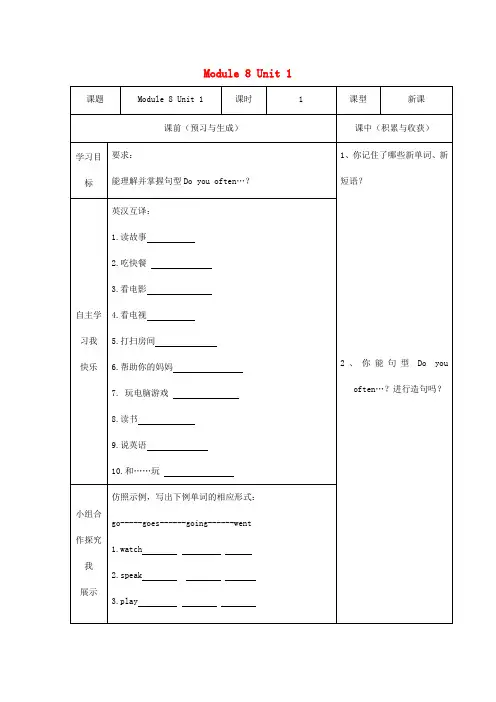
课题
Module8Unit 1
课时
1
课型
新课
课前(预习与生成)
课中(积累与收获)
学习目标
要求:
能理解并掌握句型Do you often…?
1、你记住了哪些新单词、新短语?
2、你能句型Do you often…?进行造句吗?.读故事
2.吃快餐
3.看电影
4.看电视
5.打扫房间
6.帮助你的妈妈
7. 玩电脑游戏
8.读书
9.说英语
10.和……玩
小组合作探究我
展示
仿照示例,写出下例单词的相应形式:
go-----goes------going------went
1.watch
2.speak
3.play
课前(预习与生成)
课中(积累与收获)
4.read
5.stop
6.make
(方法提示: 先自己完成习题,再以小组合作的方式来解决,并找出规律。)
3、请记录课堂中的学习收获,并用双色笔做好标注。
我的质疑
通过预习,你有哪些不明白的地方呢?
课后(反馈与提高)
课后
通过本节课的学习,你收获了哪些知识,掌握了哪些学习方法?
外研版六年级上册第八模块Do-you-often-play-with-dolls

3. Work in pairs and match.
学生两人一组,根据课文内容做连线练习。
1.Listen andrepeat.
Let’s listen andrepeat.
教师播放音频,学生听并跟读。
2. Let’s practice.
Let’s fill in the blanks with correct words.
学生观察教师手中的东西,并回答问题。
2.Watch andanswer.
观看视频,回答问题。
1.Look and answer.
Hello, boys and girls. I’d like toshow you something today. Do you know what these things are?
新知呈现
1.Watchand answer.
学生观看视频,了解课文内容,获取信息:Amy和Lingling正在谈论几张照片?
2.Look, listen andanswer.
Look at the pictureand answer the question.
学生看第一张图片,并回答问题。
3. Look, listen andanswer.
Let’swatch the videoand find it.
引导学生听录音,了解课文内容,获取信息:Amy和Lingling正在谈论几张照片?
2.Look, listen andanswer.
Askstudents tolook at the picture.
出示第一张图片,让学生来说一说,Lingling问了Amy什么问题,Amy是如何回答的。
2.能够听懂、会说,并认读句型“Do you often...?”,并能在实际情境中灵活运用。
2015外研版六年级上册英语Module8unit1Doyouoftenplaywithdolls原

重难点突破方法
针对教学重点, 采用多种教学 方法,如讲解、 示范、小组讨 论等,帮助学 生深入理解。
对于教学难点, 设计有针对性 的练习和活动, 引导学生逐步 掌握,并及时 给予反馈和指
导。
利用多媒体资 源,如图片、 视频等,将抽 象的知识具象 化,降低学生 的理解难度。
鼓励学生积极 参与课堂活动, 通过实际操作 和体验,加深 对重难点的理
添加标题
添加标题
添加标题
添加标题
教学效果:课件是否有效地帮助学 生掌握知识,提高英语能力。
技术问题:是否存在技术问题,如 卡顿、声音不清等。
感谢您的观看
汇报人:
阅读理解:提供一篇与本单元主题相关的短文,让学生阅读并回答问题, 巩固所学知识。 听力训练:播放一段与本单元主题相关的录音,让学生听并做选择题,巩 固所学知识。
总结与作业布置
总结:本节课 主要学习了如 何表达日常活 动,通过对话 练习掌握了重
点句型。
作业布置:请 同学们回家后 与家长进行对 话练习,使用 所学句型询问 并回答日常活
学生活动设计
小组讨论:学生 分组讨论玩具和 玩偶,分享自己 的喜好和理由。
角色扮演:学生 扮演不同的角色, 模拟对话和交流, 提高口语表达能 力。
游戏互动:通过 游戏和竞赛等方 式,让学生在轻 松愉快的氛围中 学习英语。
听力训练:通过 听录音和模仿, 提高学生的听力 水平。
教学重难点与 突破
教学重点与难点分析
教学手段运用
多媒体教学:利 用PPT、视频等 多媒体资源,丰 富教学内容,提 高学生的学习兴 趣。
互动式教学:通 过小组讨论、角 色扮演等形式, 引导学生积极参 与课堂活动,提 高学生的学习积 极性。
外研版(一起)六年级上册英语Module 8《Unit 1 Do you often tidy your bed》公开课PPT课件
Tell us about your partner!
My partner’s name is ____________. He/She always________________. He/She usually________________. He/She often________________. He/She sometimes________________. He/She seldom________________. He/She never________________. _____ of my guesses are correct. I think I know my partner very well/ I don’t think I know him/her very well.
Listen & Answer
• • • • How often does Amy tidy her room? A. Not very often. B. Every day. How often does Amy tidy her bookshelf? A. Not very often. B. Every day.
Game
How well do you know your partner?
My Guess a. How often do you write emails? b. How often are you late for school? C. How often do you get angry? d. How often do you read English story books? e. How often do you listen to music? My Partner’s Answer
六年级英语上册Module 8 Unit 1 Do you often tidy your bed 教案1 外研版一起
Module 8 Unit 1 Do you often tidy your bed?教学设计教学目标:a.语言知识目标:学习目标语句Do you often …?Yes , I do . / No ,I don’t .b.语言技能目标:能够听懂会说本模块句型,能运用所学语言对日常发生的行为给予回应。
c.情感态度目标:培养学生在日常的生活中要养成良好的生活习惯,为自己以后的学习生活打下良好的基础。
重点难点:重点:Do you oft en …? Yes, I do . / No, I don’t .并能在实际情景中运用。
难点:Do you often …? 的正确应用,并对比Does he often …? 句型进行比较和鉴别及tidy, messy的具体应用。
教学方法:游戏法任务法情景教学法视听法教具准备:挂图、卡片、图片、CD-ROM、录音机、调查表教学过程:Ⅰ. Warm-up(热身活动)a.教师让学生自由畅谈,引导的问题是:What do you often do ?b.出示一些短语,(tidy your bed , suck your thumb, read books,go to the library)教师通过Do you often…? 进行替换练习,并试着让学生做Yes , No 的回答。
c以上短语可以进行“听听,做做”的巩固性练习。
Ⅱ. Presentation (介绍新语言项目)a.接着教师出示两个人物,Lingling和Amy, 让学生猜一猜,他们经常做什么?(Does lingling often...?)b.当学生回答后,教师重复说出短语,并指出今天我们要争做“爱好小调查员”。
c.让学生观看今天的课文CD-ROM。
Ⅲ. Practice (练习)a.看书,听录音,并且下划线Do you often...? (反馈:同桌间或全体或小组内)b.再听课文,带着这样的问题:Does Lingling often tidy her bed?Is it tidy or messy?c.小组之间操练目标语句:Do you often tidy your bed?Yes, I do ./ No, I don’t.(一组传一组汇报)d.当有的学生回答No, I don’t 时,乘胜追击,继续问学生:What do you often do ?(形式:可以展开男女之间的对抗赛,说对每人加一分,调动学生的参与面。
(外研版)六年级英语上册Module8-Unit1-Do-you-often-play-with-dolls.
fast food
Do you want to eat fast food? Yes, l ’d love to.
(l ’d love to = I would love to)
Does Amy often play with dolls? Does Amy like reading books ? Does Amy often clean her room? Does Lingling often clean her room?
Do you often …? Yes, I do./Yes,of course. I often…. No, I don’t./Not really./Not very often.
clean your room read stories play computer games
watch films
Does Amy often play with dolls? Not really. Does Amy like reading books ? Yes, she does. Does Amy often clean her room? Not very often.
Does Lingling often clean her room? Yes, she does.
Do you often play with dogs?
They are playing basketball. Do you often play basketball?
Do you often…?
ห้องสมุดไป่ตู้Yes,I do. No ,I don’t.
你经常……吗?
不全是,事实上没有
Do you often…
六年级英语上册Module 8 Unit 1 Do you often tidy your bed 教案 外研版一起
Module 8 Unit 1 Do you often tidy your bed?教案一、教案背景1.面向学生:√小学□中学2.学科:英语外研六年级上学期3.课时:14.学生课前准备:(1)课前复习课文,完成学案部分题目。
(2)查找与本课相关的资料。
二、教学课题【教材分析】语言功能:用一般现在时对经常发生的行为进行问答。
语言结构:Do you often …?Yes, I do. / No, I don’t.教学目标:a.语言知识目标:学习目标语句DO you often …?Yes, I do. / No, I don’t.b.语言技能目标:能够听懂会说本模块句型,能运用所学语言对日常发生的行为给予回应。
c.情感态度目标:培养学生在日常的生活中要养成良好的生活习惯,为自己以后的学习生活打下良好的基础。
教学重、难点:重点:Do you often …? Yes, I do. / No, I don’t .并能在实际情景中运用。
难点:Do you often …? 的正确应用,并对比Does he often …? 句型进行比较和鉴别及tidy,messy的具体应用。
【学生分析】Do you often …? 这个句型是在二年级已学习过,学生在篇章学习中经常接触到这个句型,可以说应用起来是比较熟练的。
但是六年级再次出现这样的重点句时,学生可以在复习的基础上,在具体的情境中准确地运用,得到更高层次的提升和应用。
【设计理念】教师采用了“任务型”的教学方式进行设计。
首先在操练环节,应该在一种师生,生生的任务型互动中让学生感受到学习任务的真实性,从而让他们愿意参与到活动来,运用中来。
在运用环节中,通过巩固题目的设计,让学生从课文走向语用的天地,通过让学生大胆的输出,真正提高学生在运用时的准确性。
三、教学方法及流程本节课采用的是任务型教学本课流程如下:1、热身导入,检查课文2、组内交流,复习回顾3、基础检测,落实目标4、拓展练习,提升深化5、课堂小结,布置作业四、教学过程一【热身导入,检查课文】1、Game :1)show the phrases and read it quickly as you can.火眼金睛活动2)Listen and do.(听音做动作游戏).I say, you do. E.g. Stand up. Play football. Play the flute. Watch TV. Go swimming. Wash your hands. Sing a song. Spell the word tidy. Sit down.2、Show the task(出示任务): Try to tell us and write down What do you often do at the weekend?3、Go over the text(课文复习). Read and recite the text.二【组内交流,复习回顾】First, go over the words, phrases and main sentences together. (复习重点单词、短语、句子)Read and translate them. Then go over the review cards by groups. To remember the words, phrases and main sentences.三【基础检测,落实目标】The review plan.(复习学案)Try to finish No.1 Words and phrases. Then check it up by groups.(检测单词、短语)1.tidy( )2.常常,经常( )3.书架( )4.choose ( )5.星期,周( )6.messy的反义词( )7.整理我的房间( ) 8.tidy your bookshelf ( )9.every day ( ) 10.在一个整洁的房间里( )11.in a messy room( ) 12.I know ( )13.find my books ( ) 14.good ideas ( )15.choose some books ( ) 16.一起读书( )17.在周末( ) 18.帮助我妈妈( )19.去游泳( ) 20. 看电视( )No .2 Sentences. Finish it by yourselves and check it up by groups.1. often, Do ,tidy, room, your ,you ?______________________________2.often,read ,stories, I ,to ,brother, my, little.________________________________3. help ,mum, I ,often ,my._______________________________4.Whatdo,do,at,you,often, the ,weekend?____________________________________四【拓展练习,提升深化】Try to say as you like with I (don’t) often ……; Do you often…… What do you often do? Then write it down .Then show it.What do you often do at the weekend?五【课堂小结,布置作业】Today we go over M 8.We can recite the text .We can remember the words , phrases and main sentences. And we can use it well. Let’s see who is the winner?Homework:1.Listen and recite M 7,U12.Make review card of M 7.。
六年级上册英语-Module8Unit1Doyouoftenplaywithdolls外研版(三起)
六年级上册英语Module 8 Unit 1 Do you often play withdolls外研版(三起)教学内容本节课教学内容选自外研版(三起)六年级上册英语Module 8 Unit 1,主题为“Do you often play with dolls”。
课程围绕儿童的日常活动展开,通过学习本课,学生能够理解并运用一般现在时态来描述自己和他人经常做的活动。
教学内容包括词汇学习、句型练习以及相关日常活动的讨论。
教学目标1. 知识与技能:学生能够掌握并运用新词汇如“play with dolls”、“watch TV”等描述日常活动;能够正确运用一般现在时态提问和回答关于日常活动的问题。
2. 过程与方法:通过情景模拟、小组合作等互动方式,提高学生的英语听说能力和团队合作能力。
3. 情感态度价值观:培养学生对英语学习的兴趣,增强学生用英语进行日常交流的自信。
教学难点1. 正确使用一般现在时态描述日常活动。
2. 新词汇的发音及正确使用。
3. 句型的构造和灵活运用。
教具学具准备1. 多媒体教学设备:用于展示课件和播放相关音频。
2. 词汇卡片:用于新词汇的学习和复习。
3. 小组活动道具:用于情景模拟和角色扮演。
教学过程1. 导入:通过播放相关活动的视频或图片,引导学生进入主题,激发学生的学习兴趣。
2. 新授:展示并解释新词汇,通过例句让学生理解词汇用法,并进行跟读练习。
3. 练习:设计小组活动,让学生运用新学的词汇和句型进行角色扮演。
4. 巩固:通过游戏或竞赛形式,复习和巩固新学的词汇和句型。
板书设计板书将清晰地展示本节课的重点词汇、句型以及语法点,通过颜色和图示增加直观性和趣味性,帮助学生更好地理解和记忆。
作业设计1.抄写并默写新学的词汇。
2.完成相关语法练习题。
3.根据所学内容编写一个小对话,描述自己和同学的日常活动。
课后反思本节课通过多媒体和互动教学,有效地吸引了学生的注意力,提高了学生的学习兴趣。
外研版(一起)六年级上册Module 8《Unit 1 Do you often tidy your bed》ppt课件
f. How often do you exercise?
g. How often do you go to see the doctor?
h. How often do you drink coffee?
i. How often do you go out for dinner? j. How often do you stay up late?
• How is Amy’s bookshelf before Lingling’s help?
• A. It’s tidy.
B. It’s messy. • What will Lingling help Amy do? • A. Play in the room. B. Tidy her bookshelf. •
Listen & Answer
• • • • How often does Amy tidy her room? A. Not very often. B. Every day. How often does Amy tidy her bookshelf? A. Not very often. B. Every day.
Listen, Repeat & Answer
• How are the books now? They are tidy. • Then what will Lingling and Amy do?
They will choose some books and read together.
Read, retell, or act it out !
• How is Amy’s bookshelf before Lingling’s help?
(外研版)六年级英语上册第八模块Unit1-Do-you-often-play-with-dolls
15.drink tea
11
15
12
What do you often do after school? Write down,please. More than 3 sentences.
7.clean your room 8.eat/have fast food 9.eat bananas 7、打扫你的房间 8、吃快餐 9、吃香蕉
14
13
10
先译成英语,再给各图写上恰当的序号。 10.go swimming 11.visit your grandma 12.clean the classroom 10、去游泳 11、看望你的奶奶 12、打扫教室 13、去购物 14、发电子邮件 15、喝茶 13.go shopping 14.send an email
Yes, of course. I often read stories.
what is she doing?
clean the room
She is cleaning the room.
Do you often clean your room?
Yes, I do. /No, I don't.
Does Lingling often clean her room? Yes, she does.
Do you often…?
clean your room read stories
play computer games go to see films
1go 、去看电影 2、看电视 1. to see a film/films 2.watch TV 3、讲英语 3.speak English
点点
photos
Do you want to see my photos ?